Archive for April, 2016

Sonnet No. 121

Posted in Literature with tags , on April 23, 2016 by telescoper

Oh, go on then. Here’s another post for the 400th anniversary of the death of William Shakespeare. I’ve posted quite a few of Shakespeare’s sonnets over the years, and my book of them goes with me whenever I travel, so it seems appropriate to post another as a personal way of marking the quatercentenary. This is Sonnet 121, another in the “fair youth” sequence, although to some extent it stands apart from the verses preceding and following it.  It was apparently written about the time a mysterious scandal was circulating about the poet and it’s presumably a specific reaction to that. The message is basically that having a bad reputation  is even worse than actually being bad. The poet does not claim to be blameless, be argues that he is being insulted by those whose sins are far worse than his and who therefore have no right to criticise him. So he decides to reject hypocrisy and be himself no matter what people say. It’s a poem that will resonate for anyone who has been falsely, perhaps maliciously, accused of something they did not do.

‘Tis better to be vile, than vile esteemed,
When not to be, receives reproach of being,
And the just pleasure lost which is so deemed
Not by our feeling, but by others’ seeing:
For why should others’ false adulterate eyes
Give salutation to my sportive blood?
Or on my frailties why are frailer spies,
Which in their wills count bad what I think good?
No; — I am that I am, and they that level
At my abuses reckon up their own:
I may be straight, though they themselves be bevel;
By their rank thoughts my deeds must not be shown;
Unless this general evil they maintain,
All men are bad, and in their badness reign.


Next! – The Complete Animated Shakespeare

Posted in Literature, Television with tags , , , on April 23, 2016 by telescoper

I’m sure most readers are aware that today is the 23rd April 2016, which is the 400th anniversary of the death of William Shakespeare. Despite the fact that most modern scholars agree that many of Shakespeare’s plays were not actually written by Shakespeare, but by someone else who had the same name, it’s still a good excuse to celebrate the life and work of a towering figure in the world of literature and drama. I was trying to think I suddenly remembered this marvellous animated film I saw when it was first released over 20 years ago. I couldn’t remember the name so it took me a bit of time to find it, but I got there in the end. It’s by Aardman Animations (best known for the later Wallace and Gromit films) and it was part of a splendid series of animated shorts called Lip-synch commissioned by Channel 4 and broadcast in 1990. It’s hard to imagine Channel 4 doing anything this good nowadays.  This film, called Next,  is only 5 minutes long yet it manages to refer to every single one of Shakespeare’s plays by having the immortal bard himself do them all as an audition. It’s not only clever and visually appealing but also a lot of fun…


The UK Financial Contribution to the EU

Posted in Finance, Politics with tags , , on April 22, 2016 by telescoper

There’s so much misunderstanding and distortion flying around about the United Kingdom’s contribution to the European Budget and what it might be spent on if we left the EU that I just thought I would post this for information. It shows official figures from HMRC for 2014. Similar pie charts are available for other years, but often they include the EU contribution under “other” which is why I’ve chosen this particular one. Also, I’m very lazy and it came up first on Google…

fat cut

Although it’s a lot of money in cash terms, it’s very small compared to current expenditure on, e.g. Health, Education and Welfare and even compared to the interest payments on our national debt. Saving this contribution would not make sufficient financial resources  available to make a significant difference to these other big ticket  items. Note also that if the UK loses its current credit rating, the expense of servicing our debt will increase by an amount that could easily on its own wipe out the saving on our EU subscription.

And of course what we get for that relatively small contribution is access to beneficial trade agreements, inward investment from EU companies and other sources, and access to the science programmes. You may disagree, of course, but I think it’s money very well spent.


Buddy DeFranco Plays Rhythm Changes

Posted in Jazz with tags , , , on April 21, 2016 by telescoper

The late great Buddy DeFranco was the musician who finally convinced me that I’d never be any good at playing the clarinet, though I still make the occasional half-hearted attempt. He nevertheless remains a musical hero of mine, not least because he was one of the few people to play clarinet in a “modern” style. I found this transcription of one of his solos on Youtube a while ago and thought I’d share it here. Twelve choruses of rhythm changes at a brisk tempo provide the foundation for a great jazz musician who unleashes a flood of improvisation. Feel free to play along at home!

Fear and Loathing at Frontiers

Posted in Uncategorized on April 21, 2016 by telescoper

Here’s a truly scary inside story about the behaviour of one of the, sadly many, predatory open access journals out there.

Leonid Schneider's avatarFor Better Science

Many scientists have been receiving unsolicited emails from the Swiss publisher Frontiers, with invitations to submit papers or become peer review “editor” with this Open Access (OA) publisher. In fact, the Holtzbrick-owned Frontiers are occasionally criticized for these activities, which were compared to spamming. These “spam” emails however are not written by robots, but by actual human beings, usually interns. Many of them do not seem very happy about their jobs with Frontiers, as one can read at the employer-evaluation portal Glassdoor. Most of the criticism is directed against middle management, who, as I have previously shown, sometimes nonchalantly manage academic topics way outside of their professional competence.

Now, you can learn what goes on inside the Frontiers “spam” factory from a first-hand source.  I was approached by a reader of my website, who turned out to be a former full-time employee at Frontiers. This person…

View original post 2,745 more words

The Ballad of Barry and Freda

Posted in Television with tags , , on April 20, 2016 by telescoper

Rest in peace, Victoria Wood (1953-2016).

Public Statement

Posted in Biographical, Books, Talks and Reviews on April 20, 2016 by telescoper

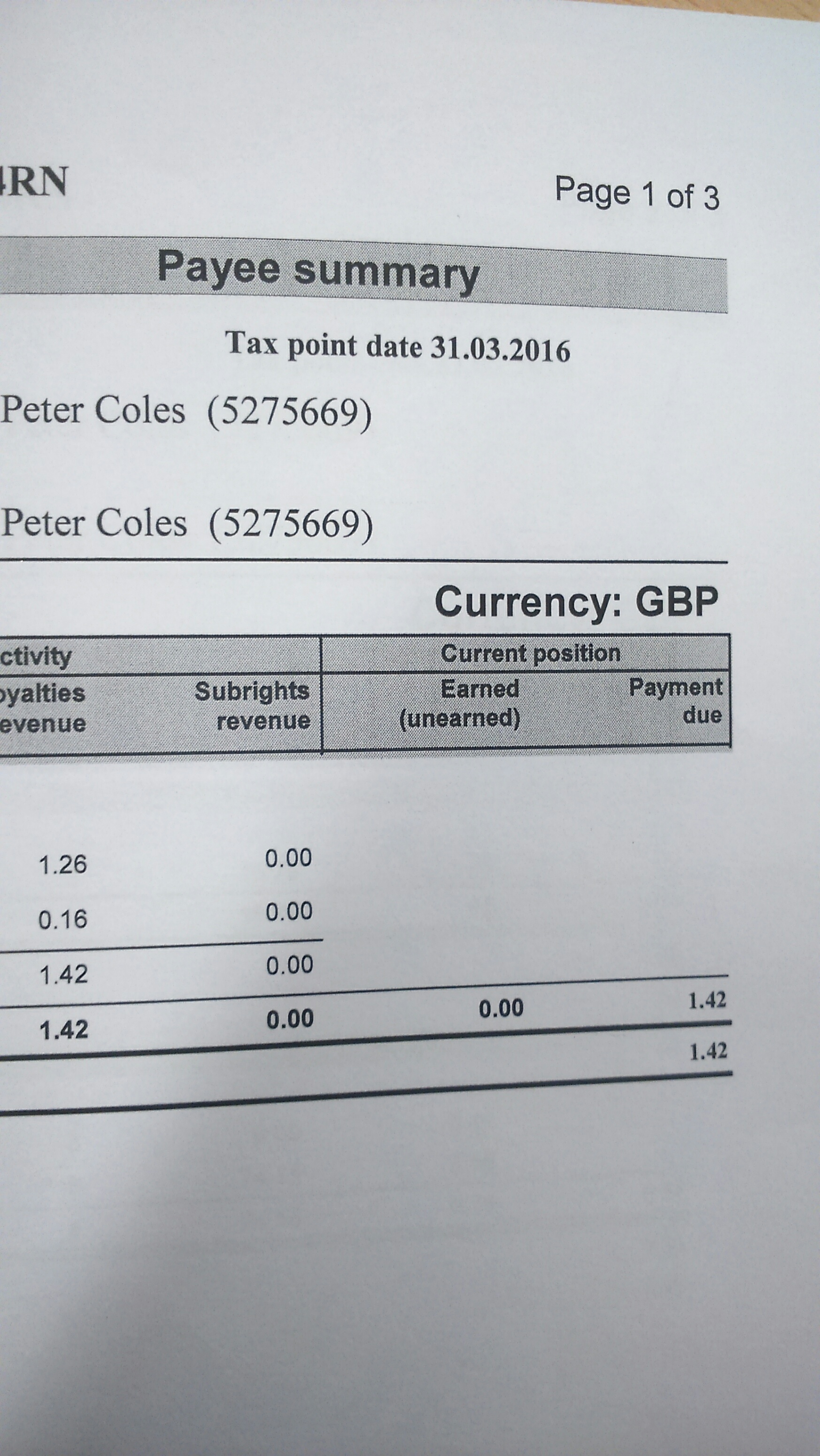
As a prominent public figure and in the interests of transparency and accountability I hereby publish my latest Royalty statement.

image

This is of course just a high-level summary. Subsequent pages give a more detailed breakdown.

I hope this clarifies the situation.

Essay Introductions: Opening Sentences

Posted in Uncategorized on April 20, 2016 by telescoper

It is a fact universally acknowledged that it’s often difficult to find a good opening sentence. My only tip is that it’s probably best to write the first sentence last. For other suggestions, read on…

gcgosling's avatarMusings

There’s no shortage of advice on how to tackle writing a tricky opening sentence. At least, not if you’re a novelist, short story writer, journalist, or even a blogger. But what about for those writing essays?

‘The Throes of Creation’ by Leonid Pasternak

It’s something we don’t talk about very often because it seems somehow petty. It’s not something that’s likely to lose you marks. The advice you get from tutors will probably focus instead on the reading you’ve brought in, the evidence you’ve assembled and the argument you present. Those are things you’ll be penalised for getting wrong. A howler of an opening line will be overlooked if you’re solid on those, which is why so many howlers go without comment.

So, what do people get wrong? Common mistakes often boil down to writing the opening to the essay before you quite know what you want to say, over-complicating in an attempt…

View original post 661 more words

Staff Whereabouts

Posted in Education with tags , , , on April 19, 2016 by telescoper

There’s been a predictably strong reaction from academic colleagues to an announcement by the University of Edinburgh that it is introducing a new staff monitoring policy that will require employees to tell management if they leave their “normal place of work” for half a day or longer.

Some have argued that this is measure is simply unenforceable and that the University concerned will have to employ extra people if all academics have to notify a management person every time they travel somewhere off campus. Perhaps the plan is to have all staff fitted with microchips like we do with pets so we can find out where they are if they go wandering off, or get temporarily adopted by friendly neighbours.

I did some time ago draft an April Fool email in which I claimed  my current employer was going to extend the attendance monitoring we perform with undergraduate students (which is partly to assess usage of teaching spaces and thus improve timetabling efficiency) to include academic staff, so we could assess usage of office space on a similar basis. I never sent the email because I thought too many would think it was real and get very angry. Although being at least slightly credible is an essential part of an April Fool, causing a riot is not.

Here at the University of Sussex academic staff are obliged to inform the University (via an official form) if they are travelling elsewhere in the course of their duties. In practice this form comes to the Head of School, which is me in in the case of Mathematical and Physical Sciences. This bit of bureaucracy is primarily for insurance purposes, but also means we have a record of where to contact people in case of emergency.

Most staff comply with this procedure  if they are travelling abroad, but they don’t always do so when they’re travelling in the UK for a day or so, e.g. for doing a PhD examination or something like that. Staff also often fail to let us know if they are working from home, which some (especially theorists and mathematicians) do a lot in order to get on with their research without interruption. Although this doesn’t often cause problems, I think it is reasonable that we should be able to get in touch with staff when they’re doing that (in case, e.g., one of their academic advisees has a problem) but it seems to me excessive that they should have to inform someone at an official level every time they work off campus for whatever reason. Leaving a contact phone number for use during working hours is quite adequate.

It seems to me that behind this move by the University of Edinburgh there’s the managerialist suspicion that everyone must be a shirker at heart. In fact one of the problems I have as a manager is not persuading staff to work longer hours, but to  stop working  excessively long hours.  I don’t think I’ve succeeded, largely because I haven’t found a way of doing my job at the same time as achieving  a sensible work-life balance.

Anyway, the point is that academic contracts do not usually specify where staff should work. There is a good reason for this, which is that the job is very diverse and replies flexible work arrangements. Academic contracts do not usually specify fixed hours of work per week, either, for the same reason. Some don’t even give a specific holiday entitlement. Staff in technical and professional service areas generally have contracts that specify both. I floated an idea at a staff that academics should file an official log of official leave. It wasn’t a popular suggestion because academic staff thought there was an implication that they were skiving by taking excessively long holidays. In fact my motivation was quite the opposite: to try to ensure that they take all the leave to which they are entitled.


The EU Referendum and the Importance of Voting

Posted in Politics on April 18, 2016 by telescoper

Here’s a post from the University of Sussex student blog site explaining why it’s important for everyone to vote in the forthcoming EU Referendum. The votes cast on June 23rd will lead to a decision that’s likely to be irrevocable so it’s especially important that younger people vote.

Alice Lomas's avatarsussexstudents

On Thursday 23rd June 2016, the UK will decide whether or not to remain in the European Union, and oh boy is this a big deal. This blog is designed to be accessible, to clear up some common misconceptions about the EU and to explain the methods of voting.  You shouldn’t need any background in European politics to understand this. I am a firm fan of the EU and fully encourage you all to vote, and to vote to stay in.6004.item

View original post 752 more words