Archive for November, 2016

Reflections on Quantum Backflow

Posted in Cute Problems, The Universe and Stuff with tags , , , , on November 10, 2016 by telescoper

Yesterday afternoon I attended a very interesting physics seminar by the splendidly-named Gandalf Lechner of the School of Mathematics here at Cardiff University. The topic was one I’d never thought about before, called quantum backflow. I went to the talk because I was intrigued by the abstract which had been circulated previously by email, the first part of which reads:

Suppose you are standing at a bus stop in the hope of catching a bus, but are unsure if the bus has passed the stop already. In that situation, common sense tells you that the longer you have to wait, the more likely it is that the bus has not passed the stop already. While this common sense intuition is perfectly accurate if you are waiting for a classical bus, waiting for a quantum bus is quite different: For a quantum bus, the probability of finding it to your left on measuring its position may increase with time, although the bus is moving from left to right with certainty. This peculiar quantum effect is known as backflow.

To be a little more precise about this, imagine you are standing at the origin (x=0). In the classical version of the situation you know that the bus is moving with some constant definite (but unknown) positive velocity v. In other words you know that it is moving from left to right, but you don’t know with what speed v or at what time t0 or from what position (x0<0) it set out. A little thought, (perhaps with the aid of some toy examples where you assign a probability distribution to v, t0 and x0) will convince you that the resulting probability distribution for moves from left to right with time in such a way that the probability of the bus still being to the left of the observer, L(t), represented by the proportion of the overall distribution that lies at x<0 generally decreases with time. Note that this is not what it says in the second sentence of the abstract; no doubt a deliberate mistake was put in to test the reader!

If we then stretch our imagination and suppose that the bus is not described by classical mechanics but by quantum mechanics then things change a bit.  If we insist that it is travelling from left to right then that means that the momentum-space representation of the wave function must be cut off for p<0 (corresponding to negative velocities). Assume that the bus is  a “free particle” described by the relevant Schrödinger equation.One can then calculate the evolution of the position-space wave function. Remember that these two representations of the wave function are just related by a Fourier transform. Solving the Schrödinger equation for the time evolution of the spatial wave function (with appropriately-chosen initial conditions) allows one to calculate how the probability of finding the particle at a given value of evolves with time. In contrast to the classical case, it is possible for the corresponding L(t) does not always decrease with time.

To put all this another way, the probability current in the classical case is always directed from left to right, but in the quantum case that isn’t necessarily true. One can see how this happens by thinking about what the wave function actually looks like: an imposed cutoff in momentum can imply a spatial wave function that is rather wiggly which means the probability distribution is wiggly too, but the detailed shape changes with time. As these wiggles pass the origin the area under the probability distribution to the left of the observer can go up as well as down. The particle may be going from left to right, but the associated probability flux can behave in a more complicated fashion, sometimes going in the opposite direction.

Another other way of thinking about it is that the particle velocity corresponds to the phase velocity of the wave function but the probability flux is controlled by the group velocity

For a more technical discussion of this phenomenon see this review article. The exact nature of the effect is dependent on the precise form of the initial conditions chosen and there are some quantum systems for which no backflow happens at all. The effect has never been detected experimentally, but a recent paper has suggested that it might be measured. Here is the abstract:

Quantum backflow is a classically forbidden effect consisting in a negative flux for states with negligible negative momentum components. It has never been observed experimentally so far. We derive a general relation that connects backflow with a critical value of the particle density, paving the way for the detection of backflow by a density measurement. To this end, we propose an explicit scheme with Bose-Einstein condensates, at reach with current experimental technologies. Remarkably, the application of a positive momentum kick, via a Bragg pulse, to a condensate with a positive velocity may cause a current flow in the negative direction.

Fascinating!


Morbid Symptoms and the Optimism of the Will

Posted in History, Politics with tags , on November 9, 2016 by telescoper

trump

So there we are then. It will soon be President Trump and I won my compensation bet, though to be honest I would have preferred to lose it. I have quite a number of friends and colleagues from the USA and all were distraught when it became clear that Trump was going to win. Perhaps not surprisingly, I don’t know any Trump supporters, either from the USA or elsewhere.

I’m not going to try to offer consoling platitudes. It must be an even scarier time for them than it is for the rest of us Citizens of the World. In the absence of anything better, all I can do is say that I’m so very sorry for the pain they’re feeling now.

I’m not going to attempt any sort of analysis of what led to Trump’s victory either. There’s a lot of twaddle already filling up the internet, much of which isn’t at all illuminating despite being written with the benefit of hindsight.

I will say, however, that the quote that sprang into my head when I checked the news on waking up this morning was the following, from Antonio Gramsci (from The Prison Notebooks, c1930):

The crisis consists precisely in the fact that the old is dying and the new cannot be born; in this interregnum a great variety of morbid symptoms appear.

Or if you prefer the original Italian:

La crisi consiste appunto nel fatto che il vecchio muore e il nuovo non può nascere: in questo interregno si verificano i fenomeni morbosi piú svariati.”

It seems to me that the old order – in the form of a broad consensus that has held in Western democracies since the end of World War 2 – is collapsing. Events like the election of Donald Trump and BrExit vote in the UK do not, however, represent the construction of a new order but are merely the death-bed convulsions of the old.

What the new world order will look like depends on what new political alignments and forms of governance can be established and whether this transformation takes place by peaceful and democratic means. I think there will be considerable social and economic upheaval in the next few years, and this will be a dangerous time if factions attempt to impose their will by violent means. It seems to me that what is vital is for people to be offered a positive vision for the future, something which today’s politicians – especially those on the left – seem unable or unwilling to do. Some of political parties may not survive, but then if they have outlived their usefulness or relevance then there’s no reason for them to.  What happens will depend entirely on who grasps the opportunities that this period of uncertainty will undoubtedly create. Clinging in despair to the wreckage of the past will put us in no position to grasp anything.

So I’ll end with another quote from Gramsci:

I’m a pessimist because of intelligence, but an optimist because of will.


We Will All Go Together When We Go

Posted in Politics with tags , on November 9, 2016 by telescoper

Romanesco and the Golden Spiral

Posted in mathematics, The Universe and Stuff with tags , , , on November 8, 2016 by telescoper

Some time ago I mentioned that I received one of these in my weekly veggie box..

romanesco

Actually, that reminds me that a new box is due tomorrow morning…

Anyway, the vegetable in the picture is called Romanesco. I’ve always thought of it as a cauliflower but I’ve more recently learned that it’s more closely related to broccoli. It doesn’t really matter because both broccoli and cauliflower are forms of brassica, which term also covers things like cabbages, kale and spinach. All are very high in vitamins and are also very tasty if cooked appropriately. Incidentally, the leaves of broccoli and cauliflower are perfectly edible (as are those of Romanesco) like those of cabbage, it’s just that we’re more used to eating the flower (or at least the bud).

It turns out that this week’s Physics World has a short piece on Romanesco, which points out that a “head” of Romanesco has a form of self-similarity, in that each floret is a smaller version of the whole bud and also displays structures that are smaller versions of itself. That fractal behaviour is immediately obvious if you take a close look. Here’s a blow-up so you can see more clearly:
romanesco-broccoli2-550x412

However, one thing that I hadn’t noticed before is that there is another remarkable aspect to the pattern of florets, in that they form an almost perfect golden spiral. This is a form of logarithmic spiral that grows every quarter-turn by a factor of the golden ratio:

\phi = \frac{1+\sqrt{5}}{2}.

Logarithmic, or at least approximately logarithmic, spirals occur naturally in a number of settings. Examples include spiral galaxies, various forms of shell, such as that of the nautilus and in the phenomenon of phyllotaxis in plant growth (of which Romanesco is a special case). It would seem that the reason for the occurrence of logarithmic spirals  in living creatures is that such a shape allows them to grow without any change in shape.

Not really relevant to anything much, I know, but I thought you might be interested…

P.S. One thing the Physics World piece fails to mention is that, regardless of its geometrical properties, Romanesco is really delicious!

American Psycho

Posted in Politics with tags , , , on November 8, 2016 by telescoper

trump

Well today’s the date of the election of the next President of the United States of America. Will it be Hillary Clinton? Or will it be an unstable racist misogynist, a pathological liar, and a man who has boasted of a string of sexual assaults? It remains to be seen. The polls are alarming close. Hillary Clinton is ahead by just 3 or 4 percent nationally but only a handful of states really matter and some of those are too close to call. I’ve been following Nate Silver’s 538 election forecast for a while now. It seems to me his methodology more accurately estimates the uncertainty in the opinion polls. After narrowing considerably when the FBI decided to throw a spanner into the works last week, the probability of a Clinton win is now over a little over 70%. Uncomfortable, but the odds have been below 2-1 very recently.

At the weekend I decided that I would follow my usual betting practice and place a wager on the outcome that I don’t want to happen. Hunting around, the best odds I could find were 18-5 against Donald Trump. I put a monkey on, so will walk away with £2300 if Trump wins. I plan to use the proceeds to begin work on the construction of a fallout shelter in my garden. If an unstable psychopath like Donald Trump gets his hands on the American nuclear codes I don’t hold out much hope for the future of civilization.

I followed the same strategy on Referendum Day as I felt it in my bones that Vote Leave was going to win. I ended up depressed but compensated to the tune of £1000. I’m afraid to say I feel the same way now about the likelihood of a Trump victory. Not very scientific, I know, but there you go.

I have never paid much attention to American politics in the past. It is as incomprehensible to me as British politics must be to them. Gore Vidal summed it up for me:

There is only one party in the United States, the Property Party … and it has two right wings: Republican and Democrat. Republicans are a bit stupider, more rigid, more doctrinaire in their laissez-faire capitalism than the Democrats, who are cuter, prettier, a bit more corrupt — until recently … and more willing than the Republicans to make small adjustments when the poor, the black, the anti-imperialists get out of hand. But, essentially, there is no difference between the two parties.

Things have changed this time. Although both parties still represent the moneyed classes more than anyone else, but this time the Republican contender has overtly fascist tendencies. No wonder Nigel Farage admires him so much. Americans are free to vote for whomever they wish, of course. I don’t have a say, as I’m a foreigner. All I can say is that you should be very careful what you wish for.

Although I find it deeply depressing that this race is even close, I won’t lose any sleep over the election night. I don’t have a television, and I’ll do what I did on the day of the EU referendum. Drink some wine, listen to music and then go to sleep. There’s no point in worrying about things that are out of your hands. And if Trump does win, at least it shortens the list of countries I will have to consider emigrating to if and when the UK does leave the European Union..

That Was The Data Innovation Day That Was

Posted in Uncategorized with tags , , on November 7, 2016 by telescoper

Time, methinks, for a quick work-related post. You may know that my current appointment is in association with Cardiff University’s Data Innovation Research Insitute, and it’s that part of my job that is taking up most of my time at the moment. Last Friday (4th November) we had our first Data Innovation Day, the aim of which was to encourage collaboration between Schools and Research Institutes in the area of Data Science.

To this end, on Friday morning we had a dozen short(ish) talks on data science aspects of all kinds of subjects, from neuroimaging to gravitational wave research to healthcare to biosocial computing to statistical modelling and so on and so forth. It was a fascinating mixture of presentations and about 75 people attended, which was a pretty good audience. After lunch we broke into groups to develop specific research projects and establish what the Data Innovation Institute can do to help foster collaborations across disciplinary and administrative boundaries. That’s much harder than it might sound, and is certainly harder than it should be in modern universities. We had no shortage of ideas, and let’s hope we can turn them into concrete projects.

Anyway, one of my contributions to the day was to set up a Twitter account for the Data Innovation Research Institute together with a logo:

dii_ligo

We currently have a princely 37 followers. Feel free to follow if you’re on Twitter and interested in Data Science!

Too Brave To Dream

Posted in Art, Poetry with tags , , , , , , , , on November 7, 2016 by telescoper

berave

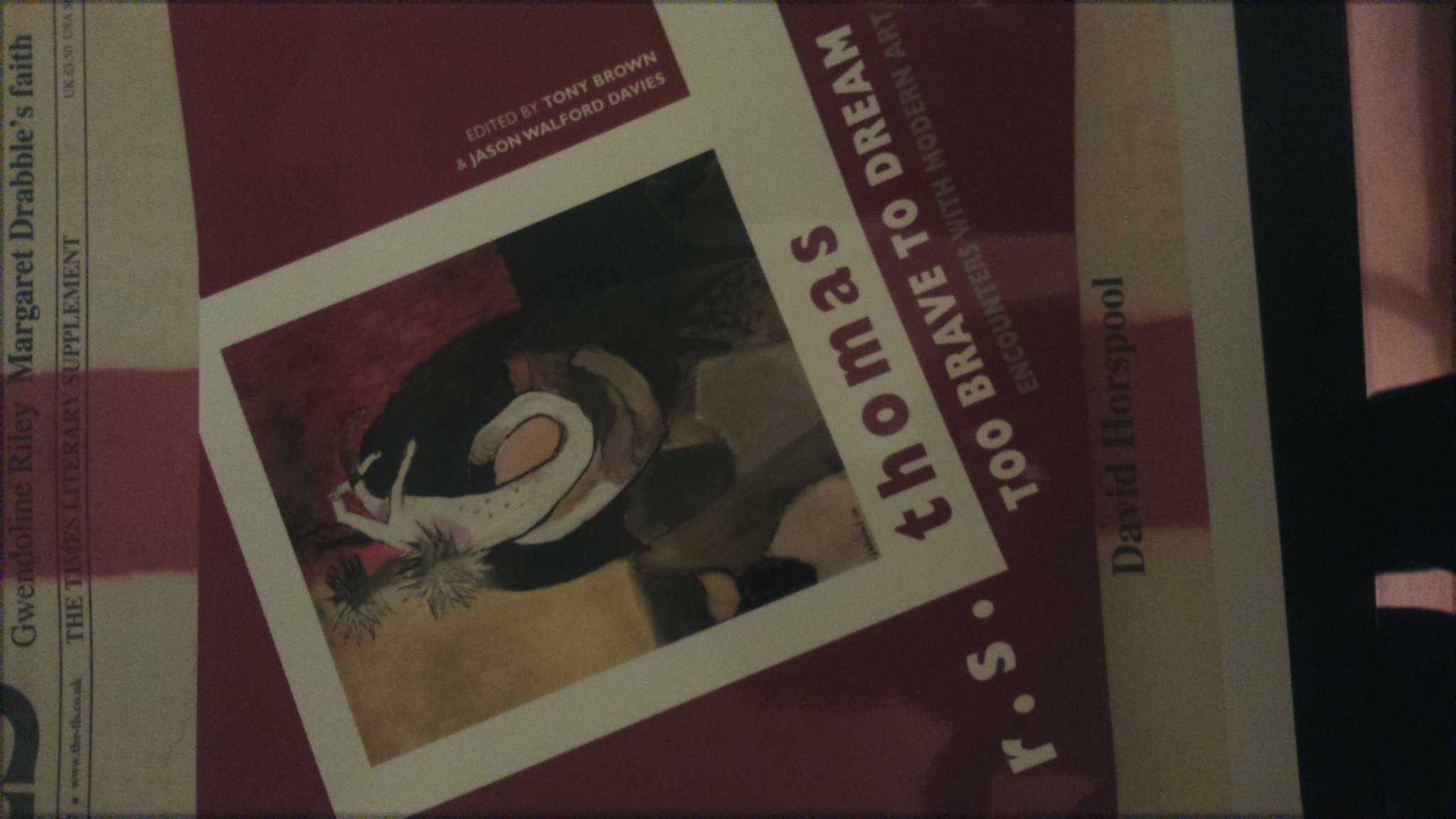
One day last week I found this wonderful item had been delivered to my house. Is a new book called Too Brave To Dream which contains about three dozen previously unpublished poems by R.S. Thomas, who died in 2000. After his death, two seminal studies of modern art were found on his bookshelves – Herbert Read’s Art Now (1933/1948) and Surrealism (1936), edited by Read and containing essays by key figures in the Surrealist movement. Poems handwritten by Thomas were later discovered between the pages of the two books. These poems written in response to a selection of the many reproductions of modern art in the Read volumes, including works by Henry Moore, Edvard Munch, George Grosz, Salvador Dalí, René Magritte and Graham Sutherland – many of whom were Thomas’s near contemporaries. Written between 1987 and 1993, these poems are published in Too Brave To Dream for the first time – alongside reproductions of the works of modern art that inspired them. They poems are instantly recognizable as works of R.S. Thomas. According to the publishers blurb:

Thomas’s readings of these often unsettling images demonstrate a willingness to confront, unencumbered by illusions, a world in which old certainties have been undermined. Personal identity has become a source of anguish, and relations between the sexes a source of disquiet and suspicion. Thomas’s vivid engagements with the works of art produce a series of dramatic encounters haunted by the recurring presence of conflict and by the struggle of the artist who, in a frequently menacing world, is ‘too brave to dream’.

The poems vary considerably in style and mood. Some are wry and playful – although Thomas isn’t perhaps best known for his sense of humour, he certainly wasn’t averse to playing with words and you can find puns throughout his work including in these new poems. Others are bleaker in tone, reflecting the disturbing nature the artworks to which they respond.

Incidentally, these poems were all written after Thomas had, after forty years of service, retired from his post as an Anglican priest. He seems to have experienced something of a crisis after his retirement, perhaps because of the lack of daily routine and regular duties require of him by the Church. He wrote to a friend in 1978, just before his retirement

I am retiring at Easter. I shall be 65. I could stay till 70, but I am glad to go from a Church I no longer believe in, sycophantic to the queen, iconoclastic with language, changing for the sake of change and regardless of beauty.

The form of his religious faith was never straightforward to R.S. Thomas but it did continue to dominate his poetry. He may have given up on the Anglican Church but that does not imply he had given up on religion altogether.

The poem that gives this book is title is a response to one of Henry Moore’s Shelter Sketches. During the ‘Blitz’ the London Underground served as a shelter for Londoners – who not only used the platforms as refuges, but also slept there. Moore produced a group of drawings based on his observations of people in the shelters. They’re are revelation if you think of Moore only as a sculptor but in any case they are very powerful images. I can’t reproduce the particular example that inspired the poem in question here for copyright reasons, but it is dated 1941 and is a sombre image of a figure in what appears to be a restless sleep, presumably during an air raid, with one hand rolled into a fist. Here is Thomas’s poem:

Hand clenched
on the dark dream
where the sleeper wanders
far from the crackling
meadows and the sharp flowers
with their smell
of combustion. Alas
that waking to safety
should be waking also
to survivors poking
among the remains of others
who were too brave to dream.


I’ve enjoyed dipping into this book enormously not only for the “new”poems by one of my favourite poets but also because of the interesting cross-section of influential works of art that it includes, including a number of artists who were completely new to me. If you’re interested in poetry or art you’ll find this book fascinating!

P.S. The cover image is Gorse on a Sea Wall, by Graham Sutherland.

Enemies of the People

Posted in Uncategorized on November 6, 2016 by telescoper

I found this on Facebook and I think I’ll just leave it here…

image

The Heavens Themselves…

Posted in Uncategorized on November 6, 2016 by telescoper

The heavens themselves, the planets and this centre 
Observe degree, priority and place, 
Insisture, course, proportion, season, form, 
Office and custom, in all line of order; 
And therefore is the glorious planet Sol 
In noble eminence enthroned and sphered 
Amidst the other; whose medicinable eye 
Corrects the ill aspects of planets evil, 
And posts, like the commandment of a king, 
Sans cheque to good and bad: but when the planets 
In evil mixture to disorder wander, 
What plagues and what portents! what mutiny! 
What raging of the sea! shaking of earth! 
Commotion in the winds! frights, changes, horrors, 
Divert and crack, rend and deracinate 
The unity and married calm of states 
Quite from their fixure! O, when degree is shaked, 
Which is the ladder to all high designs, 
Then enterprise is sick! How could communities, 
Degrees in schools and brotherhoods in cities, 
Peaceful commerce from dividable shores, 
The primogenitive and due of birth, 
Prerogative of age, crowns, sceptres, laurels, 
But by degree, stand in authentic place? 

Shakespeare, Troilus and Cressida, Act I, Scene III.

Campaigners warn on Guy Fawkes Bonfire Night Pogonophobia

Posted in Beards with tags , , on November 5, 2016 by telescoper

Remember, remember the…. er…

kmflett's avatarKmflett's Blog

Beard Liberation Front

PRESS RELEASE           4th November

Contact Keith Flett     07803 167266

CAMPAIGNERS WARN ON GUY FAWKES BONFIRE NIGHT POGONOPHOBIA

guy

The Beard Liberation Front, the informal network of beard wearers, has warned of Guy Fawkes pogonophobia as bonfires around the country burn effigies of a hirsute man over the weekend.

Pogonophobia is the ancient Greek for an irrational fear or hatred of facial hair, known as beardism in modern English.

The BLF says that November 5th is the traditional highlight of the pogonophobes year as they burn an effigy of what they assume to be a dangerous radical figure with a beard, although few will openly discuss their often deep-seated concerns about beard wearers

BLF Organiser Keith Flett said the irony is that Guy Fawkes was a deeply reactionary character who, had he lived now, would almost certainly not have had a beard under any circumstances

The BLF is calling…

View original post 21 more words