Archive for December, 2016

The changing landscape of astrostatistics and astroinformatics [IMA]

Posted in Uncategorized on December 20, 2016 by telescoper

Here’s a nice review article about the fields of astrostatistics and astroinformatics. The author, Eric Feigelson, points out that training for astronomers in these areas is relatively weak, and that’s why we at Cardiff are going to launch a couple of new Masters courses in the New Year to provide specialist postgraduate education in these and related topics!

arxiver's avatararXiver

http://arxiv.org/abs/1612.06238

The history and current status of the cross-disciplinary fields of astrostatistics and astroinformatics are reviewed. Astronomers need a wide range of statistical methods for both data reduction and science analysis. With the proliferation of high-throughput telescopes, efficient large scale computational methods are also becoming essential. However, astronomers receive only weak training in these fields during their formal education. Interest in the fields is rapidly growing with conferences organized by scholarly societies, textbooks and tutorial workshops, and research studies pushing the frontiers of methodology. R, the premier language of statistical computing, can provide an important software environment for the incorporation of advanced statistical and computational methodology into the astronomical community.

Read this paper on arXiv…

E. Feigelson
Tue, 20 Dec 16
14/88

Comments: 7 pages, to appear in ‘Astroinformatics’, IAU Symposium #325, M. Brescia et al. (eds.), Cambridge University Press (2017)

View original post

Meaning, by Czeslaw Milosz

Posted in Poetry with tags , , on December 19, 2016 by telescoper

When I die, I will see the lining of the world.
The other side, beyond bird, mountain, sunset.
The true meaning, ready to be decoded.
What never added up will add Up,
What was incomprehensible will be comprehended.
– And if there is no lining to the world?
If a thrush on a branch is not a sign,
But just a thrush on the branch? If night and day
Make no sense following each other?
And on this earth there is nothing except this earth?
– Even if that is so, there will remain
A word wakened by lips that perish,
A tireless messenger who runs and runs
Through interstellar fields, through the revolving galaxies,
And calls out, protests, screams.

by Czeslaw Milosz (1911-2004)

This poem was read during yesterday’s excellent Words and Music on BBC Radio 3, which was on the theme “Encoded”, which is available on iPlayer.


Memories of Clem Avery

Posted in Biographical, Jazz with tags on December 19, 2016 by telescoper

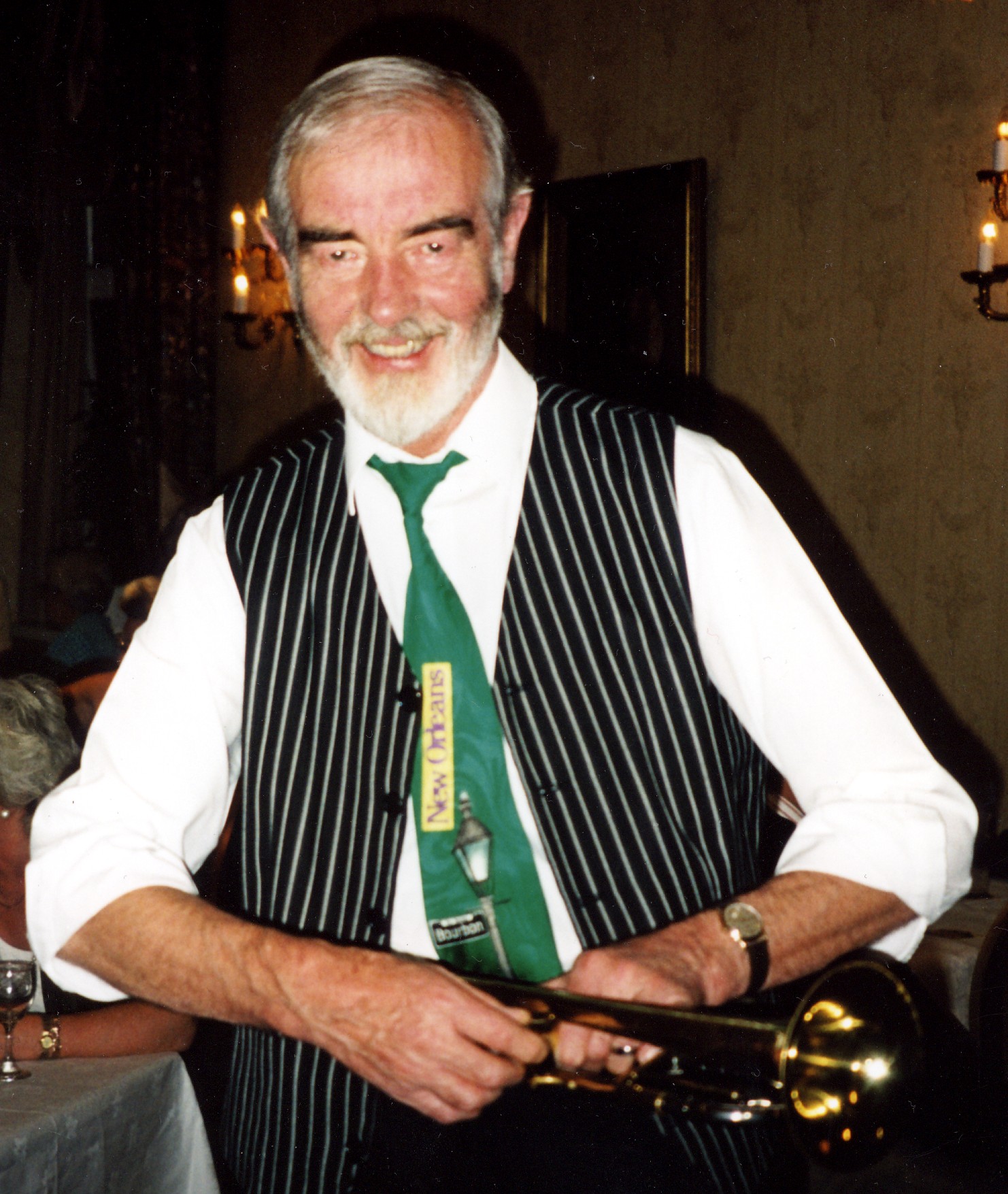
All the talk about trumpets last week reminded me of an old family friend by the name of Clem Avery. There’s a very nice tribute to Clem on a website run by guitarist Roly Veitch (whence I got the photographs).

clem1

Clem Avery (1933-2008)

Clem, who passed away in November 2008, was a very close friend of my father  who died just a year earlier in 2007.  They had known each other since at least the early 60s and had played music together on many occasions (Clem on trumpet and, in later years, bass and my father on drums). That they remained good friends for such a long time is a bit surprising since at one point Clem actually sacked my Dad from his band for being too heavy-handed on the cymbals. Having heard my father play on a few occasions I think Clem probably had a point. But Clem wasn’t the sort of person you could really fall out with for long, and their friendship survived this musical falling-out.

We did try to get Clem to come to my Dad’s funeral but he couldn’t make it. I think it was because he was already suffering from the cancer that would eventually take him.

Roly’s web tribute mentions a long-term residency at the Golden Lion pub in Winlaton during the 70s and 80s in which my Dad (real name Alan) is mentioned under his nickname “Chas”. I heard the band play there on a couple of occasions and they were really good, the presence of Roly Veitch’s (electric) jazz guitar giving them a refreshingly different sound to many other traditional bands.  

I can’t add much to Roly’s piece other than to endorse what he wrote about Clem. Firstly that he was a very accomplished musician who had a far better technique than many much more famous trumpeters. His style was very firmly based on that of Bunk Johnson, though he appreciated good music of many other kinds. As well as playing the jazz that he loved, he also worked as a music teacher and, from time to time, as a session musician. I even saw him on The Tube once (the TV programme, not the London Underground)! When he played trumpet his eyebrows had a tendency to move up and down in coordination. When they were at maximum elevation he looked a lot like Stan Laurel (at least in younger years before he grew a beard). Here is an old picture that makes that comparison a bit easier to imagine:

clem51

What I remember most about Clem, however, was just that he was an extraordinarily nice man. He was tall and rather thin with a thoughtful disposition, a  wonderfully laid back attitude to life and a fine dry sense of humour. He was very knowledgeable about many things besides music too. I often sat talking with him in my Dad’s shop in Benwell (where Clem worked on a part-time basis for a while). History (especially local history) was a speciality of his and he was never short of stories to tell.

A Bit of Hummel Again

Posted in Music with tags , , on December 16, 2016 by telescoper

Since I was recently wittering on about trumpets I thought I’d share again my favourite bit from my favourite trumpet work. It’s the central Andante movement of a Trumpet Concerto by Johann Nepomuk Hummel which was written in 1803 and was one of the first major works to be composed for the (then) recently-invented keyed trumpet.  The piece was originally written in  E major, but is often performed nowadays  in E-flat major, as in this recording, which makes the fingering less difficult on modern E-flat and B-flat trumpets.

In his own lifetime Hummel was every bit as famous as Haydn and Beethoven; he was a pallbearer at the latter’s funeral, in fact. He died in 1837 with his musical reputation apparently secure, but was quickly forgotten. Always a bit overshadowed by Mozart, when the romantic era dawned Hummel’s classical style was considered extremely old-fashioned. It’s just another illustration of a fact that applies not only in music but also in many different spheres of activity: popularity in one’s own lifetime is by no means certain to turn into renown thereafter.

I have posted this piece of music before but listening to it today something struck me that hadn’t done so before, namely that parts of the writing for strings in this movement are very reminiscent of the second (Andante) movement of Mozart’s Piano Concerto No. 21 in C Major (known to many as the “Elvira Madigan” music).

I don’t usually like the sound of the classical trumpet that much- I prefer the broader and more expressive way the instrument is used in Jazz, whether it’s the brassy brilliance of Dizzy Gillespie or the moody melancholia of Miles Davis – but this piece is really lovely, especially when played with beautiful clarity by Norwegian trumpeter Tine Thing Helseth.


Everything we'd like to do with LSST data, but we don't know (yet) how [IMA]

Posted in The Universe and Stuff with tags , on December 16, 2016 by telescoper

Here’s a nice little summary paper (via arXiver) covering the data challenges posed by the Large Synoptic Survey Telescope (LSST) which will come online in 2020 or thereabouts.

To give a bit of a perspective, when the Sloan Digital Sky Survey (SDSS) began to collect astronomical data in 2000, it amassed more in its first few weeks than all data collected in the entire history of astronomy to that date.

Continuing at a rate of about 200 GB per night, SDSS has subsequently amassed more than 140 terabytes of information.

When LSST, which is in many ways a successor to SDSS, comes online it is expected to acquire that amount of data every five days…

arxiver's avatararXiver

http://arxiv.org/abs/1612.04772

The Large Synoptic Survey Telescope (LSST), the next-generation optical imaging survey sited at Cerro Pachon in Chile, will provide an unprecedented database of astronomical measurements. The LSST design, with an 8.4m (6.7m effective) primary mirror, a 9.6 sq. deg. field of view, and a 3.2 Gigapixel camera, will allow about 10,000 sq. deg. of sky to be covered twice per night, every three to four nights on average, with typical 5-sigma depth for point sources of $r$=24.5 (AB). With over 800 observations in $ugrizy$ bands over a 10-year period, these data will enable a deep stack reaching $r$=27.5 (about 5 magnitudes deeper than SDSS) and faint time-domain astronomy. The measured properties of newly discovered and known astrometric and photometric transients will be publicly reported within 60 sec after observation. The vast database of about 30 trillion observations of 40 billion objects will be mined for the unexpected and used…

View original post 61 more words

Beard Liberation Front backs Beard Baubles but warns on beard glitter and lights

Posted in Uncategorized on December 15, 2016 by telescoper

I’m not sure I agree with beard baubles, even if they do raise money for charity!

kmflett's avatarKmflett's Blog

Beard Liberation Front press release

15th December

Contact Keith Flett 07803 167266

Beard Liberation Front backs Beard Baubles but warns on beard glitter & lights

beardlights

The Beard Liberation Front, the informal network of beard wearers, has warned beard wearers against participating in hipster trends for pre-Xmas ‘glitter’ beards and for wearing Christmas tree lights in the beard.

The campaigners say that the glitter can be difficult to remove and may cause serious damage to the beard. The Christmas lights can overheat and there is a danger that the beard will start smouldering causing significant damages to the hairs.

In contrast the BLF is backing Beard Baubles, miniature Xmas decorations that hang in the beard provided they are worn in a measured way.

Beard Baubles raise money for a skin cancer charity

BLF organiser Keith Flett said, beard glitter and Christmas lights are a pre-Xmas step too far and any…

View original post 23 more words

The Trumpet Shall Sound

Posted in History with tags , , , , , , , on December 15, 2016 by telescoper

Following on from yesterday’s post about Handel’s Messiah I thought I’d include this very nice performance of The Trumpet Shall Sound, featuring the excellent bass voice of Alastair Miles with Crispian Steele-Perkins playing the solo trumpet part. One of the reasons for posting it – other than the obvious one (that it’s great) – is that I was thinking about it after Tuesday’s  concert.  The trumpet part at the performance I went to was played (superbly) by Dean Wright on a modern (valved) trumpet, but that wasn’t invented until many years after Handel’s time.

The historical development of the trumpet is a fascinating story but the most interesting technical developments actually happened long after Handel wrote Messiah (which was in 1741).  The keyed trumpet – a forerunner of the modern valved variety – wasn’t invented until the late 18th Century. In fact Joseph Haydn wrote his Trumpet Concerto specifically to demonstrate the capabilities of this instrument; that piece wasn’t first performed until 1800. The modern valved trumpet didn’t begin to appear until about 1818. Before that orchestras used the natural trumpet, which has no valves or other means of controlling the flow of air through the instrument and is therefore only really capable of playing harmonics (rather like a bugle).  Other notes can be generated, but only with some difficulty, using the lip. This kind trumpet is the sort of instrument that would have been played in Handel’s time. The so-called baroque trumpet  is actually a 20th century invention created for musicians who want the “period sound” of  a natural trumpet but with the additional flexibility that comes from having “vents” in the tube that can be covered with the fingers. This is the kind of instrument that Crispian Steele-Perkins is playing in the video. It is valveless but has two finger holes which the trumpeter can close and open with the thumb and little finger of the right hand for fine pitch control.


Why Dublin is Right

Posted in Politics with tags , , , on December 14, 2016 by telescoper

You’ve probably heard via the news that Jolyon Maugham QC is bringing a case through the Irish courts in Dublin to the European Court of Justice in order to establish whether Article 50 of the Lisbon Treaty is reversible, i.e. whether it is possible in principle for the UK government to “untrigger” BrExit for whatever reason.

There’s be an astonishingly level of ill-informed criticism and downright personal abuse flying about as a result of his decision to crowdsource this case, but I think it’s a very good thing. I just wonder why our own government seems to be so unconcerned about the legality of its actions…

Jolyon Maugham's avatarWaiting for Godot

You can read,here, why I believe it is the right thing for both the UK and Ireland that there be legal certainty on whether Article 50, once triggered, can be reversed. I will not repeat my reasoning but I do invite you to re-read that piece.

The greatest possible compliment has been paid to that argument by those who would leave whatever the cost to our nation: they haverefused to engage with it. Instead they have attacked me. Occasional distraction though they are, I do not mind the personal attacks. They reveal more about my opponents’ paucity of thinking on the substance of my argument than they do about me. Everything I have put in the public domain aboutmyself(and mytax practice)is true.

Alongside these personal attacks, there has been some considered focus on whether this is the right step to take or at this…

View original post 645 more words

Handel’s Messiah

Posted in Music with tags , , , , on December 14, 2016 by telescoper

A performance of Handel‘s Messiah at St David’s Hall is always a pretty sure sign that the Christmas season is upon us, although the work itself was actually first performed at Easter and it’s by no means clear why it ended up being so strongly associated with this time of year. Whatever the reason I don’t mind admitting that Messiah is a piece that’s redolent with nostalgia for me – some of the texts remind me a lot of Sunday School and singing in a church choir when I was little and then, a bit later, listening to the whole thing at Christmas time at the City Hall in Newcastle. I loved it then, and still do now, over 40 years later. I know it’s possible to take nostalgia too far – nobody can afford to spend too much time living in the past – but I think it’s good to stay in contact with your memories and the things that shaped you when you were young. It’s actually been far too long – six years in fact – since I last went to a performance of Messiah (in the same venue) so  I relished the chance to hear it again.

Messiah is the most frequently performed choral work in the entire repertoire, and so much has been said and written about it already that I’m not going to say much about here, except for one thing  that struck me about it last night that I hadn’t thought about before which makes it quite an unusual work: unlike most other oratorios I’ve heard, the four vocalists are not associated with specific characters or roles. The reason for that is that the work spans the entire biblical story of the Messiah, from Old Testament prophecy to the Nativity (Part 1) , the Passion of Christ (Part II, culminating in the Hallelujah Chorus), and the Resurrection of the Dead (Part III). The Nativity only features (briefly) in Part I, which is why it’s a little curious that Messiah is so strongly associated with Christmas.

Last night’s performance involved the Orchestra of Welsh National Opera (conducted by Adrian Partington) and the BBC National Chorus of Wales (including Ed’s sister) with soloists Soraya Mafi (soprano), Patricia Bardon (mezzo), Ben Johnson (tenor) and James Platt (bass). Handel’s original scoring was for a relatively small orchestra and chorus but over the years it has become fashionable to perform it with larger forces. Last night the orchestra was modest in size, but the BBC National Chorus of Wales was more-or-less at full strength. There was a harpsichord.

I felt it took both the orchestra and the chorus a little while to warm up: the strings were a little ragged during the opening Sinfony and, early on,  the large choir seem to lack the sharpness  one might have expected given the very high standards to which they usually perform. Once they got into their stride, however, they were really excellent and Parts II and III (after the interval) were superb throughout. I can see the attraction of using smaller forces for this work, actually, because it’s much easier to bring a smaller choir into a tight focus. One the other hand, the larger choir makes the louder moments (such as the Hallelujah Chorus, for which as usual the audience stood) absolutely thrilling. It’s worth mentioning also that the orchestra expanded a little bit for Parts II and III – no brass or percussion are used in Part I – but trumpets and timpani appeared after the interval. I’d like to pick out the percussionist Patrick King (although to be honest his beard needs a bit more work) and the principal trumpet Dean Wright (whose brilliant solo playing during “The trumpet shall sound”” was absolutely thrilling when juxtaposed with the splendidly deep sonority of James Platt’s bass voice (whose beard is magnificent). I also enjoyed the crystal clarity and wonderful agility of soprano Soraya Mafi, especially on “I know that my redeemer liveth“.

All in all, it was a hugely enjoyable evening at St David’s Hall, which was so busy it seemed to take an age to get out at the end of the performance! The concert was recorded for broadcast by BBC Radio 3 on Monday 19th December at 7.30, so you can listen to it yourself and make your own mind up whether my comments above are fair.

Well, that will be the last of my concert-going for 2016 so I’d just like to thank all the musicians and singers I’ve had the pleasure of listening to since I returned to Cardiff for  shining some much-needed light into what has otherwise been a very gloomy year.


A New Head for the Old School

Posted in Biographical, Education with tags , , on December 13, 2016 by telescoper

Just a brief post to pass on the news (which I just heard this morning) that the University of Sussex has now formally announced that Professor Philip Harris will be taking over as Head of the School of Mathematical and Physical Sciences at the University of Sussex, the position I held until this summer.

I worked a lot with Philip during the time I was at Sussex as he was Head of the Department of Physics & Astronomy for part of that period. I’m sure he’ll do a great job and I wish him – and indeed the whole School – all the very best for the future!

Incidentally, the news item announcing Philip’s appointment contains the following snippet:

Both departments are ranked first in the UK for graduate prospects in the Times and Sunday Times University Guide 2017 (Destinations of Leavers from Higher Education Survey, 2015-16), with 100% of Mathematics BSc students being in work or further study within six months.

I wasn’t aware of this interesting news before today, and I’m sure it will provide a boost to the School’s efforts in the currently rather challenging student recruitment market. Of course Philip Harris can now take credit for anything good that happens to the School, whereas if anything goes wrong he can always blame it on the old Head of School!