So here we are again, on a Saturday morning, with another update of activity at the Open Journal of Astrophysics. Since the last update we have published a further five papers, bringing the number in Volume 9 (2026) to 87 and the total so far published by OJAp up to 535.
I will continue to include the posts made on our Mastodon account (on Fediscience) to encourage you to visit it. Mastodon is a really excellent service, and a more than adequate replacement for X/Twitter (which nobody should be using); these announcements also show the DOI for each paper.
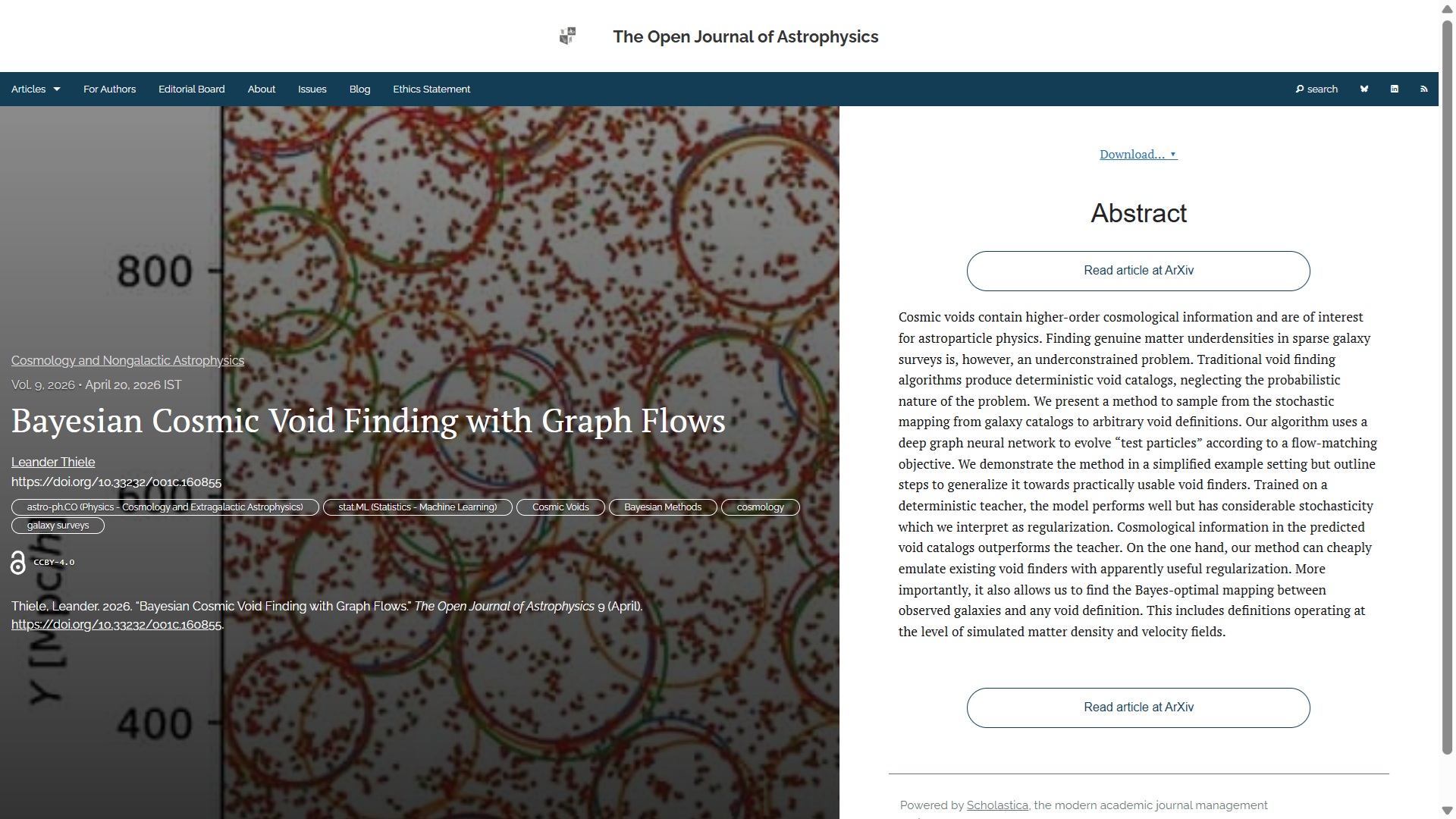
The first paper to report this week is “Bayesian Cosmic Void Finding with Graph Flows” by Leander Thiele (U. Tokyo, Japan). This was published on Monday 20th April in the folder Cosmology and Nongalactic Astrophysics. The paper presents a method using a deep graph neural network to identify cosmic voids in sparse galaxy surveys, improving upon traditional deterministic algorithms by considering the problem’s probabilistic nature. The overlay is here:
You can find the officially accepted version on arXiv here and the announcement on Fediverse here:
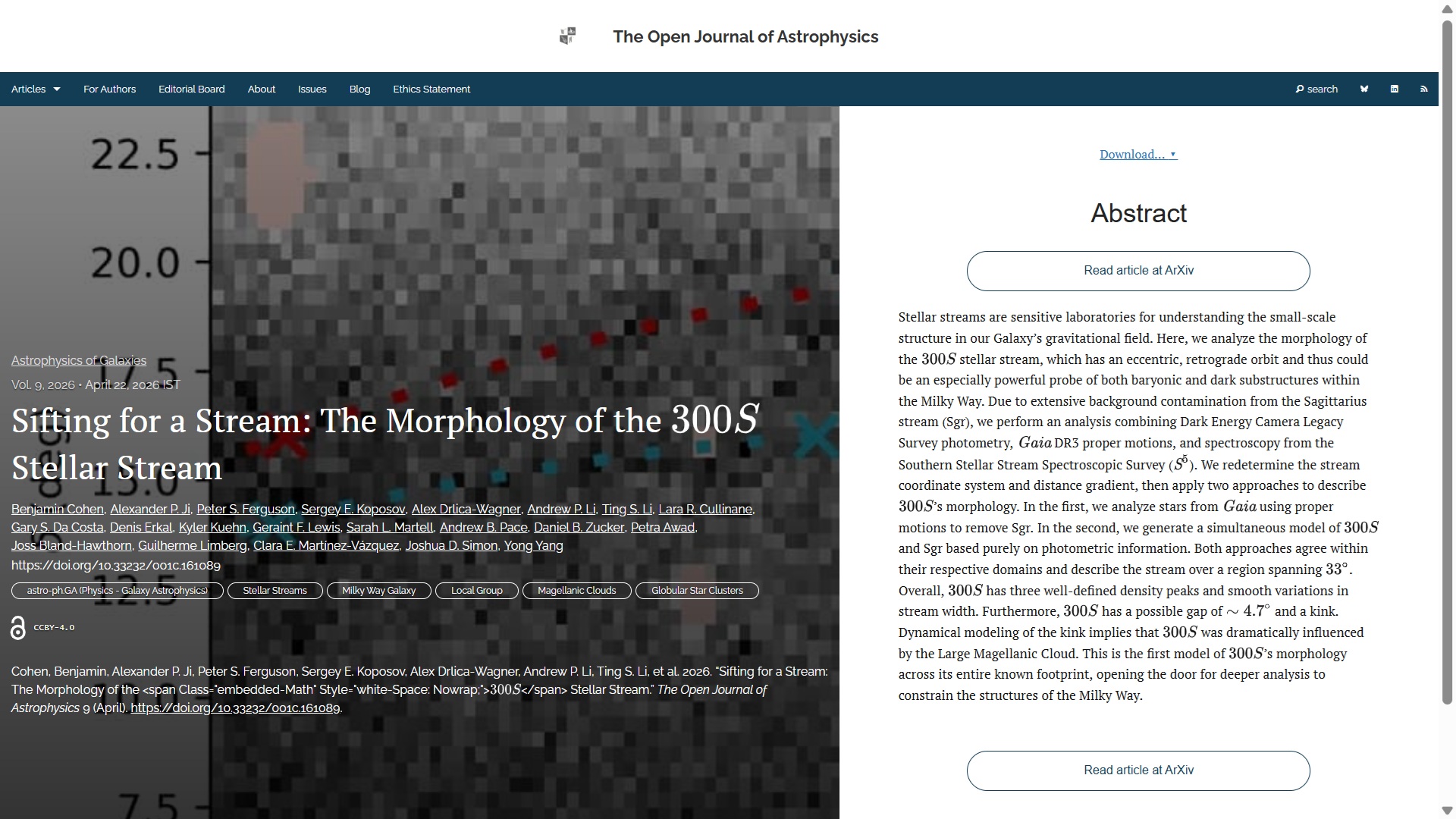
The second paper for this week, published on Wednesday 22nd April in the folder Astrophysics of Galaxies, is “Sifting for a Stream: The Morphology of the 300S Stellar Stream” by Benjamin Cohen (U. Chicago, USA) and 20 others distributed around the world. This study analyzes the morphology of the $300S$ stellar stream, revealing three density peaks, a possible gap, and a kink, suggesting significant influence from the Large Magellanic Cloud on its structure.
The overlay for this one is here:
The official version of the paper can be found on arXiv here and the Fediverse announcement here:
New Publication at the Open Journal of Astrophysics: "Sifting for a Stream: The Morphology of the 300S Stellar Stream" by Benjamin Cohen (U. Chicago, USA) and 20 others distributed around the world.
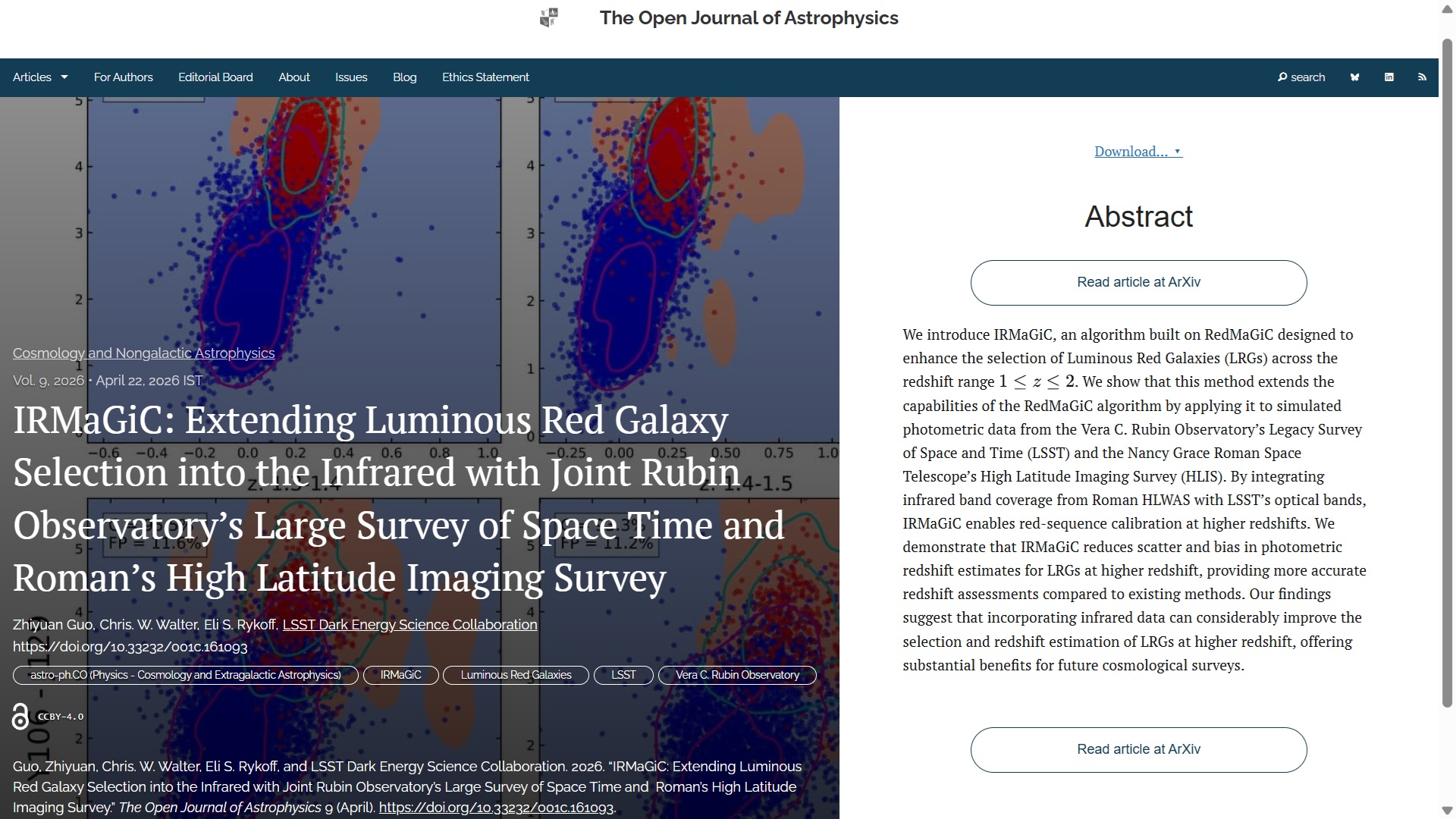
New Publication at the Open Journal of Astrophysics: "IRMaGiC: Extending Luminous Red Galaxy Selection into the Infrared with Joint Rubin Observatory’s Large Survey of Space Time and Roman’s High Latitude Imaging Survey" by Zhiyuan Guo & Chris. W. Walter (Duke U., USA) and Eli S. Rykoff (Stanford U., USA) on behalf of the LSST Dark Energy Science Collaboration
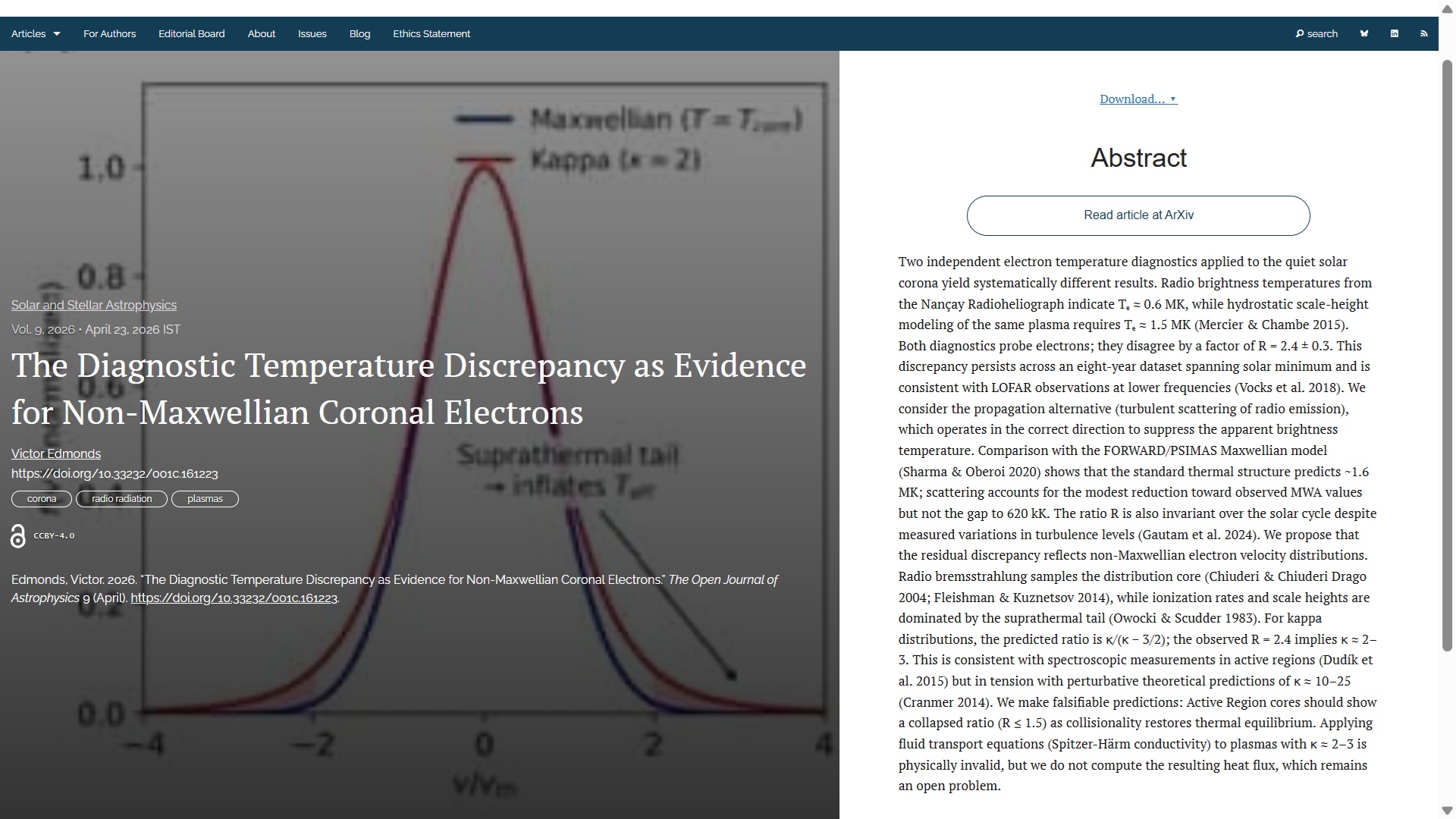
New Publication at the Open Journal of Astrophysics: "The Diagnostic Temperature Discrepancy as Evidence for Non-Maxwellian Coronal Electrons" by Victor Edmonds (Final Stop Consulting, USA)
The fifth and final paper for this week was published on Friday 24th April in the folder Astrophysics of Galaxies. The title is “Galaxy evolution in the post-merger regime. IV – The long-term effect of mergers on galactic stellar mass growth and distribution” by Sara L. Ellison (U. Victoria, Canada) and Leonardo Ferreira (Universidade Federal do Rio Grande, Brazil). This study uses a large sample of post-merger galaxies to demonstrate that galaxy mergers trigger significant and extended stellar mass growth in their central regions, independent of stellar population modelling.
The overlay is here:
You can find the authorized version of this paper on arXiv here and the Fediverse announcement is here:
New Publication at the Open Journal of Astrophysics: "Galaxy evolution in the post-merger regime. IV – The long-term effect of mergers on galactic stellar mass growth and distribution" by Sara L. Ellison (U. Victoria, Canada) and Leonardo Ferreira (Universidade Federal do Rio Grande, Brazil)
New Publication at the Open Journal of Astrophysics: "Galaxy evolution in the post-merger regime. IV – The long-term effect of mergers on galactic stellar mass growth and distribution" by Sara L. Ellison (U. Victoria, Canada) and Leonardo Ferreira (Universidade Federal do Rio Grande, Brazil)
It is Saturday morning, and therefore time for yet another update of activity at the Open Journal of Astrophysics. Since the last update we have published a further six papers, bringing the number in Volume 9 (2026) to 82 and the total so far published by OJAp up to 530.
I will continue to include the posts made on our Mastodon account (on Fediscience) to encourage you to visit it. Mastodon is a really excellent service, and a more than adequate replacement for X/Twitter (which nobody should be using); these announcements also show the DOI for each paper.
New Publication at the Open Journal of Astrophysics: "Beyond Spherical geometry: Unraveling complex features of objects orbiting around stars from its transit light curve using deep learning" by Ushasi Bhowmick & Shivam Kumaran (ISRO, Ahmedabad, India)
The second paper for this week, also published on Monday 13th April but in the folder Astrophysics of Galaxies, is “statmorph-lsst: Quantifying and correcting morphological biases in galaxy surveys” by Elizaveta Sazonova (U. Waterloo, Canada) and an international cast of 18 others. This paper presents an investigation of potential biases in quantitative morphology metrics used in galaxy evolution studies, proposing two new measurements to resolve biases, and provides a related Python package (statmorph-lsst), which can be found here on github.
The overlay for this one is here:
The official version of the paper can be found on arXiv here and the Fediverse announcement here:
New Publication at the Open Journal of Astrophysics: "statmorph-lsst: Quantifying and correcting morphological biases in galaxy surveys" by Elizaveta Sazonova (U. Waterloo, Canada) and an international cast of 18 others.
Next one up, the third paper of the week, one of four published on Friday 17th April, is “Disentangling the galactic and intergalactic components in 313 observed Lyman-alpha line profiles between redshift 0 and 5” by Siddhartha Gurung-López (Universitat de València, Spain) and 7 others based in Spain and Germany. Published in the folder Astrophysics of Galaxies, this paper uses the zELDA package to analyze Lyman-alpha photons from star-forming galaxies, revealing IGM effects dominate Lyman-alpha observability at high redshifts, while galactic outflows become more important at lower z.
The overlay for this one is here:
The final, accepted version can be found on arXiv here and the Mastodon announcement is here:
New Publication at the Open Journal of Astrophysics: "Disentangling the galactic and intergalactic components in 313 observed Lyman-alpha line profiles between redshift 0 and 5" by Siddhartha Gurung-López (Universitat de València, Spain) and 7 others based in Spain and Germany.
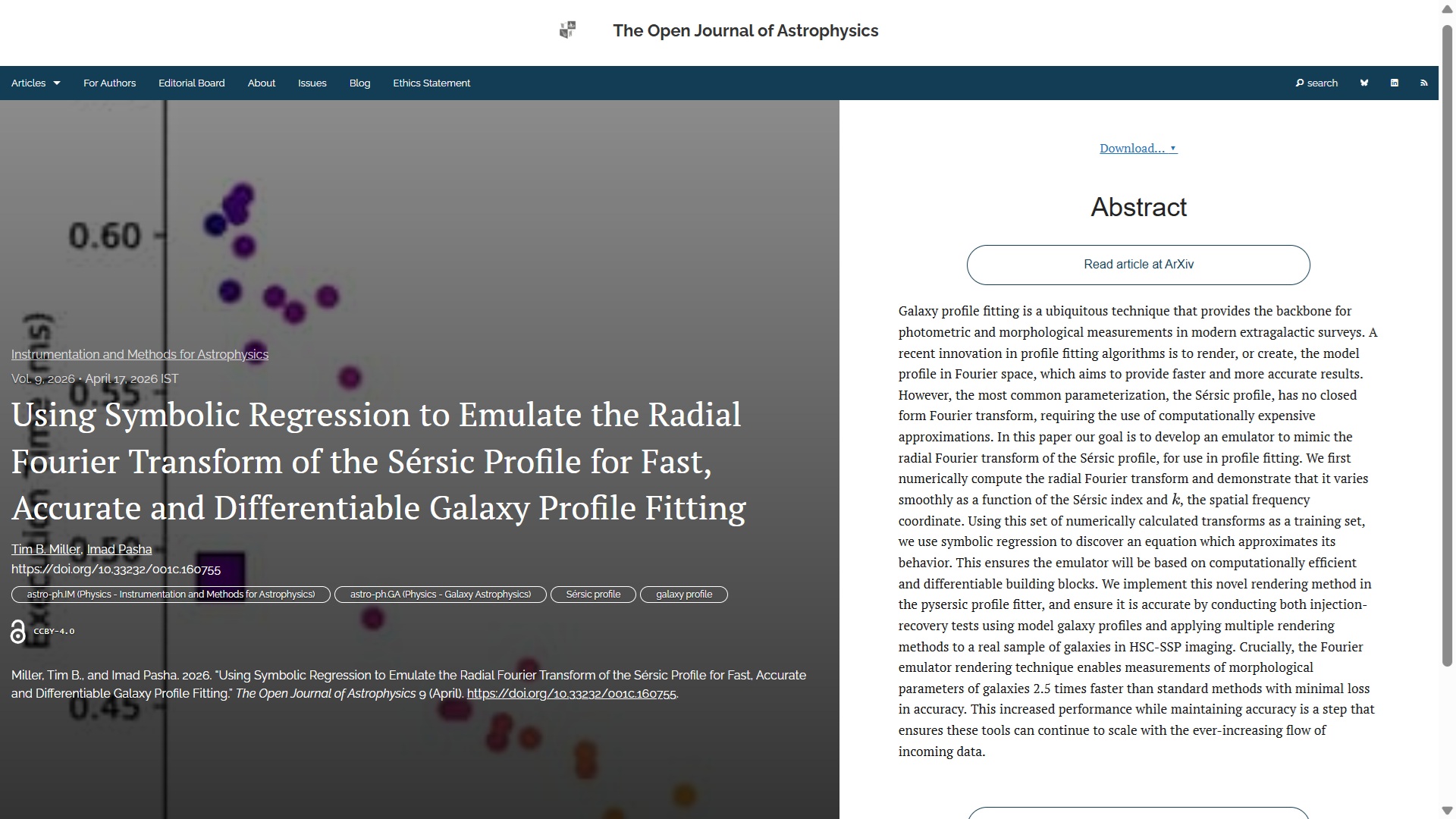
New Publication at the Open Journal of Astrophysics: "Using Symbolic Regression to Emulate the Radial Fourier Transform of the Sérsic Profile for Fast, Accurate and Differentiable Galaxy Profile Fitting" by Tim B. Miller (Northwestern University, USA) and Imad Pasha (Yale University, USA)
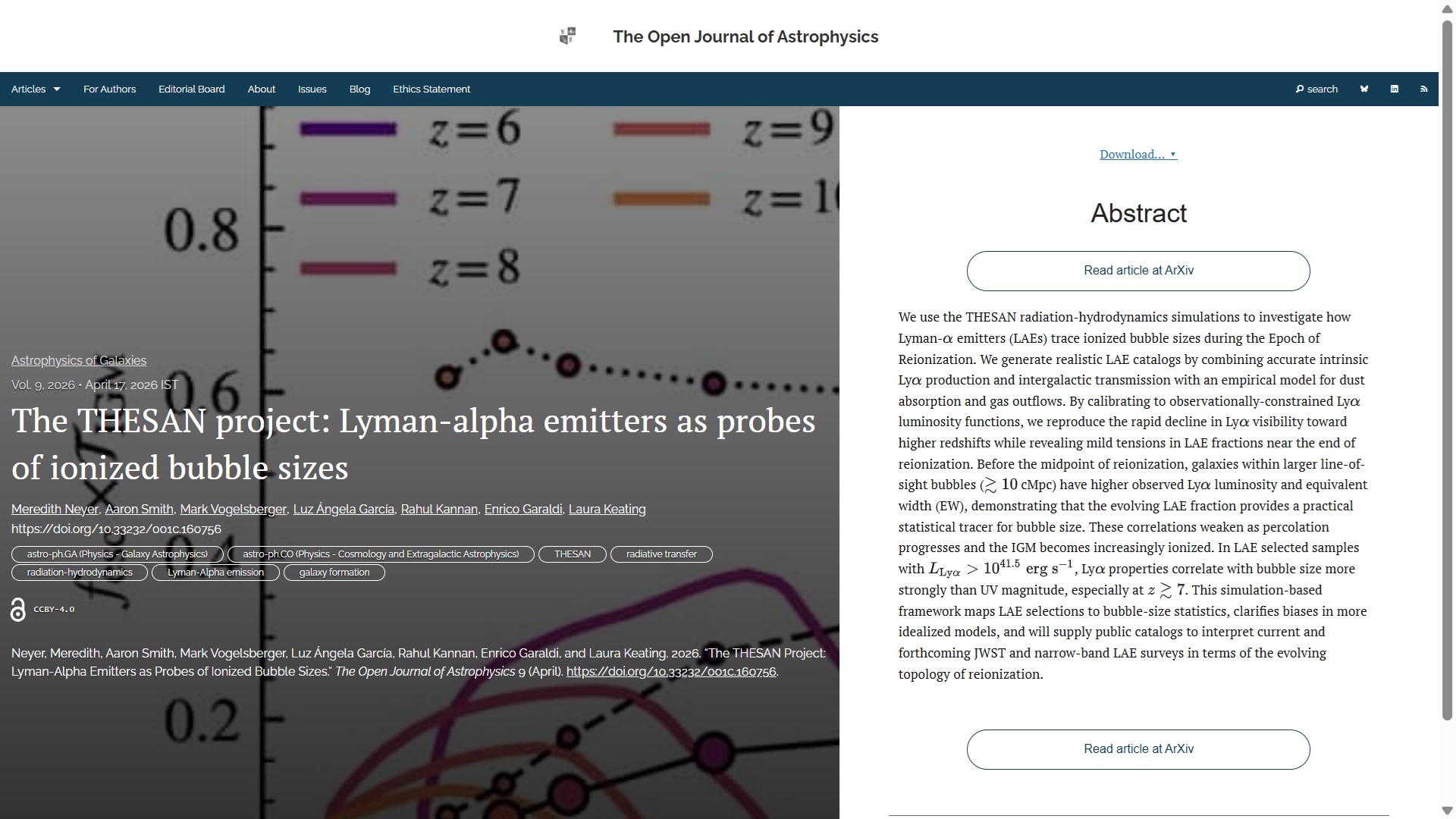
The fifth paper for this week is “The THESAN project: Lyman-alpha emitters as probes of ionized bubble sizes” by Meredith Neyer (MIT, USA) and 6 others based in the USA, Colombia, Canada, Japan and UK. The study uses THESAN simulations to explore how Lyman-alpha emitters (LAEs) trace ionized bubble sizes during the Epoch of Reionization, providing a framework for interpreting LAE surveys. This was published on Friday 17th April in the folder Astrophysics of Galaxies.
The overlay for this one is here:
You can find the authorized version of this paper on arXiv here and the Fediverse announcement is here:
New Publication at the Open Journal of Astrophysics: "The THESAN project: Lyman-alpha emitters as probes of ionized bubble sizes" by Meredith Neyer (MIT, USA) and 6 others based in the USA, Colombia, Canada, Japan and UK.
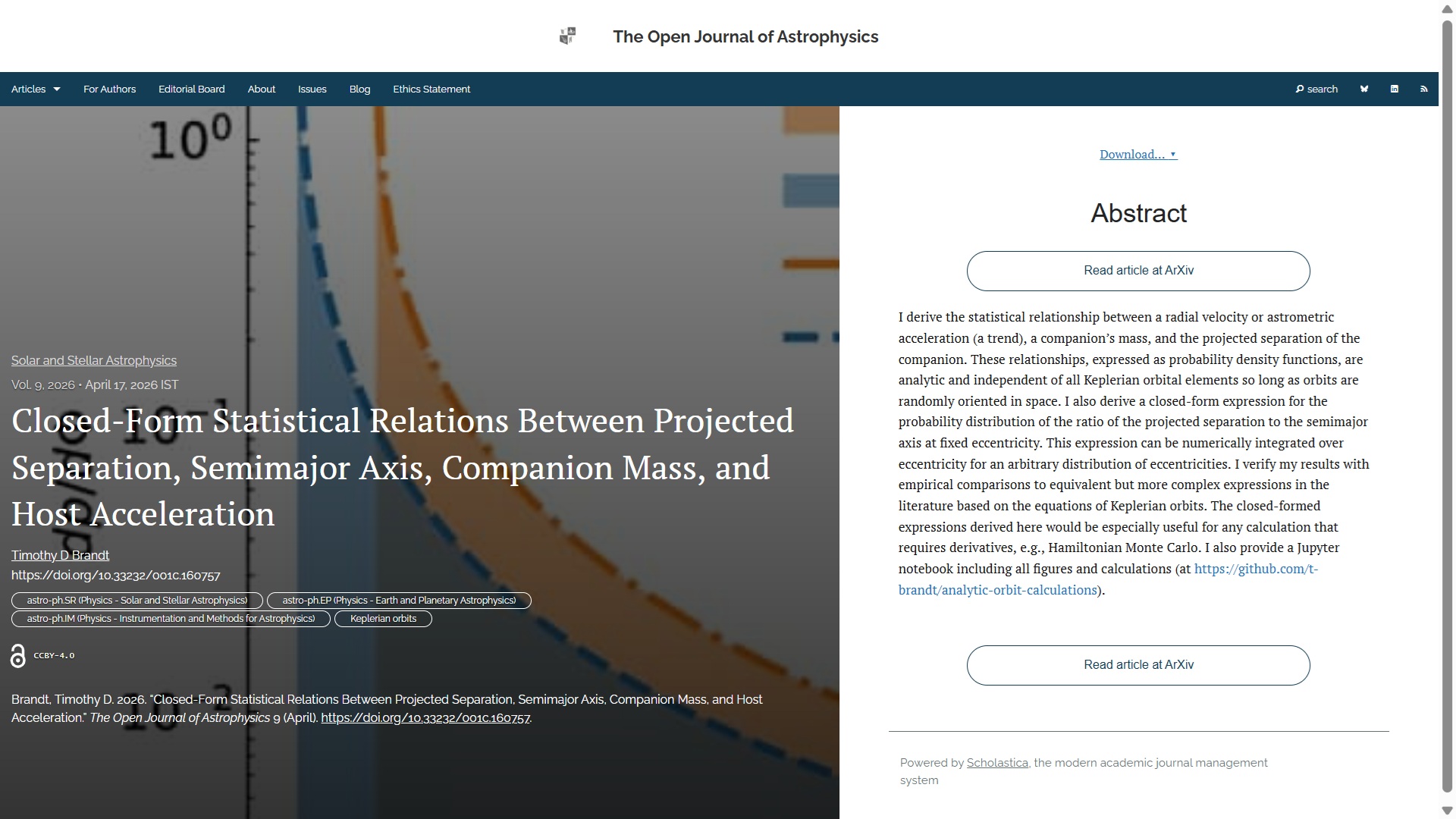
New Publication at the Open Journal of Astrophysics: "Closed-Form Statistical Relations Between Projected Separation, Semimajor Axis, Companion Mass, and Host Acceleration" by Timothy D Brandt (Space Telescope Science Institute, USA)
It’s Saturday once more, so it’s time for another update of activity at the Open Journal of Astrophysics. It has been a busy week. Since the last update we have published a further nine papers, bringing the number in Volume 9 (2026) to 45 and the total so far published by OJAp up to 493.
I will continue to include the posts made on our Mastodon account (on Fediscience) to encourage you to visit it. Mastodon is a really excellent service, and a more than adequate replacement for X/Twitter (which nobody should be using); these announcements also show the DOI for each paper.
The first four papers this week were all published on Monday 23rd February.
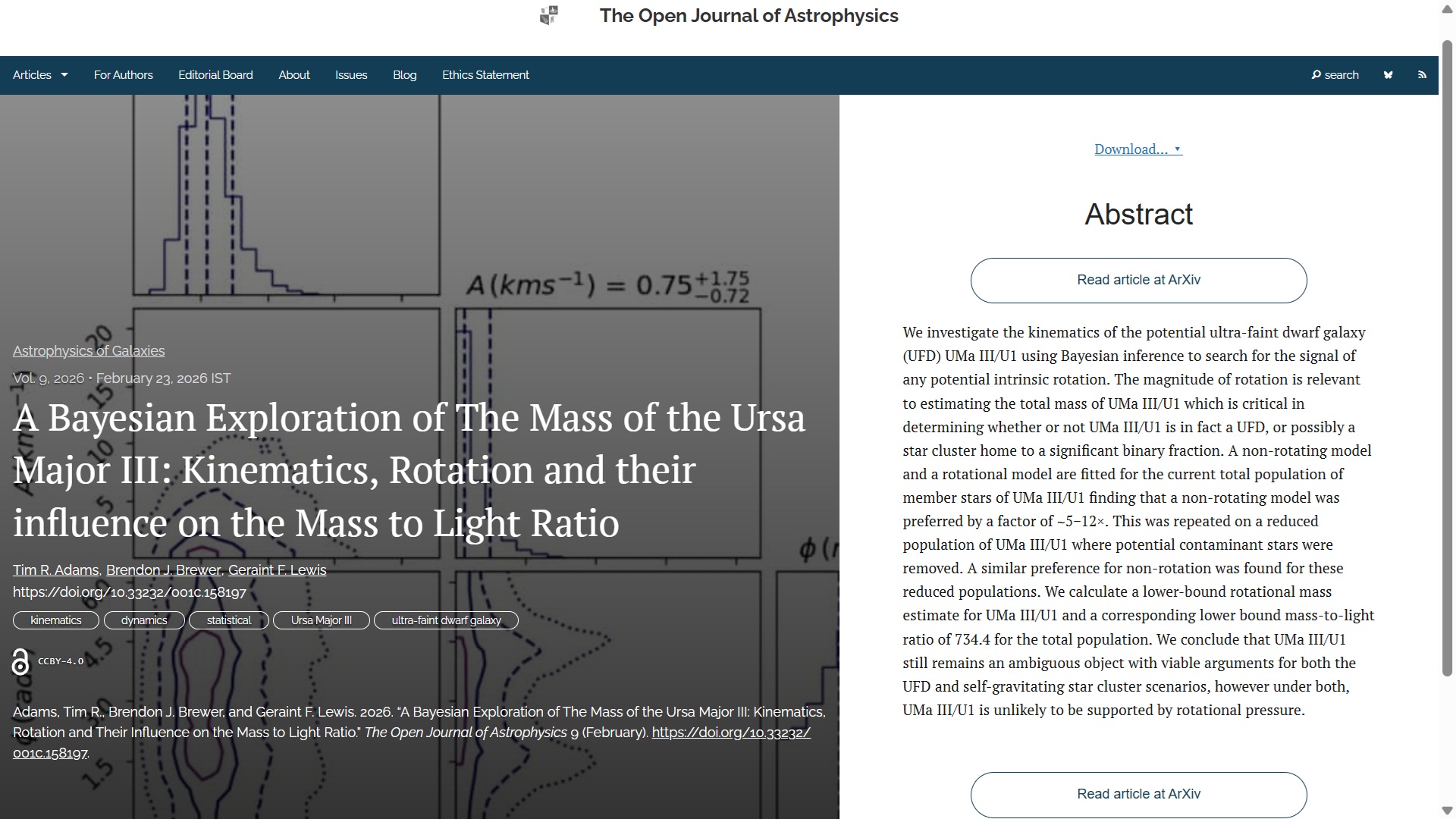
New Publication at the Open Journal of Astrophysics: "A Bayesian Exploration of The Mass of the Ursa Major III: Kinematics, Rotation and their influence on the Mass to Light Ratio" by Tim R. Adams (U. Sydney, Australia), Brendon J. Brewer (U. Auckland, New Zealand) and Geraint F. Lewis (Sydney)
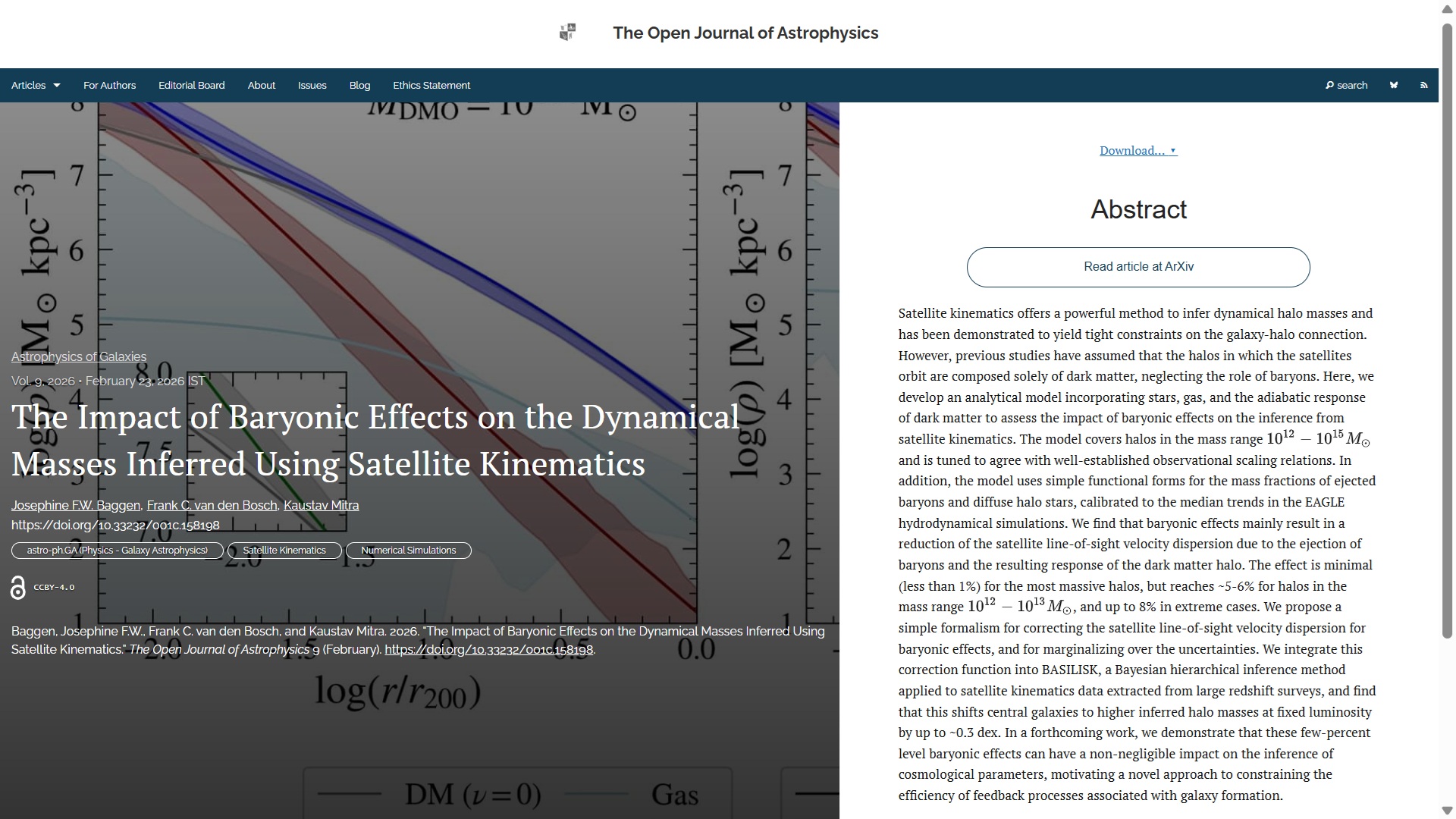
The second paper is “The Impact of Baryonic Effects on the Dynamical Masses Inferred Using Satellite Kinematics” by Josephine F.W. Baggen, Frank C. van den Bosch, and Kaustav Mitra (Yale U., USA). This paper, also in the folder Astrophysics of Galaxies, presents a model to assess the impact of stars and gas on satellite kinematics, showing that these baryonic effects can reduce the satellite velocity dispersion and increase inferred central galaxy masses.
The overlay for this one is here:
The official version of the paper can be found on arXiv here and the Fediverse announcement here:
New Publication at the Open Journal of Astrophysics: "The Impact of Baryonic Effects on the Dynamical Masses Inferred Using Satellite Kinematics" by Josephine F.W. Baggen, Frank C. van den Bosch, and Kaustav Mitra (Yale U., USA)
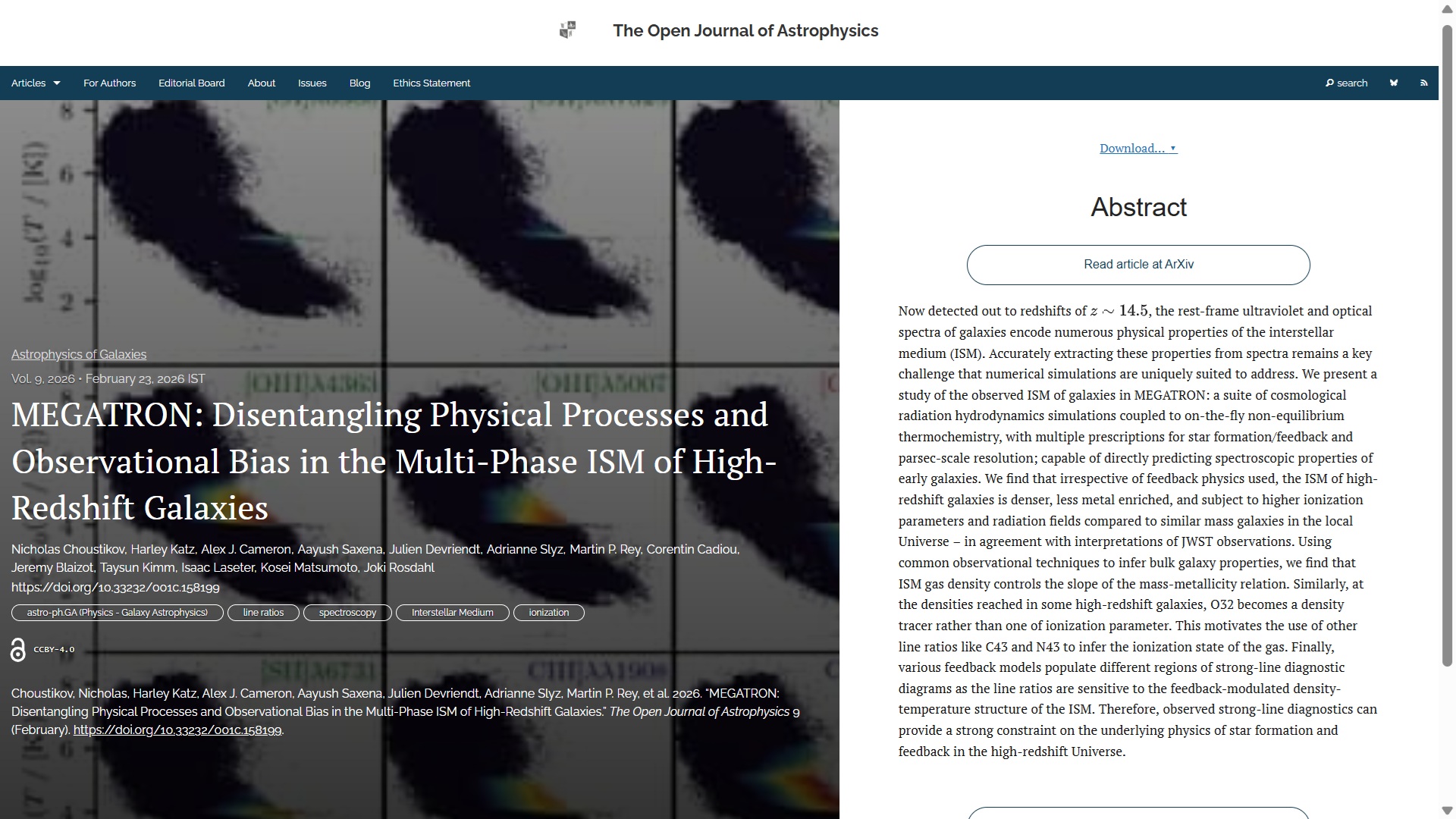
The third paper this week, and the third published on Monday 23rd February, and the third in the folder Astrophysics of Galaxies, is “MEGATRON: Disentangling Physical Processes and Observational Bias in the Multi-Phase ISM of High-Redshift Galaxies” by Nicholas Choustikov (U. Oxford, UK) and 12 others based in UK, USA, France, Korea and Belgium. The study uses MEGATRON simulations to analyze the interstellar medium (ISM) of high-redshift galaxies, finding it denser and less metal-enriched than local galaxies with implications for line ratios as diagnostics
The overlay is here:
The official version can be found on arXiv here and the Fediverse announcement is here:
New Publication at the Open Journal of Astrophysics: "MEGATRON: Disentangling Physical Processes and Observational Bias in the Multi-Phase ISM of High-Redshift Galaxies" by Nicholas Choustikov (U. Oxford, UK) and 12 others based in UK, USA, France, Korea and Belgium
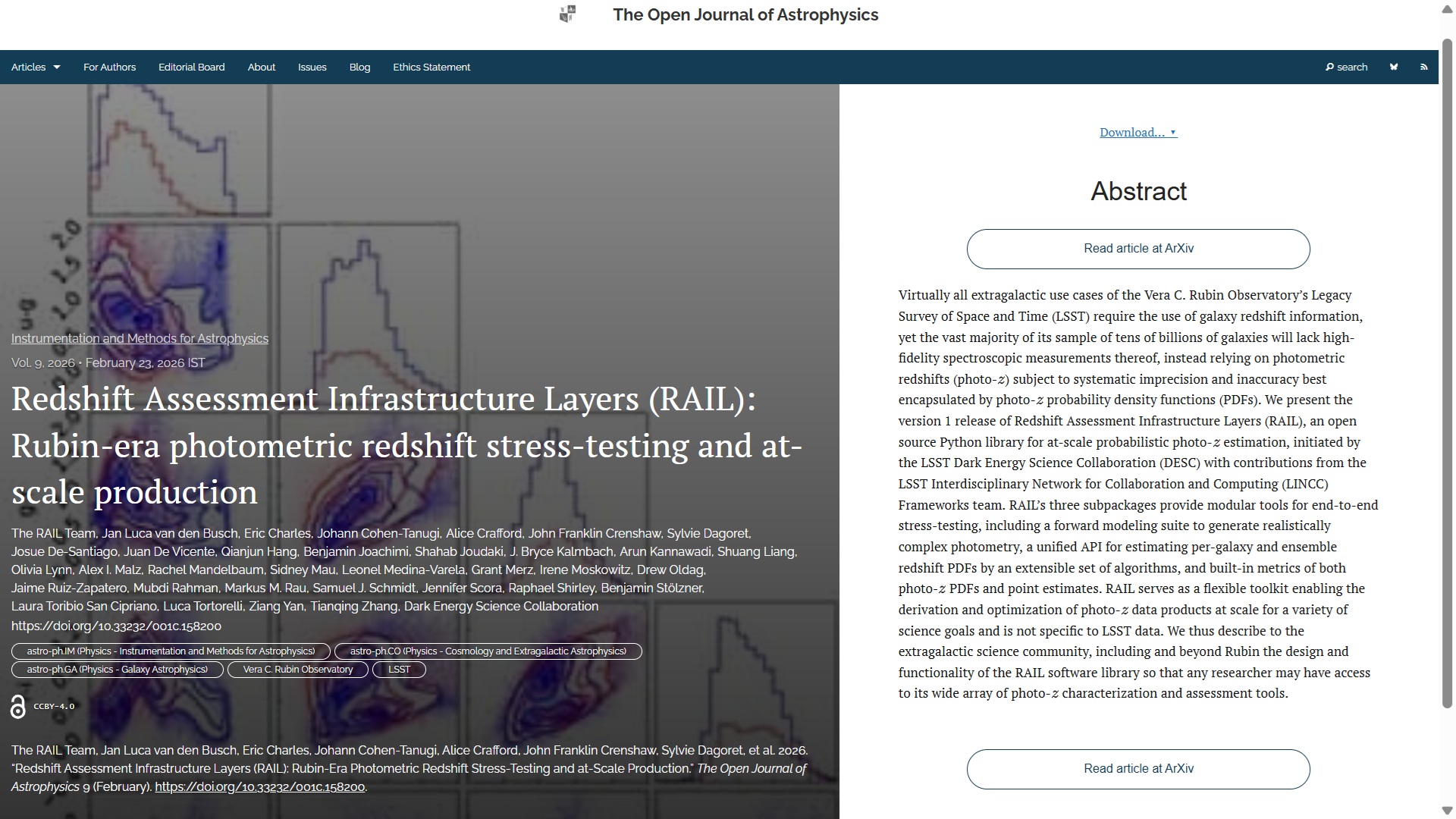
New Publication at the Open Journal of Astrophysics: "Redshift Assessment Infrastructure Layers (RAIL): Rubin-era photometric redshift stress-testing and at-scale production" by the RAIL Team (31 authors) and the Dark Energy Science Collaboration
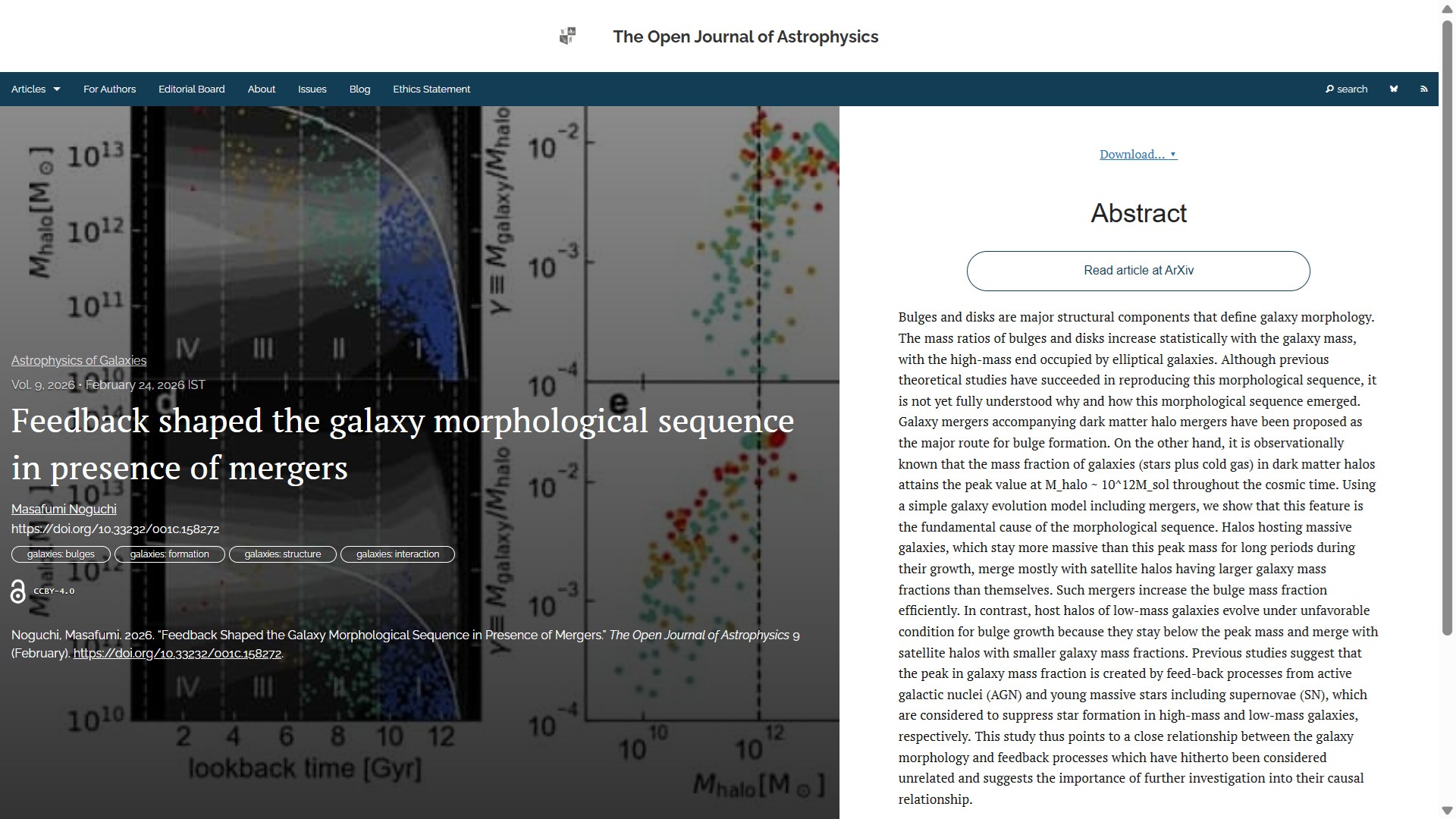
Moving on to Tuesday 24th February, the fifth paper this week, is “Feedback shaped the galaxy morphological sequence in presence of mergers” by Masafumi Noguchi (Tohoku University, Japan). This article was published in the folder Astrophysics of Galaxies. This study suggests that galaxy morphology, specifically the mass ratios of bulges and disks, is influenced by galaxy mergers and feedback processes from active galactic nuclei and supernovae.
The overlay is here:
The accepted version can be found on arXiv here, and the fediverse announcement is here:
New Publication at the Open Journal of Astrophysics: "Feedback shaped the galaxy morphological sequence in presence of mergers" by Masafumi Noguchi (Tohoku University, Japan)
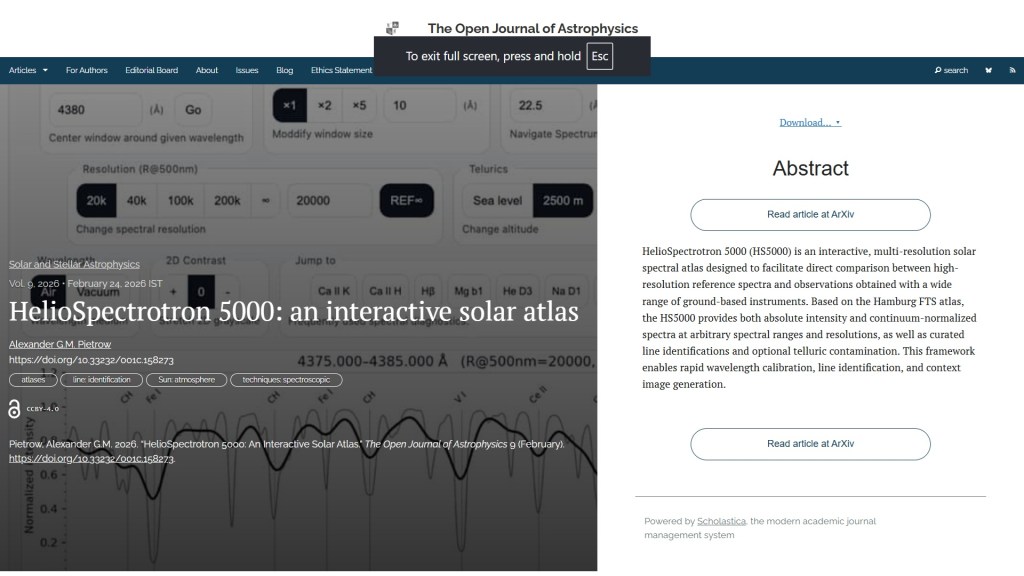
The sixth paper this week is “HelioSpectrotron 5000: an interactive solar atlas” by Alexander G.M. Pietrow (AIP Potsdam, Germany). This was published on Tuesday 24th February in the folder Solar and Stellar Astrophysics. This describes HelioSpectrotron~5000 (HS5000), which is an interactive solar spectral atlas that allows comparison between high-resolution spectra and ground-based instrument observations, aiding in wavelength calibration and line identification. The software can be found here; I had a play with it yesterday and it’s very easy to use!
The overlay is here:
You can find the officially accepted version on arXiv here and the Mastodon announcement is here:
New Publication at the Open Journal of Astrophysics: "HelioSpectrotron 5000: an interactive solar atlas" by Alexander G.M. Pietrow (AIP Potsdam, Germany)
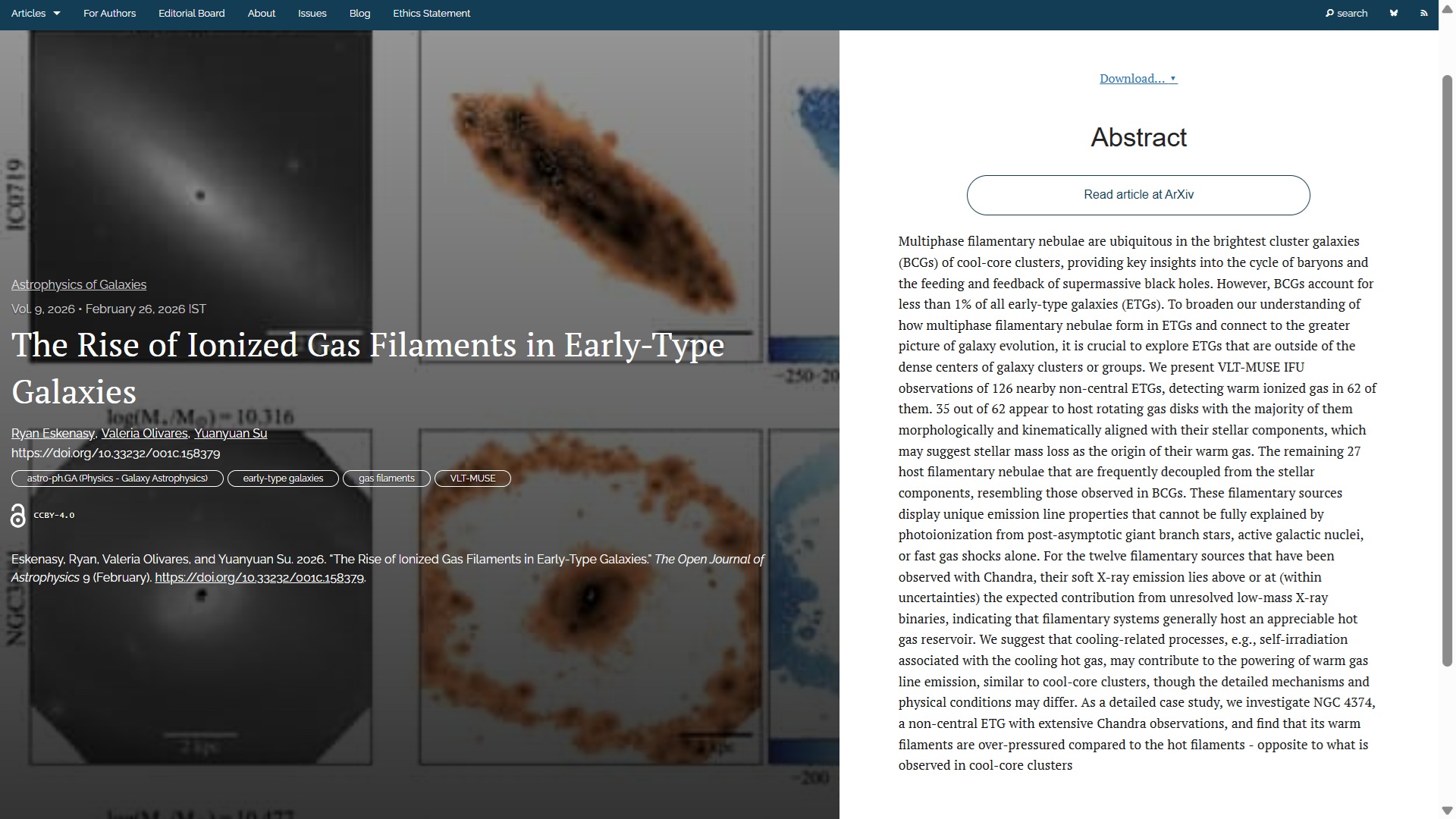
The seventh paper of this week was published on Thursday 26th February is “The Rise of Ionized Gas Filaments in Early-Type Galaxies” by Ryan Eskenasy (U. Kentucky, USA), Valeria Olivares (Universidad de Santiago de Chile) and Yuanyuan Su (U. Kentucky, USA). This article, in the folder Astrophysics of Galaxies, is an exploration of the formation of multiphase filamentary nebulae in early-type galaxies (ETGs), using VLT-MUSE IFU observations of 126 non-central ETGs, focussing on the hot gas components thereof.
The overlay is here:
The officially accepted version of this paper can be found on the arXiv here and the Mastodon announcement is here:
New Publication at the Open Journal of Astrophysics: "The Rise of Ionized Gas Filaments in Early-Type Galaxies" by Ryan Eskenasy (U. Kentucky, USA), Valeria Olivares (Universidad de Santiago de Chile) and Yuanyuan Su (U. Kentucky, USA)
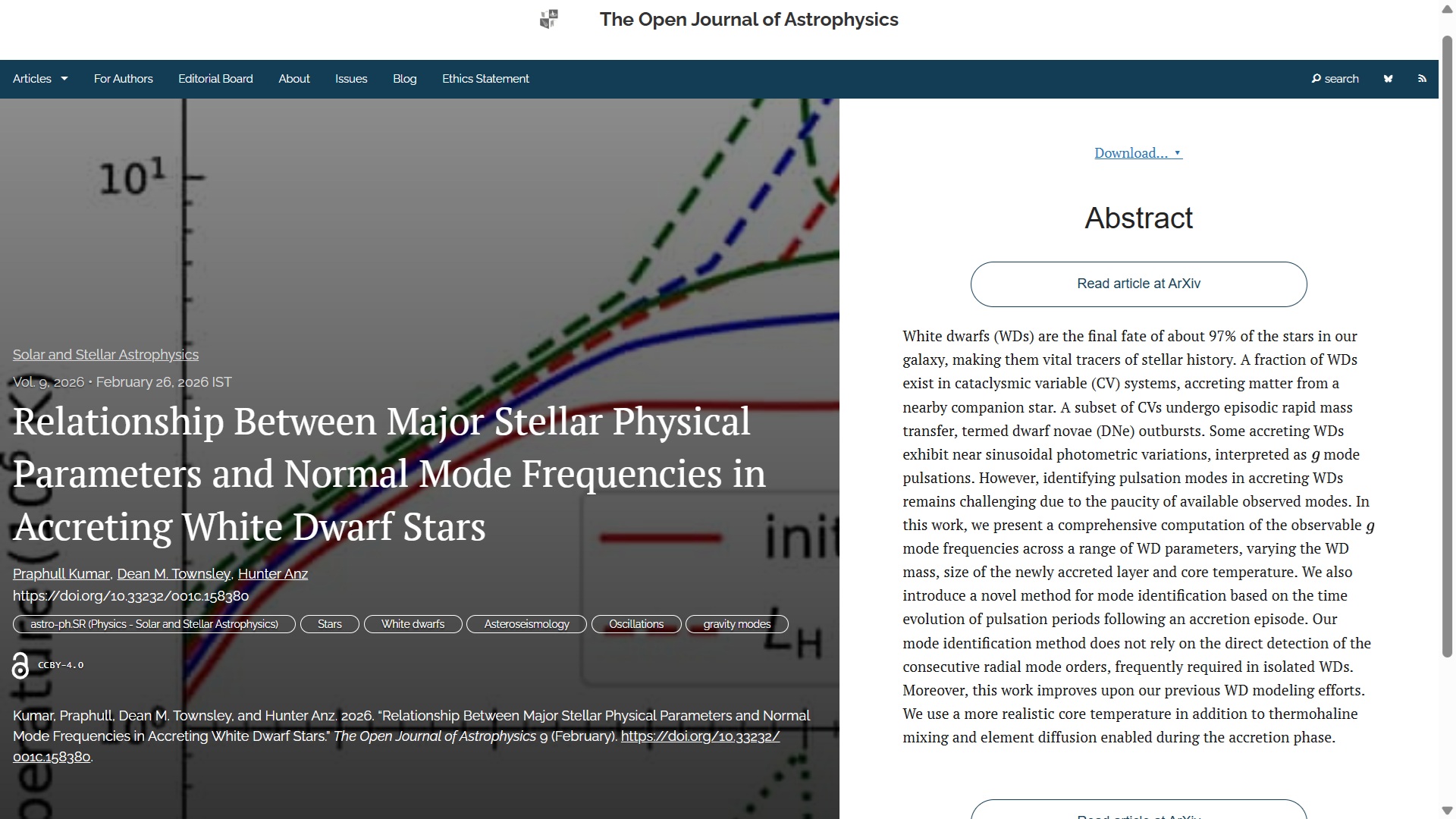
New Publication at the Open Journal of Astrophysics: "Relationship Between Major Stellar Physical Parameters and Normal Mode Frequencies in Accreting White Dwarf Stars" by Praphull Kumar, Dean M. Townsley and Hunter Anz (U. Alabama, USA)
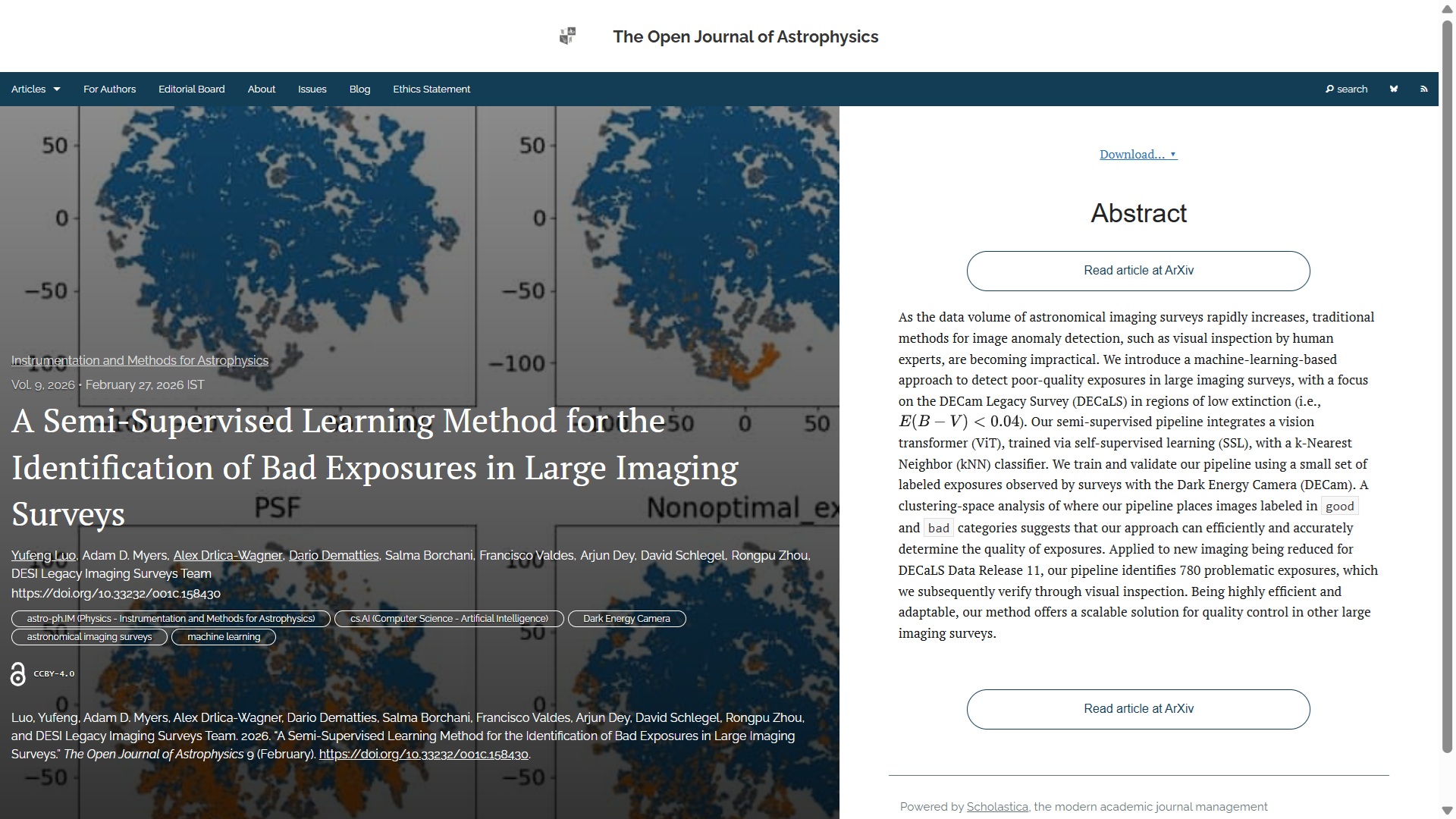
The ninth, and final, paper for this week is “A Semi-Supervised Learning Method for the Identification of Bad Exposures in Large Imaging Surveys” by Yufeng Luo (U. Wyoming, USA) and 8 others from the DESI Legacy Imaging Surveys Team. This was published on Friday 27th February, i.e yesterday, in the folder Instrumentation and Methods for Astrophysics. The paper describes a machine-learning approach for detecting poor-quality exposures in large astronomical imaging surveys, proving efficient and accurate in identifying problematic exposures.
The overlay is here:
The official version on arXiv can be found here and the Mastodon announcement follows:
New Publication at the Open Journal of Astrophysics: "A Semi-Supervised Learning Method for the Identification of Bad Exposures in Large Imaging Surveys" by Yufeng Luo (U. Wyoming, USA) and 8 others from the DESI Legacy Imaging Surveys Team
And that concludes this week’s update. We have now published 45 papers in two complete months of 2026, on which basis we can estimate about 270 papers in the year. For the record, in the first two months of 2025 we published 21 papers.
P.S. Thank you to the many people who responded to the latest call for editors. I’ve been sending out invitations and getting people onboard as quickly as I can, but I still have a number to get to so please bear with me!
It’s Saturday morning, so once again it’s time for an update of papers published at the Open Journal of Astrophysics. There were no papers to report last week but since the last update we have published four new papers, which brings the number in Volume 8 (2025) up to 11 and the total so far published by OJAp up to 246.
In chronological order of publication, the four papers published this week, with their overlays, are as follows. You can click on the images of the overlays to make them larger should you wish to do so.
First one up is “A halo model approach for mock catalogs of time-variable strong gravitational lenses” by Katsuya T. Abe & Masamune Oguri (Chiba U, Japan), Simon Birrer & Narayan Khadka (Stony Brook, USA), Philip J. Marshall (Stanford, USA), Cameron Lemon (Stockholm U., Sweden), Anupreeta More (IUCAA, India), and the LSST Dark Energy Science Collaboration. It was published on 27th January 2025 in the folder marked Cosmology and NonGalactic Astrophysics. The paper discusses how to generate mock catalogs of strongly lensed QSOs and Supernovae on galaxy-, group-, and cluster-scales based on a halo model that incorporates dark matter halos, galaxies, and subhalos.
You can find the officially accepted version of this paper on arXiv here.
Here is a screen grab of the overlay, which includes the abstract:You can find the officially accepted version of the paper on the arXiv here.
The third paper to announce, published on 29th January 2025 in the folder Cosmology and NonGalactic Astrophysics, is “A Heavy Seed Black Hole Mass Function at High Redshift – Prospects for LISA” by Joe McCaffrey & John Regan (Maynooth U., Ireland), Britton Smith (Edinburgh U., UK), John Wise (Georgia Institute of Technology, USA), Brian O’Shea (Michigan State U., USA) and Michael Norman (University of California, San Diego). This is a numerical study of the growth rates of massive black holes in the early Universe and implications for their detection via gravitational wave emission.
You can see the overlay here:
The accepted version of this paper can be found on the arXiv here.
I couldn’t resist sharing this video showing the state of play with the Vera Rubin Observatory, currently under construction on Cerro Pachón in Chile. This is a huge survey telescope with an 8.4m mirror and enormous camera to match, the main task for which will be a ten-year Legacy Survey of Space and Time (LSST) which has the same initials as the former name of the telescope (the Large Synoptic Survey Telescope). That’s obviously so they carry on using the LSST name for their website and elsewhere.
Anyway, the mount assembly has now been installed and tested (in both altitude and azimuth) so you can now get good idea of what the telescope will look like when it’s completed. It’s an amazing piece of engineering, particularly when you see such a huge piece of kit so finely balanced that it can be moved by hand…
Here’s a video showing the arrival and installation of the Top End Assembly (TEA) of the Simonyi Survey Telescope at the Vera C Rubin Observatory site on top of Cerro Pachón in Chile. The Vera C Rubin Observatory was previously known as the Large Synoptic Survey Telescope but was subsequently renamed in honour of the late Vera Rubin.
It’s fantastic to see this project progressing to this stage. I have been around long enough to remember when LSST, as it then was, seemed to be in the impossibly distant future (along with e.g. JWST). The fact that it is now really happening makes me feel extremely old! It’s still great to see though.
Here’s a nice little summary paper (via arXiver) covering the data challenges posed by the Large Synoptic Survey Telescope (LSST) which will come online in 2020 or thereabouts.
To give a bit of a perspective, when the Sloan Digital Sky Survey (SDSS) began to collect astronomical data in 2000, it amassed more in its first few weeks than all data collected in the entire history of astronomy to that date.
Continuing at a rate of about 200 GB per night, SDSS has subsequently amassed more than 140 terabytes of information.
When LSST, which is in many ways a successor to SDSS, comes online it is expected to acquire that amount of data every five days…
The Large Synoptic Survey Telescope (LSST), the next-generation optical imaging survey sited at Cerro Pachon in Chile, will provide an unprecedented database of astronomical measurements. The LSST design, with an 8.4m (6.7m effective) primary mirror, a 9.6 sq. deg. field of view, and a 3.2 Gigapixel camera, will allow about 10,000 sq. deg. of sky to be covered twice per night, every three to four nights on average, with typical 5-sigma depth for point sources of $r$=24.5 (AB). With over 800 observations in $ugrizy$ bands over a 10-year period, these data will enable a deep stack reaching $r$=27.5 (about 5 magnitudes deeper than SDSS) and faint time-domain astronomy. The measured properties of newly discovered and known astrometric and photometric transients will be publicly reported within 60 sec after observation. The vast database of about 30 trillion observations of 40 billion objects will be mined for the unexpected and used…
The views presented here are personal and not necessarily those of my employer (or anyone else for that matter).
Feel free to comment on any of the posts on this blog but comments may be moderated; anonymous comments and any considered by me to be vexatious and/or abusive and/or defamatory will not be accepted. I do not necessarily endorse, support, sanction, encourage, verify or agree with the opinions or statements of any information or other content in the comments on this site and do not in any way guarantee their accuracy or reliability.



 In the Dark