Archive for February, 2017

Farewell, Captain Cook

Posted in Cricket with tags , , on February 6, 2017 by telescoper

So Alastair Cook has resigned from his post as Captain of the England (and Wales) Cricket team, having been skipper for 59 test matches since 2012. After their drubbing in India this is hardly surprising, but I hope he finds his form and continues as an opening batsman. He’s only 32 so should have a few more years in him.

When he started as captain I felt that he was far too cautious, something perhaps he inherited from his predecessor Andrew Strauss. I think he got marginally better as time went by, but I always felt he didn’t have sufficient presence on the field to be a great team leader and too often let things drift when England were fielding. Anyway, I don’t want to be too harsh – he did lead England to two Ashes victories!

Farewell, then, Alastair Cook. But who should take his place? Is it the youngster, Joe Root? Or should Geoffrey Boycott come out of retirement to wield his stick of rhubarb in the corridor of uncertainty once more?

Fire and Ice 

Posted in Poetry with tags , , , on February 5, 2017 by telescoper

Some say the world will end in fire,
Some say in ice.
From what I’ve tasted of desire
I hold with those who favor fire.
But if it had to perish twice,
I think I know enough of hate
To say that for destruction ice
Is also great
And would suffice.

by Robert Frost (1874-1963)


Enough work…

Posted in Uncategorized on February 4, 2017 by telescoper

Boogie Woogie Boogie – Errol Garner

Posted in Jazz with tags , , on February 3, 2017 by telescoper

I have lately posted a number of classic boogie woogie and blues performances by the great Jimmy Yancey. Here’s a piece that’s related but really very different, recorded in 1944 by a musician not usually associated with boogie woogie at all, Errol Garner, who was 23 when this track was made.  The story I heard about this is that the studio bosses leant on the young and impressionable pianist to do play some things that he wasn’t keen on, including a bit of boogie woogie. Eventually Garner acceded to their request, and produced what I think is a minor masterpiece called Boogie Woogie Boogie. Note the way he doesn’t stick to the same left-hand figures throughout the track which makes this much more varied than most recordings in this genre. I particularly like the transition at about 1:35 where it all goes a bit “Batman”!  It also has a distinctively dark minor-key feel to it, which is rather atmospheric.

Have a good weekend!


The Dipole Repeller

Posted in The Universe and Stuff with tags , , , , , , on February 2, 2017 by telescoper

An interesting bit of local cosmology news has been hitting the headlines over the last few days. The story relates to a paper by Yehuda Hoffman et al. published in Nature Astronomy on 30th January. The abstract reads:

Our Local Group of galaxies is moving with respect to the cosmic microwave background (CMB) with a velocity 1 of VCMB = 631 ± 20 km s−1and participates in a bulk flow that extends out to distances of ~20,000 km s−1 or more 2,3,4 . There has been an implicit assumption that overabundances of galaxies induce the Local Group motion 5,6,7 . Yet underdense regions push as much as overdensities attract 8 , but they are deficient in light and consequently difficult to chart. It was suggested a decade ago that an underdensity in the northern hemisphere roughly 15,000 km s−1 away contributes significantly to the observed flow 9 . We show here that repulsion from an underdensity is important and that the dominant influences causing the observed flow are a single attractor — associated with the Shapley concentration — and a single previously unidentified repeller, which contribute roughly equally to the CMB dipole. The bulk flow is closely anti-aligned with the repeller out to 16,000 ± 4,500 km s−1. This ‘dipole repeller’ is predicted to be associated with a void in the distribution of galaxies.

The effect of this “void in the distribution of galaxies” has been described in rather lurid terms as “Milky Way being pushed through space by cosmic dead zone” in a Guardian piece on this research.

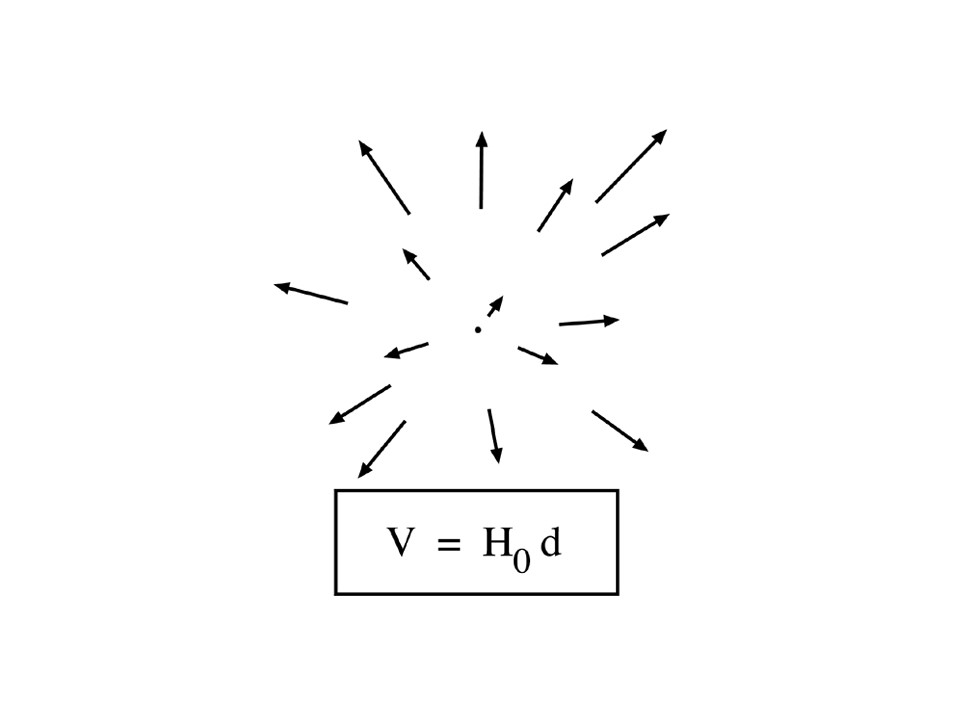
If you’re confused by this into thinking that some sort of anti-gravity is at play, then it isn’t really anything so exotic. If the Universe were completely homogeneous and isotropic – as our simplest models assume – then it would be expanding at the same rate in all directions.  This would be a pure “Hubble flow“, with galaxies appearing to recede from an observer with a speed proportional to their distance:

slide7

But the Universe isn’t exactly smooth. As well as the galaxies themselves, there are clusters, filaments and sheets of galaxies and a corresponding collection of void regions, together forming a huge and complex “cosmic web” of large-scale structure. This distorts the Hubble flow by inducing peculiar motions (i.e. departures from the pure expansion). A part of the Universe which is denser than average (e.g. a cluster or supercluster) expands less  quickly than average, a part which is less dense (i.e. a void) expands more quickly than average. Relative to the global expansion rate, clusters represent a “pull” and voids represent a “push”. That’s really all there is to it.

The difficult part about this kind of study is measuring a sufficient number of peculiar motions of galaxies around our own to make a detailed map of what’s going on in the local velocity field. That’s particularly hard for galaxies near the plane of the Milky Way disk as they tend to be obscured by dust. Nevertheless, after plugging away at this for many years, the authors of the Nature paper have generated some fascinating results. It seems that our Galaxy and other members of the Local Group lie between a dense supercluster (often called the Shapley concentration) and an underdense region, so the peculiar velocity field around us has an approximately dipole structure.

They’ve even made a nice video to show you what’s going on, so I don’t have to explain any further!


You have the power to change someone’s life – Time to Talk Day 2017

Posted in Mental Health with tags , , on February 2, 2017 by telescoper

time-to-talk-day

Today, 2nd February 2017, is Time to Talk Day, which means that it’s time for the nation’s biggest conversation about mental health.

One in four adults and one in ten young people will experience a mental health problem every year. Talking about it doesn’t have to be difficult but can make a big difference. It’s easy to have a conversation about mental health, and it could change someone’s life (including yours). You don’t have to be an expert to help: sometimes just asking  how they are is all you need to do to help someone who’s having a hard time.

Here’s a little video about Time to Talk Day:

For more information on how to get involved see here.

Fake News of the Holographic Universe

Posted in Astrohype, The Universe and Stuff with tags , , , , , , on February 1, 2017 by telescoper

It has been a very busy day today but I thought I’d grab a few minutes to rant about something inspired by a cosmological topic but that I’m afraid is symptomatic of malaise that extends far wider than fundamental science.

The other day I found a news item with the title Study reveals substantial evidence of holographic universe. You can find a fairly detailed discussion of the holographic principle here, but the name is fairly self-explanatory: the familiar hologram is a two-dimensional object that contains enough information to reconstruct a three-dimensional object. The holographic principle extends this to the idea that information pertaining to a higher-dimensional space may reside on a lower-dimensional boundary of that space. It’s an idea which has gained some traction in the context of the black hole information paradox, for example.

There are people far more knowledgeable about the holographic principle than me, but naturally what grabbed my attention was the title of the news item: Study reveals substantial evidence of holographic universe. That got me really excited, as I wasn’t previously aware that there was any observed property of the Universe that showed any unambiguous evidence for the holographic interpretation or indeed that models based on this model could describe the available data better than the standard ΛCDM cosmological model. Naturally I went to the original paper on the arXiv by Niayesh Ashfordi et al. to which the news item relates. Here is the abstract:

We test a class of holographic models for the very early universe against cosmological observations and find that they are competitive to the standard ΛCDM model of cosmology. These models are based on three dimensional perturbative super-renormalizable Quantum Field Theory (QFT), and while they predict a different power spectrum from the standard power-law used in ΛCDM, they still provide an excellent fit to data (within their regime of validity). By comparing the Bayesian evidence for the models, we find that ΛCDM does a better job globally, while the holographic models provide a (marginally) better fit to data without very low multipoles (i.e. l≲30), where the dual QFT becomes non-perturbative. Observations can be used to exclude some QFT models, while we also find models satisfying all phenomenological constraints: the data rules out the dual theory being Yang-Mills theory coupled to fermions only, but allows for Yang-Mills theory coupled to non-minimal scalars with quartic interactions. Lattice simulations of 3d QFT’s can provide non-perturbative predictions for large-angle statistics of the cosmic microwave background, and potentially explain its apparent anomalies.

The third sentence (highlighted) states explicitly that according to the Bayesian evidence (see here for a review of this) the holographic models do not fit the data even as well as the standard model (unless some of the CMB measurements are excluded, and then they’re only slightly better)

I think the holographic principle is a very interesting idea and it may indeed at some point prove to provide a deeper understanding of our universe than our current models. Nevertheless it seems clear to me that the title of this news article is extremely misleading. Current observations do not really provide any evidence in favour of the holographic models, and certainly not “substantial evidence”.

The wider point should be obvious. We scientists rightly bemoan the era of “fake news”. We like to think that we occupy the high ground, by rigorously weighing up the evidence, drawing conclusions as objectively as possible, and reporting our findings with a balanced view of the uncertainties and caveats. That’s what we should be doing. Unless we do that we’re not communicating science but engaged in propaganda, and that’s a very dangerous game to play as it endangers the already fragile trust the public place in science.

The authors of the paper are not entirely to blame as they did not write the piece that kicked off this rant, which seems to have been produced by the press office at the University of Southampton, but they should not have consented to it being released with such a misleading title.