Archive for June, 2017

The Great Dark Energy Poll

Posted in The Universe and Stuff with tags , , on June 8, 2017 by telescoper

Yesterday was a very busy day: up early to check out of my hotel and head to the third day of the Euclid Consortium meeting for the morning session, then across to the Institute of Physics for a Diversity and Inclusion Panel meeting, then back to the Euclid Consortium meeting for the last session of the day, then introducing the two speakers at the evening event, then to Paddington for the 7.15 train back to Cardiff. I was not inconsiderably tired when I got home.

I had to bale out of the evening session to get the train I was booked on, but it seemed to be going well. Before I left, Ofer Lahav asked for an informal show of hands about a few possibilities relating to the nature of Dark Energy. Since today is polling day for the 2017 General Election, I thought it might be a good idea to distract people from politics for a bit by running a similar poll on here.
There are lots of possibilities for what dark energy may turn out to be, but I’ve decided to allow only six broad classes into which most candidate explanations can be grouped:

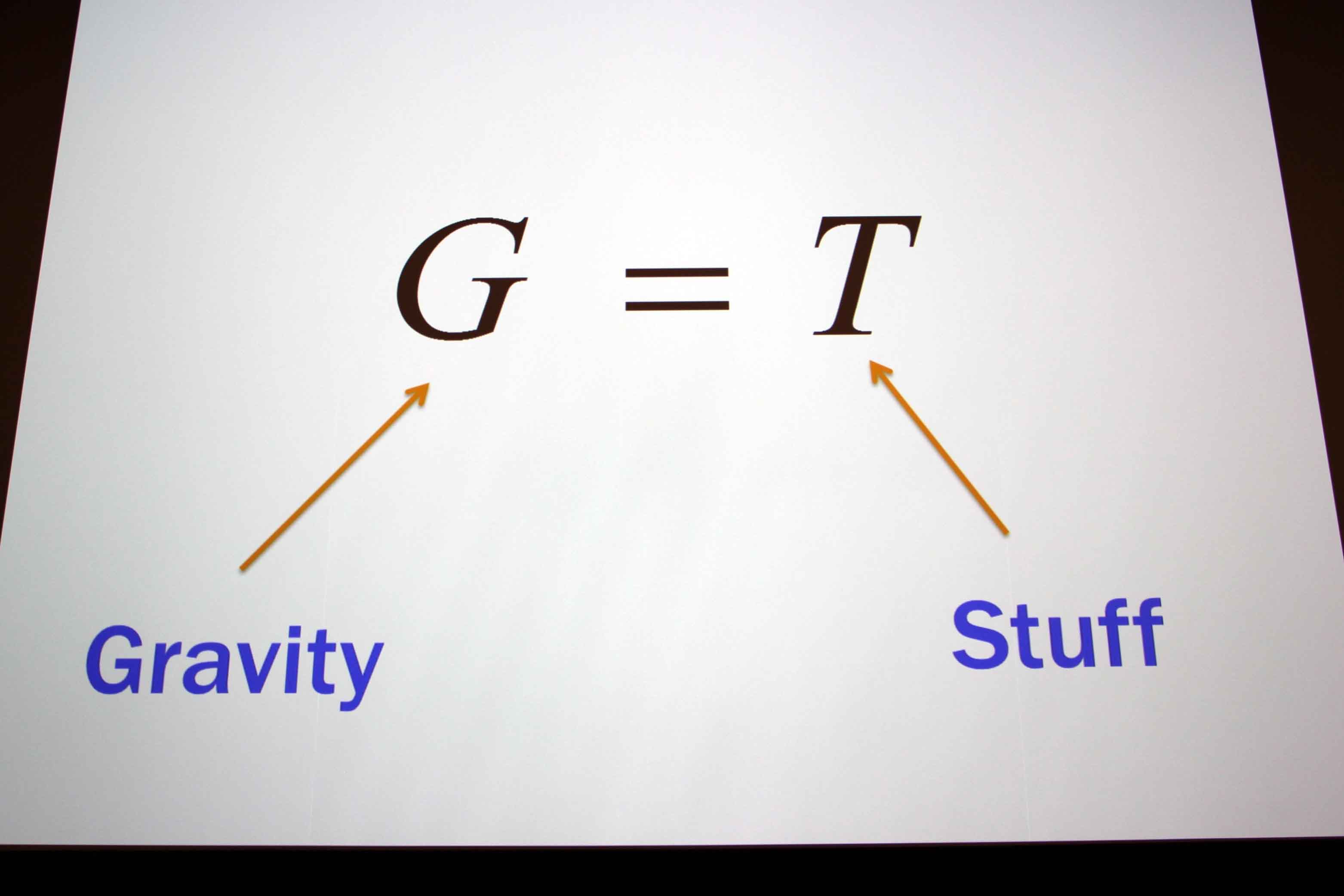
  1. The cosmological constant, originally introduced as a modification of the left hand side of Einstein’s general theory of relativity – the side that describes gravity – but more often regarded nowadays as a modification of the right-hand-side representing a vacuum energy. Whichever interpretation you make of this, its defining characteristic  is that it is constant.
  2.  Modified gravity,  in other words some modification of the left-hand-side of Einstein’s equations that manifests itself cosmologically which is more complicated than the cosmological constant.
  3. Dynamical dark energy, i.e. some other modification of the energy-momentum tensor on the right-hand side of Einstein’s equation that looks like some form of “stuff” that varies dynamically rather than being cosmologically constant.
  4.  Violation of the cosmological principle by the presence of large-scale inhomogeneities which result in significant departures from the usual Friedman-Robertson-Walker description within which the presence of dark energy is
  5. Observational error, by which I mean that there is no dark energy at all: its presence is inferred erroneously on the basis of flawed measurements, e.g. failure to account for systematics.
  6.  Some other explanation – this would include the possibility that the entire standard cosmological framework is wrong and we’re looking at the whole thing from the wrong point of view. If you choose this option you might want to comment through the box below what you have in mind.

Well, there are the six candidates. Make your choice:

Cosmology beyond the Centenary of Λ

Posted in Talks and Reviews, The Universe and Stuff with tags , , on June 6, 2017 by telescoper

I didn’t expect to be doing anything other than listening to the talks and getting updated on the progress of the Euclid project at this meeting in London, but this morning I was roped in to introduce a public event tomorrow evening, called Cosmology beyond the Centenary of Λ:
ECSM_public_evening_event_2


This will take the form of a dialogue/discussion/debate between two leading cosmologists taking a `big picture’ view of the state of cosmology now and likely future developments. I’m sure it will be very friendly so I won’t use any form of language that suggests confrontation but it features, in the red corner, George Efstathiou of the University of Cambridge and, in the blue corner, Ofer Lahav of University College London.

Incidentally, I posted some months ago about the fact that this is the centenary year of Einstein’s introduction of the cosmological constant into the field equations of general relativity in this paper:

cosmo

I recommend anyone attending this Euclid meeting and indeed anyone with a passing interest in cosmology to read that paper – it’s very different from what you might probably imagine it to be!

A Tale of Two Cities 

Posted in Biographical, The Universe and Stuff with tags , , on June 5, 2017 by telescoper

“It was the best of times, it was the worst of times..”

As planned on Saturday evening I stayed at home,  cooked myself dinner, opened a bottle of wine, and watched an old film on DVD. Self-indulgent, I know, but a good way to  have a pleasant evening while avoiding  the crowds at the UEFA Champions League final.

Some time after 10pm  I checked Twitter to see what the score was (4-1 to Real Madrid), and just to check that nothing untoward had happened before or during the match.

It hadn’t, but that was exactly when news was coming in of another terrorist attack in London, this time on London Bridge and in the area of Borough Market. Stories were initially very confused, and I went to bed before a clear picture emerged.

I checked the news feeds again when I woke up and felt the saddest I’ve ever been on a birthday, but still determined to go to Der Rosenkavalier. The best way for us all to beat terrorism is to carry on regardless.

Likewise I didn’t think twice about coming to London today for the Euclid meeting this week. That said, I did arrive very late. Torrential rain overnight in Cardiff, combined with a blocked gutter, led to a flood in my kitchen. I had to call a useful person to fix it the problem, which delayed me by a few hours. Fortunately it was only rainwater in the leak, not nasty stuff backed up from the drain.

Now I’m in London where it is also tipping down, but at least I’m in a pleasant hotel and looking to get a good night’s sleep. The sound of rain can be restful, at least when it’s not flooding your kitchen.

I made my way to the hotel, which is in Bayswater, after a wine and nibbles reception at the workshop. I have never stayed here before and it took a while to find. I was a bit nervous too, as the place is remarkably cheap by London standards. Before correctly locating the hotel I wandered into another establishment on the same street with a similar name. It was quite obviously a brothel, and they politely directed me to the correct address. The hotel turned out to be fine, though obviously without any of the ‘extras’ that would have been available at the other place.

I can’t stay the whole week here as I have to get back to Cardiff to vote on Thursday, but it’s been nice to catch up with news of the Euclid mission and to meet some old friends. There are about 400 cosmologists here in London for this meeting, some of them familiar some of them less so. The mission won’t be launched until 2021 at the earliest, and it’s unlikely I’ll be involved very much, but it’s still exciting to see it all taking shape.

Der Rosenkavalier at WNO

Posted in Opera with tags , , , , , , , on June 5, 2017 by telescoper

I’m in London attending a cosmology meeting (of which more, perhaps, anon) but I couldn’t resist posting a quick review of yesterday’s birthday treat: the first performance of a new production of Der Rosenkavalier by Richard Strauss. It wasn’t exactly a first night as such because it was a 3pm start. In fact it was still daylight when I got home..

Der Rosenkavalier is superficially a comic opera but it also moments of great depth and poignancy, dealing with the passage of time and the nature of love. The libretto contains some lovely passages, such as this:

Die Zeit, die ist ein sonderbar Ding.
Wenn man so hinlebt, ist sie rein gar nichts.
Aber dann auf einmal, da spürt man nichts als sie.
Sie ist um uns herum, sie ist auch in uns drinnen.
In den Gesichtern rieselt sie,
im Spiegel da rieselt sie,
in meinen Schläfen fliesst sie.
Und zwischen mir und dir da fliesst sie wieder,
lautlos, wie eine Sanduhr.

Most of the comedy is supplied by an intrigue involving the boorish Baron Ochs, played brilliantly by bass Brindley Sherrat, who wishes to marry the innocent Sophie (largely to acquire the property of Sophie’s father). The Baron engages dashing young Octavian to deliver a ceremonial silver rose to Sophie as a wedding gift. Octavian arrives with the gift but falls in love at first sight with Sophie and his feelings are reciprocated. When the Baron turns out to be the horrible git that he is, Octavian engineers a plot to discredit him, rescue Sophie from a potentially disastrous marriage and claim her for himself. The cunning plan, which proves successful, involves Octavian dressing as a maid in order to catch the Baron in flagrante.

It’s worth mentioning that the part of 17-year old Octavian is played by a female singer – in this production the excellent Lucia Cervoni – who at one point has to be a girl playing a boy playing a girl, rather like Cherubino in the Marriage of Figaro. Sounds silly? Well, it is but it was beautifully done and gloriously funny.

Octavian (right) presents Sophie with the silver rose..

Octavian is a `trouser role’ but in this production the character begins with trousers off, having a bit of rumpy-pumpy with the Marschallin (played by the wonderful Rebecca Evans), who is much older than Octavian. At the start of the Opera they are in a passionate relationship, but the Marschallin is conscious of the passage of time and that her relationship with Octavian can’t last. At the end of Act I, she points out to Octavian that their relationship can’t go on and he storms out, shortly to meet young Sophie (in Act II).

In this production the Marschallin is often accompanied on stage by the silent and solitary figure of an old lady, who it turns out is a representation of herself in later life. It’s a clever device and would have been even more effective had the old lady not reminded me so much of Madge Allsop

The staging is in period, and for the most part pleasantly straightforward but there is a rather gimmicky element of steadily encroaching sand, presumably ‘the sands of time’ referred to in the last line of the excerpt quoted above. I felt this was neither necessary nor convincing. The theme of time’s inexorable progress is clear enough. There’s no need to labour it.

Near the end of Act III, after much coming and going, and the odious Baron’s entrapment and humiliation, the Marschallin  is left alone with her former lover Octavian and his intended bride Sophie, we arrive at the Opera’s emotional high point, and indeed one of the most sublime moments in the entire operatic repertoire, the sumptuous trio Hab Mir’s Gelobt,  in which the Marschallin comes to terms with the loss of Octavian and blesses the relationship between him and Sophie. This is one of the pieces of music that really affects me very powerfully, and I am not too proud to admit that I did let go a tear or two. Maybe more. Not because it is especially sad, but because it’s so very beautiful the way the three voice blend together and with the orchestra.

I don’t give star ratings but from a vocal point of view this is definitely one of the finest performances I’ve ever seen on the Opera stage. All four principals: Rebecca Evans, Lucia Cervoni, Brindley Sherratt and Louise Alder (Sophie) rose to the challenges of their roles in great style. All were superb so it would be wrong to single out one, but I will say that I was surprised to discover that this was Rebecca Evan’s debut as the Marschallin – she was just about perfect in the role.

The Orchestra of Welsh National Opera directed by Tomas Hanus played Strauss’s lush score with great precision and passion,  holding together a wonderful afternoon at the Wales Millennium Centre. An altogether excellent way to spend a birthday afternoon!

In case you were wondering….

Posted in Biographical, Politics with tags , , on June 3, 2017 by telescoper

Simulation of the binary black-hole coalescence GW170104

Posted in The Universe and Stuff with tags , , , on June 2, 2017 by telescoper

Via the Cardiff University news website, I found this video of a computer simulation of the binary black-hole coalescence that gave rise to the gravitational wave event GW170104 whose detection was announced yesterday, so I thought I’d share it here.

Here’s the  blurb accompanying the video:

The video shows a numerical simulation of a binary black-hole coalescence with masses and spins consistent with the GW170104 observation. The strength of the gravitational wave is indicated by elevation as well as color, with blue indicating weak fields and yellow indicating strong fields. We rescale the amplitude of the gravitational wave during the simulation to show the signal during the entire animation not only close to merger, where it is strongest. The sizes of the black holes are increased by a factor of two to improve visibility. The bottom panel in the video shows the gravitational waveform starting at frequency of 25Hz. The fade in of the video corresponds to a frequency of about 30Hz.

© Numerical-relativistic simulation: S. Ossokine, A. Buonanno (Max Planck Institute for Gravitational Physics) and the Simulating eXtreme Spacetimes project; scientific visualization: T. Dietrich (Max Planck Institute for Gravitational Physics), R. Haas (NCSA).

The colour scheme gives me a headache, and there’s no sountrack, but it’s quite instructive nonetheless.


Captain SKA – Liar Liar

Posted in Music, Politics with tags , on June 2, 2017 by telescoper

I don’t know why, but every time I go onto Youtube these days I get a horrible Conservative Party propaganda video. Obviously some sort of algorithm has decided to inflict this crap on me because I’m deemed to be likely to be persuaded to vote for the Tories. I can promise them that this is not the case. The Tories may win next week’s election, but this campaign has revealed Theresa May as thoroughly cowardly and dishonest, despite her best efforts to hide from public scrutiny. I will be voting for Welsh Labour.

Anyway, I’ve decided to retaliate by posting this: it’s Liar Liar by Captain SKA. It’s in the top ten of the UK singles chart, but the BBC refuses to play it. I can’t compete with the Beeb, but every little helps….

New Astronomy at the New Year (GW170104)

Posted in The Universe and Stuff with tags , on June 1, 2017 by telescoper

The inside story of the detection of gravitational wave event announced earlier today..

Shane L. Larson's avatarWrite Science

by Shane L. Larson

Newton’s portrait.

January 4 holds a special place in the hearts of scientists — it is Isaac Newton’s birthday (*). Newton stood at the crossroads that led to modern science, and astronomy in particular. He was the first person to build a workable reflecting telescope, a design that now bears his name and for the past 4 centuries has been the dominant type of telescope used by amateurs and professionals alike. Newtonian telescopes have revealed much about the Cosmos to our wondering minds. Newton was also responsible for the first formulation of a physical law that describes the working of gravity, called the Universal Law of Gravitation. Today we use the Universal Law to launch satellites, send astronauts into orbit, convert the force of your feet on the bathroom scale into your “weight“, and a thousand other applications.  There is much to celebrate…

View original post 1,623 more words

Newsflash: another LIGO detection!

Posted in The Universe and Stuff with tags , , , on June 1, 2017 by telescoper

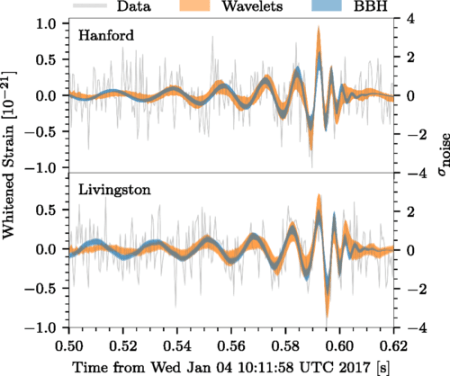
I’ve just heard the news that  LIGO has just announced the detection of another gravitational-wave signal, which has been given the identifier GW170104; it was detected on 4th January 2017.

The event was the merger of a black-hole binary system a redshift z=0.2, which is a proper distance of about 800 Mpc in the standard cosmological model, the most distant event yet detected. There are also tantalising hints that at least one of the black holes had spin opposite the orbital angular momentum, which implies it may have originated in a globular cluster. For more details please see the refereed paper.

If you’d rather just look at the plot here is the evidence for the event, in the form of coincident signals at the two components of LIGO:

 
LIGO

I reckon there’s a good chance of seeing members of the Cardiff University Gravitational Physics group celebrating in the pub later this evening!

It’s also a reasonable inference given the rate of detection of these events so far that we’re going to see many more in the very near future!

Cose da sapere su Cardiff

Posted in Bute Park, Cardiff, Football with tags , , , , , , on June 1, 2017 by telescoper

Cardiff is gearing up for the UEFA Champion’s League final between Real Madrid and Juventus which takes place in the Principality Stadium on Saturday night. Cardiff University has produced this nice video featuring some students from Italy telling visitors about `things to know about Cardiff’, which I thought I’d share here:

There’s also a Spanish version here.

As you can imagine there’s quite a lot of disruption going on in the City ahead of this event, which is expected to attracted over 200,000 visitors. Last night one of the main roads was closed to allow the construction of a temporary footbridge to help manage the flow of people from Bute Park into the Stadium in the period just before the kickoff. There is only one small exit from the Park opposite the ground, which would probably cause considerable congestion, so the bridge will provide another route out, over the famous Animal Wall.

Cowbridge road was closed to vehicles and pedestrians for this operation, which I assumed would mean a bit detour for me on my walk home from the pub last night. Nevertheless, out of curiosity, I followed my normal route until I reached the construction site. A small group of people and a couple of very friendly policemen were there. I asked nicely if there was any possibility of getting past the road block rather than walking all the way around by side streets, and one of the officers said that if I waited for about 5 minutes they were going to open it up temporarily and let people through, which they did.

Cardiff Castle and Bute Park are being used to host a few thousand `Corporate VIP Guests’ during the weekend of the Final. For that a huge part of Bute Park – the entire area of Coopers Field – is closed to the public. Not only that, but the temporary buildings that have been erected there will cause so much damage to the grass that it will have to be completely re-seeded. This area will not be re-opened to the public until September at the earliest. This seems a very heavy price for the ordinary folk of Cardiff to pay for an event very few will be able to attend.

As well as congestion and crowd control, there is also the threat of terrorist activity (especially in the wake of the Manchester bomb). This morning as I walked into work I saw several groups of armed police officers. I’m not sure if they are intended to make people feel more secure, but they just made me feel nervous.

Road_Closure_Map_A3-Preparing-Cardiff-

It’s quite easy to infer what the biggest concern is for the security services. The presence of vehicle barriers all round the city and the suspension of all vehicle traffic within a wide perimeter of the various fan zones suggests that they are worried about potential attacks involving cars or lorries running amok among the huge numbers of pedestrians. It’s sad that we have to think of such things, but these precautions seem entirely necessary.

I was toying with the idea of taking photographs of some of the security measures but on reflection thought that might not be a wise thing to do in case I was mistaken for someone plotting an atrocity!

My own plan for the Final is to shut myself in my house, batten down the hatches, cook myself a nice dinner and drink a nice bottle of wine. I’m completely neutral as far as the match is concerned. Whether it’s Real Madrid of Italy or Juventus of Spain, may the best team win!