Archive for July, 2017

The Versatile Four

Posted in History, Jazz with tags , , , , , on July 14, 2017 by telescoper

I’ve posted a few examples of Jazz drummers recently, so I thought you might be interested in this, a rare recording of performance from the (pre-Jazz) Ragtime era that provides a good example of where  Jazz drumming came from. This track was recorded in London way back in 1916 and it’s remarkable for the clarity with which you can hear the drums, which in those days usually proved very difficult to capture.  The tune, Down Home Rag (written by Wilbur C. Sweatman) was a big hit at the time and remains in the traditional jazz repertoire to this day. It’s played by The Versatile Four an almost legendary ragtime band that I know very little about other than the personnel: Tony Tuck (banjo; born 1879 Virginia); Charles W. Mills (piano; born 1883 Illinois); Gus Haston (banjo, vocals; born 1880 Missouri); and  Charlie Johnson (drums; born 1885 Kentucky). I’m not sure who it is who blows the whistle, but it may well be the drummer.

Charlie Johnson’s playing of the drums may sound very old-fashioned and a bit staff to ears accustomed to the swinging style of the jazz era, and he no doubt used a very crude kit, but this recording shows what an absolutely superb musician he was. You can also clearly hear the influence of the sort of drum patterns used by military marching bands. As well being an interesting piece from the point of view of music history, the drummer suffuses this high-energy performance with a sense of knockabout fun that is guaranteed to bring a smile to even the most crabbed face!


The Early Stages of Cosmic Inflation

Posted in The Universe and Stuff with tags , , , , on July 13, 2017 by telescoper

When asked to cite the article that first presented the theory of the inflationary Universe most cosmologists would probably offer the famous paper published by Alan Guth in 1981.

However, I recently stumbled across a paper by Demosthenes Kazanas that was published (in the Astrophysical Journal Letters in 1980. I hadn’t seen this paper before a few days ago, and I don’t think it is very well known. Here is part of the front page:

You can get the full paper here.

I know that there were other papers floating around in 1980 that got part of the way to the theory of inflation, but this one seems very close to the theory, e.g. talking about exponential expansion in the context of the cosmological horizon problem.

Interestingly, while Guth (1981) has garnered many thousands of citations, Kazanas (1980) has been cited fewer than 300 times.

Does anyone know the story of this paper, and why it has largely  been overlooked by the exponentially-expanding literature on cosmic inflation? And,while I’m on the topic, can anyone suggest other early contributions to the theory that have been similarly neglected? Please let me know through the comments box below.


Der Doppelgänger

Posted in Mental Health, Music with tags , , on July 12, 2017 by telescoper

Writing yesterday about depersonalisation for some reason brought this song by Franz Schubert to mind. I heard it on the radio recently and found it profoundly moving. Der Doppelgänger is a setting of a poem by Heinrich Heine that Schubert composed in 1828 near the end of his life; it was published posthumously in 1929 as part of Schwanengesang.t’s relevance to the topic of depersonalisation lies in the middle verse, in which the poet describes seeing a tormented figure only to realise that the figure is he (the last line says `The Moon shows me my own form’):


Da steht auch ein Mensch und starrt in die Höhe,
Und ringt die Hände, vor Schmerzensgewalt;
Mir graust es, wenn ich sein Antlitz sehe –
Der Mond zeigt mir meine eigne Gestalt.

It’s a very bleak piece, its desolate atmosphere underlined by the inexorable piano accompaniment which consists mostly of block chords. I think you can tell that this is written by a man who knows his days are numbered, but the simplicity and beauty of the composition and pervading sense of loneliness and desolation mark it as a work of genius, which Schubert undoubtedly was.

The singer is the late great Dietrich Fischer-Dieskau.

The Shrinking Seasons at WNO

Posted in Opera with tags , , , , , , , , on July 12, 2017 by telescoper

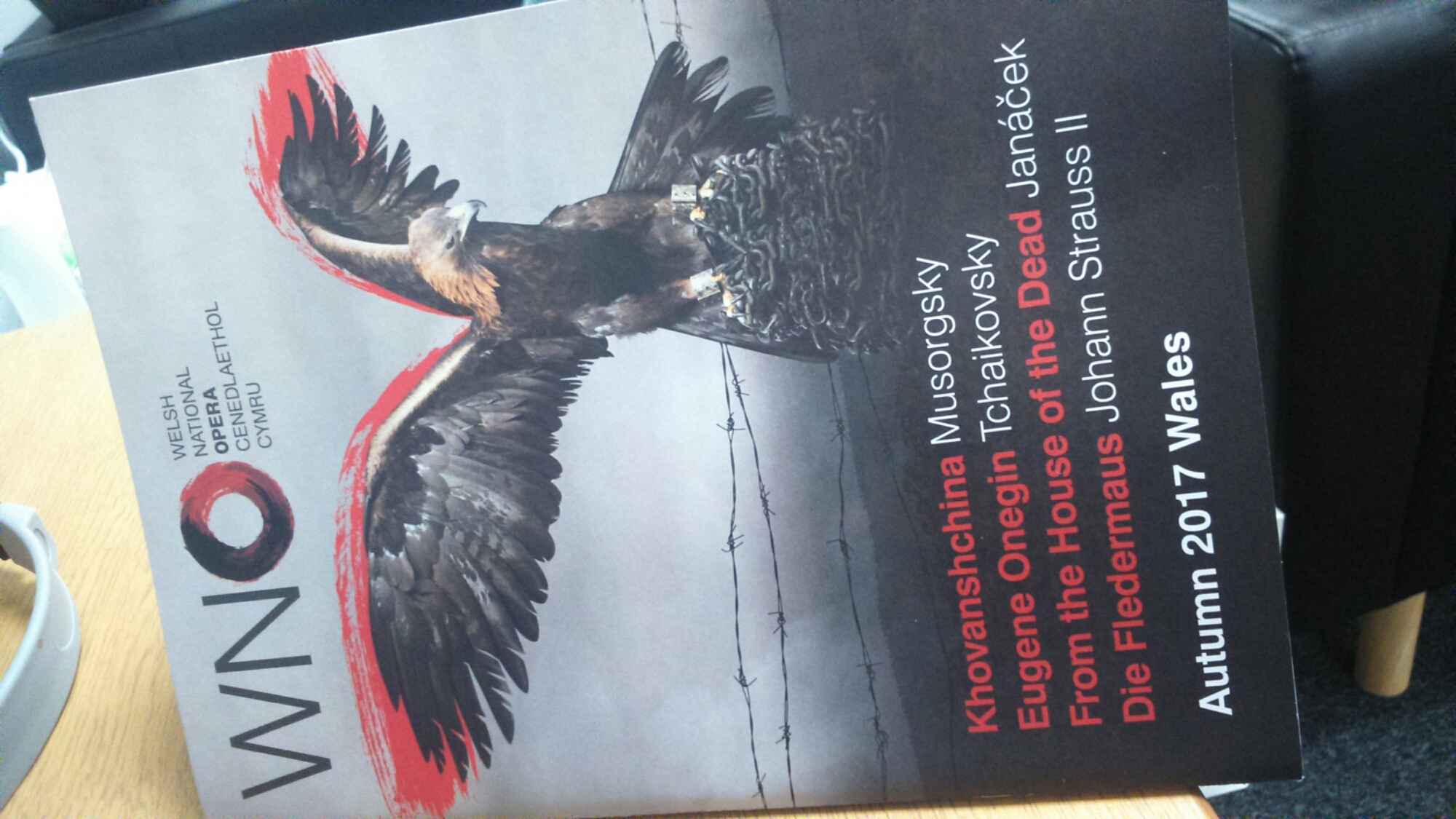
I was excited to receive the brochure shown above for the 2017/18 season at Welsh National Opera, but although it contains some very exciting things there are also many signs that times are getting very tough at WNO.

This October sees the 100th anniversary of the Russian Revolution so it’s no surprise that the Autumn season has a distinctive Russian flavour. There’s Tchaikovsky’s Eugene Onegin, Mussorgky’s Khovanschina and Janáček’s From the House of the Dead. Yes, I know Janáček wasn’t Russian – but `From the House of the Dead’ is based on a novel by Fyodor Dostoyevsky, who was…

That looks like an interesting season, but there are only two performances of From the House of the Dead in Cardiff (both of which I think I’ll have to miss) and only three each of Eugene Onegin and Khovanschina. There’s also an additional performance of Johan Strauss’s light operetta Die Fledermaus, which is one of this year’s productions.

Spring 2018 sees performances of Puccini’s Tosca, Verdi’s La Forza del Destino and Mozart’s Don Giovanni which again looks like a nice season. I’ve seen the productions of Tosca and Don Giovanni before, but won’t mind seeing them again.

But the real disappointment is that there’s no Summer season at all. Austerity has clearly bitten very hard. For year’s I’ve been celebrating my birthday (which falls in June) by going to a WNO performance in Cardiff but I guess next year I’ll just have to do something else….

On drugs (and off them)

Posted in Mental Health with tags , , , , , , on July 11, 2017 by telescoper

I came across an interesting piece in the Guardian the other day written by Deborah Orr, who had just taken antidepressants for the first time (with unpleasant consequences). This was followed by an explanatory article by blogger and author Dean Burnett who explains that nobody really knows how anti-depressants work, and why it is not surprising that they can have unexpected side effects. I hope that the articles I mentioned above help make it clearer what is involved being on medication of this sort. These drugs are in widespread use, but ignorance about them is spread even wider.

I remember a while ago, when I was working at the University of Sussex, sitting on a bus in Brighton with two people behind me talking – in a very unhelpful and ill-informed way – about depression, and how anti-depressant drugs were a `soft option’. It made me quite angry listening to some of the comments they made but I didn’t intervene. I toyed with the idea of writing a blog then but I didn’t get round to it, partly because I didn’t really want all the staff and students in the School of which I was Head to know I was taking heavy medication for much of the time I was working there.  I only told a handful of people at the time. Now I am no longer in that job I think it’s safe to be a bit more open, and add a little bit here from my own experience to the articles mentioned above.

The most widespread anti-depressant drugs currently available are called Selective Serotonin Reuptake Inhibitors (the best-known of which, Fluoxetine, is known by the trade name Prozac). Deborah Orr’s article concerned her experience with an SSRI called Citalopram, which I was using about five years years ago. More recently, for much of the time I was at Sussex I was taking Paroxetine (trade name: Seroxat). The latter is not available on the National Health Service through a General Practioner, but must instead be prescribed by a consultant psychiatrist.

Anti-depressants are not only prescribed for the treatment of clinical depression but also for, e.g., anxiety disorder, panic disorder, and post-traumatic stress disorder. Nobody really knows why anti-depressants work against depression (although there is clinical evidence that they do), and there is even less understanding why (and, in some cases, evidence that) they are effective for these other conditions. Like many treatments they seem to have been discovered empirically, by trial and error.

As Dean Burnett explains in his article, SSRIs work by increasing the level of Serotonin (a monoamine neurotransmitter). However, taking an SSRI increases the level of Serotonin almost immediately whereas the effect on depression takes weeks to register. While low Serotonin levels may play a part in depressive illness, they’re clearly not the whole story.

My experience contrasts a bit with Deborah Orr’s, in that I have never experienced significant problems going onto this sort of medication – the worst by far has been when I’ve tried to quit. I had awful problems in the summer of 2012 largely as a result of trying to come off the medication I had been on since the previous autumn. The withdrawal symptoms then included shaking fits, insomnia, visual and auditory hallucinations, nausea, and hypervigilance.

The effect of this extreme collection of withdrawal symptoms was that I didn’t eat or sleep for a couple of weeks, and ended up in a high-dependency unit at a psychiatric hospital under sedation while they figured out what to do with me. Fortunately, I recovered well enough to return to work after a couple of months.

At the end of the summer of 2012, I was offered the job of Head of the School of Mathematical and Physical Sciences at Sussex University. I moved from Cardiff to Brighton in early 2013 to take up this new position. I hadn’t been there for long when my old problem returned. The stress of the job obviously played a role in this, and I soon realised that I couldn’t keep going without help from medication. It was then that I was tried out on Paroxetine, the dose being gradually increased until I was at the maximum recommended level (60mg daily).

While this medication was effective in controlling the panic disorder, it had some unpleasant side-effects, including: digestive problems; dizziness; difficulty in concentrating; fatigue; and the weirdest of all, a thing called depersonalisation. Deborah Orr describes the latter very well in her piece but she seems to have experienced it as soon as she started taking medication, whereas in my case it came on  gradually.

 I found myself living a kind of half-life, functioning reasonably well at work but not having the energy or enthusiasm to do very much else outside of working hours. Eventually I got fed up with it.  I felt I had to choose between staying in my job as Head of School (which meant carrying on taking the drugs indefinitely) or leaving to do something else (which would mean I might be able to quit the drugs). I picked the latter. The desire to come off medication wasn’t the only factor behind my decision to stand down from my job, but it played a big part.

I knew however that Paroxetine  is associated with notoriously difficult withdrawal symptoms so, mindful of my previous experience in 2012, I followed the medical instructions to the letter, gradually cutting down my dose over a couple of months during the course of the Autumn in 2016. I still had significant withdrawal symptoms, especially the insomnia, but not as bad as five years ago. I’m hoping that my current (part-time) job allows me to manage for the foreseeable future without the need for any medication – apart, perhaps, from the odd glass of fine wine!

So those are my experiences. All I can say that I hope I’ve convinced you that anti-depressants are not a `soft option’!

The Original Tainted Love

Posted in Music with tags , on July 11, 2017 by telescoper

Following on from last week’s post of the 1981 Soft Cell version of Tainted Love, I thought I’d post the original version of this song (for those of you who didn’t realise that the Soft Cell version was a cover). Here it is, as performed by Gloria Jones in 1964. It’s a quite different take, with a definitive Northern Soul sound, but it has the same backing riff as in the Soft Cell.

Incidentally, Gloria Jones later became the girlfriend of Marc Bolan, and it was she who was driving the car in 1977 that crashed into a tree killing Marc Bolan who was in the passenger seat. I didn’t make that connection until a chance conversation at the cricket on Saturday!

The Lord’s Day

Posted in Cricket with tags on July 8, 2017 by telescoper

I made it on time this morning to Lord’s to see the third day’s play of the First Test between England and South Africa from the brand new Warner Stand.

South Africa resumed on 214 for 5 chasing England’s first-innings total of 458. England’s bowlers bowled pretty well, but the batsmen, especially nightwatchman Philander, joined by wicketkeeper De Kock,  battled gamely and South Africa progressed to 361 all out, giving England a lead of 97.
England then resumed and batted slowly but safely to close on 119 for 1 off 51 overs, losing only Jennings for 33, ahead by 216. Cook was unbeaten on 59. They will be looking to push on tomorrow and try to build a lead of around 450 to try to force a result. There were definitely signs of turn and variable bounce  for the spinners so batting last may not be easy. 

Anyway, as always, it was a very enjoyable day, complete with Scottish entertainment in the luncheon interval:

Update: Checking the score at lunchtime on Sunday I discovered that England collapsed to 182 for 8, having been 139 for 1 at one stage. South Africa are now favourites to win this game, although England’s spinners will take heart from the fact that the ball is turning sharply.

Another update: the plot thickens. England managed to add another 50 runs courtesy of Bairstow and Wood, setting South Africa 331 to win. At tea they were 25 for 3. England definitely favourites again, but with South Africa’s two best batsmen Amla and De Kock at the crease..

Final update: 5.33pm. South Africa all out for  119. England win by 211 runs.

Natwest T20 Blast: Glamorgan v Hampshire 

Posted in Cricket on July 7, 2017 by telescoper

After a quick pint after work I headed to the SSE Swalec Stadium in Sophia Gardens for the first of this year’s games in Natwest Twenty20 Blast.

I was a little late getting there and two overs had already been bowled. Hampshire, batting first, were already 30 without loss; an over later they were for 0. At that rate they were going to reach 300!

However, three wickets fell quickly and Glamorgan managed to restrict Hampshire to 167 for 4, a decent score but not impossible.

During the innings break I took a wander and chose a different view for the Glamorgan innings, more or less opposite where I was for the first 20 overs, under the big screen.

Glamorgan got off to a terrible start, losing two wickets in the first over from which they never really recovered. Though Wagg scored a bright 50, and the they never  looked like getting the runs. Afridi was the pick of the Hampshire bowlers, taking 4 for 20 off his 4 overs.

Glamorgan finished on 145 for 9 so Hampshire won by 22 runs, a narrower margin than looked likely when Glamorgan were 47 for  5…

Despite the score, and the fact that it wasn’t proper cricket, it was quite good fun. About 7000 people were there.

Anyway, time for an early night. I have to get up with the lark tomorrow to head to London for some proper cricket.

Tainted Love

Posted in LGBTQ+, Music with tags , , on July 7, 2017 by telescoper

And now for something completely different…

A little bird told me that it was exactly 36 years ago today, on 7th July 1981, that the single Tainted Love was released in the UK by Soft Cell. The record climbed rapidly to Number 1 and was the biggest-selling record of the year. Here it is being performed on Top of the Pops..

I was still at school in July 1981, having finished my A-levels; I would return to school after the summer break to take the Cambridge entrance examination.

Here’s a scary fact for those of you who, like me, remember this record from the time of its release: July 7th 1981 is closer to the end of the Second World War (August 1945) than it is to the present day (July 7th 2017).

And on that note I wish you happy weekend!


Why not give back to students their marked examination scripts?

Posted in Education with tags , , , on July 6, 2017 by telescoper

Well, the examination period is over and we’re now in that curious interregnum in the academic year that lasts until graduation, when we get to congratulate students properly and send them on their way into the big wide world. I hope the weather is a bit cooler for that event. It’s no fun at all for either staff or students wearing a suit and tie with a heavy gown on top when the temperature is 30°!

Anyway, yesterday I had a meeting with a (Masters) student about one of his recent examinations, and it prompted me to write a short post about the reason for our discussion.

Here in the School of Physics & Astronomy at Cardiff University we have a system whereby students can get access to their marked examination scripts. By `script’ I mean what the student writes (usually in a special answer book), as opposed to the `paper’ which is the list of questions to be answered or problems to be solved in the script. This access is limited, and for the purpose of getting feedback on where they went wrong, not for trying to argue for extra marks. The students can’t take the scripts away, nor can they make a copy, but the can take notes which will hopefully help them in future assessments.

When I was Head of the School of Mathematical and Physical Sciences at Sussex University I tried to introduce such a system there, but it was met with some resistance from staff who thought this would cause a big increase in workload and lead to  difficulties with students demanding their marks be increased. That has never been the experience here at Cardiff: only a handful take up the opportunity and those that do are told quite clearly that the mark cannot be changed. This year I had only one student who asked to go through their script. I was happy to oblige and we had a friendly and (I think) productive meeting.

If I had my way we would actually give all students their marked examination scripts back as a matter of routine. The fact that we don’t is no doubt one reason for relatively poor performance in student satisfaction surveys about assessment and feedback. Obviously examination scripts have to go through a pretty strict quality assurance process involving the whole paraphernalia of examination boards (including external examiners), so the scripts can’t be given back immediately but once that process is complete there doesn’t seem to me any reason why we shouldn’t give their work, together with any feedback written on it,  back to the students in its entirety.

I have heard some people argue that under the provisions of the Data Protection Act students have a legal right to see what’s written on the scripts – as that constitutes part of their student record – but that’s not my point here. My point is purely educational, based on the benefit to the student’s learning experience.

Anyway, I don’t know how widespread the practice is of giving examination scripts back to students so let me conduct a totally unscientific poll. Obviously most of my readers are in physics and astronomy, but I invite anyone in any academic discipline to vote:


And, of course, if you have any further comments to make please feel free to make them through the box below!