Archive for December, 2017

Finlandia!

Posted in History, Music with tags , , , , on December 6, 2017 by telescoper

Today marks the 100th anniversary of Finland’s Declaration of Independence from Russia, which took place on 6th December 1917.

To celebrate the occasion here is  Finlandia by Jean Sibelius from this year’s Proms, performed by the BBC Singers, BBC Symphony Chorus and the BBC Symphony Orchestra, under the direction of Finnish conductor Sakari Oramo.

Happy Independence Day to Finns everywhere, and especially to my friends and colleagues in the world of physics and astronomy!

The Days of the Double Bind

Posted in Biographical, Literature, Politics with tags , , , , , , , on December 5, 2017 by telescoper

The last few days I’ve been trying to deal with the sort of apparently insoluble problem usually called a double bind, similar to the logical paradox which provided the central plot device of Joseph Heller’s classic novel Catch-22. I’ve seen this particular double bind happen to so many colleagues from abroad wanting to work in the United Kingdom that in a sense it’s quite reassuring that the same thing happens in much the same way in other countries too, specifically Ireland.

The problem facing me is that I need to find somewhere to rent temporarily in Maynooth until I can find longer-term accommodation (i.e. by buying a house). As convenient as St Patrick’s College is as a short-term residence, it’s not somewhere I would want to live for weeks and months. The trouble is that in order to secure private rented accommodation you need to prove that you are able to pay the rent, which generally means having a bank account. On the other hand, in order to open a bank account you need to have proof of an address. No address, no bank account and no bank account, no address.

This is not exactly the same as Heller’s Catch-22 (which is basically that an airman can’t be discharged from military service on grounds of being insane because his wanting to be discharged from military service means that he can’t actually be insane), but it belongs to the same broad class of logical quandaries where there appears to be no solution.

Although it’s quite intimidating to be put in a seemingly impossible position, Robert M. Persig’s Zen and the Art of Motorcycle Maintenance offers a way out: you just need to `unask the question’, and proceed in a way that denies the (binary) premises on which the conundrum is based. Engaging in a bit of lateral thinking, calling on the assistance of influential bodies, and employing a bit of gentle persuasion you often find that what look initially like hard rules turn out to have a surprising degree of flexibility.  Anyway, to cut a long story short, and with fingers crossed, I should have my bank account and place of residence both sorted out before I return to Cardiff on Thursday.

For me of course this isn’t anything like a life-or-death situation. I have been around long enough not to let bureaucracy get to me. Things like this seem very serious at the time, but there’s always a way to resolve the, usually because there are still some reasonable people in the world. And I am lucky. I can cope with the uncertainty and frustration of being in a double bind as I have resources to fall back on if there are problems. It would no doubt have been more difficult had I just arrived in the country as a recent graduate with no savings. I’ve seen many others at all kinds of stages in their career go through a similar impasse and, though it’s troublesome, such things invariably sort themselves out in time. Still, it’s nice to get such things settled sooner rather than later.

Thinking about this as I listened to the radio this morning, I was struck by another, much larger, more important, and slightly more complex, paradox. That is the inability of the UK government to find a solution to the Irish border problem in the Brexit negotiations. In essence, the nature of this pickle is that the EU insists (as it always said it would) that there should be no hard border between Northern Ireland and the Republic of Ireland. That is possible if the UK leaves the EU but seems to require that Northern Ireland  remains in  the Single Market and Customs Union in some form. However, the PM has insisted that the United Kingdom must leave the Single Market and Customs Union. Moreover, the Democratic Unionist Party, which is propping up the Conservative government, insists (as it always said it would) that Northern Ireland should not be treated differently from the rest of the UK. If cast in these terms, there seems to be no solution to the problem.

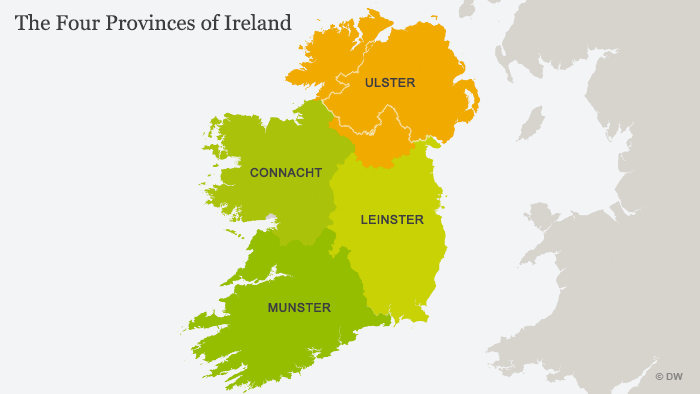
Incidentally, and I now digress, here is a map showing the Four Provinces of Ireland, together with the current border:

These are historical divisions and nowadays have no political or administrative role, but I think the map is interesting because it shows, if you didn’t know it before, that: (a) the current Irish border does not coincide with the boundary of Ulster; and (b) the most northerly point of the island of Ireland (Malin Head  on the Inishowen Peninsula, in County Donegal)  is in the Irish Republic, not in Northern Ireland. Maynooth, incidentally, is in Leinster.

Anyway, I think the current stalemate over the Irish Border is the inevitable outcome of one of Theresa May’s `red lines’ which seem to me to make a negotiated settlement impossible a priori. The only option for the Prime Minister seems to me to be to frame the problem another way. One way of making progress would be to abandon the red line on SM and CU membership. I don’t think that will happen as it would look too much like an admission of failure. Another way to do it would be to use gentle persuasion to get the DUP to shift its position. That is more likely, but will prove costly in both political and financial terms.  The best way to unask this particular question is, of course, to abandon the Brexit project altogether. I’m not going to quote odds, but the possibility of the United Kingdom remaining in the European Union is increasing by the day. That won’t affect me directly very much, as I’ll be remaining in the EU come what may.

WMAP wins the 2018 Breakthrough Prize for Fundamental Physics

Posted in The Universe and Stuff with tags , , , , on December 4, 2017 by telescoper

It’s very nice on a gloomy Monday morning to be able to share some exciting news and to congratulate so many friends and colleagues, for last night the 2018 Breakthrough Prize for Fundamental Physics was awarded to the team who worked on the Wilkinson Microwave Anisotropy Probe (WMAP). The citation reads:

For detailed maps of the early universe that greatly improved our knowledge of the evolution of the cosmos and the fluctuations that seeded the formation of galaxies.

The award, which is for the sizeable sum of $3 Million, will be shared among the 27 members of the WMAP team whose names I list here in full (team leaders are in italics):

Chris Barnes; Rachel Bean; Charles Bennett; Olivier Doré; Joanna Dunkley,;Benjamin M. Gold; Michael Greason; Mark Halpern; Robert Hill, Gary F. Hinshaw, Norman Jarosik, Alan Kogut, Eiichiro Komatsu, David Larson, Michele Limon, Stephan S. Meyer, Michael R. Nolta, Nils Odegard, Lyman Page, Hiranya V. Peiris, Kendrick Smith, David N. Spergel, Greg S. Tucker, Licia Verde, Janet L. Weiland, Edward Wollack, and Edward L. (Ned) Wright.

I know quite a few of these people personally, including Hiranya, Licia, Eiichiro, Joanna, Olivier and Ned, so it’s a special pleasure to congratulate them – and the other members of the team – on this well-deserved award.

Don’t spend all the money in the same shop!


Reading Matter

Posted in History with tags , on December 3, 2017 by telescoper

This is the book I brought with me to read while I stay here in St Patrick’s College, a Roman Catholic seminary…

The Moon and the Yew Tree

Posted in Poetry with tags , on December 3, 2017 by telescoper

This is the light of the mind, cold and planetary.
The trees of the mind are black. The light is blue.
The grasses unload their griefs at my feet as if I were God,
Prickling my ankles and murmuring of their humility.
Fumy spiritous mists inhabit this place
Separated from my house by a row of headstones.
I simply cannot see where there is to get to.

The moon is no door. It is a face in its own right,
White as a knuckle and terribly upset.
It drags the sea after it like a dark crime; it is quiet
With the O-gape of complete despair. I live here.
Twice on Sunday, the bells startle the sky –
Eight great tongues affirming the Resurrection.
At the end, they soberly bong out their names.

The yew tree points up. It has a Gothic shape.
The eyes lift after it and find the moon.
The moon is my mother. She is not sweet like Mary.
Her blue garments unloose small bats and owls.
How I would like to believe in tenderness –
The face of the effigy, gentled by candles,
Bending, on me in particular, its mild eyes.

I have fallen a long way. Clouds are flowering
Blue and mystical over the face of the stars.
Inside the church, the saints will be all blue,
Floating on their delicate feet over cold pews,
Their hands and faces stiff with holiness.
The moon sees nothing of this. She is bald and wild.
And the message of the yew tree is blackness – blackness and silence.

by Sylvia Plath (1932-1963)

Historical References

Posted in Biographical, History, Maynooth with tags , , , , , , , on December 2, 2017 by telescoper

This morning, having a few hours free after breakfast before some househunting activities, I took a stroll to buy a newspaper and decided to take a few snaps.

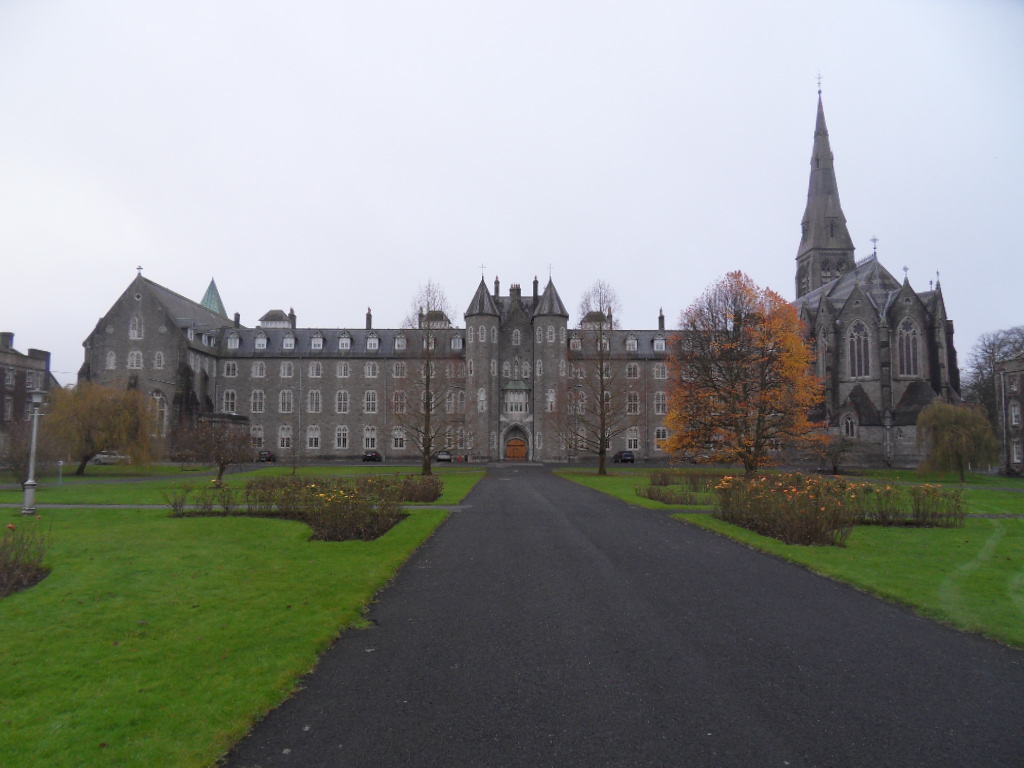
First, here are a couple of pictures of St Patrick’s College, where I am staying. My room is on the top floor, to the left in the wing that juts forward from the main building. The chapel (with the spire) is on the other side.

The building I’m in forms the most impressive side of a quadrangle, one other part of which you can see in the second photograph.

St Patrick’s College was founded in 1795, and its style could best be described as Gothic Revival. It was in fact built as a theological college with funds supplied by King George III. There was a political reason for his largesse. Roman Catholicism was brutally suppressed in Ireland during and after the Eleven Years War in the mid-17th Century, culminating in the vicious subjugation of Ireland by Oliver Cromwell. In effect, the Catholic Church in Ireland was outlawed. Starting from about 1766 some of the restrictions on Catholics began to be removed, but there were no institutions in Ireland capable of training priests so all of those wishing to join the priesthood had to study abroad, primarily in France. George was worried that this would lead to an influx of priests whose heads were filled with revolutionary ideas from the continent, so he decided to fund a place where they could be taught in Ireland, where at least there could be some control over their education.

The old theological college of St Patrick (the `Pontifical University’) forms the core of what is now the South Campus of Maynooth University. Some of the old buildings here seem to take their names from the components of the old Liberal Arts degree: there is a Music House, Logic House, Rhetoric House and so on.

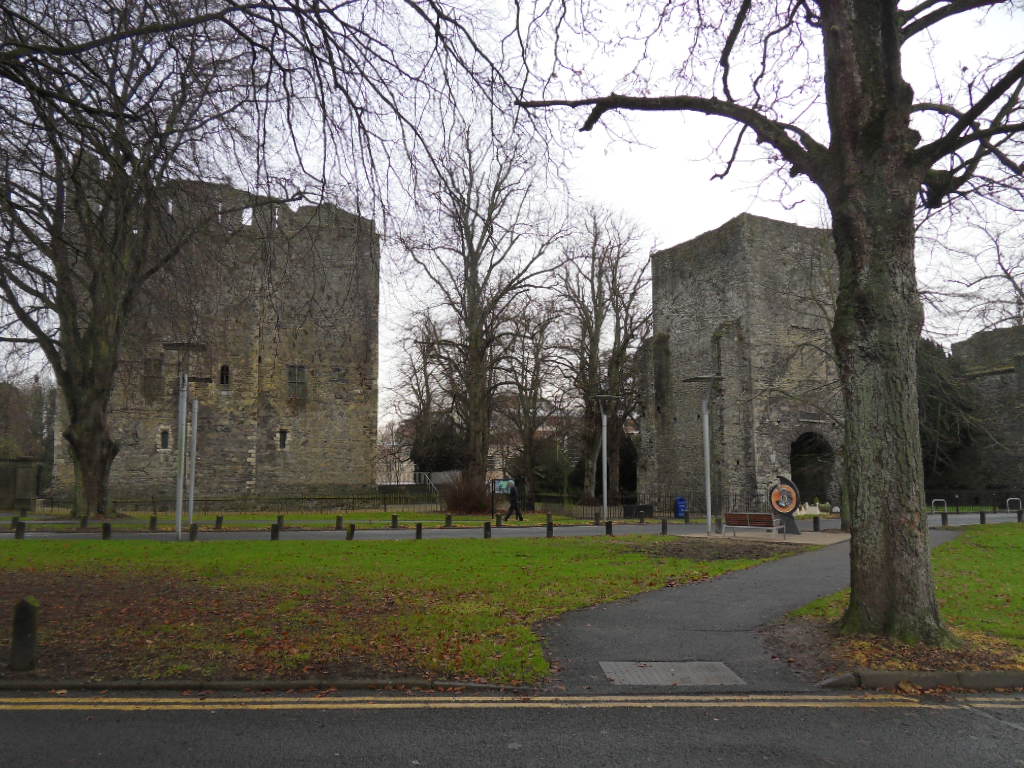
Next the entrance to the South Campus you can see this:

These are the remains of Maynooth Castle (or Geraldine Castle, after the Fitzgerald family), built around 1200. It was a huge and imposing fortress but now only the gatehouse and solar tower remain. It has violent history: heavily damaged in 1535 by siege cannons, its garrison surrendered only to be summarily executed. Rebuilt in the 1630s, it was destroyed completely in the 1640s during – you guessed it – the Eleven Years War. It has been a ruin ever since, but provides an intriguing entrance to the campus!

I’m by no means an architectural expert but I had a hunch that the Church (above) that stands opposite the Castle on the other side of the road leading into campus might also be quite old. Indeed it is. It was built in 1248 as the chapel to Geraldine Castle. It is now an Anglican Church, still used for regular worship.

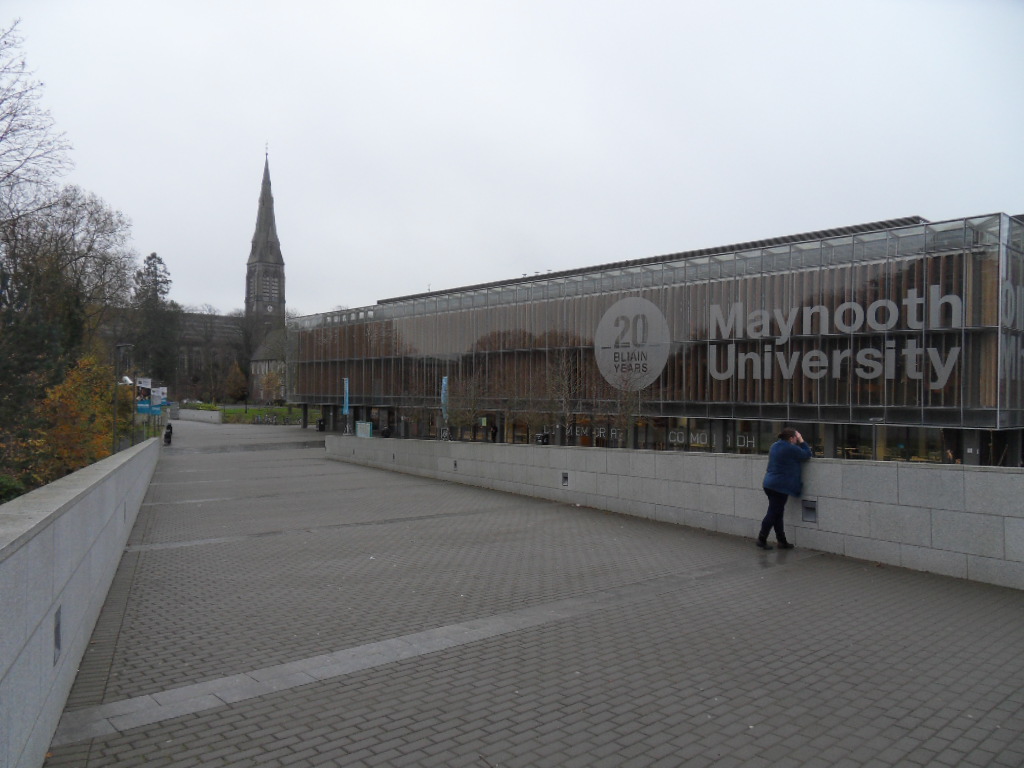
The South Campus is separated from the North Campus (where the Science Building and other modern facilities are) by a main road. The North Campus is very new, most of the buildings are less than 20 years old. Here’s a picture showing the splendid library, with the spire of the chapel of St Patrick’s College in the background.  This is one of the few newer buildings on the South Campus: the pedestrian path you see leads to the main road that splits North and South Campuses.


A Message from Maynooth

Posted in Biographical with tags , , on December 1, 2017 by telescoper

Today I started a new job, as Professor of Theoretical Physics in the Department of Theoretical Physics at Maynooth University, in County Kildare in the Irish Republic.

I haven’t resigned my job at Cardiff University. I’m currently employed there only half the time – or at least that’s what my contract says! – and I’m joining Maynooth on a 50% basis also so I can do one job alongside the other. In particularly I will be teaching in Cardiff next semester as planned.

Although I will be sharing my time equally between Wales and Ireland for the immediate future, I do intend to relocate fully to Ireland, as and when this becomes practicable and can be done in such a way as to not have any impact on ongoing activities in Cardiff.

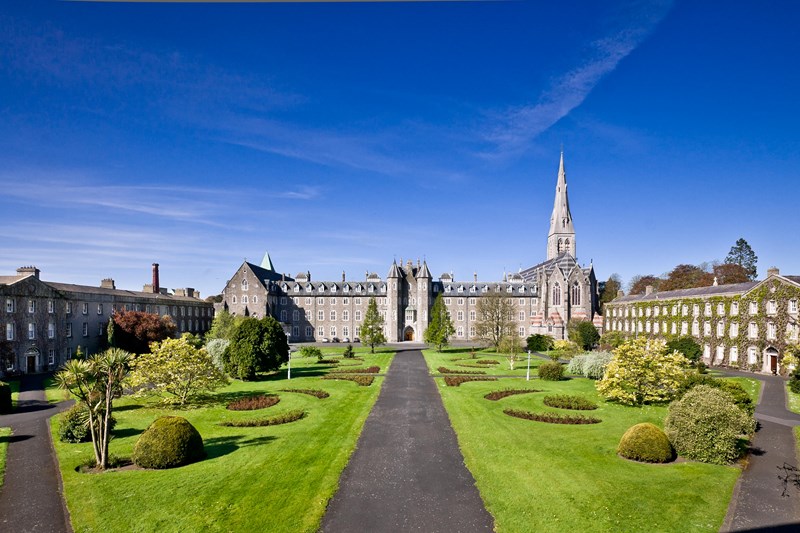
I’ll post more about Maynooth in due course, but today is filled with organisational things: getting on the IT system, arranging tax and related matters, and finding somewhere to live. In the meantime I’m staying in St Patrick’s House, part of the Catholic seminary on Maynooth University’s South Campus. It’s a lovely building, with rooms that are basic but clean, comfortable and very inexpensive. It was too dark when I arrived last night to take a picture of the place but here’s one from the net:

It’s not quite as summery at the moment, either. It was very cold when I arrived last night and that has continued into today. I will take a snap at some point, but there was a rather ugly-looking crane at the front of the building and would prefer to take a picture when it has gone!

I’ve never been in a seminary before. Although everyone I’ve met here has been wonderfully nice and friendly, I have to say the corridors have more than a hint of The Shining about them:

Anyway, that’s all for now. I hope to have some time at the weekend to have a look around Dublin, which is only 30 minutes or so away by train from Maynooth, and where I may end up living in the not-too-distant future!