Archive for 2017

LIGO and Open Science

Posted in Open Access, Science Politics, The Universe and Stuff with tags , , , , on August 8, 2017 by telescoper

I’ve just come from another meeting here at the Niels Bohr Institute between some members of the LIGO Scientific Collaboration and the authors of the `Danish Paper‘. As with the other one I attended last week it was both interesting and informative. I’m not going to divulge any of the details of the discussion, but I anticipate further developments that will put some of them into the public domain fairly soon and will comment on them as and when that happens.

I think an important aspect of the way science works is that when a given individual or group publishes a result, it should be possible for others to reproduce it (or not as the case may be). In normal-sized laboratory physics it suffices to explain the experimental set-up in the published paper in sufficient detail for another individual or group to build an equivalent replica experiment if they want to check the results. In `Big Science’, e.g. with LIGO or the Large Hadron Collider, it is not practically possible for other groups to build their own copy, so the best that can be done is to release the data coming from the experiment. A basic problem with reproducibility obviously arises when this does not happen.

In astrophysics and cosmology, results in scientific papers are often based on very complicated analyses of large data sets. This is also the case for gravitational wave experiments. Fortunately in astrophysics these days researchers are generally pretty good at sharing their data, but there are a few exceptions in that field. Particle physicists, by contrast, generally treat all their data as proprietary.

Even allowing open access to data doesn’t always solve the reproducibility problem. Often extensive numerical codes are needed to process the measurements and extract meaningful output. Without access to these pipeline codes it is impossible for a third party to check the path from input to output without writing their own version, assuming that there is sufficient information to do that in the first place. That researchers should publish their software as well as their results is quite a controversial suggestion, but I think it’s the best practice for science. In any case there are often intermediate stages between `raw’ data and scientific results, as well as ancillary data products of various kinds. I think these should all be made public. Doing that could well entail a great deal of effort, but I think in the long run that it is worth it.

I’m not saying that scientific collaborations should not have a proprietary period, just that this period should end when a result is announced, and that any such announcement should be accompanied by a release of the data products and software needed to subject the analysis to independent verification.

Now, if you are interested in trying to reproduce the analysis of data from the first detection of gravitational waves by LIGO, you can go here, where you can not only download the data but also find a helpful tutorial on how to analyse it.

This seems at first sight to be fully in the spirit of open science, but if you visit that page you will find this disclaimer:


In other words, one can’t check the LIGO data analysis because not all the data and tools necessary to do that are not publicly available.  I know for a fact that this is the case because of the meetings going on here at NBI!

Given that the detection of gravitational waves is one of the most important breakthroughs ever made in physics, I think this is a matter of considerable regret. I also find it difficult to understand the reasoning that led the LIGO consortium to think it was a good plan only to go part of the way towards open science, by releasing only part of the information needed to reproduce the processing of the LIGO signals and their subsequent statistical analysis. There may be good reasons that I know nothing about, but at the moment it seems to me to me to represent a wasted opportunity.

I know I’m an extremist when it comes to open science, and there are probably many who disagree with me, so I thought I’d do a mini-poll on this issue:

Any other comments welcome through the box below!

Rhino on the Road

Posted in Uncategorized with tags , , on August 7, 2017 by telescoper

And now for something completely different. I’m not sure what the Highway Code recommends a driver to do if confronted by an angry rhinoceros in the road, but the traffic ahead of this beast did the sensible thing of turning round and getting the hell out of there!

This was recorded in Assam, India, and the rhinoceros apparently escaped from Kaziranga National Park.

Crossed Words

Posted in Crosswords with tags , , on August 6, 2017 by telescoper

I’m abroad at the moment so failed to take my regular Sunday morning stroll to the local newsagent to pick up a copy of the Observer. I had to rely on Twitter, therefore, to tell me that I’ve won another prize in the Everyman competition.

It looks like I’ll be distributing some more dictionaries when I get back to Cardiff! Unfortunately, though, the books will probably arrive before I return so I’ll have to traipse off to the sorting office to collection them…

Incidentally, in the last Azed competition (No. 2351) I got a `Highly Commended’ for my clue for the (somewhat obscure) target word RHAGADES:

Root has a northern-style slash at ones not on cracks (8)

As usual, though, the winning clues were far better than mine! I won’t have time to do the latest competition puzzle, which is a shame because it involves a Playfair codeword, like the one I blogged about here.

P.S. The rubric for the latest Azed puzzle refers to `four clues in italics’ but I don’t see any clues in italics (at least in the online version)…

Mapping the Universe

Posted in The Universe and Stuff with tags , , on August 5, 2017 by telescoper

Following yesterday’s post, here’s a nice visualisation of how much (and indeed how little) of the Universe the latest galaxy surveys have mapped.

In this animation the Earth is at the centre, and the dots represent observed galaxies, with distances are estimated using redshifts Every blue dot in the animation is a galaxy measured by the Dark Energy Survey. Gold dots are galaxies in the DES supernova fields (measured by OzDES) and red dots are from the Sloan Digital Sky Survey. The dark space in between the surveys is yet to be mapped….

Cosmological Results from the Dark Energy Survey

Posted in The Universe and Stuff with tags , , , , , on August 4, 2017 by telescoper

At last the Dark Energy Survey has produced its first cosmological results. The actual papers have not yet hit the arXiv but they have been announced at a meeting in the USA and are linked to from this page.

I’ll jump straight to this one, which shows the joint constraints on S8 which is related to σ8 (a measure of the level of fluctuations in the cosmological mass distribution) via S8= σ8m/0.3)0.5 against the cosmological density parameter, Ωm.

These constraints, derived using DES Y1 measurements of galaxy clustering, galaxy-galaxy lensing, and weak lensing cosmic shear are compared with those obtained from the cosmic microwave background using Planck data, and also combined with them to produce a joint constraint. Following usual practice, the contours are 68% and 95%  posterior probability regions.

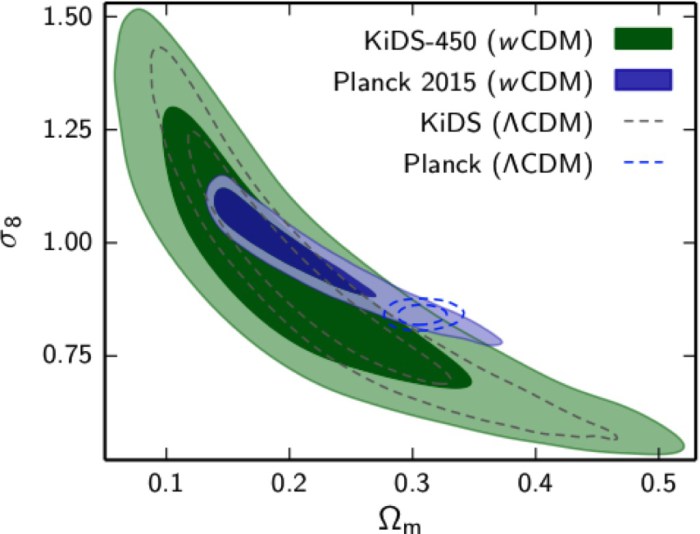
The central values of DES and Planck values are different, but the discrepancy is only marginal. Compare this with a an equivalent diagram from a paper I discussed last year.

The KIDS analysis used to produce this plot uses only weak lensing tomography, so you can see that using additional measures reduces the viable region in this parameter space.

It’s great to see new data coming in, but at first sight it seems it is tending to confirm the predictions of the standard cosmological model, rather than providing evidence of departures from it.

Incidentally, this little video shows the extent to which the Dark Energy Survey is a global project, including some of my former colleagues at the University of Sussex!


Things Falling

Posted in Finance, Politics with tags , , , , , , on August 3, 2017 by telescoper

A very busy but also very interesting day at the office in the Niels Bohr Institute ended this evening with a thunderstorm, complete with spectacular lightning and torrential rain. I got wet on the walk back to my small home, but I managed to get inside before the worst of it started. I seem to remember a similar thing happened last time I was in Copenhagen. Maybe it’s the time of year.

Anyway, torrential rain isn’t the only thing that’s been falling today. The Pound dropped sharply against the Euro, so it is currently around €1.1069, not far from its lowest point in the last year. That’s not directly relevant to my visit to Denmark, which isn’t in the Eurozone, but the Pound has tumbled against the Danish Kroner too. In fact it’s been falling steadily over the past three months:

At 8.234 Kroner to the Pound, this the worst exchange rate I can remember in all the approximately 30 years I’ve been travelling to Copennhagen. The rate has usually been about 10:1 or even higher. Copenhagen has always seemed a rather expensive place, but converting prices into Pounds at the current exchange rate makes your eyes water. Fortunately I’m getting my local expenses paid by the NBI so the increased cost won’t really affect me, but it’s definitely noticeable. Such is the shambolic state of our government that I wouldn’t bet against the pound reaching parity with the Euro before too long.

Of course one is not allowed to suggest that the falling pound and sluggish economic growth might be something to do with BrExit because that would be `talking the country down’. The worrying thing, though, is that we haven’t left the European Union yet. Just wait until March 2019 when we leave the European Union, together with the Single Market and Customs Union without any trade agreement. Where will the pound be then, I wonder?

Christian Ott’s Resignation

Posted in Harassment Bullying etc with tags , , , on August 2, 2017 by telescoper

I heard this morning an unconfirmed report that Christian Ott, the Caltech Professor who had previously been suspended for harassing two female students, and required to attend “rehabilitation”, had finally resigned from his position. Now I have found confirmation in the form of a news item and the following statement (from this source):

Ott

Ott was due to return from his suspension this summer, but instead he will remain off campus and leave the institution for good at the end of December this year.

When I posted about this episode last year, I wrote:

The first thing to say is that I find it very hard to believe that Ott will ever be able to return to his workplace after the revelations of his behaviour even if he does attend “rehabilitative training”. I very much doubt that the faculty or students would want him back. It surprises me that Caltech could even imagine that this is a realistic possibility.

It was never going to work, for all kinds of reasons, and Caltech should have realised that ages ago. I don’t, incidentally, think it’s fair to say his presence on campus would have been `divisive’. I think opinions at Caltech were pretty much united, based on the people I know there: they didn’t want him back.

It remains to be seen what Christian Ott does. I am not familiar with his work but he is, by all accounts, a talented scientist so he may well find a position at another institution. If he does, I hope, for his and for his future colleagues’ sake, that he has learned his lesson.

But it is not Christian Ott’s future that is the most important consideration. The two individuals involved in the case have had to put up with behaviour that simply shouldn’t have happened, and which should have been dealt with much more decisively before so much damage was done to the lives and careers of the young women involved.

This is a depressing story in many ways, but it seems clear to me likely that the Caltech management were afraid to dismiss Ott fearing a lawsuit and associated reputational damage. Unlike the equivalent posts in the UK, positions like Ott’s are fully tenured in the USA so a dismissal can potentially be challenged on a number of legal grounds, especially if such procedures that were in place were not properly followed. Of course it may also be that the procedures were inadequate anyway, which makes litigation even more likely to be successful. If these were the considerations that influenced Caltech’s decision, then I hope they now realise that they would in the long run have been far better advised to do the right thing, and weather any short-term storm.

The only proper reaction now for Caltech to this sorry business is to undertake a complete overhaul of the way it deals with harassment and related forms of misconduct. If done properly that might also help heal the scars this case has left. Not that Caltech is far from being the only institution with a problem in this regard…

What the Power Spectrum misses

Posted in The Universe and Stuff with tags , , , , , , , on August 2, 2017 by telescoper

Just taking a short break from work I chatted over coffee to one of the students here at the Niels Bohr Institute about various things to do with the analysis of signals in the Fourier domain (as you do). That discussion reminded me of this rather old post (from 2009) which I thought might be worth a second airing (after a bit of editing). The discussion is all based on past cosmological data (from WMAP) rather than the most recent (from Planck), but that doesn’t change anything qualitatively. So here you are.
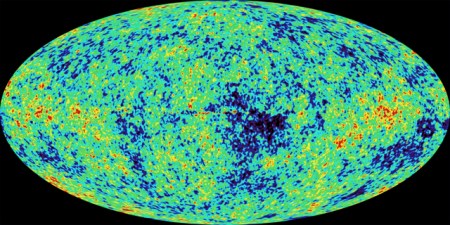
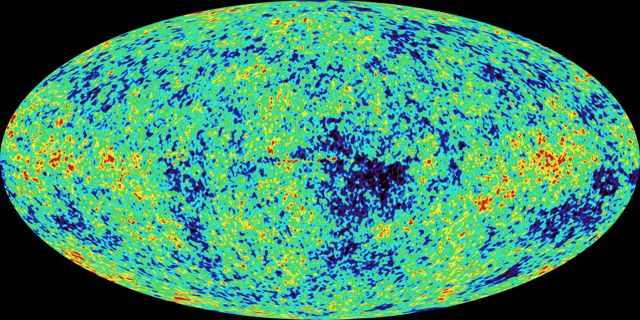
WMapThe picture above shows the all-sky map of fluctuations in the temperature of the cosmic microwave background across the sky as revealed by the Wilkinson Microwave Anisotropy Probe, known to its friends as WMAP.

I spent many long hours fiddling with the data coming from the WMAP experiment, partly because I’ve never quite got over the fact that such wonderful data actually exists. When I started my doctorate in 1985 the whole field of CMB analysis was so much pie in the sky, as no experiments had yet been performed with the sensitivity to reveal the structures we now see. This is because they are very faint and easily buried in noise. The fluctuations in temperature from pixel to pixel across the sky are of order one part in a hundred thousand of the mean temperature (i.e. about 30 microKelvin on a background temperature of about 3 Kelvin). That’s smoother than the surface of a billiard ball. That’s why it took such a long time to make the map shown above, and why it is such a triumphant piece of science.

I blogged a while ago about the idea that the structure we see in this map was produced by sound waves reverberating around the early Universe. The techniques cosmologists use to analyse this sound are similar to those used in branches of acoustics except that we only see things in projection on the celestial sphere which requires a bit of special consideration.

One of the things that sticks in my brain from my undergraduate years is being told that `if you don’t know what you’re doing as a physicist you should start by making a Fourier transform of everything. This approach breaks down the phenomenon being studied into a set of  plane waves with different wavelengths corresponding to analysing the different tones present in a complicated sound.

It’s often very good advice to do such a decomposition for one-dimensional time series or fluctuation fields in three-dimensional Cartesian space, even you do know what you’re doing, but it doesn’t work with a sphere because plane waves don’t fit properly on a curved surface. Fortunately, however, there is a tried-and-tested alternative involving spherical harmonics rather than plane waves.

Spherical harmonics are quite complicated beasts mathematically but they have pretty similar properties to Fourier harmonics in many respects. In particular they are represented as complex numbers having real and imaginary parts or, equivalently, an amplitude and a phase (usually called the argument by mathematicians),

Z=X+iY = R \exp(i\phi)

This latter representation is the most useful one for CMB fluctuations because the simplest versions of inflationary theory predict that the phases φ of each of the spherical harmonic modes should be randomly distributed. What this really means is that there is no information content in their distribution so that the harmonic modes are in a state of maximum statistical disorder or entropy. This property also guarantees that the distribution of fluctuations over the sky should have a Gaussian distribution.

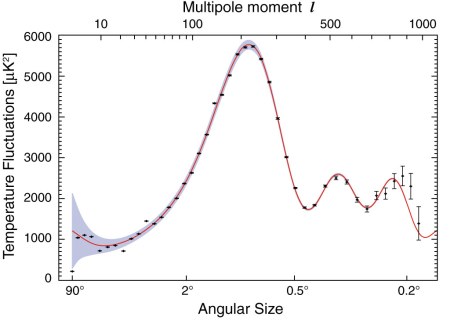
If you accept that the fluctuations are Gaussian then only the amplitudes of the spherical harmonic coefficients are useful. Indeed, their statistical properties can be specified entirely by the variance of these amplitudes as a function of mode frequency. This pre-eminently important function is called the power-spectrum of the fluctuations, and it is shown here for the WMAP data:
080999_powerspectrumm

Although the units on the axes are a bit strange it doesn”t require too much imagination to interpret this in terms of a sound spectrum. There is a characteristic tone (at the position of the big peak) plus a couple of overtones (the bumps at higher frequencies). However these features are not sharp so the overall sound is not at all musical.

If the Gaussian assumption is correct then the power-spectrum contains all the useful statistical information to be gleaned from the CMB sky, which is why so much emphasis has been placed on extracting it accurately from the data.

Conversely, though, the power spectrum is completely insensitive to any information in the distribution of spherical harmonic phases. If something beyond the standard model made the Universe non-Gaussian it would affect the phases of the harmonic modes in a way that would make them non-random.

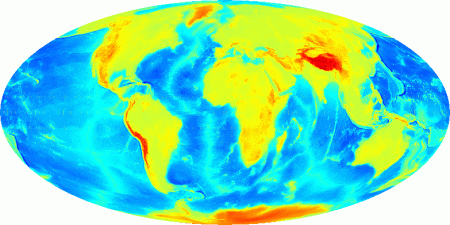
However,I will now show you how important phase information could actually be, if only we could find a good way of exploiting it. Let’s start with a map of the Earth, with the colour representing height of the surface above mean sea level:
sw_world

You can see the major mountain ranges (Andes, Himalayas) quite clearly as red in this picture and note how high Antarctica is…that’s one of the reasons so much astronomy is done there.

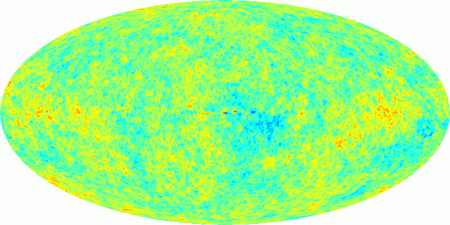
Now, using the same colour scale we have the WMAP data again (in Galactic coordinates).
sw_ilc

The virture of this representation of the map is that it shows how smooth the microwave sky is compared to the surface of the Earth. Note also that you can see a bit of crud in the plane of the Milky Way that serves as a reminder of the difficulty of cleaning the foregrounds out.

Clearly these two maps have completely different power spectra. The Earth is dominated by large features made from long-wavelength modes whereas the CMB sky has relatively more small-scale fuzz.

Now I’m going to play with these maps in the following rather peculiar way. First, I make a spherical harmonic transform of each of them. This gives me two sets of complex numbers, one for the Earth and one for WMAP. Following the usual fashion, I think of these as two sets of amplitudes and two sets of phases. Note that the spherical harmonic transformation preserves all the information in the sky maps, it’s just a different representation.

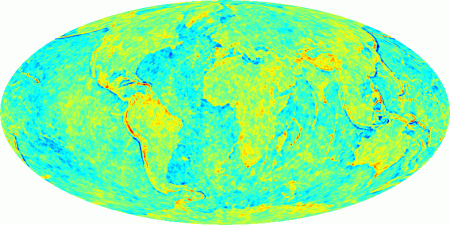
Now what I do is swap the amplitudes and phases for the two maps. First, I take the amplitudes of WMAP and put them with the phases for the Earth. That gives me the spherical harmonic representation of a new data set which I can reveal by doing an inverse spherical transform:
sw_worldphases

This map has exactly the same amplitudes for each mode as the WMAP data and therefore possesses an identical power spectrum to that shown above. Clearly, though, this particular CMB sky is not compatible with the standard cosmological model! Notice that all the strongly localised features such as coastlines appear by virtue of information contained in the phases but absent from the power-spectrum.

To understand this think how sharp features appear in a Fourier transform. A sharp spike at a specific location actually produces a broad spectrum of Fourier modes with different frequencies. These modes have to add in coherently at the location of the spike and cancel out everywhere else, so their phases are strongly correlated. A sea of white noise also has a flat power spectrum but has random phases. The key difference between these two configurations is not revealed by their spectra but by their phases.

Fortunately there is nothing quite as wacky as a picture of the Earth in the real data, but it makes the point that there are more things in Heaven and Earth than can be described in terms of the power spectrum!

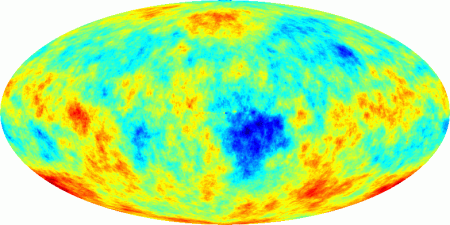
Finally, perhaps in your mind’s eye you might consider what it might look lie to do the reverse experiment: recombine the phases of WMAP with the amplitudes of the Earth.
sw_ilcphases

If the WMAP data are actually Gaussian, then this map is a sort of random-phase realisation of the Earth’s power spectrum. Alternatively you can see that it is the result of running a kind of weird low-pass filter over the WMAP fluctuations. The only striking things it reveals are (i) a big blue hole associated with foreground contamination, (ii) a suspicious excess of red in the galactic plane owing to the same problem, and (iiI) a strong North-South asymmetry arising from the presence of Antarctica.

There’s no great scientific result here, just a proof that spherical harmonic phases are potentially interesting because of the information they contain about strongly localised features

PS. These pictures were made by a former PhD student of mine, Patrick Dineen, who has since quit astrophysics  to work in the financial sector for Winton Capital, which has over the years recruited a number of astronomy and cosmology graduates and also sponsors a Royal Astronomical Society prize. That shows that the skills and knowledge obtained in the seemingly obscure field of cosmological data analysis have applications elsewhere!


Copenhagen Again

Posted in Biographical, The Universe and Stuff with tags , , on August 1, 2017 by telescoper

As you might have inferred from my earlier post, I’m back again in the wonderful city of Copenhagen, as a guest of the Niels Bohr Institute. I’ve been here almost every year since my first visit here way back in the 1980s. I didn’t come here last summer, as I was too busy finishing off my duties at Sussex and relocating back to Cardiff so it’s nice to be back again now. I’m staying in one of the `9 small homes‘ that comprise a hotel near the NBI. I’ve stayed here before though not in my current small home, which is actually a self-contained apartment on the ground floor with its own front door. It’s also got a small kitchen so I can cook for myself when I don’t feel like eating out (like tonight). Incidentally, `hjem’ (the Danish word for `home’) is pronounced exactly as `home’ is pronounced in Geordie (i.e. as `hyem’). I did some shopping earlier this evening and attempted to speak Danish when I paid for my groceries. As always, however, I got a reply in English.

I realised only this morning that it’s a year since I left my previous job. I haven’t done half the things I had hoped to do in the year after stepping down as Head of School, but that’s partly because it took quite a while to get over certain health problems and also because quite a few things have come up that I didn’t anticipate. From what I’m told the old place is doing just fine without me!

Coincidently (?), I have arrived here at the Niels Bohr Institute at precisely the time that there is a delegation here from LIGO and there’s been a lot of serious – but good-natured – discussion of `The Danish Paper‘ that came out some time ago and which questioned some aspects of the data analysis of the first detection of gravitational waves. I think there are still quite a few issues to be resolved between the two groups. Although they do seem to be converging on what’s going on, I don’t think this controversy will be fully concluded until more data are made public, as the currently available time series are not exactly those used in the actual LIGO analysis.

I think this discussion can only be of benefit to the science community in the long run, especially if it encourages LIGO to get more fully into the spirit of open science, by releasing more data for use of researchers outside the consortium.

August, a poem by Viggo Stuckenberg

Posted in Poetry with tags , , , on August 1, 2017 by telescoper

Hr. Preben pusler i Skovens Bryn,
fæster Doner, binder Bær, Bær saa rosenrøde,
bryder et Blad og bøjer en Kvist,
at liflig de Bær kunne gløde.

‘Kramsfugl! Kramsfugl! nu er det Tid!
Falder Havren, synger Segl over alle Agre,
bliver ej større en eneste Blomst,
ej Lundene mere fagre!

Gunild! Gunild! nu gulnes goldt
alle Løfter, al Lokken, al Leg fra Skærsommer!
Viger den Haand, som ikke jeg greb,
og aldrig vi sammen kommer!

Thi længst er leden den lyse Vaar,
levnet Nætter i Mulm, levnet flygtende Fugle!
Den, som ved det, maa sidde kvær
og skogre som gammel Ugle!’

Hr. Preben pusler i Skovens Bryn,
fæster Doner, binder Bær, Bær saa lifligt røde:
‘Kramsfugl! Dig sender jeg hende kvalt
og ler stor Elskov til Døde!’

by Viggo Stuckenberg (1863-1905)