Archive for 2017

 A Time of Death

Posted in Uncategorized on April 11, 2017 by telescoper

This image, courtesy of the Cardiff University Library, is of a pocket watch that belonged to the poet Edward Thomas.

It stopped at 24 minutes to eight on the morning of 9th April 1917, the precise moment when an artillery shell exploded, killing its owner. This happened in the first few hours of the Battle of Arras in the Pas-de-Calais area of Northern France.

In detective stories the stopped watch is a clumsy cliché often used to indicate the victim’s time of death, but in this case I find the image intensely powerful.

Despite heavy casualties the battle in which Edward Thomas fell went well at first for the British and Commonwealth Armies who made substantial territorial gains in the opening stages. Soon, however, the defending Germans regrouped and another bloody stalemate ensued that dragged on for another month, leaving about 300,000 casualties on both sides.

R.I.P. Gary Steigman 

Posted in Uncategorized on April 10, 2017 by telescoper


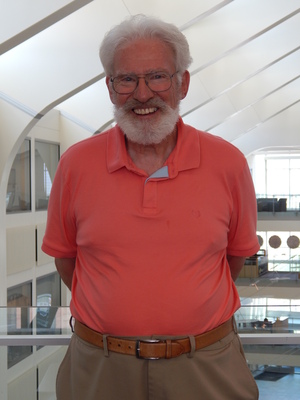
I was saddened today to hear from friends and colleagues of the death of Professor Gary Steigman (above).

Gary was a leading figure in the theory of cosmological nucleosynthesis, ie the formation of light elements by nuclear fusion reactions in the Big Bang. As well as being an eminent scientist he was also a warm, generous and extremely likeable human being. Our paths crossed only a few times, the last time being some years ago, but I remember him very well for his kindly and courteous manner. He’ll be greatly missed by a great many people.

Rest in peace, Gary Steigman.

An Image for Our Time

Posted in Uncategorized on April 9, 2017 by telescoper

This photograph has gone viral today, and I couldn’t resist sharing it here.

It was taken during a march by the fascist English Defence League in Birmingham yesterday. The young lady on the left is Saffiyah Khan, who was not part of the organised counter-demonstration but stepped forward when a group of EDL thugs surrounded another woman who was. The man on the right  threatened her with his fists and a policeman intervened in an attempt to defuse the situation.

 Ms Khan kept her hands in her pockets all the time, her smile conveying a sense of amused contempt that is truly an image for our times.

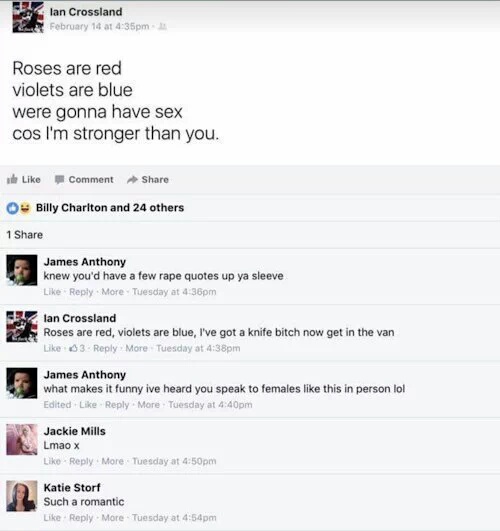
The man at the right in the picture is Ian Crossland, a leading figure in the EDL. He later wrote on Facebook that Ms Khan was “lucky she got any teeth left”.

By the way, here’s an excerpt from Mr Crossland’s Facebook page:


Saffiyah Khan is half Pakistani and half Bosnian, but I’d far rather live in a Britain made in her image than in his.

PhD Opportunities in Data-intensive Physics and Astrophysics!

Posted in Uncategorized on April 8, 2017 by telescoper

Well, I’m now officially on holiday for two weeks and probably won’t be blogging much during this break, especially about work-related things, but I couldn’t resist a quick announcement of something very exciting.

We received confirmation last week that the Science and Technology Facilities Council (STFC for short) to set up a Centre for Doctoral Training (CDT for short) involving the Universities of Cardiff, Bristol and Swansea. This will be coordinated by the Data Innovation Institute at Cardiff University and it covers  a wide range of data-intensive research in astrophysics and cosmology carried on at the three member institutions. ‘Data-intensive’ here means involving very big data sets, very sophisticated analysis methods or high-performance computing,  or any combination of these.

The Centre for Doctoral Training will be coordinated by the Data Innovation Institute at Cardiff University. It will commence in September 2017 so we will be open for applications immediately, ie. next week.

For further information, please see the Data Innovation Institute webpage which will be updated as more details are available.

By the way, for  this special programme, STFC have relaxed the  rules relating to  nationality, so full funding is potentially available for  non-UK citizens under this scheme.

If you’re looking to do a PhD in data-intensive physics or astrophysics, get writing your application now and keep an eye on this page for further announcements.

To secure a PhD place at this STFC CDT administered by the DII you’d better apply PDQ! 

The Irish Question 

Posted in Biographical with tags , , on April 7, 2017 by telescoper

Not surprisingly, given the imminent likelihood of big cuts to UK Astronomy funding as a result of our withdrawal from the European Union, quite a lot of the conversation at this evening’s RAS Club dinner revolved around ways of keeping EU citizenship in the post-BrExit era.

Through a bit of independent investigation I discovered a few weeks ago that, at least in principle, I qualify for Irish citizenship. This is because one of my grandparents (my grandfather on my mother’s side) was born in Northern Ireland. That is sufficient for me to claim Irish nationality, if I can prove it.

The problem is that the grandfather concerned died quite a long  time ago, when I was a kid. In fact, all my grandparents are deceased. To make matters worse I don’t know exactly when he was born or where or when he married my grandmother. This is a problem because I need to produce both his birth certificate and their marriage certificate, along with my mother’s birth certificate (and mine) to establish my case.

It is almost certain my grandfather was born before Ireland was partitioned in 1921, so his birth records may not even be in Northern Ireland but could be held in Dublin.

It looks like I have some interesting research to be getting on with!

A Cheeky Monkey

Posted in Uncategorized on April 6, 2017 by telescoper

No time for a post today, I’m afraid, so here’s a photograph of a Spectacled Monkey.. 

Going NUTs

Posted in The Universe and Stuff, Uncategorized with tags , , , on April 5, 2017 by telescoper

If you’ve studied General Relativity the chances are that you’ve come across the Taub-NUT exact solution discussed in this post. It’s generally regarded as something of an oddity in that it’s a bit contrived, but provides a counter-example to some well-known results. For example, in the context of a Black Hole solution, it violates the No Hair Theorem (by violating the assumption of asymptotic flatness).

When I saw this post at CQG, however, I was reminded of a paper published a few years ago discussing this in a cosmological context, where it can be seen as a special case of the Bianchi IX geometry.

Jennifer Sanders's avatarCQG+

By Paul I. Jefremov and Volker Perlick.


Among all known solutions to Einstein’s vacuum field equation the (Taub-)NUT metric isa particularly intriguing one. It is that metric that owing to its counter-intuitive features was once called by Charles Misner “a counter-example to almost anything”. In what follows we give a brief introduction to the NUT black holes, discuss what makes them interesting for a researcher and speculate on how they could be detected should they exist in nature.

paul jefremov-and-volker Volker Perlick and Pavel (Paul) Ionovič Jefremov from the Gravitational Theory group at the University of Bremen in Germany. Volker is a Privatdozent and his research interests are in classical relativity, (standard and non-standard) electrodynamics and Finsler geometry. He is an amateur astronomer and plays the piano with great enthusiasm and poor skills. Paul got his diploma in Physics at the National Research Nuclear University MEPhI in Moscow, 2014. Now he…

View original post 901 more words

The Word, by R.S. Thomas

Posted in Poetry with tags , , , on April 5, 2017 by telescoper

A pen appeared, and the god said:
‘Write what it is to be
man.’ And my hand hovered
long over the bare page.

until there, like footprints
of the lost traveller, letters
took shape on the page’s
blankness, and I spelled out
the word ‘lonely’.

And my hand moved
to erase it; but the voices
of all those waiting at life’s
window cried out loud: ‘It is true.’

by R.S. Thomas (1913-2000)


Easter Fatigue 

Posted in Biographical, Education with tags , on April 4, 2017 by telescoper

This is Week 11, which is the last week of teaching here at Cardiff University before the Easter break. In the early hours of this morning I finished marking my last set of coursework for the term and later on delivered my last (2-hour) lecture on the Physics of the Early Universe.

I’ve booked two weeks of annual leave from Friday and am really looking forward to a bit of rest, though I will have quite a few private matters to deal with while I’m away from work.

Such is the topsy-turvy world we live in that I note that this month’s meeting of the Royal Astronomical Society is  on this Friday, 7th April. This is contrary to the settled order of Nature, as these meetings are always on the second Friday of the month. This year, however, the 2nd Friday of April is Good Friday. This, after all, is Eastertide, when Christians celebrate the invention of the chocolate egg by doing arms deals with despotic middle-eastern governments. 

I’m only joking. Of course. Chocolate eggs have nothing to do with the true message of Easter, which is depicted in the following.

Anyway, it’s the fact that Easter moves about in the calendar that is the reason this term has been so long and I am tired and grumpy. I don’t like chocolate either.

On the bright side I did receive two pieces of good news today in between the other stuff. I hope to be able to pass them on tomorrow, or at any rate before I go off on my hols…

The Bayesian Second Law of Thermodynamics

Posted in The Universe and Stuff with tags , , , on April 3, 2017 by telescoper

I post occasionally about Bayesian probability, particularly with respect to Bayesian inference, and related applications to physics and other things, such as thermodynamics, so in that light here’s a paper I stumbled across yesterday. It’s not a brand new paper – it came out on the ArXiv in 2015 – but it’s of sufficiently long-term interest to warrant sharing on here. Here’s the abstract:

You can download the full paper here. There’s also an accessible commentary by one of the authors here.

The interface between thermodynamics, statistical mechanics, information theory  and probability is a fascinating one, but too often important conceptual questions remain unanswered, or indeed unasked, while the field absorbs itself in detailed calculations. Refreshingly, this paper takes the opposite approach.