Archive for 2017

Wikipedia Update 

Posted in Biographical on March 18, 2017 by telescoper

In case you didn’t realise it, I have my very own Wikipedia page. I don’t know who set it up, or who edits it, but it does seem to get updated regularly. Fortunately these updates are reasonably sensible and generally accurate.

I recently noticed that it has been updated again:

I wouldn’t say it was “pathological”, but it is indeed the case that I don’t like harpsichords (or, to be more accurate, I don’t like the noise they produce).

One day I might edit the page myself, but other than being a cosmologist who hates harpsichords I’m not sure there’s enough else to me that’s worth putting there!

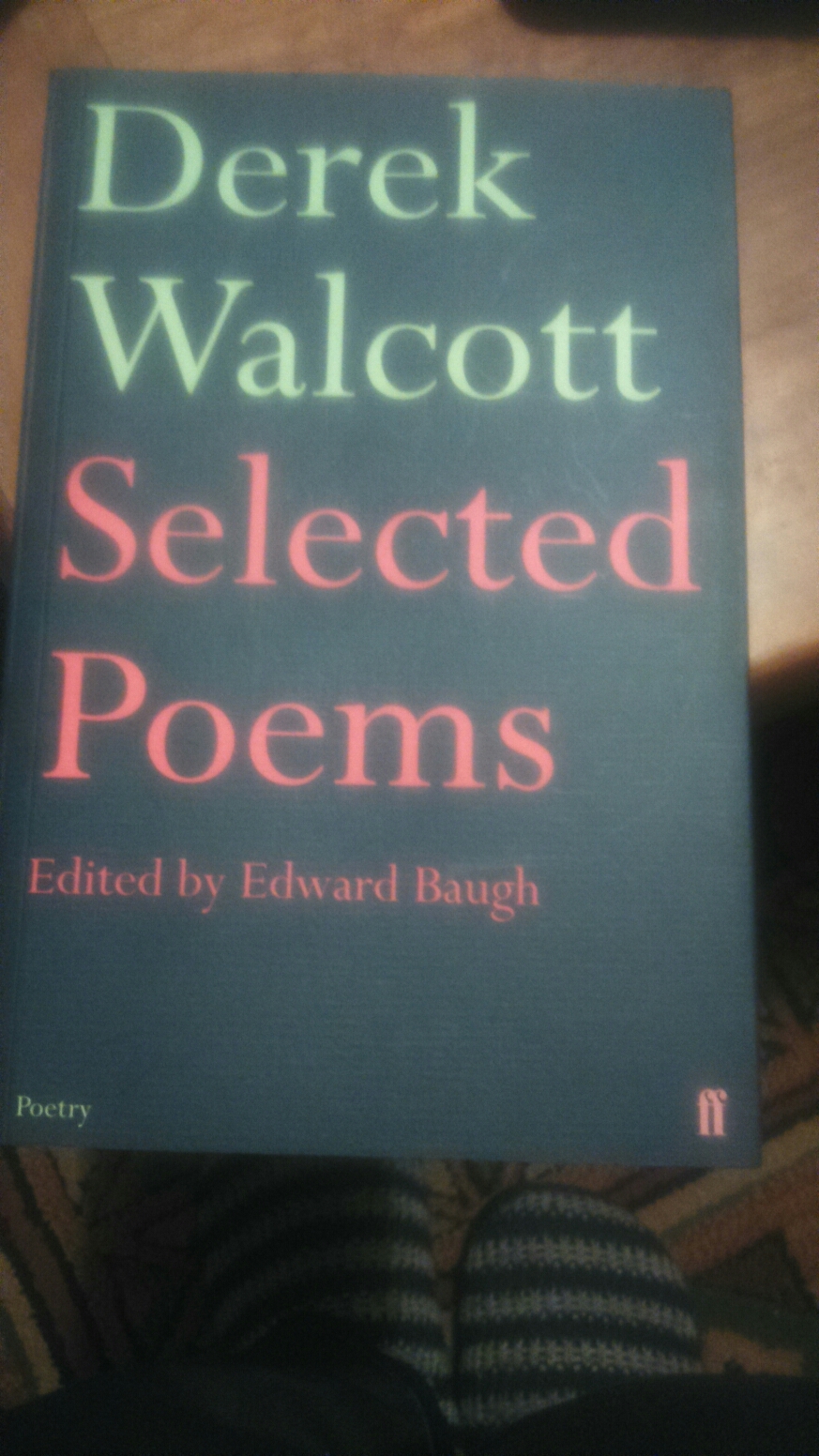
R.I.P. Derek Walcott 

Posted in Poetry on March 17, 2017 by telescoper

Out of the office all day, I heard quite late of the death at the age of 87 of the poet Derek Walcott.

Here’s one of his best-known poems, which will resonate with middle-aged men everywhere:

If you aren’t familiar with Derek Walcott, this collection is a good place to start:

A Quite Interesting Question: How Loud Was the Big Bang?

Posted in The Universe and Stuff with tags , , , , , , , on March 16, 2017 by telescoper

I just found out this morning that this blog got a mention on the QI Podcast. It’s taken a while for this news to reach me, as the item concerned is two years old! You can find this discussion here, about 16 minutes in. And no, it’s not in connection with yawning psychopaths. It was about the vexed question of how loud was the Big Bang?

I’ve posted on this before (here and here)but since I’m very busy again today I  should recycle the discussion, and update it as it relates to the cosmic microwave background, which is what one of the things I work on on the rare occasions on which I get to do anything interesting.

As you probably know the Big Bang theory involves the assumption that the entire Universe – not only the matter and energy but also space-time itself – had its origins in a single event a finite time in the past and it has been expanding ever since. The earliest mathematical models of what we now call the  Big Bang were derived independently by Alexander Friedman and George Lemaître in the 1920s. The term “Big Bang” was later coined by Fred Hoyle as a derogatory description of an idea he couldn’t stomach, but the phrase caught on. Strictly speaking, though, the Big Bang was a misnomer.

Friedman and Lemaître had made mathematical models of universes that obeyed the Cosmological Principle, i.e. in which the matter was distributed in a completely uniform manner throughout space. Sound consists of oscillating fluctuations in the pressure and density of the medium through which it travels. These are longitudinal “acoustic” waves that involve successive compressions and rarefactions of matter, in other words departures from the purely homogeneous state required by the Cosmological Principle. The Friedman-Lemaitre models contained no sound waves so they did not really describe a Big Bang at all, let alone how loud it was.

However, as I have blogged about before, newer versions of the Big Bang theory do contain a mechanism for generating sound waves in the early Universe and, even more importantly, these waves have now been detected and their properties measured.
Planck_CMB

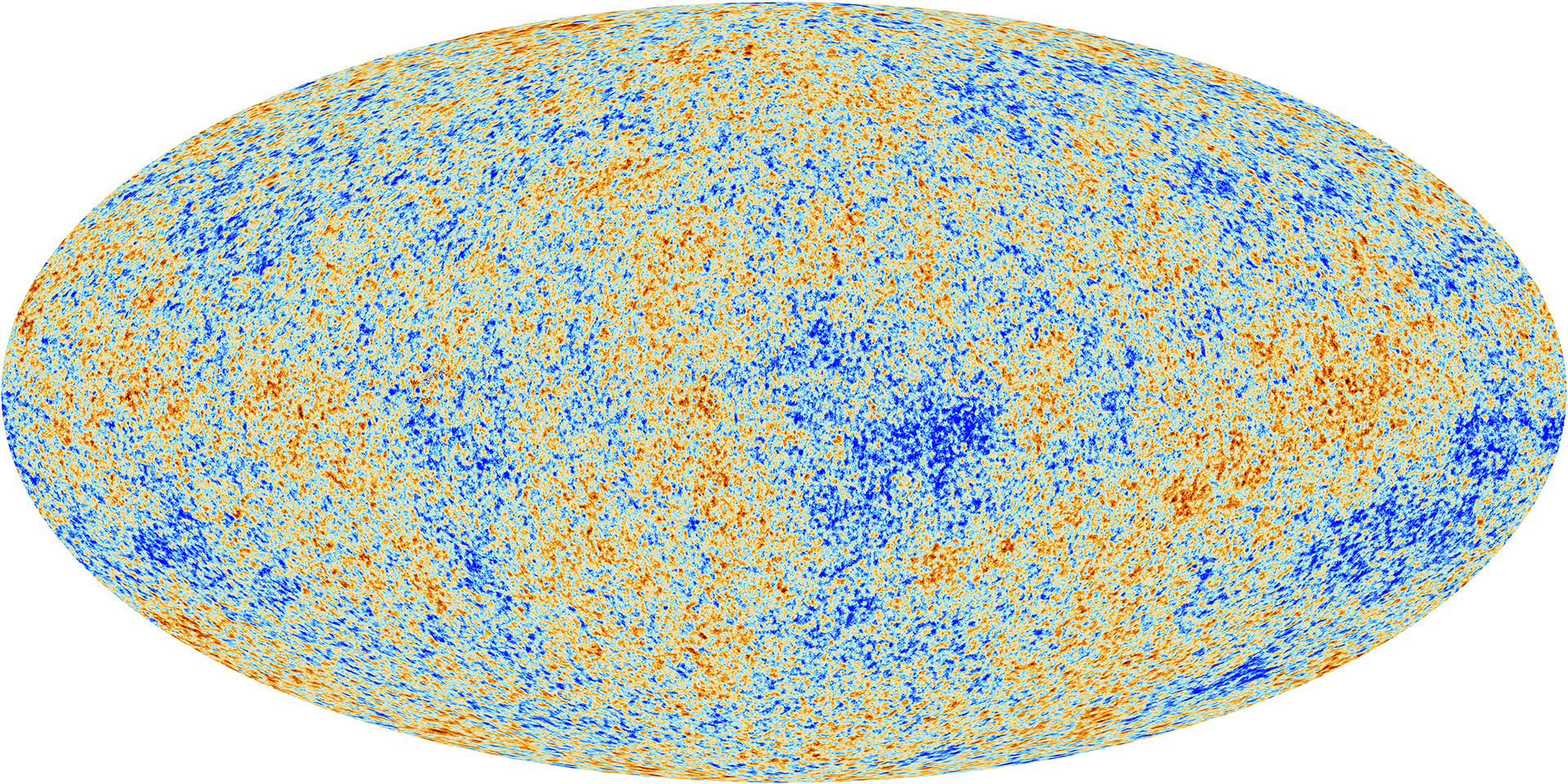
The above image shows the variations in temperature of the cosmic microwave background as charted by the Planck Satellite. The average temperature of the sky is about 2.73 K but there are variations across the sky that have an rms value of about 0.08 milliKelvin. This corresponds to a fractional variation of a few parts in a hundred thousand relative to the mean temperature. It doesn’t sound like much, but this is evidence for the existence of primordial acoustic waves and therefore of a Big Bang with a genuine “Bang” to it.

A full description of what causes these temperature fluctuations would be very complicated but, roughly speaking, the variation in temperature you corresponds directly to variations in density and pressure arising from sound waves.

So how loud was it?

The waves we are dealing with have wavelengths up to about 200,000 light years and the human ear can only actually hear sound waves with wavelengths up to about 17 metres. In any case the Universe was far too hot and dense for there to have been anyone around listening to the cacophony at the time. In some sense, therefore, it wouldn’t have been loud at all because our ears can’t have heard anything.

Setting aside these rather pedantic objections – I’m never one to allow dull realism to get in the way of a good story- we can get a reasonable value for the loudness in terms of the familiar language of decibels. This defines the level of sound (L) logarithmically in terms of the rms pressure level of the sound wave Prms relative to some reference pressure level Pref

L=20 log10[Prms/Pref].

(the 20 appears because of the fact that the energy carried goes as the square of the amplitude of the wave; in terms of energy there would be a factor 10).

There is no absolute scale for loudness because this expression involves the specification of the reference pressure. We have to set this level by analogy with everyday experience. For sound waves in air this is taken to be about 20 microPascals, or about 2×10⁻¹⁰ times the ambient atmospheric air pressure which is about 100,000 Pa.  This reference is chosen because the limit of audibility for most people corresponds to pressure variations of this order and these consequently have L=0 dB. It seems reasonable to set the reference pressure of the early Universe to be about the same fraction of the ambient pressure then, i.e.

Pref~2×10⁻¹⁰ Pamb.

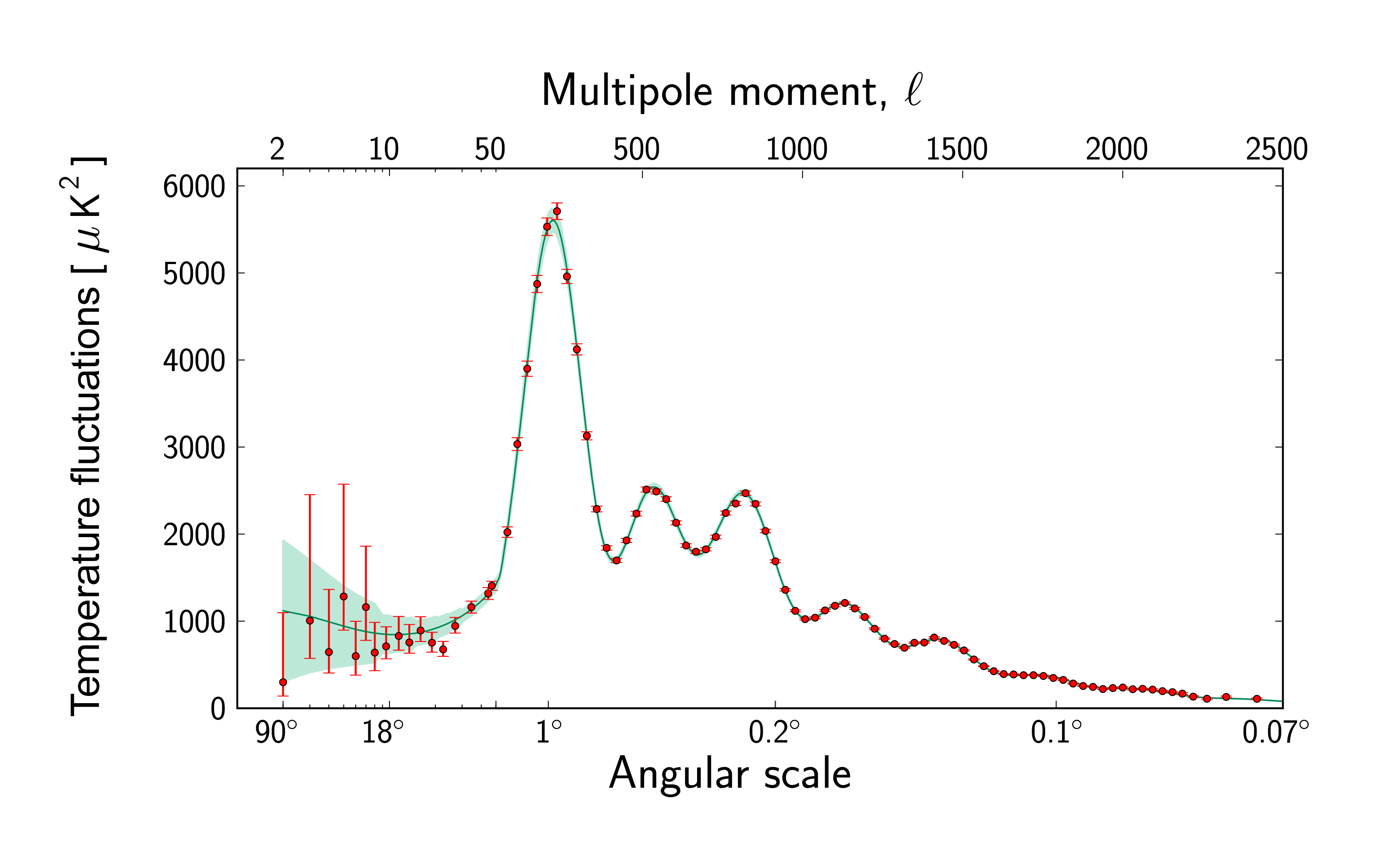
The physics of how primordial variations in pressure translate into observed fluctuations in the CMB temperature is quite complicated, because the primordial universe consists of a plasma rather than air. Moreover, the actual sound of the Big Bang contains a mixture of wavelengths with slightly different amplitudes. In fact here is the spectrum, showing a distinctive signature that looks, at least in this representation, like a fundamental tone and a series of harmonics…
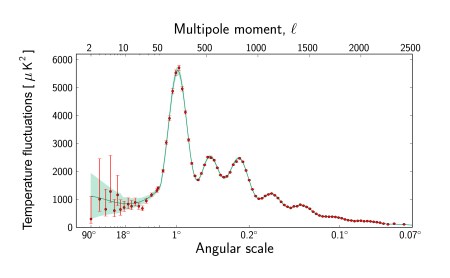
Planck_power_spectrum_orig


If you take into account all this structure it all gets a bit messy, but it’s quite easy to get a rough but reasonable estimate by ignoring all these complications. We simply take the rms pressure variation to be the same fraction of ambient pressure as the averaged temperature variation are compared to the average CMB temperature,  i.e.

Prms~ a few ×10-5Pamb.

If we do this, scaling both pressures in logarithm in the equation in proportion to the ambient pressure, the ambient pressure cancels out in the ratio, which turns out to be a few times 10-5. With our definition of the decibel level we find that waves of this amplitude, i.e. corresponding to variations of one part in a hundred thousand of the reference level, give roughly L=100dB while part in ten thousand gives about L=120dB. The sound of the Big Bang therefore peaks at levels just a bit less than 120 dB.
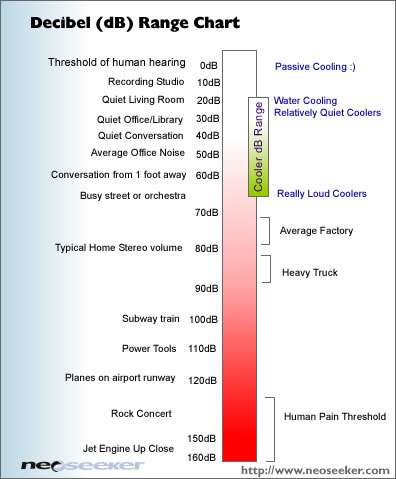
cooler_decibel_chart

As you can see in the Figure above, this is close to the threshold of pain,  but it’s perhaps not as loud as you might have guessed in response to the initial question. Modern popular beat combos often play their dreadful rock music much louder than the Big Bang….

A useful yardstick is the amplitude  at which the fluctuations in pressure are comparable to the mean pressure. This would give a factor of about 1010 in the logarithm and is pretty much the limit that sound waves can propagate without distortion. These would have L≈190 dB. It is estimated that the 1883 Krakatoa eruption produced a sound level of about 180 dB at a range of 100 miles. The QI podcast also mentions  that blue whales make a noise that corresponds to about 188 decibels. By comparison the Big Bang was little more than a whimper..

PS. If you would like to read more about the actual sound of the Big Bang, have a look at John Cramer’s webpages. You can also download simulations of the actual sound. If you listen to them you will hear that it’s more of  a “Roar” than a “Bang” because the sound waves don’t actually originate at a single well-defined event but are excited incoherently all over the Universe.

Semper Cavete Quod Idibus Martiis

Posted in Film, History with tags , , on March 15, 2017 by telescoper

Today is the Ides of March so I thought I’d keep up the little tradition I’ve established of posting this  priceless bit of British cultural history relevant to such a fateful day.

This is from the First Folio Edition of Carry On Cleo, and stars the sublime Kenneth Williams as Julius Caesar delivering one of the funniest lines in the whole Carry On series. The joke may be nearly as old as me, but it’s still a cracker…

P.S. On a less frivolous note, today the good folks of the Netherlands are going to the polls. I hope that they use their votes wisely, but am more than a little nervous about the outcome.


Transferable Skills Training

Posted in Uncategorized on March 14, 2017 by telescoper

There’s an ever-increasing need for students of physics and astronomy to broaden their knowledge base by acquiring skills that might be transferable into other fields. Thinking about this the other day it occurred to me that some physicists and astronomers may not yet be able to dance the Madison, so here is an instructional video presented by Professors Jennifer Comar and Paolo Pasta Lanna, with musical accompaniment by the Ray Bryant Combo.

Watch very carefully, as there will be a test next week.


Spring Things

Posted in Biographical, Cricket, Football, Politics, Rugby on March 13, 2017 by telescoper

I’m aware that my posts have been a bit thin recently. This is partly because I’ve had so much to do recently. I know I’m supposed to be working part-time, but that isn’t the way it’s working out. I’m being paid part-time, but without any obvious reduction in workload. Not at the moment anyway, although that’s probably mainly because of a load of deadlines coming together.

The other reason is that I’ve not been very well. On top of other things I caught a bug of some sort in January that laid me pretty low and caused continuous coughing and spluttering but seemed not to be too nasty. The problem is that I just couldn’t shake it off. When I finally started to feel better I immediately got worse again. I think I might have had two different forms of the lurgy in quick succession. Now I seem to be clear of the obvious symptoms, but just generally knackered. Perhaps it’s because I’m getting on a bit, the usual winter flu things are harder to shake off. Or maybe I should have taken some time off, but that would have meant missing even more deadlines…

Anyway, while I’ve been moping around feeling sorry for myself, Spring seems to have arrived.

On the sporting front, the 2017 Six Nations is heading towards its conclusion. With England sure to win the Championship after thrashing Scotland 61-21 on Saturday, all that remains is the question of whether they can round it off with a second successive Grand Slam by beating Ireland in the last match. To show how little I know about rugby, I thought Scotland would beat England on Saturday. I even bet on Scotland to win,  but they never really got out of the blocks and were thoroughly trounced.

There are signs of life at the SWALEC stadium now too. I’ve seen the Glamorgan players practising outside a few times now that the weather has improved a bit. I have joined as a full member this year so hope to be able to get to quite a few of the County Championship games. The fixture list arrived last week, another sign that Spring is here.

On the football side, Newcastle United had three tough away games against rivals for the Championship (Brighton, Huddersfield and Reading). They managed to beat the first two and draw 0-0 in the third, which was a good performance. But then they lost an apparently more straightforward home game against Fulham on Saturday. They’re still top of the table (on goal difference), but could still blow it. There are still nine games left of a season which seems to have gone on for ages already!

And then of course there’s the likely triggering of Article 50 of the Lisbon Treaty by Prime Minister Theresa May, assuming Parliament agrees to give her permission to do so. Then we begin the process of separating ourselves from the European Union. There’s a strong chance this will lead to Scottish independence and, perhaps a few years further down the line, a united Ireland. Holland goes to the polls on Wednesday 15th – the Ides of March – and we’ll see whether the Dutch are as willing to fall for divisive far-right rhetoric as the British and Americans have proved to be. I doubt it, actually, but there have been too many shocks recently to be sure.

March is the Month of Expectation

Posted in Poetry with tags , on March 13, 2017 by telescoper

March is the month of expectation.
The things we do not know –
The Persons of prognostication
Are coming now –
We try to show becoming firmness –
But pompous Joy
Betrays us, as his first Betrothal
Betrays a Boy.

by Emily Dickinson (1830-1886)


R.I.P. Ronald Drever

Posted in The Universe and Stuff on March 9, 2017 by telescoper

Another item of news I heard yesterday – much sadder this time – is that Professor Ronald Drever passed away earlier this week, on 7th March 2017, at the age of 85.  Ron Drever spent most of his working career at Caltech, who have posted a lengthy and glowing tribute to him which includes this quote from Kip Thorne:

“Ron was one of the most inventive scientists I’ve known, and his contributions to LIGO were huge,” says Thorne. “His approach to physics was so different from mine: intuitive rather than analytic. He could see things intuitively, quickly, that would take hours for me to understand in my more mundane way with mathematical calculations.”

It was almost certain that Ron Drever would have won a share of the 2017 Nobel Prize for Physics had he lived another year, as his work was essential to the discovery of gravitational waves last year by the Advanced LIGO facility. That result came just a little too late to win the 2016 prize but seemed to be a certainty for this year.  The loss of such a great character is always sad for friends, family and colleagues, but the timing in this case adds an ever deeper level of poignancy.

R.I.P. Professor Ronald William Prest Drever (1931-2017).


Budget: 1000 New PhD STEM Studentships

Posted in Politics, Science Politics with tags , , , on March 9, 2017 by telescoper

I was out of the office all day yesterday at a very interesting meeting at the Institute of Physics, so I wasn’t able to listen to the 2017 Budget speech by the Chancellor of the Exchequer. On the way home by train, however, I caught up with some of the content and reaction via Twitter and various news outlets.

One thing of particular relevance to those of us who work in STEM subjects was the following announcement (from the BBC website):

  • £300m to support 1,000 new PhD places and fellowships in STEM (science, technology, engineering and maths) subjects

There’s a bit more detail about this here:

He also confirmed that the Industrial Strategy Fund will be managed by Innovate UK in its first year of existence, and will be administered by UK Research and Innovation from 2018-19.

The Industrial Strategy Challenge Fund is part of the National Productivity Investment Fund. As trailed earlier in the week, a further £90m from the NPIF will be spent on an additional 1,000 PhD places in areas aligned with the government’s industrial strategy. Around 85 per cent of these places will be in science, technology, engineering and mathematics subjects, and 40 per cent will focus on strengthening industry-academia collaboration.

Also under the NPIF, a total of £160m will be spent on new fellowships for early and mid-career researchers in areas aligned with the industrial strategy.

The NPIF will also include spending of £50m over the next four years on fellowship programmes to attract researchers from overseas.

So these studentships will be funded from the “extra money” for science and research announced in the Autumn Statement last year and it looks like they will be focussed on industrial applications rather than “pure” science.

The number 1000 seems a lot, but it has to be seen in perspective. Each year the Science and Technology Facilities Council funds about 100 PhD studentships in Astronomy, and a similar number in Particle Physics. Far more Physics PhDs are funded through the Engineering and Physical Sciences Research Council, which looks after the rest of physics as well as engineering and the rest of the physical sciences. Then there are the life sciences, medical research and all the other disciplines which are larger still. In 2014 the total number of students starting a PhD in STEM disciplines in England alone was about 6600. Not all these were funded by the UK research councils, of course, but that gives you some idea of the scale. The extra places this year are a significant boost, but don’t represent a huge increase across the board. They may have a real impact in specific areas, of course, depending on where they are targetted. Note also that the recent large growth in PhD places in the UK has largely been driven by access to EU funding programmes, which we are determined to throw away.

I don’t know how these studentships will be allocated, though I suspect they will be administered through the existing Research Council channels. However, if they are to be filled from October 2017 this will have to be decided quickly, as this year’s recruitment cycle is well under way.

On the other hand, rumours of extra money for PhD students in STEM subjects have been circulating for some time so I think this has been known about behind the scenes long enough to make preparations. I suspect it has all been under wraps until yesterday for political reasons, i.e. to allow the Chancellor to include it in his speech. I imagine things will now move pretty quickly and we’ll know quite soon where the studentships will be allocated.

It’s also worth noting that the money for studentships will be spread over 4 years, which means that this increase is effectively just for one cohort of students (a PhD typically taking 3-4 years to complete). We don’t know whether this level will be maintained in future to compensate for loss of EU funds.

Extra investment in STEM subjects is to be welcomed, but I do wonder about the wisdom of increasing PhD student numbers still further. As I have stated before, I think we already produce far too many PhDs. I think this money might be better spent increasing the number of Masters graduates or improving funding for STEM undergraduate programmes.


45 Years of the Azed Crossword

Posted in Crosswords with tags , , on March 7, 2017 by telescoper

I apologize for being a little late to celebrate this publicly, but I noticed yesterday that Sunday 5th March 2017 marked the 45th anniversary of the appearance of the first Azed crossword puzzle in the Observer. The first one appeared on 5th March 1972 when I was 8 years old and the compiler, Jonathan Crowther, must have been even younger.

I should add that in 1972 I didn’t even know that the Observer newspaper existed. The only Sunday paper I was aware of in those days was the Sunday Post which, though published in Scotland, was very popular on Tyneside at the time. I remember the cartoons very well indeed, especially The Broons and Oor Wullie.

I resumed doing the Azed puzzle about a year ago with the demise of the print edition of the Independent on Sunday but I have yet to register any successes in the monthly competition. There have been a few glitches in this recently, such as incorrect grids and wrong instructions, which put me off even attempting some of the recent competitions. And those I have entered I’ve done so cursorily, with little time to think much about it.

Since this Sunday’s puzzle marks a special occasion, however, I think I might try to send in a decent clue this time. I completed the puzzle – Azed No. 2334 – last night so have a few days to ponder on an appropriate entry.

Incidentally, if you look at the across clues in this week’s puzzle you will see that the first letters form an acrostic: “FORTY FIVE YEARS OF AZED” but only if the supplied clue for 29 across beings with “R”. That’s how I realized it was the Azed Crossword’s 45th birthday!

Anyway, as a physicist I particularly enjoyed 25 down:

Particle rapidly showing displacement of neutron (6)

Not too difficult, but rather neat!

There’s also a nice one at 14 down:

Spacecraft may enter it: I soon changed pressure at this point (10)