Archive for February, 2018

A Guest Paradox

Posted in Cute Problems, The Universe and Stuff with tags , , , on February 9, 2018 by telescoper

Here’s a short guest post by my old friend Anton. As usual, please feel free to discuss the paradox through the comments box!

–0–

I thought of a physics paradox the other day and Peter has kindly granted me a guest post here about it, as follows. Consider a homogeneous isotropic closed universe as described by general relativity. Let it contain a uniform density of a single species of electrically charged particle, so that this universe has a net charge. The charged particle density is sufficiently low, however, that the perturbation from the regular uncharged metric is negligible. Since this universe is homogeneous and isotropic the electric field in it is everywhere zero. BUT if I consider a conceptual 3-dimensional sphere, small enough for space-time curvature to be neglected, then it contains a finite amount of electric charge, and therefore by Gauss’ theorem a nonzero electric field points out of it at every point on its surface. This contradicts the zero-field conclusion based on the metric.

Here are three responses (one my own) and my further responses to these, in brackets:

  1. In a closed universe it is not clear what is the outside and what is the inside of the sphere, so Gauss’ law is not trustworthy (tell this to a local observer!);
  2. the electric field lines due to the charges inside this (or any) conceptual sphere wrap round the universe an infinite number of times (this doesn’t negate Gauss’ theorem!);
  3. the curved rest of the Universe actually adds a field that cancels out the field in your sphere (neither does this negate Gauss’ theorem!)

The Success of LISA Pathfinder

Posted in The Universe and Stuff with tags , on February 8, 2018 by telescoper

Back in Maynooth, in between lecture and computer lab session, I only have time for a quick post so I’ll take the opportunity to share the recent news from LISA Pathfinder (which is basically a technology demonstrator mission intended to establish the feasibility of a proposed space-based gravitational wave facility called LISA). LISA Pathfinder is ostensibly an extremely simple experiment, consisting of two metal cubes (made of a gold-platinum mixture) about 38cm apart. The question it tries to answer is how accurately these two cubes can be put an ideal “free-fall” state, i.e. when the only force acting on them is gravity. I say `ostensibly’ however, in full knowledge that is an extremely challenging task that requires lots of clever design and painstaking work.

Initial signs were promising, and the confidence has now been justified by a paper in Physical Review Letters. Here is the abstract:

This is the key figure:

This confirms that the spacecraft has more than matched the sensitivity requirement demanded of it. Congratulations to the LISA Pathfinder mission on an outstanding success!


The Manor Farm, by Edward Thomas

Posted in Literature with tags , on February 7, 2018 by telescoper

The rock-like mud unfroze a little, and rills
Ran and sparkled down each side of the road
Under the catkins wagging in the hedge.

But earth would have her sleep out, spite of the sun;
Nor did I value that thin gliding beam
More than a pretty February thing
Till I came down to the old manor farm,
And church and yew-tree opposite, in age
Its equals and in size.
The church and yew
And farmhouse slept in a Sunday silentness.

The air raised not a straw.
The steep farm roof,
With tiles duskily glowing, entertained
The mid-day sun; and up and down the roof
White pigeons nestled.
There was no sound but one.

Three cart horses were looking over a gate
Drowsily through their forelocks, swishing their tails
Against a fly, a solitary fly.

The winter’s cheek flushed as if he had drained
Spring, summer, and autumn at a draught
And smiled quietly.
But ’twas not winter–
Rather a season of bliss unchangeable,
Awakened from farm and church where it had lain
Safe under tile and latch for ages since
This England, Old already, was called Merry.


by Edward Thomas (1878-1917; he died at Arras, France, in April 1917).


R.I.P. Donald Lynden-Bell (1935-2018)

Posted in The Universe and Stuff with tags , on February 6, 2018 by telescoper

I woke this morning to the very sad news that we have lost one of our great astrophysicists, Donald Lynden-Bell (above). He had suffered a stroke before Christmas but despite the best efforts of the medical staff at Addenbrooke’s Hospital in Cambridge, he never fully recovered. He passed away peacefully, at home, yesterday at the age of 82. The Cambridge University announcement of his death can be found here.

I saw Donald qjust a few months ago at the RAS Club where he seemed in good health. I was lucky enough to sit with him for dinner and he was excellent company, as he always was on such occasions. It’s very sad that he is no more. Sincere condolences to his family, friends and colleagues and especially to his wife Ruth (herself a distinguished chemist).

Donald is probably best known for his theoretical work on the idea that galaxies contain massive black holes at their centre, and that such black holes are the principal source of energy in quasars. He was also a member of a group of astronomers that became known as the ‘Seven Samurai’ who postulated the existence of the Great Attractor, a concentration of matter that might explain the observed peculiar motion of the Local Group of galaxies. What was most remarkable about him, however, was the creativity he brought to a huge range of disparate topics, from data analysis to telescope design, and from thermodynamics to general relativity. Donald refused to be pigeonholed, and worked on whatever took his fancy. He brought unique imagination and insight to everything he did.

I first encountered Donald Lynden-Bell when I was an undergraduate at Cambridge. He taught a first year Mathematics course for Natural Sciences students on how to solve Ordinary Differential Equations. I wouldn’t say he was the most organized lecturer I’ve ever had, but he was enormously entertaining and his remarkably loud voice meant you could never doze off! That was in 1983. I remember being terrified to see he was in the audience when I gave a talk at a conference in Cambridge as a PhD student a few years later, in 1987. He asked a question at the end that completely wrong-footed me, but I soon realised that he had a habit of doing that and it wasn’t at all malicious: he just had an unexpectedly different way of looking at things. It was quite extraordinary in that he stayed that way all through his career. It’s also remarkable how little he seemed to change in the thirty-odd years I knew him. In fact, in pictures of him taken in the 1960 he looks much the same as he did last year. I think that’s at least partly why his death was such a shock. He seemed timeless. One assumed he would live forever.

At first I found Donald Lynden-Bell intellectually intimidating but it didn’t take long to find that, inside, he was actually a very amiable and kind-hearted character who was extremely generous with his time, especially with early career researchers. A couple of years ago in the occasion of his 80th birthday, a friend and former student of Donald’s, Manuela Magliocchetti, wrote an open letter to him on here. Many of his former students have posted similar messages on social media. The sense of loss is everywhere.

I find then when I know someone a bit personally, no matter how much I admire them as a scientist, it’s often other things about them that I remember better than their scientific work. My most vivid memory of Donald is from a visit to India over twenty years ago. I ended up playing croquet with him on the lawn of the Director’s House at the Inter-University Centre for Astronomy and Astrophysics in Pune (where I visited last year). Donald seemed entirely unconcerned with his own progress in the game but concentrated fiercely on sending his opponents’ balls into the shrubbery whenever the rules allowed. That is, of course, a major part of the game but I didn’t expect a distinguished Cambridge Professor to take such impish delight. The game was a blast, but had to be called off in the deepening twilight, with bats circling overhead, as we could no longer see well enough to continue but I’ll remember Donald’s constant laughter. A very serious and brilliant scientist he may have been, but he also had an intensely human capacity for having a bit of fun.

Rest in peace, Donald Lynden-Bell (1935-2018).

A Comment on Anonymous Comments

Posted in Biographical with tags , , , on February 5, 2018 by telescoper

My post last week has generated quite a lot of traffic among which is a larger-than-usual crop of abusive comments. Here’s just one example, a response to a comment of mine describing people posting such comments anonymously as `cowardly’.


Charming. I hope I don’t have to point out that the allegation therein is completely false and defamatory. Fortunately the WordPress software blocked it, along with several more of similar ilk. I don’t see why I should allow stuff like this to be published on my blog, especially if it’s anonymous, so I deleted them all. I thought I’d take this opportunity to remind readers of what it says on the front page of this blog:

Feel free to comment on any of the posts on this blog but comments may be moderated; anonymous comments and any considered by me to be abusive will not be accepted. I do not necessarily endorse, support, sanction, encourage, verify or agree with the opinions or statements of any information or other content in the comments on this site and do not in any way guarantee their accuracy or reliability.

I don’t mind people posting contrary views as long as they’re not abusive, but if you use a fake email address and/or a fake name then your comment will be blocked. If you’ve got something to say then at least have the courage to identify yourself!

When I first started blogging, almost a decade ago, I decided to have an open comment policy so that anyone and everyone could comment without any form of intervention. That turned out to be a disaster because of the number of automatically generated  SPAM comments that clogged up the boxes. I therefore switched on a SPAM filter so it could veto obvious garbage, but otherwise kept an open policy. The alternatives offered by WordPress include one that requires all comments to be from people registered at the site (which I thought would probably be a deterrent to people only wanting to comment on the odd post). Another option is to maintain a blacklist which treats all messages from persons on the list as SPAM. It’s also possible to block all comments entirely, of course, but I enjoy reading most of them so I think it would be a shame to do that just because of a few breaches of netiquette.

All went fairly well and I only had to ban a couple of individuals for abuse. I did for a time receive a stream of crudely abusive comments (of a personal nature) from various anonymous sources. These were mostly depressingly puerile and they didn’t affect me much but I did find it very disconcerting to think that there are people sitting out there with nothing better to do.

Since WordPress notifies me every time a  comment is posted, it is quite easy to remove this junk but I found it very tiresome (when there were several per day) and eventually decided to change my policy and automatically block comments from all anonymous sources. Since this requires a manual check into whether the identity information given with the comment is bona fide, comments from people who haven’t commented on this blog before may take a little while to get approved.

There are still comments on here which may appear to a reader anonymous (or with a pseudonym) on here, but these are from people who have identified themselves to me with a proper email address or who the software has identified through their IP address or information revealed by their web browser (which is probably more than you think…). I’m happy for people to comment without requiring they release their name to the world, and will do my best to ensure their confidentiality, but I’m not happy to publish comments from people whose identity I don’t know.

If you’re interested, as of today, 28,781 comments have been published on this blog. The number rejected as SPAM or abuse is 1,802,214. That means that fewer than 1 in 60 are accepted. I simply don’t have time to go through all the flagged comments individually, so I usually just delete them all.

Am I denying freedom of speech by rejecting anonymous comments? I don’t think so. If you want freedom of speech that much, you can write your own blog (anonymous or otherwise). And if every sight of this blog makes you want to write abusive comments, perhaps you should exercise your freedom not to read it.

I’d be interested to know from any fellow bloggers if they have the same problems with abusive comments. If not, perhaps I should start taking it personally!

More generally, I will not accept anonymous comments on the subject of the anonymity of comments, but any other contributions are welcome via the box.

Unless you’re banned.

Erbarme Dich Allah

Posted in Music with tags , , on February 4, 2018 by telescoper

Here is a wonderful re-imagining of the aria Erbarme Dich, Mein Gott from the St Matthew Passion by Johan Sebastian Bach sung in Arabic with intense passion by Egyptian contralto Fadia el-Hage.

Three things struck me when I first heard this on the radio the other night. After the initial surprise when I first heard her voice, I thought how wonderfully well the Middle-Eastern inflections work with Bach. That’s no surprise of course, because Bach’s music is so beautifully constructed that it can be performed in many different ways without diminishing its power. It really is universal.

The other thing was about a different kind of universality, that it seems common to all humans to reach out for whatever it is that lies beyond everyday life and experience, whether through religion or by some other means. We don’t have to agree with each other’s beliefs to see in others the same need as ourselves. This aria in particular (I’ve posted about it before) conveys the feelings of shame and remorse of the disciple Peter after having betrayed Jesus. The point is that feelings such as this are universal. We all – men and women, christian and non-christian – come to know what it is to feel like this, just as we all come to know about pain and death. It’s the fact that we all know that we will die that gives the story of the Passion its tragic power.

Finally it occurred to me that this might annoy some intolerant folk as it translates all these things into an Islamic context. That gives me an additional reason for posting it!

The Effect of Gravity on the Muon Magnetic Moment

Posted in The Universe and Stuff with tags , , , , , on February 3, 2018 by telescoper

Only time for a short post today, but I think this may turn out to be an important result. There’s a paper by Morishima et al. on the arXiv with the rather dry title Post-Newtonian effects of Dirac particle in curved spacetime – III : the muon g-2 in the Earth’s gravity, which suggests that the anomalous magnetic dipole moment of the muon.

Here is the abstract of the paper. You can click on it to make it bigger.

In a nutshell the anomaly is that according to basic relativistic quantum theory in the form of the Dirac equation, the muon (and any other charged spin-1/2 fermion) should have a magnetic dipole moment μ of magnitude (given in terms of its mass m and fundamental constants) by μ=geħ/4m with the g-factor g=2 for Dirac fermions. The anomaly is that this can be measured and it appears that g differs from zero by a small but significant amount, i.e. (g-2) is not zero. It has been widely suggested that this discrepancy suggests the existence of physics beyond the Standard Model of Partlce Physics. Well, gravity is not included in the Standard Model so I suppose this could still be right, but the it this calculation may well disappoint those who were hoping that (g-2) might provide evidence for, e.g., supersymmetry when it looks like it might be something rather more mundane, ie the Earth’s gravity!

UPDATE: It appears there is an error in the paper; see here. You may stand down.

UPDATE: Well, that was pretty fast. There’s now a paper on the arXiv by Matt Visser that gives a detailed refutation of the above claim. Here is the abstract:

In three very recent papers, (an initial paper by Morishima and Futamase, and two subsequent papers by Morishima, Futamase, and Shimizu), it has been argued that the observed experimental anomaly in the anomalous magnetic moment of the muon might be explained using general relativity. It is my melancholy duty to report that these articles are fundamentally flawed in that they fail to correctly implement the Einstein equivalence principle of general relativity. Insofar as one accepts the underlying logic behind these calculations (and so rejects general relativity) the claimed effect due to the Earth’s gravity will be swamped by the effect due to Sun (by a factor of fifteen), and by the effect due to the Galaxy (by a factor of two thousand). In contrast, insofar as one accepts general relativity, then the claimed effect will be suppressed by an extra factor of [(size of laboratory)/(radius of Earth)]^2. Either way, the claimed effect is not compatible with explaining the observed experimental anomaly in the anomalous magnetic moment of the muon.

That’s how science goes!

`Pass-the-Harasser’ … to Turku

Posted in Education, Harassment Bullying etc with tags , , , on February 2, 2018 by telescoper

I noticed yesterday evening that there has recently been a substantial increase in the number of people viewing my posts about Christian Ott, the former Caltech Professor who eventually left his job there after harassing and committing ‘gender-based discrimination’ against two female students there.

It wasn’t difficult to find out why there had been an upsurge in interest: Christian Ott has got a new job, at the University of Turku, in Finland. As far as I understand the situation – and please correct me if I’m wrong – he was `head-hunted’ for this position, so his appointment was not the result of an open competition and it seems the position was specifically created just for him.

UPDATE: the post was advertised here, but the gap between the deadline for applications – 10th December 2017 – and the appointment being announced is too short to be consistent with the usual processes of academic appointments. Moreover, the advertised job descriptions includes teaching duties; see below for why this is relevant.

Not surprisingly both the appointment itself and the circumstances by which it was brought about have provoked considerable reaction. A group of Finnish astronomers and astrophysicists has written a Statement on Harassment, which you can sign in support (here if you’re Finnish and/or based in Finland) and here for other concerned academics. I have signed the second one.

I have two personal comments to make. The first is that I’ve seen people say that Ott should get a `second chance’, and it would be unfair for his past transgressions to force him out of academia.

This is what I wrote in an earlier piece about this:

It remains to be seen what Christian Ott does. I am not familiar with his work but he is, by all accounts, a talented scientist so he may well find a position at another institution. If he does, I hope, for his and for his future colleagues’ sake, that he has learned his lesson.

I think that makes it clear that I have no desire to see Christian Ott ruined, but I don’t think that means that I think due process should be subverted to help him, as appears to be the case here. In fact I’m bound to say that if I were a Head of Department I wouldn’t under any circumstances have offered this man a position, after what he did.

Had Ott committed a different disciplinary offence (such as plagiarism or other research misconduct) he would not have found it so easy to get another job than because it was `just’ harassment. Why should these offences be treated so differently?

Once again, research esteem seems to trump everything else. That attitude is one of the most poisonous elements in modern academia. The `Great Man of Science’ is indeed a dangerous myth.

The second thing is that, as far as I understand it (and again please correct me if I’m wrong), Ott’s new position is as an `independent researcher’ and he will have no teaching duties and minimal contact with students. I suppose that is supposed to make everything alright. It doesn’t. Indeed, there are many academics who would regard a cushy research-only contract as a reward rather than a cost. It’s a slap in the face for teaching staff at Turku that funds have been found to create a bespoke position in the way that has been done here.

As always, comments clarifications and corrections are welcome through the comments box.

UPDATE: 7/2/2018. The appointment of Dr Ott has been cancelled.

The Quickening of the Year

Posted in Education, Maynooth, Music, The Universe and Stuff with tags , , , , on February 1, 2018 by telescoper

It’s 1st February 2018, which means that today is Imbolc, a Gaelic festival marking the point halfway between the winter solstice and vernal equinox. This either happens 1st or 2nd February, and this year it is the former. In this part of the world – I’m in Ireland as I write- this day is sometimes regarded as the first day of spring, as it is roughly the time when the first spring lambs are born. It corresponds to the Welsh Gŵyl Fair y Canhwyllau and is also known as the `Cross Quarter Day’ or (my favourite) `The Quickening of the Year’.

So, talking of quickening, the pace of things is increasing for me now too. This morning at 9am I gave my first ever lecture in Maynooth University in a lecture theatre called Physics Hall, which is in the old (South) part of campus as opposed to the newer North Campus where the Science Building that contains my office is situated.

After that it was back to the Department for some frantic behind-the-scenes activity setting up accounts for the students for the afternoon lab session, which is in a computer room near to my office. Students attend one two-hour lab session in addition to the lecture, on either Thursday or Tuesday. The first lecture being this morning (Thursday) the first lab session was this afternoon, with the same material being covered next Tuesday.

I was far more nervous about this afternoon’s lab session than I was about this morning’s lecture as there seemed to be many things that could go wrong in getting the students up and running on our Linux cluster and getting them started on Python. Quite a few things did go wrong, in fact, but they were fewer in number and less drastic in outcome that I had feared.

So there we are, my first full day teaching in Maynooth. I think it went reasonably well and it was certainly nice to meet my first group of Maynooth students who, being physics students, are definitely la crème de la crème. I’ve got another 6 weeks like this (teaching on Tuesday in Cardiff and on Thursday in Maynooth) before the Easter break so it’s going to be a hectic period. Just for tonight, however, I’ve got time to relax with a glass or several of wine.

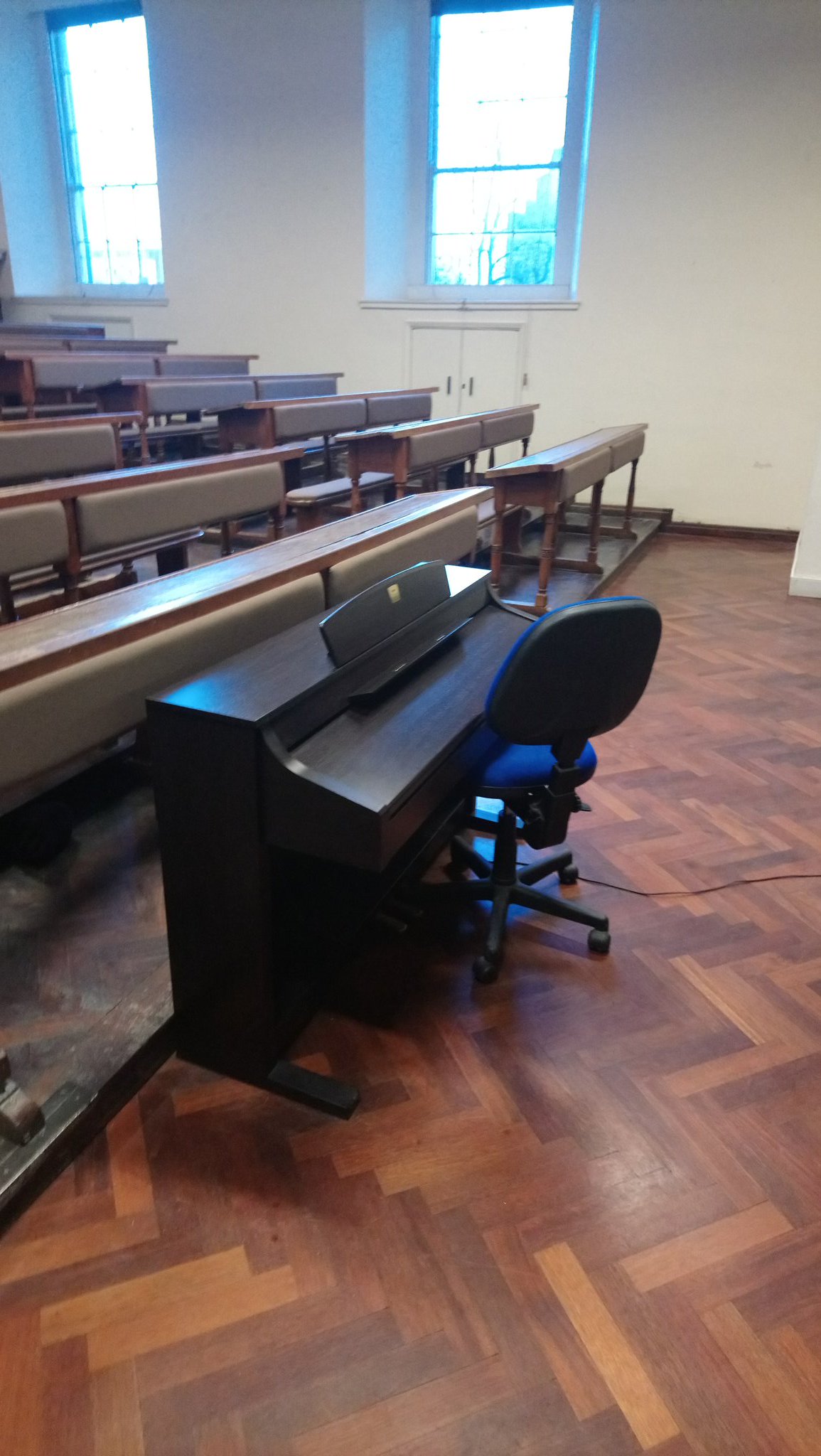
Incidentally, I was impressed that Physics Hall (where I did this morning’s lecture) is equipped with an electric piano:

I wonder if anyone can suggest appropriate musical numbers to perform for a class of computational physicists? Suggestions are hereby invited via the Comments Box!