Archive for June, 2018

Euclid2018: Highlights of Day 2

Posted in Biographical, Euclid, The Universe and Stuff with tags , , , on June 13, 2018 by telescoper

I’ve just had my breakfast so I thought I’d do a quick post before the start of play at Day 3 of the 2018 Euclid Consortium Meeting in Bonn.

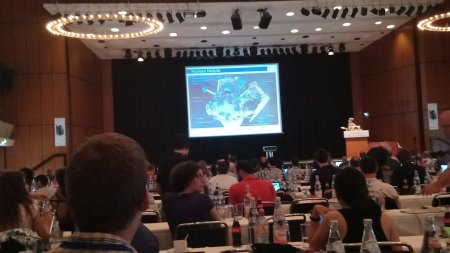
Day 2 was largely devoted to updates from the various Science Working Groups, but there was also an important presentation from Jason Rhodes about WFIRST, which is in some ways a rival to Euclid, or perhaps a complementary mission depending on how you look at it.
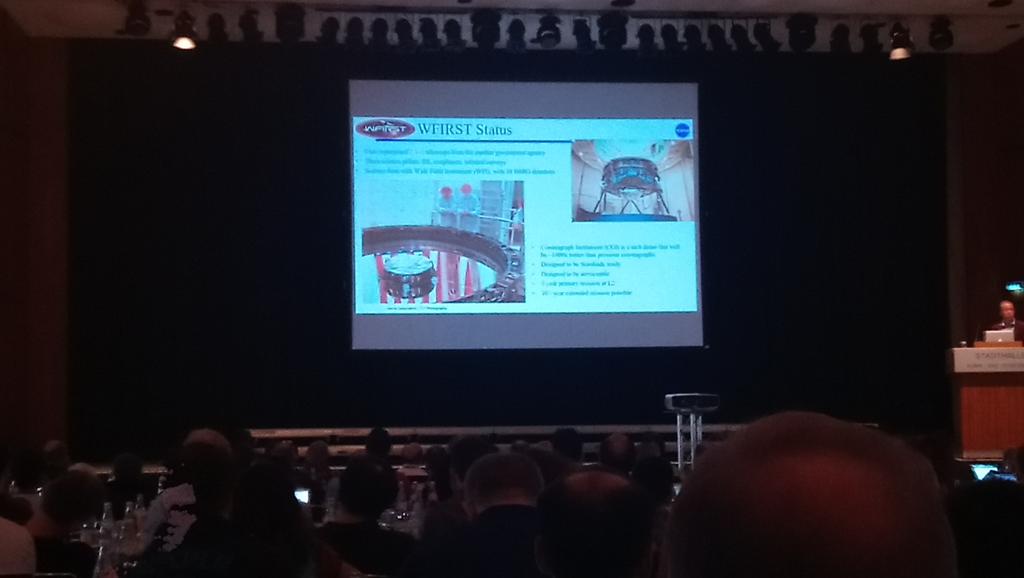

There was dismay in the global astronomy community last year when Donald Trump proposed taking the axe to WFIRST but it was good to hear that Congress not only reversed his decision but granted it additional funds over and above the original request.

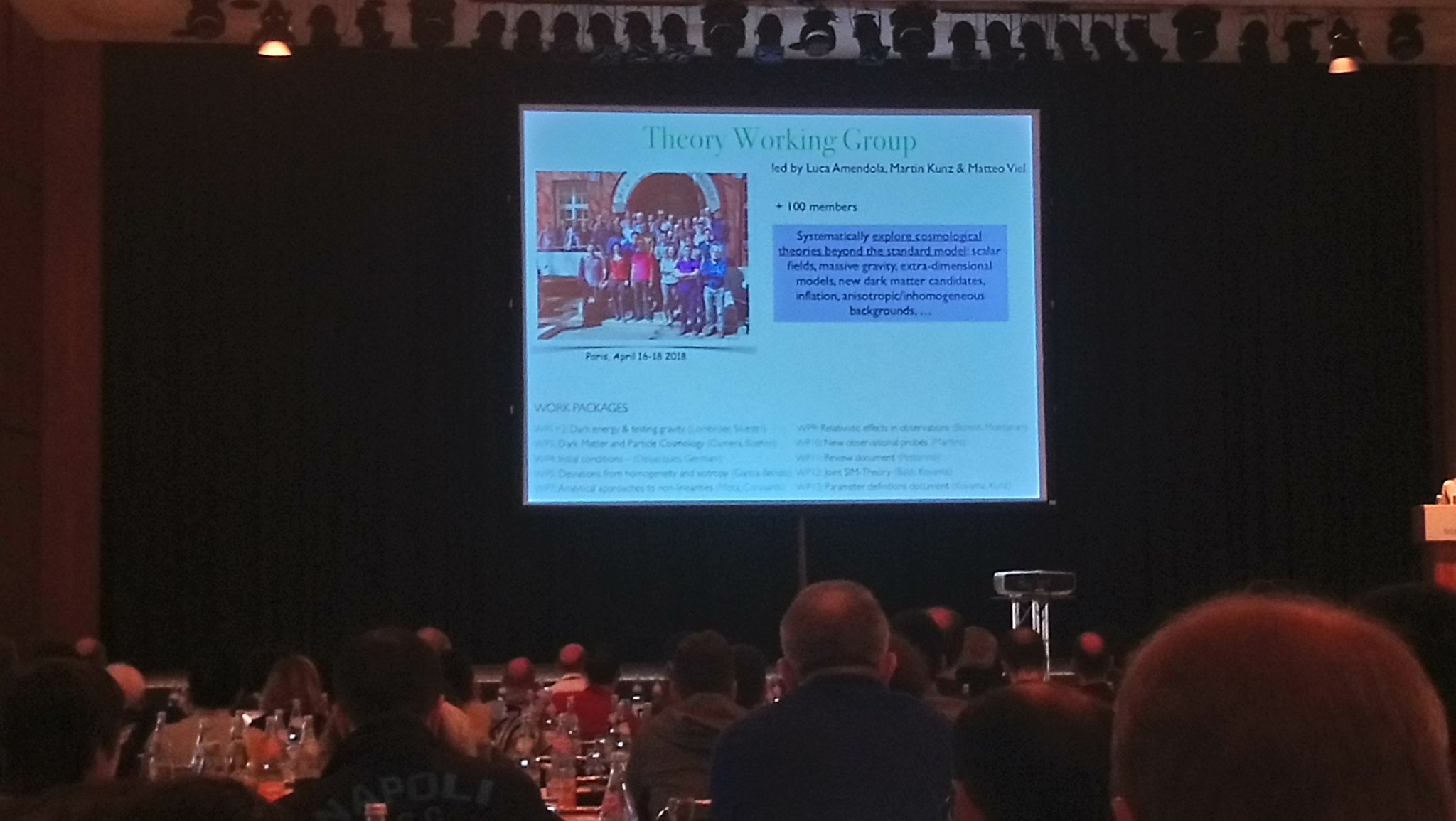
Among the SWG updates was one by Alessandra Silvestri from the Theory Working Group concentrating on how Euclid could be used to test cosmology beyond the standard model. She focussed quite a lot on Horndeski Gravity, which is the most general four-dimensional scalar-tensor theory that leads to equations of motion that have the form of second-order differential equations.
Towards the end of the day there was a session devoted to the award of the Euclid Star Prizes.

The individual awards went to Micaela Bagley, Carmelita Carbone, Teake Nutma, Bertrand Morin, and Stefanie Wachter; more details on the winners and the awards they won will be posted here. The team award was given to the Flagship simulation team. Coincidentally, I posted about the Flagship simulations last year. Much of the preparation for Euclid would be impossible without these simulations, and the award of a prize to the team is very well justified.

The day finished with short talks from each of the prizewinners. That brought to the end two days of plenary sessions in the big hall of the Stadthalle. The next two days will be the `Splinter sessions’ which are held in parallel.

Oh, and one other thing: the 2019 Euclid Consortium Meeting will be held in Helsinki from June 4-7. Looks like I’ll be spending my birthday in Finland next year!

P.S. Previous Euclid Consortium meetings were: Bologna (2011);  Copenhagen (2012); Leiden (2013); Marseille (2014);  Lausanne (2015); Lisbon (2016); and London (2017).

R.I.P. Bepi Tormen (1962-2018)

Posted in Uncategorized with tags on June 12, 2018 by telescoper

Once again I find myself having to use this blog to pass on some desperately sad news. Giuseppe Tormen, universally known as Bepi, passed away on Sunday 10th June at the age of 56.

I knew Bepi mainly from the many visits I made to Padova in the 1990s and early 2000s. As well as many other useful and enjoyable interactions I had with him, Bepi also helped enormously in proving detailed comments and numerous corrections for the book I co-wrote with Francesco Lucchin. His contributions to cosmology were many and varied, but were always characterised by the same very high standard of integrity, insight, diligence and careful accuracy. He was widely admired as an excellent scientist and splendid colleague.

Bepi had been bravely fighting cancer for some time, having defied a very poor prognosis for several years with the aid of experimental treatment, but most recently he developed a brain tumour which sadly proved terminal. My deepest condolences go to his family, friends and colleagues.

Rest in peace, Bepi Tormen (1962-2018).

Bad Godesberg Goody Bag

Posted in Biographical, The Universe and Stuff with tags , , , , on June 12, 2018 by telescoper

So here I am, then, at the start of Day 2 of Euclid 2018 in Bad Godesberg. The morning session contains a number of talks giving updates from the various Science Working Groups related to Euclid. After yesterday’s talks had finished I checked into my hotel which is nice, and then headed off via the Stadtbahn (local underground system) to a pleasant reception of drinks and nibbles in the University of Bonn. I’m very impressed with the local public transport, by the way. With my hotel booking I received a pass giving free unlimited on all buses, trams, overground and underground trains in the area. I’ll post more about the meeting later if I get time, but in the meantime I thought I’d show the contents of the conference Goody Bag: I’ve got quite a collection of conference bags that I’ve accumulated over the years, but this is the first one I’ve got that’s a lurid green colour. There’s a mug and a bag of Haribo sweets (which, I’m told, originate in Bonn). There is also a book which I looked at last night. I found it rather lacking in both plot and character development, but that is largely attributable to the fact that all the pages are blank. The final item, which I originally thought was some form of specimen jar, turns out to be a glass for Kölsch, a kind of beer brewed in Cologne.
 

News from Euclid 2018

Posted in Biographical, Euclid, The Universe and Stuff on June 11, 2018 by telescoper

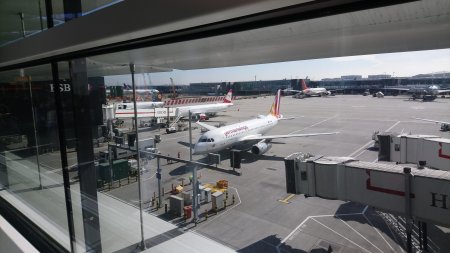
At the second attempt I managed to check in for my flight to Cologne (which is apparently near a place called) en route to Bonn for the Euclid 2018 Consortium Meeting.

I was mightily relieved when a plane actually arrived this time.

We got to our destination just about on time. I bumped into fellow Euclidean Tom Kitching in the airport and we made it to the conference venue in time for a spot of lunch, after which the afternoon session was kicked off by Mark Cropper:

I missed the morning session, during which the most important piece of news was an official announcement that the launch date of Euclid has been moved back from 2020 until 2022. This was not unexpected, and is largely driven by problems with on-board electronic system, but it will obviously impact the timetable of the mission significantly.

Since the flight of Euclid will be delayed for two years, I wonder which hotel it will be staying in at ESA’s expense?

Not Bad Godesberg

Posted in Biographical, Cricket with tags , , , , , , on June 10, 2018 by telescoper

Well, dear Readers, at this time I was supposed to be in Bad Godesberg, a municipal district of Bonn, in southern North Rhine-Westphalia in Germany for the 2018 Euclid Consortium Meeting which starts there tomorrow morning. To make sure I didn’t miss the opening sessions I booked a flight to Bonn/Cologne Airport from Heathrow at 8.50am today, and took the National Express Coach from Cardiff at 3.15am in order to make sure I arrived in good time for the flight.

Unfortunately, only 15 minutes after the Coach started on its way I got a text from the airline (a budget subsidiary of Lufthansa called `Eurowings’) had been cancelled. This was either to do with a strike of French Air Traffic Controllers or Thunderstorms; they never really got their story right. After a number of abortive attempts to rebook my flight using the coach’s wifi (e.g. to Frankfurt, whence by train to Bonn). I was advised that the system was overloaded and I should rebook at the airport.

Arriving at Heathrow Terminal 2 at 6.30, there was already a long line at the ticketing desk for Lufthansa/Eurowings. It got longer and longer as people arrived to find other flights had been cancelled too. When, after about 90 minutes in a queue, I finally got to a desk very few rebooking opportuninities were available, all of them involving silly routes (e.g. flying to Berlin, followed by a four and a half hour train trip to Bonn).

Exasperated, I suggested I could fly tomorrow instead if they offered to put me up in a hotel overnight. I didn’t fancy going back to Cardiff just so I could get up at stupid o’clock tomorrow to repeat the exercise. I’ll miss the first session of the meeting, but that’s not the end of the world.

So here I am, not in Bad Godesberg, but in the Holiday Inn at Heathrow Airport. I was booked in, given vouchers for lunch, dinner and breakfast tomorrow morning, and given two vouchers for the shuttle bus to and from Terminal 2. The hotel is characterless, but clean and the food is OK. I arrived about 10am and the room was available for me straight away, so I was able to catch up on a bit of sleep before watching most of Scotland’s memorable victory over England in today’s One Day International.

Now that I’ve had my free dinner (grilled Sea Bass) I am going to get some kip before getting up for my free breakfast and free trip back to the airport. The only question remains: will tomorrow’s flight be cancelled too?

Yet more sexual harassment in Astronomy

Posted in Uncategorized with tags , , on June 10, 2018 by telescoper

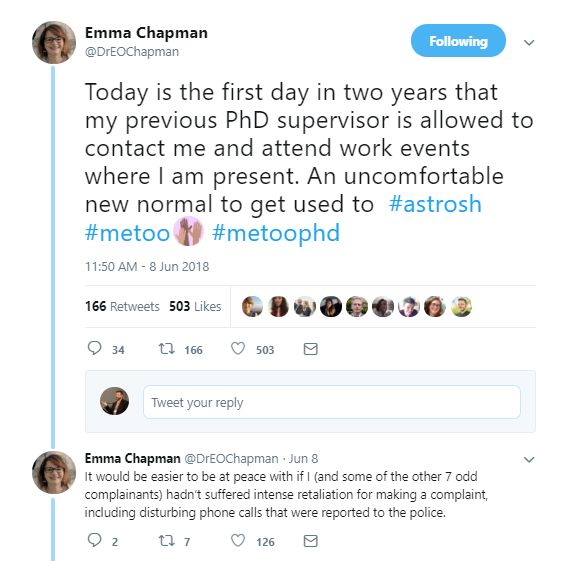
Yesterday I saw a thread on Twitter commencing with the following tweet by Dr Emma Chapman (now of Imperial College):

You can find the whole thread here; and here is one of the documents that have now been published:

I have met Dr Chapman and knew that she had endured sexual harassment in the recent past, but did not know any of the details of her case because they remained confidential until yesterday. They relate to sexual harassment by her PhD supervisor, Dr Filipe Abdalla of University College London (whom I don’t know personally). It has taken Dr Chapman two years to get documents relating to this case disclosed publicly. I also didn’t realise that episodes of harassment of other women were involved or that Dr Abdalla, who remains in post at UCL, has apparently been indulging in retaliatory behaviour towards those who have made complaints against his conduct. I am given to understand that Dr Abdalla is on a final written warning for his conduct.

I suggest you read the whole thread and form your own conclusions.

For what its worth, although I find it very hard to avoid the conclusion that University College London has handled this case abysmally at an institutional level, it is important to realise that failure to tackle sexual harassment properly is a systemic problem not confined to that particular institution. I know that the Department of Physics & Astronomy at UCL has fought very hard to tackle sexual harassment and discrimination, but efforts at such a level are not always helped by the attitudes of those in higher places.

I would like to take the opportunity to praise Emma Chapman for having the determination to get this out in the open (at considerable personal cost) and her legal advisors for finding a way through the wall of silence.

I have blogged a number of times before about sexual harassment cases, but I’ll take this opportunity to repeat what I said in an earlier post:

Failure to act strongly when such behaviour is proven just sends out the message that the institution doesn’t take sexual harassment seriously. In my view, confidentiality is needed during an investigation – to protect both sides and indeed the person doing the investigation – but if the conclusion is that misconduct has taken place, it should be acknowledged publicly. Justice has to be seen to be done. Sexual assault, of course, is another matter entirely – that should go straight to the police to deal with.

I’ve talked about protocols and procedures, but these can only ever apply a sticking-plaster solution to a problem which is extremely deeply rooted in the culture of many science departments and research teams across the world. These tend to be very hierarchical, with power and influence concentrated in the hands of relatively few, usually male, individuals. A complaint about harassment generally has to go up through the management structure and therefore risks being blocked at a number of stages for a number of reasons. This sort of structure reinforces the idea that students and postdocs are at the bottom of the heap and discourages them from even attempting to pursue a case against someone at the top.

The unhealthy power structures I’ve discussed will not be easy to dismantle entirely, but there are simple things that can be done to make a start. “Flatter”, more democratic, structures not only mitigate this problem but are also probably more efficient by, for example, eliminating the single-point failures that plague hierarchical organisational arrangements.

We are very far indeed from eliminating harassment or the conditions that allow it to continue but although cases like this are painful, I think they at least demonstrate that we are beginning to acknowledge that there’s a problem.

I think we’re now long past the point where acknowledgement is necessary. It’s now time to take action against the individuals and institutions responsible for perpetuating the problem.

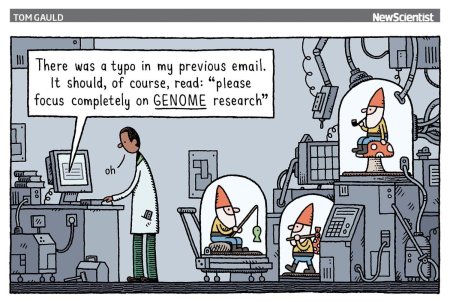
Why you should proofread your emails before sending them..

Posted in Uncategorized on June 9, 2018 by telescoper

If you have any amusing email gaffes to report please do so through the comments box. I have a few.

My favourite was from a (female) astronomer who replied to decline an email invitation to give a seminar because she was “too busty”.

There was also a “here is the reviled version of our paper”.

I also liked the one that included the phrase “your model has many appalling features”..

BBC NOW: Tchaikovsky and Shostakovich at St David’s Hall

Posted in Biographical, Music with tags , , , , , on June 8, 2018 by telescoper

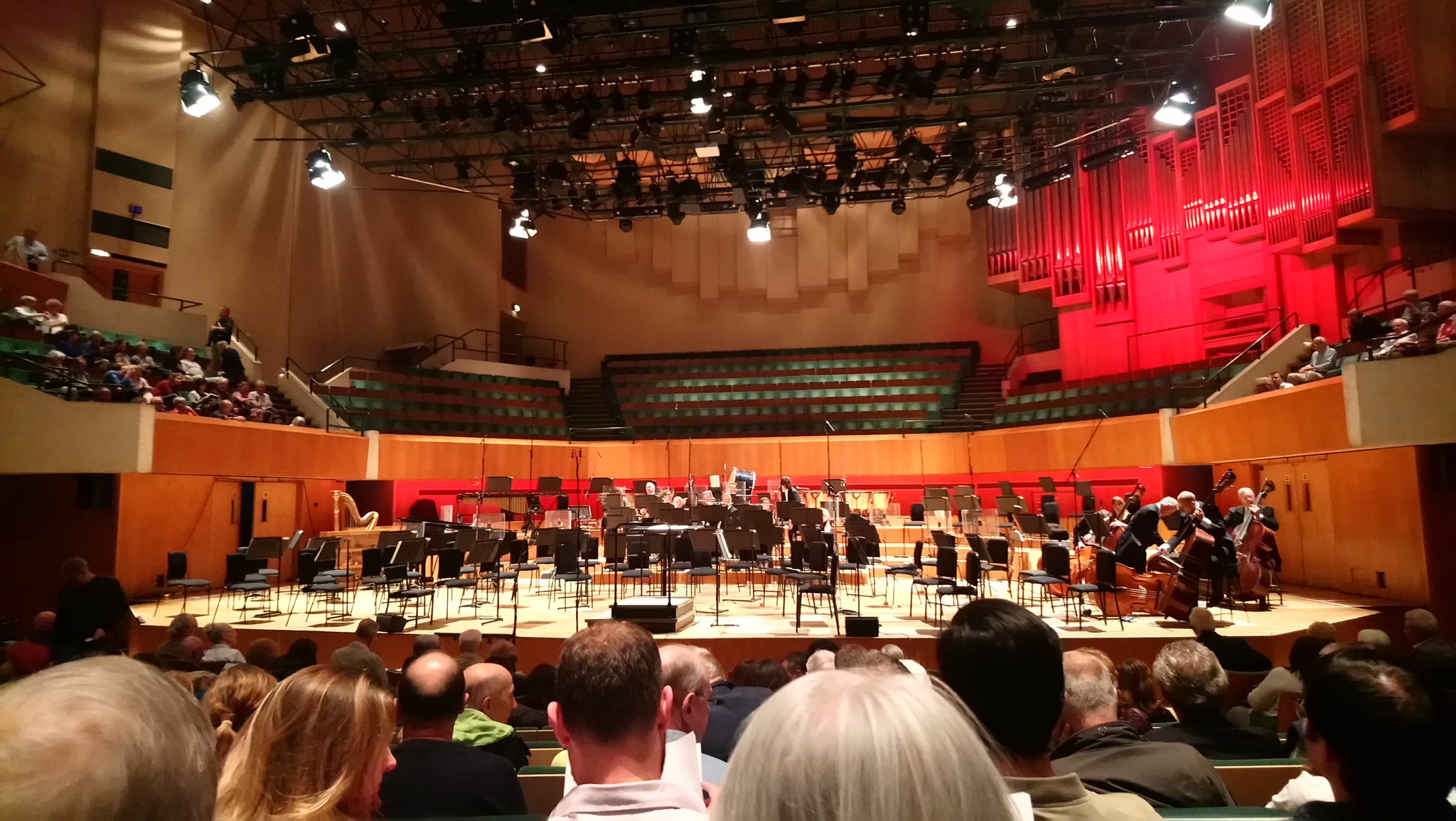
Last night I took my seat in St David’s Hall for a concert by the BBC National Orchestra of Wales under the direction of Principal Conductor Thomas Søndergård. It was an all-Russian menu, and very enjoyable it was.

The first course was the Violin Concerto by Pyotr Ilyich Tchaikovsky. It’s a familiar work but it was ravishingly played by Latvian soloist Baiba Skride, who seemed to revel in the virtuosic elements of this work, as well as bringing out the lyricism in the more romantic passages. The Orchestra were on top form too. I particularly enjoyed the way they dealt with the introduction of the famous `big tune’ in the first movement: brisker and with less of the tendency to wallow in it than you find in many performances.

Then, after the wine break, we had the main dish for the evening, the Symphony No. 5 by Dmitri Shostakovich. This is a very famous work and is perhaps the most accessible of all the Shostakovich symphonies. It was an immediate success with Soviet critics and public alike when it was first performed in 1937, and though it marked Shostakovich’s return to favour with the authorities after his denunciation by Stalin, this work has the composer’s very characteristic sense of things not being quite as they seem on the surface. Indeed, in this and many other of his compositions, he seems to manage to say one thing at the same time as saying the exact opposite of that thing; nowadays this might be called `constructive ambiguity’. This is especially in the finale, in which the sense of triumph is almost a parody of itself. Overall the Fifth Symphony is a sombre work, the dark undertone established right at the start with an imposing theme on the cellos and double basses, but it has passages of great beauty too, especially in the slow third movement. Like all great symphonies – and this is one of the greatest – it takes you on a journey full of of excitement and interest. The 45 minutes or so of this performance seemed to fly by, and its ending was greeted with rapturous applause and a standing ovation from many in the audience.

It’s interesting to consider that only 60 years had elapsed between the composition of these two pieces, but what different worlds they represent!

Anyway, the full strength National Orchestra of Wales, produced a gripping performance of this tremendous work with every section playing at the top of its form and the finale really brought the house down. But you don’t have to take my word for it – the whole concert will be broadcast on BBC Radio 3 next Tuesday, 12th June.

This concert is the last of the BBC National Orchestra of Wales season at St David’s Hall and indeed the last of at St David’s with Thomas Søndergård as Principal Conductor (though he will be conducting the Orchestra a couple of times at the Proms this summer). I wish him all the very best for his future musical adventures. It’s also the last concert by the BBC National Orchestra of Wales I’ll be attending before departing for Ireland. I don’t think I’ll get much chance to hear them after I’ve relocated, so let me take this opportunity to thank every single member of the Orchestra for the many performances I’ve enjoyed over the years, and to wish them well for the future.

History of astronomy – reading the classics

Posted in History, The Universe and Stuff on June 7, 2018 by telescoper

I’m sharing this excellent blog post here on this blog for the edification and benefit of anyone interested in the history of astronomy as it contains a really useful list of references and comments related thereto!

thonyc's avatarThe Renaissance Mathematicus

Most non-specialists get their knowledge of the history of astronomy from general surveys of the subject or from even more general surveys of the history of science. The information contained in these on Ptolemaeus, Copernicus and the other boys in the history of astronomy band is often from secondary if not tertiary or even quaternary sources and as a result also often inaccurate if not completely false. The solution to this problem is of course to read the originals but not all of us are blessed with the linguistic abilities necessary to tackle second century Greek or Early Modern Latin, to say nothing of Galileo’s seventeenth century Tuscan. However, the current scholar interested in the classical texts from the history of astronomy is blessed with modern, annotated English translations of these and in this post I want to briefly present these and some secondary literature to assist in understanding them.

View original post 1,650 more words

Captain James Doohan

Posted in History, Television with tags , , , , , on June 6, 2018 by telescoper

The pictures above are photographs of a young Captain James Doohan of the Royal Canadian Artillery.

Doohan was in action on D-Day where he served with exceptional courage and distinction during the assault on Juno beach. He killed two enemy snipers and successfully led his men on foot through a minefield. Doohan was then hit six times by machine gun fire, 4 times in the leg, once in the finger, and once in the chest. The latter round would probably have killed him but for the cigarette case he had in his tunic pocket which deflected the bullet.

In case you haven’t yet realised, after the war was over, James Doohan became an actor, best known for the role of ‘Scotty’ in the TV series Star Trek…

Captain James Doohan was just one of around 160,000 officers and men who took part in the invasion of Normandy that began on 6th June 1944.

Another, not now famous, whose name along with many others, I came across this morning while waiting for my plane, was a George Jones of No 4 Commando who landed at Ouistreham (Sword beach) with the 1st Special Service Brigade around 7.30am on D-Day. Between the beach and Pegasus Bridge, four miles inland, his unit was constantly under fire and all but 80 of his 500 comrades were killed or wounded.

George Jones, James Doohan and countless other brave men like them were fighting to liberate a continent from Nazi tyranny. It is to our shame that so many today who owe their freedom to the sacrifices of an earlier generation are once again marching to the fascist drum.