Archive for July, 2018

Nature After Planck…

Posted in Maynooth, The Universe and Stuff with tags , , , , , , on July 24, 2018 by telescoper

After last week’s short update about the last tranche of papers from the European Space Agency’s Planck Mission it’s time for another short update about a piece in Nature (by David Castelvecchi) that explains how researchers are moving to smaller projects studying different aspects of the cosmic microwave background.

In the spirit of gratuitous self-promotion I should also mention that there’s a little quote from me in that piece. My comment was hardly profound, but at least it gets Maynooth University a name check…

Much of Davide’s piece echoes discussions that were going on at the meeting I attended in India  last October, but things have moved on quite a bit since then at least as far as space experiments are concerned. In particular, the proposed Japanese mission Litebird has been shortlisted for consideration, though we will have to wait until next year (2019) at the earliest to see if it will be selected. An Indian mission, CMB-Bharat, has also emerged as a contender.

While the end of Planck closes one chapter on CMB research, several others will open. These are likely to focus on polarization, gravitational lensing and on cosmic reionization rather than refining the basic cosmological parameters still further.

Farewell to Brexit Britain

Posted in Biographical, Politics with tags , , on July 23, 2018 by telescoper

I popped into the office at Cardiff University today to finish off one piece of outstanding business I didn’t have time to complete on Friday and to collect the last of my possessions – including a number of bottles of wine! – before flying to Ireland tomorrow morning.

I couldn’t resist doing a quick post about the chaotic state of UK politics towards Brexit. For all the turmoil of the past two weeks, In a sense nothing has changed since I wrote about this almost exactly a year ago. The so-called `Chequers Plan’ was greeted with predictable disdain by the EU negotiators who must be exasperated that Theresa May seems not to have understood anything that’s said about the European Single Market for the last two years, as well as signalling that she wanted to renege on agreements already reached in December. And then we had the new Brexit Secretary, Dominic Raab, announcing that he intended that the UK would not pay its outstanding bills if a Trade Deal were not agreed, despite the UK having agreed to this months ago too.

All this is consistent with what I have always felt would be this government’s approach to the Brexit negotiations, which is not to negotiate at all. Their plan, as it has always been, is just to go through the motions until they able to find some pretext to storm out, blaming the EU for trying to bully them. The staged walkout will probably happen in October, after a summer media offensive against the EU supported by propaganda pieces in the Daily Express, Mail and Telegraph. That is, I believe, the Government’s plan. The new Foreign Secretary more or less said so today. It is why Theresa May called a snap election, hoping to build up a larger majority and a full parliamentary term to withstand the inevitable backlash. That gamble backfired, but the Conservatives are still in power and the plan remains in place.

This strategy might just allow the Tories to cling onto power while the economy suffers as we crash out of the EU in the most disorderly fashion possible. This will not only cause chaos for trade and commerce but will also be awful for for EU residents in the UK and UK residents in the EU. Above all, it will show that the UK government has not been acting in good faith at all throughout the process, and will ensure for generations to come that the United Government is entirely untrustworthy. And that’s before you even consider the fact that the 2016 referendum has now been demonstrated beyond all reasonable doubt to have been crooked, due to unlawfully excessive spending by both Leave campaigns, and other dirty tricks such as illegal use of personal data.

So why has the Government decided to adopt this position? Simple. It does not have the wherewithal even to formulate a negotiating position, let alone deliver a successful outcome., because no possible end result can deliver the economic and political benefits of remaining in the European Union. If we’re going to make people suffer, the reasoning goes, we might as well find a scapegoat to deflect criticism away from our poor choices.

And what about the EU position? Well, they hold all the cards so they won’t be worried. Their priority will be to take over all the business opportunities that we have decided we no longer want. Whatever happens with the negotiations, the UK leaves the EU in March 2019. That’s plenty of time for EU companies to relocate their operations to mainland Europe, to write British producers out of their supply chains, and to expand its portfolio of trade agreements to the further disadvantage of the UK economy, like it has recently done with Japan.

The UK government views my new home, Ireland, as the Achilles Heel of the European Union. Things could get very tough in the Republic when the UK crashes out of the EU, no doubt to the delight of the Tory party’s henchmen in the DUP. But even if that is the case I’d much rather be living in Ireland than in Brexit Britain. Just as a xenophobic backward-looking insular and authoritarian agenda grips the UK, Ireland is moving in the opposite direction, towards a modern outward-looking progressive liberal democracy.

Oh, and if you’re an academic who is as fed up with the UK as I am, take a look at Science Foundation Ireland’s Future Research Leaders scheme. Maynooth University is particularly keen to welcome applicants to the Scheme!
On Bendy Thumbs

Posted in Biographical with tags , , on July 22, 2018 by telescoper

My thumbs can bend backwards about 90 degrees, a property known as distal hyperextensibility or, less formally, ‘hitchhiker’s thumb’.

I don’t know of any particular advantage or disadvantage of having bendy thumbs, although it does make holding a clarinet or soprano saxophone a little awkward, as the thumbs are used to support the instrument when it is played. The only useful thing I can think of is the comedy value of seeing people freak out when they see the bendy thumbs in action.

I don’t think this ‘condition’ has been studied very much, but I am given to understand that somewhere between 15 and 30% of the population has bendy thumbs. The property is inherited and is commonly believed to be controlled by a single gene with two alleles, one for ‘straight’ and one for ‘bendy’ ; the one expressing bendiness being recessive explains why straight thumbs are more common. I now realise, however, that this is not the case. For one thing, it seems that thumb bendiness is not a simple binary property. That also makes it difficult to define it for statistical purposes: what angle of bend do you choose to classify a thumb as bendy?

I also have blue eyes, which is another recessive trait, but it has been known for some time that eye colour is not controlled by a single gene.

Glamorgan versus Somerset: Vitality Blast Twenty20

Posted in Cardiff, Cricket, Uncategorized on July 20, 2018 by telescoper

After a little drinks reception in the School of Physics and Astronomy (at which I was given a very nice gift of wine) I joined the staff outing to Sophia Gardens to watch this evening’s Twenty20 cruise cricket between Glamorgan and Somerset.

The start was delayed by rain so we lingered in a pub on the way only to be caught on the hop when play actually started and missing the first few overs. Somerset batted well to reach 190 off their 20 overs, with Anderson hitting four big sixes in his 59.

Without Shaun Marsh, who will miss the rest of the season, the Glamorgan batting lineup seemed to have a very long tail and a lot rested on Khawaja and Ingram. Both scored runs quickly while they were in but neither could build a big score. Once those two were out, the Glamorgan innings faltered and they never looked like reaching Somerset’s total. The finished on 160 for 9, losing by 30 runs.

After Graduation

Posted in Biographical with tags , on July 20, 2018 by telescoper

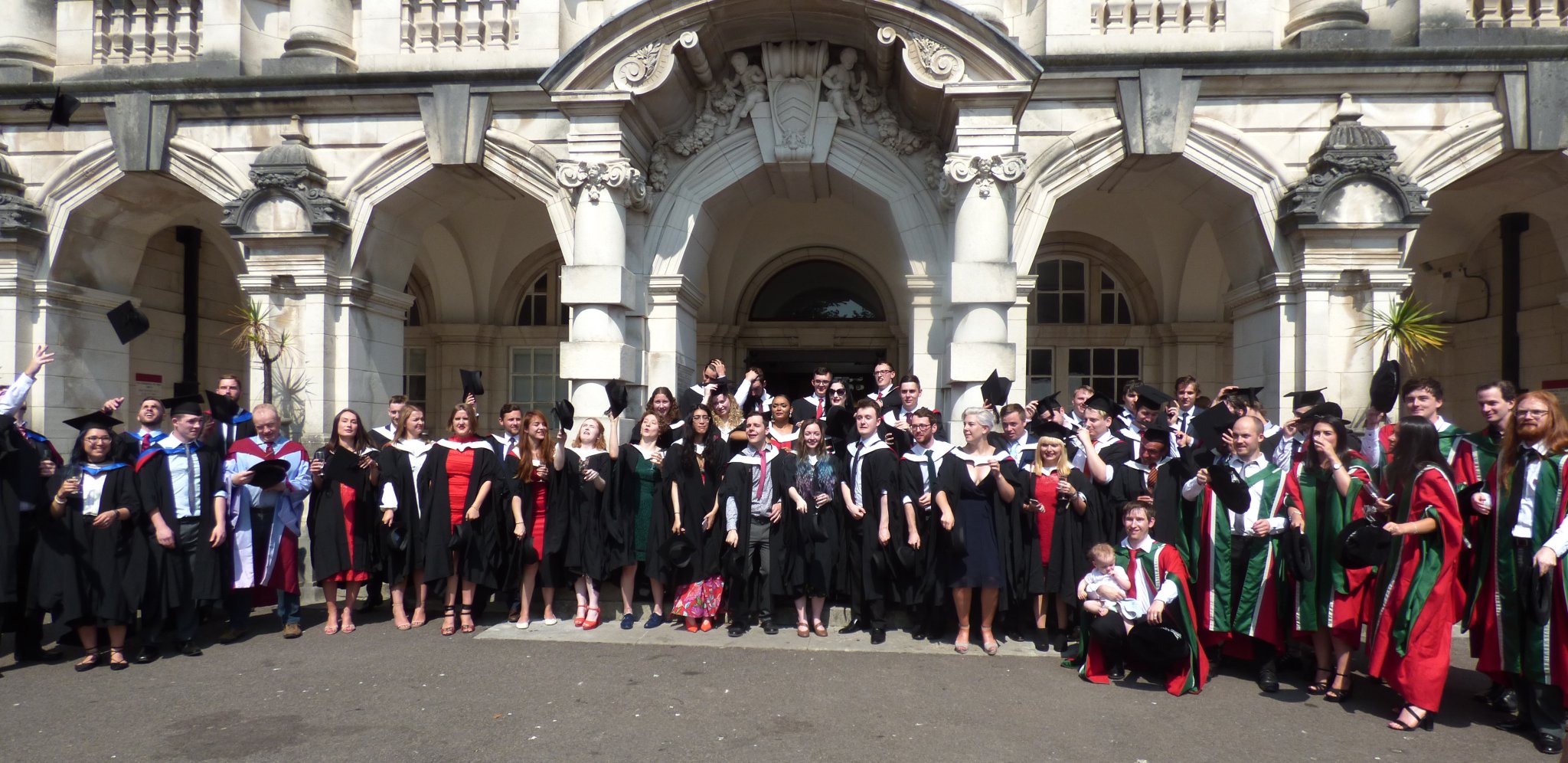
I didn’t get time to blog yesterday as I was involved with various festivities to with the graduation of students from the School of Physics & Astronomy at Cardiff University who, for some reason, shared a ceremony with students from the School of History, Archaeology and Religion. The ceremony was more-or-less my last official duty here at Cardiff. This morning I backed up my computer, returned my keys and removed my boxes of books and other stuff from the office of the Data Innovation Research Institute back to my house. This afternoon I gather there’ll be a small event to celebrate my departure, after which there’s a staff trip to see the cricket at Sophia Gardens (Glamorgan versus Somerset in the Vitality Blast).

Yesterday’s ceremony started at 12 noon and, as usual, was in St David’s Hall in Cardiff. When it was over we adjourned to the Main Building for a reception at which we were informed there would be `unlimited Prosecco’. This turned out to be untrue, as the Prosecco ran out by about 5pm, at which point we moved to a local pub and thence for a late-night curry. It was all a bit excessive and I had a not inconsiderable hangover this morning. I suspect that was the case for many of the graduands too!

It was a very hot with all the graduation clobber, which is no doubt why such a large volume of liquid refreshment was consumed. The drinks were dispensed in a marquee which was sweltering inside. Anyway, here’s a pic of some of those students who received their degrees yesterday. I was actually there, but just out of shot to the right.

Graduation ceremonies are funny things. With all their costumes and weird traditions, they even seem a bit absurd. On the other hand, even in these modern times, we live with all kinds of rituals and I don’t see why we shouldn’t celebrate academic achievement in this way. I love graduation ceremonies, actually. As the graduands go across the stage you realize that every one of them has a unique story to tell and a whole universe of possibilities in front of them. How their lives will unfold no-one can tell, but it’s a privilege to be there for one important milestone on their journey.

I always find graduation a bittersweet occasion. There’s joy and celebration, of course, but tempered by the realisation that many of the young people who you’ve seen around for three or for years, and whose faces you have grown accustomed to, will disappear into the big wide world never to be seen again.

Graduation of course isn’t just about dressing up. Nor is it only about recognising academic achievement. It’s also a rite of passage on the way to adulthood and independence, so the presence of the parents at the ceremony adds another emotional dimension to the goings-on. Although everyone is rightly proud of the achievement – either their own in the case of the graduands or that of others in the case of the guests – there’s also a bit of sadness to go with the goodbyes. It always seems that as a lecturer you are only just getting to know students by the time they graduate, but that’s enough to miss them when they go.

Anyway, all this is a roundabout way of saying congratulations once more to everyone who graduated yesterday, and I wish you all the very best for the future!

Ongoing Hubble Constant Poll

Posted in The Universe and Stuff with tags , , , , on July 18, 2018 by telescoper

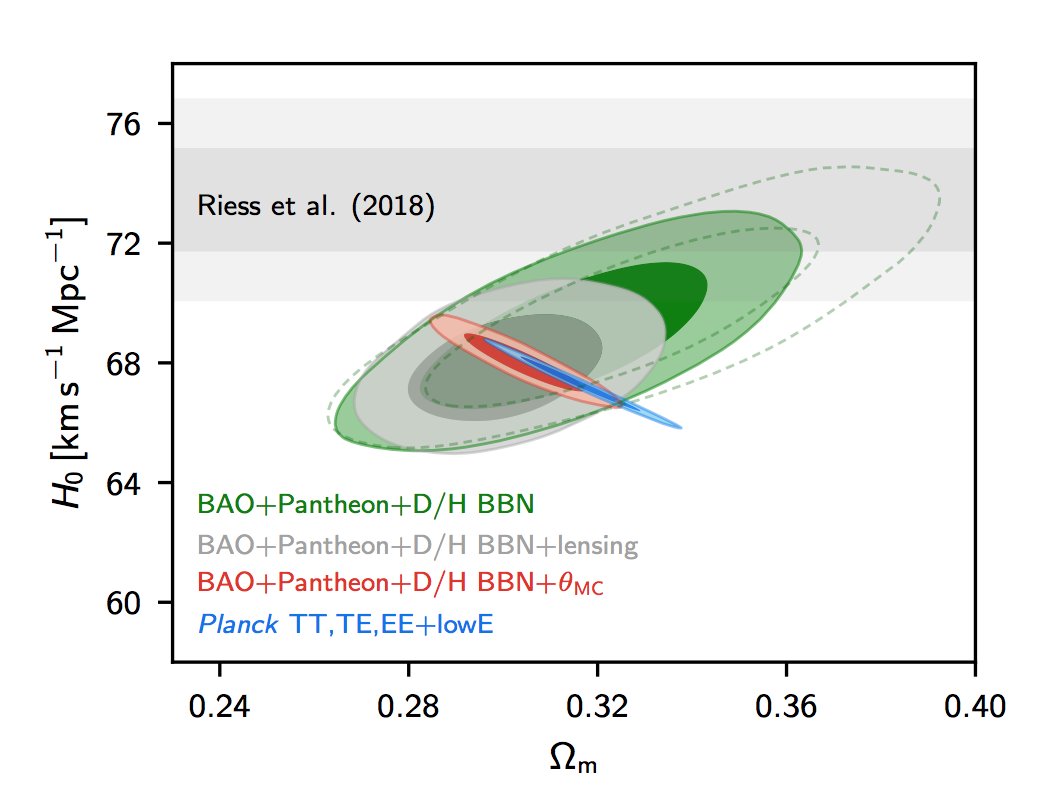
Here are two interesting plots that I got via Renée Hložek on Twitter from the recent swathe of papers from Planck The first shows the `tension’ between Planck’s parameter estimates `direct’ measurements of the Hubble Constant (as exemplified by Riess et al. 2018); see my recent post for a discussion of the latter. Planck actually produces joint estimates for a set of half-a-dozen basic parameters from which estimates of others, including the Hubble constant, can be derived. The plot  below shows the two-dimensional region that is allowed by Planck if both the Hubble constant (H0) and the matter density parameter (ΩM) are allowed to vary within the limits allowed by various observations. The tightest contours come from Planck but other cosmological probes provide useful constraints that are looser but consistent; `BAO’ refers to `Baryon Acoustic Oscillations‘, and `Pantheon’ is a sample of Type Ia supernovae.

You can see that the Planck measurements (blue) mean that a high value of the Hubble constant requires a low matter density but the allowed contour does not really overlap with the grey shaded horizontal regions. For those of you who like such things, the discrepancy is about 3.5σ..

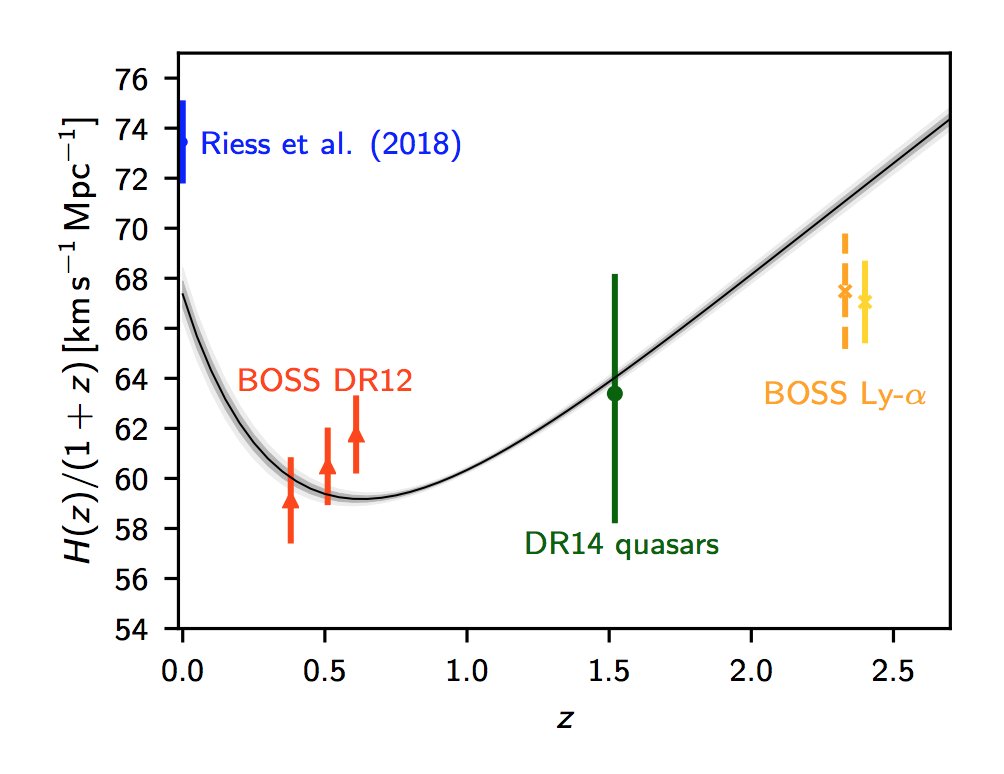
Another plot you might find interesting is this one:

The solid line shows how the Hubble `constant’ varies with redshift in the standard cosmological model; H0 is the present value of a redshift-dependent parameter H(z) that measures the rate at which the Universe is expanding. You will see that the Hubble parameter is larger at high redshift, but decreases as the expansion of the Universe slows down, until a redshift of around 0.5 and then it increases, indicating that the expansion of the Universe is accelerating.  Direct determinations of the expansion rate at high redshift are difficult, hence the large error bars, but the important feature is the gap between the direct determination at z=0 and what the standard model predicts. If the Riess et al. 2018 measurements are right, the expansion of the Universe seems to have been accelerating more rapidly than the standard model predicts.

So after that little update here’s a little poll I’ve been running for a while on whether people think this apparent discrepancy is serious or not. I’m interested to see whether these latest findings change the voting!

Ireland And The Roman Empire. Modern Politics Shaping The Ancient Past?

Posted in History with tags , , , on July 18, 2018 by telescoper

I’m here in Dublin Airport, not far from Drumanagh, the site discussed in the following post. I’m on my way back to Wales for, among other things, tomorrow’s graduation ceremony for students from the School of Physics & Astronomy at Cardiff University.

I thought I’d reblog the post here because it’s very interesting and it follows on from a comment thread relating to my post a few days ago about the current drought in Ireland which has revealed many previously unknown features of archaeological interest, and the (unrelated but also recent) discovery of a 5500 year-old passage tomb in County Lowth.

The site at Drumanagh is not related to either of those new discoveries, but it is fascinating because of the controversy about whether or not it is evidence of a Roman invasion of Ireland in the first century AD. I think the idea that no Romans ever set foot in Ireland during the occupation of Britain is hard to accept given the extensive trading links of the time, but there’s no evidence of a full-scale military invasion or lengthy period of occupation. The only unambiguously Roman finds at Drumanagh are coins and other artefacts which do not really indicate a military presence and there is no evidence there or anywhere else in Ireland of the buildings, roads or other infrastructure that one finds in Roman Britain.

My own opinion is that the Drumanagh site is more likely to have been some sort of trading post than a military fort, and it may even be entirely Celtic in origin. The position and overall character of the site seems more similar to Iron Age promontory forts than Roman military camps. I am, however, by no means an expert.

You can find a description of the Drumanagh site in its historical context here.

An Sionnach Fionn's avatarAN SIONNACH FIONN

Way back in 1996, the Sunday Times newspaper in Britain ran an enthusiastic if awkwardly-phrased banner headline proclaiming that a “Fort discovery proves Romans invaded Ireland”. The “fort” in question was an archaeological site in north County Dublin known as Drumanagh, situated on a wave-eroded headland near the coastal village of Loughshinny. Nearly 900 metres long and 190 metres wide, the monument consists of a trio of parallel ditches protecting an oblong thumb of land jutting out into the ocean, the seaward sides of the irregular protrusion relying on the waters of the Irish Sea for defence. The location is fairly typical of a large number of Iron Age promontory settlements found in isolated spots throughout the country. However what made the area at Drumanagh of particular interest was the significant number of Roman artefacts found within its fields.

Unfortunately a comprehensive archaeological survey of the site has yet to be published due to questions over property rights and compensatory payments for finds, meaning most discoveries from the location have come through agricultural work or destructive raids by…

View original post 1,387 more words

Planck’s Last Papers

Posted in The Universe and Stuff with tags , , , , on July 17, 2018 by telescoper

Well, they’ve been a little while coming but just today I heard that the final set of a dozen papers from the European Space Agency’s Planck mission are now available. You can find the latest ones, along with the all the others, here.

This final `Legacy’ set of papers is sure to be a vital resource for many years to come and I can hear in my mind’s ear the sound of cosmologists all around the globe scurrying to download them!

I’m not sure when I’ll get time to read these papers, so if anyone finds any interesting nuggets therein please feel free to comment below!

Georges Lemaître: Google Doodle Poll

Posted in History, The Universe and Stuff with tags , , , , on July 17, 2018 by telescoper


I noticed this morning that today’s Google Doodle (above) features none other than Georges Lemaître. That reminded me that a while ago I stumbled across a post on the Physics World Blog concerning a radio broadcast about Georges Lemaître.

Here’s a description of said programme:

Few theories could claim to have a more fundamental status than Big Bang Theory. This is now humanity’s best attempt at explaining how we got here: A Theory of Everything. This much is widely known and Big Bang Theory is now one of the most recognisable scientific brands in the world. What’s less well known is that the man who first proposed the theory was not only an accomplished physicist, he was also a Catholic priest. Father Georges Lemaître wore his clerical collar while teaching physics, and not at Oxford, Cambridge or MIT but at the Catholic University of Leuven in Belgium. It was this unassuming Catholic priest in an academic backwater who has changed the way we look at the origins of the universe. His story also challenges the assumption that science and religion are always in conflict. William Crawley introduces us to the “Father” of the Big Bang.

The question is whether the word “Father” in the last sentence should be taken as anything more than a play on the title he’d be given as a Catholic priest?

Lemaître’s work was indeed highly original and it undoubtedly played an important role in the development of the Big Bang theory, especially in Western Europe and in the United States. However, a far stronger claim to the title of progenitor of this theory belongs to Alexander Alexandrovich Friedman, who obtained the cosmological solutions of Einstein’s general theory of relativity, on which the Big Bang model is based, independently of and shortly before Lemaître did. Unfortunately the Russian Friedman died in 1925 and it was many years before his work became widely known in the West. At least in my book, he’s the real “father” of the Big Bang, but I’m well aware that this is the source of a great deal of argument at cosmology conferences (especially when Russian cosmologists are present), which makes it an apt topic for a quick poll:

P.S. I prefer to spell Friedman with one “n” rather than two. His name in his own language is Алекса́ндр Алекса́ндрович Фри́дман and the spelling “Friedmann” only arose because of later translations into German.

Hair pursued by two planets

Posted in Art with tags , , on July 16, 2018 by telescoper

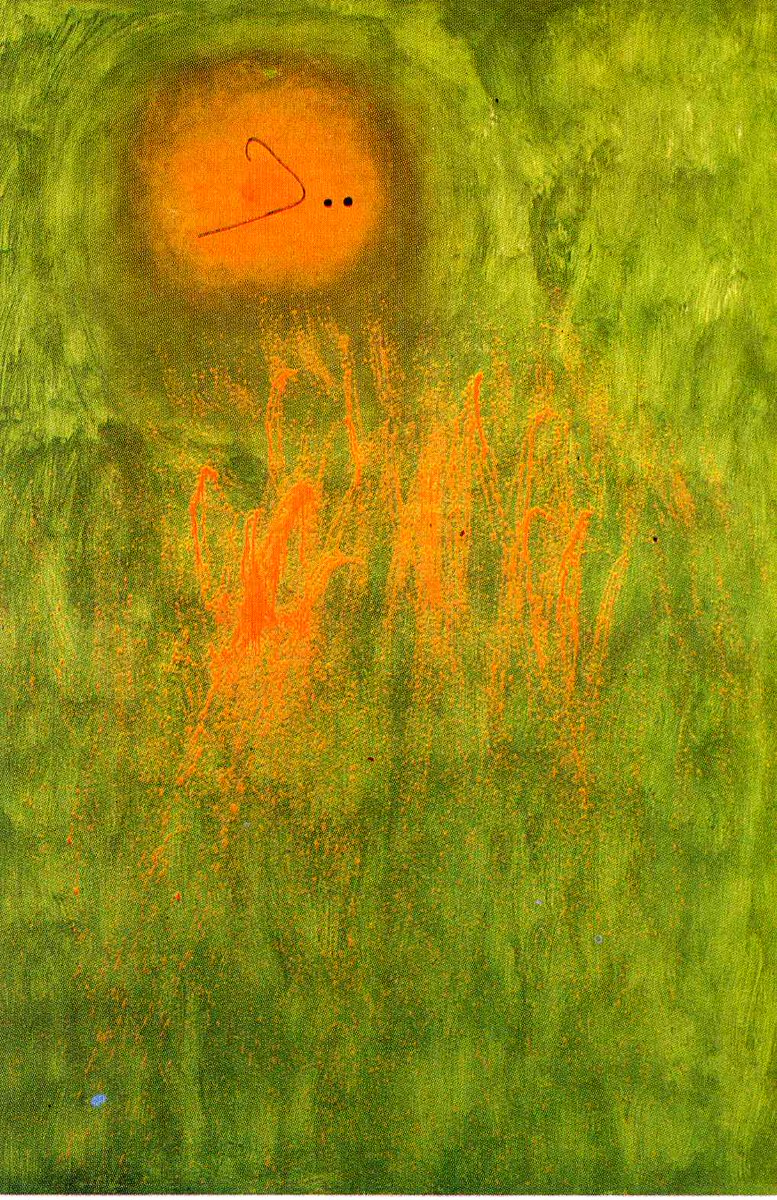
Joan Miró (1893-1993), painted in 1968. Oil and acrylic on canvas, 195 X 130 cm (Fundació Joan Miró, Barcelona). Original title: Cabell perseguit per dos planetes.