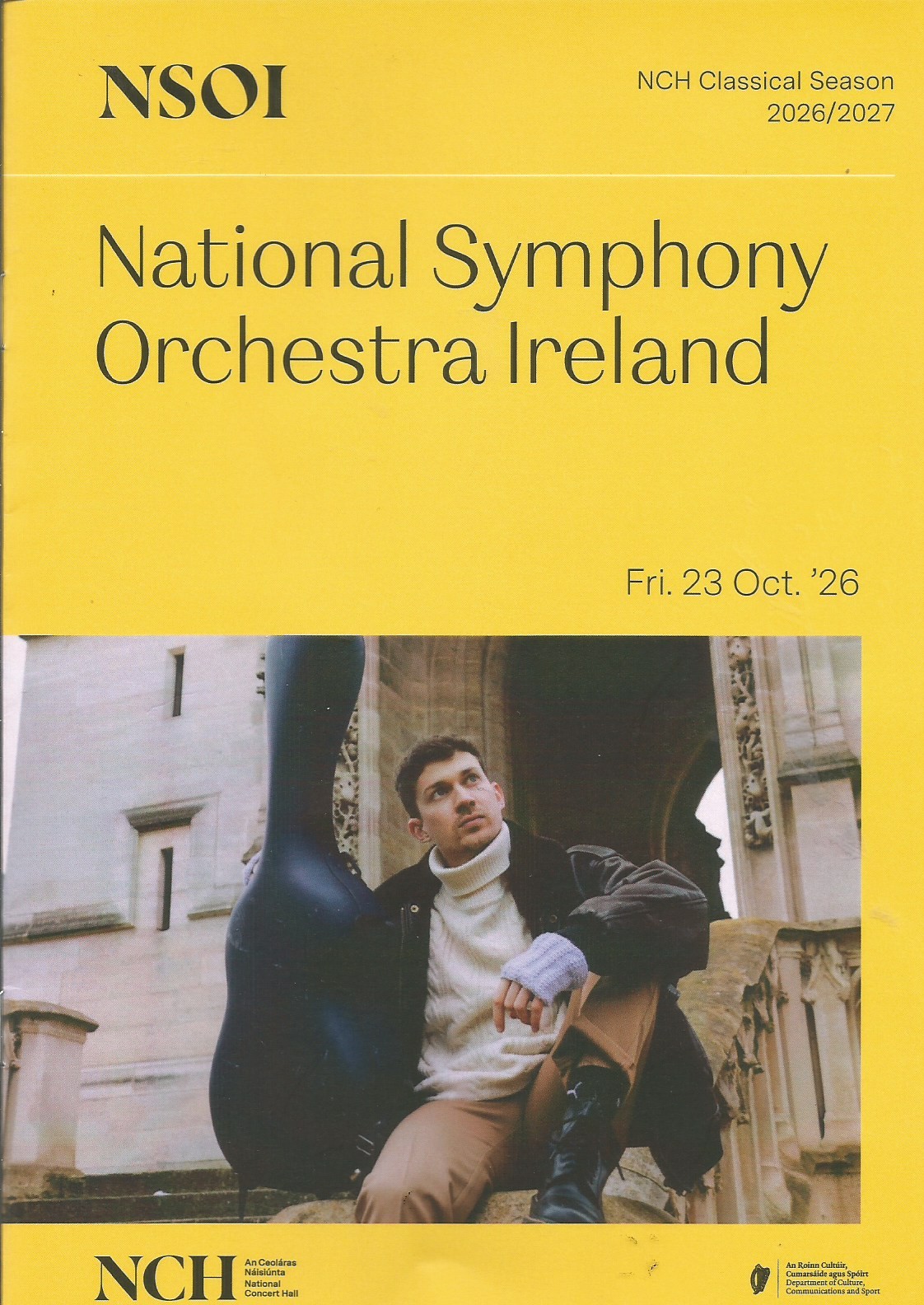
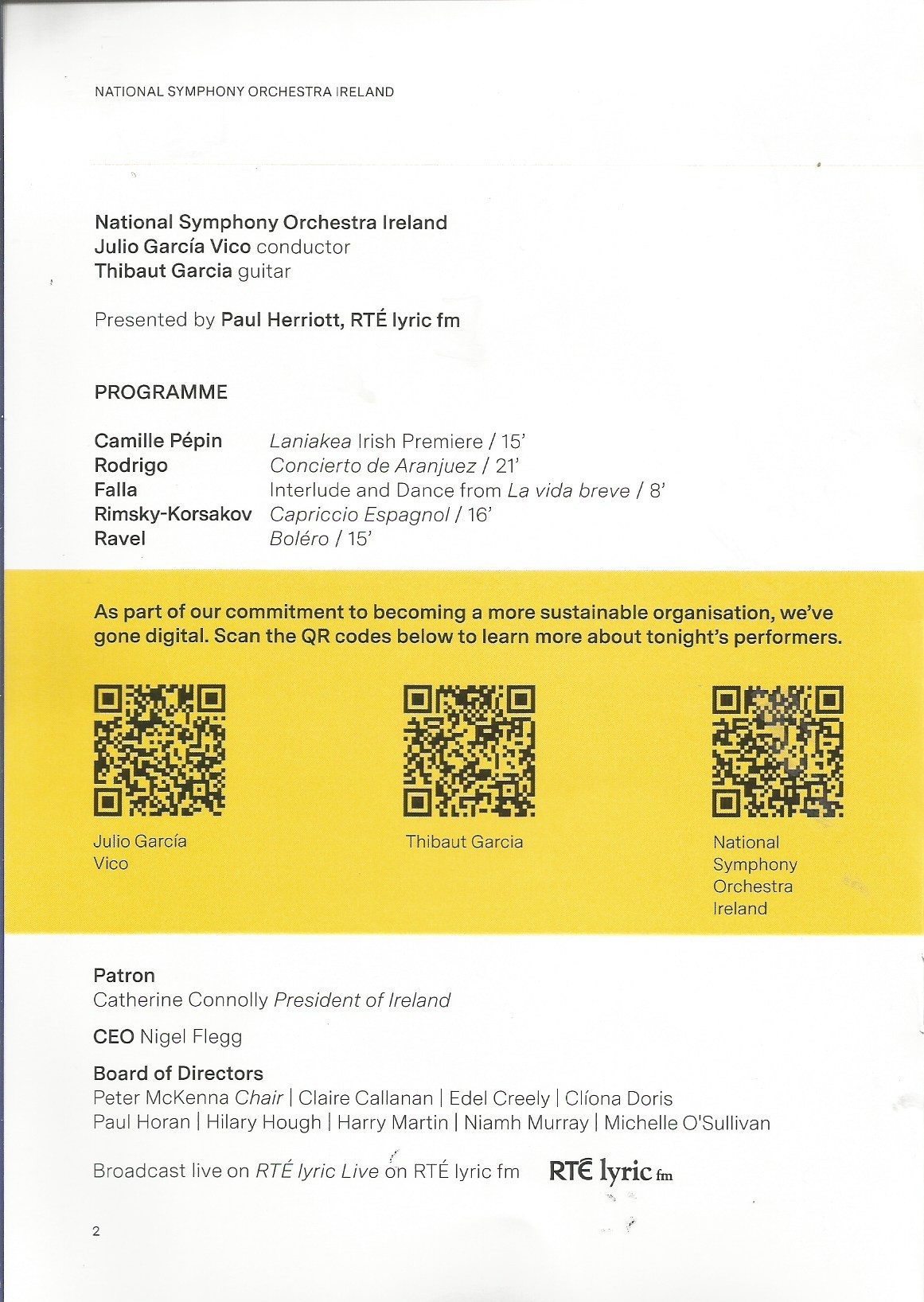
Last night I travelled into Dublin for another concert by National Symphony Orchestra Ireland, this time under the direction of guest conductor Julio García Vico in a programme of music heavy with French and Spanish influences.
The undoubted star of the show was classical guitarist Thibaut Garcia, who is French but has Spanish ancestry, who played the Concierto de Aranjuez by Joaquin Rodrigo. I’ve loved this piece for ages, and have several recordings of it, but although it’s been a familiar part of the concert repertoire ever since it was composed in 1939, I’ve never heard it played live. Last night’s performance was stunningly beautiful, one of those occasions on which it was a privilege just to be there. I loved the way he played the first movement Allegro con Spirito with poise and precision but without a hint of punctiliousness. The famous second movement Adagio gives the soloist much more latitude for interpretation, and Garcia’s version was very different from others I’ve heard. The music here evokes a sense of nostalgia, which comes with both joy and melancholy. I think in too many performances melancholy has the upper hand, but last night we really felt the joy. The final movement, Allegro gentile, contains a playful series of call-and-answer sequences set against varied rhythmic backgrounds. I adored this performance.
I noticed while he was playing that Thibaut Garcia has hyperextensible thumbs (as do I) and, as I went to the bar for my interval drink, I found myself wondering whether having bendy thumbs was an advantage for playing classical guitar. You could have knocked me down with a feather when, as I was returning to my seat after the wine break, that the man himself was sitting in the seat right behind mine preparing to listen to the second half of the concert. I couldn’t resist telling him how much I enjoyed the performance and mentioned his thumbs. It must be very irksome for an artist when strange people intrude awkwardly like that, but he was absolutely charming. After a brief comparison of thumbs, I sat down and left him alone. I was too starstruck to ask him whether distal hyperextensibility is a plus when it comes to playing the guitar. Perhaps someone can offer an opinion through the comments?
Anyway, it would be remiss not to mention the rest of the programme, which contained a great of interest. The first piece, for example, Laniakea by Camille Pépin is inspired by our Local Supercluster of galaxies which astronomers have named Laniakea, an Hawaiian word meaning “immeasurable heaven”.
The programme after the interval contained energetic and colourful performances of music from the opera La Vida Breve by Manuel de Falla, the Capriccio Espagnol by Nikolai Rimsky-Korsakov and, for the finale, the famous Bolero by Maurice Ravel. All these were played very well, but the first half was so wonderful that it was always going to be impossible for the second half to match it.


