Archive for August, 2018

Summer Repeats, Removals and Research

Posted in Uncategorized on August 8, 2018 by telescoper

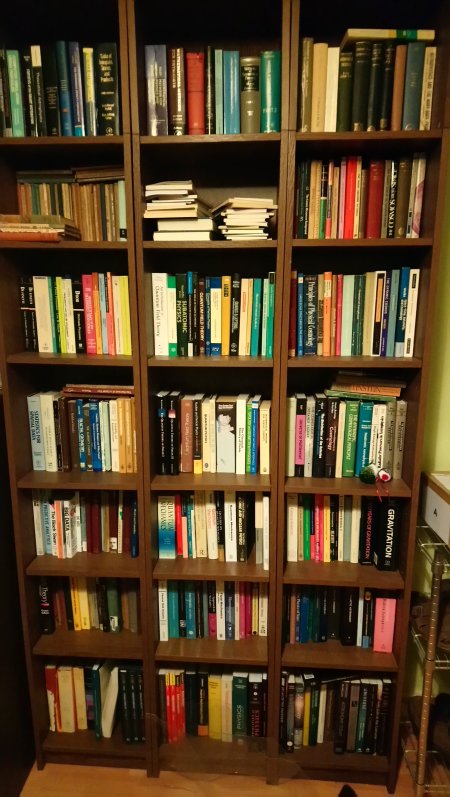
For those people who think the summer is one long holiday for academics, I’m using a narrow window in my calendar to pack, and supervise the removal from Cardiff to Ireland of, some of these:

There will be about 30 boxes of books to ship. I have more than that, but I’m only moving my technical books for now; the novels, poetry, dictionaries, and other stuff will stay until I buy a house in Ireland.

I also have three or four boxes of old lecture notes. I almost threw these out when I left Sussex two years ago ago. I. thought I wouldn’t need them again because I was planning to take early retirement. Now things have changed and they might prove very useful.

In September I start to teach two new courses at Maynooth, one of which (Vector Calculus and Fourier Series) has similar content to modules I’ve previously taught in Sussex and Cardiff so hopefully I can use some of the notes and examples instead of starting entirely from scratch. That’s for students in their second year at Maynooth. The other new module is on Astrophysics and Cosmology for final-year students and I also have material for that. I’m looking forward to that as it is closest to my own research interests.

Anyway before I can start preparing for the new academic year there is the end of the old one to take care of. Coming up next week are the repeat (resit) examinations which have to be marked pronto so the relevant students know if they can continue in September.

And then there’s the small matter of research. I have two papers to write up {and one project which I’m stuck with) that I wanted to finish this summer .

Oh, and the new edition of my book Cosmology: A Very Short Introduction needs finishing off. And a publication for next year’s centenary of the famous Eddington Eclipse expedition. And getting the Open Journal of Astrophysics fully operational.

But, yes, it’s the summer holiday.

Now I’d better get back to work.

Glamorgan versus Essex: Vitality Blast Twenty20

Posted in Cricket with tags , , , , , on August 7, 2018 by telescoper

I’m back in Cardiff for a few days sorting out some logistics, and also to make the most of what remains on my season ticket for Glamorgan cricket club, where I spent this evening.

While my late supper warms in the oven I just have time to post a quick item about this evening’s events at Sophia Gardens.

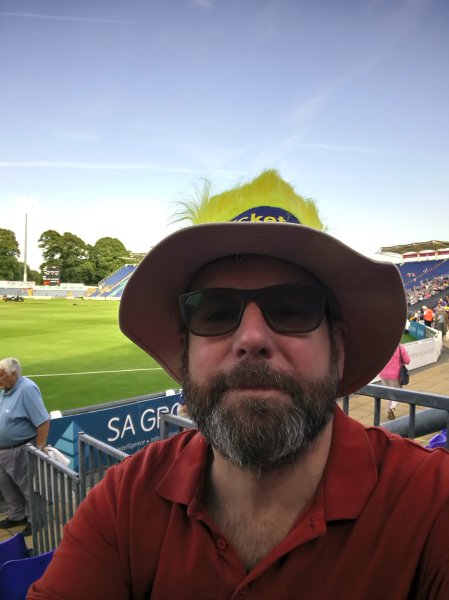
I don’t normally do selfies unless they’re of other people but I’m posting the above one because it made it via Twitter onto the big screen during the match. Fame at last!

Essex won the toss and out Glamorgan into bat. Glamorgan got off to a poor start, losing both openers cheaply. That brought Colin Ingram to the crease and the scoring accelerated, especially when he took apart the hapless Quinn for 30 off one over.

Glamorgan reached 110 for 3 off 11 overs, of which Ingram had scored 85, but they then faltered against good bowling. Ingram fell with the score on 135 for 7, at the start of the 17th over. Essex were on top.

Graham Wagg and Ruaidhri Smith then launched a stunning counter-attack and in the blink of an eye and a flurry of boundaries, Glamorgan were suddenly 198 for 7 off their 20 overs.

It was a good score in the end, but Essex started well with the bat and Glamorgan’s bowlers at first struggled to contain them. Gradually however Glamorgan began to exert some control. Wagg was outstanding in the crucial middle overs.

Pressure built, some wickets fell, but Essex didn’t collapse and kept more or less in touch with wickets in hand and the experienced Bopara at the crease and looking in good form.

The crowd waited anxiously for the climax. Essex needed 48 off the last 3 overs. Then 32 off 2. Then, after an excellent penultimate over from Wagg, 24 from the last. With Ravi Bopara on strike.

Michael Hogan ran into bowl. His first two balls conceded two fours, one a very difficult dropped catch that might have gone for six if the fielder hadn’t got a hand to it. Now it was 16 off 4 balls. The next ball was skied but fell safe for 2 runs. That meant 14 from 3; at least one six needed. Hogan bowled and Bopara obliged, slogging one into the Grandstand.

Eight now needed off two balls. Possible. Nerves jangling around the ground, Hogan bowled again, a very good one. Bopara was beaten and the ball went through to the keeper. A dot ball. A huge cheer went up from the crowd. That was effectively that. An inconsequential single off the last ball meant that Glamorgan won by six runs.

That makes it four wins out of four for Glamorgan, who go 3rd in the table. They now have a good chance of a semifinal place that looked beyond their reach four games ago. Poor old Essex are bottom of the table, with only one win from ten matches.

Walking home just know it occurred to me that as well as ones for fours and sixes they should give out cards to wave when a dot ball is bowled. It’s often those that win matches!

Setting it Straight

Posted in Uncategorized on August 6, 2018 by telescoper

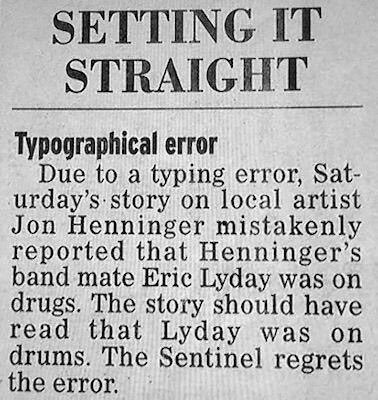
I’m just posting this clipping I found on the interwebs here because (a) it’s funny and (b) I want to test the connection with the new page I’ve had to make on Facebook.

UPDATE: (a) it’s still funny and (b) the connection works.

Brú na Bóinne

Posted in Art, Biographical, History with tags , , on August 6, 2018 by telescoper

Today is Lá Saoire i mí Lúnasa (August Bank Holiday) in Ireland, but I thought I’d pop into the Department at Maynooth University to say farewell to the guests at the Quark Confinement Conference, the last of whom depart today. As I mentioned on Saturday I helped guide a party of around 40 conference participants around the prehistoric sites at Brú na Bóinne.

There’s a huge amount of information on the official website for this site and there’s no point trying to repeat it here, but I will say a few things. First of all, the site is about 5 miles inland (west) along the River Boyne from Drogheda. There is a huge amount of archaeology in the Boyne Valley and it’s impossible to see all of it in the half-day trip we had on Saturday, so we went to just one of the three major megalithic sites in the area, at Knowth. The two other sites are Newgrange and Dowth (where another passage tomb has just been discovered), neither of them far from where we were but we didn’t have time to visit them. In order to restrict numbers, access to all three of these monuments is by guided tour only. You have to take a shuttle bus from the main visitor’s centre, which is near to the oldest site at Newgrange. You could see all three in a day but you need at least an hour at each one to appreciate it fully, plus time to get to and fro by shuttle bus.

Anyway, people do say that the main Knowth monument is the most impressive not least because the main passage tomb has never collapsed. You can see from the above picture that the main structure is surrounded by many smaller structures. The `passage’ is about 40 metres long:

Guests at the site are not allowed into the depths of the site, but there is an antechamber with a display explaining what the interior looks like. The passage is quite constricted and oppressive: anyone over 5 foot tall would have to crouch. It’s also not inconsiderably creepy!

I took the above picture with my mobile phone. Here is one with a better camera and a flash which gives you a better idea of the construction:

Incidentally, this and the other structures nearby are all called `passage tombs’ because evidence of cremation has been found inside them, and (in the case of Knowth) a basin stone on which remains had been placed, but it is generally accepted that they were much more than just graves. They were probably temples of some sort. Each of three major monuments at Knowth, Newgrange and Dowth, has a convincing astronomical alignment but each is different: there are alignments with sunrise at the winter solstice (Newgrange) and summer solstice (Dowth); there are two alignments at Knowth for the two equinoxes.

The people who built these extraordinary buildings are thought to have been the first farmers in Ireland (as opposed to the hunter-gatherers who preceded them). It seems likely that the astronomical alignments were to do with some kind of rituals that marked the seasons of the year; the spring equinox would be associated with planting crops and the autumn equinox with harvesting.

The generally good state of preservation of Knowth is partly accidental: at some point in the Iron Age, a Celtic chief decided to build a fort on top of the main tumulus and dig a ditch around its perimeter. The soil removed from the ditch was used to build an embankment on the inside and that provided protection for the right of about 130 kerbstones that surrounds the tomb. Only three of these are missing. They are weathered and worn, which is hardly surprising given that they are 5000 years old, but can be seen in place:

The stones are all carved in different ways – a complete gallery can be found here – but their meaning is lost. As well as the kerbstones there are pieces of quartz and smooth granite stones like large round pebbles, which may have been used for some sort of ritual magic. There are also carved stones inside the monument, including one thought to depict the moon.

For me, it’s the fact that sites like this are so mysterious that makes them so fascinating. Five thousand years is just the blink of an eye on a geological or astronomical timescale, and no doubt the people who lived at Knowth were not all that different from you or I, but what they have left behind is unknowable. If there is life on Earth in 5000 years’ time, what will they think of our civilization?

The stones used at Knowth came from as far away as County Wicklow. It was once believed that these were lugged overland to their current location (which is in County Meath) but the land would probably have been heavily wooded at that time and it is now thought much more likely they were transported by river and sea, probably using log rafts.

As an added bonus you can climb on top of the monument. The view is grand. This is the view to the South, with the hills North of Dublin visible in the distance.

This is to the West; you can see the River Boyne.

The countryside, as you can see, is lovely. Irish agriculture is much less intensive than in England, with the result that woodland and hedgerows are much more abundant. It’s a pity that in so many minds the name `Boyne’ is just an excuse to use a battle that happened over 300 years ago to stir up sectarian conflict.

Anyway, that will have to do. I will definitely return to Brú na Bóinne in the not-too-distant future as I still have to see Newgrange and Dowth. I thoroughly recommend a trip there to anyone visiting Ireland. The professional guides were really good and the visitor’s centre contains excellent reconstructions of everyday life in the neolithic era.

No doubt for a group of particle physicists the site had a particular resonance:

The Art of Knowth

Posted in Art with tags , on August 4, 2018 by telescoper

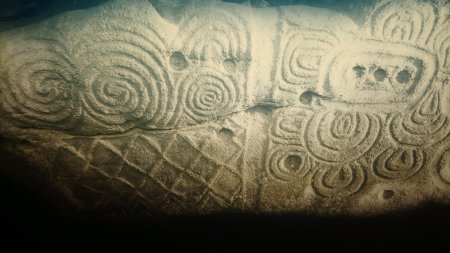
Just back to Maynooth after a fascinating afternoon at the megalithic sites at Brú na Bóinne. I’ll post a few more pictures in due course, but how’s this for an amazing piece of abstract art?

These carvings are on one of the kerb stones that surround the large passage tomb at Knowth. There are about 130 of these stones ringing the main structure and many more inside, all carved differently. Some of the patterns seem to have astronomical significance, but nobody knows exactly what they mean.

These works of art are about 5000 years old and were made by a stone age civilisation that comprised farmers rather than hunter-gatherers.

The Rooks of Maynooth

Posted in Maynooth with tags , , , , on August 3, 2018 by telescoper

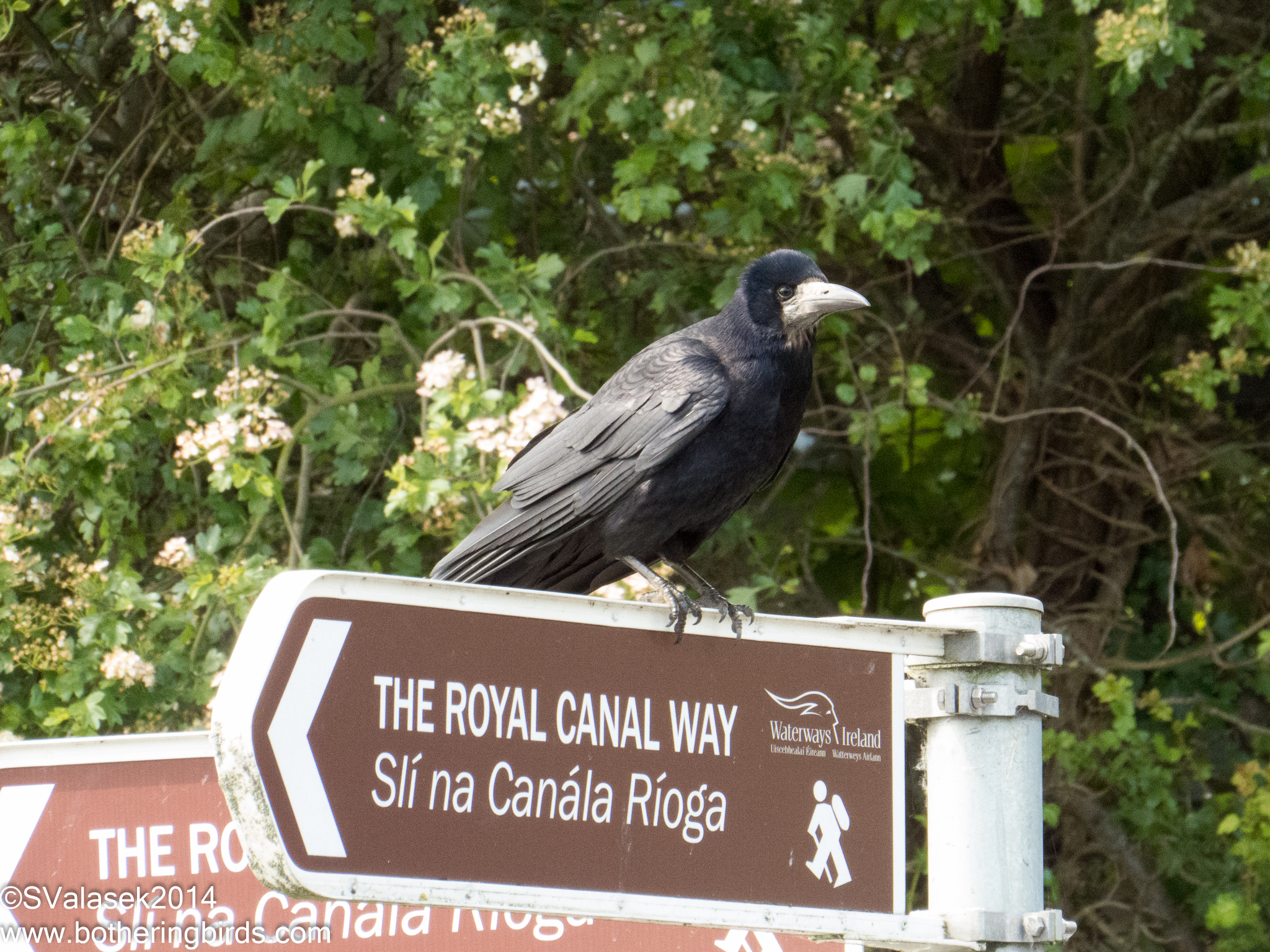
In a previous post I mentioned the proliferation of crows in Maynooth. It turns out that was a terminological inexactitude, in that the birds in question were actually rooks. It’s true that rooks are part of the crow family (genus Corvus, family Corvidae) which also includes ravens and jackdaws but they do have a distinctive look and character. See the above picture (taken in Maynooth but not by me; picture credit here).

The rooks have been prevalent in Maynooth for centuries. A quick google found this quote from 1802 from the poet W.M.Letts:

The men of Maynooth are like o’ the rooks,
With their solemn black coats an’ their serious looks.

This refers to the young men studying at the Roman Catholic seminary of St Patrick’s College, of whom there were 500 or so in those days. The seminarians are somewhat fewer in number now, but the rooks are still plentiful.

I wouldn’t say that rooks are the most visually attractive birds, and they do have a slightly sinister aspect, but they are very characterful creatures and I find them very amusing to watch. They’re very sociable and tend to go about their business in large groups, especially when scouring pieces of open land for insects and other things to eat. They also seem to tolerate the presence of their cousins the jackdaws (of which there are also quite a few in Maynooth, though not as many as the rooks). Jackdaws are a bit smaller, prettier, and neater in appearance than rooks (which often look very scruffy indeed). I imagine that the jackdaws look down on the rooks rather snootily, as one might one’s less sophisticated relatives. The collective noun for rooks is a `Parliament’, which also suggests that they are not held in very high regard.

Like jackdaws, rooks have two modes of locomotion along the ground: a sort of strutting walk and a two-legged hop, both of which are rather comical. Their walk makes them look like officious constables, whereas the hop is more like a child pretending to be a horse. The rooks are basically scavengers and they have a penchant for systematically emptying litter bins in their quest for scraps of food. At the rear of the apartment block in which I live there is a place for storing rubbish for collection in large dumpsters. Sometimes somebody forgets to close the lid with the inevitable result that a large group of rooks gets inside and strews garbage all over the place. When they’re not patrolling around or rooting through rubbish they tend just to sit there watching the world go by, waiting for another opportunity for mischief.

I’m told that, in the old days, the rooks of Maynooth used to gather at the Old Mill, but since that was demolished to make way for a shopping centre they seem mostly to congregate on the playing fields on or near the Royal Canal. Anyway, I’ve got used to them in the short time I’ve been in Maynooth and I always look out for them when I’m walking around.

What prompted me to write this post is that on my way to the Department yesterday morning I came across a dead rook lying on the path. It looked like it had died only recently, as there was no sign of decay. It was well away from the road, so it seemed unlikely it had been hit by a car. I suppose it just died of natural causes.

Long and Short Goodbyes

Posted in Biographical with tags , on August 2, 2018 by telescoper

This morning I discovered that my email account at Cardiff University has been disabled. Obviously the IT Services folk there don’t hang about when somebody leaves! I did get a couple of warnings that this was going to happen, but didn’t expect it quite so soon.

The withdrawal of access to IT services at Cardiff seems a bit abrupt, but I suppose that’s just the policy these days. My employment there has terminated so I don’t think it’s unreasonable that they shut down my email.I guess they just don’t go in for long goodbyes!

Anyway, I know I haven’t always been very good at replying to email recently, but if you email me at Cardiff from now on then I really can’t reply. I can’t even read your message!

This also reminds me that it’s been two years since I left my job as Head of Mathematical and Physical Sciences at Sussex University. I’ve only been back to Brighton once since I left that position. I thought I might have a bit more time to visit there after moving onto a part-time contract at Cardiff, but that didn’t happen.

I was very tearful on my last day at Sussex, and can remember vividly how I felt walking down the steps from the Pevensey building for the last time. Still, it’s not a good idea to look back too often.The old School is in good hands, and I’m sure is going from strength to strength.

One great thing that has happened since I left Sussex is that the University has become an official partner of Brighton & Hove Pride, which is taking place this weekend. Best wishes to everyone taking part in the parade and associated festivities!

The two years since then have not turned out at all the way I planned when I left MPS: I had a three-year part-time contract at Cardiff, after which I planned to retire (in Cardiff). Now, two years on, I’m not retired nor am I in Cardiff, but living and working in another country.

Life is weird.

On His Queerness

Posted in Poetry with tags , , on August 2, 2018 by telescoper

When I was young and wanted to see the sights,
They told me: ‘Cast an eye over the Roman Camp
If you care to.
But plan to spend most of your day at the Aquarium –
Because, after all, the Aquarium –
Well, I mean to say, the Aquarium –
Till you’ve seen the Aquarium you ain’t seen nothing.’

So I cast my eye over
The Roman Camp –
And that old Roman Camp,
That old, old Roman Camp
Got me
Interested.

So that now, near closing-time,
I find that I still know nothing –
And am still not even sorry that I know nothing –
About fish.

by Christopher Isherwood (1904-1986)


Blog Endings

Posted in Biographical with tags , , on August 1, 2018 by telescoper

I was surprised and disappointed to learn via Twitter that the Guardian is to shut down its science blog network.

I have no idea why the powers that be at the Grauniad took this decision and I’m not sure any of the blog authors know why, either. Does anyone out there know the reason?

Whatever the grounds it’s a shame, because the various blogs on the network have generated a lot of interesting posts and related discussion over the years.

I toyed with the idea of applying to join the Guardian Science Blog Network way back in the summer of 2012, but nothing came of it so I just carried on here. The one real attraction of doing a Guardian blog was that I would have made a bit of money out of blogging, but the downside would probably have been feeling obliged to concentrate on science topics rather than whatever random stuff comes into my mind, which is what I do now. Anyway, whatever the reason I don’t regret keeping In The Dark going as an independent blog even if I have never made a penny out of it.

Next month (September 2018) will see the tenth anniversary of the first post on In The Dark. They say that all good things come to an end, on which basis this blog should probably carry on forever, but maybe a decade is long enough. On the hand it’s become a habit now, and I’m not sure I could stop even if I wanted to!