Archive for November, 2018

Competition bristles for Beard of the Year shortlist

Posted in Beards on November 8, 2018 by telescoper

After reaching the dizzying heights of Beard of Winter 2018 earlier this year, I now find I am on the long list for Beard of the Year.

The competition is stiff, but my beard is soft and velvety with an almost lemony freshness.

You can vote here!

kmflett's avatarKmflett's Blog

Beard Liberation Front

Media Release 8th November

Contact Keith Flett 07803 167266

Competition bristles for Beard of the Year 2018 shortlist

Shanjei

The Beard Liberation Front the informal network of beard wearers, has revealed the longlist for the 2018 Beard of the Year Award.

There is a public poll to determine the top ten beard wearers who will go through to the final Beard of the Year poll which opens on 1st December with the winner announced on 28th December.

The campaigners say that the longlist comprises those whose beard has had a positive impact in the public eye during the year rather than the style or the length of the beard

BLF Organiser Keith Flett said, obviously views will vary as to whether a particular beard wearer has had a positive public impact during 2018 which is why we select a diverse range of hirsute public…

View original post 108 more words

Learned Societies and Open Access

Posted in Open Access with tags , , , , , on November 8, 2018 by telescoper

Tuesday’s quick post about a letter of opposition to Plan S generated some comments from academics about the role of “Learned Societies” in academic publishing.  I therefore think it’s relevant to raise some points about the extent that these organizations (including, in my field,  the Royal Astronomical Society and the Institute of Physics) rely for their financial security upon the revenues generated by publishing traditional journals.

Take IOP Publishing, for example. This is a wholly-owned subsidiary of the Institute of Physics that has an annual turnover of around £60M generated from books and journals. This revenue is the largest contribution to the income that the IoP needs to run its numerous activities relating to the promotion of physics.  A similar situation pertains to the Royal Astronomical Society, although on a smaller scale, as it relies for much of its income from Monthly Notices of the Royal Astronomical Society, in which as a matter of fact I have published quite a few papers.

Not surprisingly, these and other learned societies are keen to protect their main source of cash. When I criticized the exploitative behaviour of IoP Publishing some time ago in a recent blog post, I drew a stern response from the Chief Executive of the Institute of Physics, Paul Hardaker. That comment seems to admit that the high prices charged by IOP Publishing for access to  its journals is nothing to do with the real cost of disseminating scientific knowledge but is instead a means of generating income to allow the IoP to pursue its noble aim of  “promoting Physics”.

This is the case for other learned societies too, and it explains why such organizations have lobbied very hard for the “Gold” Open Access some authorities are attempting to foist on the research community, rather than the far more sensible and sustainable “Green” Open Access model and its variants.

Some time ago I came across another blog post, pointing out that other learned societies around the world are also opposing Green Open Access:

There is also great incentive for the people who manage and run these organisations to defend their cartel. For example, the American Chemical Society, a huge opponent to open access, pays many of its employees, as reported in their 990 tax return, over six figures. These salaries ranged from $304,528 to $1,084,417 in 2010.

The problem with the learned societies behaving this way is twofold.

First, I consider it to be inevitable that the traditional journal industry will very soon be completely bypassed in favour of some form of green (or at least not gold) Open Access. The internet has changed the entire landscape of scientific publication. It’s now so cheap and so easy to disseminate knowledge that traditional journals are already virtually redundant, especially in my field of astrophysics where we have been using the arXiv for so long that many of us hardly ever look at journals.

The comfortable income stream that has been used by the IoP to “promote Physics”, as well as to furnish its brand new building in King’s Cross, will dry up unless these organizations find a way of defending it. The “Gold” OA favoured by such organizations their attempt to stem the tide. I think this move into Gold `Open Access’, paid for by ruinously expensive Article Processing charges paid by authors (or their organizations) is unsustainable because the research community will see through it and refuse to pay.

The other problematic aspect of the approach of these learned societies is that I think it is fundamentally dishonest. University and institutional libraries are provided with funds to provide access to published research, not to provide a backdoor subsidy for a range of extraneous activities that have nothing to do with that purpose. The learned societies do many good things – and some are indeed outstandingly good – but that does not give them the right to siphon off funds from their constituents in this way.  Institutional affiliation, paid for by fee, would be a much fairer way of funding these activities.

I should point out that, as a FRAS and a FInstP, I pay annual subscriptions to both the RAS and the IoP. I am happy to do so, as I feel comfortable spending some of my own money supporting astronomy and physics. What I don’t agree with is my department having to fork out huge amounts of money from an ever-dwindling budget for access to scientific research that should be in the public domain because it has already been funded by the taxpayer.

Some time ago I had occasion to visit the London offices of a well-known charitable organization which shall remain nameless. The property they occupied was glitzy, palatial, and obviously very expensive. I couldn’t help wondering how they could square the opulence of their headquarters with the quoted desire to spend as much as possible on their good works. Being old and cynical, I came to the conclusion that, although charities might start out with the noblest intentions, there is a grave danger that they simply become self-serving, viewing their own existence in itself as more important than what they do for others.

The commercial academic publishing industry has definitely gone that way. It arose because of the need to review, edit, collate, publish and disseminate the fruits of academic labour. Then the ease with which profits could be made led it astray. It now fulfills little or no useful purpose, but simply consumes financial resources that could be put to much better effect actually doing science. Fortunately, I think the scientific community knows this and the parasite will die a natural death.

The question for learned societies is whether they can find a sustainable funding model that isn’t reliant upon effectively purloining funds from university library budgets. If their revenue from publishing does fall, can they replace it? And, if not, in what form can they survive?

Lectures and Lava Lamps

Posted in Education, Maynooth, The Universe and Stuff with tags , , , on November 7, 2018 by telescoper

Teaching at Maynooth University has resumed after the Study Break, and yesterday I gave my first lecture on Astrophysics & Cosmology after a gap of a week. I still haven’t got onto the Cosmology bit yet, but am most of the way through a set of half-a-dozen lectures or so on stellar structure and evolution.

In past incarnations I’ve deployed a lava lamp as a prop to illustrate convection, one of the ways that heat can be transported from the core of a star (where it is generated by nuclear fusion) to its surface (whence it is radiated). The simple demonstration of how a temperature gradient can lead to convective motion always proved popular with students. In fact, more-or-less the only complimentary comments I ever got about my lectures on this topic were about how nice the lava lamp was.

Anyway, no longer having access to the official Cardiff University School of Physics & Astronomy Lava Lamp, I thought I’d just show a video chosen from the many available on youtube. They seem quite popular, perhaps because they are rather restful:

Unfortunately, however, the fates had it in for me yesterday. The Powers That Be decided to update the version of Windows on all the PCs in all the teaching rooms on campus during the study break. When I tried to show the video the computer crashed and would not restart. I had to run back to the office to get my laptop, which I eventually got to work, but I had lost so much time that I skipped the video. Hopefully I’ll get to show it properly at some point in the future.


Chemists against Plan S..

Posted in Open Access, The Universe and Stuff with tags , , , , on November 6, 2018 by telescoper

There’s an `Open Letter’ doing the rounds which rails against the European Plan S for open access to research papers . You can find it here on Google Docs. It is apparently initiated by some chemists, and there are very few signatories who are not chemists, though the language used in the letter suggests that the authors are talking for a much broader group.

My own thoughts on Plan S can be found here. I’m basically supportive of it. I suggest you read the letter for yourself and decide what you think. I think there are many rather inaccurate statements in it, including the idea that the journals run by Learned Societies are not profit-making. In my experience some of the most exploitative publishing practice comes from these organizations, though it takes something to beat the likes of Elsevier and Springer in that regard.

I share the concern about some researchers being driven to expensive `Gold’ Open Access modes of publication,  which is why I started the Open Journal of Astrophysics which I think offers a viable route to peer-reviewed publication that’s not only low-cost, but entirely free for authors and readers. Open Access publication is really not expensive to do. It’s just that some organizations see it as an opportunity to make enormous profits.

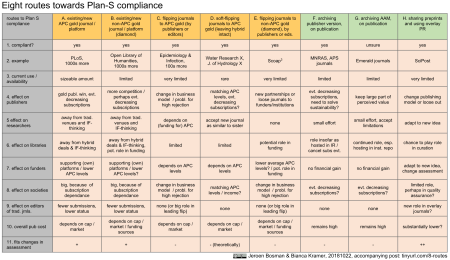
Incidentally, I just came across this summary of different routes to open access and their implications here:

In my opinion, Column H is the place to be!

I’ve given quite a few talks about Open Access recently and one of the things that struck me in the Q & A sessions after them is the extent to which attitudes differ in different disciplines. My own research area, astrophysics and cosmology, embraced open access over twenty-five years ago. Virtually every paper published in this discipline can be found for free on the arXiv, as is the case for particle physics. More recently, condensed matter physics and some branches of mathematics have joined in.

Chemistry, by contrast, is conspicuous by its absence from the arXiv. I don’t know why. Moreover, those who have expressed the most negative attitudes to Open Access whenever I’ve given talks about it have always been chemists. And now there’s this letter. It’s definitely part of a pattern. If any chemists out there are reading this, perhaps they could tell me why there’s such an enormous cultural difference between physics and chemistry when it comes to research publication?

The Letter states (paragraph 4):

Plan S has (probably) a much larger negative effect on chemistry than on some other fields.

Maybe so, but isn’t that just another way of saying that chemistry is more in need of cultural change than other disciplines?

P.S. I’d be happy to advise anyone interested in setting up an Open Journal of Chemistry, but if you want it to run like the Open Journal of Astrophysics you will have to set up a chemistry arXiv first – and that’s a much bigger job!

P.P.S. Thanks to a comment below I now know that there is a Chemistry archive, but it only has a small number (hundreds) of papers on it. Moreover, it does not host final refereed versions of papers. It is run by the American Chemical Society, German Chemical Society, and the Royal Society of Chemistry all learned societies who are opposed to Open Access no doubt because it threatens their funding models.

A Familiar Sight

Posted in Maynooth with tags , on November 5, 2018 by telescoper

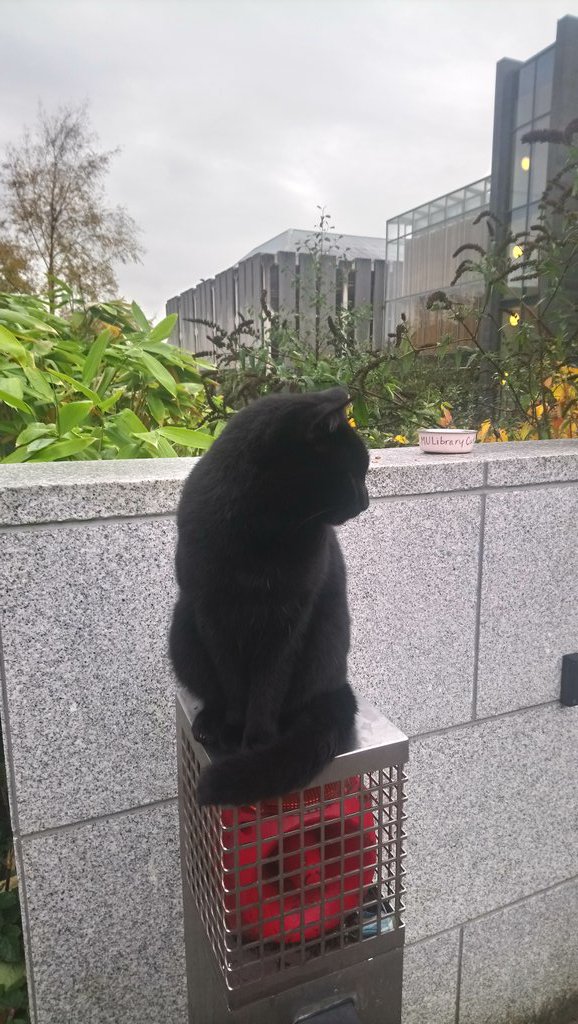
It’s been a busy day today back at work after Study Week. Before this week’s telecon,  I thought I’d take a few minutes to share a picture of the local celebrity feline, who was on his perch this morning as I walked across campus. This splendid cat seems to have no name other than Maynooth Library Cat – see the dish on the wall behind – and he roams freely around Maynooth University. I don’t know where he sleeps, but he’s well nourished, in good health is a familiar sight, especially in the area in front of the library.

He’s also quite friendly, and likes to be petted, although he turned his head away when I took this picture (presumably because I didn’t bring any food with me…).

Arms and the Boy, by Wilfred Owen (who died on 4th November 1918)

Posted in Poetry with tags , , , on November 4, 2018 by telescoper

Wilfred Owen, probably the greatest poet of the First World War, died precisely 100 years ago today, on 4th November 1918, aged 25, just one week before the Armistice that brought the war to an end. I am posting this poem in his memory.

Let the boy try along this bayonet-blade
How cold steel is, and keen with hunger of blood;
Blue with all malice, like a madman’s flash;
And thinly drawn with famishing for flesh.

Lend him to stroke these blind, blunt bullet-leads,
Which long to nuzzle in the hearts of lads,
Or give him cartridges of fine zinc teeth
Sharp with the sharpness of grief and death.

For his teeth seem for laughing round an apple.
There lurk no claws behind his fingers supple;
And God will grow no talons at his heels,
Nor antlers through the thickness of his curls.

by Wilfred Owen (1893-1918).

On the Naming of the Plimsoll

Posted in Biographical on November 3, 2018 by telescoper

The items of footwear depicted photographically above are usually named ‘plimsolls’, ‘plimsoles’, or ‘pumps’. They were originally developed for use as beachwear way back in the 1830s which is no doubt why, when I was a lad growing up on Tyneside, they were invariably known as ‘sandshoes’.

Recently, however, I have discovered that in Wales (at least in Cardiff) these canvas and rubber shoes are called ‘daps’ and, in parts of Scotland, ‘gutties’. Does anyone out there in the interwebs know any other names for them?

Please let me know through the comments box below..

Stokes, Lonsdale and DCU

Posted in Cosmic Anomalies, Maynooth, Talks and Reviews, The Universe and Stuff with tags , , , on November 2, 2018 by telescoper

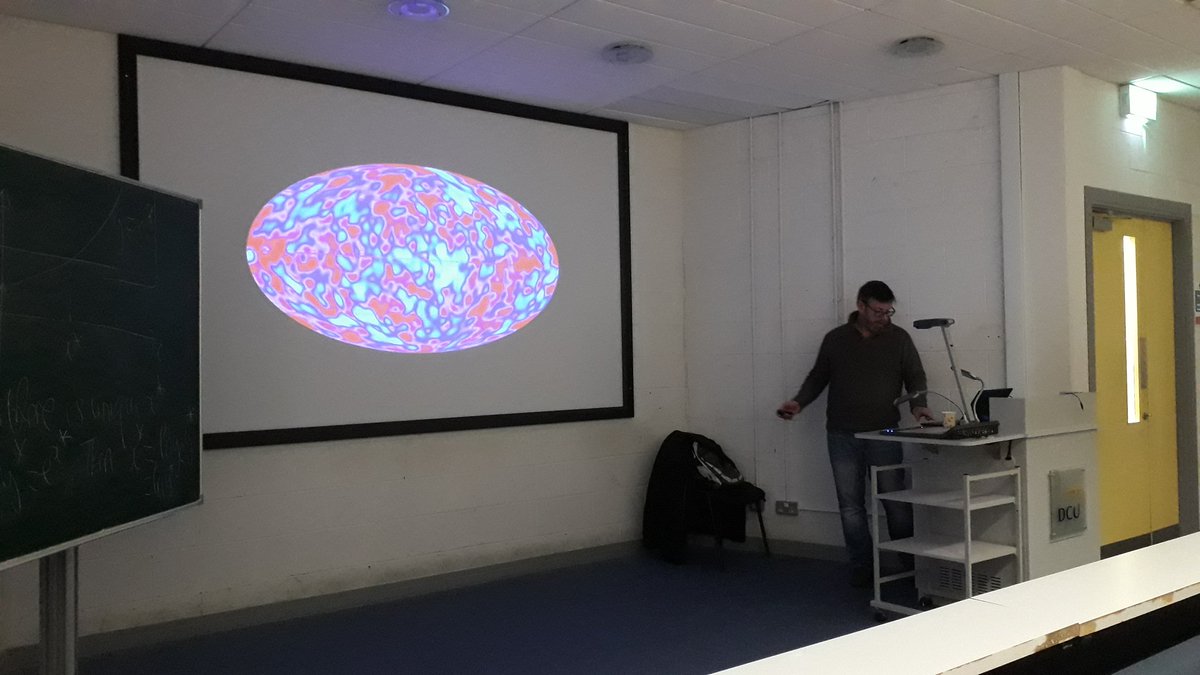
On Wednesday I took a trip from Maynooth into Dublin to give a talk at the Centre for Astrophysics and Relativity at Dublin City University (DCU). I’ve stolen the above picture, which someone took near the start of the talk, from Twitter.

My talk was very general, as it was not a specialist cosmology audience, and was similar to the talks I was giving a few years ago about the Axle of Elvis Axis of Evil. If anyone is interested in the slides, here they are.

Confusingly, Dublin City University (DCU) consists of the same combination of quarks as University College Dublin (UCD), but I managed to find my way to the correct campus via Drumcondra Railway Station (which is next to historic Croke Park). Anyway, there was quite a big audience and not all of them fell asleep (even though I did go on too long) so by that measure at least the talk was moderately successful. Thanks to everyone there for their hospitality during the afternoon!

Incidentally, my talk was in the Lonsdale Building which is right next to the Stoke Building. Both are named in honour of famous Irish-born scientists. physicist George Stokes (who was born in Skreen, in County Sligo, but spent most of his adult life in Cambridge) and crystallographer Kathleen Lonsdale (who was born in Newbridge, County Kildare, but moved to England when she was only five).

Grave Wave Doubts?

Posted in Bad Statistics, The Universe and Stuff with tags , , , , on November 1, 2018 by telescoper

coverns

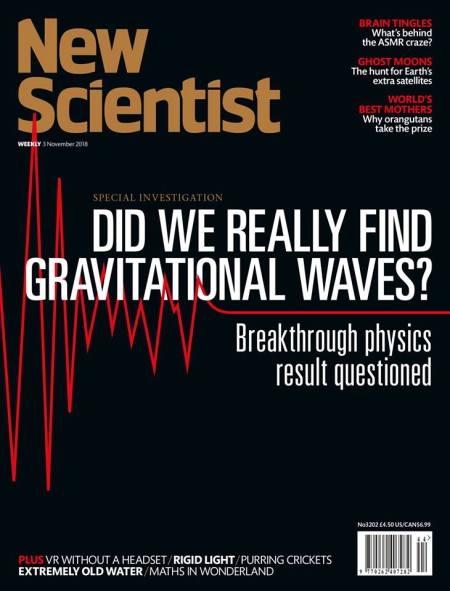
I noticed this morning that this week’s New Scientist cover feature (by Michael Brooks)is entitled Exclusive: Grave doubts over LIGO’s discovery of gravitational waves. The article is behind a paywall – and I’ve so far been unable to locate a hard copy in Maynooth so I haven’t read it yet but it is about the so-called `Danish paper’ that pointed out various unexplained features in LIGO data associated with the first detection of gravitational waves of a binary black hole merger.

I did know this piece was coming, however, as I spoke to the author on the phone some time ago to clarify some points I made in previous blog posts on this issue (e.g. this one and that one). I even ended up being quoted in the article:

Not everyone agrees the Danish choices were wrong. “I think their paper is a good one and it’s a shame that some of the LIGO team have been so churlish in response,” says Peter Coles, a cosmologist at Maynooth University in Ireland.

I stand by that comment, as I think certain members – though by no means all – of the LIGO team have been uncivil in their reaction to the Danish team, implying that they consider it somehow unreasonable that the LIGO results such be subject to independent scrutiny. I am not convinced that the unexplained features in the data released by LIGO really do cast doubt on the detection, but unexplained features there undoubtedly are. Surely it is the job of science to explain the unexplained?

It is an important aspect of the way science works is that when a given individual or group publishes a result, it should be possible for others to reproduce it (or not as the case may be). In normal-sized laboratory physics it suffices to explain the experimental set-up in the published paper in sufficient detail for another individual or group to build an equivalent replica experiment if they want to check the results. In `Big Science’, e.g. with LIGO or the Large Hadron Collider, it is not practically possible for other groups to build their own copy, so the best that can be done is to release the data coming from the experiment. A basic problem with reproducibility obviously arises when this does not happen.

In astrophysics and cosmology, results in scientific papers are often based on very complicated analyses of large data sets. This is also the case for gravitational wave experiments. Fortunately, in astrophysics these days, researchers are generally pretty good at sharing their data, but there are a few exceptions in that field.

Even allowing open access to data doesn’t always solve the reproducibility problem. Often extensive numerical codes are needed to process the measurements and extract meaningful output. Without access to these pipeline codes it is impossible for a third party to check the path from input to output without writing their own version, assuming that there is sufficient information to do that in the first place. That researchers should publish their software as well as their results is quite a controversial suggestion, but I think it’s the best practice for science. In any case there are often intermediate stages between `raw’ data and scientific results, as well as ancillary data products of various kinds. I think these should all be made public. Doing that could well entail a great deal of effort, but I think in the long run that it is worth it.

I’m not saying that scientific collaborations should not have a proprietary period, just that this period should end when a result is announced, and that any such announcement should be accompanied by a release of the data products and software needed to subject the analysis to independent verification.

Given that the detection of gravitational waves is one of the most important breakthroughs ever made in physics, I think this is a matter of considerable regret. I also find it difficult to understand the reasoning that led the LIGO consortium to think it was a good plan only to go part of the way towards open science, by releasing only part of the information needed to reproduce the processing of the LIGO signals and their subsequent statistical analysis. There may be good reasons that I know nothing about, but at the moment it seems to me to me to represent a wasted opportunity.

CLARIFICATION: The LIGO Consortium released data from the first observing run (O1) – you can find it here – early in 2018, but this data set was not available publicly at the time of publication of the first detection, nor when the team from Denmark did their analysis.

I know I’m an extremist when it comes to open science, and there are probably many who disagree with me, so here’s a poll I’ve been running for a year or so on this issue:

Any other comments welcome through the box below!

UPDATE: There is a (brief) response from LIGO (& VIRGO) here.