Archive for February, 2020

Beethoven from Brexit Day

Posted in Music with tags , , on February 4, 2020 by telescoper

I may not have been able to attend the concert at the National Concert Hall in Dublin on Friday 31st January, but I did listen to it live on the Radio. Now you can experience the whole thing yourself via the Youtube recording of the live stream. The programme consisted of three pieces by Ludwig van Beethoven played by the RTÉ National Symphony Orchestra under the direction of Leonard Slatkin:

  • The Consecration of the House Overture
  • Violin Concerto (soloist Stefan Jackiw)
  • Symphony No. 7

I very much enjoyed listening to the concert, especially the up-tempo finale of the Seventh Symphony. I gather there was a problem with the live stream that meant the sound wasn’t broadcast along with the pictures, but they’ve fixed it on the recording so now you can experience both sight and sound from the NCH:


Voids, Galaxies and Cosmic Acceleration

Posted in The Universe and Stuff with tags , , , , , , on February 4, 2020 by telescoper

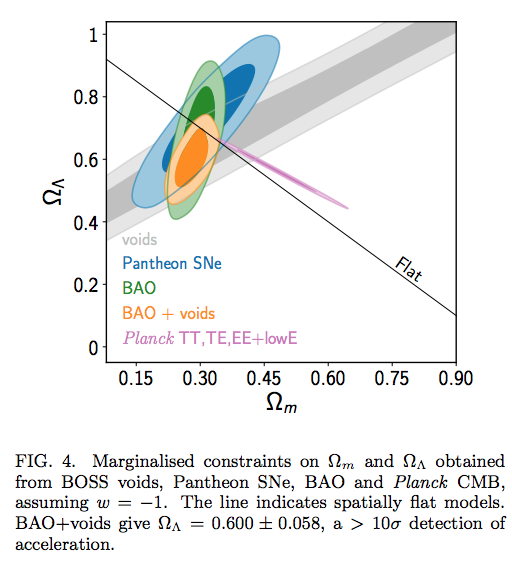
Time for a quick plug for a paper by Nadathur et al. that appeared on the arXiv recently with the title Testing low-redshift cosmic acceleration with large-scale structure. Here is the abstract:

You can make it bigger by clicking on the image. You can download a PDF of the entire paper here.

The particularly interesting thing about this result is that it gives strong evidence for models with a cosmological constant (or perhaps some other form of dark energy), in a manner that is independent of the other main cosmological constraints (i.e. the Cosmic Microwave Background or Type 1a Supernovae). This constraint is based on combining properties of void regions (underdensities) with Baryon Acoustic Oscillations (BAOs) to produce constraints that are stronger than those obtained using BAOs on their own. The data used derives largely from the BOSS survey.

As well as this there’s another intriguing result, or rather two results. First is that the the BAO+voids data from redshifts z<2 gives H0 = 72.3 ± 1.9, while, on the other hand adding, BAO information from the Lyman-alpha forest for from z>2 gives a value H0 = 69 \pm 1.2, favouring Planck over Riess. Once again, the `tension’ over the value of the Hubble constant appears to be related to using nearby rather than distant sources.

Irish Election Update

Posted in Politics with tags , , , , on February 3, 2020 by telescoper

I couldn’t resist one more update before Saturday’s General Election because there has been another opinion poll (Irish Times/IPSOS-MRBI), which I’ve added to the previous ones here:

  • Sunday Times/Behaviour & Attitude: FF 32%; FG 20%; SF 19%
  • Irish Times/IPSOS-MRBI: FF 25%; FG 21%; SF 21%
  • BusinessPost/Red C: FF 26%; FG 23%; SF 19%
  • Daily Mail/Ireland Elects: FF 27%; FG 22%; SF 22%
  • Sunday Times/Panelbase: FF 23%; SF 21%; FG 19%
  • Business Post/Red C: FF 24%; SF 24%: FG 21%.
  • Irish Times/IPSOS-MRBI: FF 23%; FG 20%; SF 25%

This last one is the first to put Sinn Féin in the lead, although to be honest the margin of error is 3% again so there’s really no evidence for a significant change on the last poll by the same outfit.

I still find it very hard to predict what kind of Government Ireland will end up with, but it seems even less likely than before that Leo Varadkar will be leading it.

British friends keep asking me whether all this change is a result of Brexit. I have to say that the answer to that is ‘no’ and neither is it driven entirely by thoughts of a United Ireland. The focus of campaigning is largely on domestic political issues, chiefly housing and health. Most people tend to think Varadkar has handled Brexit pretty well, but his party had failed badly in these other areas.

Spring Semester Starts

Posted in Biographical, Education, Maynooth with tags , , , , , , on February 3, 2020 by telescoper

It’s February 3rd 2020, which means that today is two days after Imbolc, a Gaelic festival marking the point halfway between the winter solstice and vernal equinox. The 1st Day of February is also the Feast day of St Brigid of Kildare (c. 451-525), one of Ireland’s patron saints along with Saints Patrick and Colm Cille. One of her miraculous powers was the ability to change water into ale, which perhaps explains her enduring popularity among the Irish.

In Ireland this day is sometimes regarded as the first day of spring, as it is roughly the time when the first spring lambs are born. It corresponds to the Welsh Gŵyl Fair y Canhwyllau and is also known as the `Cross Quarter Day’ or (my favourite) `The Quickening of the Year’.

Today is, appropriately enough in the light of all this, the start of the Spring Semester of teaching at Maynooth University, the third Spring Semester I will have experienced here. The weather has even played along; it has definitely been spring-like. The Campus, whicgh has beenhas been very quiet for the last week or so since the examinations finished, is full of students again.

This Semester, as was the case last year, I am teaching Engineering Mathematics II and Computational Physics I. The former, what you would probably call a `service course’, covers a mixture of things, mainly Linear Algebra but with some other bits thrown in for fun, such as Laplace transforms. Interestingly I find the Mathematical Physics students do not encounter Laplace Transforms in the first year, but perhaps engineers use them more often than physicists do? I think I’ve written only one paper that made use of a Laplace transform. Anyway, I have to start with this topic as the students need some knowledge of it for some other module they’re taking this semester. I reckon six lectures will be enough to give them what they need. That’s two weeks of lectures, there being three lectures a week for this module.

Once again my teaching timetable for this module is quite nice. I have lectures on Monday, Tuesday and Wednesday and then the students have a choice of tutorial (on either Thursday or Friday). That means I can get through a decent amount of material each week before each tutorial. I don’t do the tutorials, by the way: that’s left to one of our PhD students, who gets paid for doing that and correcting the weekly coursework. There are about 50 students on this module, divided into two courses: Electronic Engineering and Robotics and Intelligent Devices. We don’t have Civil or Mechanical or Chemical Engineering, etc at Maynooth, in case you were wondering.

Anyway, my first lecture was this afternoon at 2pm and had a good turnout. It was so sunny outside that we had to close all the blinds. That’s quite an unusual event for a February lecture!

My first Computational Physics lecture is on Thursday, after which it will be back to the Department for some frantic behind-the-scenes activity ahead of the afternoon lab session, which is in a computer room near my office. Students attend one two-hour lab session in addition to the lecture, on either Thursday or Tuesday. The first lecture being on Thursday the first lab session will be Thursday afternoon, with the same material being covered the following Tuesday.

While my teaching duties are the same this year as they were in the corresponding semester last year, there is a significant difference this year in that I am now also Head of Department. Either side of my first lecture I had to attend a meeting of the Faculty Executive for Science & Engineering, a meeting on `Project LEGO’ (which, sadly, did not involve any actual Lego but was instead about the proposed redesign of the University’s website) and a meeting of Academic Council. I have also been trying to sort out tutors and tutorials for the forthcoming Semester: these don’t start until next week so there’s time, but it’s quite a challenge to get everyone sorted out. A few timetable clashes have also come to light. So, in summary, I’m a bit worn out after today and will shortly go home to vegetate.

At least I didn’t have to find time for the regular Monday afternoon Euclid telecon in which I usually participate. There wasn’t one today because the working group of which I am part is actually meeting in person for a few days… in Paris! I couldn’t go because of all the above!

UK and Ireland Trade

Posted in Politics with tags , on February 2, 2020 by telescoper

For reasons that are probably obvious I recently took a look at the latest figures relating to trade between Ireland and the United Kingdom. These were produced by the UK Government but I’ll nevertheless assume they are trustworthy. The latest complete figures are from 2018; the report was published in January this year (2020).

Here are the key points:

  • In 2018, UK exports to Ireland were worth £35.1 billion; imports from Ireland were £21.6 billion, resulting in a trade surplus of £13.5 billion with Ireland.
  • The UK had a surplus with Ireland in both goods and services.
  • Ireland accounted for 5.5% of UK exports and 3.2% of all UK imports.
  • Ireland was the UK’s 5th largest export market and the 10th largest source of imports.
  • The UK has recorded a trade surplus with Ireland every year between 1999 and 2018.

Brexiter logic states that the fact that the EU exports more to the UK than vice versa means that the EU needs the UK more than the UK needs the EU. Applying the same argument to Ireland would imply that the UK needs Ireland more than Ireland needs the UK (if it were correct). The reality is that membership of the single market has been of benefit to the economy of both countries (and the rest of the EU). Trade is not a zero-sum game. While the Single Market has allowed the UK to generate a trading surplus with Ireland, Ireland has found other opportunities elsewhere to more than make up. Contrary to popular myth, the UK now only accounts for a small fraction of goods exports from Ireland.

As the United Kingdom has left the European Union it must now try to negotiate new trading arrangements that will cover trade with remaining member states, including Ireland. No doubt the EU negotiators will be pressed by Ireland to take steps to reduce the imbalance described above. As the UK no longer wants to avail itself of the benefits of Single Market, it seems likely that other EU member states will want to seize the opportunity to boost their trade by filling the gaps.

Since the UK’s trading agreement with the EU (if there ever is one, which is doubtful) will probably not include services, I thought it would be interesting to look at goods: here is a summary of the breakdown of this category of UK exports to Ireland:

`Miscellaneous manufactured articles’, incidentally, means things made out of plastic, etc.

As a relatively recent arrival in Ireland I find these figures quite interesting in light of my own experience of shopping here. I know that consumer goods aren’t representative of all trade so this is just a comment on my own impressions and is not to be taken too seriously.

If you go into a Supermarket in Ireland you will find that fresh vegetables, meat and dairy products are generally all from local sources. There is a wide choice of these items and value for money is generally very good. The same is true for bread and bread-related products. Some fruit is imported from the EU (especially France and The Netherlands, but including some, e.g. apples, from the UK) and some from further afield (e.g. bananas from the Caribbean and Latin America). You will be shocked to learn that bendy bananas are freely available.

Moving to processed foods (including confectionery, canned items, etc) the picture changes quite a bit. There are local Irish brands but they tend to be alongside familiar British ones. There are also items from elsewhere, e.g. from Italy, that I have never seen on sale in the UK. The (smaller) Irish brands of, say, marmalade seem to be a bit dearer than their imported equivalent but are often of better quality.

As an aside I’ll also mention that supermarkets here have a noticeably smaller range of convenience foods (e.g. microwave meals and ready-made sandwiches) than in corresponding outlets in the UK.

I’ve been impressed at the quality and availability of another important staple, wine. There is a better range of French, Spanish and Italian wines in Supervalu in Ireland, especially at the quality end of the spectrum, than in stores of a similar size in the United Kingdom. There is also a good range of wines from Australia, New Zealand, South Africa and Latin America. I haven’t tried Irish wine yet…

In summary, then, it’s perfectly easy to eat and drink well in Ireland without buying any British products. For myself, I have always tried to buy local food products whenever possible to support the Irish economy as best I can.

Elsewhere in the store however you can see a much greater dominance of UK products. This is particularly true of toiletries (including toothpaste, shampoo), pharmaceutical goods, domestic cleaning products and so on. These tend to be dominated by familiar British brands, although they seem to be more expensive here in Ireland than in the UK.

None of the goods mentioned in the previous paragraph are at all perishable so they could in principle be quite easily be imported from further afield. I wonder if we’ll soon start seeing products of this sort starting to appear from elsewhere?

Irish Election Update

Posted in Biographical, Maynooth, Politics with tags , , , , on February 1, 2020 by telescoper

Well. Life goes on, and so does the Irish General Election campaign. A week today I’ll be casting my vote. Sinn Féin seem the most energized by the events of the last week, even to the extent that their posters have been going up around Maynooth. The one above, showing leader Mary Lou McDonald, is on my way into work (the North Campus of Maynooth University is on the other side of the road, beyond the trees).

Since last week’s update there have been other opinion polls (by the Sunday Times/Panel base and Red C), which I’ve added to the previous ones here:

  • Sunday Times/Behaviour & Attitude: FF 32%; FG 20%; SF 19%
  • Irish Times/IPSOS-MRBI: FF 25%; FG 21%; SF 21%
  • BusinessPost/Red C: FF 26%; FG 23%; SF 19%
  • Daily Mail/Ireland Elects: FF 27%; FG 22%; SF 22%
  • Sunday Times/Panelbase: FF 23%; SF 21%; FG 19%
  • Business Post/Red C: FF 24%; SF 24%: FG 21%.

The latest polls (like the others) are based on a small sample (1000) so has a large marging of error (around 3%) and is based on online responses and an uncertain methodology which may create a systematic bias. Those caveats aside, however, they seems to be telling the same story as the others: decline for Fine Gael and a relatively strong showing for Sinn Féin who are up 7% and 5% on the previous Panelbase and Red C numbers, respectively.

I wouldn’t be at all surprised if Sinn Féin end up with a share of the first preference votes around 25%. If that is the case they’ll probably wish they had stood more candidates, which they will probably do next time if they perform strongly in the actual election. They did poorly in the European Elections last year, which probably explains their rather defensive strategy. On the other hand if Fianna Fáil really are polling in the low twenties they may regret standing so many candidates, as their vote may end up splitting so that none reach the quota.

It will be very interesting to see how this all pans out. I find it very hard to predict what kind of Government Ireland will end up with, but I’m willing to bet that Leo Varadkar won’t be leading it.