Archive for July, 2020

Reading Finnegans Wake

Posted in Literature, Maynooth with tags , on July 25, 2020 by telescoper

Doing my bit to support local businesses as they come out of lockdown I decided to order a book from the excellent independent bookshop on Main Street. You can’t browse there yet but you can order books for collection.

I went to collect my order yesterday. I was worried that they might be struggling for business but the place was chock-a-block with packs of school books ready for collection ahead of the new school year.

I picked up this bit of light reading:
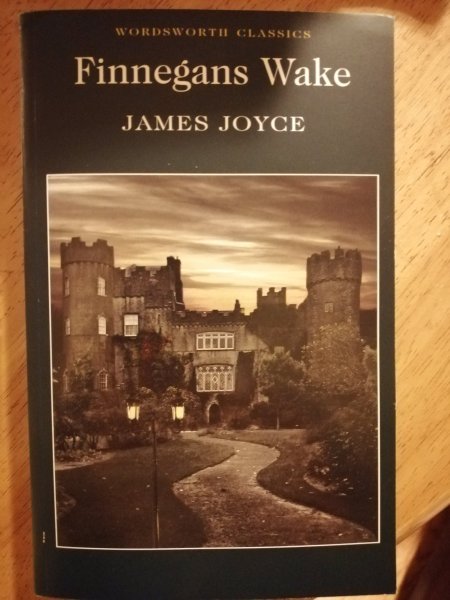
I disagree with people who say that Ulysses is a difficult read, but Finnegans Wake is certainly a challenge. The lady in the bookshop said “Good luck with it!” as she handed it to me…

Alfred Hitchcock once claimed that “puns are the highest form of literature” and one of the features of Finnegans Wake is the constant stream of puns (in different languages). It seems that almost every sentence contains some form of double meaning too. Finnegans Wake may be hard going but it’s very playful, not only with linguistic meaning but with the sounds that words make, which can be delightful in itself independently of what they’re supposed to mean.

I’ve always thought of Finnegans Wake not so much as a novel but as as a very long poem to be read out loud. Indeed here is a strange but fascinating clip of Joyce himself reading an excerpt. Note the attention he pays to the rhythm:

I’ve set myself the target of reading 10 pages a day, which means it will take me a couple of months to finish it. I’ll try reading some bits out to myself, though I can’t do the accent…

On Grinds

Posted in Literature, mathematics with tags , , , , on July 24, 2020 by telescoper

When I moved to Ireland a couple of years ago, one of the words I discovered had a usage with which I was unfamiliar was grind. My first encounter with this word was after a lecture on vector calculus when a student asked if I knew of anyone who could offer him grinds. I didn’t know what he meant but was sure it wasn’t the meaning that sprang first into my mind so I just said no, I had just arrived in Ireland so didn’t know of anyone. I resisted the temptation to suggest he try finding an appropriate person via Grindr.

I only found out later that grinds are a form of private tuition and they are quite a big industry in Ireland, particularly at secondary school level. School students whose parents can afford it often take grinds in particular subjects to improve their performance on the Leaving Certificate. It seems to be less common for third level students to pay for grinds, but it does happen. More frequently university students actually offer grinds to local schoolkids as a kind of part-time employment to help them through college.

The word grind can also refer to a private tutor, i.e. you can have a maths grind. It can also be used as a verb, in which sense it means `to instil or teach by persistent repetition’.

This sense of the word grind may be in use in the United Kingdom but I have never come across it before, and it seems to me to be specific to Ireland.

All of which brings me back to vector calculus, via Charles Dickens.

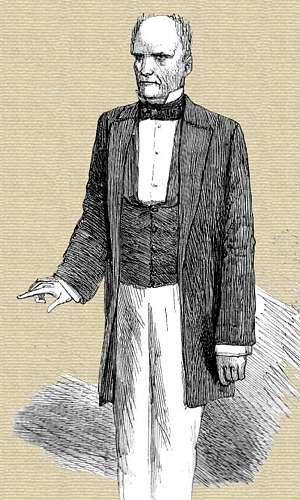
In Hard Times by Charles Dickens there is a character by the name of Mr Thomas Gradgrind, a grimly utilitarain school superintendent who insisted on teaching only facts.

Thomas Gradgrind (engraving by Sol Eytinge, 1867).

If there is a Mr Gradgrind, why is there neither a Mr Divgrind nor a Mr Curlgrind?

Royal Society University – Science Foundation Ireland University Research Fellowships

Posted in Maynooth with tags , on July 23, 2020 by telescoper

It is now time for a quick public information broadcast.

Did you know about the scheme run jointly between the  Royal Society and Science Foundation Ireland that enables early career researchers in Ireland access to University Research Fellowships?

This scheme provides five years of research funding (with the possibility of renewal) and has proved to be a stepping stone to their first permanent academic position for a great many scientists. Here are a couple of items about the eligibility and duration.

Eligibility:  The scheme is open to early career Post Doctoral Researchers with between 3-8 years of actual research experience since their PhD (date on which the degree was approved by board of graduate studies) by the closing date.  You cannot apply if you hold a permanent post in the university or have held (or currently hold) an equivalent fellowship that provides the opportunity to establish independence.  Please see call notes for further details.

Funding and Duration:  Funding consists of the research fellow’s salary and research expenses for an initial period of 5 years with the possibility to apply for a further 3 years.  Research expenses cover the standard consumables/materials, equipment up to €12,000, travel, training and public engagement.  Fellowships are expected to have commenced by October 2021.

For full details of the scheme, see here.

The scheme covers a wide range of disciplines. including physics and astronomy. Of course if you want to do cosmology, the best place here to do it is here in Maynooth! The deadline if you want to apply to hold a URF from 2020 in Ireland is 3rd September 2020, which is not far off,  so please get cracking!

P.S. Five years residency in Ireland qualifies you for Irish citizenship. Just saying…

“I think the Devil shits Dutchmen…”

Posted in History with tags , , on July 22, 2020 by telescoper

Just time for a short update on the aftermath of the Dutch Raid on the Medway as recounted by Samuel Pepys which I blogged about last month.

The Dutch fleet withdrew from the Medway in mid-June of 1667 (Old Calendar) but they did attempt further raids later that month and in early July. Fed by wild rumours about the intentions and whereabouts of the Dutch, London was a jittery place. Pepys summed up the mood in his Diary, ending with a quote which has become famous:

A Lockdown Perspective on the Hubble Tension (plus Poll)

Posted in The Universe and Stuff with tags , , on July 22, 2020 by telescoper

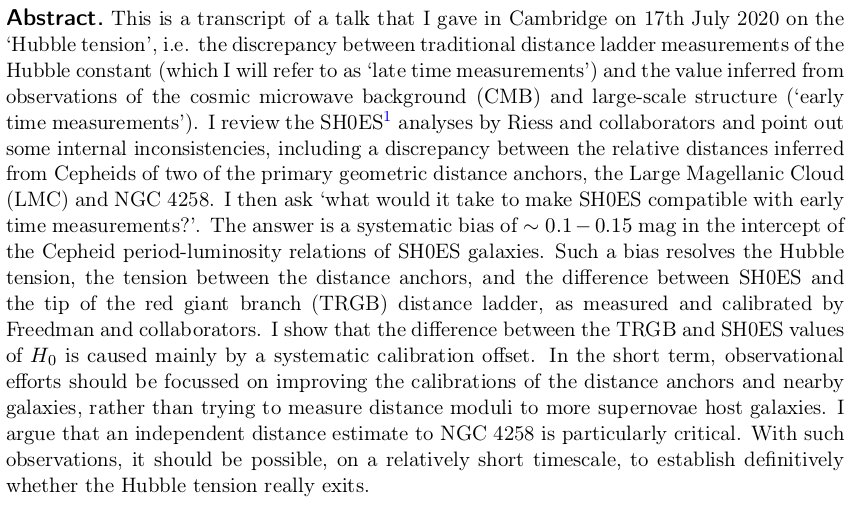
These are busy days in cosmological circles, especially regarding the Hubble Constant controversy. The latest contribution to appear on the arXiv is by George Efstathiou of Cambridge. Here is the abstract:

I don’t know if George has voted in my ongoing poll relating to this issue, but I bet that if he did he would vote low – along with the majority (so far):

Incidentally, I have seen no evidence of Russian interference in the voting.

Three Funerals and a Cartoon

Posted in Biographical, Football, Maynooth with tags , , , on July 21, 2020 by telescoper

I was later than usual coming to the office today as I had to arrange some things to do with the house I’m buying in Maynooth. It was mid morning when I walked up towards campus. I was a little bit confused to see a large crowd of people walking along Main Street, but when I got closer I realized they were all walking behind a hearse on their way to a funeral service at St Mary’s Church. I followed the procession all the way along Main Street and up Mill Street where another large group of people was waiting outside the Church. I don’t know who had passed away but judging by the attendance they must have been popular in the community.

This is the first time I’d seen such a procession here in Ireland, though I was of course already aware that the Irish treat funerals very differently from the English. Coincidentally, though, today saw the funeral of Jack Charlton which began with a procession through the streets of Ashington, the cortege led by piper playing the Northumbrian pipes. Many hundreds turned up to show their respects.

Because of Covid-19 restrictions, only about 20 people could attend the funeral service, which was held at the West Road Crematorium in Newcastle upon Tyne. As it happens, that was where the funeral of my Mam took place about 9 months ago. There were no Covid-19 restrictions then, which makes it seem like a different age altogether.

Anyway, going back to Jack Charlton, I saw last week marvellous comic book tribute to him called The Life and Times of Jack Charlton by David Squires in the Guardian. The poignant last panel is beautifully done.

Cosmology Talks: Eva-Maria Mueller on the last (e)BOSS Data Release

Posted in The Universe and Stuff, YouTube with tags , , , , on July 20, 2020 by telescoper

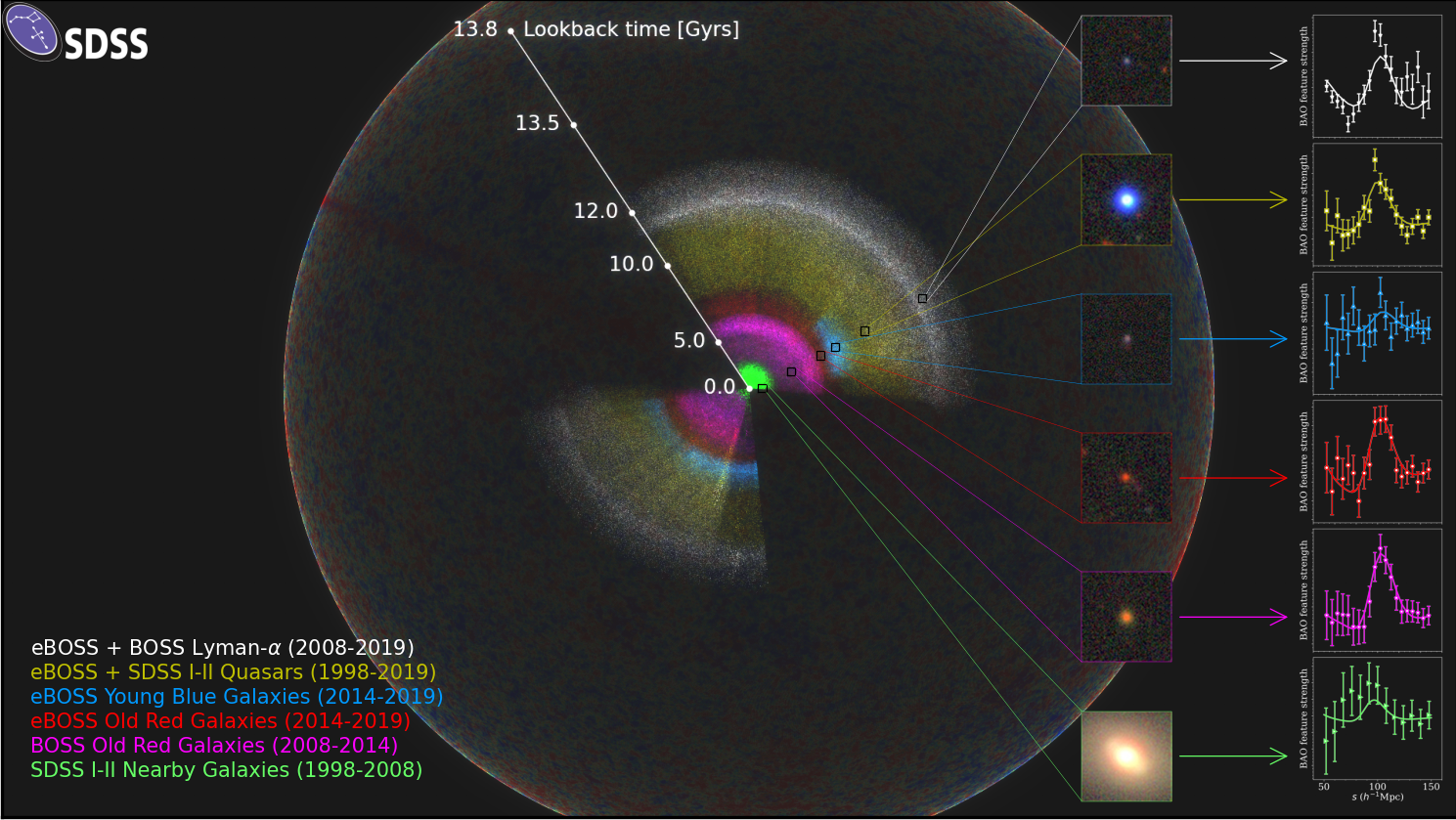
Today is another big day for cosmology as the last and final – why do people say that? – data release from the Extended Baryon Oscillation Spectroscopic Survey (eBOSS) is now available. That is the culmination of 20 years of effort with the Sloan Digital Sky Survey. Here is a pretty picture showing the enormous scales probed by the survey:

There is an overview paper on the cosmological implications of the survey on the arXiv here. Fortunately, the latest Cosmology Talk on the YouTube channel of Shaun Hotchkiss features a very interesting presentation by Eva-Maria Mueller who is the first author of that paper:


The people who do things and what they do

Posted in Art, Cricket, Football, Opera, Television with tags , on July 19, 2020 by telescoper

It’s a tough lesson to learn in life that the people you admire or idolize for their contribution in a particular arena (whether that be sport, art, science or something else) turn out to be people you can’t stand in terms of their character or political views.

You have to separate, for example, having a high regard for Ian Botham’s cricketing prowess from having a high regard for his personal character. In fact I can think of few sportspeople whose company I’d enjoy socially.

The same goes in many other spheres. Richard Feynman was a truly great physicist but I’ve never bought into the personality cult surrounding him. In fact I doubt I would have liked him very much at all if we’d ever met in person. They say you should never meet your heroes. They’re right.

Another example is Richard Wagner, a brilliant composer but really horrible man, who brings us to this clip from the end of Twilight of the Gods (the last episode of Series 7 of Inspector Morse, first broadcast in 1993).

I won’t spoil the plot if you haven’t seen it but it involves a famous opera singer, Gladys Probert, who visits Oxford to perform and receive an honorary degree. On the way to the ceremony she is shot, but was she the intended victim?

Opera-loving Morse is a huge admirer of Gladys Probert but in the course of his investigation he uncovers some unpleasant truths about her private life. He solves the crime but the case leaves him dispirited.

Here is the ending. John Thaw is Inspector Morse and Kevin Whateley is Detective Sergeant Lewis.

Leaving Late

Posted in Covid-19, Education, Maynooth with tags , , on July 18, 2020 by telescoper

The time of Covid-19 was already an “interesting” time to be an academic in Ireland but yesterday it got more interesting still, as news emerged that this year’s (estimated) Leaving Certificate results will not be published until 7th September, which is three weeks later than usual. The first round of CAO offers will be made on 11th September. All this is about three weeks later than the usual cycle of examinations and results.

Here at Maynooth University the start of the academic year has been delayed by one week to September 28th, so the three week delay in Leaving Cert means we have to speed the processes up of getting everything in place for new students to start by two weeks. That is going to be a challenge, and even if we manage it we will only find out very late in the day how many students we have to accommodate in first-year lectures.

The current plan for teaching next semester at Maynooth University is that all modules will be allocated the same timetable slots and rooms as last year. However, most lecture rooms have had their capacity reduced by more than half. Lecturers need to know how many students they have in order to decide how to use the available lecture slots and how to strike a balance between live and online delivery.

To give an example, I had about 90 students in my first-year module last year for which I had three lectures per week in Physics Hall, which has a normal capacity of 90. Next year the capacity of this room is likely to be around 30 with social distancing so. if I have the same numbers as last year, I will have to split the class into three groups and have one weekly session with each group. The material not covered live will be put online. I’m planning on that basis now, but if I find we have more students in Year 1 than last year I’ll have to have a Plan B. I won’t know that until just before teaching starts.

And then there is the possibility that teaching will actually start later for first-year students, requiring the lecture content to be revised. That’s not the current plan at Maynooth University, but a lot can happen between now and September…

We do indeed live in interesting times.

Of course I’m not the only one to be facing such challenges. Mine is a relatively small class by first-year standards and other bigger courses will experience far more serious difficulties.

If any prospective student is getting worried reading this, I can promise you that we will be doing the best we can to provide the best education we can in whatever circumstances we find ourselves in this September. Please bear in mind that workloads on academic staff (including Heads of Department!) are going to be very heavy after a summer in which very few will have been able to take any holidays at all. So please bear with us. We didn’t want any of this any more than you did, but we just have to make the best of it.

Poll – The Hubble Constant: High or Low?

Posted in The Universe and Stuff with tags , on July 17, 2020 by telescoper

Given yesterday’s news from the Atacama Cosmology Telescope, among other things suggesting a low value of the Hubble constant of around 67.6 km s-1 Mpc-1, it might be fun to run another totally unscientific poll about which of the two Hubble constant camps has the most support in the community. The two camps are:

  • A `high’ value H0 ~ 73.5 ± 1.5 km s-1 Mpc-1 (as favoured by most stellar distance indicators, i.e. `local’ measurements).
  • A `low’ value H0 ~ 67.5 ± 0.5 km s-1 Mpc-1 (as favoured by most `cosmological’ estimates, e.g. cosmic microwave background fluctuations).

Of course you might also believe that both are wrong and the `true’ result lies outside both error regions but I’d like to focus on these two possibilities, so the question is posed assuming that one of them is right, which one is that most likely to be. In your opinion. Humble or otherwise.