Archive for August, 2020

Disturbing Admissions

Posted in Education, Maynooth with tags , , , on August 13, 2020 by telescoper

So, as the second day of Repeat Examinations at Maynooth University gets under way, students in the United Kingdom are receiving their A-level results. I’ve already heard a number of stories from friends and colleagues flabbergasted by the way some marks have been treated, so it all looks likely to be quite a mess. I have great sympathy for the students, for whom this has been an extraordinarily difficult year, and I hope the A-level fiasco doesn’t affect too many too badly.

My experience of over 30 years teaching in UK universities has convinced me that A-levels are not a very good preparation for higher education anyway and the obsession with them is rather unhealthy. Some of the best students I’ve ever had the pleasure of teaching came to University with poor A-level grades (for a variety of reasons).

In fact I’d go as far as to say that the entire system of University admissions in the United Kingdom needs to be overhauled. As I said in a post almost a decade ago:

…if we had the opportunity to design a process for university admissions from scratch, there is no way on Earth we would end up with a system like the current one.

Of course I longer work in the UK so there’s no longer a “we”, but the system in Ireland is not that much different, with the Leaving Certificate playing the role of A-levels for the vast majority of students.

As things stand in the UK, students apply for university places through UCAS before they have their final A-level results (which don’t come out until August). Most applications are in by January of the year of intended admission, in fact. The business of selecting candidates and making offers therefore usually makes use of interim results or “predicted grades” as supplied by teachers of the applicant.

In my (limited) experience most teachers systematically overestimate the grades of their pupils, which is presumably why so many of this year’s A-level results are being downgraded, but there are lots of unconscious biases at play here and I accept that some teachers may be unduly pessimistic about their students likely performance.

But the inaccuracy of predicted A-level grades is not the only absurdity in the current system. Universities have to engage in enormous amounts of guesswork during the admissions process. Suppose a department has a quota of 100, defining the target number students to take in. They might reasonably get a minimum of 500 applications for these 100 places, depending on the popularity of university and course.

Each student is allowed to apply to 5 different institutions. If a decision is made to make an offer of a place, it would normally be conditional on particular A-level grades (e.g. AAB). At the end of the process the student is expected to pick a first choice (CF) and an insurance choice (CI) out of the offers they receive. They will be expected to go to their first choice if they get the required grades, to the insurance choice if they don’t make it into the first choice but get grades sufficient for the reserve. If they don’t make either grade they have to go into the clearing system and take pot luck among those universities that have places free after all the CFs and CIs have been settled.

Each university department has to decide how many offers to make. This will always be larger than the number of places, because not all applicants will make an offer their CF. They have to honour all offers made, but there may be penalties if they under or over recruit. How many offers to make then? What fraction of students with an offer will put you first? What fraction of them will actually get the required grade?

The answers to these questions are not at all obvious, so the whole system runs on huge levels of uncertainty. I’m amazed that each year any institution manages to get anywhere close to the correct number, and we usually get very close indeed by the end.

It’s a very skilled job being an admissions tutor, but there’s no question it would all be fairer on both applicants and departments to remove most of the guesswork by which I mean allowing students to apply to University after they have got their results. But there is the rub. There are two ways I can see of changing the timetable to allow this:

  1. Have the final A-level examinations earlier
  2. Start the university academic year later

The unavoidable consequence of the first option would be the removal of large quantities of material from the A-level syllabus so the exams could be held several months earlier, which would be a disaster in terms of preparing students for university.

The second option would mean starting the academic year in, say, January instead of September. This would in my opinion be preferable to 1, but would still be difficult because it would interfere with all the other things a university does as well as teaching, especially research. The summer recess (July-September), wherein much research is currently done, could be changed to an autumn one (September-December) but there would be a great deal of resistance, especially from the older establishments; I can’t see Oxbridge being willing to abandon its definitions of teaching term! And what would the students do between July and January?

Either of these options would cause enormous disruption in the short-term, which is presumably why they have never been implemented. However, this year everything is disrupted anyway so there’s an opportunity to redesign the whole process. Delaying the start of the academic year until January 2021 would make a great deal of sense this year in particularly, though I think it’s a bit late to be doing it now.

I don’t really imagine the Government is thinking of doing this but here are some suggestions of elements of a new admissions system:

  • Students to apply after receiving A-level* grades (i.e. implement 1 or, preferably, 2 above)
  • All university applications to be anonymous to prevent discrimination.
  • The identity of the applicant’s school to be withheld to prevent undue influence.
  • Teachers to play no part in the process.

*I don’t think A-levels are fit for purpose so here I mean grades of whatever examination replaces them.

Marginalia

Posted in Cute Problems, Education, The Universe and Stuff with tags , , , , , on August 12, 2020 by telescoper

While this morning’s repeat exams were going on I was leafing through an old second-hand text book, one of many I have acquired over the years looking for nice problems and worked examples. The good thing about old books is that solutions to the problems are usually not available on the internet, unlike modern ones. The book concerned this morning is a classic: Statics by Horace Lamb, which you can still get via Cambridge University Press. I have the first edition, published in 1912.

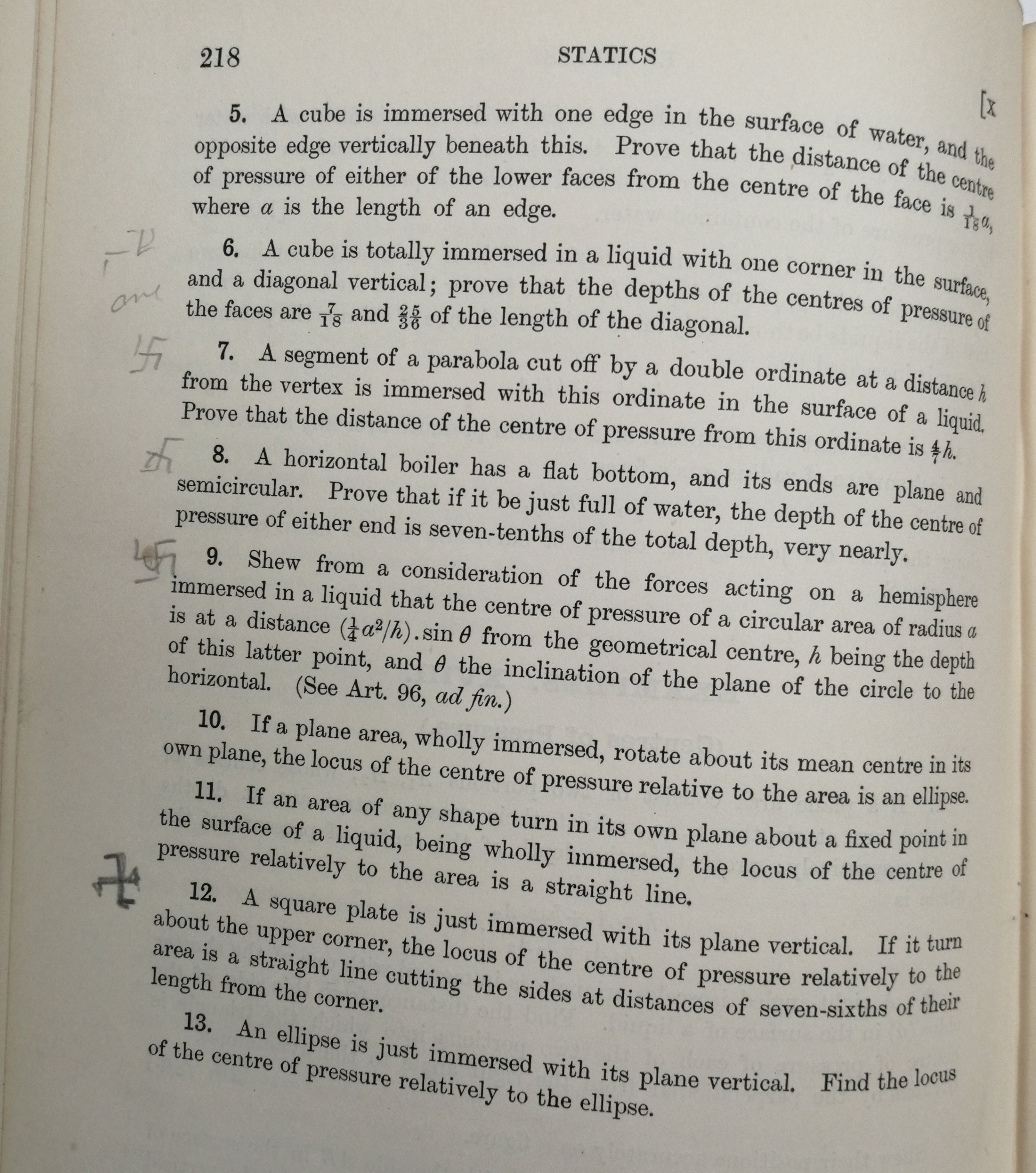
Looking through I was somewhat alarmed to see what had been pencilled in some of the margins:

Of course anyone who has been to India knows that the swastika isn’t necessarily a Nazi symbol: you find it all over the place in the Indian sub-continent, where it is used as a symbol for good luck. I remember being given a very nice conference bag in Pune many years ago with a swastika on it. I didn’t use it back home, of course.

The first owner of the copy of Statics that I have was acquired in 1913 by a J.H.C (or G) Lindesay of Sidney Sussex College, Cambridge. I know because he/she inscribed their name in the front. That doesn’t look to me like an Indian name, but I think it’s a fair bet that the book passed through many hands before reaching me and that one of the past owners was Indian. I haven’t tried any of the problems marked with the swastika, but perhaps they are difficult – hence the `good luck’ symbol? I notice though that the symbol at the bottom of the page has a chirality different from the others. Is this significant, I wonder?

All of which irrelevance reminded me of an discussion I’ve had with a number of people about whether they like to scribble in the margins of their books, or whether they believe this practice to be a form of sacrilege.

I’ll put my cards on the table  straightaway. I like to annotate my books – especially the technical ones – and some of them have extensive commentaries written in them. I also like to mark up poems that I read; that helps me greatly to understand the structure. I don’t have a problem with scribbling in margins because I think that’s what margins are for. Why else would they be there?

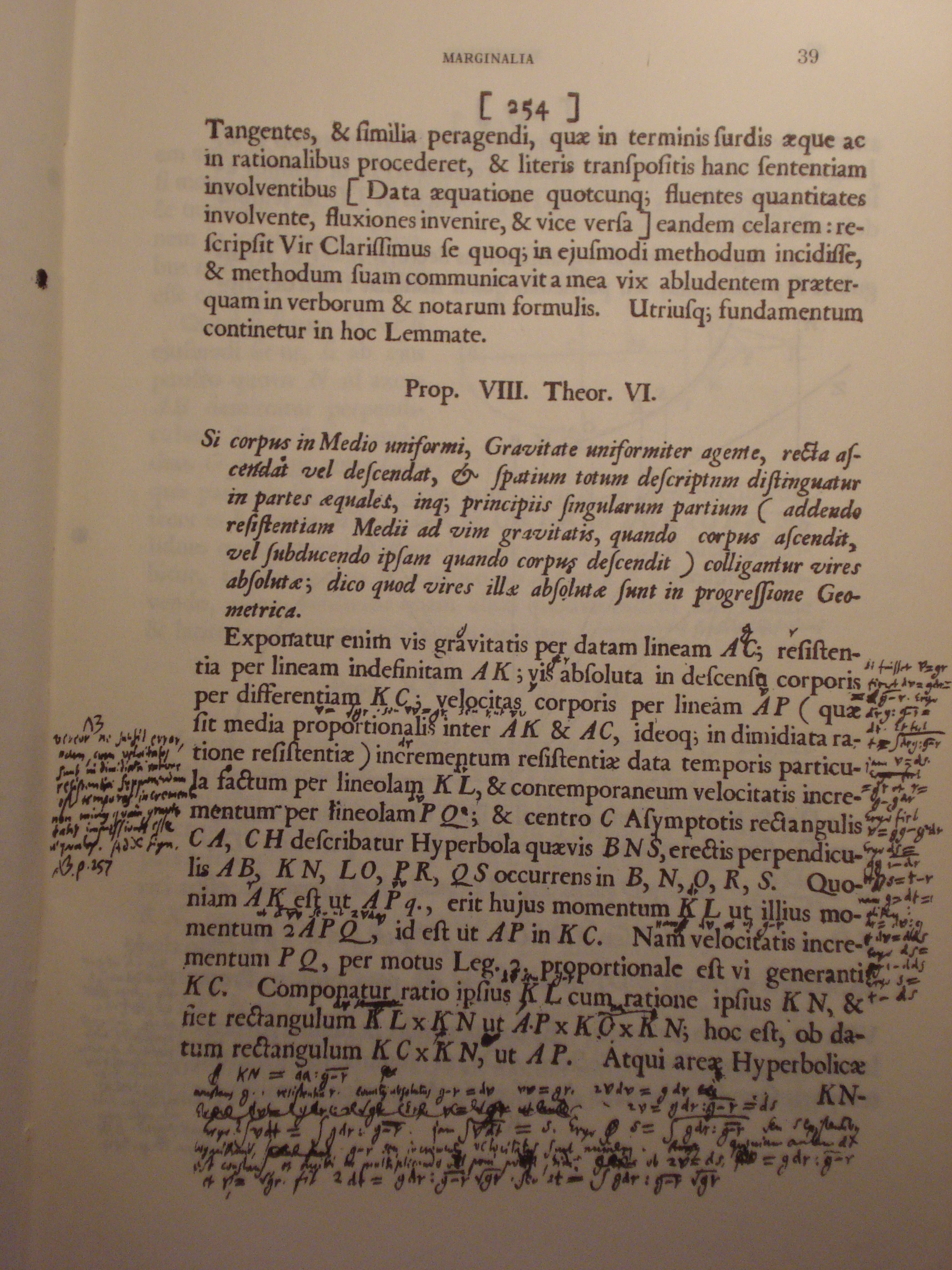
This is a famous example – a page from Newton’s Principia, annotated by Leibniz:

dsc00469

Some of my friends and fellow academics, however, regard such actions as scandalous and seem to think books should be venerated in their pristine state.  Others probably find little use for printed books given the plethora of digitial resources now available online or via Kindles etc so this is not an issue..

I’m interested to see what the divergence of opinions is in with regard to the practice of writing in books, so here’s a poll for you to express your opinion:

Examination Shenanigans

Posted in Covid-19, Education, Maynooth with tags , , , on August 12, 2020 by telescoper

So here I am in my office while the first batch of our repeat examinations gets under way here in Maynooth. They seem to have started correctly so I’ve taken a break to have a cup of coffee and catch up on the news.

I find that examinations seem to be making headlines in the United Kingdom. First there was a to-do and a hoo-ha in Scotland that resulted in school examination results that had been downgraded being upgraded again. The downgrading involved using some sort of statistical model to `correct’ teacher-assigned grades and coursework but this model apparently generated significant anomalies.

Then, not to be outdone by the Scots, the English government has announced that estimated A-level grades, presumably obtained by a similar process to that deployed in Scotland, were to be upgraded too. Or not. It seems they will get the original grades but be able to appeal the results.

Writing in today’s Daily Telegraph, presumably without irony, Gavin Williamson explains the decision not to upgrade A-level results automatically:

Increasing the A Level grades will mean a whole generation could end up promoted beyond their abilities.

Gavin Williamson wrote that. Gavin Williamson.

Universities in the UK receive A-level results a few days before the students in order to make admissions decisions, but this year the results students eventually receive may differ from those the universities got. I can imagine the chaos this is causing behind the scenes.

If I understand correctly the new `Triple Lock’ on A-level results means that a student’s grade will be whichever is the highest of:

  • their mock exam result;
  • the grade estimated by their teacher;
  • an A*.

(OK, I made up that last bit.)

Some people think this approach might lead to grade inflation, but I imagine the authorities are less concerned about that than they are by the prospect of getting sued.

Another issue with the downgrading/upgrading situation is that students who took the International Baccalaureate (IB) and have received algorithmic grades have not had their grades increased, which seems to put them at a disadvantage with respect to students who took A-levels and may cause them to miss out on UK university places.

Meanwhile, here in Ireland, we await the School Leaving Certificate results. These are not due until 7th September but I think the plan is to moderate them as in the United Kingdom. Delaying these results gives Ireland the chance to learn from the UK but whether the process will end up being any fairer here is anyone’s guess!

On the Eve of the Repeats

Posted in Covid-19, Education, Maynooth with tags , , on August 11, 2020 by telescoper

I won’t deny that I was caught on the hop by Friday’s sudden announcement of a partial lockdown in an area that includes Maynooth but at least we’ve had a couple of working days to activate Plan B and get all the online assessments ready to replace the repeat examinations that were due to start on campus tomorrow.

Happily all the necessary supports were provided quickly over the weekend and I think we’re now ready to go, with the first paper(s) starting tomorrow morning at 9.30am. There will be several of these per day for the next week or so so it’s going to be a busy period supervising them (remotely) and then marking the scripts when they’re finished. At least we have now got some experience of these tests, having done these before (in May). There are also fewer candidates for the repeats than first time round so it should all be manageable.

When the repeat exams are all marked and the Exam Board finished, we should have a firm idea how many students are progressing to the next academic year so we can draw up plans for lectures and tutorials in September.

Apart that is for the first year, where we won’t know the numbers until September. That will cause a bit of a rush but I’m sure we’ll manage.

All of this assumes that we are doing on-campus teaching in September, which would require the local lockdown to have been lifted. If not we’ll have to do everything online, including tutorials. A ray of hope is that the number of new cases is just 35 today, down from 174 on Saturday, but we’ll have to have nany more days like that to feel secure. We’ll just have to wait and see.

Bluegrass Jordu!

Posted in Jazz with tags , , on August 11, 2020 by telescoper

A couple of weeks ago when I was looking on Youtube for a recording of Jordu by Duke Jordan for a blog post I stumbled across this version, which seemed so unlikely that I had to listen to it and, somewhat to my surprise, I loved it and decided to share it. Those of you out there who like your jazz and your American country music will no doubt feel the same way.

It’s by a band led by virtuoso banjo player Bill Keith consisting of fiddles, mandolins, guitars and string bass (as well as banjo), the type of ensemble you expect for American bluegrass music so I couldn’t imagine in my mind’s ear how they would sound playing a bebop standard. As it turns out they sound great! The middle eight of this tune sounds so funky on those instruments. Hats off to Bill Keith for this adventurous choice of number!

P.S.  My Dad used to play the drums in traditional jazz bands, some of which included a banjo player. He never had a good word to say about banjo players, accusing them (rightly or wrongly) of always “speeding up” (which is anathema to jazz musicians).

The Law of the Sea

Posted in Politics with tags , , , , , , , on August 10, 2020 by telescoper

There are few things more despicable than a Government that manufactures outrage in order to distract from its own failings. The latest example  is the UK Government’s ridiculous response to a few desperate migrants crossing the English Channel in boats. The Home Secretary, Priti Patel, has appointed a “Clandestine Channel Threat Commander” (whatever that is supposed to mean) and is apparently considering sending Royal Navy to protect the United Kingdom from the terrifying women and small children arriving in dinghies. Pathetic.

Mind you, I think sending the Royal Navy to the Channel is in some ways a good idea. Once there they could offer greater assistance to small boats in peril on the sea and bring their occupants safely to port in England. That, after all, would be their duty under international law. I know we can’t expect the Home Secretary to either know or care about the law, but I suspect Royal Navy officers do. The Law of the Sea is far older than any Government.

Following age-old maritime traditions, the 1982 United Nations Convention on the Law of the Sea (UNCLOS) obliges that a ship’s master “render assistance to any person found at sea in danger of being lost” and to rescue those in distress so long “as he can do so without serious danger to the ship, the crew or the passengers” of his own vessel. The International Convention for the Safety of Life at Sea (SOLAS) includes a similar obligation requiring ship masters, on hearing about a vessel in distress, to provide assistance and inform the search and rescue service that they are doing so. The International Convention on Maritime Search and Rescue requires parties to provide assistance to anyone in distress “regardless of the nationality or status of such a person or the circumstances in which that person is found.” These laws require the rescue of survivors from unseaworthy vessels crossing the English Channel as much as they do to the Mediterranean (where they are sadly routinely flouted).

Not only is there both a moral and a legal duty to rescue those in danger of losing their life at sea, it is the responsibility of the rescuer to take them to a place of safety. Amendments to the Convention for Safety of Life at Sea and the International Convention on Maritime Search and Rescue codify this obligation of Member States to ensure that the rescued survivors disembark the vessel in a safe place. A safe place is one “where their basic human needs (such as food, shelter and medical needs) can be met.” People rescued in national territorial waters (usually within 12 miles of the coast) become the responsibility of the nation concerned.

There is a far greater humanitarian crisis in the Mediterranean, of course, and we should not forget the failure of other countries (and the European Union) to deal with it properly, but that is not an excuse for Britain to behave so callously.

I saw a comment on Twitter the other day – from a person I subsequently blocked – arguing that migrant boats should be rammed and the occupants allowed to drown. Proudly in his Twitter profile was the slogan. `ALL LIVES MATTER’.

Local Difficulties

Posted in Covid-19 with tags , , on August 9, 2020 by telescoper

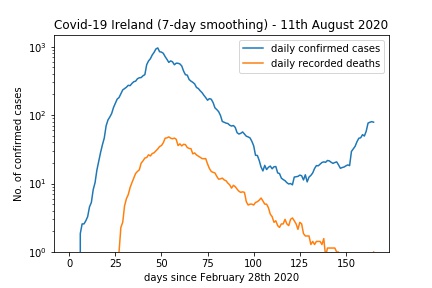
This morning I checked on the Covid-19 tracker app and found that County Kildare is in second place behind Dublin for cases:

Today’s figure of 68 is down on yesterday’s (174) but still too high.

Anyway a couple of hours later I picked up my phone again and discovered that it was very hot and the battery almost flat. It turns out that a bug has emerged that causes some kind of runaway interaction between the Covid-19 tracker and Google Play Services on Android phones.

I tried some of the fixes suggested on social media but they didn’t work, so I have now uninstalled the app. At a guess I’d say there some upgrade was pushed out to one or other app which has somehow triggered the failure. It’s not good that this has happened in the middle of a spike in cases but hopefully they can fix it soon.

It’s worth noting that although the app has been downloaded over a million times, I’ve never seen more than about 250,000 checked in on any day. There’ll probably be a lot fewer than that now!

Not Returning to Campus

Posted in Covid-19, Maynooth with tags , , , on August 8, 2020 by telescoper

Well.

Having spent the day yesterday getting our return to campus sorted, the Government last night announced restrictions on the counties of Offaly, Laois and Kildare. Following that a message came round from the President of Maynooth University, Philip Nolan including this:

Following the announcement this evening, the gradual reopening of campus from Monday, 10th August will be paused. Staff who are working from home should, in the main, continue to do so. Staff who are coming on campus to do their work effectively may continue to do so, and in certain circumstances, staff may, with the approval of their Head of Department, return to the campus to work, where it is necessary to do their work effectively or prepare for the coming academic year.

So we’re on hold for a couple of weeks (at least). That’s frustrating but not the end of the world. I don’t imagine we would have had that many people coming in over the next two weeks anyway.

On the bright side the recent outbreaks are very localised and there is a good testing and tracking system in place, which suggests they can be contained through isolation. On the other hand they are large clusters and it only takes a small amount of leakage to trigger a much wider spread.

Of more immediate concern is this:

Unfortunately, the restriction on travel means that it is no longer appropriate to go ahead with the on-campus resit examinations scheduled for next week. We will work with the colleagues involved and where possible we will replace these with online exams at the same times; where this is not possible, we will reschedule the exams at the earliest feasible time. We will of course continue to support our students in their studies in every way that we can.

Obviously we can’t hold examinations on campus if students can’t travel here from other counties. There is also a restriction of six on the number of people at an indoor event which would rule them out too.

Fortunately we have a Plan B and all these examinations will be replaced by online timed assessments. That means a busy couple of days next week – the exams are due to start next Wednesday (12th August) – but it is manageable.

I know a lot of people are angry about the new (partial) lockdown, especially pubs and restaurants. In my opinion the decision yesterday was inevitable given the steep increase in new cases (98 reported yesterday) :

Update: 174 new cases today (Saturday 8th August). Grim.

This growth is dominated by clusters of infections, mostly in meat processing works, in the three counties under lockdown. That includes 80 announced yesterday in the same plant. None of these is particularly close to Maynooth but the country boundaries are the only simple way of imposing local restrictions.

Serious questions do need to be asked, though, about how we got to this situation.

Outbreaks of Covid-19 in meat processing plants have been widely reported elsewhere for months, and Ireland does not seem to have learned from these. There are allegations that the plants involved may not have undergone proper inspections and that public health guidance has not been followed. The present circumstances could well be a result of negligence on the side of the businesses concerned and/or the government. These issues require urgent investigation to prevent possible occurrences elsewhere. If negligence can be demonstrated I sense a large number of lawsuits…

Let me just add one final comment. It seemed to me that the original return to work Roadmap, with five phases, was sensible and that it was working. I had serious reservations when it was decided to try speeding it up. If a carefully thought-out plan is working why change it on the fly?

The announcement of the accelerated Roadmap was interpreted by many in the general population as a signal that the Covid-19 epidemic in Ireland was over. Complacency set in and social distancing rules began to be flouted, especially among younger people.

I’m not saying this is the reason for the clusters in meat factories but it is probably behind the parallel increase in community transmission.

Now the Roadmap is paused and we’re behind where the original version would have put us. You can add impatience and complacency to the reasons we’re in this local difficulty.

Returning to Campus

Posted in Covid-19, Education, Maynooth with tags , , on August 7, 2020 by telescoper

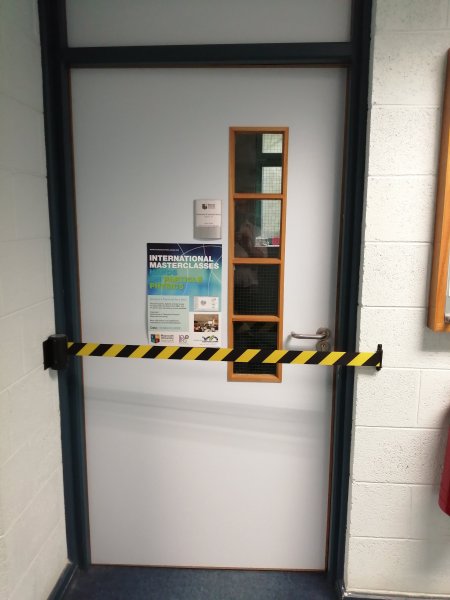
It’s been a busy day (so far) putting the finishing touches to return to work planning at the Department of Theoretical Physics at Maynooth University. We have improved the signage and decluttered the main corridor to allow the two-way system to operate.

We’ve also fitted the odd tensor barrier (that’s what the above thing is called) to prevent people wandering into offices uninvited contrary to social distancing requirements.

As well as all that I’ve received delivery of a selection of face masks, hand gel and disinfectant wipes.

All this is because the repeat examination period starts next week and we’re consequently preparing for the second wave (of examination marking) by allowing staff to come onto campus to collect their scripts, which most should be able to do from next week.

Update: owing to the recent increases in Covid-19 cases in Kildare Offaly and Laois, as of this evening, local restrictions have been imposed on these counties. As a consequence the return to work process has been paused and all repeat exams scheduled to take place on campus will be replaced by online timed assessments. Sigh.

Watch “The Eddington Eclipse Experiment of 1919” on YouTube

Posted in History, The Universe and Stuff, YouTube with tags , , , on August 6, 2020 by telescoper

I’d forgotten about this little video made after I appeared on the Pat Kenny show on NewsTalk radio last year. It was just me and the camera in a little room, but it turned out less like a hostage video than I’d feared..