Archive for May, 2021

Remote Exam Time Again

Posted in Education, Maynooth with tags , , , on May 14, 2021 by telescoper

It’s Friday 14th May 2021 which means that it’s the first day of the Summer examination period here in Maynooth, so let me begin by sending my best wishes to everyone taking examinations today and over the next few weeks, wherever you are. It’s a lovely morning in Maynooth. It seems to be a law of Nature that examinations always take place when the weather outside is nice.

For readers elsewhere in the world, full-time undergraduate students at Maynooth what is called 60 “credits” in a year, usually split into two semesters of thirty credits each. This is usually split into 5-credit modules with an examination in each module at the end of each semester. Projects, and other continuously-assessed work do not involve a written examination, but the system means that a typical student will have at least 5 written examination papers in January and at least another 5 in May.  This is very similar to the system in most UK universities that I am aware of except that a full year’s work over there is 120 credits so there’s a conversion factor of 2:1. A 5-credit module in Ireland would be a 10-credit module in the United Kingdom, for example, but otherwise the system is similar.

Each examination is usually of two hours’ duration. We’ve kept that length after moving examinations online, although students are given extra time to scan and upload their answers. The question papers themselves have been slightly adapted online use by having much less “bookwork”. Generally these assessments are unsupervised and students are allowed to consult notes and textbooks so there is little point in asking them to copy out standard derivations and formulae. That means we can concentrate on the problem-solving aspects of theoretical physics, which are the most interesting bits (and perhaps the most challenging).

One big difference between our examinations in Theoretical Physics in Maynooth and those at other institutions I’ve taught at in the UK is that most of the papers here offer no choice of questions to be answered. Elsewhere  it is quite common to find a choice of two or three questions from four or five on the paper.

One  advantage of our system is that it makes it much harder for students to question-spot in the hope that they can get a good grade by only revising a fraction of the syllabus. If they’re well designed, two long questions can cover quite a lot of the syllabus for a module, which they have to in order to test all the learning outcomes. To accomplish this, questions can be split into parts that may be linked to each other to a greater or lesser extent to explore the connections between different ideas, but also sufficiently separate that a student who can’t do one part can still have a go at others. With such a paper, however, it is a  dangerous strategy for a student to focus only on selected parts of the material in order to pass.

As an examiner, the Maynooth style of examination also has the advantage that you don’t have to worry too much if one question turns out to be harder than the others. That can matter if different students attempt different questions, but not if everyone has to do everything.

But it’s not just the number of questions that’s important, it’s the duration. I’ve never felt that it was even remotely sensible for undergraduate physics examinations to be a speed test, which was often the case when I was a student. Why the need for time pressure? It’s better to be correct than to be fast, I think. I always try to set examination questions that could be done inside two hours by a student who knew the material, including plenty of time for checking so that even a student who made a mistake would have time to correct it and get the right answer. If a student does poorly in this style of examination it will be because they haven’t prepared well enough rather than because they weren’t fast enough.

My first examination is this afternoon. The subject is (3rd Year) Computational Physics. This is an unusual module as a majority of the marks (60%) come from continuous assessment in the form of four class tests (20% altogether) and a mini-project (40%). The exam is a theory paper concerned with such topics as accuracy and stability. There are two questions on the paper, both of them compulsory. Next week there is my (4th year) Advanced Electromagnetism paper with four questions, again all compulsory. Obviously I’ll have to wait to see how the students do.

In the meantime here are some tips for students

  1. Try to get a good night’s sleep before the examination!
  2. Be ready well before the start and try to ensure you won’t be disturbed for the duration.
  3. If you’re doing an unsupervised examination, download the paper and any supplementary material needed  at the start to avoid problems if you get disconnected.
  4. Read the entire paper before starting to answer any questions. In particular, make sure you are aware of any supplementary information, formulae, etc, given in the rubric or at the end.
  5. Start off by tackling the question you are most confident about answering, even if it’s not Question 1. This will help settle any nerves.
  6. Don’t rush! Students often lose marks by making careless errors. Check all your numerical results on your calculator at least twice and remember to put the units!
  7. Show your working! Especially in an unsupervised examination you need to convince the examiner that you actually did the problem rather than looking up the answer on the net somewhere.
  8. Don’t panic! You’re not expected to answer everything perfectly. A first-class mark is anything over 70%, so don’t worry if there are bits you can’t do. If you get stuck on a part of a question, don’t waste too much time on it (especially if it’s just a few marks). Just leave it and move on. You can always come back to it later.
  9. Try to finish the paper at the assigned time, i.e. use the upload time for uploading rather than doing more work. There is always the chance that you might run out of time for upload if you’re rushing right at the end.
  10. If you’re scanning and uploading answers, check that you have submitted everything you intended to. I have had several examples of missing pages over the last year…

Anyway, once again, good luck and best wishes!

The Affair of the Missing Trophy

Posted in Covid-19, Crosswords with tags , , on May 13, 2021 by telescoper

A few weeks ago I posted about my first ever First Prize in the Azed Crossword Competition. At the end of that post I mentioned that I was eagerly anticipating being sent a silver trophy called the Azed Instant Victor Verborum Cup to hold for a month before passing it on to the winner of the next competition.

Unfortunately it seems that, owing to a combination of the Royal Mail and Covid-19, the Azed trophy has gone missing somewhere on its travels. In fact it hasn’t even reached the winner before me (a Dr S.J. Shaw) yet. The chances of it being located, retrieved and then sent to me before it would be time to send it on to the next winner are now remote so I don’t suppose I’ll ever get my hands on it. Ho hum.

Still, I did get a nice card from Dr Shaw explaining the situation and sending his congratulations:

I hope the trophy is found because it would be a shame if the tradition of passing it on came to an end, but it’s not such a big deal that I’ll miss out on having it on my mantelpiece for a few weeks. At least it absolves me of the responsibility of ensuring it reaches the next winner…

What is the Standard Cosmological Model?

Posted in The Universe and Stuff with tags , , , , on May 12, 2021 by telescoper

There’s a nice little paper – a summary of a talk – by Eric Linder on the arXiv here. The abstract is:

Reports of “cosmology in crisis” are in vogue, but as Mark Twain said, “the report of my death was an exaggeration”. We explore what we might actually mean by the standard cosmological model, how tensions – or their apparent resolutions – might arise from too narrow a view, and why looking at the big picture is so essential. This is based on the seminar “All Cosmology, All the Time”.

You can find a PDF here.

The paper discusses not only the question “what is the standard cosmological model?” in a fairly general way but also the more basic question “what is cosmology?” I’d think you’d be surprised how different would be the answers to that question from different cosmologists!

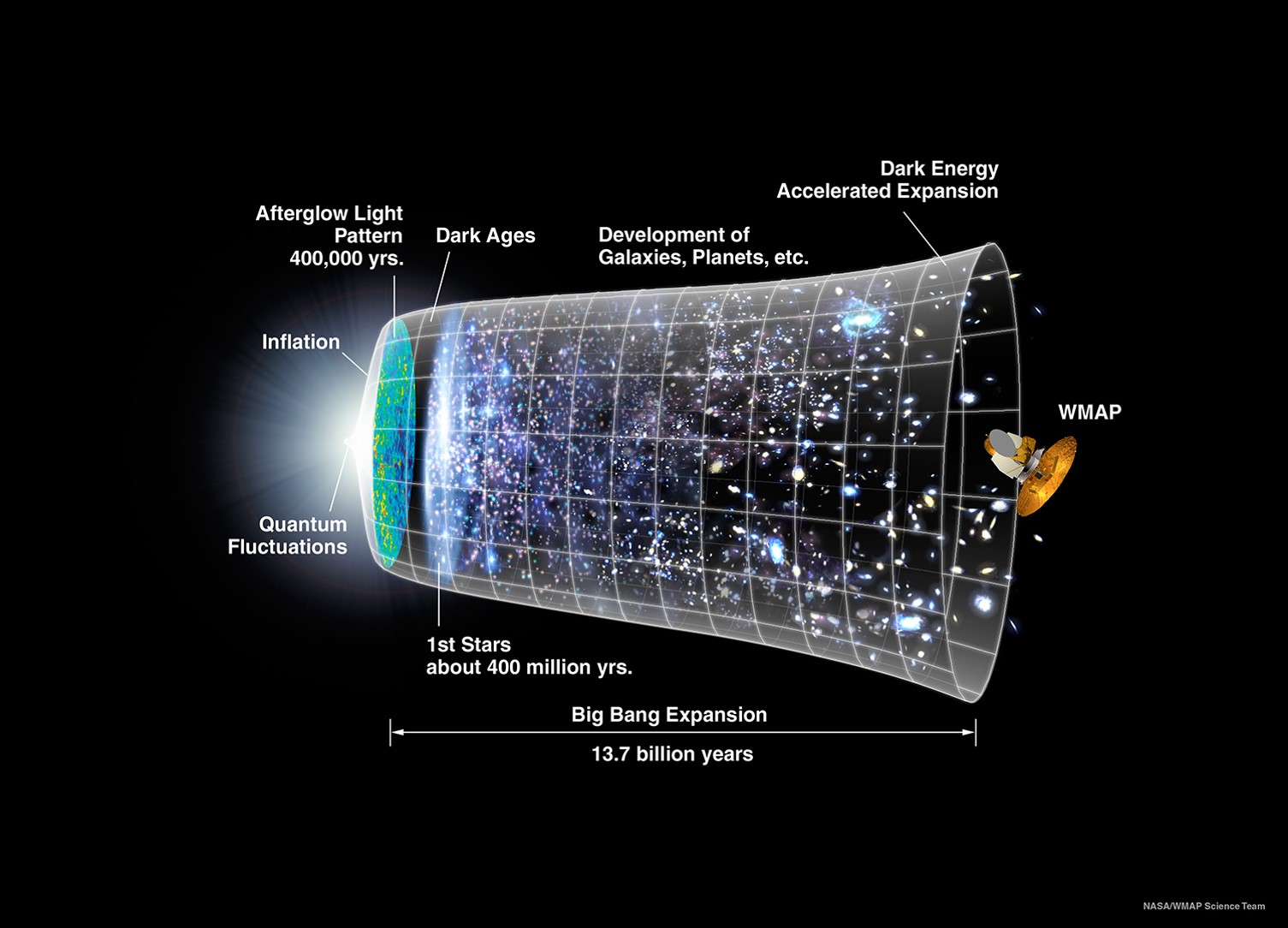
Anyway, I usually say when I give talks that the following are the six main ingredients of the standard model:

  1. General Relativity
  2. The Cosmological Principle
  3. Cold Dark Matter
  4. Cosmological Constant
  5. Primordial (nearly) Gaussian adiabatic fluctuations
  6. Inflation in the very early Universe

There are other ingredients of course, such as baryons and neutrinos but I don’t include them in a model because I feel one should distinguish at some level between the ingredients of a model and the  ingredients of the actual Universe. What I mean by that is that we know baryons exist (though we may not know their cosmic abundance precisely) but we don’t know for sure whether Cold Dark Matter exists.

Note that (1) isn’t really a model because it has no free parameters: it’s only when you add (2) that it comes a FLRW model with e.g. the curvature as a free parameter, and some assumed form of the energy-momentum tensor. The other ingredients have one or more free parameters, e.g. the density of CDM (3) and the value of Λ (4); these can be made more flexible by including, e.g., a dark energy term with equation of state w. Ingredient (5) needs the user to specify an initial power spectrum, which is at least two parameters (amplitude and slope), which may or may not be motivated by (6).

Anyway, the following items in the above list are – to a greater or lesser extent – open to question:

  1. General Relativity
  2. The Cosmological Principle
  3. Cold Dark Matter
  4. Cosmological Constant
  5. Primordial (nearly) Gaussian adiabatic fluctuations
  6. Inflation in the very early Universe

We’d be unwise to question only, e.g., 3 or 4 while ignoring the possibility that we may be wrong about the others!


Ceci n’est pas un restaurant

Posted in Biographical with tags , on May 11, 2021 by telescoper

If you are among the several people who follow this blog on my Facebook Page then I apologize for any confusion caused by the fact that Facebook appears to have decided that I am a restaurant:

I wish to point out for the record that I am not a restaurant and therefore am not available at any time for delivery, and only in certain circumstances for pick-up.

I hope this clarifies the situation.

Mark Zuckerberg is 36.

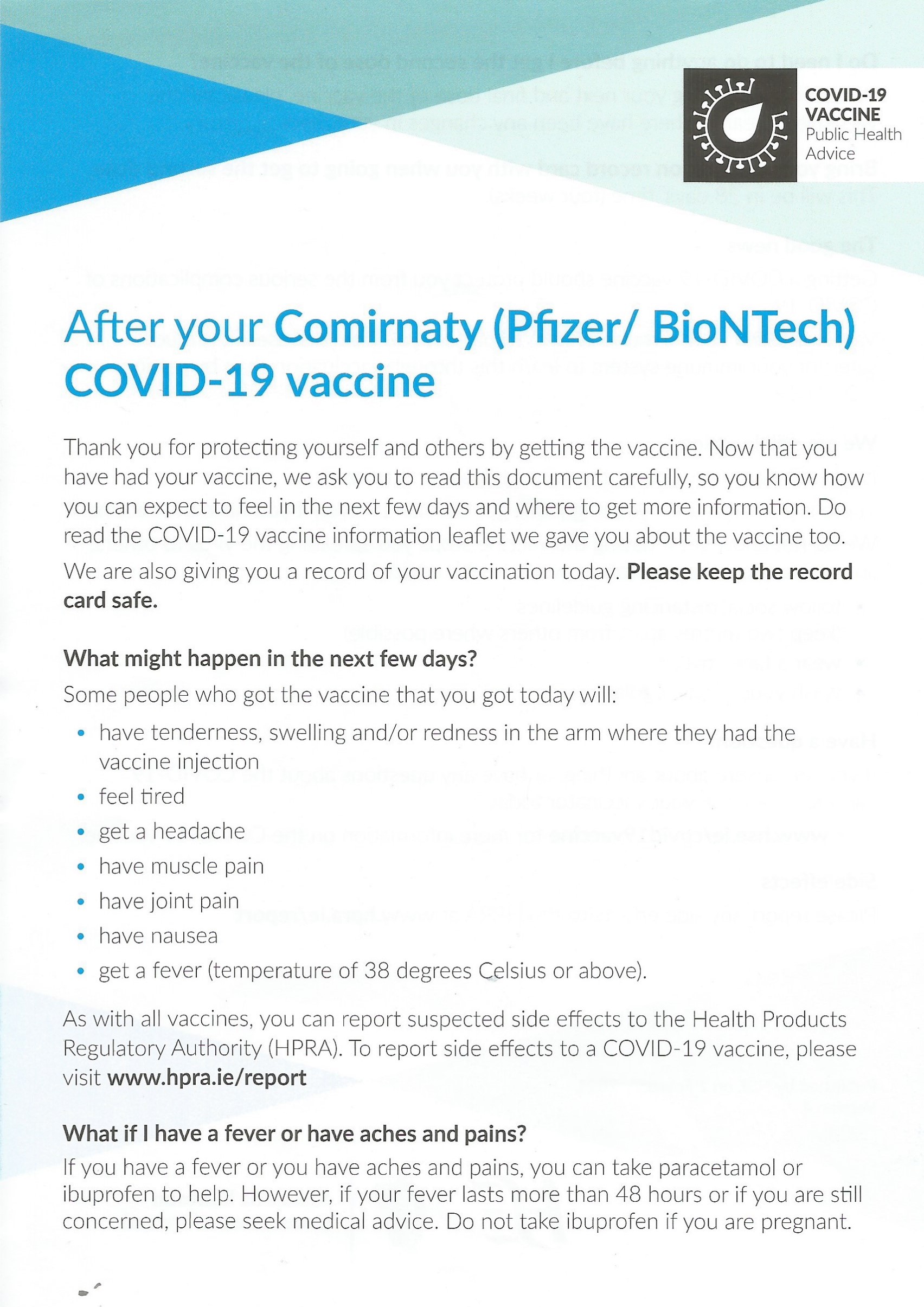
First Shot of Comirnaty!

Posted in Biographical, Covid-19 on May 11, 2021 by telescoper

So here I am, then, back home from the CityWest Convention Centre where I had my first shot of the Pfizer-BioNTech vaccine, which is actually called Comirnaty. The vaccination centre was very busy (with parking quite a long way from it) so it took a little longer than anticipated to get in and out, but only by 45 minutes instead of the expected 30 so nothing at all to complain about.

They don’t allow photography inside the place, which is a huge theatre/auditorium, though only the floor space is used for this purpose. There was quite a lot of queueing: first for an ID check, then to register, then to get the jab. The lady in front of me in the queue said it was like Ryanair, but it rather reminded me of one of those laboratory experiments with rats. Most people were very relaxed and happy to chat while waiting, but one or two seemed very anxious. That had probably been anticipated and there were friendly faces on hand to help calm people down if there were signs of distress. Not everyone likes crowds and not everyone likes needles, and no doubt for some the combination of the two is especially difficult.

Quite a lot of the people running the show were members of the Irish Defence Forces, including the guy who gave me my jab. After that I adjourned to the crossword-solving area for the mandatory 15 minutes of observation, before heading out and back to the car for my lift back home.

So there I am, phase one complete. No side effects so far but it’s too early for that just now anyway. Thanks to all the on-site staff – many of whom are volunteers – for being so friendly and well-organized. See you again in due course for the second shot!

UPDATE: 12th May 2021. It’s now 24 hours since my first dose and thankfully I can report no ill effects whatsoever. The leaflet I’ve got does say that a reaction is more likely after the second dose than the first, but so far so good!

Cosmology and the Born-Again Bayesians!

Posted in Bad Statistics, Biographical, The Universe and Stuff with tags , , , , on May 10, 2021 by telescoper

The other day, via Twitter, I came across an interesting blog post about the relatively recent resurgence of Bayesian reasoning in science. That piece had triggered a discussion about why cosmologists seem to be largely Bayesian in outlook, so I thought I’d share a few thoughts about that. You can find a lot of posts about various aspects of Bayesian reasoning on this blog, e.g. here.

When I was an undergraduate student I didn’t think very much about statistics at all, so when I started my DPhil studies I realized I had a great deal to learn. However, at least to start with, I mainly used frequentist methods. Looking back I think that’s probably because I was working on cosmic microwave background statistics and we didn’t really have any data back in 1985. Or actually we had data, but no firm detections. I was therefore taking models and calculating things in what I would call the forward direction, indicated by the up arrow. What I was trying to do was find statistical descriptors that looked likely to be able to discriminate between different models but I didn’t have the data.

Once measurements started to become available the inverse-reasoning part of the diagram indicated by the downward arrow came to the fore. It was only then that it started to become necessary to make firm statements about which models were favoured by the data and which weren’t. That is what Bayesian methods do best, especially when you have to combine different data sets.

By the early 1990s I was pretty much a confirmed Bayesian – as were quite a few fellow theorists -but I noticed that most observational cosmologists I knew were confirmed frequentists. I put that down to the fact that they preferred to think in “measurement space” rather than “theory space”, the latter requiring the inductive step furnished by Bayesian reasoning indicated by the downward arrow. As cosmology has evolved the separation between theorists and observers in some areas – especially CMB studies – has all but vanished and there’s a huge activity at the interface between theory and measurement.

But my first exposure to Bayesian reasoning came long before that change. I wasn’t aware of its usefulness until 1987, when I returned to Cambridge for a conference called The Post-Recombination Universe organized by Nick Kaiser and Anthony Lasenby. There was an interesting discussion in one session about how to properly state the upper limit on CMB fluctuations arising from a particular experiment, which had been given incorrectly in a paper using a frequentist argument. During the discussion, Nick described Anthony as a “Born-again Bayesian”, a phrase that stuck in my memory though I’m still not sure whether or not it was meant as an insult.

It may be the case for many people that a relatively simple example convinces them of the superiority of a particular method or approach. I had previously found statistical methods – especially frequentist hypothesis-testing – muddled and confusing, but once I’d figured out what Bayesian reasoning was I found it logically compelling. It’s not always easy to do a Bayesian analysis for reasons discussed in the paper to which I linked above, but it least you have a clear idea in your mind what question it is that you are trying to answer!

Anyway, it was only later that I became aware that there were many researchers who had been at Cambridge while I was there as a student who knew all about Bayesian methods: people such as Steve Gull, John Skilling, Mike Hobson, Anthony Lasenby and, of course, one Anthony Garrett. It was only later in my career that I actually got to talk to any of them about any of it!

So I think the resurgence of Bayesian ideas in cosmology owes a very great deal to the Cambridge group which had the expertise necessary to exploit the wave of high quality data that started to come in during the 1990s and the availability of the computing resources needed to handle it.

But looking a bit further back I think there’s an important Cambridge (but not cosmological) figure that preceded them, Sir Harold Jeffreys whose book The Theory of Probability was first published in 1939. I think that book began to turn the tide, and it still makes for interesting reading.

P.S. I have to say I’ve come across more than one scientist who has argued that you can’t apply statistical reasoning in cosmology because there is only one Universe and you can’t use probability theory for unique events. That erroneous point of view has led to many otherwise sensible people embracing the idea of a multiverse, but that’s the subject for another rant.

To Hell with rolling out and ramping up!

Posted in Uncategorized on May 9, 2021 by telescoper

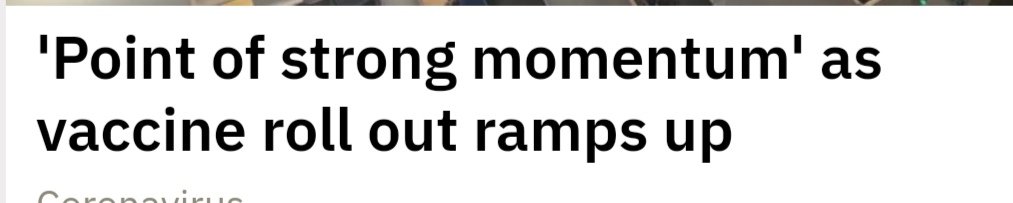
The above headline appeared on the RTÉ website the other day. It made me realize the extent to which I’ve come to hate anything that “rolls out” or “ramps up”, especially if it does both at the same time. So upset was I to see these two phrases together in the same text that I was even distracted from the bizarrely meaningless “point of strong momentum”. Nor did I spot the missing space in “rollout”, the noun form of the verbal phrase “to roll out”.  I think that short headline might have been specifically designed to drive me mad.

It’s been a while since I took aim at another phrase that I hate with a passion – “going forward” – but that doesn’t mean I’ve stopped caring about such things. In my brief time as a Head of School Sussex I collected quite a few new aversions: “robust” and “transparent” being the two front-runners. What’s most annoying about these is that I sometimes find myself using them before I can stop myself. The shame of it.

Another word I hate is “upcoming”. Forthcoming is the word you really want when you’re tempted to come up with upcoming.

The trouble with these hackneyed words and phrases is that lazy journalists and columnists trot them out so frequently that they get into your head and it’s hard to resist allowing them out when you have to write something yourself.

Anyway, back to rolling out and ramping out. These are being used to describe Covid-19 vaccination programmes but as well as being tired through overuse they are also inappropriate.  A “rollout” is  the first public appearance of a new product, especially a car or aircraft. The term does not apply to something that is well into production and distribution. The rollout of Covid-19 vaccines happened many months ago. It is not happening now.

And as for “ramping up”, what the heck is wrong with “increasing”?

If anyone would like to vent their spleen against other words or phrases please feel free to roll them out in the Comments Box below.

A Vaccine’s Progress

Posted in Biographical, Covid-19, Maynooth on May 8, 2021 by telescoper

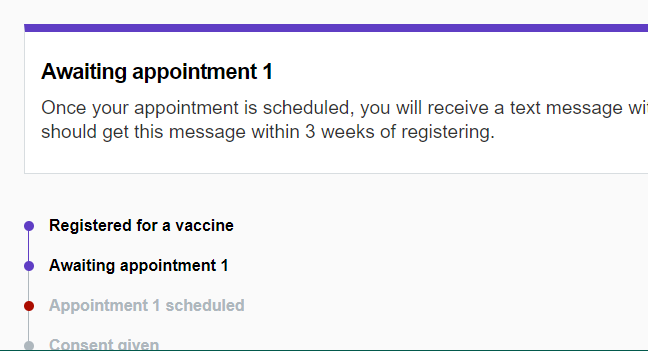
As I mentioned a few days ago, I was able to register for my shot of Covid-19 vaccine on Thursday 6th May, which I duly did. For those of you who haven’t yet registered in Ireland, it’s a straightforward process although you do need a mobile phone as well as an internet connection.

I said in my earlier post that

…I have no idea what that means for when, where or with what I will actually get vaccinated. As with so many things these days we’ll just have to wait and see.

When I registered I was informed that it would be up to three weeks before an appointment would be arranged. Actually, I got a text this morning giving the answers to all three questions I wondered about in that quote, and very interesting they turned out to be!

First my appointment is actually on Tuesday 11th May, just three days from now. The location is Citywest Convention Centre, in Saggart (outside Dublin), and the vaccine I will be receiving is Pfizer/BioNTech.

All three of these pieces of information surprised me: the date (because it is so soon – not that I’m complaining about that); the location (because I was led to believe I would be vaccinated in the County I live in, Kildare, the vaccination centre for which is Punchestown Racecourse, near Naas; Citiwest is in County Dublin); and the vaccine (for reasons I discussed here, I assumed I would be given either the AstraZeneca or Janssen (J&J) vaccine).

Anyway, I’m delighted with the way it has turned out, which means I’ll could well be fully vaccinated by the end of June, depending on the timing of the second dose.

The only (very slight) downside to this is that I was actually quite looking forward to visiting the racecourse at Punchestown as I’ve never been there before and it is an easy journey from Maynooth by bus. The consultant who looks at my knees from time to time is at Naas Hospital, so the trip is a familiar one to me. Citiwest may be marginally closer as the crow flies, but it’s basically inaccessible by public transport from here so I’ll have to get a taxi there and back. The vaccination system here seems to assume that everyone has a car as many of the big centres are in out-of-town locations hard to reach by public transport.

Some people I know who have had this vaccine have reported side-effects and others have experienced none whatsoever. I’ll just have to wait and see what happens in my case. I’ll get my jab in the morning so if I do react badly to it I’ll have an excuse for missing the Faculty Meeting scheduled for Tuesday afternoon!

What should universities keep after Covid?

Posted in Education, Maynooth with tags , , , on May 7, 2021 by telescoper

On the last day of teaching for this academic year, with reasonably encouraging signs of some form of reopening of campus education being possible in September, it will shortly be time to think about how we proceed next academic year.

It seems obvious to me that although university staff have worked very hard over the last year the Covid-19 restrictions have meant that we have not been able to provide the level of education we would have liked and most of us are longing to get back to some form of face-to-face teaching. On the other hand, the restrictions imposed upon us have generated some new approaches and it would be silly just to abandon what we have learnt and go straight back to the way things were before the pandemic.

I have two main things in mind, one on teaching and one on assessment, both of them relating to my own discipline – theoretical physics – but hopefully of some wider interest.

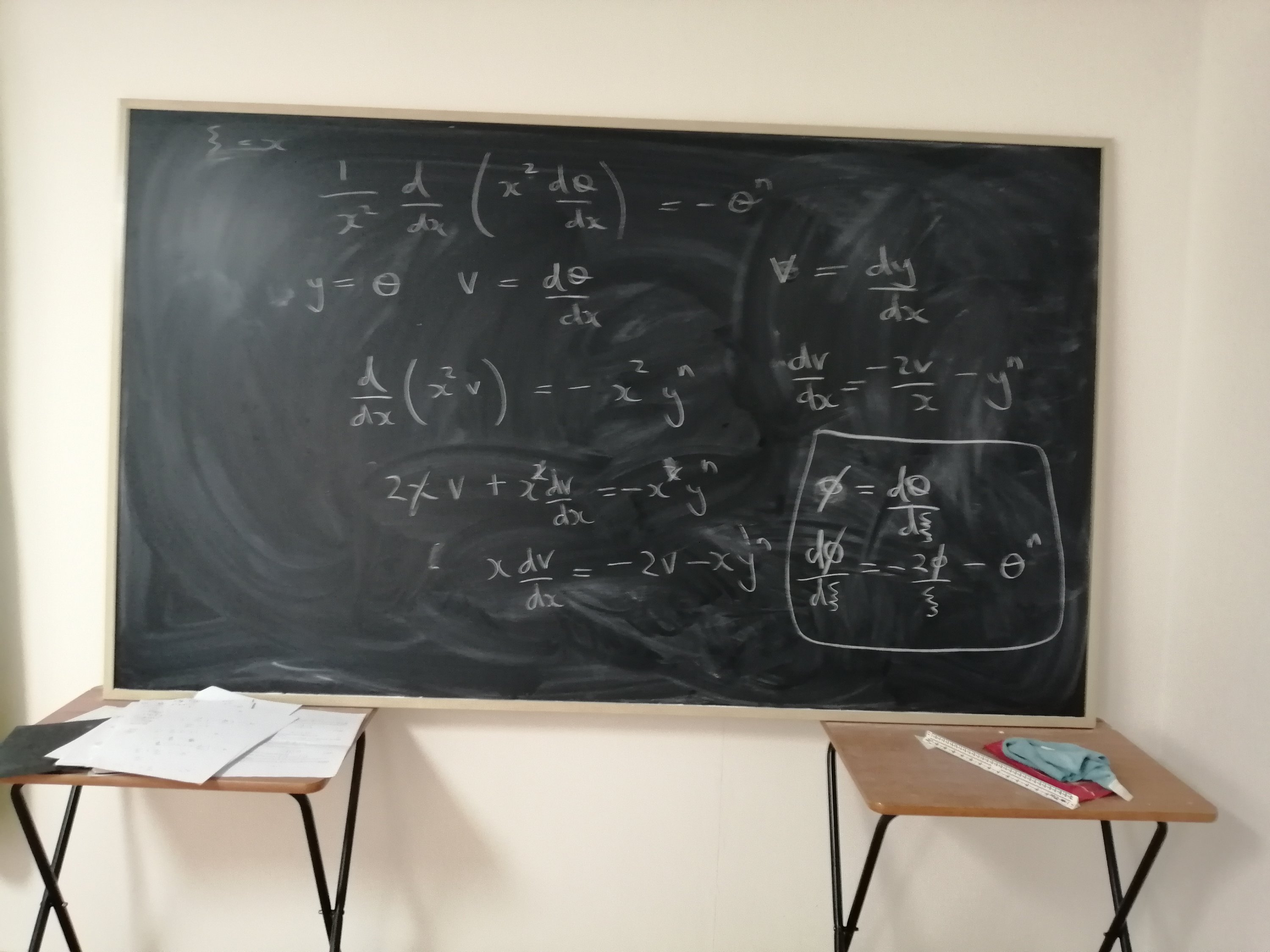
Implementing the Lane-Emden equation as two coupled first-order ODEs.

First, on teaching. Over the past year we have mainly been delivering lectures and tutorials remotely, using a mixture of platforms (Zoom, Panopto, Microsoft Teams, etc). Most lecturers have done lectures as live webcasts as well as recording the sessions to be viewed later. I have used Panopto for most of mine, actually. I am actually looking forward to being able to dismantle the setup I have in my study for this, to reclaim a bit of space, but probably won’t do so until we know for sure what we’ll be doing next Semester!

(By the way does anyone know where I should send the bill to my employers for their use of my study over the last year?)

For the record, I have found about 50% of the registered students have watched the lectures as live broadcasts from my home; the rest watch the recordings offline.

Maynooth didn’t have any facilities for lecture capture on campus until September 2020, in contrast to my two previous employers – the University of Sussex and Cardiff University – who both had systems in place long before the pandemic. I blogged about this 8 years ago, in fact. In Cardiff they actually use Panopto; all lectures were recorded as standard. In my view the benefits of lecture capture far outweigh the disadvantages, and we should incorporate recordings of lectures as part of our standard teaching provision, as a supplement to learning rather than to replace face-to-face sessions.

It seems to me that much of the argument against providing lecture recordings is from older staff who thing the younger generations should learn exactly the same way they themselves did despite the reality that classroom teaching in schools is now utterly different from what my generation experienced.

My view is that every student learns in a different way and we should therefore be doing as much as we possibly can to provide a diverse range of teaching resources so that each can find the combination that suits them best. Technology allows us to do this far better now than in the past.

Some really enjoy live lecture sessions, but others don’t. Others have reasons (such as disability) for not being able to attend in-person lectures, so providing recordings can help them. But why not in that case provide recordings for everyone? That seems to me to be a more inclusive approach.

The problem with continuing lecture capture beyond September 2021 in Maynooth is that we will need to improve the cameras and recording equipment in the large lecture rooms to make this possible for lectures with a significant mathematical content, as the existing setups in teaching rooms do not easily allow the lecturer to record material on a whiteboard or blackboard. In Cardiff the larger rooms have more than one camera, usually one on the lectern and one on the screen or whiteboard (which has to be placed further away and therefore needs to be of higher resolution). In Maynooth we only have small podium cameras in the teaching rooms.

The next topic is assessment. Since we were forced to switch to online timed assessments last May we have been doing most of our assessments that way. The student is given an exam paper at the appointed time, which they do on their own, then scan and upload their answers online (in our case via Moodle).

This mode of assessment has its problem. One is the possibility that students can collude (as there are no invigilators). Another is that not all students have a home environment conducive to taking an examination, nor a decent internet connection.

We decided to implement these as truly “open book” exams in which students are free to consult their notes, textbooks and internet resources. That format means it is pointless to ask the students to regurgitate definitions or learn derivations by rote so we concentrate on problem-solving, testing the understanding and application of concepts. Although it makes it a little harder to construct the examination papers, I think this a good way of assessing ability and knowledge of physics. If we can go do exams back on campus I think we should retain this approach at least for advanced topics, providing supervised spaces on campus to prevent collusion.

There are doubtless many other innovations we have brought in over the last year that people feel strongly about (one way or the other). Feel free to share them through the comments!

Bernard Schutz FRS!

Posted in Cardiff, The Universe and Stuff with tags , , , , on May 6, 2021 by telescoper

I was idly wondering earlier this week when the annual list of new Fellows elected to the Royal Society would be published, as it is normally around this time of year. Today it finally emerged and can be found here.

I am particularly delighted to see that my erstwhile Cardiff colleague Bernard Schutz (with whom I worked in the Data Innovation Research Institute and the School of Physics & Astronomy) is now an FRS! In fact I have known Bernard for quite a long time – he chaired the Panel that awarded me an SERC Advanced Fellowship in the days before STFC, and even before PPARC, way back in 1993. It just goes to show that even the most eminent scientists do occasionally make mistakes…

Anyway, hearty congratulations to Bernard, whose elevation to the Royal Society follows the award, a couple of years ago, of the Eddington Medal of the Royal Astronomical Society about which I blogged here. The announcement from the Royal Society is rather brief:

Bernard Schutz is honoured for his work driving the field of gravitational wave searches, leading to their direct detection in 2015.

I thought I’d add a bit more detail by repeating what was included in the citation for Bernard’s Eddington Medal which focuses on his invention of a method of measuring the Hubble constant using coalescing binary neutron stars. The idea was first published in September 1986 in a Letter to Nature. Here is the first paragraph:

I report here how gravitational wave observations can be used to determine the Hubble constant, H 0. The nearly monochromatic gravitational waves emitted by the decaying orbit of an ultra–compact, two–neutron–star binary system just before the stars coalesce are very likely to be detected by the kilometre–sized interferometric gravitational wave antennas now being designed1–4. The signal is easily identified and contains enough information to determine the absolute distance to the binary, independently of any assumptions about the masses of the stars. Ten events out to 100 Mpc may suffice to measure the Hubble constant to 3% accuracy.

In this paper, Bernard points out that a binary coalescence — such as the merger of two neutron stars — is a self calibrating `standard candle’, which means that it is possible to infer directly the distance without using the cosmic distance ladder. The key insight is that the rate at which the binary’s frequency changes is directly related to the amplitude of the gravitational waves it produces, i.e. how `loud’ the GW signal is. Just as the observed brightness of a star depends on both its intrinsic luminosity and how far away it is, the strength of the gravitational waves received at LIGO depends on both the intrinsic loudness of the source and how far away it is. By observing the waves with detectors like LIGO and Virgo, we can determine both the intrinsic loudness of the gravitational waves as well as their loudness at the Earth. This allows us to directly determine distance to the source.

It may have taken 31 years to get a measurement, but hopefully it won’t be long before there are enough detections to provide greater precision – and hopefully accuracy! – than the current methods can manage!

Here is a short video of Bernard himself talking about his work:

Once again, congratulations to Bernard on a very well deserved election to a Fellowship of the Royal Society.

UPDATE: a more detailed biography of Bernard is now available on the Royal Society website.