Archive for July, 2021

Back to Civilisation

Posted in Biographical, Cardiff, Covid-19, Cricket, GAA, Maynooth with tags , , , on July 24, 2021 by telescoper

So last night I returned safely from Cardiff to Ireland via Birmingham. Travel both ways was relatively uneventful. There can’t have been more than 30 people on the flight in either direction. I did however almost screw up the return flight by omitting to fill in the obligatory Covid-19 passenger locator form which I hadn’t realised is now online-only. I only found out that I had to do it before they would let me on the plane, resulting in a mad scramble with a poor phone connection to get it done. After a few goes and quite a bit of stress I succeeded and was allowed to board, conspicuously the last passenger to do so. We still managed to leave early though, and the short flight to Dublin – passing directly over Ynys Môn was relaxing and arrived on schedule; the immigration officer scanned my new-fangled Covid-19 vaccination certificate but wasn’t interested in the passenger locator form that caused me so much stress on departure.

I returned to Cardiff to take a bit of a break, to check up on my house and also prepare to move the rest of my belongings to Ireland. I was relieved when I got there last week that everything was basically in order, although there were lots of cobwebs and a very musty smell, which was hardly surprising since I hadn’t been there for 15 months. The inside of the fridge wasn’t a pretty sight either.

One night last week after meeting some friends for a beer in Cardiff I walked back via Pontcanna Fields and saw, much to my surprise, Camogie practice in progress in the twilight:

Camogie Practice, Pontcanna Fields, Cardiff.

The logistics of my planned removal proved a bit more complicated than I expected but eventually I cracked it and all the arrangements are now in place. I should receive delivery here in Maynooth next month. I’m doing it on the cheap as a part-load, which is why it will take a bit longer than usual.

Cleaning and packing was very hard work owing to the intense heat over the last week or so – it was regularly over 30° C – during the day, so I took quite a few siestas. My neighbours tell me it’s been much the same here in Maynooth, although it is a bit cooler today, around 20° with a very pleasant breeze.

Despite the hard work it was nice to have a change of scenery for a bit and also to meet up with some old friends from Cardiff days. Everyone has been in a state of limbo for the last 18 months or so, and although we’re not out of the woods yet there are signs of things coming back to life. When I went to Bubs in Cardiff for a drink last week it was the first time I’d been inside a pub since February 2020!

Incidentally, most people I saw observed social distancing, wore masks, etc. The rules in Wales are still fairly strict. Although open for indoor service, bars and restaurants seem to have few customers. Some people on trains to and from Birmingham didn’t wear masks. One group of unmasked and obnoxious English passengers on my return journey were loudly boasting how backwards Wales was compared to England, where the rules have relaxed despite a huge surge in cases. I moved to another carriage.

The only other thing I managed to do was attend a Royal London One-Day Cup match at Sophia Gardens between Glamorgan and Warwickshire in the baking heat of Sophia Gardens. It turned out to be a good tight game, with Glamorgan winning by 2 wickets courtesy of two consecutive boundaries. Most of the time I was sitting there in the shade I was thinking how glad I was not to be fielding in such conditions.

One thing that was very noticeable during my stay in Wales was that it was very hard to get fresh salad vegetables and the like. That may be partly due to weather-related demand or it may be due to a shortage of lorry drivers or other staff owing to Covid-19 isolation requirements and may be a consequence of Brexit. Who knows? I’ll just say that there’s been hot weather in Ireland, where the Covid-19 pandemic is also happening but there are no reports of shortages of fresh food here. I’m very much looking forward to having a nice salad with my dinner this evening.

Anyway, I suppose that’s enough rambling. At some point I’ll have to open up my email box to see what horrors lurk therein. Still can’t be worse than the fridge I opened last week. Can it?

Interlude

Posted in Uncategorized on July 13, 2021 by telescoper

I’m now taking a short break so I can travel to a strange and distant land for a week or so.

Normal service will be resumed as soon as possible, but in the meantime there will be a short intermission.

Why Do England Always Lose on Penalties?

Posted in Biographical, Football with tags , , , on July 12, 2021 by telescoper

I’m reblogging this post from a few years ago. It remains topical.

I thought I’d add my own (very limited) experience of taking penalties. In the period from 1988-90 or thereabouts I played for a team called the University Associates in the Sussex Sunday League (2nd Division). The League also had a cup competition, and one day we played a game that ended in a draw after extra time, so went to penalties. I used to play in midfield for that team, rather than as a striker and I scored only 2-3 goals a season. I wasn’t one of the five nominated penalty takers but after those it was 2-2 so it went to sudden death and my turn came up at 3-3 after one round. It was the only penalty I’ve ever taken (not counting 5-a-side). I wasn’t at all confident but my biggest fear was the ribbing I would undoubtedly get if I didn’t even hit the target, so I decided to hit it as hard as I could straight at the goal. I thought my natural level of inaccuracy might take the ball to one side or the other of the goalie.

So I paused, took a deep breath, ran up and blammed it as hard as I could. It went quite hard straight at the goalie. If he’d stayed where he was standing it would have hit him at chest level. Fortunately for me he dived out of the way and I scored. 4-3! So I have a 100% success rate at scoring penalties (based on a sample of one).

The story didn’t end entirely happily though. My opposite number scored to make it 4-4 and we ended up losing 5-4.

Andrew Chambers's avatarIB Maths Resources from Intermathematics

penalties2

Statistics to win penalty shoot-outs

With the World Cup nearly upon us we can look forward to another heroic defeat on penalties by England. England are in fact the worst country of any of the major footballing nations at taking penalties, having won only 1 out of 7 shoot-outs at the Euros and World Cup. In fact of the 35 penalties taken in shoot-outs England have missed 12 – which is a miss rate of over 30%. Germany by comparison have won 5 out of 7 – and have a miss rate of only 15%.

With the stakes in penalty shoot-outs so high there have been a number of studies to look at optimum strategies for players.

Shoot left when ahead

One study published in Psychological Science looked at all the penalties taken in penalty shoot-outs in the World Cup since 1982. What they found was pretty incredible – goalkeepers…

View original post 1,070 more words

The Morning After…

Posted in Biographical, Football with tags , , , , on July 12, 2021 by telescoper
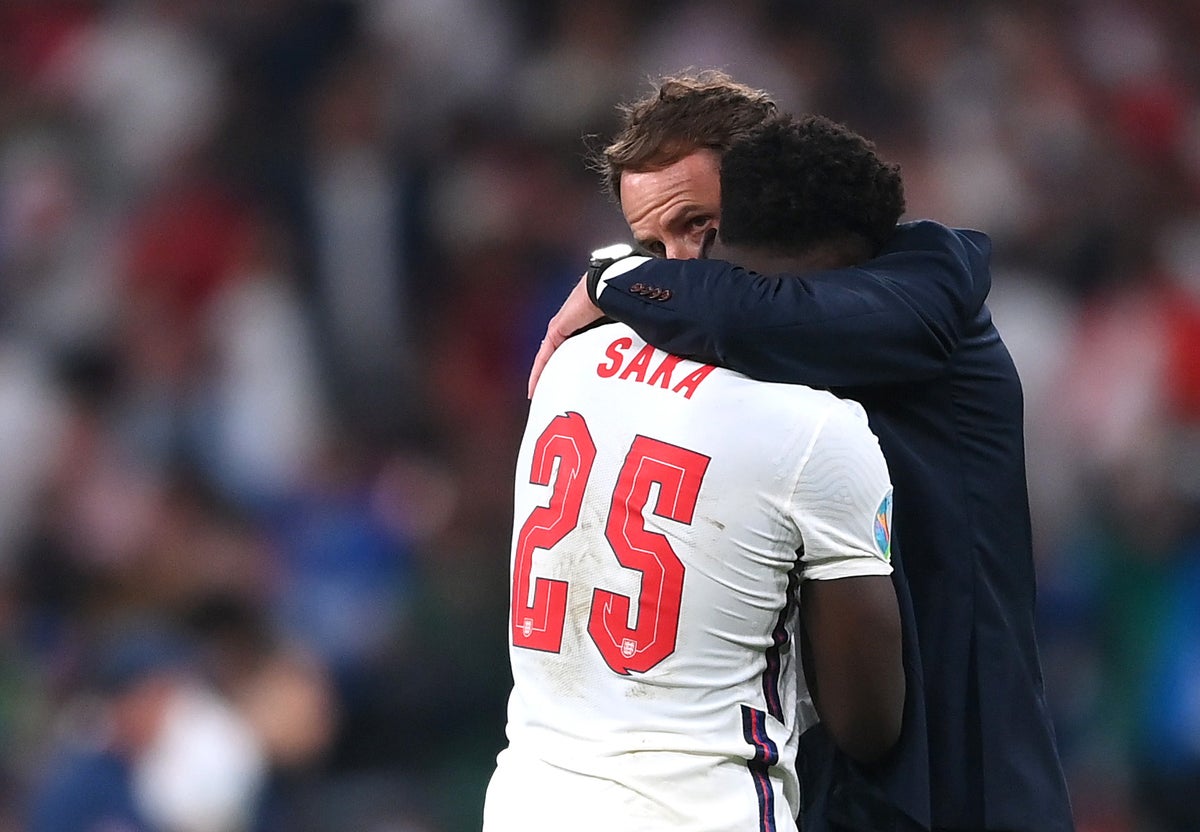
Gareth Southgate consoles Bukayo Saka who missed the last penalty in the shootout against Italy

Well that’s that. Last year’s European Championship is over. Italy beat England in the final last night on penalties. England lost in the semi-final of the, World Cup in 2018. Many people suggested they would go a step further this time, and they did: they lost in a final.

It wasn’t a great game. Finals seldom are – there’s too much at stake for the players to play with any freedom. But it was tense and dramatic and in the end, for England fans and players, heartbreaking. Italy have been the most consistently impressive team in the tournament, and had a far more difficult draw than England (who, in my opinion were very lucky to beat Denmark in the semi-final thanks to a very dodgy penalty) and didn’t have home advantage.

Overall I think Italy deserved to win the tournament and happy for them, though sad a bit for Gareth Southgate who has proved himself the most gentlemanly of managers. The manner of this loss – on penalties yet again – must hurt him, but he will be gracious in defeat. I wish the same could be said of some of the England supporters.

People have been critical of Southgate’s rather defensive tactics for last night’s match. For what it’s worth I think his cautious approach was dictated by his awareness of the weaknesses in his side. He had good attacking players but lacked strength in midfield. Italy were much more tenacious and comfortable in possession. For large parts of last night’s match England were just unable to get the ball; the official possession stats were 65:35 in Italy’s favour. A playmaker in the centre of the park would make a huge difference to England’s chances of landing a major trophy.

The great thing about this young England football team is how it has managed to provide so many positive role models, through its dignified response to racism and embrace of inclusivity, while at the same time respecting the time-honoured English tradition of losing on penalties. They will no doubt be feeling awful right now but they have a lot to build on for the World Cup next year if they can pick themselves up, though they might not get such a favourable draw.

I have enjoyed the tournament. I didn’t watch all the games because I was too busy, but I watched most of the 8pm matches and found them a welcome distraction. As an émigré I no longer feel any obligation to support England, but I don’t feel any need to despise them either so I was able just to enjoy the football. As I said above, I think Italy performed most consistently at a high level throughout the competition but I also enjoyed watching Spain (who would be world-beating if they had a decent striker) and Belgium, either of whom would have been worthy finalists had the draw. I feel a bit sorry for Denmark given what happened in their first match. They can be very proud of the way they rallied to reach the semi-finals without their star player Christian Eriksen.

Anyway, well played Italy! I have quite a few Italian friends and colleagues and I know they’re all delighted. Il Calcio sta tornando a casa…

Searching for the Predicted Peaks in the CMB Power Spectrum

Posted in The Universe and Stuff with tags , , on July 11, 2021 by telescoper

I came across this on social media and thought I’d share it here. It’s a nice graphical demonstration of the interplay between theory and experiment in the field of cosmic microwave background physics. The video was created by Forrest Fankhauser and Lloyd Knox at the University of California, Davis with funding from the National Science Foundation.

As someone famous once said: “we’ve come a long way from pigeon shit…”

The Killing of Samuel Luiz: why do you straight men do this?

Posted in Biographical, Brighton, LGBTQ+ with tags , , on July 10, 2021 by telescoper

This is a picture of Samuel Luiz, a young gay man who was kicked and punched to death outside a nightclub in A Coruña, Galicia, Spain, on Saturday 3rd July 2021. At least 12 men were involved in the vicious assault and they were shouting the word maricón as they beat him. The word is a derogatory term in Spanish for a gay man, roughly equivalent to “faggot” in English. At least four men (all between the ages of 20 and 25) have been arrested for this murder. Let’s hope some justice is served. Demonstrations were held across Spain to protest Samuel’s killing.

This attack came just a few days after the end of Pride Month and if nothing else shows how far we still have to go. People sometimes ask why we still need Pride, after all we now have gay marriage? Well, Spain has gay marriage, but mobs still murder gay men. Anti-gay hate crime is reportedly on the increase in Spain and probably elsewhere. The Government of Hungary has enacted specifically homophobic legislation

There’s nothing new about this kind of homophobic violence. Queer-bashing was endemic in Brighton when I lived there in the 1980s. I know. I was on the receiving end of a beating myself. There were only four assailants in my case, and of course I didn’t die. My physical injuries were relatively superficial, but it was a life-changing experience and not in a good way. The word that was ringing in my eyes as I lapsed into unconsciousness then was “faggot”, so reading about Samuel Luiz brought it back. Sometimes things like this make me want to go and live off-grid somewhere far away from people to avoid such thoughts intruding again.

Anyway, that experience on Brighton sea front left me convinced that however much attitudes and laws change there will always be men – presumably straight – who for some reason despise gay men so much that they want to inflict violence on us. I can’t rid myself of the belief a very large number of straight men would behave in that way if they thought they would get away with it. It takes me a very long time to trust a heterosexual man enough to call him a friend.

I wish I could understand what causes so much hate. Believe me, if thought about it a lot and for a very long time and it remains incomprehensible to me. Perhaps it expresses some kind of need to assert dominance, much as misogynistic transphobic, and racist violence does? Or perhaps just a form of tribalism like football violence? The one firm conclusion I have reached is that the people who do this sort of thing are utter cowards. Why else would they need a gang to beat up one person? And the people who just look on and don’t intervene are cowards too.

In a piece a while ago I wrote about my experience in Brighton:

I have to say that for quite a long time in this period my general presumption was that a majority of heterosexual people were actively hostile to LGBT+ people, and that would always remain the case. There were quite a few gay people in Brighton who felt the same and their reaction was to become separatists. The logic was that straight people were always going to be horrible, so to hell with them. You could drink in gay bars, eat in gay restaurants, live in a gay part of the town, etc, and thereby minimize interaction with the hostile majority. This seemed an attractive lifestyle to me for some time, but I gradually began to feel that if there was ever going to be a chance of things changing for the better, LGBT+ people had to engage and form alliances. That strategy seems to have worked for the wider community, and I applaud the many straight people who have become allies.

It’s easy to say you’re an ally but are you willing to stand up and be counted?

A comment below objects to the “you” in the title of this post. I thought very carefully before including it. The response “not all straight men are like that” is unhelpful for lots of reasons.

First, I know that. All gay people do. We already know not every straight man is a murderer, or otherwise violent. We don’t need you to tell us. Second, it’s defensive. When people are defensive, they aren’t listening to the other person; they’re busy thinking of ways to defend themselves. It’s a classic social media response. Third, people saying it aren’t furthering the conversation, they’re sidetracking it. The discussion isn’t about the men who aren’t a problem. Fourth – and this the most important point – nobody can really know which straight men are “like that” and which aren’t until it’s too late.

I would genuinely love to live in a society without prejudice on the grounds of identity but we’re not there yet. I don’t think it does any harm to hold a mirror up to the kind of stereotyping that many groups have to deal with on an everyday basis. You may not like being included in a generalisation but at least you’re not put in mortal danger because of your identity. It’s not you who is a target.

IRC Starting and Consolidator Awards

Posted in Maynooth, Science Politics, The Universe and Stuff with tags , , , , on July 9, 2021 by telescoper

Just a quick post to pass on the news that there are a couple of new funding programmes run by the Irish Research Council. The full description of these programmes can be found here, but here is an excerpt:

The Council is inviting applications at the early and mid-career level (Starting and Consolidator). Funding will be awarded on the basis solely of excellence, assessed through a rigorous and independent international peer-review process. Laureates will enhance their track record and international competitiveness. As well as the benefits for the laureate and their team, it is anticipated that the award will enhance the potential for subsequent ERC success as a further career milestone; indeed it will be a requirement of all laureates that they make a follow-on application to the ERC.

Fortunately the remit of the IRC is broader than Science Foundation Ireland, which has a narrow focus on research likely to lead to short-term returns, so it is more likely to appeal to those working in more speculative fundamental or frontier science, including Astrophysics. Unfortunately IRC has a lot less money than SFI.

An overview of the programme can be found in the following recording of a webinar that took place last week:

The way the call works is that you must first lodge an Expression of Interest with the institution to which you wish to apply, i.e. Maynooth University. That must be done by 27th August 2021. Full applications will then be due in November.

Extensive view of Carton House, County Kildare, with Maynooth in the distance – Willem van der Hagen

Posted in Architecture, Art, History, Maynooth with tags , , , on July 8, 2021 by telescoper

I came across the above painting on the Maynooth local history Facebook page the other day and thought I’d share it here. It’s by a fairly obscure artist called Willem van der Hagen who was Dutch but who settled in Ireland around 1720. The painting (oil on canvas, 107.6 cm by 133.6 cm) dates from around 1730 and was sold at Christie’s in 2017 for £428,750. The painting was probably commissioned by Henry Ingoldsby who inherited Carton Demesne on the death of his father Sir Richard Ingoldsby in 1712.

The view is of Carton House, a location very close to where I live and which I blogged about here. The grounds of Carton House are very pleasant for taking recreational walks.

The bird’s-eye view in the painting shows Carton and its demesne before the house was extensively remodelled in the mid-18th Century, although the layout is still recognizable in the modern house:

Th refurbishment of the house was undertaken by architect Richard Castle for the 19th Earl of Kildare between 1739 and 1745. The view in the painting dates from before this change and shows Carton at the centre of an elaborate formal garden. In the foreground, on the southern side of the house, avenues of lime trees radiate outward into the countryside from the enclosed entrance courtyard; on the northern side of the house can be seen a stepped series of walled gardens and terraced walks.

The gardens and demesne were also transformed when the house was rebuilt to reflect mid eighteenth-century taste. More recently the grounds have been turned into golf courses, one to the front and one to the rear as the house itself is now a golfing resort hotel so nothing remains of these extensive gardens.

In the distance to the far left you can see the ruins of the keep of the ancient FitzGerald castle in Maynooth, but St Patrick’s College was not built until the end of the 18th Century and much of the present-day town centre dates from the 19th Century so in those days Maynooth was a small place. The area between the castle and the walls surrounding Carton House demesne is now largely built-up although there is a pleasant tree-lined avenue leading from Maynooth towards the House as far as the Dunboyne Road.

In the right foreground you can see the Prospect Tower built by the Earl of Tyrconnell, which still stands. I always assumed this was some sort of folly but it was apparently intended as a mausoleum for one of the previous owners of the house.

New Publication at the Open Journal of Astrophysics

Posted in OJAp Papers, Open Access, The Universe and Stuff with tags , , , , , on July 7, 2021 by telescoper

Time to announce another publication in the Open Journal of Astrophysics. This one was actually published last Friday, but I didn’t get time to post about it until just now. It is the fifth paper in Volume 4 (2021) and the 36th paper in all.

The latest publication is entitled Gravitational Wave Direct Detection does not Constrain the Tensor Spectral Index at CMB Scales and the author is Will Kinney of the State University of New York at Buffalo (which is SUNY Buffalo, for short).

Here is a screen grab of the overlay which includes the abstract:

You can click on the image to make it larger should you wish to do so. You can find the arXiv version of the paper here. This one is, fairly obviously, in the Cosmology and Nongalactic Astrophysics folder..

Over the last few months I have noticed that it has taken a bit longer to get referee reports on papers and also for authors to complete their revisions. I think that’s probably a consequence of the pandemic and people being generally overworked. We do have a number of papers at various stages of the pipeline, so although we’re a bit behind where we were last year in terms of papers published I think may well catch up in the next month or two.

I’ll end with a reminder to prospective authors that the OJA  now has the facility to include supplementary files (e.g. code or data sets) along with the papers we publish. If any existing authors (i.e. of papers we have already published) would like us to add supplementary files retrospectively then please contact us with a request!

Interaction in Lectures

Posted in Biographical, Education on July 6, 2021 by telescoper

There’s been dismay among many students at the University of Manchester at the news that said institution is planning to keep lectures online next year. If the reason for that decision were that campuses are likely to be closed again by September then I would consider it wise, but it seems this is to be a permanent thing; see the following excerpt.

The clear assumption here is that large lectures never involve interaction. I can think of many colleagues besides myself who would object to that most strongly. Even in a big lecture hall interaction is key to the learning experience. The thing the above statement misses entirely is the extent to which the presence of an audience actually helps the lecturer to improve the learning experience for the students. It’s astonishing to me that the person quoted above seems to think interaction only happens in one direction! On the contrary, a lecture is – or should be – a shared experience between lecturer and students.

If you think about it is a very strange situation when someone stands up in front of a bunch of students and lectures at them for an hour or more. I frequently have the best part of a 100 people watching, and occasionally listening to, me drone on about something or other. What’s strange is that all those people see basically the same thing, whereas the lecturer gets to see all their different facial expressions, at least the lecturer can when the lecture is in person not online with everyone’s video muted.

I’m one of those people who finds it very difficult to give a lecture without looking at the audience, which is why I’ve found the transition to online teaching so difficult. It’s partly to try to establish some kind of rapport with them, notably in order to encourage them to answer when I ask a question or to offer questions of their own, but also to try to figure out whether anyone at all is following what I’m saying. Not all students are helpful in this regard, but some have very responsive mannerisms, nodding when they understand and frowning when they don’t. When I’m teaching a class for the first time I usually look around a lot in an attempt to identify those students who are likely to help me gauge how well things are going. Usually,  there are only a few barometers like this but I would be lost without them. Fortunately most students seem to sit in the same place in the theatre for each lecture so you can usually locate the useful ones fairly easily, with a discreet look around before you  start.

Most other students seem to have a default lecture face.  The expressions range from a perpetual scowl to a vacant smile (each of which is in its own way a bit scary). There’s the “wish I wasn’t here” face of pure boredom,  not to mention those who are fast asleep; I don’t mind them as long as they don’t snore. There’s the Bookface of someone who’s not listening but messing around on Facebook, and the inscrutable ones whose faces are masks, even when not literally wearing a mask, yielding no clues as to what, if anything, is going on behind. The brightest students often seem to belong to the last group, although I haven’t done a statistical study of this so that must be taken as purely anecdotal.

Anyway, by way of a bit of audience participation if you can be bothered, here’s a poll. If you don’t know what your own lecture face is, then you could always ask, that is if you’re one of the lucky folks who’s actually been in a lecture at all as opposed to sitting in your room watching a recording.