Archive for July, 2021

Reasons for Optimism

Posted in Biographical, Covid-19, Education with tags , , , , , , on July 6, 2021 by telescoper

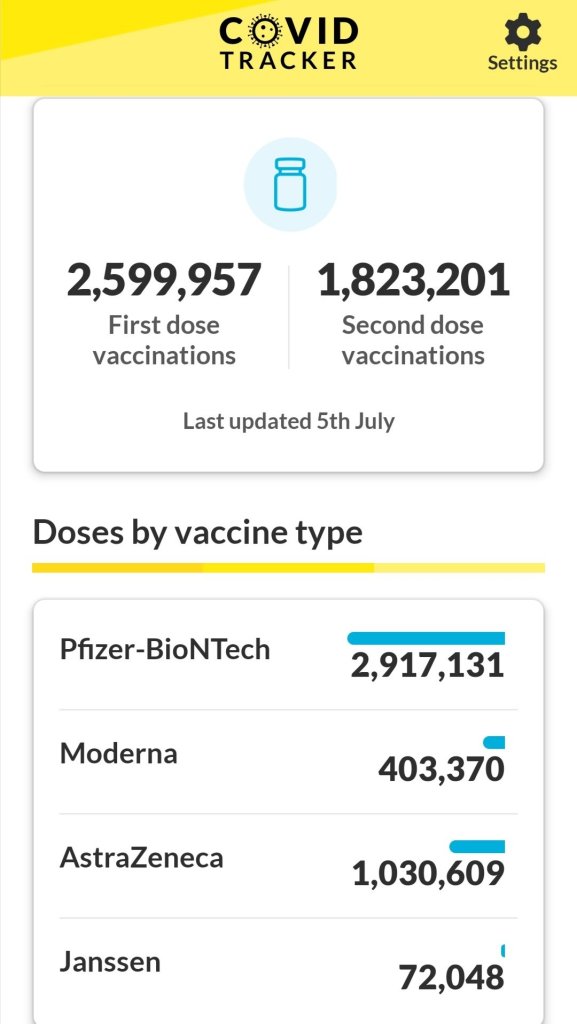
After an interruption of almost two months because of a Cyberattack on the Health Service Executive’s computer system, daily updates of Ireland’s vaccination statistics have at last resumed, including via the Covid-19 app (which has been moribund since 11th May).

You might think it strange but I find the restoration of daily updates reassuring. I suppose it’s because I work in a quantitative discipline but I like having things expressed in figures, though I am of course aware of their uncertainties and other problems involved in interpreting them.

The latest figures above show that about 70% of the adult population has received at least one dose while about 50% have had two doses; the latter are regarded as “fully” vaccinated as are the smaller number who have received the one-shot Janssen vaccine produced by Johnson & Johnson. Although the Government missed by some margin its target of giving one dose to 82% of the adult population by the end of June, I find myself much more optimistic than in past few weeks about how things are going.

Two developments in particular have helped.

First the Government is set to purchase about a million doses of Pfizer/BioNTech from Romania. That would be enough to fully vaccinated about 10% of the population. These doses have become available because take-up in Romania is very poor and the shots would go to waste if not disposed of elsewhere. What’s bad news for Romania is, however, good news for Ireland.

The second change is that the Government has decided to allow the AstraZeneca and Janssen vaccines to be used on adults in the age range 18-34 and that vaccinations of this group are now being carried out by pharmacists. Previously these vaccines were only to be given to persons aged 50 and over. Indications are that there is some reluctance among the younger cohort, which is hardly surprising since it was only a few weeks ago that they were being told these vaccines were too risky, but I suspect this change will go a long way towards fully vaccinating the adult population, which may be possible by the end of August.

I regard the immunization of students next year’s intake to third level education institutions as a necessary condition for opening up campuses to something like “normal” teaching. Just a couple of months ago I didn’t think this would be possible, but now it might be. It’s still possible that there will be disruptions in supply but it’s looking reasonably good at the moment based on the arithmetic of how many doses are available.

The fly in the ointment is of course the so-called Delta Variant, which has already gained a foothold in Ireland and is set to cause case numbers to rise substantially. We will soon see whether this causes an increase in hospitalizations and deaths. The most vulnerable should be protected so the probability of a case turning into serious illness or death should be much lower, but we don’t know by how much. Unfortunately the statistics of Covid-19 are still not being reported publicly. Some people seem to think this means they’re not happening. It doesn’t. It just means the system for reporting them is not working. I expect the forthcoming announcement of the backlog will cause some alarm.

The Irish Government recently decided to pause the gradual reopening of the economy to allow vaccinations to proceed further. There is still a race between the Delta variant and the vaccination programme. The number of people vaccinated increases approximately linearly with time, while the number of Covid-19 cases grows exponentially in the growth phase of the pandemic. I think the pause was sensible.

Across the Irish Sea there is a different situation. The English Government has decided to abandon all attempts to control the spread of Covid-19 at precisely the point when the pandemic is in another exponential phase. The number of cases is now likely to increase dramatically. The number of resulting deaths may be fewer than in previous waves but won’t be zero. Perhaps more importantly, allowing a huge pool of virus to develop increases the chance of yet another variant evolving, perhaps one that can evade the defences afforded by vaccination even more effectively than the Delta variant. I shudder to think of the consequences if that does happen. Perhaps it already has.
The Fourth of July – Charles Ives

Posted in Music with tags , , , , on July 5, 2021 by telescoper

I’m a day late posting this, but I only thought of it this morning. It’s a fine performance by the New York Philharmonic conducted by Leonard Bernstein of “The Fourth of July”, the third movement of his “Holidays Symphony” by the great Charles Ives. The video even shows the score so you can play along at home! As Ives himself famously said:

Stand up and take your dissonance like a man!

On LinkedIn

Posted in Science Politics, The Universe and Stuff with tags , , , , on July 4, 2021 by telescoper

A former colleague recently contacted me with a request to join my “network” on LinkedIn.  That was quite hard to do as (at least until this morning) I was not on LinkedIn. That reminded me of a talk at INAM2019 a couple of years ago about the Astronomical Society of Ireland  which was about to be re-launched with a new website. One of the main reasons for doing this is that Ireland recently joined the European Southern Observatory and in order to capitalize on its involvement it is important to persuade the Irish government to invest in the resources needed (especially postdocs, etc) to do as much science as possible using ESO facilities. The idea was to improve the lobbying power for astronomy in Ireland. One of the suggestions made yesterday was that astronomers in Ireland should join LinkedIn in order to raise their profile individually and collectively.

I was not on LinkedIn at the time and didn’t get around to joining it mainly because I’ve always thought it was more for businessy types than academics. Anyway, in the light of recent events I decided it couldn’t do any harm to bite the bullet and set up a LinkedIn profile, which you can find here. It’s really a rather basic profile but I think I’ve set it up so that posts from here will be posted to LinkedIn too, so if you’re on it yourself you might want to add me. Or not. It’s up to you!

P.S. The only thing I have put under “Awards and Honours” is Winner of Beard of Ireland 2020.

Stepping Down

Posted in Biographical, Education, Maynooth on July 3, 2021 by telescoper

I was planning to be on leave now; I intended to make up for the fact that I didn’t get a summer holiday last year by taking most of July off. Unfortunately that was not to be and I have to stay at work for at least another week to participate in an interview panel. I may still get a couple of weeks after that but if I do it will be taken up with organizing the move of the rest of my belongings from Cardiff to Maynooth, rather than being an actual holiday.

Over the last few days, in an exhausted and demoralized state, I have been looking back over the best part of two years I have been Head of the Department of Theoretical Physics at Maynooth University – most of which has coincided with the Covid-19 pandemic. Frankly, I have found the burden of administration on top of the heavy teaching load required of me to be unmanageable. Because we are a very small Department teaching a full degree course, all of us have to teach many more modules than is reasonable for for staff who are expected to do research as well. I had to teach five modules* last academic year; that would have been bad enough even without having to do everything online and without the additional and frequently onerous duties associated with the Head of Department. There is no prospect of that burden decreasing for the foreseeable future.

I was appointed as Head of Department for three years, but last week I asked the University to let me step down from my role as Head of Department of Theoretical Physics from the end of September 2021, a year early. I’ll carry on as a Professor, hopefully with some time to do research, although my teaching duties will undoubtedly remain heavy.

At least now, if I do get some holiday this summer I’ll be spared some of the dread of what I’ll have to return to afterwards…

*For those who are wondering, two of those modules are 36 lectures (3 per week for a 12-week semester), two are 24 lectures (two per week for a semester) and one is computer-based (1 lecture + a 2hr lab session per week for a semester). That load is about average for full-time staff in the Department; if I did less someone else would have to do more.

UPDATE: 6th July. The University has agreed to my request. “Freedom Day” for me is October 1st 2021.

Hubble Tension – The Plot Thickens

Posted in The Universe and Stuff with tags , , , on July 2, 2021 by telescoper

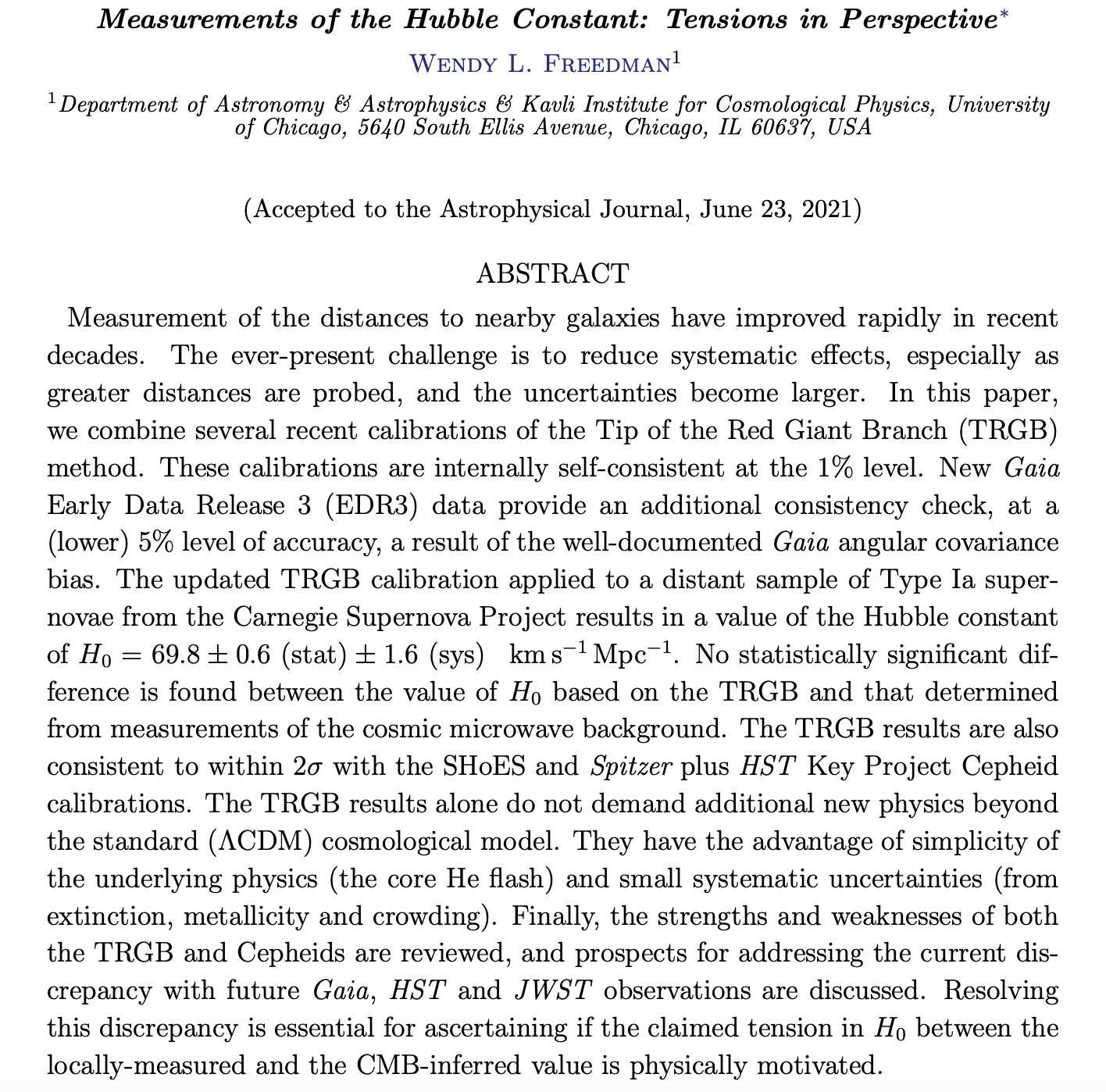
One topic on this blog seems to be as perennial as the weeds in my garden: the so-called Hubble Tension. I just saw a review paper by Wendy Freedman, one of the acknowedged experts in this area, on arXiv here. I have abstracted the abstract here:

You can find the PDF here.

What’s particularly interesting about this discussion is that stellar distance indicators have typically produced higher values than the 69.8 ± 0.6 (stat) ± 1.6 (sys) km s-1 Mpc-1 quoted here, which is consistent with the lower value favoured by Planck. See the above graphic discussed here. So perhaps there’s no tension at all. Maybe.

Anyway, here’s that poll again! I wonder if this paper might change the voting.


Villanelle for Our Time – Leonard Cohen

Posted in Music, Poetry on July 1, 2021 by telescoper

Today (1st July) is Canada Day so here is something by Canada’s finest, the great Leonard Cohen.

We miss you, Leonard.

This is the faith from which we start:
Men shall know commonwealth again
From bitter searching of the heart
We rise to play a greater part


Ireland’s Covid-19 Models

Posted in Covid-19, mathematics, Maynooth with tags , , , , , on July 1, 2021 by telescoper

Yesterday the Chair of the National Public Health Emergency Team (NPHET), who also happens to be the President of Maynooth University, Professor Philip Nolan published a lengthy but interesting Twitter thread (which you can find unrolled here). In these tweets he explained the reason behind NPHET’s recommendation to pause the process of relaxing Covid-19 restrictions, postponing the next phase which was due to begin on 5th July with indoor dining.

The basic reason for this is obvious. When restrictions were lifted last summer the reproduction number increased to a value in the range 1.4 to 1.6 but the infection rate was then just a handful per day (on July 1st 2020 the number of new cases reported was 6). Now the figures are orders of magnitude higher (yesterday saw 452 new cases). A period of exponential growth starting from such a high base would be catastrophic. It was bad enough last year starting from much lower levels and the Delta variant currently in circulation is more transmissable. Vaccination obviously helps, but only about 40% of the Irish population is fully immunized.

Incidentally the target earlier this year was that 82% of the adult population should have received one jab. We are missing detailed numbers because of the recent ransomware attack on the HSE system, but it is clear that number has been missed by a considerable margin. The correct figure is more like 67%. Moreover, one dose does not provide adequate protection against the Delta variant so we’re really not in a good position this summer. In fact I think there’s a strong possibility that we’ll be starting the 2021/22 academic year in worse shape than we did last year.

In general think the Government’s decision was entirely reasonable, though it obviously didn’t go down well with the hospitality sector and others. What does not seem reasonable to me is the suggestion that restaurants should be open for indoor dining only for people who are fully vaccinated. This would not only be very difficult to police, but also ignores the fact that the vast majority of people serving food in such environments would not be vaccinated and are therefore at high risk.

As things stand, I think it highly unlikely that campuses will be open in September. Rapidly growing pockets of Delta variant have already been seeded in Ireland (and elsewhere in Europe). It seems much more likely to me that September will see us yet again in a hard lockdown with all teaching online.

But the main reason for writing this post is that the thread I mentioned above includes a link to a paper on the arXiv (by Gleeson et al.) that describes the model used to describe the pandemic here in Ireland. Here is the abstract:

We describe the population-based SEIR (susceptible, exposed, infected, removed) model developed by the Irish Epidemiological Modelling Advisory Group (IEMAG), which advises the Irish government on COVID-19 responses. The model assumes a time-varying effective contact rate (equivalently, a time-varying reproduction number) to model the effect of non-pharmaceutical interventions. A crucial technical challenge in applying such models is their accurate calibration to observed data, e.g., to the daily number of confirmed new cases, as the past history of the disease strongly affects predictions of future scenarios. We demonstrate an approach based on inversion of the SEIR equations in conjunction with statistical modelling and spline-fitting of the data, to produce a robust methodology for calibration of a wide class of models of this type.

You can download a PDF of the paper here.

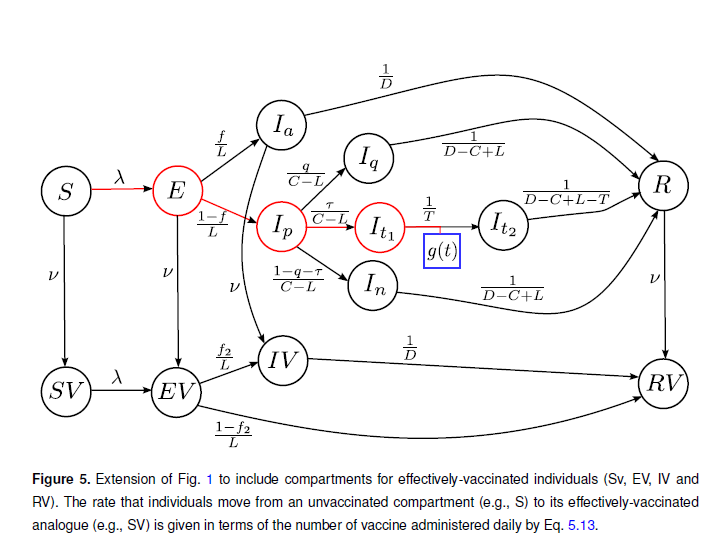
This model is a more complicated variation of the standard compartment-based models described here. Here’s a schematic of the structure:

This model that makes a number of simplifying assumptions but it does capture the main features of the growth of the pandemic reasonably well.

Coincidentally I set a Computational Physics project this year that involved developing a Python code that does numerical solutions of this model. It’s not physics of course, but the network of equations is similar to what you mind find in physical systems – it’s basically just a set of coupled ODEs- and I thought it would be interesting because it was topical. The main point is that if you study Theoretical Physics you can apply the knowledge and skills you obtain in a huge range of fields and disciplines. Developing the model does of course require domain-specific epidemiological knowledge but the general task of modelling complex time-evolving systems is definitely something physicists should be adept at doing. Transferable skills is the name of the game!

P.S. It came as no surprise to learn that the first author of the modelling paper, Prof. James Gleeson of the University of Limerick, has an MSc in Mathematical Physics.