Archive for November, 2021

Worrying Times…

Posted in Biographical, Covid-19, Education, Maynooth with tags , , , on November 14, 2021 by telescoper

So here I am, trying to plan my teaching for next week and wondering what’s going to happen between now and the end of term. Here at Maynooth University lectures finish on 17th December, five weeks from now. I’m just about on schedule to cover everything I’m supposed to, so I’m not worried about that.

What I am worried about is that Covid-19 cases are continuing to climb. The latest 7-day rolling average of new cases is over 3900 per day and the increasing trend show no sign of slowing down. It will reach the 5000 mark in a week or two. Some daily figures have already passed that milestone. The death rate is still relatively low – 74 Covid-19 related deaths were recorded in the last week – but is edging up; over a hundred people with Covid-19 are being treated in ICU as of today.

The Irish Government seems to have no intention of introducing effective countermeasures and is instead just advising people to cut down the amount of socializing they do. I don’t think that will work. It seems very clear to me that the Government lost the room many weeks ago by frequently implying that the Covid-19 pandemic was over. They then caved in to the hospitality industry by allowing nightclubs to open. It is no doubt in such places that the virus is spreading. The Government keep stating that they are concerned but do nothing, blinking at the onrushing disaster like rabbits caught in the headlights of an approaching car.

Case numbers on campus at Maynooth remain fairly low, though the latest figure (69) is almost double last week’s figure (35). Students in my classes continue to wear face coverings and observe the other protocols and all the signs are that lecture halls and labs are pretty safe environments but we have no say in what happens off campus. As well as being concerned for the health of students and staff, I have particular worries about my Department. We’ve been short-staffed since the start of term and simply have no spare effort to provide cover for lectures or tutorials if anyone becomes sick.

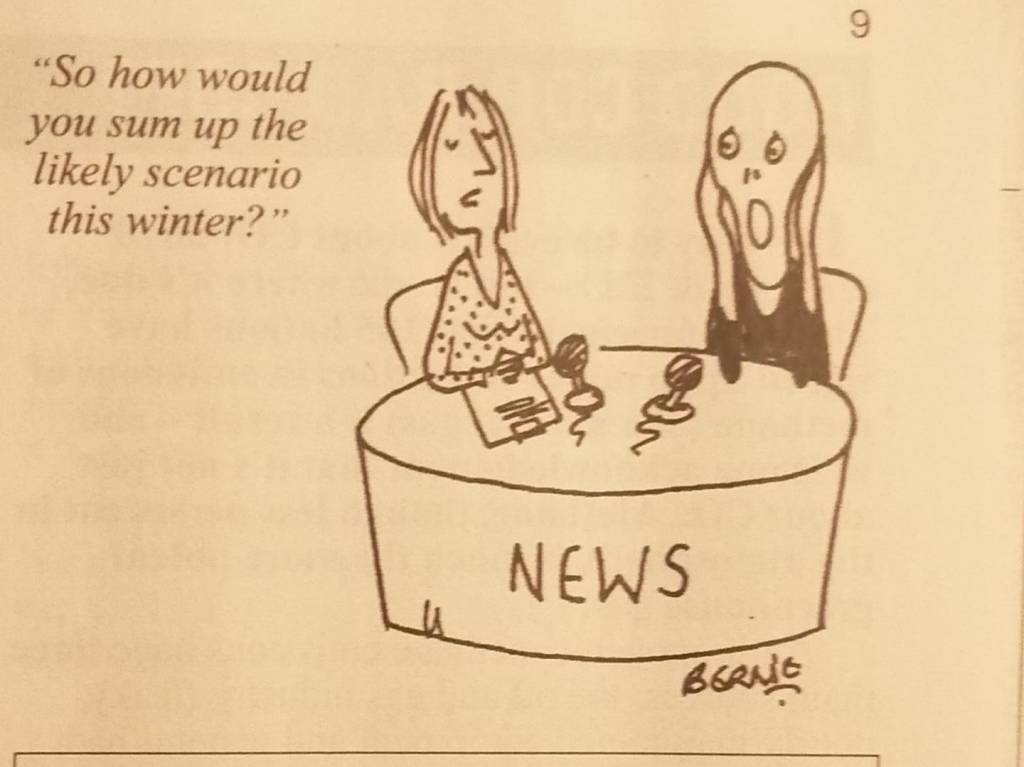
The Irish Health Service is under extreme pressure and the delivery of booster shots is being rolled out very slowly. I had my second Pfizer dose in June so should get a third shot in December but it is not clear that I will. I’m not going anywhere at Christmas anyway so that’s not a big deal but I’m worried by the broader picture. A cartoon in a recent issue of Private Eye is very apt:

Might we have to switch our lectures back online again before Christmas? Might our examinations be online again in January? Who knows. We’ll just have to wait and see but I think the blackboard in my study might be back in use very soon.

Pithecanthropus Erectus – Charles Mingus

Posted in Jazz with tags , on November 13, 2021 by telescoper

I heard this track on the radio the other night courtesy of John Kelly’s show and thought I’d write a post about it because I think it’s a neglected masterpiece. Pithecanthropus Erectus is the title track of an album by Charles Mingus released in 1956. For that time it was incredibly new: the long passages of static harmony, along with grunts and squeals from the horns, all became common place in avant garde jazz in later years but it is very surprising to hear them in a record from the mid 50s.

Mingus intended this piece to convey in music humanity’s evolution, which he imagined would end in violent destruction. Who’s to say he was wrong? The tune itself is in an intriguing ABAC form with the B and C sections based on the same unvarying harmonic pattern but the C section being agitated and even chaotic. On the first and last choruses the alto sax of Jackie Mclean and the tenor of J.R. Monterose play improvised duets on the B section while the C section involves the whole band improvising collectively in a style reminiscent of the free jazz of the 1960s. The unusual accents on the fourth beat of the bar were later adopted by Miles Davis on Milesetones. These are just a couple of examples of how influential this track was to turn out to be. Looking back on it in historical perspective you can see how much of the musical vocabulary of jazz expanded with this one track.

Mingus shared with Miles Davis the ability to create music that was distinctively his own while somehow at the same time giving his musicians plenty of time to express themselves. In this performance there’s a very fine piano solo by Mal Waldron who, among other things, very effectively channels Thelonious Monk to a marvelous bass accompaniment by Mingus.

The other three tracks on the album are good too, but inevitably pale beside this work of genius in which Mingus managed to weld all these new and untried elements into a completely satisfying unity that was years ahead of its time.

Introducing the Icelandverse

Posted in Biographical with tags , , , on November 13, 2021 by telescoper

At the end of another exhausting week this parody of Mark Zuckerberg and his “metaverse” cheered me up no end. It reminds me that I visited Iceland once in 2008 and enjoyed it enormously, but for some reason have never been back…

That Was The Masterclass That Was

Posted in Education, Maynooth, The Universe and Stuff with tags , , , on November 12, 2021 by telescoper

This morning we did the Astrophysics and Cosmology Masterclass advertised here. I think it went quite well. Apparently we had over sixty schools registered – at least one in every County – about a 1,000 schoolkids altogether. Certainly there were lots and lots of questions, which is a good sign!

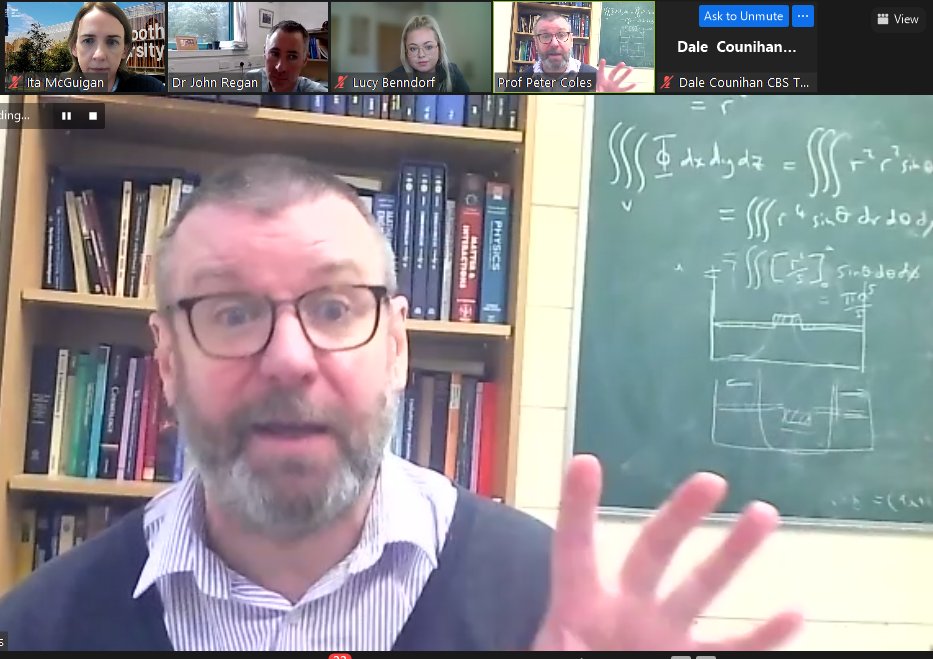
Here is a screen grab of part of the event. I didn’t realize my camera was a bit wonky!

In case anyone is interested here are the slides I used for my part of the talk:

I’ll post a recording of the whole event when it becomes available. Here is the recording of the workshop:

I had to leave before the end to go to a vector calculus lecture that was interrupted by the arrival of the Power Rangers, but that’s a different story…

Unsolved, by John McCrae

Posted in History, Poetry with tags , , , , on November 11, 2021 by telescoper

The poet John McCrae served with distinction in the Canadian Field Artillery during the First World War, rising to the rank of Lieutenant Colonel. He died in 1918, of pneumonia, shortly before the end of the conflict.
McCrae is best known for writing the poem In Flanders Fields, the imagery of which led to the adoption of the poppy as the emblem of Remembrance Day (11th November i.e. today). He wrote many other interesting poems, however, so I thought I’d share one here to celebrate his life.

Amid my books I lived the hurrying years,
Disdaining kinship with my fellow man;
Alike to me were human smiles and tears,
I cared not whither Earth’s great life-stream ran,
Till as I knelt before my mouldered shrine,
God made me look into a woman’s eyes;
And I, who thought all earthly wisdom mine,
Knew in a moment that the eternal skies
Were measured but in inches, to the quest
That lay before me in that mystic gaze.
“Surely I have been errant; it is best
That I should tread, with men their human ways.”
God took the teacher, ere the task was learned,
And to my lonely books again I turned.

by John McCrae (1872-1918)


Please don’t call me “Sir”!

Posted in Biographical, Education, Maynooth on November 10, 2021 by telescoper

Yesterday, on the way out of the lecture theatre after finishing a class, I was chatting with some of the students therein and the subject came up of how they should address me (and their lecturers in general).

One thing I’ve noticed since moving to Ireland is that, more so in England or Wales, first-year students often call me “Sir” if they want to attract my attention to something such as – to give a purely hypothetical example – a missing minus sign in a calculation. I suppose that me something to do with more of the schools perhaps being run on more traditional lines than in the UK.

For completeness I should point out that I went to an old-fashioned grammar school at which all the teachers were called “Sir” as they were all male. Some teachers were unbearably pompous in their insistence on that form of address, which is probably why I dislike it so much although I do appreciate the attempt to be polite.

I can understand why students – at least initially – carry on at university with behaviours that were deemed appropriate at school, but to my mind universities are really different because everyone is an adult. Of course I’m supposed to know more about the stuff that I’m teaching than the student, but the aim of the education is to eradicate that difference as effectively as possible. I think an important step on that journey is for the students to feel part of a joint venture than being talked at by some sort of authority figure. Formal titles do not encourage students to ask questions, which is an essential part of the teaching process.

Anyway, when a student asked me if he should call me “Sir” I said “No. Please don’t!”

“What should I call you then?”, he asked. “Professor?”

“My name is Peter, so that’s what you should call me” I replied. The student seemed quite shocked at the level of informality implied, but as far as I know I think all the teaching staff in the Department of Theoretical Physics are all comfortable with first-name terms.

I’ve never really thought about this before so I wonder what other university teachers think. Do any of you out there insist on using formal titles or is informality the norm?

A Gift

Posted in Biographical, Maynooth with tags , , on November 9, 2021 by telescoper

It is with a sense of relief bordering on joy that I can report that after many weeks of delay because of visa issues the last of our temporary lecturers has finally arrived in Maynooth. He has been teaching online for half the semester but at least he can do the second half in person.

He also gave me a wonderful gift in the form of a sumptuously illustrated multi-lingual edition of the Rubáiyát of Omar Khayyám:

Here is a glimpse inside:

I am familiar with Edward Fitzgerald‘s famous English translation of these quatrains with an AABA rhyming scheme by the Astronomer-Poet of Persia but skimming the volume I see that the translations into other languages are rather different. It must be difficult to find three rhyming endings for each quatrain without stretching the original meaning, so some of the translations don’t attempt this. Here is the German translation (not by Fitzgerald) in the book of one of the most well-known verses:

Es schreibt die Hand und schreibt
Weder dein Witz noch all dein Glaubensmut
Euft sie zurück, daß sie ein Wort nur tilgt –
Kein Tüttelchen löscht deiner Tränen Flut.

Learned Societies, Equity, and Open Access

Posted in Open Access with tags , , , , , on November 8, 2021 by telescoper

I’m not getting much time these days to think about new ideas for blog posts so yet again I’m going to rehash an old one, but at least it is somewhat topical because of an interesting blog post I saw recently about the American Sociological Association. Referring to the inequity of the way this particular society is funded the author says

The greatest source of income for the association is publications, which is mostly subscriptions to journals paid by academic libraries, which are being bled dry by profit-making publishers that ASA organizes academic labor to subsidize with free content and editorial services. This is a wealth transfer from poorer, teaching-intensive libraries to richer, research-intensive libraries.

I tthink it’s relevant to raise some points about the extent that such organizations (including, in my field,  the Royal Astronomical Society and the Institute of Physics) rely for their financial security upon the revenues generated by publishing traditional journals and why this is not in the best interests of their disciplines.

Take IOP Publishing, for example. This is a wholly-owned subsidiary of the Institute of Physics that has an annual turnover of around £60M generated from books and journals. This revenue is the largest contribution to the income that the IoP needs to run its numerous activities relating to the promotion of physics.  A similar situation pertains to the Royal Astronomical Society, although on a smaller scale, as it relies for much of its income from Monthly Notices of the Royal Astronomical Society, in which as a matter of fact I have published quite a few papers.

Not surprisingly, these and other learned societies are keen to protect their main source of cash. When I criticized the exploitative behaviour of IoP Publishing some time ago in a recent blog post, I drew a stern response from the Chief Executive of the Institute of Physics, Paul Hardaker. That comment seems to admit that the high prices charged by IOP Publishing for access to  its journals is nothing to do with the real cost of disseminating scientific knowledge but is instead a means of generating income to allow the IoP to pursue its noble aim of  “promoting Physics”.

This is the case for other learned societies too, and it explains why such organizations have lobbied very hard for the “Gold” Open Access some authorities are attempting to foist on the research community, rather than the far more sensible and sustainable approaches to Open Access employed, for example, by the Open Journal of Astrophysics.

Some time ago I came across another blog post, pointing out that other learned societies around the world are also opposing anything other than the most expensive forms of Open Access:

There is also great incentive for the people who manage and run these organisations to defend their cartel. For example, the American Chemical Society, a huge opponent to open access, pays many of its employees, as reported in their 990 tax return, over six figures. These salaries ranged from $304,528 to $1,084,417 in 2010.

The problem with the learned societies behaving this way is twofold.

First, I consider it to be inevitable that the traditional journal industry will very soon be completely bypassed in favour of  other forms of Open Access publishing. The internet has changed the entire landscape of scientific publication. It’s now so cheap and so easy to disseminate knowledge that traditional journals are already virtually redundant, especially in my field of astrophysics where we have been using the arXiv for so long that many of us hardly ever look at journals.

The comfortable income stream that has been used by the IoP to “promote Physics”, as well as to furnish its brand new building in King’s Cross, will dry up unless these organizations find a way of defending it. The “Gold” OA favoured by such organizations their attempt to stem the tide. I think this move into Gold `Open Access’, paid for by ruinously expensive Article Processing Charges paid by authors (or their organizations) is unsustainable because the research community will see through it and refuse to pay.

The other problematic aspect of the approach of these learned societies is that I think it is fundamentally dishonest. University and other institutional libraries are provided with funds to provide access to published research, not to provide a backdoor subsidy for a range of extraneous activities that have nothing to do with that purpose. The learned societies do many good things – and some are indeed outstandingly good – but that does not give them the right to siphon off funds from their constituents in this way.  Institutional affiliation, paid for by fee, would be a much fairer way of funding these activities.

I should point out that, as a FRAS and a FInstP, I pay annual subscriptions to both the RAS and the IoP. I am happy to do so, as I feel reasonably comfortable spending some of my own money supporting astronomy and physics. What I don’t agree with is my department having to fork out huge amounts of money from an ever-dwindling budget for access to scientific research that should be in the public domain because it has already been funded by the taxpayer.

Some time ago I had occasion to visit the London offices of a well-known charitable organization which shall remain nameless. The property they occupied was glitzy, palatial, and obviously very expensive. I couldn’t help wondering how they could square the opulence of their headquarters with the quoted desire to spend as much as possible on their good works. Being old and cynical, I came to the conclusion that, although charities might start out with the noblest intentions, there is a grave danger that they simply become self-serving, viewing their own existence in itself as more important than what they do for others.

The commercial academic publishing industry has definitely gone that way. It arose because of the need to review, edit, collate, publish and disseminate the fruits of academic labour. Then the ease with which profits could be made led it astray. It now fulfills little or no useful purpose, but simply consumes financial resources that could be put to much better effect actually doing science. Fortunately, I think the scientific community knows this and the parasite will die a natural death.

The question for learned societies is whether they can find a sustainable funding model that isn’t reliant upon effectively purloining funds from university library budgets. If their revenue from publishing does fall, can they replace it? And, if not, in what form can they survive?

Keys, Blues, a House, and an Infirmary

Posted in Music with tags , , , , on November 7, 2021 by telescoper
Scott’s Corner

I’m not finding very much time these days to continue trying to teach myself how to play the piano but I thought I’d share a quick post that probably only demonstrates how little I know about music.

The other day I decided to try to play The House of the Rising Sun without the music, i.e. by ear. Knowing that it is basically an 8-bar blues for which I thought I could easily figure out the chords I looked up what key it should be played in. Google confidently told me this:

So I set about trying to pick out the melody in that key, but I couldn’t get it to sound right at all (even allowing for the fact that my piano is a bit out of tune). Then I realized that it’s not really in F Major at all. It’s actually in D Minor (the relative minor of F Major, so it also has the same B flat but with a scale that starts on A rather than F). Transposing the chords into D Minor makes it sound much more moody. It can also be played in A Minor as demonstrated by the Modern Jazz Quartet whose Blues in A Minor is unmistakably the same tune:

Anyway, fooling around with 8 bar blues in different keys I tried F Minor and it struck me that there was a marked similarity between House of the Rising Sun and another famous 8-bar blues St James Infirmary. In fact you can sing the lyrics to St James Infirmary quite easily to the tune of House of the Rising Sun.

Both of these tunes have very old origins: Jack Teagarden, for example, introduced his classic 1947 live performance of St James Infirmary with the words “the oldest blues I ever heard”. I always assumed both these tunes referred to real places, but that seems wrong too. There was no “House in New Orleans” they called the Rising Sun, nor was there a St James Infirmary. They are not the same song, and neither started off as an 8-bar blues, but they do have elements in common and may be derived from a common ancestor.

The most famous version of The House of the Rising Sun is the 1964 hit by Eric Burdon with the Animals (including Alan Price on keyboards, who did the arrangement):

Interestingly, Eric Burdon and the Animals made a much less famous version of St James Infirmary in 1968 which I think demonstrates the similarity between the two tunes:

Notes from Half Way

Posted in Biographical, Covid-19, Education, Maynooth with tags , , , , , , on November 6, 2021 by telescoper

We’ve now reached the halfway point in our teaching semester at Maynooth University. That means there are another six weeks of teaching before the end of term break. I was looking through the notes of my modules this morning in order to make a plan for the rest of term and was relieved to find that I’m roughly on track to finish on time. That is despite the first years starting a week late and lectures being 45 minutes long instead of 50.

At this point I’m still finding it very disconcerting talking to an audience of masked students, but it’s a heck of a lot better than just talking at a camera. Quite a few times I’ve been walking around campus and a student without a face covering has said “hello Peter” or words to that effect and I’ve smiled and said “hello” back while wondering who they were. Outside, you see, people take their masks off while, inside, I’m the only person whose face is uncovered.

Still, at least during lectures I get to make eye contact with the students. I don’t know why that matters so much to me, but it does. I remember as a student I had some lecturers who were pathologically incapable of making eye contact with the class, usually staring at a spot about six feet over the heads of the students. I found that most off-putting.

Although it still feels a bit weird, I’m glad that the mask-wearing protocol is being observed very well at least in lecture theatres. Unfortunately cases are skyrocketing right now – almost 4000 yesterday, as high as last January – which is all very worrying. Are we going to move to a Plan B? I doubt it, because the Government doesn’t seem to have one. Nevertheless I do think there’s still a significant possibility of our January exams being moved online yet again, but that hasn’t been decided yet.

Meanwhile, in the UK, University staff have been balloted over industrial action relating to the USS pension scheme and to various issues relating to terms and conditions. The majority of votes cast were in favour of strikes, but some institutions did not reach the 50% threshold required for strike action to be legal (some by just a handful of votes) and others achieved the threshold in only one of the disputes. I don’t know what will happen next, but I’d like to express my solidarity with those taking what I consider to be entirely justified action.

I couldn’t resist quoting this from the Universities UK statement on the dispute:

After a difficult 18 months, students do not deserve any further disruption.

Yes, it has been a difficult 18 months for students, but the absence of even a teeny bit of recognition that it has also been very difficult for staff is extremely telling.

I’m taking a particular interest in the disputes not only because I have friends and former colleagues in the UK but also because I have the best part of 30 years’ contributions locked into the USS pension scheme, plus some additional voluntary contribitions, and am relying on the benefits from those for my own retirement. If anything happens to that source of income I am financially screwed.

Apart from the USS scheme, the other side of the UCU dispute concerns ‘four fights‘ over:

  1. Pay
  2. Workload
  3. Equality
  4. Casualisation

These issues don’t only apply in the UK, of course. Workloads in my Department are at ridiculous levels – not only for me – and we have been forced by Management decisions into a situation in which half of our lecturing is being done by staff on short-term contracts. I suspect that the unpaid overtime we have put in during the pandemic is the expectation for the future, and I see no sign of the casualisation of our teaching staff being reversed in the immediate future. I hope I’m proved wrong, but in the meantime I’m keeping a close eye on my USS pension in case early retirement proves the only way to escape…