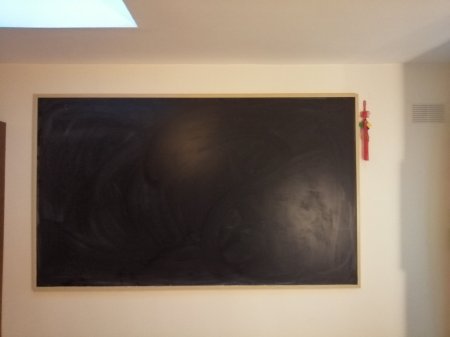
Untitled, by Peter Coles (2021), 2m by 1.2m, chalk dust and oil on panel, Castlebridge Art Museum.
Untitled, by Peter Coles (2021), 2m by 1.2m, chalk dust and oil on panel, Castlebridge Art Museum.
The latest contribution to the ongoing debate about the Hubble constant is a new paper by Adam Riess and collaborators which you can find on the arXiv here. The abstract reads:
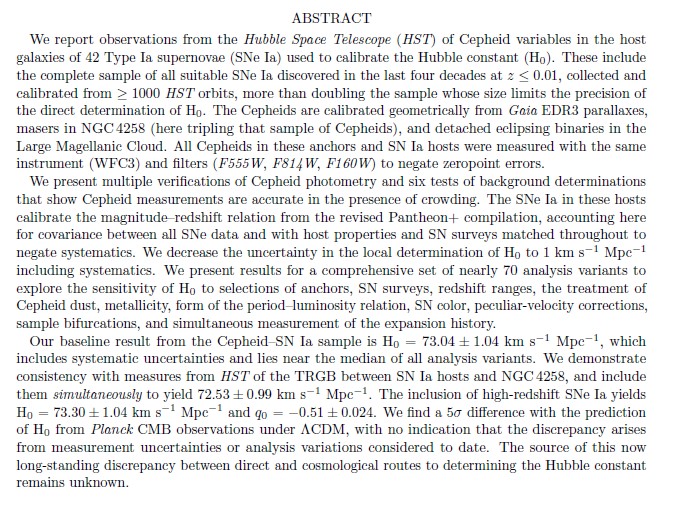
As you can see, this group is doubling down up on a high value for the Hubble constant. This longstanding discrepancy gives me an excuse to post my longstanding opinion polls on the topic.
First, would you go for a “high” (73-ish) or “low” (68-ish) value:
Second, do you think the discrepancy or tension is anything to get excited or even tense about?
When I was updating my Covid-19 page today I thought I would try something a bit different. Here are the cases and deaths (in the form of 7-day rolling averages) as I usually plot them:

You can see a slight recent downturn – the latest 7-day average of new cases is 4214.3; it has been falling for a few days. A log plot like this shows up the changing ratio between deaths and cases quite well, as in l if you multiply a quantity by a factor that manifests itself as a constant shift upwards or downwards. There is clearly a bigger shift between the orange and blue curves after 500 days than there is, say, between, 300 and 400.
(I don’t think you can read much into the gap between the curves at the beginning (up to around 100 days in) as testing coverage was very poor then so cases were significantly underestimated.
Anyway, to look at this a bit more clearly I plotted the ratio of daily reported deaths to daily confirmed cases over the course of the pandemic. This is the result:

The sharp downward glitches occur whenever the number of reported deaths is zero, as log of zero is minus infinity. The broader downward feature after about 300 days represents the period in January 2021 when cases were climbing but deaths had not caught up. To deal with that I tried plotting the deaths recorded at a particular time divided by the cases two weeks earlier. This is that result:

The spike is still there, but is much decreased in size, suggesting that a two week lag between cases and deaths is a more useful ratio to look at. Note the ratio of deaths to cases is significantly lower from 500 days onwards than it was between 200 and 400 (say), by a factor a bit less than ten.
This obviously doesn’t translate into a direct measure of the efficacy of vaccines (not least because many of the recent cases and deaths are among the minority of unvaccinated people in Ireland) but it does demonstrate that there is a vaccine effect. Without them we would be having death rates up to ten times the current level for the same number of daily cases or, more likely, we would be in a strict lockdown.
On the other hand if cases do surge over the Christmas period there will still be a huge problem – 10 % of a large number is not zero.
We’re approaching the end of term here at Maynooth University; the forthcoming week is the last week of teaching, after which we have the luxury of a full week without lectures or tutorials before Christmas itself. Apart from eating and drinking I think I’ll spend most of the holiday sleeping. The first official duty I will have in the new year is on Saturday 8th January when one of my online examinations is due to take place. After that it will be all marking papers and after that it will be preparing teaching for Semester 2…
At this start of this academic year I was quite confident that Semester 2 would find us more-or-less back to normal but that now seems very unlikely. I think that we’re going to be starting Semester 2 at the end of January 2022 exactly the same way that we started Semester 2 in January 2021, i.e. with everything fully online.
As of today, the recent rapid growth in Covid-19 infections seems to have slowed (and cases have been decreasing for a few days) but a Christmas surge seems inevitable and with many people having low protection against the omicron variant and very high case numbers even before the festive period, the period from January to March may be very difficult indeed. I stand to be proved wrong, though, and the trajectory of the pandemic is highly uncertain. We’ll just have to wait and see how things turn out. Fingers crossed.
I have explained before on this blog that I am going to be working from home next week, delivering my last lectures from my study and via recordings. I have better facilities for doing online lectures at home, because the University has failed to invest in decent recording equipment in its lecture theatres.
In any case I only have one full lecture to give in my first-year module (due tomorrow); the other two will be revision classes. I have finished the lectures for my second-year module so was just planning to do a revision class in the Tuesday slot. I did have some other (virtual) meetings in my calendar for next week but most of these have all been cancelled for one reason or another.
The one remaining task is to get all the online exams ready to go in January. We haven’t got the special Moodle spaces set up yet, but I imagine that will happen sometime next week.
By the way, when I responded to the close contact alert I received on Friday I was told I’d be sent an antigen test kit from the HSE. I haven’t got it yet but I suppose it may arrive next week. I still don’t have any symptoms though, and am effectively self-isolating anyway, so I’m not concerned. I just hope I get my booster on Wednesday without having to queue for too long…
And now for something completely different in the form of a lovely bit of British revivalist Jazz from 70 years ago. Once upon a time I had a 7″ EP record with this track on it, but I’m afraid I lost it along the way. I’ve been hoping someone would put it on Youtube and it seems about six months ago somebody did!
The song Rum and Coca Cola was a hit for the Andrews Sisters in the immediate post-war years although it began as a satirical calypso with clear references to prostitution. Anyway, it’s a catchy tune and it’s no surprise that it was picked up by traditional jazz bands during the New Orleans revival, including this terrific version by the Christie Brother Stompers made in 1951; note the calypso-style piano intro.
When this particular record was made, British bands were being heavily influenced by the discs that were coming over from the States at the time – especially from Bunk Johnson’s 1940s band and the Kid Ory band – to the extent that a recorded-in-a-garage sound was sedulously acquired. Despite the somewhat muffled sound quality, I really love this record for the general exuberance of the playing, especially that of the superb trombonist Keith Christie whose style of tailgate trombone was clearly influenced by Kid Ory.
Keith Christie was for some time a member of the front line of Humphrey Lyttelton’s band and when Keith Christie passed away in 1980, Humph devoted full hour on his weekly radio programme The Best of Jazz to examples of his work (including this track). I remember Humph drawing attention to the robust humour that permeated Keith’s playing and admitting that when he was with the Lyttelton band they had several band meetings in which he tried to get him to temper the playful side of things. Quite wrongly, he admitted because while Keith Christie often brought out the humorous side of trombone he never mocked it.
The revivalist bands of that day were indeed a bit po-faced about their jazz and although the music they produced is great fun to listen to, they were all deadly serious about it. I think “The Guv’nor” Ken Colyer (who plays cornet on this track) was even more grave than Lyttelton and I’m not sure how he felt about Keith’s propensity to emphasize the knockabout fun of the music, though it is true that this band did change personnel rather abruptly shortly after the 1951 session.
The full line-up is: Keith Christie (trombone); Ian Christie (clarinet, Keith’s brother); Ken Colyer (cornet); Pat Hawes (piano); Ben Marshall (banjo); Micky Ashman (bass); and George Hopkinson (drums). I think Keith Christie’s playing on this is absolutely terrific, not only his solo – built in Kid Ory style around a single phrase – but his rumbustious contributions to the ensemble from about 1:45 seconds. And what a head of steam they build up together! Enjoy!
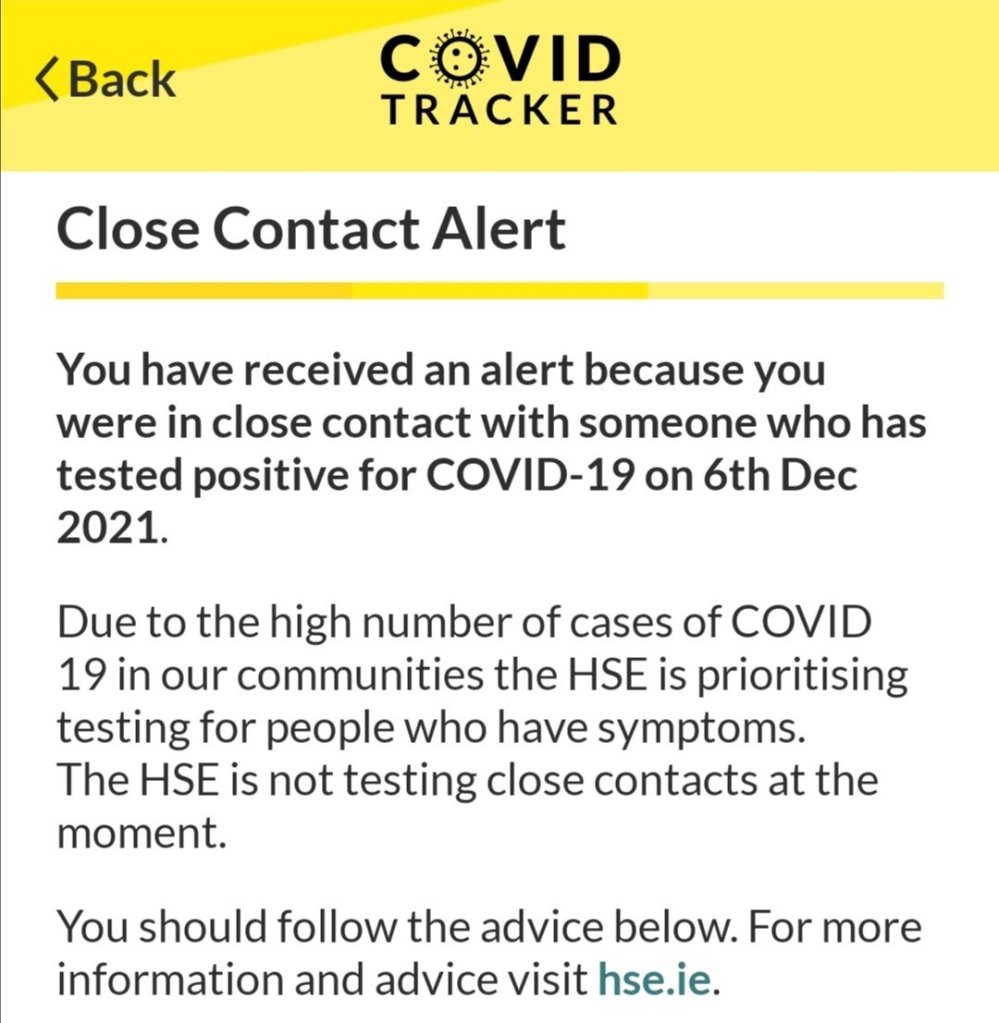
Having just started working from home yesterday, this afternoon I received the above message, via the Covid-19 tracker app, saying that I have been a close contact of someone who has tested positive for Covid-19. I don’t have symptoms so don’t have to do anything drastic, just restrict my movements for 5 days. I was going to do the latter anyway, so the timing is somewhat ironic!
Oh and they’re going to send me an “antigen kit”, presumably to keep me occupied for the next few days. It should be fun because I’ve never made an antigen before.
Incidentally the message isn’t very clearly worded. I think I was a close contact on 6th December of someone who subsequently tested positive. That may account for why I have only got this message on 10th!
Time to announce yet another publication in the Open Journal of Astrophysics. This one was published yesterday, actually, but I didn’t get time to post about it until just now. It is the 16th paper in Volume 4 (2021) and the 47th in all.
The latest publication is entitled MCMC generation of cosmological fields far beyond Gaussianity and is written by Joey Braspenning and Elena Sellentin, both of Leiden University.
Here is a screen grab of the overlay which includes the abstract:

You can click on the image to make it larger should you wish to do so. You can find the arXiv version of the paper here. This is another one for the Cosmology and Nongalactic Astrophysics folder.
I was saddened to hear this evening of the death at the age of 61 of Steve Bronski, co-founder of the band Bronski Beat which provided much of the soundtrack of my early twenties. I spent many an hour in the mid-80s dancing away in gay clubs to their up-tempo numbers like Hit That Perfect Beat but, as I’ve mentioned on this blog before, the song Smalltown Boy had a particular resonance for me because it was about thoughts and feelings I knew very well but had never heard expressed in popular music. I really felt like the Smalltown Boy in the song.
Rest in Peace, Steven William Forrest, aka Steve Bronski (1960-2021).

After expressing concern about the prospects of getting a timely booster jab last night I received an SMS message offering me an appointment next Wednesday for a shot. The text was sent on 8th December, six months to the day since my second jab (8th June). I will once again have to travel to City West in order to receive it, so will have take some time off work but that’s a small price to pay.
I had inferred (incorrectly) that it would take much longer to get a date for booster because most of the people I know in their sixties haven’t had theirs yet and they are higher priority than me. I now realise that may be because they had the AstraZeneca vaccine, which had a longer interval between first and second doses than the 4 weeks for the Pfizer vaccine I had, so had a later second dose than mine.
My third vaccine dose will be of the Moderna vaccine; the previous two were Pfizer/BioNTech. It seems everyone who is getting a shot this month will be getting the Moderna version as Ireland has a large stock of this vaccine due to expire next month. Although its efficacy against the omicron variant is unknown, I will of course attend the appointment.
Yesterday, before I received the text message announcing my booster shot, I emailed the students in my classes to say the remaining lectures of the term will be online-only because of the high levels of Covid-19 in circulation and my waning immunity. Next week’s booster doesn’t change that as next week is the last week of teaching. My plan is to do the lectures live as webcasts and make the recordings available afterwards, which is how I’ve done them the entire term, except I’ll be doing them from home with no in-person audience. Apart, that is, from next Wednesday, when I’ll only be able to offer a pre-recorded lecture as I’ll be at City West when the lecture is scheduled. That will be my last lecture of the Semester, as most of my teaching is concentrated in the early part of the week.
Owing to a combination of Covid-19, Storm Barra and no doubt sheer exhaustion, student attendance at lectures and tutorials on campus has fallen sharply, though attendance at my second-year class has remained quite high. On Tuesday the campus was virtually deserted but about 70% of my class for Vector Calculus & Fourier Series were there. Somehiw, though, I don’t think they’ll mind too much watching the remaining couple of lectures from the comfort of their homes!
A colleague pointed out to me yesterday that evidence is emerging of a four-month periodicity in the number of Covid-19 cases worldwide:

The above graph shows a smoothed version of the data. The raw data also show a clear 7-day periodicity owing to the fact that reporting is reduced at weekends:
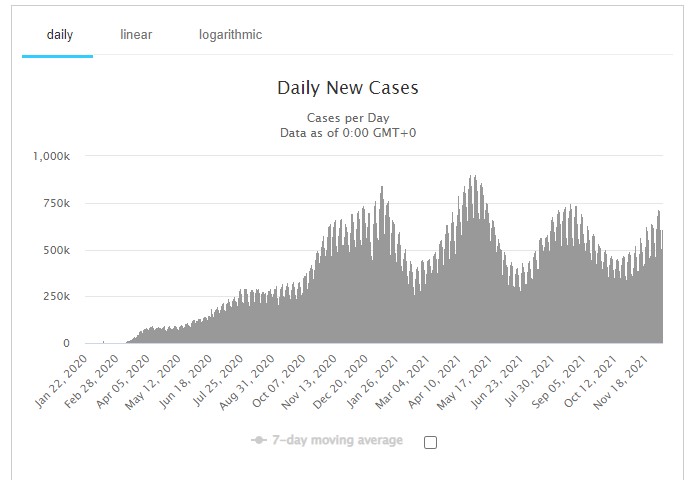
I’ll leave it as an exercise for the student to perform a Fourier-transform of the data to demonstrate these effects more convincingly.
Said colleague also pointed out this paper which has the title New indications of the 4-month oscillation in solar activity, atmospheric circulation and Earth’s rotation and the abstract:
The 4-month oscillation, detected earlier by the same authors in geophysical and solar data series, is now confirmed by the analysis of other observations. In the present results the 4-month oscillation is better emphasized than in previous results, and the analysis of the new series confirms that the solar activity contribution to the global atmospheric circulation and consequently to the Earth’s rotation is not negligeable. It is shown that in the effective atmospheric angular momentum and Earth’s rotation, its amplitude is slightly above the amplitude of the oscillation known as the Madden-Julian cycle.
I wonder if these could, by any chance, be related?
P.S. Before I get thrown into social media prison let me make it clear that I am not proposing this as a serious theory!

 In the Dark