It’s Saturday again so it’s time for another update of activity at the Open Journal of Astrophysics. Since the last update we have published a further three papers, bringing the number in Volume 9 (2026) to 126 and the total so far published by OJAp up to 574.
I will continue to include the posts made on our Mastodon account (on Fediscience); these announcements also show the DOI for each paper.
The first paper to report this week, published on Monday 15th June, is “SN 2025adpq: A Type Ia supernova in a collisional ring formed during a major galaxy merger” by Brendan O’Connor (Carnegie Mellon University, USA) and 18 others based in the USA, Germany and Australia. The study reports the discovery of a Type Ia supernova, SN 2025adpq, within a collisional ring formed by a major galaxy merger., offset from the nucleus of the primary galaxy. It is published in the folder Astrophysics of Galaxies.
The overlay for this paper is here
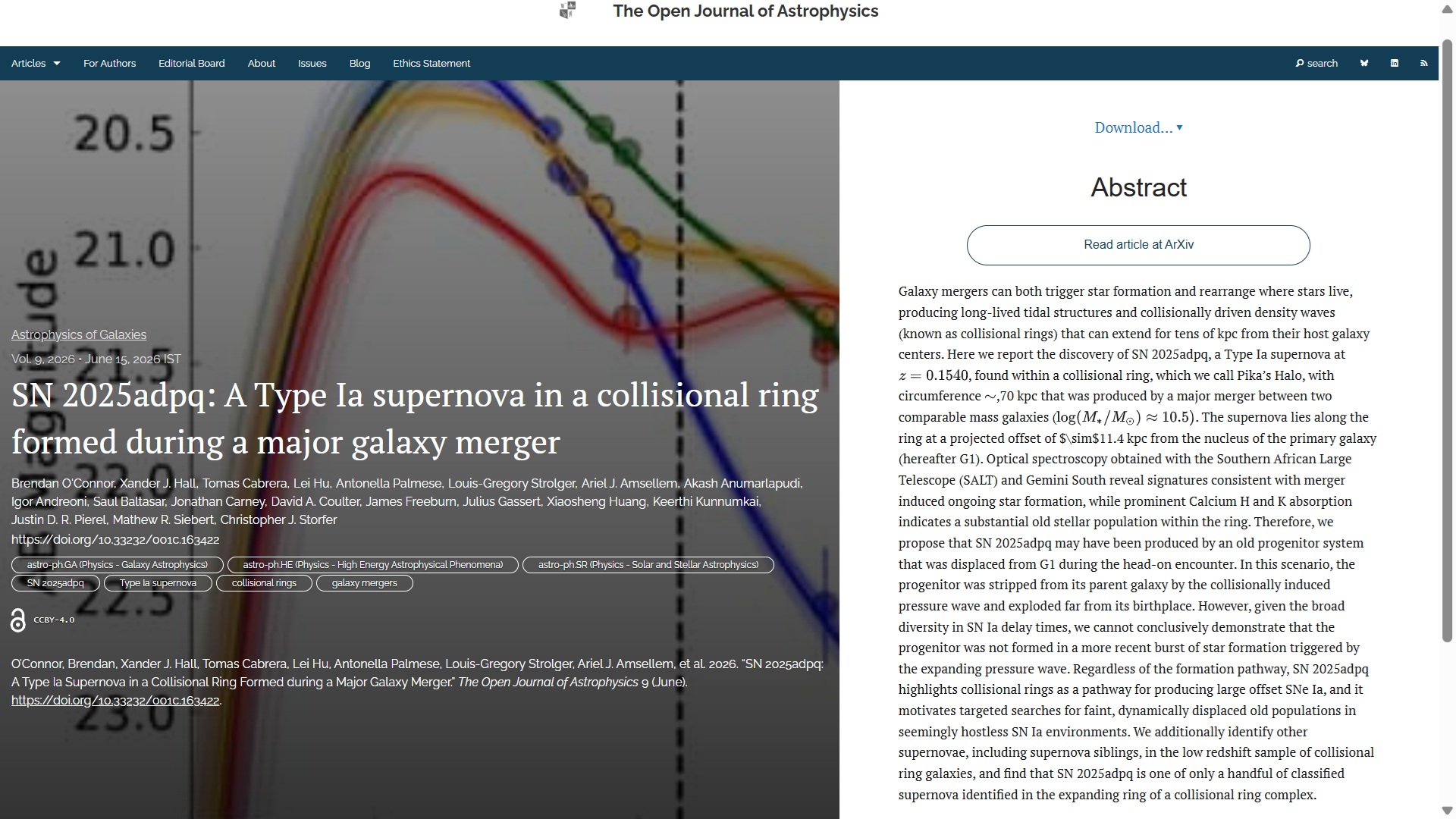
You can find the officially accepted version on arXiv here and the announcement on Fediverse here:

The second paper for this week, published on Tuesday June 16th in the folder Astrophysics of Galaxies is “The Colors of Ices: Measuring ice column density through photometry” by Adam Ginsburg (U. Florida, USA) and ten others based in the USA, Germany and Spain. This study demonstrates that JWST photometry can identify and quantify interstellar ices, using new open-source models, interstellar ices, finding significant abundance in non-star-forming gas, suggesting many avenues for further research.
The overlay looks like this:
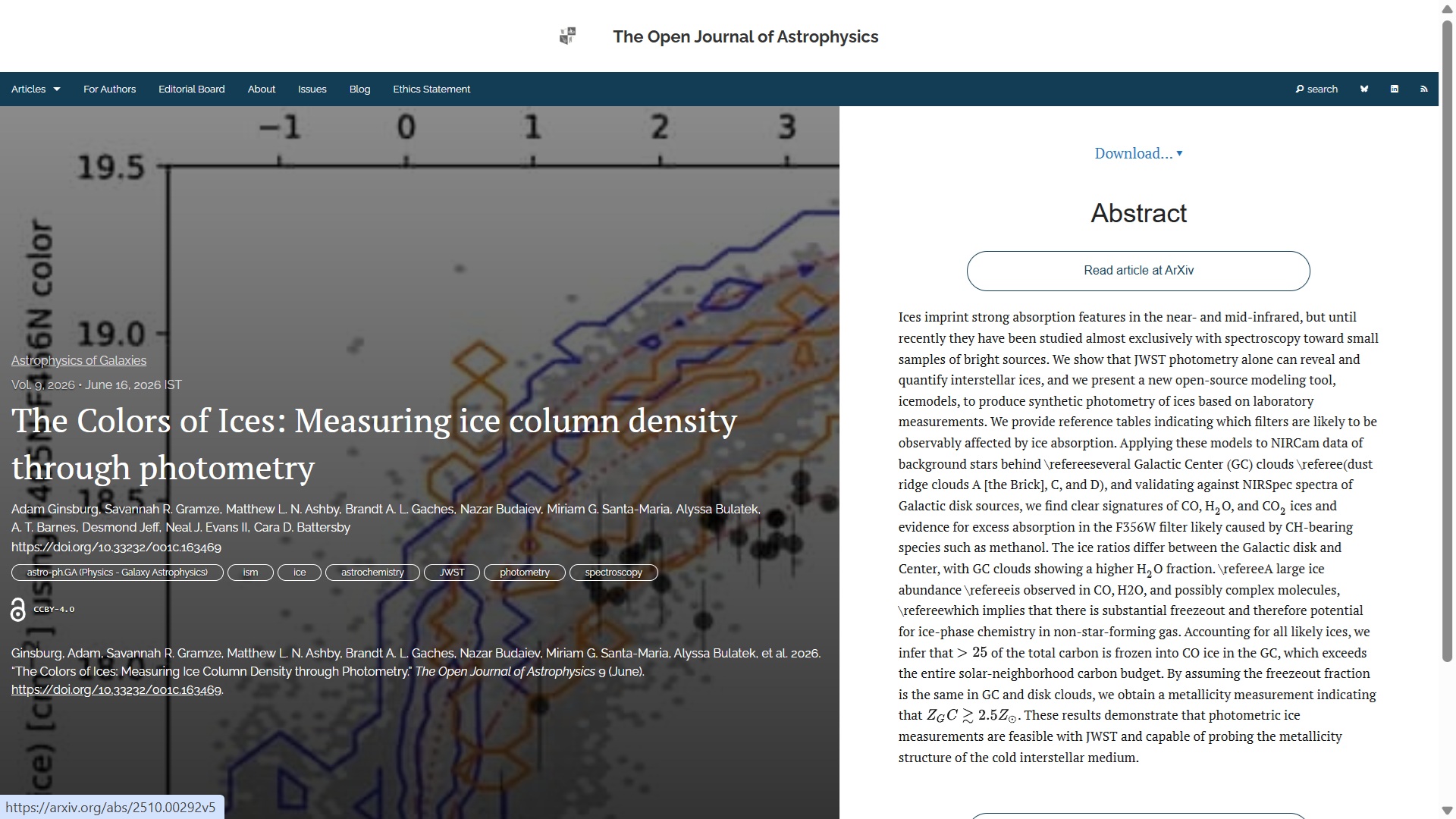
The official version of the paper can be found on arXiv here and the Fediverse announcement here:
The third paper of the week, published on Wednesday 17th June in the folder Cosmology and Nongalactic Astrophysics is “The Non-Gaussian Weak-Lensing Likelihood: A Multivariate Copula Construction and Impact on Cosmological Constraints” by Veronika Oehl and Tilman Tröster (both of ETH Zurich, Switzerland). This study presents a framework for computing non-Gaussian likelihoods for correlation functions, particularly useful in large-scale weak-lensing surveys. It suggests Gaussian likelihoods are sufficient for stage-IV surveys.
The overlay for this one is here:
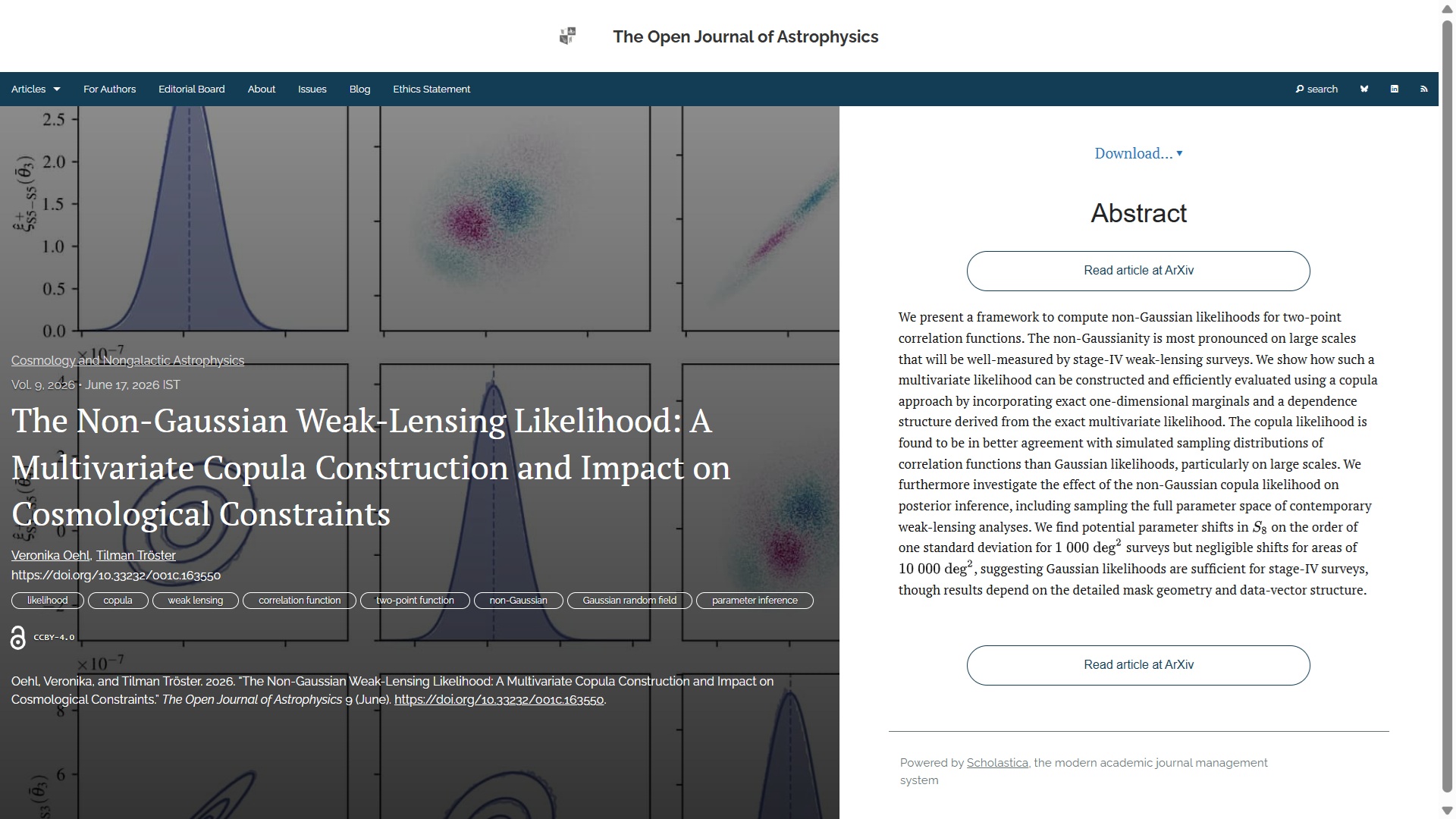
The final, accepted version can be found on arXiv here and the Mastodon announcement is here:
The fourth and final paper of the week, also ublished on Wednesday 17th June but in the folder Astrophysics of Galaxies, is “Black Hole Feedback, Galaxy Quenching and Outflows at Cosmic Dawn: Analysis of the SEEDZ Simulations” by Lewis R. Prole (Maynooth University, Ireland) and 15 others based in Ireland, Germany, USA and UK. The study analyzes the growth and feedback effects of massive black holes in SEEDZ simulations, suggesting that black hole feedback, not nearby supernovae or gas exhaustion, limits initial growth.
The overlay is here:
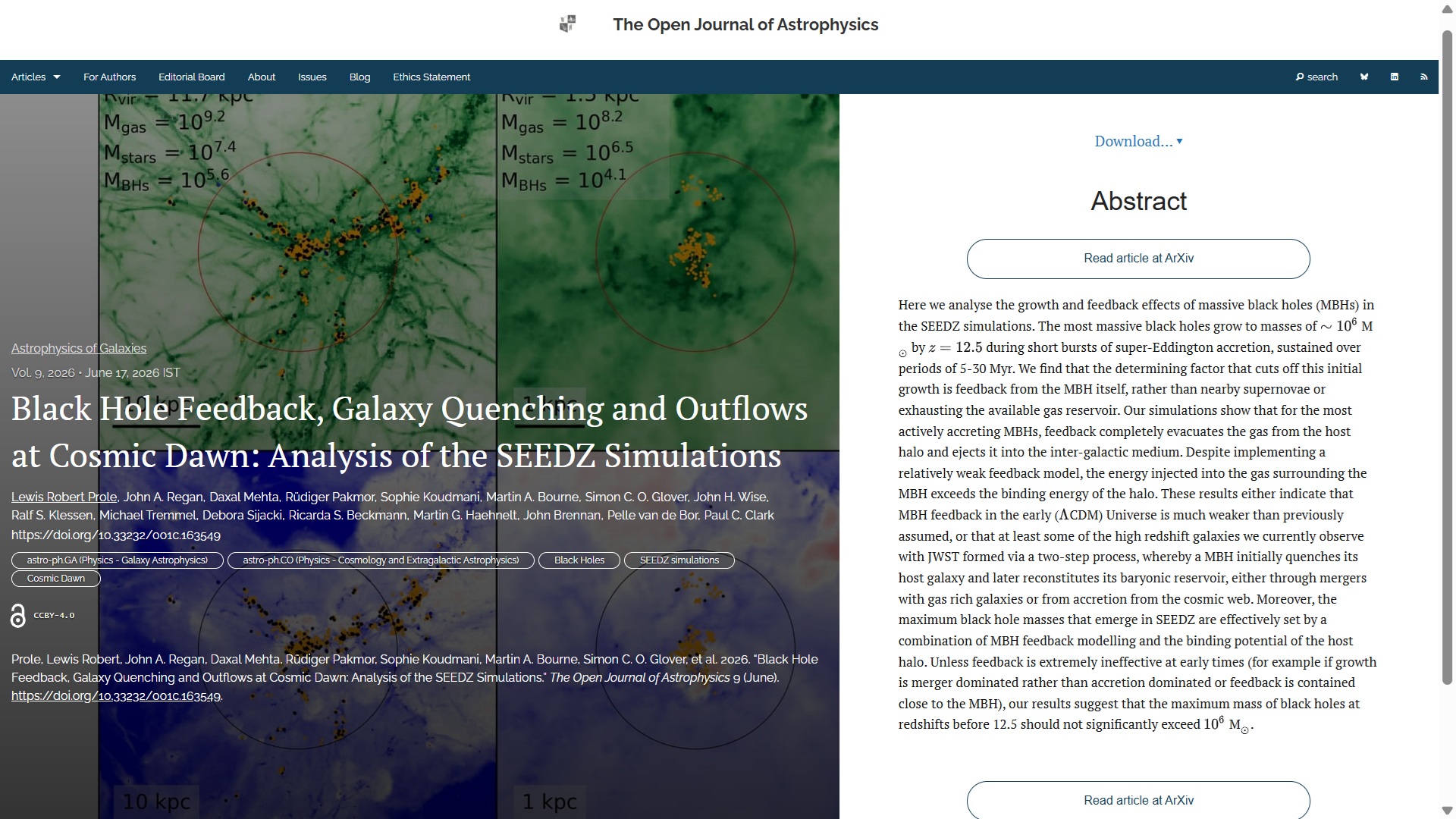
The final, accepted version can be found on arXiv here and the Mastodon announcement is here:
And that concludes this week’s update. It has been a slow week on the publishing front, but the main reason is that we have a big backlog of papers accepted but waiting for the authors to put their final versions on arXiv and we can’t do anything about that! I’ll do another update next Saturday.

 has a normal distribution with zero mean and variance
  . Consider the variable
 is a constant. What is the probability density of
  ?
?

