Archive for April, 2022

Job Opportunity in Theoretical Physics at Maynooth!

Posted in Maynooth on April 22, 2022 by telescoper

Just a short post passing on the information that we have a permanent Lectureship (Assistant Professorship) available in the Department of Theoretical Physics at Maynooth University. You can find the details, including a full Job Description and salary, here.

For the purposes of this position we interpret Quantum Physics broadly to include quantum computation, quantum information theory, quantum many-body systems, quantum field theory, and applications thereof to condensed matter and high-energy physics, etc.

This position is the first of several to be advertised across the Departments of Theoretical & Experimental Physics at Maynooth University, in areas including Astronomy and Earth Science, on top of this opportunity at Professorial level in Observational Astrophysics or Cosmology. Watch this space for more details!

The position is available from 1st September 2022 and the deadline for applications is 23.30 on Sunday 22nd May 2022 and you should apply through the Maynooth jobs portal here.

P.S. This position comes with membership of the Irish Single Public Service Pension Scheme

Why we don’t need scientific papers

Posted in Open Access, Science Politics with tags , , on April 21, 2022 by telescoper

There’s a recent piece by Stuart Ritchie in The Grauniad that argues that the concept of the “scientific paper” has outlived its usefulness and should be scrapped. I think there’s a lot in the arguments presented and the article is well worth reading. Indeed, I have made similar points myself a number of times on this blog relating both to individual papers and to the journals in which they are published.

In this post from a couple of years ago, for example, I asked the question: what are scientific papers for? Here is an extract:

I can think of two main purposes (which aren’t entirely mutually exclusive): one is to disseminate knowledge and ideas; the other is to confer status on the author(s) .

The academic journal began hundreds of years ago with the aim of achieving the former through distribution of articles in print form. Nowadays the distribution of research results is achieved much less expensively largely through online means. Nevertheless, journals still exist (largely, as I see it, to provide editorial input and organize peer review) .

Alongside this there is the practice of using articles as a measure of the ‘quality’ of an author. Papers in certain ‘prestigious’ ‘high impact’ journals are deemed important because they are indicators of status, like epaulettes on a uniform, and bibliometric data, especially citation counts, often seem to be more important than the articles themselves.

By the way, I put up a poll in that piece, which is still open. You can vote here:

The point – also made by Stuart Ritchie – is that the traditional scientific journal is a 17th Century invention and, as such, does not reflect the way modern scientific is performed and disseminated.

In fields like astrophysics and particle physics this anachronistic approach leads to absurdities such as papers with thousands of authors, many of whom won’t have even read, let alone contributed any writing to, the article. Reflecting on the publication of a paper with 5000 authors back in 2015, I wrote this:

It seems quite clear to me that the academic journal is an anachronism. Digital technology enables us to communicate ideas far more rapidly than in the past and allows much greater levels of interaction between researchers. I agree with Daniel Shanahan that the future for many fields will be defined not in terms of “papers” which purport to represent “final” research outcomes, but by living documents continuously updated in response to open scrutiny by the community of researchers. I’ve long argued that the modern academic publishing industry is not facilitating but hindering the communication of research. The arXiv has already made academic journals virtually redundant in many of branches of  physics and astronomy; other disciplines will inevitably follow. The age of the academic journal is drawing to a close. Now to rethink the concept of “the paper”…

This is the closing paragraph of Ritchie’s piece, which says much the same thing:

We’ve made astonishing progress in so many areas of science, and yet we’re still stuck with the old, flawed model of publishing research. Indeed, even the name “paper” harkens back to a bygone age. Some fields of science are already moving in the direction I’ve described here, using online notebooks instead of journals – living documents instead of living fossils. It’s time for the rest of science to follow suit.

It seems to me that the barrier to opening up the processes of scientific publication to these is that the more accurately publications reflect how science is actually done in the digital age, the more difficult it is for the bean counters to assess research quality or productivity. The academic publishing industry has cornered the market on bibliometric indicators so it rather than the scientific community gets to dictate how scientific quality will be measured. The tail is wagging the dog. Until that ends – and it will only end when we fairer ways of evaluating research – we will be saddled with the broken system we have now.

A Question of the Past

Posted in Biographical, Cute Problems, Education, Maynooth, The Universe and Stuff with tags , , , , , on April 20, 2022 by telescoper

I was tidying up some old files earlier today and came across some old examination papers, including those I took for my final examinations in Part II of the Natural Sciences Tripos in 1985. There were six of these, in the space of three consecutive days…

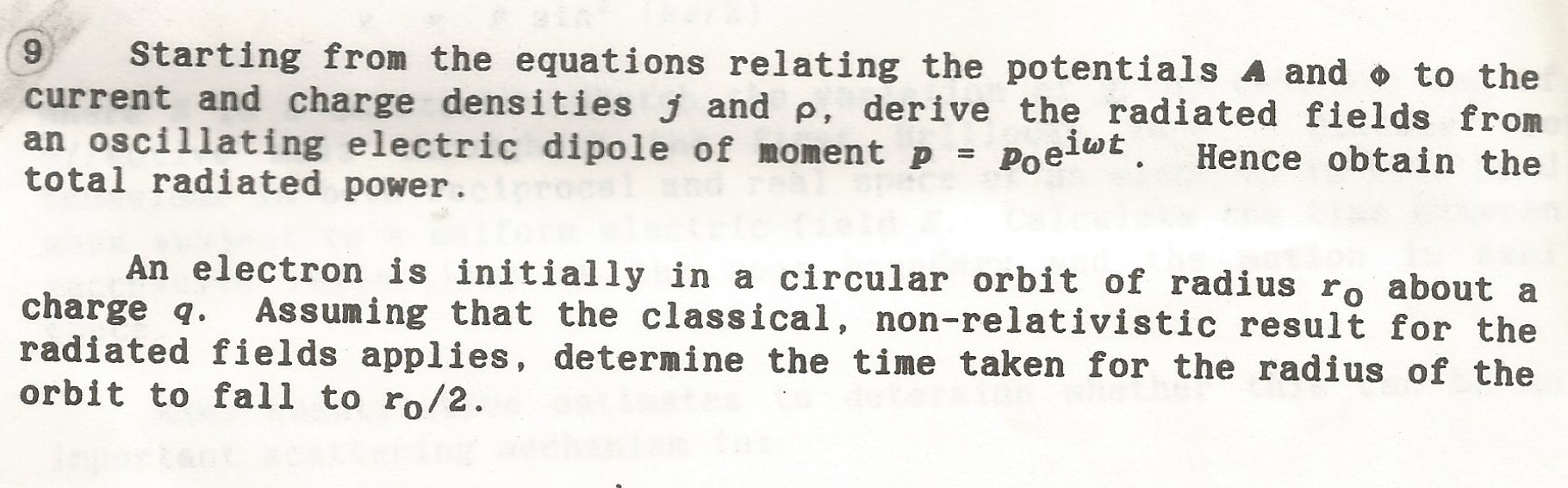
I picked one of the questions to share here because it covers similar ground to my current (!) Advanced Electromagnetism module for final-year students in Maynooth. Sorry it’s a bit grubby!

It’s been a long time since I took my finals and I’d largely forgotten what the format was. The question above was taken from Paper II which consisted of nine questions altogether in three Sections, A (Solid State Physics), B (Statistical Physics) and C (Electromagnetism, from which Q9 above was taken; I think the course was actually called Electrodynamics & Relativity). The examination was 3 hours in duration and students were asked to answer four questions, including one from each Section. That means each question would be expected to take about 45 minutes.

Looking at the paper in general and the above question in particular, a number of things sprang to mind about differences between then in Cambridge and now in Maynooth:

  1. Our theoretical physics papers in Maynooth are 2 hours in duration in which time students are to answer four questions, so that the questions are a bit shorter – 30 minutes each rather than 45.
  2. Our papers are also on a single subject rather than a composite of several; we typically don’t offer the students choice; my Advanced Electromagnetism paper has four questions and students have to answer all four for full marks.
  3. The questions on the old Tripos papers are less structured. There is no indication of the marks allocated to each part of the question in the question above.
  4. As far as I can recall there was no formula booklet back in 1985, though there was a sheet of physical constants. My Advanced Electromagnetism examination this year comes with a couple of pages of useful formulae from vector calculus and key equations in EM theory. One might argue that the old Cambridge papers relied rather more on memory (especially when you take into account that everything was in the space of three days).
  5. Back to Question 9, it is true that this along with the other Electromagnetism questions is at a similar level to what I have been teaching this Semester. If I recall correctly the relevant course in Cambridge was of 24 lectures, the same length as the course I’m teaching this year.
  6. Students taking my course should know how to do both parts of Question 9 without too much difficulty.

On the final point, the easiest way to tackle this sort of problem is to do what the question says: determine the electric and magnetic potentials, derive the electric and magnetic fields from them, then work out the Poynting vector quantifying the energy flux. The part of this that survives in the far-field limit gives you the radiated power then – Bob’s your Uncle – the answer is basically the Larmor Formula which is ubiquitous in problems of this type. The case of an oscillating dipole is a standard derivation but this method works for any time-varying source, as long as you remember to include the retarded potentials if it’s not periodic.

Had I been writing this question for a modern exam I think I would at very least have ended the first part with “Show that the radiated power is…” and then given the formula, so that it could be used for the second part even if a student could not derive it.

The Researchfish Scandal

Posted in Science Politics with tags , , on April 19, 2022 by telescoper

You may remember that about a month ago I posted a piece about the scandalous behaviour of the people who operate Researchfish – the execrable software system intended to collect data relating to the outputs of research grants funded by the various UK Research Councils.  The scandal consisted of bullying of researchers who dared to criticize mighty Researchfish followed by an atrocious non-apology when challenged about their conduct.

Well now today UKRI (UK Research and Innovation, the umbrella organization for the Research Councils) has stepped in, with the result that the scandal has now deepened.

UKRI issued a statement which begins by claiming Researchfish acted in response to “abusive” tweets. The tweets I have seen were by no means abusive so that’s a very poor start. More importantly however, the “update” doesn’t deal at all with the substantive issues raised, namely the sinister threat to communicate researchers’ personal information to UKRI. I have always thought that Researchfish would be better off trying to engage with the research community to improve its system, especially the awful user interface, than threatening the people who criticize it but it now seems the situation is even worse than I originally thought.

According to a story in Research Fortnight, “UK Research and Innovation has admitted it (my emphasis) encouraged Researchfish to report some tweets from academics to it, after enraged researchers criticized the online service for doing this last month”. UKRI goes on to say that they have “stopped this approach with immediate effect and recognize that it was the wrong thing to do”. Damn right it was wrong, but I wonder who made the decision to do it in the first place, and what sanction they will face?

There is also this:

We understand that this has raised questions around personal data. We take data protection very seriously. Our assessment of the data protection considerations is ongoing and is expected to be concluded shortly.

I rather think this calls for an independent inquiry but, although I fear a whitewash is in progress, let’s see wait and see…

How to enjoy doing your PhD

Posted in Biographical, The Universe and Stuff on April 18, 2022 by telescoper

I’ve seen quite a number of posts on Twitter recently about how difficult it is doing a PhD, so I thought I’d just add a bit of a counter based on my own experiences in case the amount of doom and gloom circulating is in danger of putting anyone off. I have to say that although at times it was tough going, I had the best time of my life doing my PhD – well, DPhil actually – and I know many others who feel the same.

The point is that a postgraduate research degree is very different from a programme of undergraduate study. For one thing, as a research student you are expected to work on your own a great deal of the time. That’s because nobody else will be doing precisely the same project so, although other students will help you out with some things, you’re not trying to solve the same problems as your peers as is the case with an undergraduate. Your supervisor will help you of course and make suggestions (of varying degrees of helpfulness), but a PhD is still a challenge that you have to meet on your own.

(Incidentally, I don’t think it is good supervisory practice to look over a research student’s shoulder all the time. It’s part of the purpose of a PhD that the student learns to go it alone. There is a balance of course, but my own supervisor was rather “hands off” and I regard that as the right way to supervise. I’ve always encouraged my own students to do things their own way rather than try to direct them too much.)

That loneliness is tough in itself, but there’s also the scary fact that you do not usually know whether your problem even has a solution, let alone whether you yourself can find it. There is no answer at the back of the book; if there were you would not be doing research. A good supervisor will suggest a project that he or she thinks is both interesting and feasible, but the expectation is that you will very quickly be in a position where you know more about that topic than your supervisor.

I think almost every research student goes through a phase in which they feel out of their depth. There are times when you get thoroughly stuck and you begin to think you will never crack it. Self-doubt, crisis of confidence, call it what you will, I think everyone who has done a postgraduate degree has experienced it. I certainly did. A year into my PhD I felt I was getting nowhere with the first problem I had been given to solve. All the other research students seemed much cleverer and more confident than me. Had I made a big mistake thinking I could this? I started to panic and began to think about what kind of job I should go into if I abandoned the idea of pursuing a career in research.

So why didn’t I quit? There were a number of factors, including the support and encouragement of my supervisor, staff and fellow students in the Astronomy Centre at Sussex, and the fact that I loved living in Brighton, but above all it was because I knew that I would feel frustrated for the rest of my life if I didn’t see it through. I’m a bit obsessive about things like that. I can never leave a crossword unfinished either…

What happened was that after some discussion with my supervisor I shelved that first troublesome problem and tried another, much easier one. I cracked that fairly quickly and it became my first proper publication. Moreover, thinking about that other problem revealed that there was a way to finesse the difficulty I had failed to overcome in the first project. I returned to the first project and this time saw it through to completion. With my supervisor’s help that became my second paper, published in 1987.

I know it’s wrong to draw inferences about other people from one’s own particular experiences, but I do feel that there are some general lessons. One is that if you are going to complete a research degree you have to have a sense of determination that borders on obsession. I was talking to a well-known physicist at a meeting not long ago and he told me that when he interviews prospective physics students he asks them “Can you live without physics?”. If the answer is “yes” then he tells them not to do a PhD. It’s not just a take-it-or-leave-it kind of job being a scientist. You have to immerse yourself in it and be prepared to put long hours in. When things are going well you will be so excited that you will find it as hard to stop as it is when you’re struggling. I’d imagine it is the just same for other disciplines.

The other, equally important, lesson to be learned is that it is essential to do other things as well as your research. Being “stuck” on a problem is part-and-parcel of mathematics or physics research, but sometimes battering your head against the same thing for days on end just makes it less and less likely you will crack it., ’m sure that I’m not the only physicist who has been unable to sleep for thinking about their research or who has spent hours sitting at their desk achieving nothing at all. The human brain is a wonderful thing, but it can get stuck in a rut. One way to avoid this happening is to have more than one thing to think about.

I’ve lost count of the number of times I’ve been stuck on the last clue in a crossword. What I always do in that situation is put it down and do something else for a bit. It could even be something as trivial as making a cup of tea, just as long as I don’t think about the clue at all while I’m doing it. Nearly always when I come back to it and look at it afresh I can solve it.

It can be difficult to force yourself to pause in this way, but I think it is essential to learn how to effect your own mental reboot. In the context of my actual research this involved simply turning to a different research problem, but I think the same purpose can be served in many other ways: taking a break, going for a walk, playing sport, listening to or playing music, reading poetry, doing a crossword, or even just taking time out to socialize with your friends. Back in Brighton in the 1980s I spent most evenings in bars and nightclubs. I never felt the slightest bit of guilt for having so much fun. Without the nightlife and all that I’m not sure I would have finished my PhD.

So, for what it’s worth, here is my advice to new or prospective postgraduate students: work hard but enjoy the challenges. Listen to advice from your supervisor, but remember that the PhD is your opportunity to establish your own identity as a researcher so take ownership of it. Never feel guilty about establishing a proper work-life balance. Having more than one dimension to your life will not only improve your well-being but may also make you a better researcher.
Astronomy Look-alikes No. 102

Posted in Astronomy Lookalikes, Television with tags , , on April 17, 2022 by telescoper

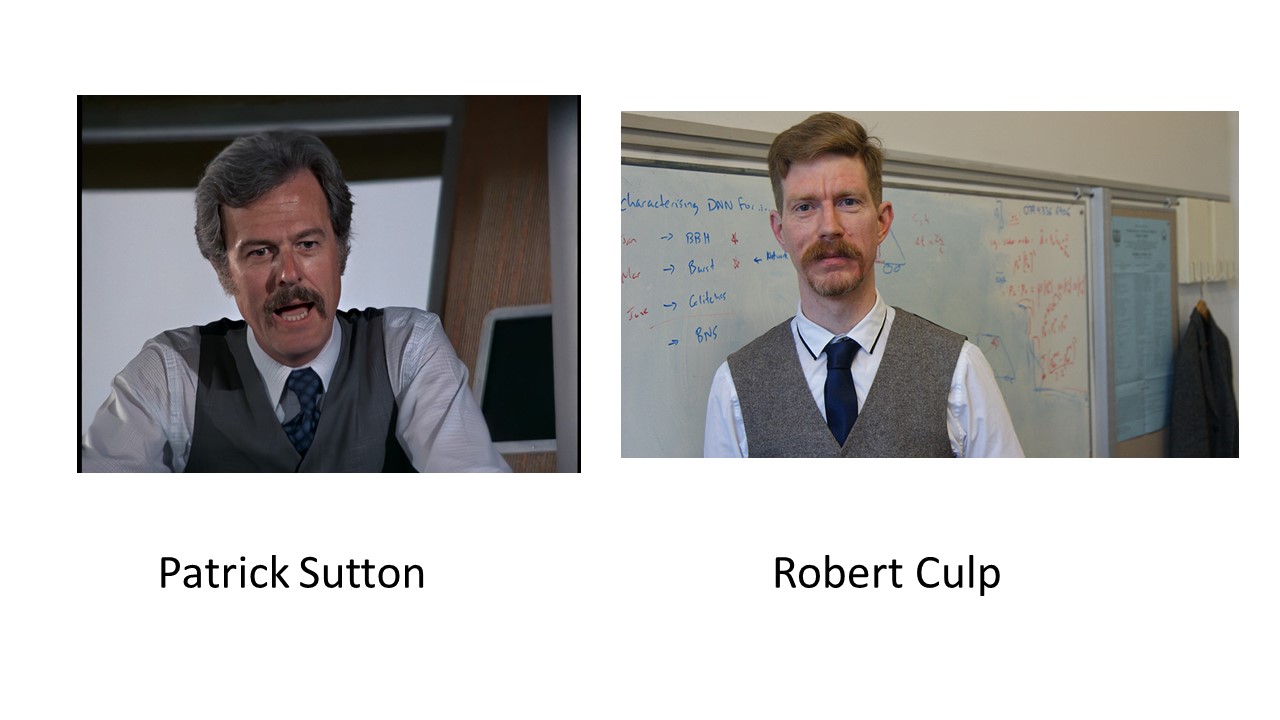
Today being Easter Sunday, I was engaging in a religious observation of an old episode of the TV detective series Columbo when the spirit moved me to post an item in my Astronomy Look-alikes folder. I wonder if unscrupulous murderer Patrick Sutton and gravitational wave expert Robert Culp might in some way be related? The attempt to grow a beard as well as a moustache isn’t fooling anyone, but I think we should be told anyway…

Resurrection, by R. S. Thomas

Posted in Literature with tags , , on April 17, 2022 by telescoper

Easter. The grave clothes of winter
are still here, but the sepulchre
is empty. A messenger
from the tomb tells us
how a stone has been rolled
from the mind, and a tree lightens
the darkness with its blossom.
There are travellers upon the road
who have heard music blown
from a bare bough, and a child
tells us how the accident
of last year, a machine stranded
beside the way for lack
of petrol, is crowned with flowers.

by R.S. Thomas (1913-2000)

Handel’s Messiah at the National Concert Hall

Posted in Music with tags , , on April 16, 2022 by telescoper

I wasn’t there in person yesterday – I haven’t been to a concert for a couple of years now – but I thought I’d share this recording of the sold-out Good Friday performance of Handel’s Messiah from the National Concert Hall in Dublin. Although nowadays associated mainly with Christmas, Messiah was intended to be performed at Easter and had its premiere 280 years ago in Dublin on Good Friday in 1742. The National Symphony Orchestra was conducted by Nicholas McGegan, with soloists including Máire Flavin (soprano) James Oxley (tenor) and Stephan Loges (bass-baritone) with the National Symphony Chorus (David Young, chorus director). Enjoy!

The Old Rugged Cross – George Lewis

Posted in History, Jazz with tags , , , on April 15, 2022 by telescoper

A descendant of Senegalese slaves, George Lewis was born in the French Quarter of New Orleans in 1900 where he learned to play the clarinet and started to play with jazz bands in the 1920s. Many musicians left New Orleans for Chicago during that period but Lewis stayed and lived on in relatively obscurity until the New Orleans “revival” began in the 1940s. After appearing on records with likes of Bunk Johnson, Lewis became a sort of Patron Saint of traditional jazz, with a style rooted in the home-town traditions of Gospel Music and Street Parades that was very different from that of the popular clarinetists of the Swing Era such as Benny Goodman and Artie Shaw. Lewis was never a great player from a technical point of view, but he was an authentic emblem of early Jazz and the back-to-basics move he represented proved very popular especially in Western Europe and Lewis had a late renaissance in his career in which he travelled widely playing with “traditional” bands around the world during the height of the “trad” boom of the fifties and sixties. He died in 1968.

Anyway, because it’s Good Friday I thought I would post this video of him in his later years playing the hymn The Old Rugged Cross, which was written in 1912 and has been a staple of New Orleans funeral processions ever since:

The Wellness of Being

Posted in Biographical, Maynooth, Mental Health with tags , , on April 14, 2022 by telescoper

So we’ve arrived at the Easter weekend. No work tomorrow, Good Friday, or on Easter Monday. I’ve put my out-of-office autoreply on and I’m taking a break from work for four days in an attempt to recharge the batteries before the examination and marking season. I only have two papers to correct this year, but because my Computational Physics class larger than it has been for a few years so I have quite a lot of projects to assess too. The deadline for those is in May, as are the examinations.

Today while finishing off a few things before the break – including the last Computational Physics lab test – I noticed an email from Human Resources, announcing that May 2022 is “Employee Wellbeing Month”. Among other delights we are promised a “wide range of wellbeing workshops that will run throughout May” which most of us teaching staff will be far too busy to attend.

And don’t get me started on making us come in for an Open Day on the May Bank Holiday weekend…

I wonder if there’s any empirical evidence at all that wellbeing workshops and whatnot do anything at all to alleviate work-related stress? I suspect not. It seems to me that they’re just a way of telling academic staff that they’d better get used to it because no attempt will ever be made to deal with the real causes of burnout: lack of resources, staff shortages, ever-increasing workloads, and the suffocating influence of remote and unsympathetic management.

This week though I learnt a far better way to experience feelings of wellbeing. Yesterday evening, for the first time in ages, I went to a pub for drinks with some current and former postgrads and colleagues (and partners thereof) from the Department of Theoretical Physics. Unlike, for example, Cardiff (where visits to the pubs with colleagues were a regular occurrence for me) I hadn’t really socialised with folks from Maynooth University even before the lockdown put paid to the possibility entirely. Last night was actually an initiative by some of our PhD students, and I’m very grateful to them for organizing it!

I’d been to the pub – McMahon‘s on Main Street – a few times before so when invited to go along it seemed like having a couple of pints there might be a good way of trying to shake off the agoraphobia. The evening turned out to be ideal for that purpose – the pub had enough people in it to have atmosphere but not so many that it was heaving. I went with the intention of staying an hour or two, but ending up leaving at midnight.

I hope this sort of thing becomes a regular feature from now on. Going to the pub with some friends now and then is far more likely to improve my state of mind than any number of wellness seminars. Although slightly hungover this morning I was in a very good mood, at least until my computer decided to embark on a Windows Update that took over an hour to complete…