Archive for August, 2022

In Defence of Blackboards

Posted in Covid-19, Education, Maynooth with tags , on August 21, 2022 by telescoper
Lecturing from Home

I wasn’t very surprised to find that the large lecture theatres in the swanky new building at Maynooth University are not equipped with chalkboards, as I had been told that the powers-that-be were finding it difficult to “source” boards of the appropriate size. I was more surprised and disappointed to find that none of the smaller teaching rooms have blackboards either; the best they have is very small whiteboards which are useless for teaching mathematical subjects.

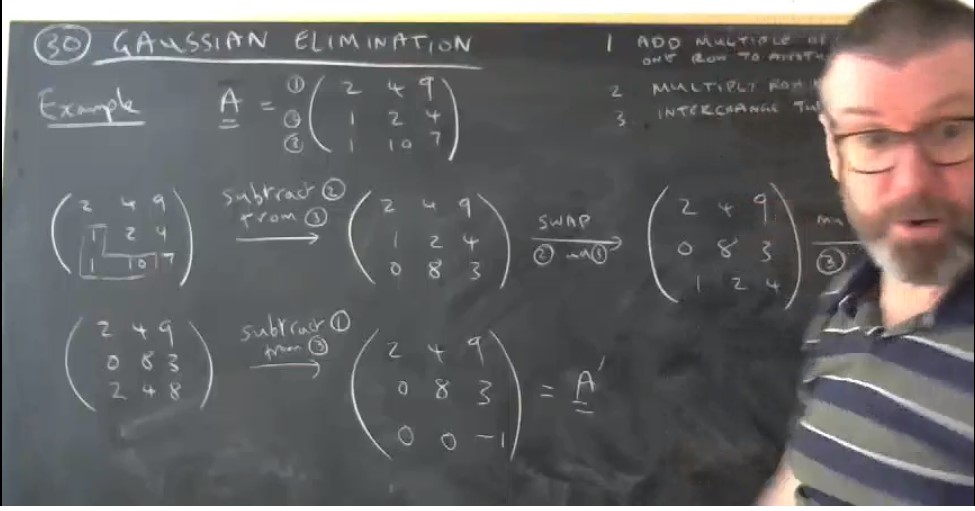
I know people think I am very old fashioned in persistently using a chalkboard (a better word than “blackboard” as many chalkboards are actually dark green). They also find it quite amusing that I bought one especially so I could do lectures during the pandemic from home using it. One reason for that is that it’s far easier to get a decent contrast on camera than using a whiteboard. I also find that standing up and walking around allows me to communicate more effectively, at a decent pace and with a reasonable amount of energy which made the lectures from home a little less unbearable to give and, hopefully, to watch. Here’s the green blackboard in my office that I used to give some lectures during lockdown:

The very chalky chalkboard in my office on campus

It was never the intention of course that the board in my office would be used for lecturing. We have such things to facilitate the communication of ideas during a discussion by scribbling mathematical expressions or diagrams.

I found some time ago an article about why Mathematics professors at Stanford University still use chalkboards. I agree with everything in it. The renowned Perimeter Institute in Canada and the Isaac Newton Institute in Cambridge also have blackboards, not only in teaching rooms but also in corridors and offices to encourage scientific discussions.

For teaching I think the most important thing for the students in a lecture on a subject like theoretical physics to see a calculation as a process unfolding step-by-step as you explain the reasoning, rather than being presented in complete form which suggests that it should be memorized rather than understood. Far too many students come to university with the impression that their brain is just a memory device. I fill it’s our job as lecturers to encourage students develop genuine problem-solving skills. The example in the first picture above – Gaussian Elimination – is a good illustration of this. Most of my colleagues in Theoretical Physics and in the Department of Mathematics and Statistics seem to prefer chalkboards too, no doubt for similar reasons.

I know that many in Senior Management think of us as dinosaurs for clinging to “old technology” but the fact is that new technology isn’t always better technology. Whiteboards are just awful. As well as being impossible to read in a large room or to record from, the marker pens are expensive, filled with nasty solvent, and impossible to recycle when empty. Unfortunately the purveyors of these items seem to have cornered the market I hate whiteboards so much I call them shiteboards.

Anyway, with the new academic year due to start in a month, and there being no likely resolution of the accommodation crisis, it looks like many students will be unable to attend lectures in person. It doesn’t matter whether rooms have blackboards or whiteboards or enhanced multimedia digital display screens if the students can’t get to the campus…

The Accommodation Crisis Again

Posted in Education, Maynooth with tags , , on August 20, 2022 by telescoper

There’s an article on the RTÉ website drawing attention to the national crisis in student accommodation. Included in the article is an example of a student at Maynooth:

Clara Battell is heading into her second year of studying Law and Criminology at Maynooth University. The Sligo student and her four friends thought they’d beat the crowd when they started looking for accommodation shortly after Christmas. However, eight months on, they’re still looking.

I checked this morning on daft.ie and there are just two properties currently available to rent in Maynooth; the rest are miles away and would require the tenant(s) to have a car. One is property is a studio apartment for €1,250 per month (which is way beyond the budget of a typical undergraduate student) and the other a four-bedroom shared house suitable at €3,800 per month. And remember that new students haven’t even started looking yet as this year’s CAO offers are not out until September. Clara Battell might end up having to commute from Sligo:

I’m from Sligo, it’s a three hour train journey and the only option at this stage appears to be commuting. It’s surely not feasible, six hours every day – and you’re not getting the best out of your education if you are travelling so much. We are all a bit stuck really.

Not to mention of course the inability to participate in clubs, societies and other extra-curricular activities. Clara’s situation is by no means atypical. Some brave students may try long-distance commuting this for a week or two, but few will keep it up for the entire academic year when they know how tough it is going to be.

The reality is that a great many students will have to choose between lengthy commutes and skipping lectures. This is particularly bad at Maynooth where the University Management has failed to invest in lecture recording equipment that would at least do something to mitigate the negatives of not being able to attend campus teaching sessions. I can see attendance on campus being very low this forthcoming term, as it was last term. The reality for many students is that they will be stuck at home just like during the lockdown, but without online classes. This was entirely predictable, but little has been done. It’s extremely frustrating for staff as well as students.

I heard this week of a much-needed proposal for a new housing complex including 260 student beds in Maynooth. It’s not on campus, but within walking distance on the other side of the Moyglare Road. This is good news, but the application for planning consent has only just been lodged; a decision is not expected until November 30th. Even if permission is granted it will take years to build and remember that there are 15,000 students in Maynooth so 260 beds is a drop in the ocean.

It is important to stress what is driving this. With costs increasing but income per student falling over many years, third-level institutions have had no choice but to recruit more and more students. The same Government that has driven this requirement is also responsible for inadequate investment in housing across the country. Some people are trying to blame the current crisis on the 48,000 Ukrainian refugees now in Ireland, but all their presence has done is to expose the long-term negligence of the Government at whose door the blame must rest.

It will take at least two years, and probably much longer, to fix this crisis. The big question is whether Ireland’s University system will survive that time without disintegrating.

La Même Chose

Posted in Uncategorized with tags , , on August 19, 2022 by telescoper
What is she saying?

You can’t move on Twitter these days without seeing the above photograph which seems to have become the latest viral meme. The game as always is to tweet the picture with a suggestion of what the girl is saying. Here is my effort:

You can play the game yourself at home by suggesting your own version of what she’s saying. There are quite a lot of astronomy-related attempts circulating already. The Hubble Tension is an obvious example topic.

Interestingly, just like ChorizoGate, the picture in question was first circulated a few years ago (in 2019) and was also apparently created in Spain. Perhaps there’s some kind of law that states that these things circulate on a 3-4 year cycle?

Talking of ChorizoGate, especially the French Dimension thereof, I wondered whether the French word for “Meme” is the same as it is in English. The French word however turns out to be “Mème”. So the English word “Meme” is not quite the same in French; the French word for Meme is “Mème” which is also not quite the same in French (“Même”). To put it another way, “Même” is the same in French but it’s not the same as either “Mème” or “Meme” neither of which are the same in French (nor in English).

I hope this clarifies the situation.

P.S. I chose the title from the well-known French saying “plus ça change, plus c’est la même chose”.

A-level Again

Posted in Education with tags , , on August 18, 2022 by telescoper

So once again it’s the day that students in United Kingdom are receiving their A-level results. It seems the number of top grades is down this year but as always my advice to students who got disappointing results is

There’s always the clearing system and there’s every chance you can find a place somewhere good. If you’re reading this blog you might be interested in Physics and/or Astronomy so I’ll just mention that both Cardiff and Sussex have places in clearing and both are excellent choices.

At least you’ve got your results; students here in Ireland will have to wait until September 2nd to get theirs!

My experience of over 30 years teaching in UK universities has convinced me that A-levels are not a very good preparation for higher education anyway and the obsession with them is unhealthy. Some of the best students I’ve ever had the pleasure of teaching came to University with poor A-level grades (for a variety of reasons).

In fact I’d go as far as to say that the entire system of University admissions in the United Kingdom needs to be overhauled. As I said in a post over a decade ago:

…if we had the opportunity to design a process for university admissions from scratch, there is no way on Earth we would end up with a system like the current one.

Of course I longer work in the UK so there’s no longer a “we”, but the system in Ireland is not that much different, with the Leaving Certificate playing the role of A-levels for the vast majority of students.

As things stand in the UK, students apply for university places through UCAS before they have their final A-level results (which don’t come out until August). Most applications are in by January of the year of intended admission, in fact. The business of selecting candidates and making offers therefore usually makes use of interim results or “predicted grades” as supplied by teachers of the applicant.

In my (limited) experience most teachers systematically overestimate the grades of their pupils, which is presumably why so many of this year’s A-level results are being downgraded, but there are lots of unconscious biases at play here and I accept that some teachers may be unduly pessimistic about their students likely performance.

But the inaccuracy of predicted A-level grades is not the only absurdity in the current system. Universities have to engage in enormous amounts of guesswork during the admissions process. Suppose a department has a quota of 100, defining the target number students to take in. They might reasonably get a minimum of 500 applications for these 100 places, depending on the popularity of university and course.

Each student is allowed to apply to 5 different institutions. If a decision is made to make an offer of a place, it would normally be conditional on particular A-level grades (e.g. AAB). At the end of the process the student is expected to pick a first choice (CF) and an insurance choice (CI) out of the offers they receive. They will be expected to go to their first choice if they get the required grades, to the insurance choice if they don’t make it into the first choice but get grades sufficient for the reserve. If they don’t make either grade they have to go into the clearing system and take pot luck among those universities that have places free after all the CFs and CIs have been settled.

Each university department has to decide how many offers to make. This will always be larger than the number of places, because not all applicants will make an offer their CF. They have to honour all offers made, but there may be penalties if they under or over recruit. How many offers to make then? What fraction of students with an offer will put you first? What fraction of them will actually get the required grade?

The answers to these questions are not at all obvious, so the whole system runs on huge levels of uncertainty. I’m amazed that each year any institution manages to get anywhere close to the correct number, but they do tend to get very close indeed by the end. Usually.

It’s a very skilled job being an admissions tutor, but there’s no question it would all be fairer on both applicants and departments to remove most of the guesswork by which I mean allowing students to apply to University after they have got their results. But there is the rub. There are two ways I can see of changing the timetable to allow this:

  1. Have the final A-level examinations earlier
  2. Start the university academic year later

The unavoidable consequence of the first option would be the removal of large quantities of material from the A-level syllabus so the exams could be held several months earlier, which would be a disaster in terms of preparing students for university.

The second option would mean starting the academic year in, say, January instead of September. This would in my opinion be preferable to 1, but would still be difficult because it would interfere with all the other things a university does as well as teaching, especially research. The summer recess (July-September), wherein much research is currently done, could be changed to an autumn one (September-December) but there would be a great deal of resistance, especially from the older establishments; I can’t see Oxbridge being willing to abandon its definitions of teaching term! And what would the students do between July and January?

Either of these options would cause enormous disruption in the short-term, which is presumably why they have never been implemented. However, this year everything is disrupted anyway so there’s an opportunity to redesign the whole process.

I don’t really imagine the Government is will do any of this but here are some suggestions of elements of a new admissions system:

  • Students to apply after receiving A-level* grades (i.e. implement 1 or, preferably, 2 above)
  • All university applications to be anonymous to prevent discrimination.
  • The identity of the applicant’s school to be withheld to prevent undue influence.
  • Teachers to play no part in the process.

*I don’t think A-levels are fit for purpose so here I mean grades of whatever examination replaces them.

Quiet Quitting

Posted in Biographical, Education, Maynooth with tags , , on August 16, 2022 by telescoper

Not long ago I had lunch with a friend and former colleague from Sussex now working elsewhere. During the conversation I found myself saying words to the effect of “It’s only easy being a manager of something if you don’t care”. Speaking in the context of University management I meant “care” about the things that matter, i.e. staff and students and teaching and research, not metrics, rankings and key performance indicators.

Over the years that I’ve worked in universities, I’ve seen them systematically taken over by people who really don’t care at all about the important things. The result among ordinary staff is exhaustion caused by the overwork required to meet arbitrary criteria of productivity imposed by a remote and uncaring managerial class. Universities are thus a microcosm of neoliberal society at large, with the management being the propertied class, the academics being the workers, and the students being mere commodities.

The drive to alienate and demoralize staff through overwork accelerated during the Covid-19 pandemic. Teaching staff were required to transform their working methods, undertake countless hours of unpaid overtime and suffer long periods of isolation and stress. Being a Head of Department with lots of responsibilities but no actual power and no reduction in teaching load to compensate for the administrative burden, compounded this They did it because they knew there was an emergency and because they actually care. In return for this sacrifice they have generally received no appreciation except for platitudes and nothing by way of financial compensation, with the notable exception of Queen’s University Belfast which paid a bonus to staff in recognition of their exceptional efforts. Well done to them, but they are the exception rather than the rule. Elsewhere the only reward for efforts during the pandemic looks likely to be real-terms cuts in pay.

My worry, which is rapidly becoming reality, is that in the post-pandemic era The Management, aware of how far their employees were prepared to go during the pandemic, will continue to take them completely for granted, increase their workload by recruiting more and more students to be taught with fewer and fewer resources, all of it driven by financial targets. Why do we continue to put up with this gross exploitation? Are we doomed forever to labour under the dead weight of managerialism?

Over the past few weeks I’ve seen a number of articles about quiet quitting, most recently this one in the Guardian. Roughly speaking “quiet quitting” means fulfilling one’s contract but not going any further – no work at evening or weekends, taking one’s full holiday entitlement, and so on. Staff have generally done these things because they care but that care has been and is still being systematically exploited. Indeed, it says something about the way higher education institutions operate nowadays that “working to contract” is generally regarded as a form of industrial action! Universities would grind to a halt without the good will of staff, and there’s very little of that still left. In my own case, my employer still hasn’t fulfilled the terms of my employment contract almost five years after I joined.

So am I now going to join the ranks of those quitting quietly? You might very well think that. I couldn’t possibly comment. What I will say is that my union, IFUT, is going to ballot its members next month on industrial action over pay. I think you can probably guess which way I’ll be voting…

Love after Love, by Derek Walcott

Posted in Poetry with tags , , , on August 15, 2022 by telescoper

The time will come
when, with elation
you will greet yourself arriving
at your own door, in your own mirror
and each will smile at the other’s welcome,

and say, sit here. Eat.
You will love again the stranger who was your self.
Give wine. Give bread. Give back your heart
to itself, to the stranger who has loved you

all your life, whom you ignored
for another, who knows you by heart.
Take down the love letters from the bookshelf,

the photographs, the desperate notes,
peel your own image from the mirror.
Sit. Feast on your life.

by Derek Walcott (1930-2017)

The Wrong Sort of Open Access

Posted in Open Access with tags , , , , , on August 14, 2022 by telescoper

I came across two articles this week on the subject of Open Access and thought I’d share them here with a few comments of my own.

The first article was published in the LSE blog on 11th August with the title Article Processing Charges (APCs) and the new enclosure of research. For those of you not in the know, an Article Process Charge (APC) is a fee that authors are required to pay a publisher to allow Open Access to the paper on publication, i.e. without readers having to pay. The fees for some journals can many thousands of dollars. The lede for the LSE blog post reads:

Drawing on a recent analysis of APC pricing and movements within the commercial publishing sector, Gunnar Sivertsen and Lin Zhang argue that APCs have now firmly established themselves as the predominant business model for academic publishing. Highlighting the inequalities inherent to this model, they posit now is the time to consider alternatives.

In the text the authors reveal that in 2020 alone APCs contributed over $2Bn in revenue to academic journal publishers. I agree with the authors’ conclusion that the APC model is unfair and unsustainable. Indeed I would go further: it’s a complete con. The actual cost of processing an article for publication is a tiny fraction of the APC – the rest is just profit. The academic community is being fleeced. The right “time to consider alternatives” was many years ago, however, when we could have prevented this ridiculous model from being established in the first place. I still believe that the model will collapse under the weight of it’s own contradictions, however, so it’s not too late to change.

The second paper (which was published in January 2022) is entitled Open Science – For Whom? and is published in the Data Science Journal. It was drawn to my attention by the first author, Martin Dominik. Here is an excerpt:

So-called “Open-Access journals” lift the economic barrier to reading scholarly articles, but flipping the paywall from the reader to the author is not a viable solution and inhibits global participation in the scientific process. While article processing charges as well as read-and-publish deals currently on offer appear to be unaffordable to many institutions or individuals (not only in low- and middle-income countries), already the requirement of somebody else having to sign off for getting research published collides with the principles of academic freedom.

and later:

Flipping the paywall is not a solution for scholarly communication in a global Open Science ecosystem. Author-pays-charge models for disseminating research results are not viable in practice and simply absurd.

Simply absurd is right; see the above comments. How on Earth did we let the APC model take hold? I think the answer to that is inertia and lack of imagination within the academic community. It seems many researchers are willing to complain publicly about the absurdity of APCs but far fewer are willing to do something about the situation.

I pointed out the unfairness of APCs in a blog post ten years ago. I ended that post with this paragraph:

I for one have no intention of ever paying an Article Processing Charge. If the journals I publish in insist on levying one, I’ll just forget about the journals altogether and put my papers on the arXiv. I urge my colleagues to do the same.

I’m glad to say that I’ve kept that pledge and have never paid an APC. I recently completed a survey about Open Access which included a question about what level of APC I thought was reasonable; I put zero.

The way forward, I believe, is Diamond Open Access (i.e. free for both authors and readers), such as that offered by the Open Journal of Astrophysics. This is not the only model, of course, but we have at least demonstrated that it is viable (and indeed rather successful). And at least in setting up the Open Journal of Astrophysics I’ve done a bit more than whinge.

The Student Accommodation Crisis

Posted in Biographical, Education, Maynooth with tags , , on August 13, 2022 by telescoper

These days many of Ireland’s newspapers are carrying stories about the drastic shortage of accommodation for students ahead of the start of the new academic year.; see, for example, here and here. Sinn Féin spokesperson on Further and Higher Education, Rose Conway-Walsh, has called on the Government to prepare emergency measures to tackle the crisis “before it’s too late”.

Unfortunately I think it’s already too late. I think this year we’re going to see a complete breakdown of the University system and that’s even without the industrial action that looks likely to take place. Although third-level institutions could have done more, the root cause is the funding model. There’s also a lack of housing nationally which is caused by systematic underinvestment over many years.

To illustrate the problems let’s look at Maynooth University, where I work. Some of the issues here are common across the University sector but some are specific. Maynooth is Ireland’s only real “University Town” in the sense that the University constitutes a very large part of the population; the local football team is even called Maynooth University Town. This is often used as a selling point for the University and indeed Maynooth is a pleasant place to work and study, but this year the special status of Maynooth is exacerbating the national crisis.

The number of permanent residents in Maynooth is about 15,000 and there is a similar number of students (13,700, including about 11000 undergraduates), so the population almost doubles during teaching term. Both populations are steadily rising. The University is recruiting more and more students without comparable increase in student housing – this year looks like being another record intake – but there is also pressure on housing due to other factors, particularly the dramatic expansion of the Intel plant in nearby Leixlip, with many of the new workers trying to find places to live in Maynooth. New properties are being built but at a rate much slower than the demand is increasing.

It is now mid-August, about a month before term starts for returning students. This is the time when foreign students start arriving and looking for accommodation. As a matter of fact I have two PhD students due to start in September, both of whom are new to Ireland. Usually getting in ahead of the home students helps them find somewhere ahead of the rush, but this year there is absolutely no accommodation to be found in Maynooth. I don’t mean there’s a shortage. I mean there isn’t anything. And the incoming first-year students haven’t even started looking yet.

This year’s Leaving Certificate results will not be out until September 5th. After that more than 3000 students will begin looking for accommodation. But the supply is already exhausted in August. Some will find accommodation on campus, but at the moment there are over 800 Ukrainian refugees living in the halls who will have to leave at the end of August to make way for students, but where will they go? And in any case there spaces vacated will only accommodate a fraction of the new arrivals.

There’s also the question of cost. The law of supply and demand is merciless in this situation so as private accommodation is so scarce, the rents payable have soared. That’s fine if you’re a landlord, of course…

The only solution I can see in the short term is temporary accommodation in caravans or tents or perhaps in large buildings such as sports halls. That’s highly unsatisfactory of course, but the alternative is lengthy commuting which is exhausting and which we saw last year leads to widespread disengagement.

Maynooth has just opened a new building on campus, the TSI Building, with large teaching rooms anticipating ever-increasing class sizes driven by the bums-on-seats mandate. But how many students will be able to attend?

New Teaching Room in the TSI Building

I’ve been arguing for over a year that we need to accept the reality that many students will not be able to attend on-campus sessions as we would like them to so we should invest in remote teaching methods to allow them to study at home. We did this during the pandemic emergency and we should do it during the accommodation emergency too. I am appalled that Maynooth has not bothered to install proper lecture capture facilities in its teaching rooms. These facilities were commonplace in the UK long before the pandemic and it’s shocking that they are not deployed routinely in Maynooth. I have better lecture capture facilities in my study at home than the University provides in its lecture theatres.

Although this crisis has been brewing for many months, the Irish Government has done little to help. Individual universities have also been staring into the headlights and doing nothing. Government funding per student has been falling steadily so Universities wishing to maintain their income have been forced to recruit more students, despite the lack of investment in accommodation and other infrastructure.

It’s stressful enough for academic staff having to contend with this looming disaster, but I can hardly imagine how awful it must be for students. All I can do is apologize, which is something the people really responsible will not do.

Anomalies in Physical Cosmology

Posted in The Universe and Stuff with tags , , , on August 12, 2022 by telescoper

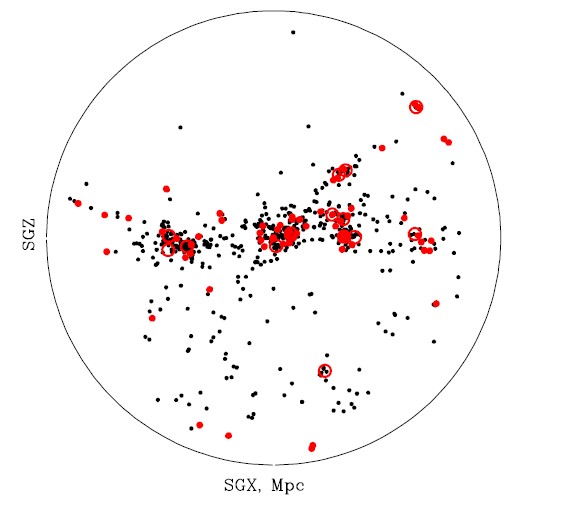
Just a quick note to mention that there’s an interesting review article on the arXiv by elder statesman of cosmology Jim Peebles with the abstract:

The ΛCDM cosmology passes demanding tests that establish it as a good approximation to reality. The theory is incomplete, of course, and open issues are being examined in active research programs. I offer a review of less widely discussed anomalies that might also point to hints to a still better cosmological theory if more closely examined.

Here is Figure 4 from the paper, which I’ve picked because it is pretty. It shows the distribution of bright (red) and faint (blue) galaxies within 9Mpc of the Milky Way.

Maynooth University Library Cat Update

Posted in Maynooth with tags on August 11, 2022 by telescoper

Over the past week or so I’ve made numerous trips back and forth to the Examinations Office and Exam Halls on matters relating to the repeat examinations, which finished yesterday. In the course of my perambulations I’ve been keeping an eye out for Maynooth University Library Cat, but until yesterday I didn’t see him anywhere. When I did catch a glimpse of him yesterday he had flaked out underneath a bush and I didn’t want to disturb him to take a photograph. Luckily however whoever operates Maynooth University’s Twitter feed managed to get a good snap of him today:

It can’t be ideal in this weather to be wearing a black fur coat, but he seems well. I guess he has been keeping a low profile in the shade most of the time. Whenever I passed his residence I made sure there was water in his bowl, but if he got really thirsty he could probably drink from the little stream that flows under the bridge on which he holds court. There are fish in there, and even the occasional otter, so I suppose the water is OK to drink. I don’t think I’ll put that to the test though. Certainly not now. I’ve just finished marking the last batch of scripts so I think I’ll go for a glass of wine…