Archive for September, 2022

A Cardiff Visit

Posted in Art, Cardiff with tags , , , on September 7, 2022 by telescoper

So here I am, then, in Cardiff, for an overdue visit to try to sort out some things to do with the my house and the hopefully forthcoming sale thereof. I decided to treat myself to a stay in a nice hotel for a couple of days while I am here. I have been stuck at home a lot over the last three years or so and I thought it would be nice just have someone else cook my breakfast and make my bed for a change!

It’s been raining off and on while I ran various errands hither and yon so at lunchtime I popped into the excellent National Museum in Cardiff. Entry to this establishment is free, as it is to all the similar public museums and galleries in Ireland.

Not many people know what a rich treasury of art you can find in the National Museum. Did you know, for example, that the famous La Parisienne by Pierre-Auguste Renoir is here in Cardiff?

The impressionist collection is very fine indeed, although only part of the collection is on display. Here are two very different post-impressionist works by Paul Cézanne: Still Life With Teapot and Provençal Landscape.

The second of these has to be seen up close to be fully appreciated: the paint looks like it has been combed onto the canvas with different colours going in different directions in such a way that messes with the viewer’s perception of depth.

Here is one from the modern collection. It is by Andre Stitt and is called Municipal Wall Relief for a Residential Housing Complex in a Parallel Universe:

I also experienced the installation Vertigo Sea by John Akomfrah, a moving and at times harrowing visual account of the sea and the dark side of humanity’s relationship with it, from whaling and pollution to slave killings and the trafficking of refugees. There’s some stunning contemporary footage in this work, juxtaposed with archive recordings spread out over three screens. Here’s a short trailer that gives you an idea:

When I lived in Cardiff I hardly ever visited the collection in the National Museum of Wales. Indeed the few times I entered the building were for various meetings and other functions. It was nice to see it as a tourist!

Anyway, I still have a couple more things to do so that will do for now!

Ethics and the SpaceX Business

Posted in Biographical, Euclid, Politics with tags , on September 6, 2022 by telescoper

Six months ago when Russia invaded Ukraine there was considerable debate about the practicality of sanctions on Putin’s regime. The discussion largely centered around whether economic sanctions would be effective and whether they would harm the nations imposing them more than they would Putin. At the time it seemed to me this was the wrong way of looking about it. The main issue as far as I was concerned was not their likely efficacy, but the ethical and moral dimension of doing business with a warmongering state. A similar issue came up frequently in the 1980s over South Africa, for example. The issue was not for me whether not buying South African oranges would end apartheid; it was about whether I personally felt morally comfortable with doing business with a racist state. Russia is not the only country or entity nowadays with whom I would feel very uncomfortable being involved, but it is one.

Ethical considerations are however often compromised by practical issues. A complete ban on Russian oil and gas imports would cause devastation in the short term, for example, so Western sanctions on Putin have concentrated elsewhere.

Individuals also make ethical decisions about what products they buy, which employers they work for, which countries they visit, and so on. These are of course private matters but people have a right to voice their opinions and argue their case.

At least an individual can decide their own position with unanimity. It’s somewhat more complicated in an organization or group as there are likely to be dissenting views. Nevertheless, I think it is good to have these discussions out in the open. That’s what should happen in a free society and in a well-run organization.

You may nor may not agree with the blog post by Arthur Loureiro about Elon Musk and SpaceX that was published here last week, but I think it raises a similar question: with whom do you feel comfortable doing business?

I suspect that I’m not alone in agreeing with Arthur’s discomfort about Elon Musk. As a matter of fact I think he’s a thoroughly nasty piece of work. Many people no doubt also felt moral discomfort at the prospect of Euclid being launched on a Soyuz spacecraft. In the end the decision will probably be based on pragmatism rather than ethics, but I think it was right for Arthur to raise the issue publicly and I am glad to have been able to make his views public via this website. There are limits and we need to discuss where those limits lie.

P.S. I am glad that the Euclid Consortium has stated aims to be as diverse and inclusive as possible. I am also aware that there are members of the Consortium who disagree with its EDI policies. I’ve observed in many organizations that those who disfavour diversity and inclusion often complain about having diversity “forced upon them”. I shall refrain from commenting further.

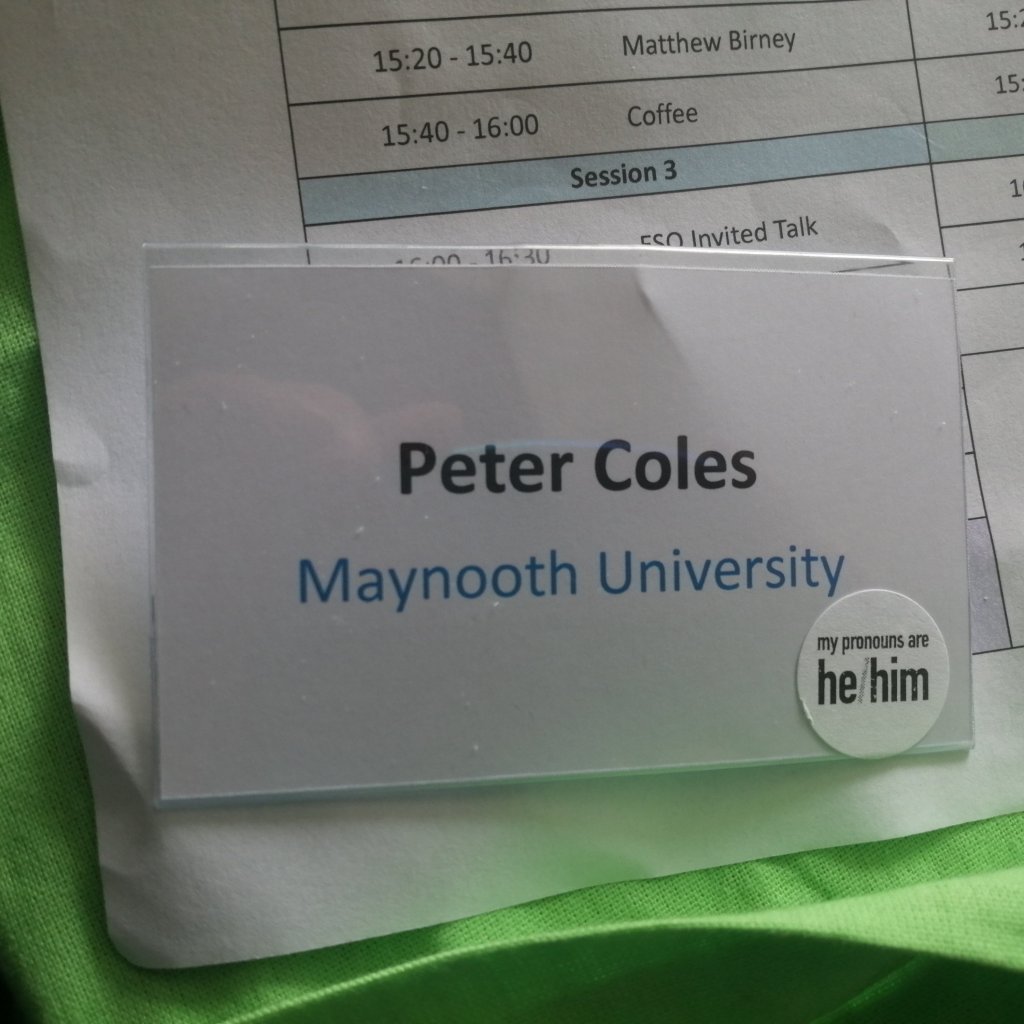
Conference Badge

Posted in Uncategorized on September 5, 2022 by telescoper

I thought I’d share a picture of my conference badge from INAM 2022, complete with pronouns, for the benefit of those who are triggered by such things.

If you are one of those people triggered by pronouns, just wait until you find out about adjectives!

Louis Armstrong and Bix Beiderbecke: Singin’ the Blues

Posted in History, Jazz with tags , , on September 4, 2022 by telescoper

 Leon “Bix” Beiderbecke became a jazz-age romantic legend not only by playing brilliant cornet but also by drinking too much bad prohibition liquor resulting his premature death in 1931, at the age of only 28. His short life was punctuated by episodes of very bad health caused by chronic alcoholism in an era when the only booze that was available was bathtub gin or rotgut whisky. Despite all his problems, Bix still gave us some of the greatest ever jazz records.

Although he was of middle-class white origins, Bix’s playing was deeply admired by leading black musicians of the day notably the great Louis Armstrong. Some years ago I listened to a radio play called Bix: Singing the Blues which is a fictional account of the only occasion in which Bix Beiderbecke and Louis Armstrong played together, in a private, after-hours session. Given the description of that as “fictional” I assumed that Bix and Satchmo didn’t know each other well. Recently, however, I came across a recording of Louis Armstrong talking about Bix Beiderbecke that shows I was wrong:

(There is one little bit of confusion in the discussion: Bix wasn’t 31 when he died: he died in 1931, at the age of 28. )

So how good was Bix? Well, make your own mind up. Here is his classic version of Singing the Blues, with Frankie Trumbauer’s Orchestra in 1927, a three minute track in which Bix’s stunning solo starts a minute in and lasts a minute.

Jazz being largely improvised music, it is often a bit rough around the edges; even the Hot Fives and Hot Sevens have their share of duff notes. Bix’s solo on this record with that beautiful ringing, bell-like tone, and effortless swing at what is quite a slow tempo, is as close to perfection as you’ll ever find.

But you don’t need to take my word for it.

During his heyday in the1920s Louis Armstrong played virtually every popular tune that was put in front of him, including many songs that seemed unpromising from a jazz perspective, and in the process turned any amount of base metal into solid gold. Singin’ the Blues was a smash hit, but Louis Armstrong refused to play it. When asked why he replied that he didn’t think he could play it as well as Bix. There is no higher praise.

Life, the Universe and the Drake Equation

Posted in The Universe and Stuff with tags , , , , , , , on September 3, 2022 by telescoper

Picture of Frank Drake with his equation

Frank Drake and the Drake Equation (Picture credit: Space.com)

I heard last night of the death at the age of 92 of astronomer Frank Drake, one of the pioneers of the Search for Extraterrestrial Intelligence (SETI). He was best known to most people for formulating the Drake Equation, so since it’s a rainy Saturday morning I thought I’d commemorate him here by presenting a brief discussion of that equation and what it means.

Our Universe is contrived in such a way as to make life possible within it. After all, we’re here! But just because it is possible, that doesn’t mean that it is commonplace. Is life all around us, or did it only happen on Earth? It fascinates me that this topic comes up so often in the question sessions that follow the public lectures I give on astronomy and cosmology. Do you think there is life on other worlds? Are there alien civilisations more advanced than our own? Have extraterrestrials visited Earth? These are typical of the kind of things people ask me when I give talks on the Big Bang theory of the origin of the Universe. It often seems that people are more interested in finding out if there is life elsewhere than in making more serious efforts to sustain life in the fragile environment of our own planet. But there’s no doubting the effect that it would have on humanity to have proof that we are not alone in the cosmos. We could then accept that the Universe was not made for our own benefit. Such proof might also help release mankind from the shackles currently placed on it by certain fundamentalist religious cults. But whatever the motives for seeking out life on other worlds, this is undoubtedly a subject worthy of serious scientific study.

Our understanding of the origins of terrestrial life still has important gaps. There is still no compelling direct evidence that life has existed elsewhere in the Solar system. Conditions may, for example, have been conducive to life earlier in the history of Mars but whatever did manage to evolve there has not left any unambiguous clues that we have yet found. The burgeoning new field of astrobiology seeks to understand the possible development of life far from Earth, and perhaps in extreme conditions very different from those found on our planet. This is, however, a very new field and it will be a very long time before it becomes fully established as a rigorous scientific discipline with a solid experimental and observational foundation. What I want to do in this discussion is therefore not to answer the question “Are we alone?” but to give some idea of the methods used to determine if there might be life elsewhere, including the SETI (Search for ExtraTerrestrial Intelligence) industry which aims to detect evidence of advanced civilizations.

The first ever scientific conference on SETI was held in 1961, in Green Bank, West Virginia, the site of a famous radio telescope. A search had just been carried out there for evidence of radio signals from alien intelligences. This conference didn’t exactly change the world, which is not surprising because only about ten people showed up. It did, however, give rise to one of the most famous equations in modern science: the Drake Equation.

The astronomer Frank Drake was setting up the programme for the inaugural SETI conference and he wanted to summarize, for further discussion, the important factors affecting the chances of detecting radio transmissions from alien worlds. The resulting equation yields a rough guess of the number of civilizations existing in the Milky Way from which we might get a signal. Of course we can’t calculate the answer. The equation’s usefulness is that it breaks down the puzzle into steps, rather than providing the solution. The equation has been modified over the years so that there are various versions of it addressing different questions, but its original form in all its glory was


N=R× fp × ne × fl × fi × fc × L


The symbols in this equation have the following meanings. The left hand side N is the number of transmitting civilisations in our Galaxy, which is what we want to determine  The first term on the right hand side is R, which is the birth-rate of stars in our Galaxy per year. We know that the Milky Way is about 10 billion years old, and it contains about 100 billion stars. As a very rough stab we could guess that the required birth-rate is therefore about ten stars per year. It seems unlikely that all stars could even in principle be compatible with life existing in their neighbourhood. For example, very big stars burn out very quickly and explode, meaning that there is very little time for life to evolve there in the first place and very little chance of surviving once it has. Next in the equation is fp, the fraction of these stars having planets, followed by ne, the typical number of planets one might find.  This is followed by fl, the fraction of all planets on which life in some form does actually evolve. The next term is fi, the fraction of those planets with life on them that have intelligent life on them. Finally we have two factors pertaining to civilization: fc is the fraction of planets inhabited by intelligent beings on which civilizations arise that are capable of interstellar communication and L is the average lifetime of such civilizations.

The Drake equation probably looks a bit scary because it contains a large number of terms, but I hope you can see that it is basically a consequence of the rules for combining probabilities. The idea is that in order to have a transmitting civilisation, you must the simultaneous occurrence of various properties each of which whittles away at the original probability.

To distil things a little further we can simplify the original Drake equation so that it has only four terms

N=NH × fl × fc × fnow

The first three terms of the original equation have been absorbed into NH, the number of habitable planets and the last two have become fnow, the fraction of civilized planets that happen to be transmitting now, when we are trying to detect them. This is important because many civilizations could have been born, flourished and died out millions of years in the past so will never be able to communicate with them.

Whichever way you write it, the Drake equation depends on a number of unknown factors. Combining factors multiplicatively like this can rapidly lead to very large (or very small) numbers. In this case each factor is very uncertain, so the net result is very poorly determined.

Recent developments in astronomy mean that we at least have something to go on when it comes to NH, the number of habitable planets. Until relatively recently the only planets we knew about for sure were in our own Solar System orbiting our own star, the Sun. We didn’t know about planets around other stars because even if there were there we were not able to detect them. Many astronomers thought planets would turn out to be quite rare but absence of evidence is not evidence of absence.  Observations now seem to support the idea that planets are fairly common, and this also seems to be implied by our improved understanding of how stars form.

Planets around distant stars are difficult to detect directly because they only shine by light reflected from their parent star and are not themselves luminous. They can, however, be detected in a number of very convincing ways. Strictly speaking, planets do not orbit around stars. The star and the planet both orbit around their common centre of mass.  Planets are generally much smaller than stars so this centre of mass lies very close to the centre of the star. Nevertheless the presence of a planet can be inferred through the existence of a wobble in the stars’ path through the Galaxy. Dozens of extrasolar planets have been discovered using this basic idea. The more massive the planet, and the closer it is to the star the larger is the effect. Interestingly, many of the planets discovered so far are large and closer in than the large ones in our Solar System (Jupiter, Saturn, Uranus and Neptune). This could be just a selection effect – we can only detect planets with a big wobble so we can’t find any small planets a long way from their star – but if it isn’t simply explained away like that it could tell us a lot about the processes by which planets formed.

The birth of a star is thought to be accompanied by the formation of a flattened disk of debris in the form of tiny particles of dust, ice and other celestial rubbish. In time these bits of dirt coagulate and form larger and larger bodies, all the way up in scale to the great gas giants like Jupiter. The planets move in the same plane, as argued by Laplace way back in the 19th century, because they were born in a disk.

As an aside I’ll mention that when I started my PhD in 1985 there were no known extra-solar planets -exoplanets for short – so as a field exoplanet research hadn’t really started. Now it’s one of the biggest areas of astrophysics and is set to grow even more with the launch of JWST, which has just made its first direct image of an exoplanet:


Of course, while planets may be common we still do not know for sure whether habitable planets are also commonplace. We have no reason to think otherwise, however, so we could reasonably assume that there could be one habitable planet per system of planets. This would give a very large value for NH, perhaps 100 billion or so in our Galaxy.

The remaining terms in the Drake Equation pose a bit more of a problem. We certainly don’t have any rational or reliable way to estimate fl. We only know of one planet with life on it. Even Bayesians can’t do much in the way of meaningful statistical inference in this case because we do not have a sensible model framework within which to work. On the other hand, there is a plausibility argument that suggests fl may be larger rather than smaller. We think Earth formed as a solid object about 4.5 billion years ago. Carbon-isotope evidence suggests that life in a primitive form had evolved about 3.85 billion years ago, and the fossil record suggests it was abundant by 3.5 billion years. At least the early stages of evolution happened relatively quickly after the Earth was formed and it is a reasonable inference that life is not especially difficult to get going.

It might be possible therefore that fl=1, or close to it, which would mean that all habitable planets have life. On the other hand, suppose life has a one-in-a-million chance of arising then this reduces the number of potentially habitable planets with life actually on them to only a millionth of this value.

The factor fc represents the fraction of inhabited planets on which transmitting civilizations exist at some point. Here we really don’t have much to go on at all. But there may be some strength in the converse argument to that of the previous paragraph. The fact that life itself arose 3.85 billion years ago but humans only came on the scene within the last million years suggests that this step may be difficult, and fc should consequently take a small value.

The last term in the simplified Drake equation, fnow, is even more difficult because it involves a discussion of the survivability of civilizations. Part of the problem is that we lack examples on which to base a meaningful discussion. For present purposes, however, it is worth looking at the numbers for terrestrial life. The Milky Way is roughly 10 billion years old. We have only been capable of interstellar communication for about 80 years, initially accidentally through through stray radio broadcasts. This is only about one part in 200 million of the lifetime of our Galaxy. If we destroy ourselves in the very near future, either by accident or design, then this is our lifetime L as it appears in the original Drake equation. If this is typical of other civilizations then we would have roughly a one in 200 million chance of detecting them at any particular time. Even if our Galaxy had nurtured hundreds of millions of civilizations, there would only be a few that would be detectable by us now.

Incidentally, it is worth making the comment that Drake’s equation was definitely geared to the detection of civilizations by their radio transmissions. It is quite possible that radio-based telecommunication that results in leakage into space only dominates for a brief stage of technological evolution. Maybe some advanced form of cable transmission is set to take over. This would mean that accidental extraterrestrial communications might last only for a short time compared to the lifetime of a civilization. Many SETI advocates argue that in any case we should not rely on accidents, but embark on a programme of deliberate transmission.  Maybe advanced alien civilizations are doing this already…

In Drake’s original discussion of this question, he came to the conclusion that the first six factors on the right-hand-side of the equation, when multiplied together, give a number about one. This leads to the neat conclusion that N=L (when L is the lifetime of a technological civilization in years). I would guess that most astronomers probably doubt the answer is as large as this, but agree that the weakest link in this particular chain of argument is L. Reading the newspapers every day does not make me optimistic that L is large…


A Memory of Dunsink

Posted in Biographical, History, Open Access, The Universe and Stuff with tags , on September 2, 2022 by telescoper
Dunsink Observatory

Just time for an early morning post before I get the train in order to attend the second day of this year’s Irish National Astronomy Meeting at Dunsink Observatory (in the above picture, which I took yesterday morning). Incidentally, Dunsink Observatory is Réadlann Dhún Sinche in the Irish language.

Thinking about this meeting ahead of the event reminded me of a loose end, which I managed to tidy up this week.

Once upon a time, before the pandemic, I was involved in various events to celebrate the centenary of the famous eclipse expeditions of May 1919 which had a strong connection with Dunsink Observatory (see e.g. here). Among these things was an invitation to write a paper on the subject, which appeared in Contemporary Physics in June 2019.

Contemporary Physics being a commercial journal the paper was published behind a paywall. The publication rules however allowed the paper to be made freely available after an embargo period of one year.

I had intended to put the paper on arXiv in June 2020 when the embargo period lapsed, but at that point Covid-19 had taken hold, my workload went through the roof and I forgot about it until this week when a combination of my forthcoming trip to Dunsink and the appearance of my student’s first paper on arXiv conspired to remind me. Finally, therefore, the paper has now appeared in a fully open-access form on the arXiv here, just over two years later.

The title is A Revolution in Science: the Eclipse Expeditions of 1919 and the abstract reads:

The first direct experimental test of Einstein’s theory of general relativity involved a pair of expeditions to measure the bending of light at a total solar eclipse that took place one hundred years ago, on 29 May 1919. So famous is this experiment, and so dramatic was the impact on Einstein himself, that history tends not to recognise the controversy that surrounded the results at the time. In this article, I discuss the experiment in its scientific and historical background context and explain why it was, and is, such an important episode in the development of modern physics.

Guest Post: The Euclid Consortium has an EDI challenge if ESA goes ahead with SpaceX

Posted in Euclid, LGBTQ+, The Universe and Stuff with tags , , , on September 1, 2022 by telescoper

The following is a guest post from Arthur Loureiro who is Euclid Science Ground Segment Senior Scientist at the The University of Edinburgh. Opinions expressed here are personal and do not reflect those of the Euclid Collaboration nor the University of Edinburgh.

This guest post is based on an open letter sent by Arthur Loureiro & Gabriele Mainetti to the Euclid Consortium Diversity Committee.

–o–

According to news outlets, the European Space Agency is considering using Elon Musk’s SpaceX to send the Euclid Space Telescope to L2. SpaceX is seen as an alternative to fill the gap left by the Soyuz spacecraft – removed by Roscosmos as a consequence of the Russian invasion of Ukraine. Russia made its first invasion of Ukraine back in 2014 and, since then, ESA had plans to use the future Ariane 6 rocket to deliver Euclid. But the plan to use Ariane 6 went to space (differently from Euclid) as Ariane Space signed their largest contract ever with… Bezos! The comic book vilan billionaire doesn’t seem to have enough rockets in his back garden. He needs to cut the queue ahead of Euclid to send more space junk low-orbit satellites for Amazon.

So, off to SpaceX we (seem to) go.

The issue is that SpaceX’s CEO is known to be a complicated figure (to say the least!). Musk has attacked multiple times subjects at the core of the Euclid Collaboration’s values. We cannot claim to care for diversity, inclusion, equality, LGBTQIA+ rights, climate change, vaccines, and democracy and close a deal with such a vile figure. Launching the Euclid telescope via SpaceX would mean dumping millions of euros in the pockets of someone who is very vocal against these values.

In case our telescope decides to hitch a $50+M hike in SpaceX’s Falcon 9, the Euclid Collaboration has an EDI challenge ahead.

Personally, as one of the few Latin Americans involved in Euclid, it feels like a slap in the face to know we will be doing business with him. Musk has zero respect for the fragile democracy we have in our southern continent. In 2020, for example, Musk said “We will coup whoever we want. Deal with it” about the coup against the elected president Evo Morales in Bolivia. For context, the coup was mainly motivated by gaining access to Bolivia’s Lithium reserve. I find this statement absurdly disturbing. Reminiscents of a (hopefully) long gone colonial epoch.

I cannot speak for the group, but I suspect the feeling must be similar for the LGBTQIA+ community within Euclid. Musk has consistently and openly attacked the LGBTQIA+ community on multiple fronts. For the (few) women in the Collaboration, I imagine the feeling is of absolute repulse and disgust. On top of other issues Musk has with women, the telescope they have been working for will be (possibly) launched by SpaceX where recent accusations of sexual harassment have been raised against the CEO.

As a collective and diverse group of scientists, engineers, and academics, are we endorsing Musk and his attitudes by signing a multi-million dollar contract with his company?

As a collaboration that endorses the values of EDI, science, and democracy, what are we going to do to mitigate the damage caused by paying this person and company so much money?

How are we going to deal with the bitter taste (to say the least) left for those members of the EC that has been directly or indirectly attacked by Musk and his followers?

Euclid must fly to its final destination at L2. We cannot wait to see all that our Dark Universe mission has to reveal to us! If ESA decides to use Musk’s SpaceX, that is beyond the Euclid Collaboration’s decision power. However, the Collaboration can and must discuss how to avoid being linked in any way, shape or form to this despicable figure before we change from ESA’s Euclid Mission to Elon’s Euclid Mission. Credit to Musk must be avoided at all costs as the cost will be Euclid’s shot at being a diverse and inclusive Collaboration.