I did a post a few months ago about Space Warps, a new citizen science project on the Zooniverse platform, in which volunters can search to find rare and elusive strong gravitational lenses in never-before-seen images captured by the European Space Agency’s Euclid space telescope. The project aims at shining a light on dark matter in galaxies and providing clues about the mysterious thing call dark energy.
The Space Warps Euclid project is entering the closing stages, but there is still about a week in which you can help with refining the final sample. Read more about it here:
So much has happened since that it’s hard to believe that just two years ago I was enjoying a sabbatical in Barcelona. I was delighted when it was announced that this year’s Euclid Consortium Meeting would be held there, but when I saw the dates (25th to 29th May) I was worried that the meeting might clash with examining duties. When the examination timetable was published a couple of months ago, that possibility became a reality and I realized that I couldn’t attend. In fact I have an examination to deal with tomorrow, and will be grading the scripts for the rest of the week ahead of the Bank Holiday weekend.
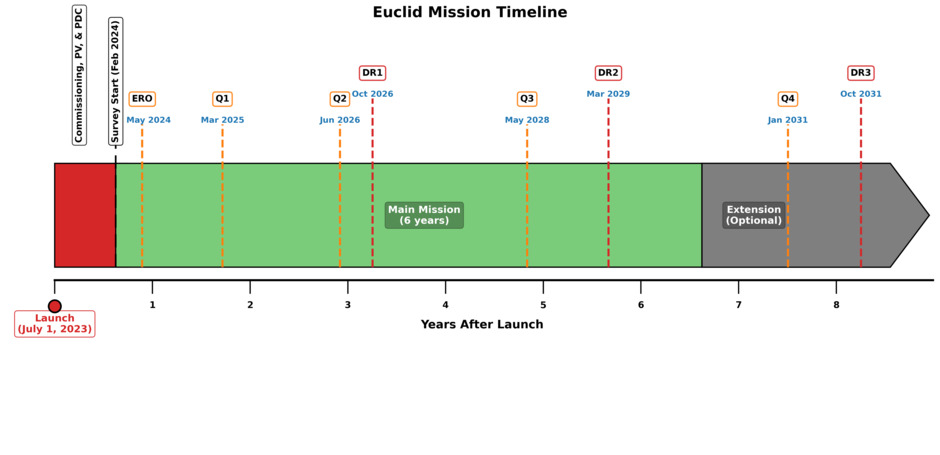
It’s a shame I can’t make the EC meeting because this will be the last one before the first main release of data, DR1, which is scheduled to take place on October 21st this year. I’ve been following progress in the science working group on galaxy clustering via weekly Zoom conferences, but it would have been nice to see what has been going on in the other groups as well as catching up with colleagues in person as opposed to online.
The second data release, DR2 will not happen until March 2029, by which time I will have retired. In fact there will be at most two Euclid Consortium meetings that I can attend – in 2027 and 2028 – and the second of those may be after my retirement. The final data release, DR3, will happen in October 2031.
It’s worth also mentioning that there will be another Quick Release of data, this one from the Euclid Galactic Bulge Survey, on June 24 this year. There will be quite a lot of press activity around that, but I’m not involved in it.
Here is the complete timeline for reference:
I’d like to take this opportunity to wish everyone involved in the Euclid Consortium Meeting an enjoyable and productive time in Barcelona as well as a fun stay in what is truly an amazing city. I’ll be enjoying the beautiful weather in Maynooth (25°C and sunny) while all the participants are slaving over hot cosmology.
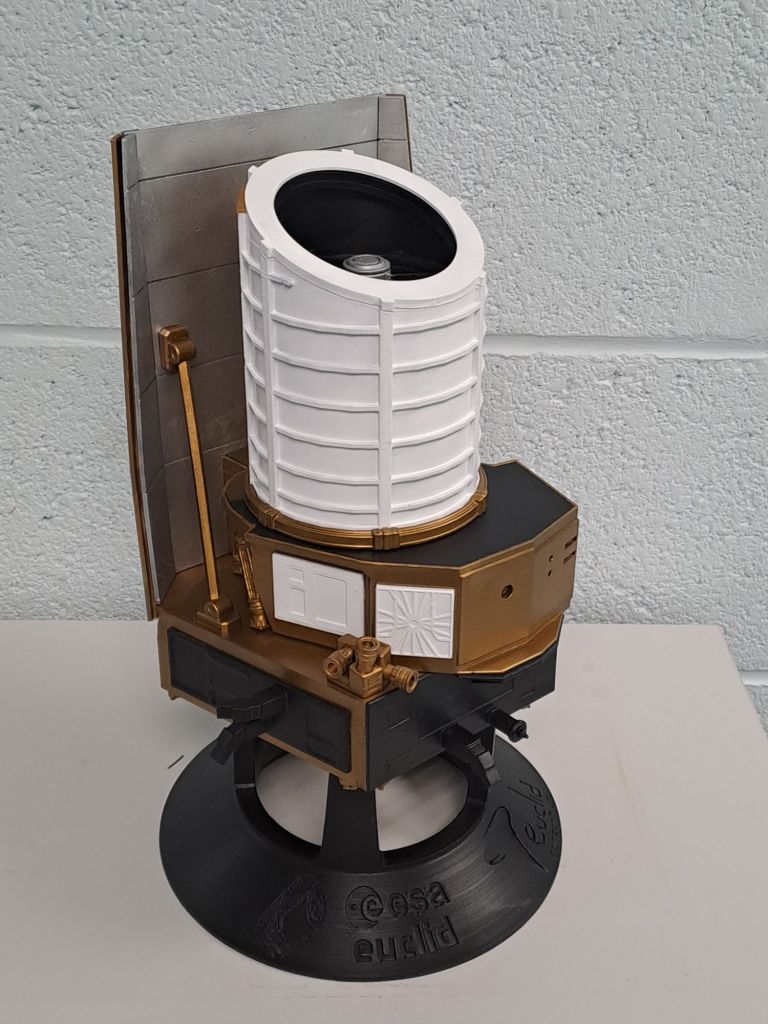
A few weeks ago the Euclid Consortium released a printable 3D model of the Euclid Spacecraft. Being a mere theoretician, I don’t know how to operate a 3D printer so I had to ask our technicians if they would make a version for use at open days, etc. The larger version is indeed quite large and everyone has been busy with labs etc, so took a while to print, but thanks to Pat Seery (who did the printing) and Ian McAuley (who assembled and painted the result), here is our model:
The scale for the model is 1:16, so its actual dimensions are 29.5 × 19.5 × 19 cm for the model, and 33 × 20 × 20 cm including the stand. The real thing is over 4.5m tall. There is a little model of an astronaut that comes with the kit (not pictured above) to give an idea of the real size. It’s going to get a protective coat of varnish on it before we use it in public, but it will be a nice addition to our open-day stand and will otherwise be on show in a display case in the Physics Department.
Anyway, if you have access to a 3D printer and would like to make your own version, you can download full instructions here.
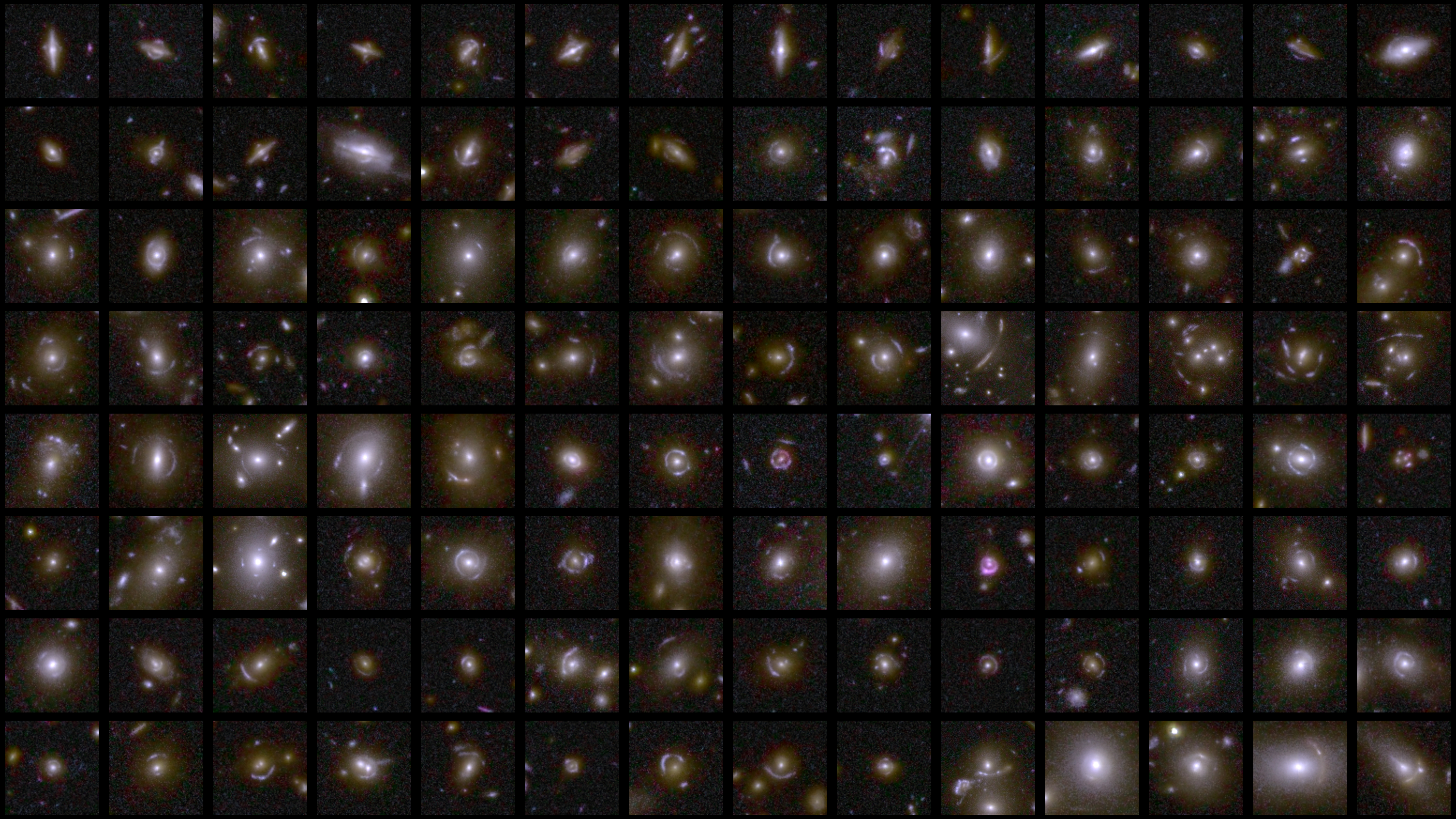
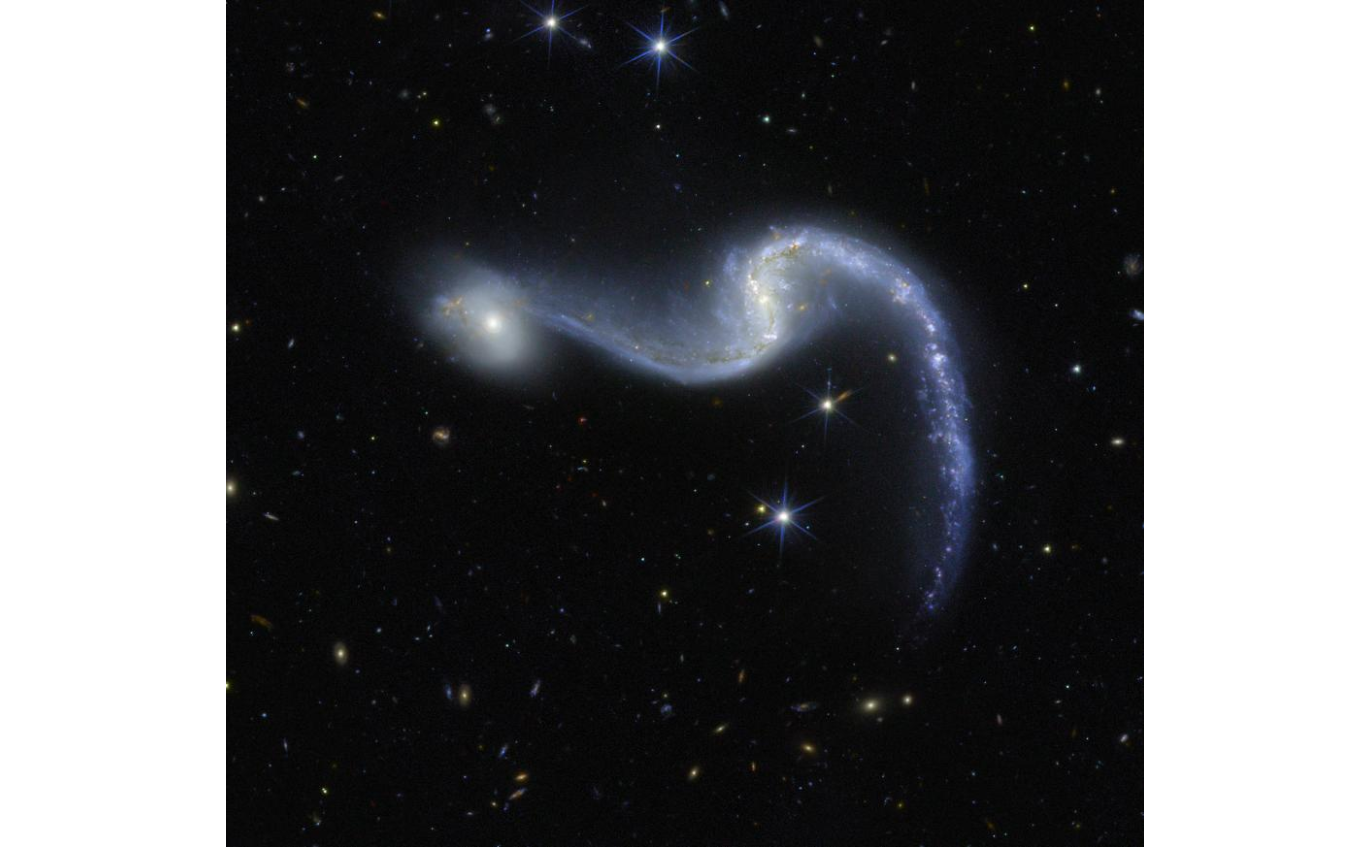
A collage of fourteen by eight squares containing examples of gravitational lenses. Credit: ESA/Euclid/Euclid Consortium/NASA, image processing by M. Walmsley, M. Huertas-Company, J.-C. Cuillandre.
I’m sharing the text of a press release from Euclid here to encourage readers to join in this new Zooniverse project.
–o–
In brief
With the launch of Space Warps, a new citizen science project on the Zooniverse platform, you can now join in the search to find rare and elusive strong gravitational lenses in never-before-seen images captured by the European Space Agency’s Euclid space telescope. The project aims at shining a light on dark matter in galaxies and providing clues about mysterious dark energy.
In-depth
Warps in spacetime do not only show up in science fiction movies like Interstellar. In real life, we can see the warping effect that gravity has on spacetime in the form of gravitational lensing.
The enormous gravity of a massive object – such as a galaxy or cluster of galaxies – distorts the shape of spacetime and can bend the light rays coming from a distant galaxy behind. By warping spacetime, the foreground galaxy acts like a magnifying glass.
Light from the background object that would be obscured doesn’t travel in a straight line anymore. Instead, it curves around the intervening mass, often producing multiple images, stretched arcs, or even a complete ring known as ‘Einstein ring’, like the one recently discovered by Euclid.
Strong gravitational lenses offer a striking demonstration of Einstein’s theory of general relativity, showing that matter in the Universe can act as a natural telescope, bringing distant objects into sight.
ESA’s Euclid telescope is revolutionising the studies of strong gravitational lensing by providing very sensitive imaging over large swaths of the sky in unprecedented detail. This is exactly what is needed to identify rare gravitational lenses.
In March 2025, 500 galaxy-galaxy strong lenses were found nestled in just the first 0.04% of Euclid data, most of them previously unknown. This pioneering catalogue was created thanks to the combined effort from citizen scientists, artificial intelligence (AI) and researchers.
Early glimpse of new Euclid images
As Euclid continues its survey, sending around 100 GB of data back to Earth every day, ESA and the Euclid Consortium once again need help from citizen scientists to identify strong gravitational lenses in a large data set.
For this, the Space Warps team has launched a citizen science project based on new Euclid images, which will be part of the future Euclid Data Release 1. While this data is not public yet, by participating in this new citizen science project you can get an early glimpse of these new images of galaxies captured by the telescope.
For this project, you will be inspecting new high quality imaging data from Euclid in which many previously unknown strong lenses are hiding. About three hundred thousand images pre-selected by AI algorithms will be shown, which are fine-tuned with the results from the initial citizen-science Euclid strong lens search. These are the highest ranked candidates from a whopping 72 million galaxies from DR1 that were classified by the AI algorithms. Scientists expect that this exquisite high-quality data will reveal more than 10 000 new lenses.
What can we learn from strong lenses
The Euclid mission explores how the Universe has expanded and how its structure has changed through cosmic history using mainly two methods: weak lensing and baryonic acoustic oscillations. From this, scientists can learn more about the role of gravity and the nature of dark matter and dark energy.
Strong gravitational lenses can also provide insights into these central questions. For example, strong lensing features can ‘weigh’ individual galaxies and clusters of galaxies. This reveals the total matter (whether dark or light) and traces the distribution of dark matter. By studying strong lenses across cosmic time, scientists can trace the expansion of the Universe and its apparent acceleration. This will provide additional insight into the role of dark energy.
“We’ve already seen the success of combining AI with visual inspection by citizen volunteers and scientists on Space Warps, efficiently finding hundreds of high‑probability lens candidates in an initial small Euclid search in 2024”, explains Aprajita Verma, Space Warps’ co-founder and project lead at the University of Oxford, UK. “In this brand new DR1 data, 30 times larger than the initial search and together with our improved AI algorithms, we are expecting to find more than 10 000 high quality lens candidates. This is more than four times the number of lenses than we have been able to find since the first gravitational lens was discovered nearly 50 years ago.”
This step-change is possible thanks to Euclid. The mission can map large areas of the sky with unique sharpness, an ideal combination for finding rare objects like strong gravitational lenses.
“We can’t wait to see what we will find within this unprecedented dataset. Join us on Space Warps to take part in this exciting search!” concludes Aprajita.
Euclid is a European mission, built and operated by ESA, with contributions from NASA. The Euclid Consortium – consisting of more than 2000 scientist from 300 institutes in 15 European countries, the USA, Canada, and Japan – is responsible for providing the scientific instruments and scientific data analysis. ESA selected Thales Alenia Space as prime contractor for the construction of the satellite and its service module, with Airbus Defence and Space chosen to develop the payload module, including the telescope. NASA provided the detectors of the Near-Infrared Spectrometer and Photometer, NISP. Euclid is a medium-class mission in ESA’s Cosmic Vision Programme.
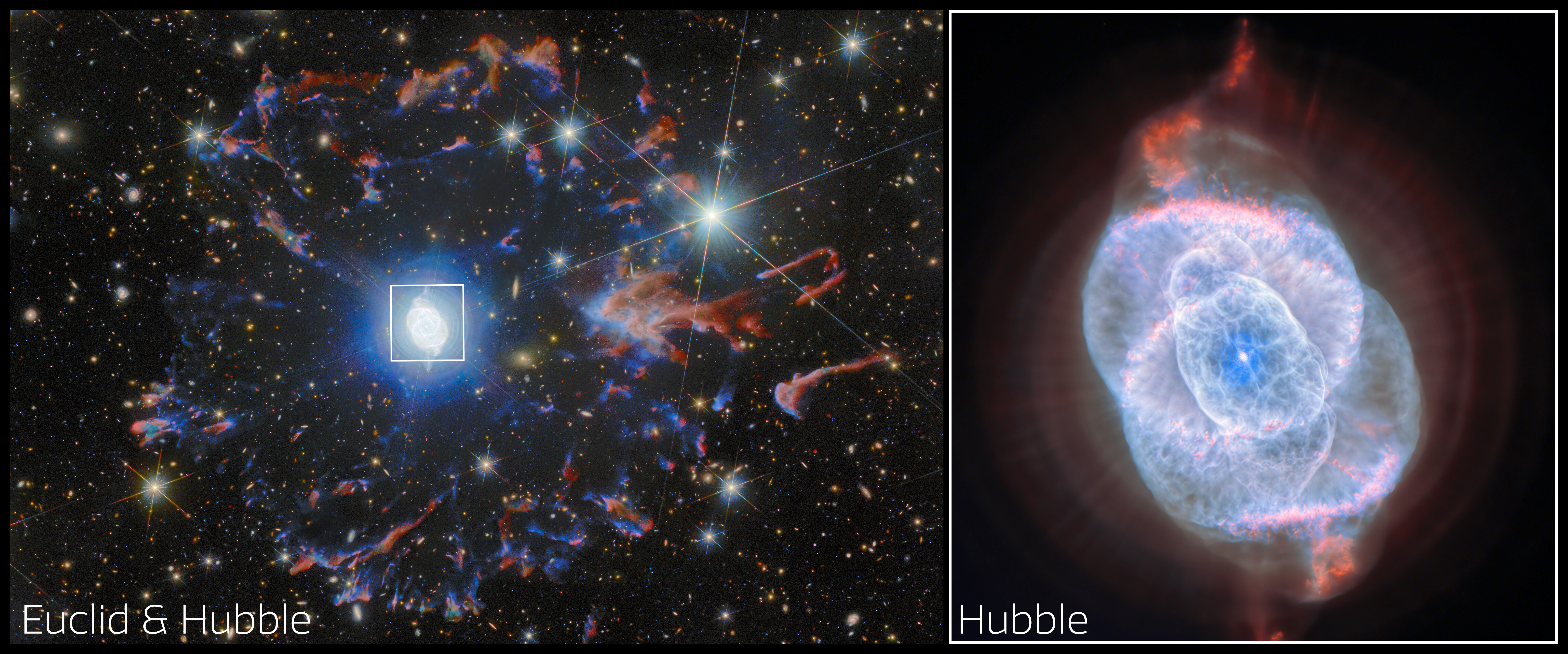
This extraordinary planetary nebula in the constellation Draco has captivated astronomers for decades with its elaborate and multilayered structure. Observations with ESA’s Gaia mission place the nebula at a distance of about 4300 light-years.
Planetary nebulae, so-called because of their round shape when viewed through early telescopes, are in fact expanding gas thrown off by stars in their final stages of evolution. It was the Cat’s Eye Nebula itself where this fact was first discovered in 1864 – examining the spectrum of its light reveals the emission from individual molecules that’s characteristic of a gas, distinguishing planetary nebulae from stars and galaxies.
Here, the nebula is showcased through the combined eyes of the NASA/ESA Hubble Space Telescope and ESA’s Euclid, highlighting the remarkable complexity of stellar death.
Though primarily designed to map the distant Universe, Euclid captures the Cat’s Eye Nebula as part of its deep imaging surveys. In Euclid’s wide, near-infrared and visible light view, the arcs and filaments of the nebula’s bright central region are situated within a halo of colourful fragments of gas zooming away from the star.
This ring was ejected from the star at an earlier stage, before the main nebula at the centre formed. The whole nebula stands out against a backdrop teeming with distant galaxies, demonstrating how local astrophysical beauty and the farthest reaches of the cosmos can be seen together in modern astronomical surveys.
Within this broad view of the nebula and its surroundings, Hubble captures the very core of the billowing gas with high-resolution visible-light images, adding extra detail in the centre of this image. The data reveal a tapestry of concentric shells, jets of high-speed gas and dense knots sculpted by shock interactions, features that appear almost surreal in their intricacy. These structures are believed to record episodic mass loss from the dying star at the nebula’s centre, creating a kind of cosmic “fossil record” of its final evolutionary stages.
Combining the focused view of Hubble with Euclid’s deep field observations not only highlights the nebula’s exquisite structure but also places it within the broader context of the Universe that both space telescopes explore. Together, these missions provide a rich and complementary view of NGC 6543 – revealing the delicate interplay between stellar end-of-life processes and the vast surrounding space.
–o–
For more information, see here. There’s also this video which shows the Nebula in context in Euclid’s extraordinarily impressive wide field capability and Hubble’s superb resolution in the optical band:
P.S. I put the following on my office door in Maynooth University to demonstrate the true scale (!) of my own involvement in Euclid.
For last year’s words belong to last year’s language
And next year’s words await another voice.
And to make an end is to make a beginning.
From Four Quartets, ‘Little Gidding’ by T. S. Eliot.
So it’s New Year’s Day. Athbhliain faoi mhaise dhaoibh!
For me this brings the festive season to an end. I’ve been eating and drinking too much for the last week as one is supposed to. Last night I brought in the new year with a dish of roast duck and the last of the Christmas vegetables. I think I’ll be buying any sprouts and parsnips for a while. When the iron tongue of midnight told twelve, I had a glass of excellent Irish Whiskey in the form of Clonakilty Single Pot Still (46%). It has been a most enjoyable week, but heightened level of self-indulgence has been rather exhausting, and I’ll be taking things a bit easier for a few days before I go back to work on Monday. It’s hard work being a glutton.
Anyway, I thought I’d mention a few things looking forward to the New Year.
January will, as usual, be dominated by examinations, and especially the marking thereof. The first examination for which I am responsible is on January 12th. The examination, incidentally, will be held in the Glenroyal Hotel in Maynooth as the Sports Hall on campus – usually a major exam venue – is out of commission due to building work.
I have a couple of writing deadlines, in addition to having to correct the examinations, so it will be a busy January.
Then February sees the start of a new semester. I’ll be teaching Particle Physics again. I was a bit surprised to be asked to teach this again, as I was filling last year in for our resident particle physicist who was on sabbatical. I’m glad to be able to continue with it given the work I put in to do it last time. My other module is Computational Physics which I have taught at Maynooth every year since 2018, apart from 2024 when I was on sabbatical. This time, however, I will have to think hard about how to deal with the use of generative AI in the coursework.
Will I get to teach any astrophysics or cosmology at Maynooth before I retire? That’s looking very unlikely. I think it’s probable that the new academic year, starting in September, will find me teaching the same modules as last year.
The year ahead will also see the first data release (DR1) from the European Space Agency’s Euclid Mission. The date for that will be October 21st 2026. This is a hard deadline. There’s a huge amount of work going on within the Euclid Consortium to extract as much science as possible from the observations so far before the data becomes public, but you’ll have to wait until October to find out more!
This reminds me that I forgot to share this nice image from Euclid that was released just before Christmas.
Galaxy NGC 646 looking like a cosmic holiday garland in this image from the European Space Agency’s Euclid space telescope.
Once upon a time, WordPress used to send an email about the year’s blog statistics, etc, but it stopped doing that some time ago. I checked this morning, however, and learned that traffice on the blog in 2025 was up by 2.6% since 2024. I’m not sure how meaningful this is, because there is so much scraping going on these days. That figure doesn’t include the people who get posts via email or RSS or via other platforms such as the Fediverse.
While I’m on about social media I’ll mention a stat about my Bluesky account. I joined Bluesky in 2023 when I abandoned Xitter. As of today I have 8,078 BlueSky followers, which is more than I ever had on X, and with far higher levels of engagement and much friendlier interactions.
I’m also on Mastodon, although with a much smaller following (1.4k). This blog also has a separate existence on Mastodon here. I very much like the federated structure of Mastodon (which, incidentally, accords with my view of how academic publishing should be configured) and am a bit disappointed that it doesn’t seem to have caught on as much as it should.
That disappointment pales into insignificance, however, with the outrage I feel that my employer – along with most other universities – persists in using Xitter. Touting for trade in a far-right propaganda channel is no way for a institution of higher education to behave. You can read my views on this matter here.
And finally there’s the Open Journal of Astrophysics. The year ahead will see the 10th anniversary of our first ever publication – on an experimental prototype platform, long before we moved to Scholastica. It will be next Monday before we resume publishing, starting Volume 9. Which author(s) will be the first to get their final versions on arXiv in 2026? Stay tuned to find out!
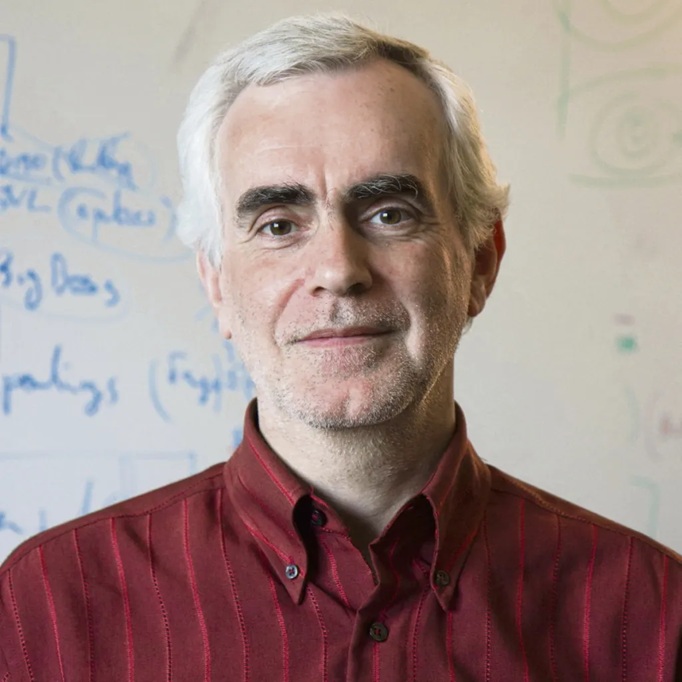
Last night I received a message via the Euclid Consortium conveying the very sad news of the death, at the age of 67, of the French astrophysicist and cosmologist Yannick Mellier (pictured left). Among many other things, Yannick was the Euclid Consortium Lead in which role he took on enormous responsibility for getting the project started and, with his team, keeping everything running. His loss is incalculable.
Yannick’s research work focussed on cosmology and the search for dark matter using gravitational lensing. Back in 1987 he was part of the observational team that discovered the first giant arc produced by strong gravitational lensing. He also did pioneering work in the field of weaking gravitational lensing with the Canada-France Hawaii Telescope in that regard starting back in 2000.
For well over a decade now Yannick had been involved with the European Space Agency’s Euclid mission. He was a major force right from the beginning, making the proposal, and after it was accepted leading the Consortium assembled to bring the project into being, preparing for launch, and dealing with the first data. The Euclid Consortium is a huge collaboration and it is impossible to overestimate the scale of the task facing the Lead. The first full data release (DR1) from Euclid will take place towards the end of next year (2026). It is sad beyong words that he did not live to see this.
During the period when I was Chair of the Euclid Consortium Diversity Committee I had a number of interactions with Yannick, sometimes dealing with difficult and confidential matters. I found him to be a man of great wisdom and sensitivity. Despite having many other things to deal with, including a long-term illness, he was unfailingly supportive and his advice was always sound.
The following is an excerpt from the message sent out yesterday:
Yannick’s death leaves a huge void within the consortium and our community. Those of us who have been here the longest know how hard he worked to make the Euclid project a success. He became its embodiment, working tirelessly to ensure its success; we owe him an immense debt of gratitude, and we will surely have the opportunity to reflect in detail on all that we owe him.
Indeed. I hope the Euclid Consortium – and the international cosmological community generally – will, at some stage, organize an appropriate tribute to Yannick.
The journal Astronomy & Astrophysics (A&A for short) announced last week that it was increasing page charges on longer papers. The table of new charges to be implemented is here:
A&A is published on behalf of the European Southern Observatory by EDP Sciences(Édition Diffusion Presse Sciences) which began life as a joint venture of four French learned societies in science, mathematics, and medicine. The company was acquired in 2019 by China Science Publishing & Media (which has headquarters in Beijing). Judging by its social media activity, EDP Sciences sees A&A as a flagship journal; for a list of other journals it runs see here. I gave some background on A&A here.
A&A publishes papers through a curious hybrid model called “S2O” (Subscribe to Open; not to be confused with “420”). This is not fully Open Access because it requires libraries to pay a subscription to access the journal. For this reason it is not compatible with some institutional open access policies. Unlike some journals, however, A&A does allow authors to place their papers on arXiv without restriction, so they can be read there for free. Previously A&A required authors (or their institutes) to pay “Page Charges” – essentially an Article Processing Charge (APC) – if they were not from a “member country”; this policy was introduced in 2020. Authors from a member country will now have to pay APCs to publish (if their paper exceeds the page limit) but their institutional libraries still have to pay a subscription if they are to access the paper. In other words, A&A is double-dipping.
According to A&A,
… the average length of papers has also been increasing. Too often, papers are longer than necessary, leading to increased workload for authors, referees, and editors, and hindering the reader’s ability to efficiently grasp their content. As well as needing logistical consideration, the challenges related to the journal’s growth have financial implications that must be addressed to ensure long-term sustainability.
I agree that many papers are far too long. As a journal Editor myself I know that it is much harder to find people willing to review very long papers, a fact that some authors seem reluctant to recognize. On the other hand I very much doubt that any of the funds generated by page charges will be given to the refeees who do the most important – indeed I would argue the only important – work of a journal.
If the desired effect is to reduce the number of long papers this policy may work, though I suspect authors who are incurably prolix will respond by splitting their work into several shorter papers to avoid the page charges and thereby generating even more work for the journal. I suspect however that the desired effect is really to increase revenue; so often in the context of academic publishing “sustainability” really means “profitability”. I would also bet that these charges will increase further in future.
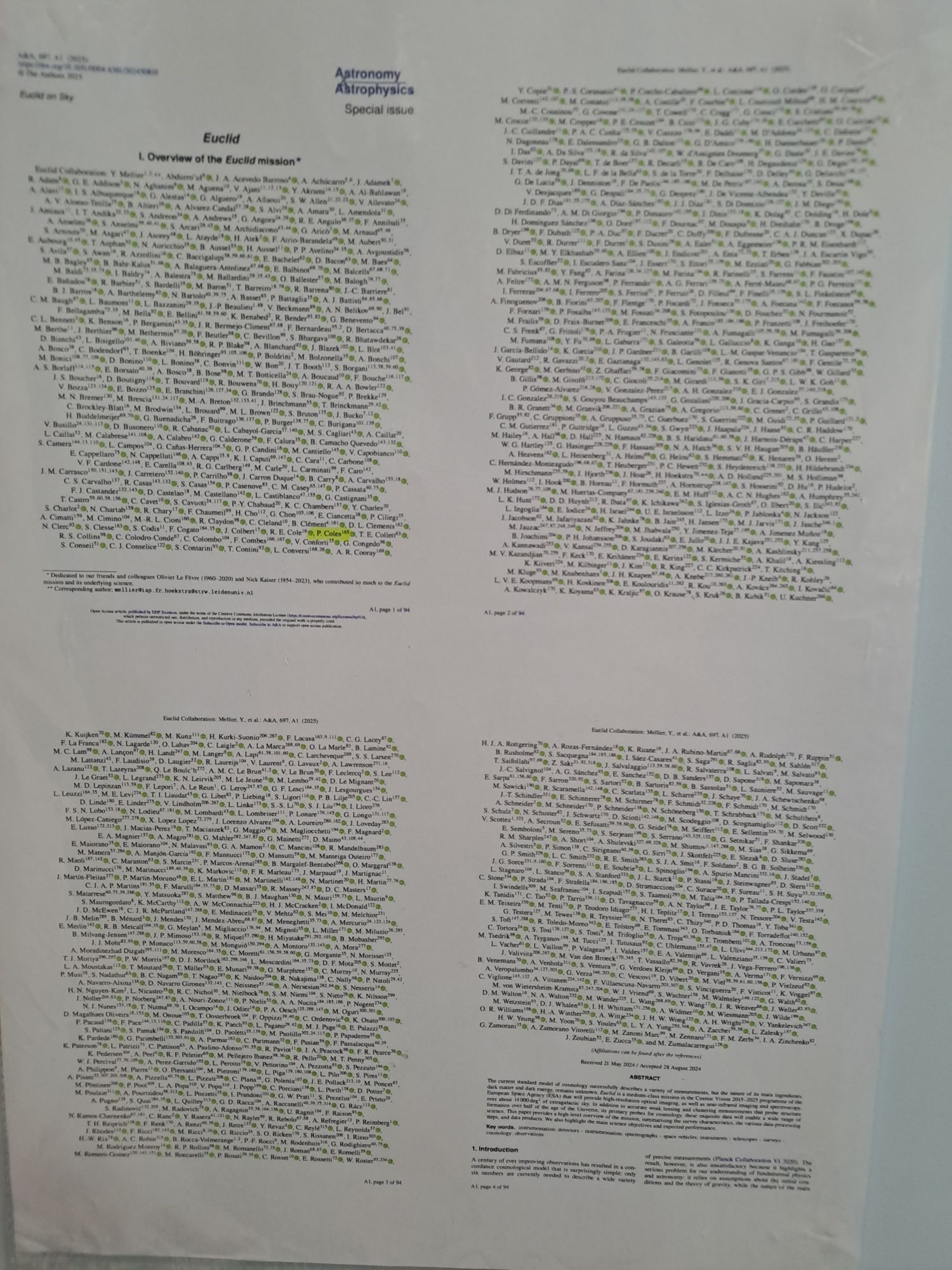
The changing charges at A&A have widespread implications, including for the Euclid Consortium, most of whose scientific papers are published there. I’m sure the Euclid Consortium Editorial Board will discuss this development. I’m not a member of the ECEB so it would be inappropriate to comment further on publication policy so I’ll leave the discussion to them. I would say, however, that the publication process at A&A is rather slow. The main post-launch Euclid Overview paper by Mellier et al., for example, was accepted for publication in August 2024 but has still not appeared. It is, however, available on arXiv, which is all that really matters. That paper, incidentally, is over 90 pages long. According to the table above that would cost about €12,000 in page charges. It was submitted in May 2024 and accepted quite quickly but is planned to appear in a special issue Euclid on Sky the publication of which is being delayed by other papers still going through the editorial process.
(Incidentally, Mellier et al. has already acquired 157 citations despite not yet being officially published, which illustrates how little difference “official” publication is actually worth.)
For last year’s words belong to last year’s language
And next year’s words await another voice.
And to make an end is to make a beginning.
From Four Quartets, ‘Little Gidding’ by T. S. Eliot.
January is named after the Roman deity Janus, who according to Wikipedia, is the god of beginnings, gates, transitions, time, duality, doorways, passages, frames, and endings. Since I did a retrospective post yesterday about 2024 in retrospect, I thought I’d do a quick one today (1st January 2025) to mention a few things looking forward.
January will, as usual, be dominated by examinations, and especially the marking thereof. The first examination for which I am responsible is on January 13th.
February sees the start of a new semester. I’ll be teaching Particle Physics for the first time at Maynooth. I taught this subject for many years at Nottingham and Cardiff (the latter combined with Nuclear Physics), so it should be OK. My other module is Computational Physics which I have taught at Maynooth every year since 2018, apart from 2024 when I was on sabbatical.
The big event in March will be the release of “Q1” data from Euclid. This is only a very small part of the full survey, but is an important milestone and will no doubt attract a lot of press coverage. There’s a blog post by Knud Jahnke here. No doubt I’ll do a few blog posts too. The first full data release DR1 will take place in 2026. The Q1 release is timed to coincide with the annual Euclid Consortium Meeting, which this year takes place in Leiden. I won’t be able to attend in person, as it happens during teaching term, but may be able to follow some of the sessions remotely.
In April we will have a very special visitor to Maynooth to deliver the Dean’s Lecture (of which more anon). Much less significantly, I’ll be giving a Colloquium in the Department of Physics.
May will largely be taken up with second semester exams and assessments – there will be a lot of computational physics projects to correct as well as the usual examinations.
And then it will be summer. I did a lot of travelling during my sabbatical so I am not planning to travel much in 2025, though I may try to visit some more places in Ireland. Hopefully I’ll be able to get on with some research too. This year I am supervising my first MSc project at Maynooth, so that will be an interesting new experience.
And then we’re more-or-less into the next academic year 25/26. That’s beyond my planning horizon. I don’t know what I’ll be teaching, but it may be the same as 2024 (at least for Semester 1). I wonder if I’ll get to teach any astrophysics or cosmology here before I retire? It doesn’t look likely…
A few months ago I posted about a joint initiative between Euclid and Galaxy Zoo that involved engaging members of the public in a project involving galaxy morphology. Well, a new “collab” (as you young people call such things) has just been announced on social media, and I encourage you to investigate further
The new venture is called `Space Warps – ESA Euclid’, and its aim is to find strong gravitational lenses in Euclid survey images. You can find out more about this project in this blog post by Knud Jahnke and you can find instructions and sign up for the project here.
The announcement of this initiative gives me an opportunity to pass on a little update on progress with the Euclid survey. The first `Quick’ Data Release (known to its friends as Q1) was made available to Euclid Consortium members just a few weeks ago. This will be made available to the general public next March, around the same time as the joint ESLAB and Euclid Consortium meeting in Leiden next year.
The Euclid survey is constructed as a set of contiguous `tiles’ covering the survey region, which will ultimately be about 15,000 square degrees (about one-third of the sky), with most of the region scanned by the satellite many times. The Q1 data will just be a taster of this. The main component of the Q1 data relates to a single visit (at the depth of the Euclid Wide Survey) over the Euclid Deep Fields (EDFs): 20 deg2 of the EDF North, 10 deg2 of EDF Fornax, and 23 deg2 of the EDF South. The deep fields will subsequently be visited multiple times during the mission. The Q1 release will be of Level 2 data, i.e. data at the level of individual tiles.
The first full data release (DR1) is due to be published in June 2026.
The views presented here are personal and not necessarily those of my employer (or anyone else for that matter).
Feel free to comment on any of the posts on this blog but comments may be moderated; anonymous comments and any considered by me to be vexatious and/or abusive and/or defamatory will not be accepted. I do not necessarily endorse, support, sanction, encourage, verify or agree with the opinions or statements of any information or other content in the comments on this site and do not in any way guarantee their accuracy or reliability.