Archive for October, 2022

Remembering Violet Gibson

Posted in History, Politics with tags , , , on October 23, 2022 by telescoper

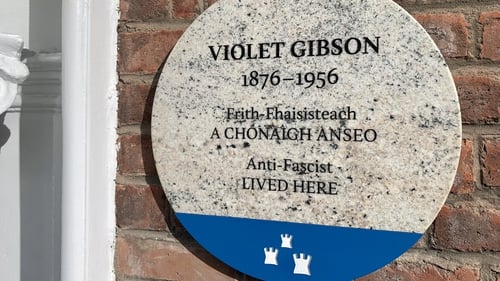
A few years ago I posted an item about Violet Gibson. Last week Dublin City Council unveiled a plaque in her memory, outside her childhood home, which reminded me of her story.

The story of Violet Gibson is both bizarre and tragic. She was born in 1876 into a well-to-do family living at No. 12 Merrion Square in Dublin, where the above plaque is now located. Her father, Edward Gibson, was made Baron Ashbourne in 1886. To cut a long story short, Violet Gibson turned up in Rome in 1926 where, at 11am on 26th April of that year, she attempted to shoot Fascist Leader Benito Mussolini with a pistol. She only failed in this task because Mussolini moved his head at the instant she pulled the trigger, and the bullet just grazed his nose. She tried to fire again, but her gun jammed. She was then seized by the angry mob of fascist supporters with whom she had mingled to get close enough to shoot. She was almost lynched but saved by the police. Eventually, the authorities came to the conclusion that she was insane and she was sent back to England. She spent the rest of her life in a psychiatric institution in Northampton. She died there in 1956, at the age of 79.

P.S. If you want to find out more about Violet Gibson, I recommend a book about her life called The Woman Who Shot Mussolini by Frances Stonor Saunders.

How to be good at Physics

Posted in Education, The Universe and Stuff with tags , , , on October 22, 2022 by telescoper

A couple of articles appeared recently that I encourage people to read who are studying physics, or interested in studying physics.

The first article by Carl Wieman is from Physics Today and is entitled How to become a successful physicist. It is aimed at graduate students, though most of what it says is relevant to those at an earlier stage of their studies. Here’s an excerpt from near the beginning:

The primary characteristic of a successful physicist is being a good problem solver.

The article goes on to say some very interesting and instructive things, and is well worth reading in its entirety. There are one or two things that I don’t agree with though. One is the statement that…

…textbook problems provide all the information needed and have a single well-defined path to a solution.

That’s true of many problems at an elementary level, but problems at undergraduate or graduate level often have more than one way of finding the solution. That’s certainly true of many that I set as assignments. Indeed, sometimes the students come up with better ways of approaching them than I did! The important difference between textbook and research problems is that you know the textbook problems have a solution. Research is scarier because you don’t know at the outset that an answer can be found!

The second article, by Ethan Siegel, is called The secret to becoming an excellent physicist. Here is a quote from that, revealing the “secret”:

It’s simplicity itself: you become good at physics by solving physics problems. That’s it: that’s the secret. If you want to become competent at physics, you will solve physics problems in the area you wish to learn.

I hope you get the message. It’s not about rote-learning facts and formulae. The brain is much more than a memory device. It’s all about problem-solving. The ability to do that effectively can only be learned through practice.

I’m currently teaching two modules on Mathematical Physics and I devote most of the time in lectures for both of them to doing worked examples rather than proving theorems or presenting facts, theorems, derivations, formulae, etc to learn. I spend quite a lot of time in lectures giving students things to work out, which makes classes more interactive, but students also have tutorials built around problem-solving tasks to complement this.

If you’re interested you can see my post on How to Solve Physics Problems; there is also a video version here.

I’d add one piece of advice. If you really want to develop as a physicist, don’t just solve a lot of easy problems; challenge yourself by tackling difficult ones too. Don’t be afraid to get “stuck” or make a mistake, as those are both necessary parts of the learning process. Above all, develop the confidence in your ability to take on a problem and back yourself to solve it and don’t be deterred if the answer doesn’t come quickly!

A New Head for the UK

Posted in Biographical, Politics with tags , , on October 21, 2022 by telescoper
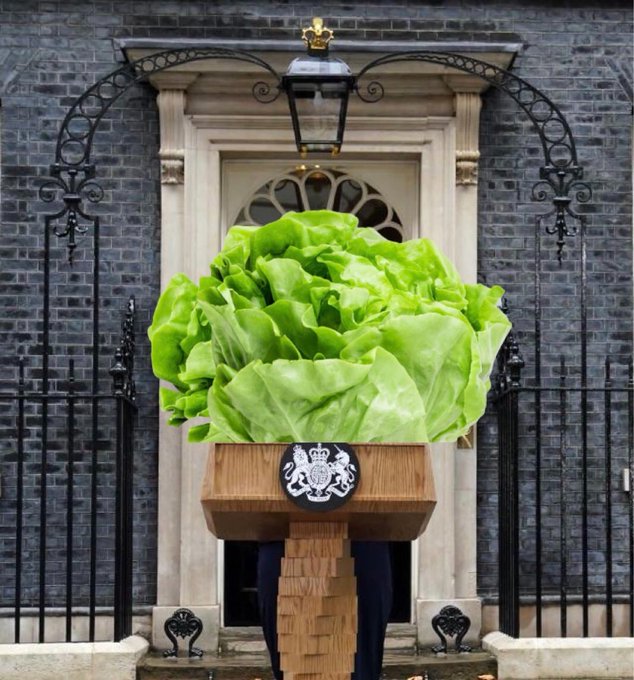
The UK’s new Head of Lettuce Government

Although I no longer live in Britain, every morning I look at the UK news media to check the previous night’s football results and find out who is the latest Prime Minister.

I had a quick look this morning before work and unless I’ve misunderstood things, Liz Truss has been replaced as PM by a lettuce.

I think we need to know whether the lettuce voted leaf or romaine ‘cos the answer to that little gem could be the tip of the iceberg that may end up determining whether its popularity will rocket… (continued, p. 94)

SpaceX for Euclid

Posted in The Universe and Stuff with tags , , , , , , , on October 20, 2022 by telescoper

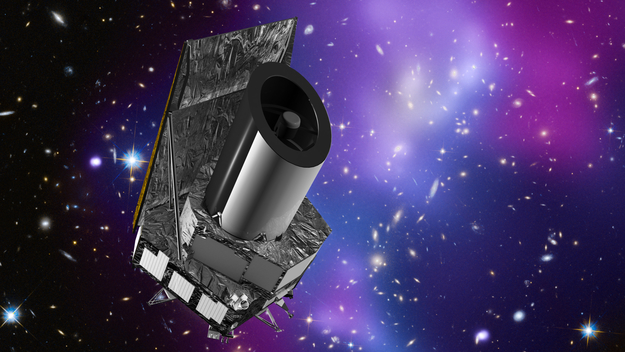
Aa few months ago I posted a piece about the European Space Agency’s Euclid Mission which had been due to be launched in 2023 on a Soyuz ST 2-1b rocket. That no longer being possible because of Russian’s invasion of Ukraine, it seemed there would be a lengthy delay in the launch of Euclid, with late 2024 seeming the earliest feasible date for launch on the obvious alternative, the new Ariane 6.

I ended that piece with this:

It seems to me that the best hope for a resolution of this problem would be for ESA to permit the launch of Euclid using something other than Ariane 6, which means using a vehicle supplied by an independent commercial operator. I sincerely hope ESA is able to come up with an imaginative solution to this very serious problem.

In the Dark, 17th June

Well I’ve just read official confirmation that a few hours ago ESA Council has approved the proposal to launch Euclid on a Falcon 9 rocket operated by SpaceX. If all goes well -specifically if the Euclid Consortium member states agree with this move – it might be possible to launch Euclid by the end of 2023. Although I don’t have any firm information about what date is being proposed I believe it could be as soon as July 2023.

Setting aside any personal opinions about Elon Musk, the Falcon 9 has proved to be very reliable, with the latest version having 110 out of 110 successful launches. Euclid will not be in an Earth orbit, like most of the satellites so far launched by SpaceX, but has to be delivered to the 2nd Lagrange Point, L2. That should not pose to much of a difficulty, however.

Non-disclosure Nonsense at Leiden University

Posted in Harassment Bullying etc with tags , on October 19, 2022 by telescoper

I saw last night that a Professor at Leiden University has been “removed for extremely unacceptable behaviour”. The announcement from the University can be found here though it has been modified; the original form said “dismissed for gross misconduct”.

A related article (original in Dutch) says in English translation about the case:

It concerns a systematic pattern of denigration, abuse of power, gender discrimination, belittling in public, and the constant threat that the complainants’ careers would be damaged. The professor also made comments ‘with a sexual charge’ and the committee found that in one case ‘he had approached an employee in an undesirable manner’.

My initial reaction to this was dismay that someone had behaved in such a way for what seems to have been a considerable period of time, but relief that a case had been brought against this “Professor”.

But wait.

A statement from the Executive Board at Leiden University includes:

Because the committee has also established that the scientific quality of this professor is indisputable, there is no reason to deprive him of his professorship.

So the Professor is not actually being dismissed. He will be able to carry out research, presumably on full salary, His punishment for toxic behaviour thus effectively amounts to an indefinite period on sabbatical. Perhaps I am being excessively cynical, but I read the above statement as implying that the Professor has a portfolio of research grants that the University wants to keep.

Worse, the name of the Professor has not been released, presumably because there is a non-disclosure agreement covering this case. Neither I nor anyone I know at Leiden knows who it is; at least some may but not be legally allowed to say. Nor do I know what field he works in. It may or may not be related to Astronomy. This is a nonsense, for at least two reasons.

The first is that someone who has behaved in such a way should be named on principle, so that potential collaborators and future employers know what he has done. In previous posts on this topic I have defended confidentiality (e.g. here) during an investigation, but I do think that once it has been decided that a disciplinary offences have been committed there should be full disclosure.

The second is that failing to identify the individual concerned has led to a proliferation of rumours inside and outside Leiden (none of which I am prepared to repeat here). As a result, the finger of suspicion is no doubt now being pointed at the wrong people and that will continue to happen until the name of the abusive Professor is revealed. The environment at Leiden must be very difficult right now.

The hands of Leiden University may well be tied by a legally-binding non-disclosure agreement, but I think this case just demonstrates what a nonsense what such agreements are. And in my view it’s just a matter of time before the identity of the Professor concerned is revealed anyway. It will only take one person to leak it.

P.S. Please don’t email me to ask who it is. I honestly have no idea!
Simons Observatory News

Posted in Cardiff, Science Politics, The Universe and Stuff with tags , , , on October 18, 2022 by telescoper

It seems a lot longer than four years ago that I drew the attention of readers of this blog to the science case for the Simons Observatory, the next big thing in ground-based studies of the cosmic microwave background.

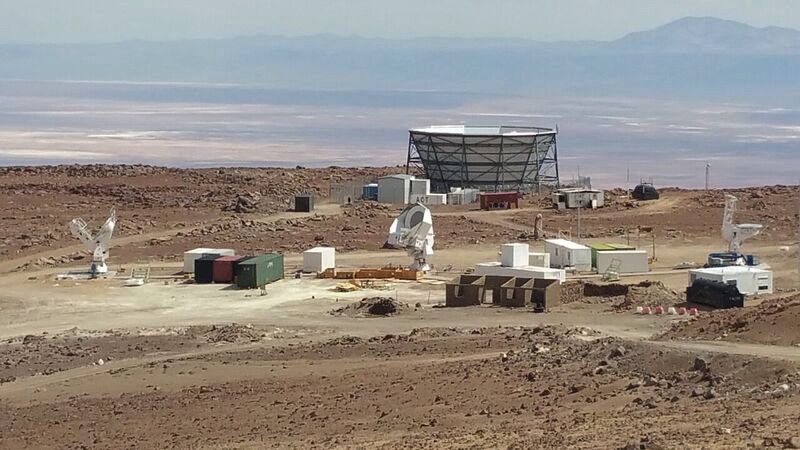
The Simons Observatory Site in Chile, as it appeared four years ago

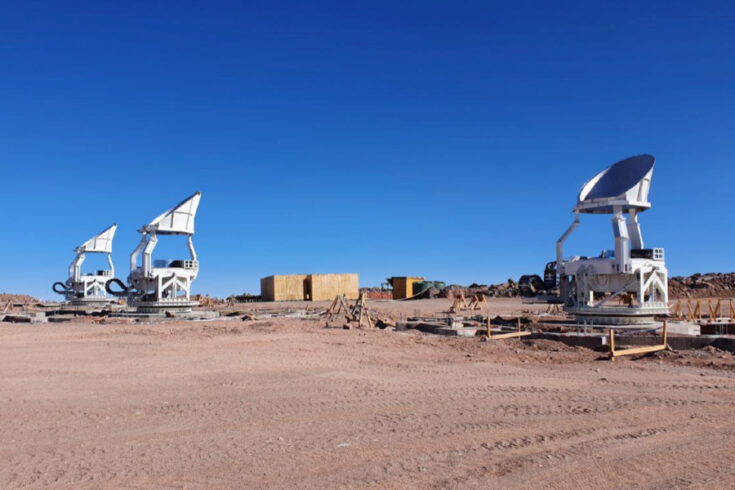
Obviously a couple of years of pandemic have intervened, amongst other things, but I was delighted to read yesterday that the UK has invested £18M in the Simons Observatory, which will enable further development of the facility at Cerro Toco, high above the Atacama Desert in Chile.

Simons Observatory in May 2022

The project was already a large international collaboration led from the USA, but the new funds from UKRI mean that six UK institutions will now join. These are (in alphabetical order): Cambridge; Cardiff; Imperial College London; Manchester; Oxford; and Sussex. Although I’m not involved in this project myself I know many people at these institutions (two of which I have worked at) and elsewhere who will be absolutely thrilled to be able to participate in this exciting project. Congratulations to them!

It would have been great if Ireland had been able to get involved in the Simons Observatory, but sadly fundamental science of this type is not a priority for the powers that be in Irish science funding. This is unfortunate because I think membership of international consortia like this would enable a small country to punch above its weight in science. Still, at least the UK PI, Prof. Michael Brown (Manchester), is an Irishman…

Open Access Week and the arXiv

Posted in Open Access with tags , , on October 17, 2022 by telescoper

Just time for a quick post to advertise the fact that next week (commencing October 24th 2022) is International Open Access Week.

I’ll be participating in one of the events – a panel discussion – organized by arXiv as part of Open Access Week. This event is entitled Trends in Peer Review of Open Access Preprints and the description is:

Speed of research is a major feature of open access preprint platforms like arXiv – formal peer review can follow later after rapid distribution of results. However, as submissions to arXiv and other preprint servers have grown, many researchers are seeking new avenues for community feedback and peer review. At this panel discussion, leaders in preprints and peer review will discuss current trends in virtual overlay journals, open peer reviews, and more. (Video recording will be available to registrants after the event)

Panelists:

  • Peter Coles, PhD, Theoretical Cosmologist at Maynooth University in Ireland and Managing Editor of The Open Journal of Astrophysics
  • Jessica Polka, PhD, Executive Director of ASAPbio
  • Antti Mikael Rousi, PhD, Senior Advisor, Research Services at Aalto University, Finland
  • Steinn Sigurdsson, PhD, Professor of Astronomy at Penn State University and arXiv Scientific Director

The event is at on Wednesday, October 26, 2022 at 15:00 UTC /11:00 EDT; that’s 16:00 Irish Time. It’s on Zoom (unless you are at Cornell and can attend in person). You need to register here.

The Autumn Leaves

Posted in Biographical, Maynooth with tags , , on October 16, 2022 by telescoper

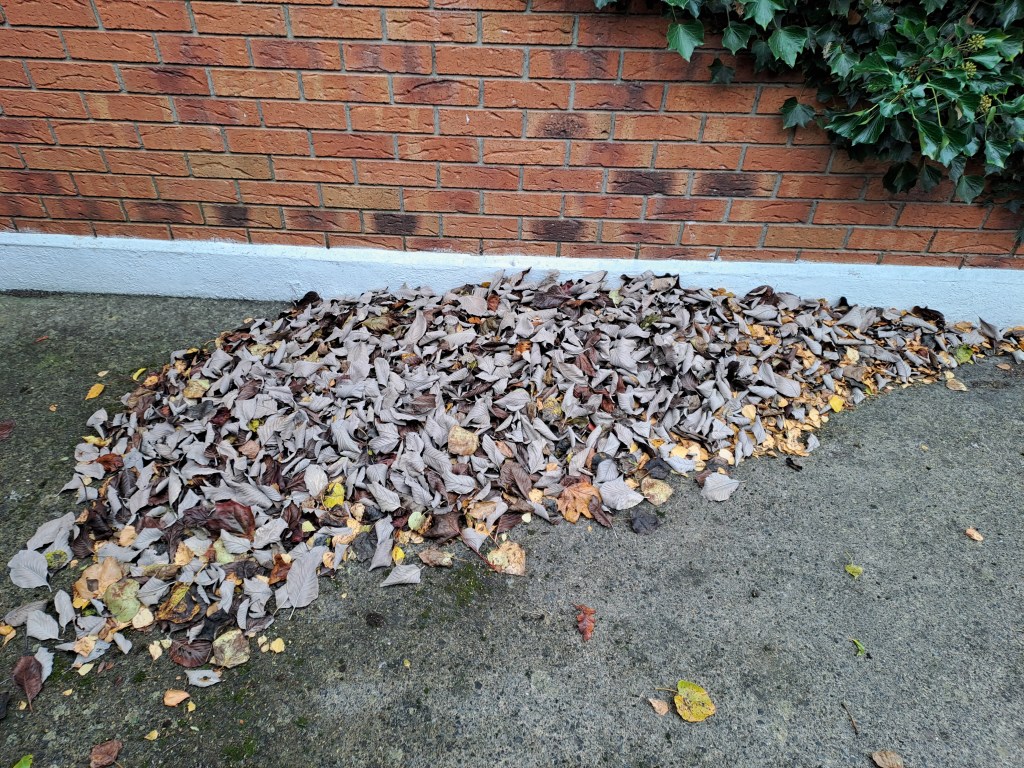
Autumn is definitely here. It’s very nice to live in a tree-lined street but the consequence of that at this time of year is that there are leaves everywhere. They don’t call it “fall” for nothing. Actually I let the leaves lie until they compost down on the actual garden but unfortunately the side of my house is a bit of wind trap and they tend to accumulate there in large quantities. When they do start to break down it makes a slippery hazard for anyone visiting, especially if it rains.

So this lunchtime I cleared away most of the leaves from the path leading up to my front door, in which task I was joined by a little robin who was no doubt hoping I would disturb some bugs or at any rate something edible when I swept up the leaves. I’m not sure this is the same robin that came in my house earlier this year, but it wasn’t afraid to come very close.

Reading a little about robins I discovered that many don’t live to reach their first birthday, but those that do have a good chance of living quite a while longer. The record is 19 years! Today’s robin could be the same one I’ve seen before, but I can’t be certain.

That reminded me that it was about time to start putting the bird feeders out again so I went out and bought some seed and peanuts and fat balls, although I think I’ll keep those for when it’s a bit colder.

At some point soon I’ll have to get the ladders out and trim back the ivy which is once again reaching the top of the wall. That will have to wait a few days, though, as my garden refuse bin is now full and won’t be empty again until Wednesday.

Angela Gheorghiu at the National Concert Hall

Posted in Music with tags , , , on October 15, 2022 by telescoper

I almost missed out on last night’s performance at the National Concert Hall in Dublin. I saw the details in the brochure when it arrived at the start of the season and marked the date in my diary but dithered about buying a ticket and when I did get round to trying a few weeks ago the concert was sold out. I kept checking on the website though and was fortunate enough to find that there were some returns, so I managed to get there after all.

Angela Gheorghiu is of course a celebrated Diva with a huge following around the world, so I should have known tickets would sell quickly. The foyers and bars of the National Concert Hall were as busy as I’ve ever seen them before a performance, and there was a bit of delay getting everyone into their seats at the start as it was so full.

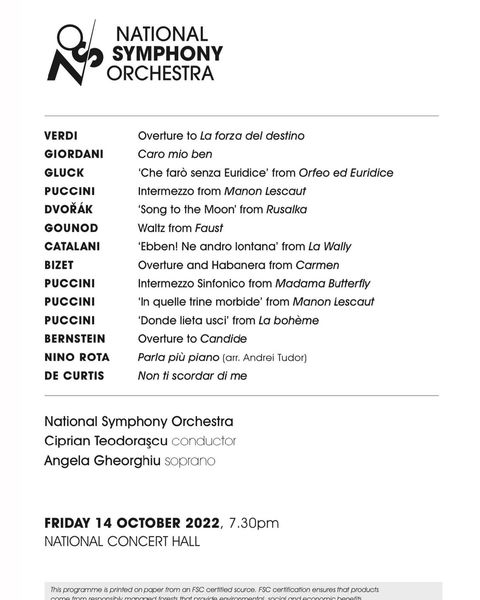
Last night’s concert wasn’t the normal Friday night affair at the NCH. There were no microphones and no Paul Herriott on stage so I presume it wasn’t broadcast on RTÉ Lyric FM as the weekly concerts usually are, or even recorded. I guess there were contractual reasons for that. The National Symphony Orchestra was conducted by Ciprian Teodorașcu from Romania, as of course is the star of the show herself.

I thought Angela Gheorghiu took a little while to get into her stride, not helped by the tempo for the second number Che farò senza Euridice? which I thought was far too slow. By the time we got to Song to the Moon from Rusalka, however, she was in full flow; thereafter the concert just got better and better, especially after the wine break (which was after the Habanera from Carmen). Gheorghiu’s voice seems well suited to Puccini, and the two of his arias in the second half were particularly fine.

Angela Gheorghiu was not only in excellent voice but also looked every inch the glamorous operatic superstar we expected. In the first half she was dressed in a black dress with a plunging neckline and in the second in a blazing red gown. She established a huge rapport with the audience, making a point of turning around from time to time and singing to the folk in the choir stalls.

Picture Credit: National Symphony Orchestra.

The concert was of standard operatic repertoire but I didn’t know what Parla più piano was until I read the programme notes: it’s the love them from The Godfather, usually sung in English as Speak Softly Love. The last time I heard that was at my Mother’s funeral. Can that really have been three years ago?

The performance was received very warmly indeed, with loud cheers and standing ovations. There were encores too, of course. I just knew the first would be an Irish song, and so it was – The Last Rose of Summer. The next was Puccini’s O mio babbino caro from Gianni Schicchi and the one after that was Granada, another standard component of the concert repertoire.

There may have been more encores, but I had to leave after three to get the train home after an unforgettable evening which was a much needed tonic after an exhausting week.

Cosmic Ignorance Today

Posted in The Universe and Stuff with tags , , , on October 14, 2022 by telescoper

Sorry to be so late advertising this but it’s been a busy week. This year’s Royal Astronomical Society Gerald Whitrow lecture will be given this afternoon by Prof. Pedro Ferreira of Oxford University, as a hybrid event. You have until 3pm to register. Among many other things, Pedro is a member of the Editorial Board of the Open Journal of Astrophysics…

The abstract of the lecture is:

Observations of the large scale structure of the Universe have allowed us to validate a powerful mathematical model of the Universe. We can now measure with remarkable precision, a number of properties such as its geometry, its matter content and the morphology of the initial conditions. This model is firmly rooted in physics that we know yet also reliant on speculative assumptions: inflation, dark matter and dark energy. As our understanding of the cosmological model has developed, and with ever improving data, we have been confronted with anomalies and inconsistencies. There is hope that, with new observations, more powerful simulations and the new developments in machine learning and data science, we will be able to fully resolve any inconsistencies. But there is a real risk that, if we don’t start to think differently, we will never completely understand our mathematical model. Ultimately we may never know how our Universe really works.

It should be an interesting talk and there’s still a bit of time to register. Alternatively you can wait until the recording appears on YouTube. I’ll add a link here when it does.