Archive for October, 2022

The Christopher Backhouse Case

Posted in Harassment Bullying etc with tags , , on October 13, 2022 by telescoper

I want to thank everyone who has contacted me about the Christopher Backhouse harassment case I blogged about yesterday. Based on what I’ve been told, the details revealed in the Guardian article – which are bad enough – are just the tip of the iceberg. I can’t say any more in case there are further legal developments.

I saw this reaction from Erica Smith yesterday.

This experience must have been absolutely dreadful for her and I sincerely hope yesterday’s announcement allows her to bring some closure to the matter. Many would have given up given the lack of action from the police, but Erica Smith had the courage to pursue a civil action getting a sub poena that led to the identity of her harasser being revealed.

Some of the people who have contacted me are people involved with DUNE. Although the harassment went on for years, none of them knew anything about the case until very recently. They are all very disturbed that this was going on in their midst for so long.

I am not a lawyer but it remains a mystery to me why Dr Backhouse has not faced a criminal prosecution. This seems to have enabled him to simply walk away from all the trouble he has caused?

I have been told that because the online harassment was anonymous – because Backhouse used proxy servers – the US Police could not pursue the matter. However, now Backhouse’s cover has been blown and the evidence is clear, shouldn’t the matter now be referred to the UK Police for him to be prosecuted there, or even extradicted to the USA to stand trial there?

In England & Wales Some crimes of harassment are dealt with summarily (i.e. by a Magistrates’ Court) which means the maximum custodial sentence on conviction is six months. However, more serious offences can be tried in the High Court and according to the Sentencing Council guidelines much longer sentences are possible for more serious offences. I’m no in favour of sending people to prison unless it’s absolutely necessary, but the harassment alone seems to me to warrant it in this case.

Anyway, my purpose in writing this post was really to point out that however strongly I feel about this there is little I myself can do of a practical nature, except encourage people who have further information on this case to take it to the proper authorities and urge others in similar situations to be inspired by the example of Erica Smith.

Update: some further information clarifying some matters related to this case is available on this Twitter thread

The Christopher Backhouse Harassment Case

Posted in Harassment Bullying etc with tags , , , , on October 12, 2022 by telescoper

I hardly know what to say about the harassment case involving Christopher Backhouse, a former researcher at University College London covered in today’s Guardian, except that everyone should be aware of just what a shocking case it is. The opening paragraph of the Guardian story gives a taste:

A former academic at University College London must pay almost £50,000 in damages to a former colleague after falsely portraying her as a sex worker on social media as part of a months-long campaign of harassment.

I don’t know Backhouse personally, but he is (or was) apparently a Royal Society Research Fellow working on the DUNE experiment, an underground neutrino physics experiment.

The whole story is very disturbing, not least because the harassment went on for so long. One strange aspect of this case is that the victim of Backhouse’s campaign of harassment, Erica Smith, had to pursue a civil action against him to put an end to his behaviour. One would have imagined that a criminal case would have been more appropriate. I for one think he should be in prison; the description presented in the Guardian article seems to constitute harassment as defined under the Public Order Act 1986 and the Protection from Harassment Act 1997. If such an offence is committed with intent to cause harassment, alarm or distress, the offender can be given 6 months’ imprisonment or a hefty fine. Why has Backhouse not been prosecuted?

The article ends with

A UCL spokesperson said Backhouse was no longer employed by the university.

I’m glad at least of that, but I wonder what UCL did during the “campaign of harassment” carried out by Christopher Backhouse and whether he left voluntarily or was sacked. I wonder what they have done to help Erica Smith put her life back together after this horrific episode. Does UCL have a vicarious liability?

This case on its own raises grave questions about the way harassment cases are handled in the Department of Physics & Astronomy at UCL but this is far from the first such case there that has gone public; see e.g. here.

UCL clearly has a lot of work to do to put its house in order.

In more general terms, I’ll repeat what I have said in earlier posts on this issue:

Failure to act strongly when such behaviour is proven just sends out the message that the institution doesn’t take sexual harassment seriously. In my view, confidentiality is needed during an investigation – to protect both sides and indeed the person doing the investigation – but if the conclusion is that misconduct has taken place, it should be acknowledged publicly. Justice has to be seen to be done. Sexual assault, of course, is another matter entirely – that should go straight to the police to deal with.

I’ve talked about protocols and procedures, but these can only ever apply a sticking-plaster solution to a problem which is extremely deeply rooted in the culture of many science departments and research teams across the world. These tend to be very hierarchical, with power and influence concentrated in the hands of relatively few, usually male, individuals. A complaint about harassment generally has to go up through the management structure and therefore risks being blocked at a number of stages for a number of reasons. This sort of structure reinforces the idea that students and postdocs are at the bottom of the heap and discourages them from even attempting to pursue a case against someone at the top.

We are obviously very far indeed from eliminating harassment or the conditions that allow it to continue but although cases like this are very painful, I think they at least demonstrate that we are beginning to see the extent of the problem, and how the measures taken to deal with it are inadequate. We have to work much harder to stop this sort of thing from happening in the first place.

Cosmological Dipole Controversy

Posted in Astrohype, Bad Statistics, The Universe and Stuff with tags , , on October 11, 2022 by telescoper

I’ve just finished reading an interesting paper by Secrest et al. which has attracted some attention recently. It’s published in the Astrophysical Journal Letters but is also available on the arXiv here. I blogged about earlier work by some of these authors here.

The abstract of the current paper is:

We present the first joint analysis of catalogs of radio galaxies and quasars to determine if their sky distribution is consistent with the standard ΛCDM model of cosmology. This model is based on the cosmological principle, which asserts that the universe is statistically isotropic and homogeneous on large scales, so the observed dipole anisotropy in the cosmic microwave background (CMB) must be attributed to our local peculiar motion. We test the null hypothesis that there is a dipole anisotropy in the sky distribution of radio galaxies and quasars consistent with the motion inferred from the CMB, as is expected for cosmologically distant sources. Our two samples, constructed respectively from the NRAO VLA Sky Survey and the Wide-field Infrared Survey Explorer, are systematically independent and have no shared objects. Using a completely general statistic that accounts for correlation between the found dipole amplitude and its directional offset from the CMB dipole, the null hypothesis is independently rejected by the radio galaxy and quasar samples with p-value of 8.9×10⁻³ and 1.2×10⁻⁵, respectively, corresponding to 2.6σ and 4.4σ significance. The joint significance, using sample size-weighted Z-scores, is 5.1σ. We show that the radio galaxy and quasar dipoles are consistent with each other and find no evidence for any frequency dependence of the amplitude. The consistency of the two dipoles improves if we boost to the CMB frame assuming its dipole to be fully kinematic, suggesting that cosmologically distant radio galaxies and quasars may have an intrinsic anisotropy in this frame.

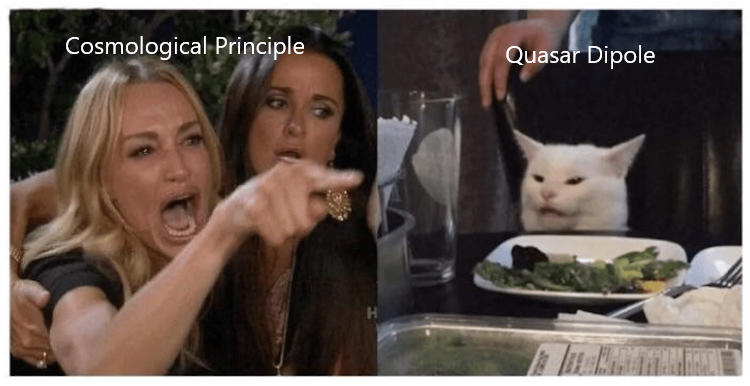
I can summarize the paper in the form of this well-worn meme:

My main reaction to the paper – apart from finding it interesting – is that if I were doing this I wouldn’t take the frequentist approach used by the authors as this doesn’t address the real question of whether the data prefer some alternative model over the standard cosmological model.

As was the case with a Nature piece I blogged about some time ago, this article focuses on the p-value, a frequentist concept that corresponds to the probability of obtaining a value at least as large as that obtained for a test statistic under a particular null hypothesis. To give an example, the null hypothesis might be that two variates are uncorrelated; the test statistic might be the sample correlation coefficient r obtained from a set of bivariate data. If the data were uncorrelated then r would have a known probability distribution, and if the value measured from the sample were such that its numerical value would be exceeded with a probability of 0.05 then the p-value (or significance level) is 0.05. This is usually called a ‘2σ’ result because for Gaussian statistics a variable has a probability of 95% of lying within 2σ of the mean value.

Anyway, whatever the null hypothesis happens to be, you can see that the way a frequentist would proceed would be to calculate what the distribution of measurements would be if it were true. If the actual measurement is deemed to be unlikely (say that it is so high that only 1% of measurements would turn out that large under the null hypothesis) then you reject the null, in this case with a “level of significance” of 1%. If you don’t reject it then you tacitly accept it unless and until another experiment does persuade you to shift your allegiance.

But the p-value merely specifies the probability that you would reject the null-hypothesis if it were correct. This is what you would call making a Type I error. It says nothing at all about the probability that the null hypothesis is actually a correct description of the data. To make that sort of statement you would need to specify an alternative distribution, calculate the distribution based on it, and hence determine the statistical power of the test, i.e. the probability that you would actually reject the null hypothesis when it is incorrect. To fail to reject the null hypothesis when it’s actually incorrect is to make a Type II error.

If all this stuff about p-values, significance, power and Type I and Type II errors seems a bit bizarre, I think that’s because it is. In fact I feel so strongly about this that if I had my way I’d ban p-values altogether…

This is not an objection to the value of the p-value chosen, and whether this is 0.005 rather than 0.05 or, , a 5σ standard (which translates to about 0.000001!  While it is true that this would throw out a lot of flaky ‘two-sigma’ results, it doesn’t alter the basic problem which is that the frequentist approach to hypothesis testing is intrinsically confusing compared to the logically clearer Bayesian approach. In particular, most of the time the p-value is an answer to a question which is quite different from that which a scientist would actually want to ask, which is what the data have to say about the probability of a specific hypothesis being true or sometimes whether the data imply one hypothesis more strongly than another. I’ve banged on about Bayesian methods quite enough on this blog so I won’t repeat the arguments here, except that such approaches focus on the probability of a hypothesis being right given the data, rather than on properties that the data might have given the hypothesis.

Not that it’s always easy to implement the (better) Bayesian approach. It’s especially difficult when the data are affected by complicated noise statistics and selection effects, and/or when it is difficult to formulate a hypothesis test rigorously because one does not have a clear alternative hypothesis in mind. That’s probably why many scientists prefer to accept the limitations of the frequentist approach than tackle the admittedly very challenging problems of going Bayesian.

But having indulged in that methodological rant, I certainly have an open mind about departures from isotropy on large scales. The correct scientific approach is now to reanalyze the data used in this paper to see if the result presented stands up, which it very well might.
How well-intentioned white male physicists maintain ignorance of inequity and justify inaction

Posted in Science Politics with tags , , , , , on October 10, 2022 by telescoper

I just noticed a paper on arXiv by Melissa Dancy and Apriel Hodari, which will probably annoy many people who deserve to be annoyed. Here is the abstract:

Background: We present an analysis of interviews with 27 self-identified progressive white-male physics faculty and graduate students discussing race and gender in physics. White men dominate most STEM fields and are particularly overrepresented in positions of status and influence (i.e. full professors, chairs, deans, etc.), positioning them as a potentially powerful demographic for enacting systemic reform. Despite their proclaimed outrage at and interest in addressing inequity, they frequently engage in patterns of belief, speech and (in)action that ultimately support the status quo of white male privilege in opposition to their intentions.


Results: The white male physicists we interviewed used numerous discourses which support racist and sexist norms and position them as powerless to disrupt their own privilege. We present and discuss three overarching themes, seen in our data, demonstrating how highly intelligent, well-intentioned people of privilege maintain their power and privilege despite their own intentions: 1) Denying inequity is physically near them, 2) Locating causes of inequity in large societal systems over which they have little influence and 3) Justifying inaction.


Conclusions: Despite being progressively minded, well-meaning, and highly intelligent, these men are frequently complicit in racism and sexism in physics. We end with recommendations for helping these men to engage the power they hold to better work with women and people of color in disrupting inequity in physics.

(I added the spacing and underlining.)

The paper does not mention the additional issue that not all white male professors are even well-intentioned…

The Scales of Things

Posted in Maynooth, The Universe and Stuff with tags , , , , , on October 9, 2022 by telescoper

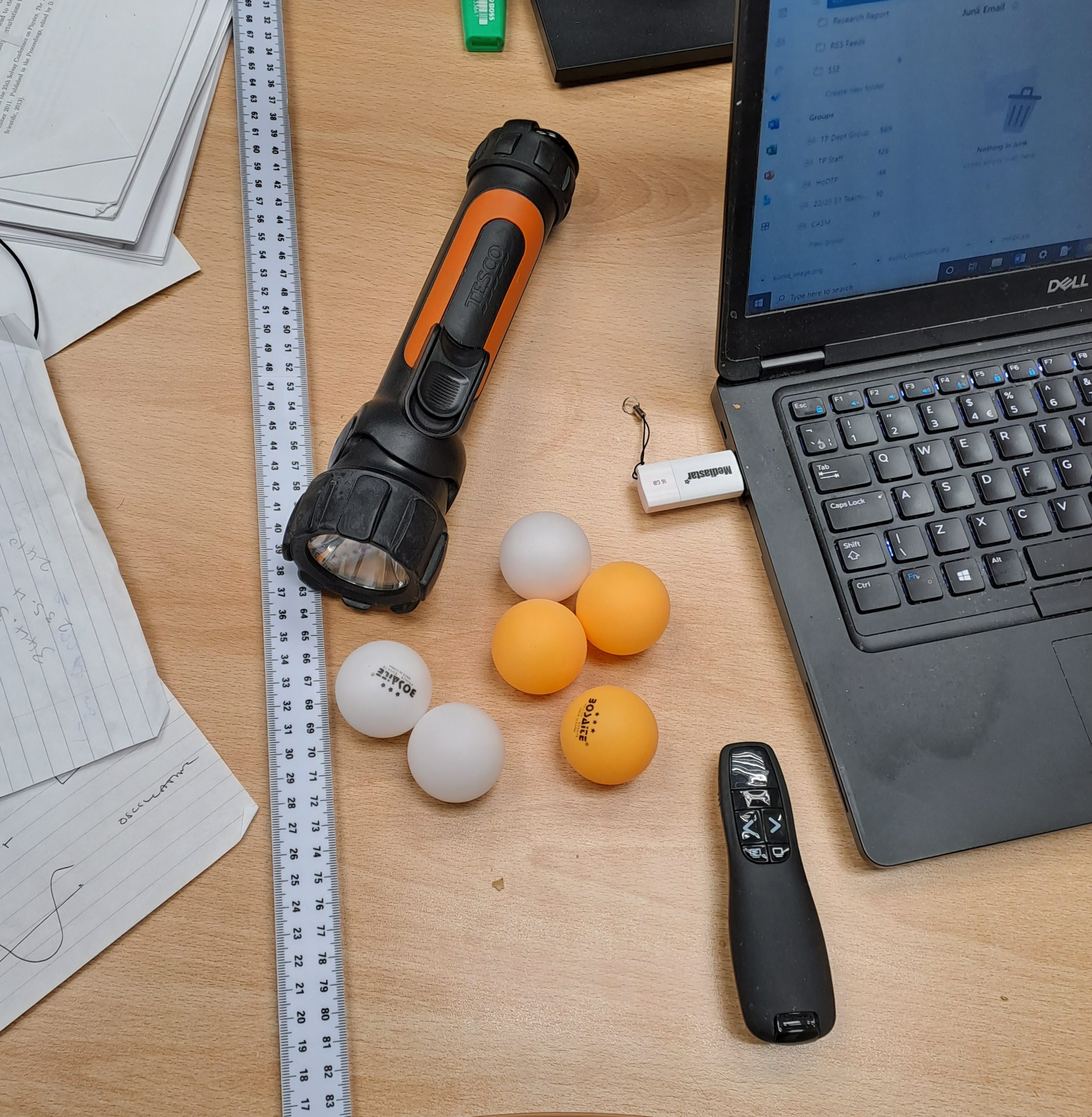
A few people have asked me why I needed such extravagant equipment (ping-pong balls, a torch and a metre-ruler) in my lecture on Thursday night.

I did only use one ping pong ball in the talk but I found the local budget shop Eurosaver only sells them in packs of twelve (for the princely sum of €3) so I now have plenty of spares. The metre ruler was borrowed from the Department of Experimental Physics (who have expertise using sophisticated measurement devices) and returned on Friday morning. The torch was procured from Tesco along with two batteries.

One of the things I wanted to do in my lecture was to explain some of the difficulties about measuring cosmological distances. I started by holding up a ping pong ball (radius 2cm) and asking if the ping pong ball were the Sun (radius 7 × 10⁸ m), on the same scale how far away would be the nearest other star (Proxima Centauri)?

To cut a long story short – and you can do the arithmetic yourself – the answer surprises most people who haven’t seen this demonstration before. It’s not the back of the lecture theatre, nor is it the town centre, nor the next town. It’s 1200 km away. That’s as far from Maynooth as, say, Geneva, or Copenhagen. The distances between stars is huge, even in the relatively dense part of a Galaxy, such as where the Sun is situated. The Universe is very big and very empty, even in the places that look crowded.

The torch and the metre rule were used to demonstrate two ways of possibly measuring astronomically large distances. I had a student stand up at the back of the theatre holding the metre rule. I explained that I could measure the distance to the student using geometry by measuring the angle subtended by the ruler if I knew its length (which I do). This is the principle behind the angular diameter distance; the metre rule is called a “standard rod”.

The torch is used to illustrate the luminosity distance. If I knew its power output I could measure the intensity of light using a lightmeter and infer the distance from that using the fact that it follows an inverse-square law. The torch is thus a “standard candle”.

Of course in cosmology we don’t have perfectly standard rods or candles but we can apply the principle of the angular diameter distance to features in the galaxy distribution or the cosmic microwave background or gravitational lenses and supernovae can provide us with accurate luminosity distances.

There are additional complications. Objects at large distances are receding with the Hubble expansion so light from them is redshifted, affecting their apparent luminosity. Einstein’s theory of general relativity allows for the possibility that light rays don’t travel in straight lines either (because space is curved), affecting the angular diameters. That means the two methods don’t necessarily give the same distance unless these factors are taken into account.

Tchaikovsky, O’Leary and Beethoven at the NCH

Posted in Music with tags , , , , , , , , on October 8, 2022 by telescoper

Last night I attended another Friday evening concert at the National Concert Hall in Dublin by the National Symphony Orchestra directed by Kenneth Montgomery, featuring yet another world premiere.

Friday evening concerts are all broadcast live on RTÉ Lyric FM and Jane O’Leary, the composer of the intriguing work unfolding soundscapes for piano and orchestra, was in the audience last night for what was the broadcast premiere of her composition; the world premiere of this piece was the night before, in Galway, where Jane O’Leary lives.   I thought it was a fascinating atmospheric piece with the brightness of the piano played by Finghin Collins contrasted with a wide variety of orchestral colours.

Talking of contrasts, the O’Leary piece was itself contrasted sharply with the two more familiar pieces performed either side of it. The concert opened with Tchaikovsky’s Serenade for Strings. This is a bit more than the usual lollipop you tend to get to start a concert, as it is a substantial work of four movements that lasts about 30 minutes. Though not a symphony, and performed by strings only rather than a full orchestra, it is a rather symphonic piece in the way it develops. The first movement, in Sonatina form, is a clear tribute to Mozart. The second movement, Valse, is very familiar and is sometimes performed on its own. Though not in my view one of Tchaikovsky’s more compelling works, it makes for a very enjoyable listen.

After the wine break we had a very familiar piece, Beethoven’s 6th Symphony (“The Pastoral”). It’s interesting that this hugely popular work was actually composed alongside the 5th Symphony (and both were premiered at the same concert in 1808) because they contrast so much in temperament and texture and that the 6th Symphony is an overtly programmatic work, which the 5th definitely is not. The Pastoral is celebration of the composer’s love of nature, starting with “awakening of joyful feelings upon arrival in the country” depicted in the first movement. It does have its darker moments, especially in the tempestuous 4th movement but the overall mood is upbeat and at times even jolly.

Unusually, Kenneth Montgomery had the double basses all lined up at the back of the orchestra, behind the wind instruments, for this performance which is something I’ve never seen before. The winds, especially the brass instruments, were in particularly good form and the orchestra definitely succeeded in evoking the elemental power expressed by Beethoven’s composition. The performance was much appreciated by the audience at the NCH.

It was quite a long programme and I only just made it back to Pearse station in time to have my usual hot sausage roll before the train back to Maynooth. This is the kind of concert I like very much, juxtaposing the familiar classics with brand new works and am very happy the NSO does programmes like this!

That Was The (Space) Week That Was

Posted in Biographical, Maynooth, The Universe and Stuff with tags , , , , on October 7, 2022 by telescoper

Last night I participated in an event at Maynooth for Space Week which I think went very well. We had a big audience so the decision to move to a bigger lecture theatre was a good one. Nobody took count but I think we had as many as 400 people of all ages, including some very young kids, some students and a variety of others.

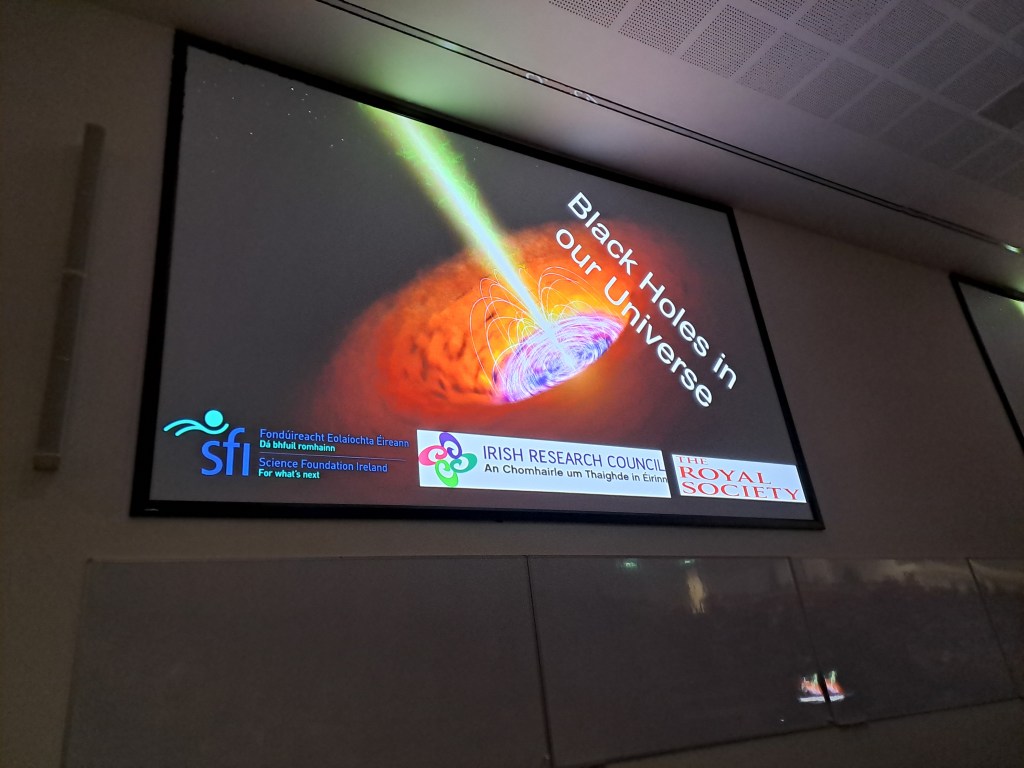
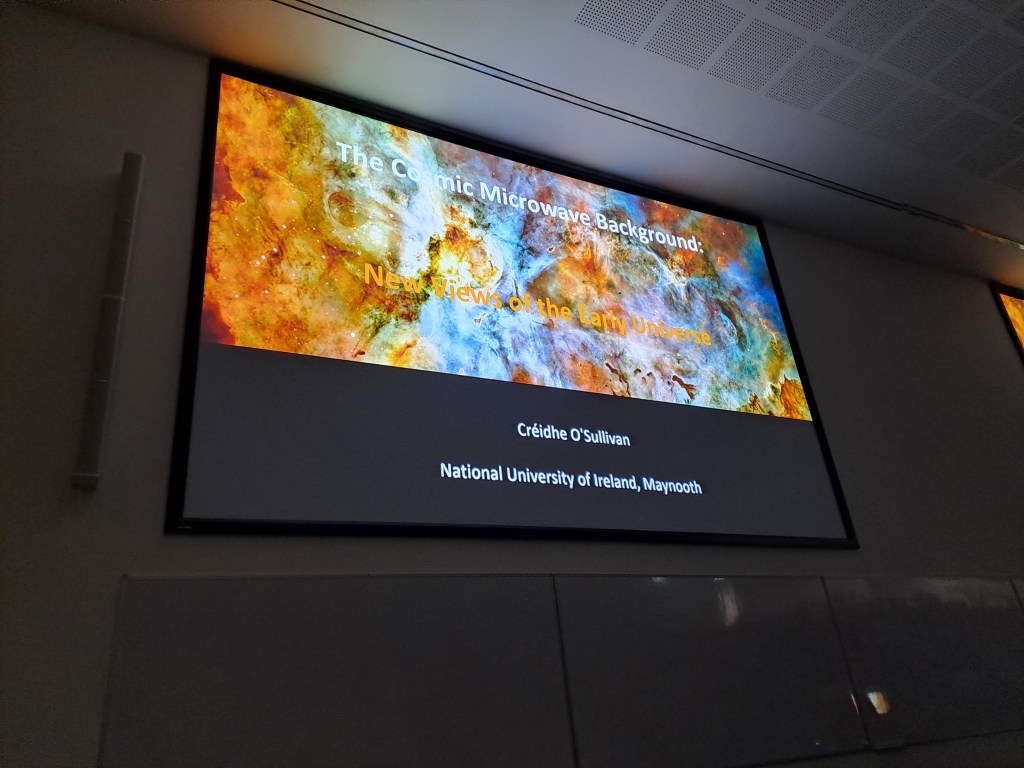
I was the last one up to speak and took a few pictures at the three talks before mine but obviously couldn’t take a picture of mine so I’ve included a pic of some of the hi-tech equipment I used for a couple of demonstrations:

If anyone wants to see the pictures I showed you can find them here:

There was an official photographer there last night so I’ll upload any pictures I come across in due course. Watch this space.

UPDATE: Here’s a picture of the four speakers

Last night’s four speakers: Créidhe O’Sullivan, Me, Emma Whelan and John Regan

Anyway, thank you to everyone for coming last night and especially to all the people who helped organize and run the event, including our student volunteers. We’re planning to do similar event for space week next year and hopefully this will become a regular feature in the calendar.

Last Call for Exploring the Cosmos

Posted in Maynooth, Talks and Reviews, The Universe and Stuff with tags , on October 5, 2022 by telescoper

A couple of weeks ago I announced that we’re holding a Space Week event here at Maynooth University called Exploring the Cosmos. Well, the inexorable march of time means that event is actually tomorrow so I’m posting this as a last chance for you to register, which you can do here.

The demand for tickets so far has been a bit overwhelming. So much so, in fact, that we’ve moved to a bigger room, organized microphones, and enlisted various people to help, e.g. to guide people into the venue. Fortunately all I have to do is give the last talk and then go to the pub.

Nobel Prize for Physics Speculation

Posted in The Universe and Stuff with tags , on October 3, 2022 by telescoper

Just  to mention that tomorrow morning (Tuesday October 4th 2022) will see the announcement of this year’s Nobel Prize for Physics. I must remember to make sure my phone is fully charged. Of course this is just one of the announcements. This morning, for example, there is the announcement of the Prize for Physiology or Medicine and on Wednesday is the Prize for Chemistry both of these sometimes go to physicists too. You can find links to all the announcements here.

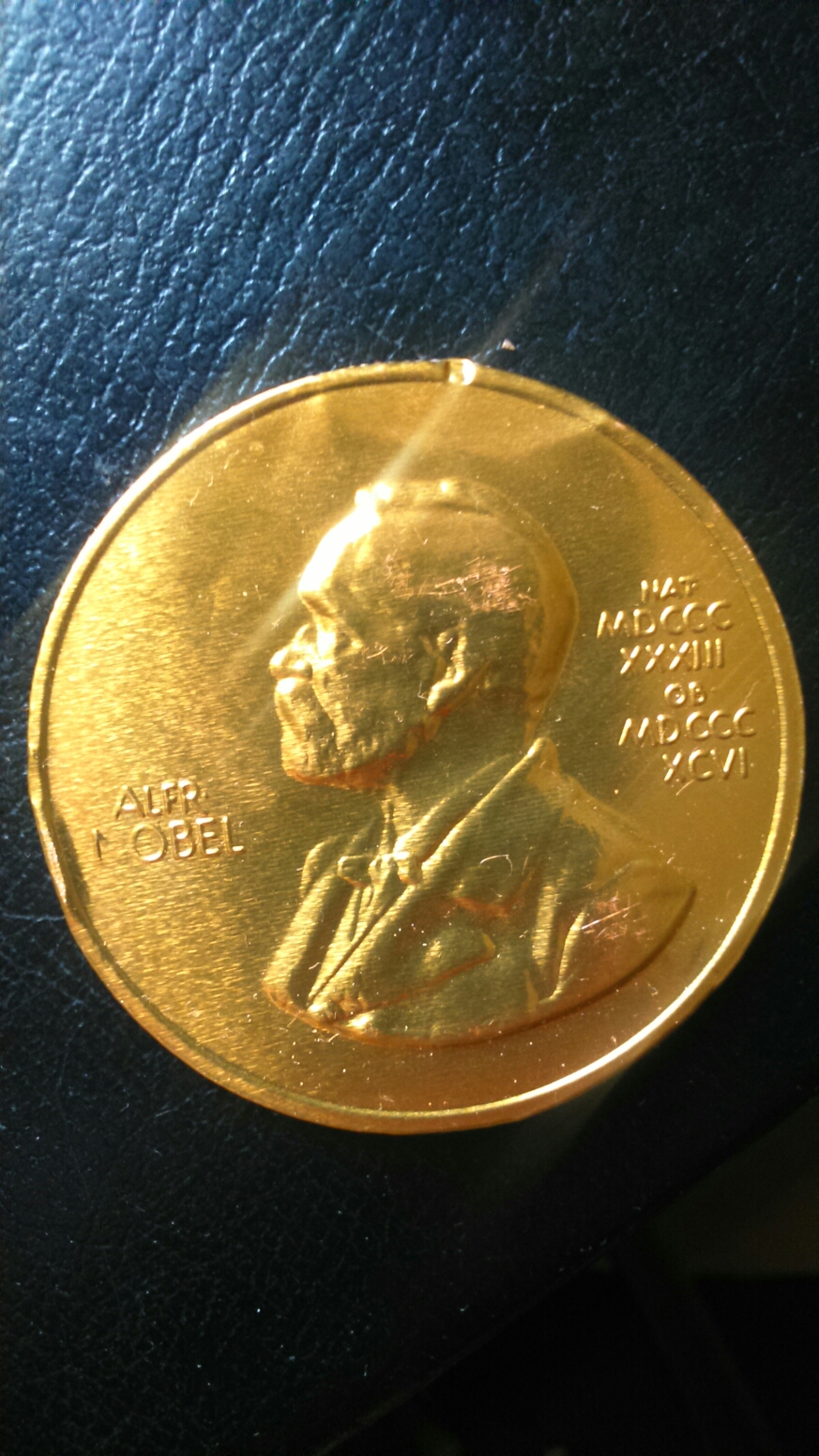
I do, of course, already have a Nobel Prize Medal of my own already, dating from 2006, when I was lucky enough to attend the prize-giving ceremony and banquet.

I was, however, a guest of the Nobel Foundation rather than a prizewinner, so my medal is made of chocolate rather than gold. I think after 16 years the chocolate is now inedible, but it serves as a souvenir of a very nice weekend in Stockholm!

I also won a prize here once:

It’s been a good few years for cosmology and astrophysics, with Jim Peebles, Michel Mayor & Didier Queloz (2019), Roger Penrose, Andrea Ghez & Reinhard Genzel (2020) following on from Kip Thorne, Rainer Weiss and Barry Barish (2017) for the detection of gravitational waves.  I think it’s very unlikely that it will be in this area again.

I have no idea who will win but I have on previous occasions suggested Alain Aspect, Anton Zeilinger and John Clauser for their Bell’s inequality experiments and contributions to the understanding of quantum phenomena, including entanglement, so I’ll make them my prediction again. I’m probably wrong again though. I have a spectacularly bad track record at predicting the Physics Nobel Prize winner, but then so does everybody else.

Feel free to make your predictions through the comments box below.

To find out you’ll have to wait for the announcement, around about 10.45 (UK/Irish time) tomorrow morning. I’ll update tomorrow when the wavefunction has collapsed.

Anyway, for the record, I’ll reiterate my opinion that while the Nobel Prize is flawed in many ways, particularly because it no longer really reflects how physics research is done, it does at least have the effect of getting people talking about physics. Surely that at least is a good thing?

UPDATE: It seems I called it right! Congratulations to Alain Aspect, John F. Clauser and Anton Zeilinger, winners of the 2022 Nobel Prize for Physics!

Faking Proceedings

Posted in Open Access with tags , , , , , , on October 2, 2022 by telescoper

Almost every day I get an invitation to a fake conference somewhere, usually somewhere nice (to make the event more attractive). Usually these are caught by my spam filter, but when one isn’t the conference often turns out to be in a field I don’t work in. A small fraction are in cosmology or astrophysics but fortunately those fields are relatively small and it’s quite easy to identify whether or not they are bona fide. I’ve often wondered what happens if you turn up at one of these fake meetings, but not enough to waste money on trying to find out. Perhaps one of my readers knows? One day someone should turn up at one of them with a film crew…

It seems that along with these fake conferences there are fake conference proceedings, not just proceedings of fake conferences but proceedings of conferences that didn’t actually happen.

Publishers make a killing from publishing books of conference proceedings, which generally have a very short shelf-life. I stopped contributing to conference proceedings some time ago as I don’t think they’re worth the effort any more. It’s far better in my view for contributors just to put a copy of their slides on the conference website. I fully accept however that conference proceedings or similar publications may be important in other fields and it does seem that there is still a considerable traffic in them, with some publishers – including Institute of Physics Publishing – setting up special journals to exploit the traffic.

My attention was drawn today to an article in The Times (behind a paywall). The Times piece appears to be based on this one by the excellent Retraction Watch. It seems the IOP publishing system has been comprehensively hacked by (mostly Chinese) publishing mills. As a result the publisher has retracted 494 papers:

The vast majority – 463 articles – are from the Journal of Physics: Conference Series, while 21 are from IOP Conference Series: Materials Science & Engineering, and 10 are from IOP Conference Series: Earth & Environmental Science.

A statement from the IOP explains

These articles are being retracted following an allegation that raised concerns regarding several manuscripts. IOP Publishing has conducted a comprehensive investigation, which indicated that some papers may have been created, manipulated, and/or sold by a commercial entity.

I’m told that to be named as an author of a paper costs anything from about $500 to $US5000, depending on the calibre of the journal and how prominently you want your name to appear. It’s easy to find companies willing to provide such a service, e.g. on Facebook.

Of course this episode raises serious questions about the quality of the peer review applied to these papers, but the more serious issue is how science let itself get into a mindset that fetishizes publications in the first place. The publishing industry must share some of the blame for this. As long as this absurd situation exists there will be unscrupulous people willing and able to exploit it.