Archive for January, 2023

Reflections on Exam Marking

Posted in Education, Maynooth with tags , , , on January 21, 2023 by telescoper

At long last I’ve finished my marking my examination scripts. I’ve also entered the marks onto a spreadsheet and combined them with coursework so I’m almost done with this task. They just need one more check through and I can upload the results onto the system. in good time for next week’s departmental exam board meeting. It took a lot longer than I had anticipated because we have a big first-year class this year. So much for my New Year resolution not to work at weekends…

I’m a bit tired now so I thought I’d just rehash an excerpt from something I posted a while ago on the subject of examinations and what I believe to be the over-assessment of students at modern universities.

My feelings about examinations agree pretty much with William Wordsworth, who studied at the same University as me, as expressed in this quotation from The Prelude:

Of College labours, of the Lecturer’s room
All studded round, as thick as chairs could stand,
With loyal students, faithful to their books,
Half-and-half idlers, hardy recusants,
And honest dunces–of important days,
Examinations, when the man was weighed
As in a balance! of excessive hopes,
Tremblings withal and commendable fears,
Small jealousies, and triumphs good or bad–
Let others that know more speak as they know.
Such glory was but little sought by me,
And little won.

It seems to me a great a pity that our system of education – and not only at Third Level- places such a great emphasis on examination and assessment to the detriment of real learning. In particular, the biggest problem  with physics education in many institutions is the way modular degrees have been implemented.

I’m not at all opposed to modularization in principle. I just think the way we teach modules often fails to develop any understanding of the interconnection between different aspects of the subject. That’s an educational disaster because what is most exciting and compelling about physics is its essential unity. Splitting it into little boxes, taught on their own with no relationship to the other boxes, provides us with no scope to nurture the kind of lateral thinking that is key to the way physicists attempt to solve problems. The small size of each module makes the syllabus very “bitty” and fragmented. No sooner have you started to explore something at a proper level than the module is over. More advanced modules, following perhaps the following year, have to recap a large fraction of the earlier modules so there isn’t time to go as deep as one would like even over the whole curriculum.

Students in Maynooth take 60 “credits” in a year, split into two semesters. These are usually split into 5-credit modules with an examination at the end of each semester. The first-year module I teach is different, being 7.5 credits. Projects, and other continuously-assessed work do not involve a written examination, but the system means that a typical  student will have four or five written examination papers in January and another four or five in May. Each paper is usually of two hours’ duration.

One consequence of the way modularization has been implemented throughout the sector is that the ratio of assessment to education has risen sharply over time  with a negative effect on real understanding. The system encourages students to think of modules as little bite-sized bits of education to be consumed and then forgotten. Instead of learning to rely on their brains to solve problems, students tend to approach learning by memorizing chunks of their notes and regurgitating them in the exam. I find it very sad when students ask me what derivations they should memorize to prepare for examinations. A brain is so much more than a memory device. What we should be doing is giving students the confidence to think for themselves and use their intellect to its full potential rather than encouraging rote learning.

You can contrast this diet of examinations with the regime when I was an undergraduate. My entire degree result was based on six three-hour written examinations taken at the end of my final year, rather than something like 30 examinations taken over 3 years. Moreover, my finals were all in a three-day period.

Morning and afternoon exams for three consecutive days is an ordeal I wouldn’t wish on anyone, so I’m not saying the old days were better, but I do think we’ve gone far too far to the opposite extreme. The one good thing about the system I went through was that there was no possibility of passing examinations on memory alone. Since they were so close together there was no way of mugging up anything in between them. I only got through  by figuring things out in the exam room.

I don’t want to denigrate the achievements of students who are successful under the current system.  What I’m saying is that I don’t think the education we provide does justice to their talents. That’s our fault, not theirs…


The Black Saint and the Sinner Lady

Posted in Jazz with tags , on January 20, 2023 by telescoper

I was just reminded via social media that it was on this day 60 years ago, i.e. on 20th January 1963, that a recording session took place under the direction of Charles Mingus that led to the class album The Black Saint and the Sinner Lady. I hadn’t realized that this entire album was recorded in a single day!

The Black Saint and the Sinner Lady relies much less on soloists than earlier Mingus performances and involves a rather bigger band: Mingus himself (bass, piano and composer); Jerome Richardson (soprano & baritone saxophone, flute), Dick Hafer (tenor saxophone, flute); Charlie Mariano (alto saxophone); Rolf Ericson and Richard Williams (trumpet); Quentin Jackson (trombone); Don Butterfield (tuba, contrabass trombone); Jaki Byard (piano); Jay Berliner (acoustic guitar); and Dannie Richmond (drums). Charlie Mariano is outstanding on this album but the other solos tend to be short, acting more as punctuation than as part of the actual composition. It is very much an orchestral work, with thematic material introduced and recycled in various ways, some of it from pervious recording sessions. That gives this work a retrospective feeling, as well as being very original in style. Overall the sense is of Mingus trying out how he could use elements of his past approaches in a new direction. A good example are the accelerando passages. Danny Richmond did have a bit of a habit of speeding up, but on this album these bits are intentional. The first, however, starts very abruptly and doesn’t really work. Mingus tries the idea again, much more successfully, and again a couple of times more.

This is a great album but I think it provided Mingus with a practical difficulty, in that he was clearly getting more interested in longer works with big orchestral textures but most of the venues he could play in could only cope with smaller bands. He responded by working more at jazz festivals that could indulge this taste.

Anyway, here is the whole album which I have just listened to all the way through. I have it on vinyl LP and CD but fortunately it is also on the YooToob:

Accessibility on arXiv

Posted in Education, Open Access with tags , , , , , on January 20, 2023 by telescoper

There’s an interesting paper on the arXiv that came out before Christmas, but which I’ve only just seen, about attempts to make arXiv content more accessible. Here is the abstract:

The research content hosted by arXiv is not fully accessible to everyone due to disabilities and other barriers. This matters because a significant proportion of people have reading and visual disabilities, it is important to our community that arXiv is as open as possible, and if science is to advance, we need wide and diverse participation. In addition, we have mandates to become accessible, and accessible content benefits everyone. In this paper, we will describe the accessibility problems with research, review current mitigations (and explain why they aren’t sufficient), and share the results of our user research with scientists and accessibility experts. Finally, we will present arXiv’s proposed next step towards more open science: offering HTML alongside existing PDF and TeX formats. An accessible HTML version of this paper is also available at https://info.arxiv.org/about/accessibility_research_report.html

I think this is well worth reading.

This reminds me a bit of the experiences I’ve had teaching theoretical physics to blind and partially-sighted students. Years ago this used to involve making braille copies of notes, but there are now various bits of software to help such people manage LaTeX both for creating and reading documents. In particular there are programs that can read Latex documents (including formulae and equations) which means that if a lecturer can supply LaTeX source version of their notes the student can hear them spoken out loud as well as make their own annotations/corrections. While HTML might be better for some fields, I wonder if physicists and other people in disciplines that make heavy use of mathematics might prefer to use the LaTeX source code which is already downloadable from arXiv?

I’d be interested in views on this through the comments!

As Time Goes By – Dexter Gordon

Posted in Jazz with tags , on January 19, 2023 by telescoper

I’ve been grading examinations all day and still haven’t quite finished so here’s a quick post I’ve been keeping up my sleeve for a busy day. It’s the great Dexter Gordon recorded in 1980 playing As Time Goes By. Ever since Coleman Hawkins recorded Body and Soul in 1939, the yardstick by which tenor saxophonists have tended to be measured is their playing on ballads and Dexter Gordon was right up there among the best. It’s very hard to play with accuracy and imagination at slow tempo than it is to produce a quick flurry of notes. Young musicians can learn a lot from his intelligent, but never overcomplicated, improvisations.

This performance was filmed in 1980 when Dexter Gordon was 57 years old but it has to be said that he looks much older, no doubt as a result of his lifelong struggle with drugs and alcohol. He seems somewhat inebriated as he recites the words to the song at the start – something he did regularly in live performances – but once he’s in the zone he plays quite beautifully. I am sad I never got to see him live; Dexter Gordon passed away in 1990, at the age of 67.

P.S. When he was much younger, Dexter Gordon featured in one of the most famous of all jazz photographs taken by Herman Leonard in 1948 which I’m taking the liberty of posting here:

Time goes by indeed.

PhD Opportunity in Theoretical Astrophysics at Maynooth!

Posted in Maynooth, The Universe and Stuff with tags , , , on January 18, 2023 by telescoper

Posting this again because the deadline (31st January) is coming up fast….

The Department of Theoretical Physics at Maynooth University invites applications for a PhD in Theoretical Astrophysics starting in September 2023. The successful applicant will work in the group led by Dr. John Regan on a project examining the formation processes of massive black holes in the early Universe. Massive black holes populate the centres of all massive galaxies and are now also observed in both the centres and in off-centre locations in less massive dwarf galaxies.

For more details and instructions on how to apply, see here.

Royal Mail Failure

Posted in Politics with tags on January 18, 2023 by telescoper

Quite a few people I know in the UK are unaware that the Royal Mail is currently unable to deliver any mail to locations outside the UK. The above message, from the Royal Mail website, has been there for a week now and has not changed in that time apart from the date at the top. There is no information about what has happened, no estimate when services will resume, and no idea what will happen to mail stuck in the system. This failure to communicate with users just adds insult to injury. It also calls into question the claim that this failure is “temporary”

I am mildly inconvenienced by the Royal Mail’s collapse, as I am waiting for some items of legal correspondence, but it must be catastrophic for small businesses who use its services to export products abroad. I’m sure any that survive this disaster will be taking their custom elsewhere as soon as they can.

Ooh. An update! Hopefully, they’ll start to clear the backlog soon.

Marking Schemes

Posted in Biographical, Education, Maynooth with tags , , , on January 17, 2023 by telescoper

It’s 3.40pm so I’ve reached the tea interval on the first day of marking the scripts from my first-year module on Mechanics and Special Relativity. Blogging will be a bit thin until I’ve completed this task, which will take even longer than usual as we have more students on this module than in previous years, up by more than 50% on last year. At the current rate I estimate it will take me until Friday to finish.

It turned very cold here at the weekend and I realized I had run out of food for the birds so I had to dash out to the shops on Sunday and replenish my stock. When I refilled the feeders it only took a few minutes for the robin to arrive, closely followed by starlings, a magpie, some sparrows, a woodpigeon, and then some more starlings. While I was waiting for my pot of tea to brew I filled the dispensers again.

I woke up this morning to find a very hard frost in Maynooth. The temperature hasn’t risen above zero all day so the frost is still there now. I am at home while I do the marking, which gives me an excuse not to venture out into the cold (except to feed the birds). It’s nice to be in the warm, but marking at home ensures that I am not interrupted by anyone but myself and especially not a student who might wander into my office on campus with all the scripts lying around.

Some scripts (side view)

For the last two years we’ve held this examination as an online timed assessment, but now uses old-fashioned written answer books which are much easier on the eye. I still find however that I can only managed about 30 scripts in one sitting before my attention starts to wander. I’ve therefore divided them into five packets, taking a break when I’ve finished each one. Thirty is about the number of overs you get in a session of Test Match Cricket, though I don’t stick very strictly to the same timings; I don’t always have lunch at 1pm, for example.

I’ve often discussed the process of marking examinations with my colleagues and they all have different techniques. What I do is mark one question at a time rather than one script at a time. What I mean by that is that I go through every script marking all the attempts at Question 1, then I start again and do Question 2, etc. I find that this is much quicker and more efficient than marking all the questions in each script then moving onto the next script. The reason for this is that I can upload into my mind the model answer for Question 1 so that it stays there while I mark dozens of attempts at it so I don’t have to keep referring to the marking scheme. Other advantages are that it’s easier to be consistent in giving partial credit when you’re doing the same question over and over again, and that also you spot what the common mistakes are more easily.

Whichever way you do it, grading this number of examinations is a long job, a marathon not a sprint. We also owe it to the students to be as fair as possible, all of which means taking it at a steady pace.

Now, it’s 4pm and time for the resumption…

Composition in Blue – Fernand Léger

Posted in Art with tags , on January 16, 2023 by telescoper

Fernand Léger, Composition in Blue, 1920-27, oil on canvas, 130.5 × 97.2 (Art Institute of Chicago)

ScienceCast and arXiv

Posted in Open Access with tags , , on January 15, 2023 by telescoper

Browsing the arXiv blog, as one does from time to time, I saw an item about ScienceCast and arXiv which I think is worth highlighting here. I wasn’t aware of ScienceCast before seeing the arXiv blog entry so perhaps some readers of this blog hadn’t either.

According to its own website,

ScienceCast provides a website where researchers can create explainer videos in a collaborative space and receive feedback on their work from other researchers through blog posts and chat functions. The platform also provides the ability for users to post datasets supporting the researcher’s work so that the work can be verified by reference to its data.

Although I haven’t used it, the first of these features seems very nice, allowing users to develop video explainers for science projects with feedback from collaborators. This will be of interest to people wanting to make their work a little more accessible and those, especially at the early career stage, who would like advice on video presentations. The second feature may be of less interest to astrophysicists, who already have platforms for sharing data and whose data sets are often very large, but it might work for smaller examples.

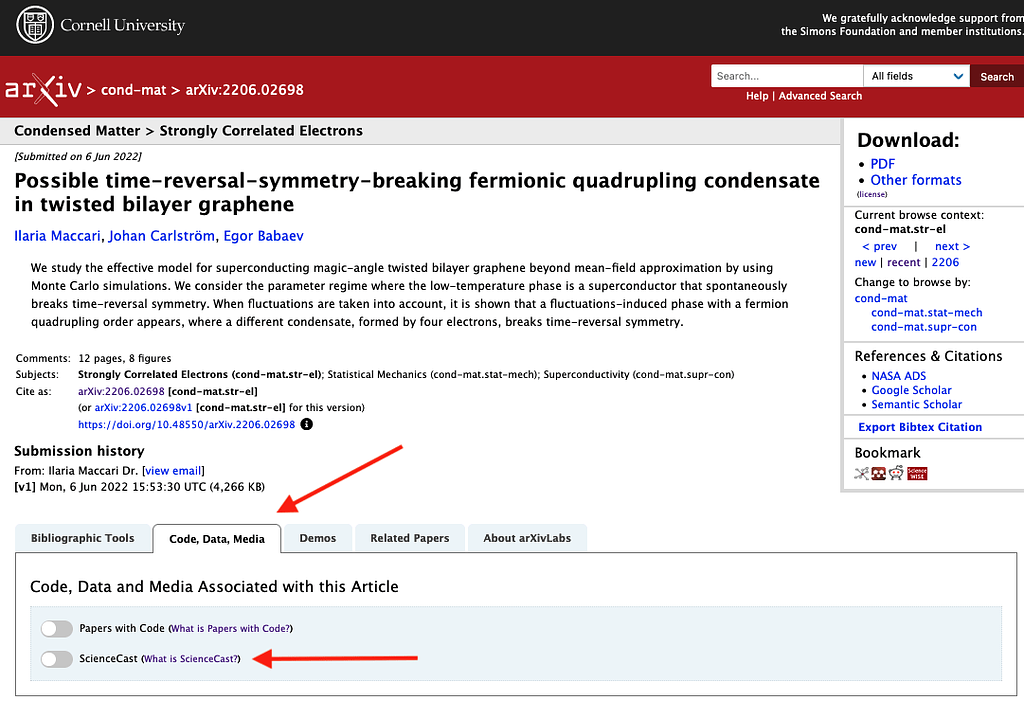
Anyway, the new feature from arXivLabs that the arXiv blog post is about allows users to include ScienceCast material directly on the arXiv. Here’s how it looks:

Activating the ScienceCast feature using the slider allows one to see any content there directly on arXiv. Which is nice. I’ll be interested to see what the uptake is like. I may even play around with it myself, although that will have to wait until I’ve finished marking examinations…

Mahler, Weber, Schubert and Strauss at the NCH

Posted in Biographical, Music with tags , , , , , , , , , , , , on January 14, 2023 by telescoper

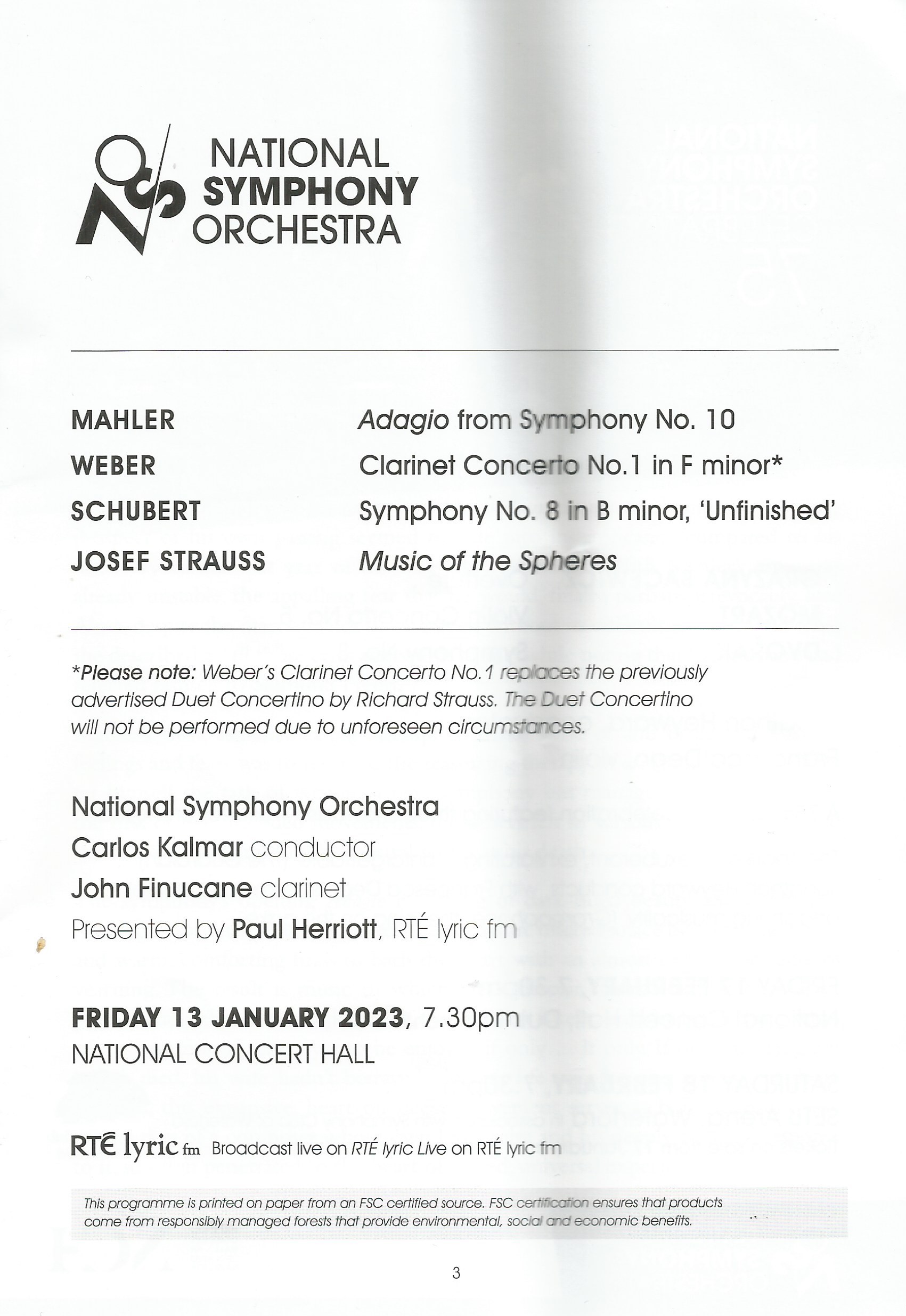
And so it came to pass that last night I took the train into Dublin for my first concert of the year 2023 at the National Concert Hall in Dublin which happened to be by the National Symphony Orchestra under the direction of guest conductor Carlos Kalmar.

It was an unusual programme in terms of its construction. Often the menu for such concerts begin with a short appetizer but this one started with the first movement of  Gustav Mahler‘s 10th Symphony. The composer died a hundred years ago in 1910 having not actually finished the rest of the symphony, but I gather that he left sufficiently detailed sketches and notes that complete versions have been constructed, but nevertheless the first movement is frequently performed on its own. It’s quintessentially Mahler in many ways, but it’s a strange opening for a symphony because it’s a very long Adagio movement (lasting about 30 minutes). It’s a complex and weighty movement for a full orchestra, rather cryptic in nature but overall with a rather dark tone, far from the usual lollipop to start a concert!

Originally this programme was supposed to feature the Duet Concertino by Richard Strauss but it was announced last week that this would be replaced by the Clarinet Concerto No. 1 in F Minor by Carl Maria von Weber with the NSO’s principal clarinettist John Finucane. Unusually for a concerto performance, John Finucane was reading a score, which perhaps suggests he stood in at short notice but in any case the performance was very fine. The third movement, a spirited Rondo kicked off by a very jaunty theme, is probably the most familiar piece, but I particularly enjoyed the interplay between clarinet and horns in the slow (2nd movement). John Finucane had brought his fan club with him, and the audience responded warmly.

After the wine break we had Symphony No. 8 in B Minor by Franz Schubert, the famous “Unfinished Symphony”. Somewhat surprisingly, I am pretty sure that I had never heard this piece performed live until this concert.

Schubert apparently wrote the first two wonderful movements of this piece in the space of only eight days in 1822 but then seems to have abandoned it. The composition wasn’t interrupted by his death – he didn’t pass away until 1828 – so it’s a mystery why he didn’t finish it. It wasn’t even discovered until the 1860s. Unlike Mahler 10, we don’t have any idea what the rest of this symphony would have been but the two existing movements are exceptional, not least for the stream of lovely melodies. This work clearly belongs to the same world as the Weber piece (which was composed in 1811) but having one after the other emphasizes the transition from Classical to Romantic, and having Mahler on the same programme contrasts early and late Romantic in a very illuminating way.

The last piece was Music of the Spheres, a waltz by Josef Strauss, the younger brother of the more famous Johan Strauss II. It’s a jolly enough but rather insubstantial piece that seemed rather incongruous to me in this programme, especially at the end as it is the sort of piece one could imagine as an appetizer. It seems to have been decided that something was needed in place of the missing movement(s) of the Schubert Symphony, so perhaps it was meant to play the role of a dessert?

In any case it was an upbeat way to end the concert which was very enjoyable. I then made my way out into the rain to get the train back to Maynooth. For a Friday night, Dublin was very quiet indeed, perhaps because of the inclement weather and/or the post-Christmas lull. The NCH wasn’t full but there was a decent attendance and the performance was warmly appreciated.

P.S. Note that the National Symphony Orchestra is no longer the RTÉ National Symphony Orchestra owing to some restructuring. Note also that it is planned to close down the NCH for at least two years for extensive refurbishment. I’m not sure what will happen to the NSO during this period.