Archive for April, 2023

Maynooth Astronomy Picture of the Week!

Posted in Maynooth, The Universe and Stuff with tags , , , , on April 17, 2023 by telescoper
“A Stellar Sprinkler”

I think for the first time, Maynooth astronomers have been featured in the European Space Agency’s Picture of the Week. Here is the blurb from ESO:

–o–

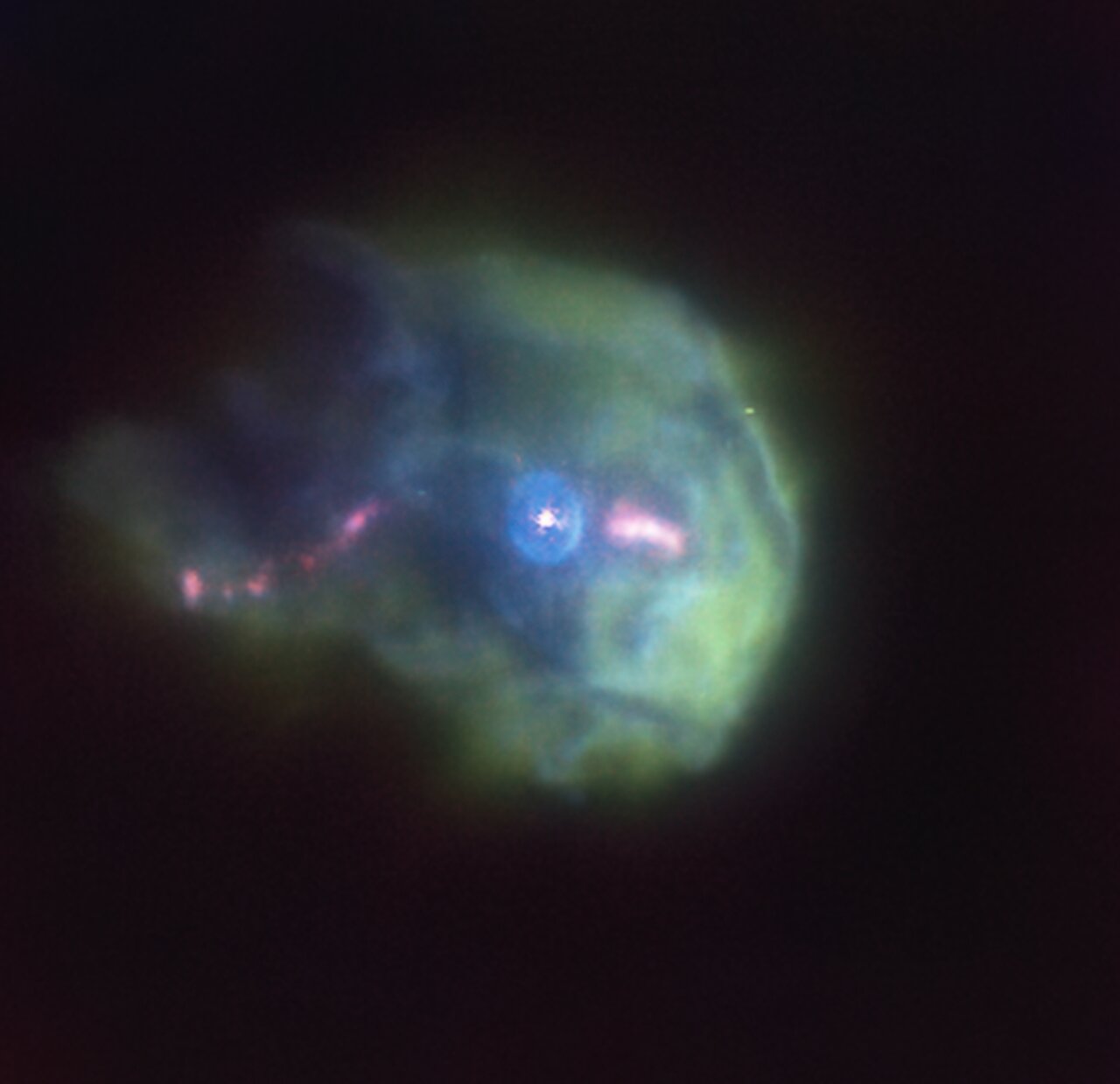
This Picture of the Week shows the young stellar object 244-440 in the Orion Nebula observed with ESO’s Very Large Telescope (VLT) –– the sharpest image ever taken of this object. That wiggly magenta structure is a jet of matter launched close to the star, but why does it have that shape?

Very young stars are often surrounded by discs of material falling towards the star. Some of this material can be expelled into powerful jets perpendicularly to the disc. The S-shaped jet of 244-440 suggests that what lurks at the center of this object isn’t one but two stars orbiting each other. This orbital motion periodically changes the orientation of the jet, similar to a water sprinkler. Another possibility is that the strong radiation from the other stars in the Orion cloud could be altering the shape of the jet.

These observations, presented in a new paper led by Andrew Kirwan at Maynooth University in Ireland, were taken with the Multi Unit Spectroscopic Explorer (MUSE) instrument at ESO’s VLT in Chile. Red, green and blue colours show the distribution of iron, nitrogen and oxygen respectively. But this is just a small fraction of all the data gathered by MUSE, which actually takes thousands of images at different colours or wavelengths simultaneously. This allows astronomers to study not only the distribution of many different chemical elements but also how they move. 

Moreover, MUSE is installed at the VLT’s Unit Telescope 4, which is equipped with an advanced adaptive optics facility that corrects atmospheric turbulence, delivering images sharper than Hubble’s. These new observations will therefore allow astronomers to study with unprecedented detail how stars are born in massive clouds like Orion.

–o–

There’s also a little video showing how the picture was made using MUSE:

Congratulations to Andrew Hirwan and supervisor Emma Whelan from the Department of Experimental Physics for this coup!

The Cyclic Universe of the UK Astronomy Grant System

Posted in Biographical, Science Politics, The Universe and Stuff with tags , , , on April 17, 2023 by telescoper

I stumbled by accident yesterday on a bit of news relating to UK Astronomy Grant funding via the Science and Technology Facilities Council (STFC). I am of course completely out of that system, and have been for years, but I am nevertheless quite nosy so was interested to find out about the changes. Thanks to Alan Heavens and Paul Crowther for enlightening me.

Way back in 2010 I wrote in somewhat critical terms about the new-style Consolidated Grants that STFC was planning to introduce. This system replaced a dual approach of so-called “Standard Grants” – which were typically rather small, usually funding one postdoctoral researcher and bits and bobs – and “Rolling Grants” – which were usually larger, covering all the activities of a department or institution – with a single system of “Consolidated Grants”. The Standard Grants were “responsive”, in that investigators could put in an application whenever they wanted, whereas Rolling Grants were on a fixed timetable. After the change, the responsive mode went out the window and Departments were forced to apply collectively, once every three years.

Much of the reason for the change was the administrative cost of the system. There were huge numbers of standard grant applications. Back in the mists of time there were two application deadlines per year so it was a heavy burden on the panels and the Swindon office, especially since so little funding was available in the first place. Standard grants were also the first to get squeezed when there was a funding shortfall, whereas Rolling grants generally carried on rolling.

Well, the news is that the current Astronomy grant round, with applications in 2022 and grants starting in 2023, will see the last of these Consolidated Grants. From this year on, there will be a new system of – wait for it – “Small” and “Large” grants, thought these are officially called Type 1 and Type 2. The Small Awards scheme is described here and it looks very much like the old Standard Grant system. Details of the Large grants scheme are not yet available, but I believe they will start next year. You can find more details here (PDF).

So now it seems something very like the old system is returning, and there are no doubt the same worries that Large grants will eat up most of the money, leaving very little for the Small grants. Déjà vu.

Anyway, the way I came across this piece of news was via the announcement of a clutch of PDRA positions in cosmology and extragalactic astrophysics at the University of Sussex (where I worked from 2013-16). It seems the Astronomy Centre must have done pretty well in the (final) STFC Consolidated Grant round, which is very good to hear! It seems there might be a bit more money generally in the grant line this year too, which is also good news.

The Other Side of Easter

Posted in Biographical, Maynooth with tags , on April 16, 2023 by telescoper

I haven’t been reading my work email for a few days as I’ve been working from home during the recent Easter mini-break and wanted to catch up on a few things without too many distractions. Having to return to campus tomorrow, however, I decided with some trepidation to see what had accumulated in my inbox while I wasn’t looking and got a rather pleasant surprise.

Just before Easter I mentioned that I had been granted a half-year sabbatical for next academic year. Well, reading my email this morning I found a letter saying that it had been decided to change that to a full year, which is what I originally requested:

The period of sabbatical leave granted is from 1st September 2023 to 31st August 2024.

So having spent a bit of time thinking about how to spend the reduced period, I’m now back to square one (but in a good way). I’m not sure why the powers that be changed their mind on this. Perhaps they’re even keener to get me out of the way than I thought?

The revised schedule means that I will still be around in Maynooth for the August repeat examinations (and marking thereof), but I hope to leave shortly after that is all done and dusted. I’m sure I will miss the teaching next year, but I’m looking forward to being able to concentrate on research and to working in a different environment for a time.

All this means that we will shortly have an advertisement for a sabbatical replacement lecturer in the Department of Theoretical Physics at Maynooth University to cover my teaching while I’m absent. Watch this space. Obviously I will help advertise the position, but I can’t play any further role in the recruitment process.

Anyway, the immediate focus of my attention will be the remaining three weeks of teaching for this Semester. I have a couple more Computational Physics laboratory sessions to organize, as well as the final batch of lectures for Advanced Electromagnetism. That will be followed by an intense period of grading project work, revision lectures, and finally correcting examination scripts. The Examination Period in Maynooth starts on Friday 12th May, but the two with which I am directly involved take place on Thursday 18th and Saturday 20th.

But for now, back to my inbox…

Voices

Posted in Biographical, Education, Poetry with tags , , , on April 15, 2023 by telescoper

Not long ago I did a post about an anthology of Poems I studied at school many years ago. I bought that second-hand at the same time as I bought the three volumes shown above, Books 1-3 of Voices (edited by Geoffrey Summerfield). I seem to remember that we studied these at an earlier stage of 11+ education, probably in consecutive years before O-level. I remember the covers quite well, especially the rather spooky picture on Book 3.

They’re quite interesting books, each of which contains an eclectic collection of poems, including traditional rhymes and there is even some music at the back to accompany some of the verses that work as songs.

Anyone else remember these books?

Why Are Universities So International?

Posted in Biographical, Education, Maynooth on April 15, 2023 by telescoper

This is an interesting post about internationalization in universities. The Faculty in the Department of Theoretical Physics at Maynooth provides a good illustration. It includes seven people, only two of whom were born in Ireland. The others were born in the Netherlands, Norway, Czech Republic, USA and UK. The blog post says there are two reasons why universities are so international: specialization and diversification. Both of these do apply, but there is a third reason, which concerns personal life, love, the pursuit of happiness, politics, and so on. I gave my reasons for moving to Ireland here.

The personal dimension shouldn’t be ignored, though it is much more complex than the others. Academics are people after all.

4gravitons's avatar4 gravitons

Worldwide, only about one in thirty people live in a different country from where they were born. Wander onto a university campus, though, and you may get a different impression. The bigger the university and the stronger its research, the more international its employees become. You’ll see international PhD students, international professors, and especially international temporary researchers like postdocs.

I’ve met quite a few people who are surprised by this. I hear the same question again and again, from curious Danes at outreach events to a tired border guard in the pre-clearance area of the Toronto airport: why are you, an American, working here?

It’s not, on the face of it, an unreasonable question. Moving internationally is hard and expensive. You may have to take your possessions across the ocean, learn new languages and customs, and navigate an unfamiliar bureaucracy. You begin as a temporary resident, not…

View original post 437 more words

Tá mé sa bhaile – Biden’s Irish

Posted in Irish Language, Politics with tags , , , , , , on April 14, 2023 by telescoper

TRIGGER WARNING: CONTAINS PRONOUNS!

Yesterday, President of the United States of America, Joe Biden, addressed a joint sitting of the houses of Oireachtas in Dublin. Predictably he included an attempt at Irish in his speech to the obvious appreciation of those attending. I was a bit confused by the way what he said was reported in the Irish media, however, e.g.

My confusion was that I didn’t think he said tá mé seo abhaile as widely reported. For one thing, even I as a beginner could see that phrase means “I am this home”, which doesn’t make any sense (not to me, anyway). There are various possibilities for what Joe Biden did say. For what it’s worth I thought it was tá mé sa bhaile which, loosely, means “I am at home”. I note that the news media have generally changed their accounts (e.g. here) to reflect this, although other forms of words are possible. I’m not surprised that Biden struggled with the pronunciation – most of us beginners do, but I think the writers and editors of the newspapers above might at least have corrected his grammar.

The phrase illustrates a couple of interesting curiosities about the Irish language. Expressing the verb “to be” in Irish isn’t as straightforward as it is English. There are two grammatically distinct ways of doing this. The two Irish forms are , which is like the English verb “to be” and the so-called copula, is, which is sometimes called a defective verb. It’s admittedly a bit confusing that the copula looks like the third-person singular of the verb “to be” in English, but there you go.

Going back to, it is frequently referred to as tá (its present tense form as in the phrase above). It can be fully conjugated in all tenses and persons but it is highly irregular. Grammatically, is also just like any other verb, coming first in the sentence, followed by a subject (either a separate noun or pronoun or a suffix, depending on the tense and person, as shown in the conjugations), and then its predicate and any remaining adverbial information. Thus tá mé is “I am” with the pronoun . The accents (síneadh fada)  mean that this is pronounced taw-may.

The copula, however, is not fully conjugated for different subjects, which are always expressed by separate nouns or pronouns, and it only has two forms for different tenses: is can be used for present or future meaning, and ba (with lenition) is used for past or conditional meanings.

Among the specific situations in which the copular is must be used instead of but the main one is to be followed by a noun. You can’t say “I am a Professor” using – it has to be Is Ollamh – but to say “I am old” it is Tá mé sean.

One final remark. If you’re scared of pronouns please look away now. There are over 120 different pronouns in the Irish language. There’s a special version of the pronoun written mise which has two uses that I am aware of. One is when the copular is used for identification – so “I am Peter” is Is mise Peadar – and the other is for emphasis, when it is roughly equivalent to “myself” in English.

P.S. The Irish word for “pedantry” is pedantraí

The Gruber Prize for Cosmology 2023: Richard Ellis

Posted in Biographical, The Universe and Stuff with tags , , on April 13, 2023 by telescoper
Professor Richard Ellis

I’m delighted to be able to convey the news that the 2023 Gruber Prize for Cosmology has been awarded to Richard Ellis. Heartiest congratulations to him! The official announcement reads:

Over the past five decades Richard Ellis’s innovations have reimagined cosmology in fundamental ways. His observations have pushed the cosmic horizon—how far across the universe we can see—to a period close to the development of the first galaxies. Meanwhile the instruments he conceived, then shepherded through development and execution, have transformed myriad astronomical methodologies.

The full citation is here:

The Gruber Foundation is pleased to present the 2023 Cosmology Prize to Richard Ellis for his numerous contributions in the fields of galaxy evolution, the onset of cosmic dawn and reionization in the high redshift universe, and the detection of the earliest galaxies via the Hubble Ultra Deep Field study. 

Richard Ellis has also driven several frontier instrumental developments in optical astronomy, especially the use of multi-object spectroscopy to study many galaxies in the same field of view.  These included the “autofib” instrument, the “2dF” facility on the Anglo-Australian Telescope, which led to the discovery of baryon acoustic oscillations, the “LDSS” on the Herschel Telescope, which studied the redshifts of faint galaxies, and the “PFS” currently under commissioning on the Subaru Telescope to study dark matter and dark energy.

There’s a lot more information and biographical material in the full press release here.

If I can add just a couple of personal comments. Way back in 1985, when I was about to start my PhD DPhil, I attended an SERC summer school for new research students held in Durham. The lectures on Observational Cosmology at that school were delivered by Richard Ellis. I still have the notes, in fact. In many ways, this was my first encounter with modern cosmology. Quite few things have changed since then of course, but it was a formative experience. One thing I particularly remember is his discussion of the Hubble constant controversy:

 You will see that there were two main estimates, one low and one high, both about three sigma away from the currently-favoured value of around 70. Plus ça change, plus c’est la même chose…

The second comment is that Richard was the external member on the panel that awarded me my first Chair position way back in 1998. Gosh. Was that really 25 years ago? Still, it goes to show that even an eminent scientist such as Richard can sometimes make an error of judgement!

New Results from the Atacama Cosmology Telescope

Posted in The Universe and Stuff with tags , , , , , , on April 12, 2023 by telescoper

I wish to draw your attention to a clutch of new papers out on the arXiv today (here, here and here) which describe latest results from the Atacama Cosmology Telescope (ACT for short). There was a webinar about this yesterday, which I failed to attend because I forgot about it.

The first of the papers listed above summarizes the key science results, which include a mass map obtained from gravitational lensing of the cosmic microwave background and its implications for cosmology.

As cosmic background photons propagate freely through space, i.e. without scattering, from the time of recombination to the observer, they are deflected by the gravitational effect of the large-scale distribution of matter in the Universe. This lensing effect leaves imprints in the temperature and polarization anisotropies, which can be used to reconstruct a map of the lensing potential, the gradient of which determines the lensing deflections. Structures in the CMB temperature pattern look bigger on the sky if we view them through an overdense clump of dark matter. By looking how the typical size of hot and cold spots in the CMB temperature map vary across the sky, it is possible to reconstruct the lensing deflections and hence the distribution of dark matter integrated along the line of sight. Since the structure through which the radiation passes is changing with time, this sort of map can provide constraints on models for the evolution of structure.

To cut a long story short, here is the map obtained using Data Release 6 of the ACT data over about 25% of the sky:

There’s a lot of information in the three papers but the key conclusion can be found in the last sentence of the abstract of the first paper:

Our results provide independent confirmation that the universe is spatially flat, conforms with general relativity, and is described remarkably well by the ΛCDM model, while paving a promising path for neutrino physics with gravitational lensing from upcoming ground-based CMB surveys.

Nothing revolutionary, then, but interesting nevertheless. There is an article on the BBC website about these results.

Response to the Nelson Memorandum from arXiv

Posted in Open Access with tags , , on April 11, 2023 by telescoper

I just noticed on the arXiv blog that arXiv, along with bioRxiv and medRxiv, has released its response in the form of an open letter to the US Office of Science and Technology Policy (OSTP) “Nelson Memorandum” which recommends that US government agencies update their public access policies to make publications and data from research funded by US taxpayers publicly accessible immediately without embargo or cost. I thought I’d take the liberty of reproducing the letter in full here because what it says should apply beyond the United States. I agree particularly strongly with the last paragraph. I haven’t edited the letter except to replace footnotes with links.

—o—

April 11, 2023

The recent Office of Science and Technology Policy “Nelson Memorandum” on “Ensuring Free, Immediate, and Equitable Access to Federally Funded Research” is a welcome affirmation of the public right to access government funded research results, including publication of articles describing the research, and the data behind the research. The policy is likely to increase access to new and ongoing research, enable equitable access to the outcome of publicly funded research efforts, and enable and accelerate more research. Improved immediate access to research results may provide significant general social and economic benefits to the public.

Funding Agencies can expedite public access to research results through the distribution of electronic preprints of results in open repositories, in particular existing preprint distribution servers such as arXivbioRxiv, and medRxiv. Distribution of preprints of research results enables rapid and free accessibility of the findings worldwide, circumventing publication delays of months, or, in some cases, years. Rapid circulation of research results expedites scientific discourse, shortens the cycle of discovery and accelerates the pace of discovery.

Distribution of research findings by preprints, combined with curation of the archive of submissions, provides universal access for both authors and readers in perpetuity. Authors can provide updated versions of the research, including “as accepted,” with the repositories openly tracking the progress of the revision of results through the scientific process. Public access to the corpus of machine readable research manuscripts provides innovative channels for discovery and additional knowledge generation, including links to the data behind the research, open software tools, and supplemental information provided by authors.

Preprint repositories support a growing and innovative ecosystem for discovery and evaluation of research results, including tools for improved accessibility and research summaries. Experiments in open review and crowdsourced commenting can be layered over preprint repositories, providing constructive feedback and alternative models to the increasingly archaic process of anonymous peer review.

Distribution of research results by preprints provides a well tested path for immediate, free, and equitable access to research results. Preprint archives can support and sustain an open and innovative ecosystem of tools for research discovery and verification, providing a long term and sustainable approach for open access to publicly funded research.

Patterns of Earth – Hyam Plutzik

Posted in Poetry with tags , , on April 11, 2023 by telescoper

Now the new grass is vivid with dandelions,
As last night the ancient sky was constellated.

And the Scorpion, the Dog, Perseus and Hercules
Are less than the gold children of my field.

Whom I will name quickly for their time is flying:
The Butcher, the Baker, and the Candlestick maker.

They will be gone in a fortnight, full upon the wind
And the bullies of the sky will resume their mastery.

by Hyam Plutzik (1911-1962)