Archive for July, 2023

Swan Update

Posted in Maynooth with tags , , on July 24, 2023 by telescoper

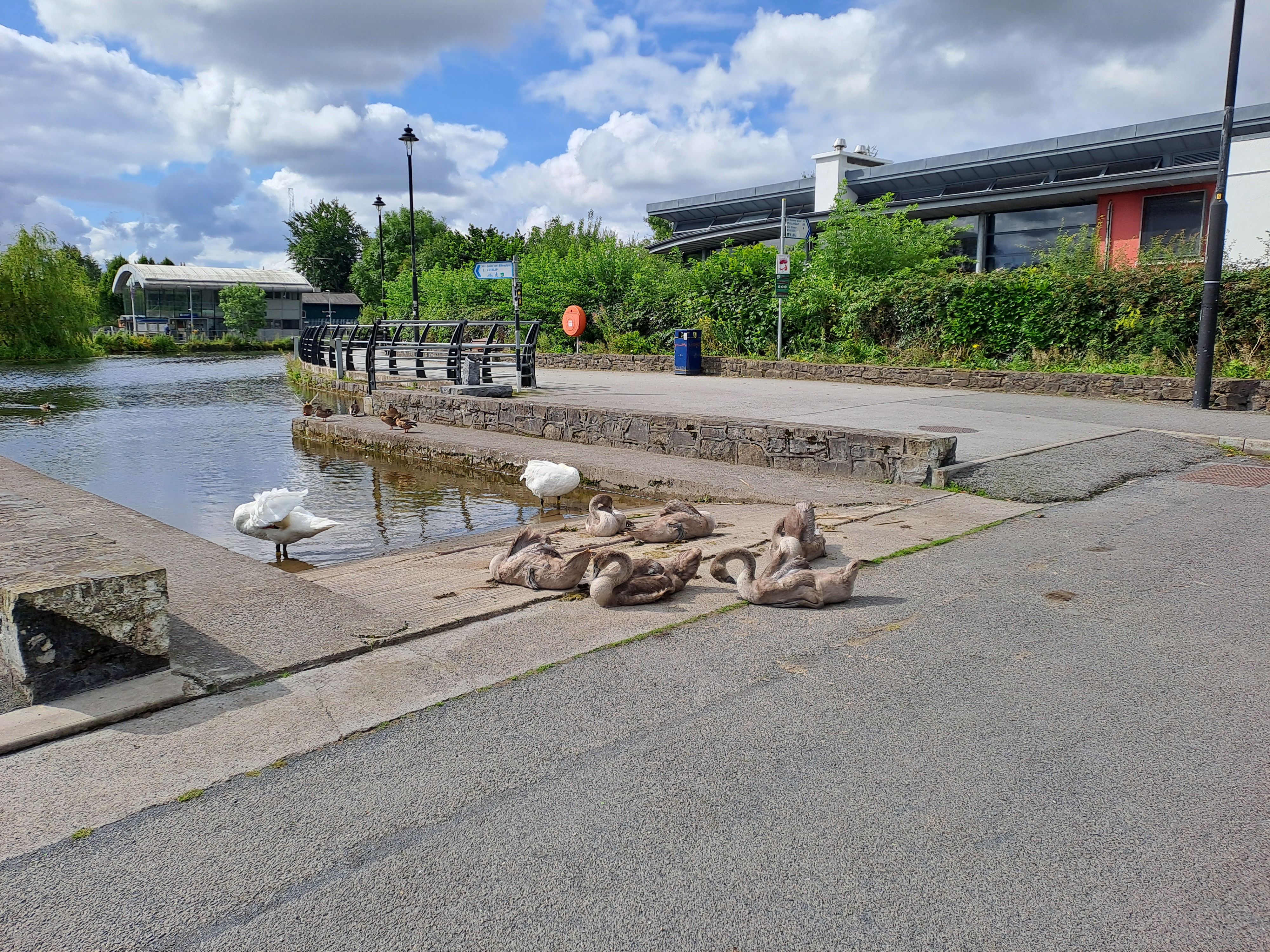
It has been not quite three months since I posted about the swans at Maynooth and, since I passed the family on the way in to work today I thought I’d give an update. Here they are on the left, compared with what they looked like in May.

You’ll notice two main differences.

One is that the cygnets are so much bigger, almost full size, although they still have their brownish colouring. They grow very quickly!

The other difference is that there are only six cygnets in the recent picture, while there were seven originally. It’s not unusual for one or two to fall by the wayside, but what happened in this case is that one of them had a damaged tail, and the others seemed to be bullying it. The wildlife people therefore decided that it was best to take it away, fix its injuries, and find it a home elsewhere. That was a few weeks ago. As far as I know, it survived.

All-Ireland Hurling Final Day!

Posted in GAA with tags , , on July 23, 2023 by telescoper

Today’s the day! It’s the All-Ireland Senior Hurling Championship Final at Croke Park, between Kilkenny and Limerick (reigning champions). The weather isn’t as bad as forecast, but it’s still a bit wet. I’m hoping for a cracking match. The atmosphere in Ireland on this very special day is very much like it used to be for the FA Cup Final when I was a kid. Maynooth is closer to Kilkenny than Limerick but I saw more green shirts than black-and-amber in town this morning. I hope it’s a cracking match between two fierce rivals. In fact it’s a repeat of last year’s final.

Anyway, we’ve just had the throw-in. Updates later!

Half Time: Kilkenny 1-09 Limerick 0-09

It’s not a disappointment so far, in front of a crowd of 82,300. In the words of commentator Marty Morrissey “It’s a right old battle”. Kilkenny, giving it everything in a frantic, bruising match, are deservedly leading by 3 courtesy of a goal by Eoin Cody in the 10th minute. But Limerick are a strong, physical side can they get back into the game? Can Kilkenny keep up the intensity?

Full Time: Kilkenny 2-15 Limerick 0-30

So, after a dominant second-half display, Limerick win it comfortably, by 9 points. Kilkenny just couldn’t keep up the pressure on in the middle third of the pitch, allowing Limerick to rack up a big score with points from long range. For Kilkenny it was like a boxer fighting an opponent with a much longer reach. The longer the game went on the stronger Limerick got, and the more Kilkenny’s brave challenge faded.

That’s four in a row for Limerick, deserved Champions yet again!

New Publication at the Open Journal of Astrophysics

Posted in OJAp Papers, Open Access, The Universe and Stuff with tags , , , , , , on July 22, 2023 by telescoper

Time to announce yet another new paper at the Open Journal of Astrophysics. This one was published yesterday, on 21st July 2023.

The latest paper is the 27th  so far in Volume 6 (2023) and the 92nd in all. The authors are Sohan Ghodla, Richard Easther, M.M. Briel and J.J. Eldridge, all of the University of Auckland in New Zealand.

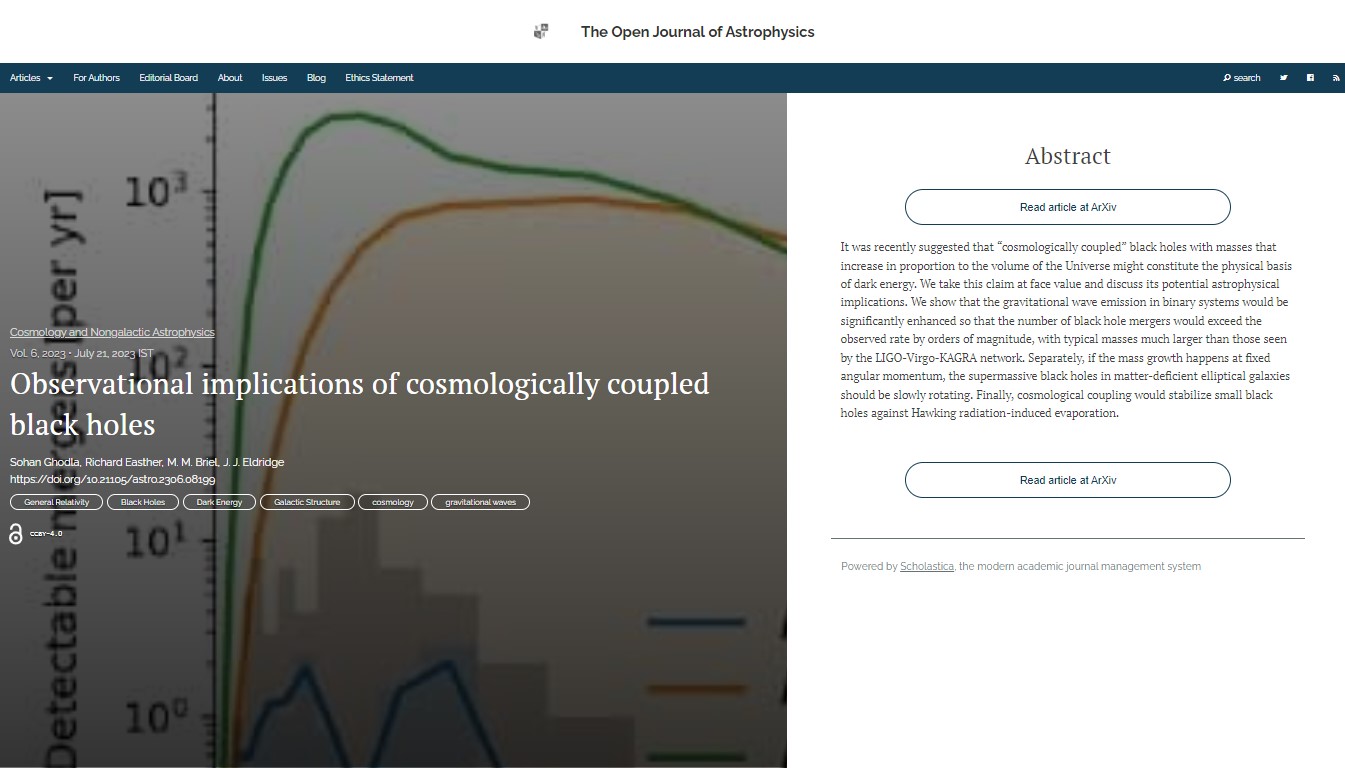
The primary classification for this paper is Cosmology and Nongalactic Astrophysics and its title is “Observational implications of cosmologically coupled black holes”.  The paper elucidates some of the consequences of a suggestion that the interaction between black holes and the global properties of space-time underlying explanation for dark energy. The key result is that the existence of cosmologically-coupled black holes implies a much larger rate of black-hole merger events than is observed.

The papers to which this is a response are mentioned here. For reference ,these earlier works were published in The Astrophysical Journal and The Astrophysical Journal Letters. There is also a detailed twitter thread about this paper by Richard Easter, posted when it was submitted as a preprint to the arXiv last month:


Anyway, here is a screen grab of the overlay of the published version which includes the  abstract:


You can click on the image of the overlay to make it larger should you wish to do so. You can find the officially accepted version of the paper on the arXiv here.

R.I.P. Tony Bennett (1926-2023)

Posted in Jazz, R.I.P. with tags , , , , on July 21, 2023 by telescoper

I just heard that the great singer Tony Bennett has passed away, just a couple of weeks short of his 97th birthday. In 2021, Bennett revealed that he was living with Alzheimer’s, a condition that had been diagnosed in 2016, but he had continued to perform until that announcement. His death does not come as a shock, but it is always sad to hear of the death of a legend.

What can I say about about Tony Bennett, except that I absolutely adored his singing? In fact I think he got better with age, his older voice showing even greater artistry in phrasing and melodic invention than when he first emerged as a star performer in the 1950s. He was admired by people across the generations, across different musical genres, and by the harshest judges of all – other musicians.

By way of a tribute I thought I’d pick a tune from my favourite album of his, recorded back in 1975 with Bill Evans on piano. I think the intimate combination of his voice with only a piano accompaniment suited him very well indeed. I’ve picked this tune, Days of Wine and Roses, which Henry Mancini wrote for an excellent film of the same name.

I picked this track, partly because it is lovely, but also because its title reminds me of a little poem by Ernest Dowson entitled Vitae Summa Brevis Spem Nos Vetat Incohare Longam, which I translate from my half-remembered schoolboy Latin as something like “the brief span of Life forbids us from conceiving an enduring hope”. It’s a quotation from one of the Odes of Horace (Book I, Ode 4, line 15). These aren’t the lyrics of the song, but seem apt in the circumstances:

They are not long, the weeping and the laughter,
Love and desire and hate:
I think they have no portion in us after
We pass the gate.

They are not long, the days of wine and roses:
Out of a misty dream
Our path emerges for a while, then closes
Within a dream.

Rest in peace, Anthony Dominick Benedetto (1926-2023).

Guest Post: Update from Hannelore

Posted in Harassment Bullying etc with tags , on July 20, 2023 by telescoper

Last November, I published an anonymous guest post entitled The Bullying of Hannelore by a Professor of Astronomy, recounting the bullying of a member of administrative staff (referred to pseudonymously as Hannelore) in an Astronomy Department in the UK. That was subsequently followed by a post giving Hannelore’s own side of the story. This post, again from Hannelore herself, is an update showing that an already shocking story is getting worse as time goes on.

As before, all the names have been changed and the institution is not identified. Among other features of the response to the previous posts, it was remarkable how many people from different institutions inferred that they were about their own institution, which strongly suggests that bullying of the sort described is endemic in UK universities.

Update from Hannelore

Hannelore has been bullied by her Head of Department. The evidence is overwhelming. Those aware of it are shocked by the cruelty of her treatment. Meanwhile careful information management, also known as confidentiality, ensures the belief is upheld that “there is another side to the story” while the full story is never told.

Before being set upon Hannelore was a popular member of her department, known for reliability and competence, and for going above and beyond to support others.

A helpful HR person proposed that she summarise her concerns about the director’s behaviour informally, in writing. Since Hannelore was afraid of raising a grievance of her own, they were included into someone else’s – which was itself investigated under the wrong policy. The helpful HR person had been busy setting up an independent investigation, i.e. one in which she herself became a witness while discussing with others the potential application of a forthcoming investigation report.

The report was duly delivered. There was no substance to Hannelore’s concerns, but instead of malice, it was the strength of her perceptions and the veracity of her feelings which were cited as their cause. Hannelore could not now be punished for unfounded allegations, at least not in accordance with the University’s Dignity at Work policy.

But the director saw it differently, proposing a catalogue of retaliatory measures, associated instead with the veracity of Hannelore’s feelings – another word for her mental health. There was now evidence, in a report, which the director delighted in sharing with others, that the formerly trustworthy Hannelore was in fact a risk to others, as well as to herself.

A redundancy notice swiftly followed. There was no bandwidth in the department to address the issues identified in the report. The director spoke of “zeroing out” the grant funding her, while the helpful HR person mused that Hannelore’s role surely would be taken over by another institution…


The whistle was blown at the abuse. Appalled colleagues intervened, where HR and senior management had failed. A protected disclosure was made, on the grounds of health and safety. Within hours of Hannelore’s funding finally signed off, the three senior professors who had assisted her became the victims of a string of vicious allegations, 18 of them in total, all made by the director and ranging from falsifying documentation to misusing Hannelore’s distress as a means of alleging inappropriate behaviour on his part.


The 18 allegations were taken most seriously. Not entertaining the possibility of error or even exaggeration, the helpful HR person suggested immediate escalation to a formal investigation.
A year-long process, conducted by an expensive barrister, enabled the director to finish his term, but failed to extract a single shred of evidence to substantiate any of his 18 extremely serious claims. In the meantime, Hannelore’s colleagues remained accused, potential bullies waiting to be cleared of fictitious wrongdoing.


In tandem, the same investigator had also examined the bullying of Hannelore. Here, there was no shortage of evidence. It was all the more unfortunate, therefore that the terms of reference, drawn up by the helpful HR person, didn’t quite capture the substance of the investigation conclusions: It was not Hannelore who had been viciously bullied, but her colleague, a senior professor coerced by the director into giving up most of his grants, to one of the director’s friends, including eventually the one funding Hannelore. Ignominious behaviour was indeed reported and evidenced. The damage done to Hannelore was recognized – but only as collateral damage. So, there would be no case to answer, the “responsible” person concluded in carefully drafted words.

As to the 18 grotesque allegations which were made against Hannelore’s colleagues, some identified by a High Court judge as properly defamatory, they were minimized, summarized, and repackaged into another set of aptly drafted terms of reference, to form the premise to the investigation conclusion.


In somewhat patchy English it was communicated to Hannelore’s colleagues that the lack of substance in the 18 very serious allegations was unfortunate, and that consequently the allegations, at least those which were investigated, would not be upheld. A surely most fortunate conclusion, given the gravity of the alleged conduct.

As to disciplining the accuser, a little more wordsmithing had seen to that, at the expense of common sense: the concept of malicious, as defined by the Dignity at Work policy – unfortunately – did not allow for it to be matched to the making of unfounded allegations of a very serious nature… Not even an apology would be required.

More outcome letters were signed and sent by senior management, adding insult to the injury already suffered by their former colleagues and fellow academics – with HR looking on, ready to assist with more helpful process, more helpful advice, and more helpful drafts, to manage the undignified environment they contribute to create.


And so, the artifices of process and policy, used and abused in a court-inspired pantomime turn an academic institution into a theatre of the absurd. Helpfully drafted conclusions, which are no longer their own, enable its most senior people to be “responsible” without accountability for the judgement they make, and to argue unashamedly that the implausible is indeed plausible, the indefensible defensible, and the institution’s values a thing of the past.
Four New Publications at the Open Journal of Astrophysics

Posted in OJAp Papers, Open Access, The Universe and Stuff with tags , , , , , , , on July 19, 2023 by telescoper

Time for an update at the Open Journal of Astrophysics. Owing to a well-deserved holiday by a member of the OJAp team, we were unable to register DOIs and associated metadata for a couple of weeks so refrained from announcing new papers during this period while other functions of the journal continued. Anyway, this week we have caught up with the backlog of four papers, which I now present to you here, all published on 17th July 2023. These four take the count in Volume 6 (2023) up to 26 and the total published by OJAp up to 91.

In no particular order, the four papers published this week, with their overlays, are as follows. You can click on the images of the overlays to make them larger should you wish to do so.

“Large-scale power loss in ground-based CMB mapmaking” by Sigurd Naess (Oslo, Norway) and Thibaut Louis (Saclay, France). This one is a discussion of the possible biases introduced by using a data model to create sky maps of CMB temperature fluctuations and is in the folder marked Instrumentation and Methods for Astrophysics.

Here is a screen grab of the overlay, which includes the abstract:


You can find the officially accepted version of the paper on the arXiv here.

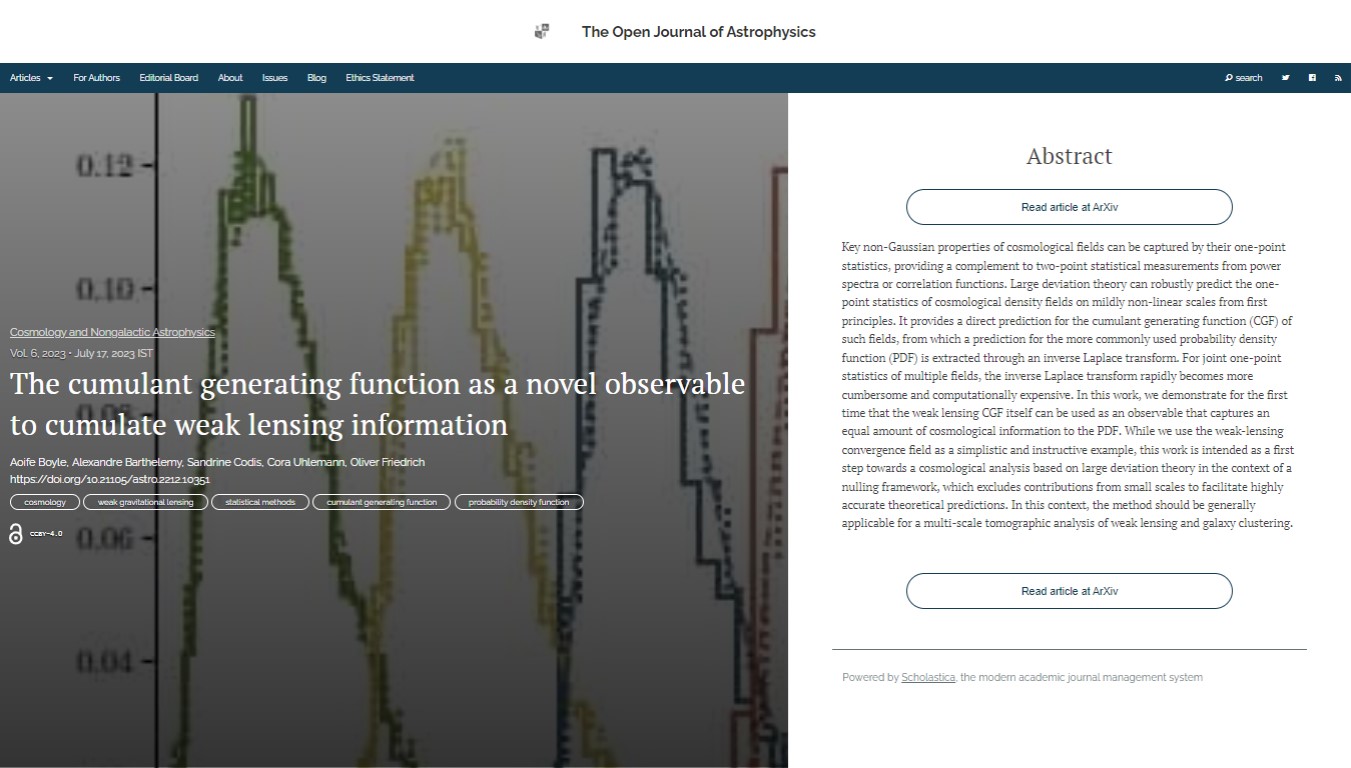
The primary classification for the next paper paper is Cosmology and Nongalactic Astrophysics and its title is “”The cumulant generating function as a novel observable to cumulate weak lensing information”. The authors are Aoife Boyle (Saclay, France), Alexandre Barthelemy (LMU, Germany), Sandrine Codis (Saclay, France), Cora Uhlemann (Newcastle, UK) & Oliver Friedrich (LMU, Germany). The paper explores the use of the cumulant generating function (CGF), from which the probability density function (PDF) can be obtained, in the context of weak gravitational lensing information.

You can click on the image of the overlay to make it larger should you wish to do so. You can find the officially accepted version of the paper on the arXiv here.

Also in the folder marked Cosmology and Nongalactic Astrophysics is the third paper “Cosmology with 6 parameters in the Stage-IV era: efficient marginalisation over nuisance parameters” by B. Hadzhiyska (Berkeley, USA), K. Wolz (Trieste, Italy), S. Azzoni (Oxford, UK; Tokyo, Japan), D. Alonso (Oxford, UK), C. García-García (Oxford, UK), J. Ruiz-Zapatero (Oxford, UK) and A. Slosar (Tokyo, Japan). This presents an efficient analytical method to speed up marginalization over nuisance parameters introduced to model systematic effects in large-scale structure data.

Here is a screen grab of the overlay which includes the abstract:


You can find the officially accepted version of the paper on the arXiv here.

The final paper in this quartet, also in Cosmology and Nongalactic Astrophysics, is “Modeling the Galaxy Distribution in Clusters using Halo Cores” by D. Korytov, E. Rangel, L. Bleem, N. Frontiere, S. Habib, K. Heitmann, J. Hollowed, and A. Pope (all of the Argonne National Laboratory, USA). This presents a new method to speed up numerical simulations using a method of simplifying the handling of substructure in galaxy clusters using halo ‘core-tracking’.

The overlay of this one is here:


You can find the officially accepted version of the paper on the arXiv here.

The Mysterious Case of Christine Moran

Posted in Maynooth on July 18, 2023 by telescoper
Christine Moran

Until a few weeks ago, accountant Christine Moran (pictured above) was a prominent member of the Governing Authority of Maynooth University. She is still listed described as such here.

Then she suddenly resigned her position. A statement from the University to this effect can be found here:

Maynooth University Governing Authority member, Christine Moran, has resigned from her position on the Authority with immediate effect and will no longer work with the university in any capacity.  
 
While Ms Moran’s reasons for resigning are not linked to Maynooth University or her role with the organisation, she is resigning her position to best serve the interests of the university.

Maynooth University Website, retrieved 18th July 2023

All other mention of Christine Moran has been removed from the University website. I must have missed the communication to all staff of the University explaining the reasons for this sudden departure, so can only speculate.

Perhaps it was due to this story about someone who allegedly requested a payment of €225,000 not to block a housing development in Dublin?

Shouldn’t we be told the reason? Shouldn’t a public-funded institution adopt the principles of openness and transparency about its governance?

And what does this case imply about the confidence we can have in the procedures involved in selecting members of Maynooth’s Governing Authority?

Answers on a postcard please.

Dunkirk

Posted in Biographical, Film, History with tags , , on July 17, 2023 by telescoper

On Saturday I watched the 2017 film Dunkirk for the first time. I don’t often watch films on TV but I saw this one in the listings and since it got some very positive reviews I thought I’d watch it. Here’s the trailer.

So what did I think?

First, the positives. There is some wonderful cinematography in this movie, and some realistic action sequences that manage to be disturbing without degenerating into a gorefest. It’s also quite interesting that we don’t really see the enemy at all at any point during the film. In summary, I found the first forty minutes or so very gripping, despite (or perhaps because of) the almost complete lack of dialogue.

After that, though, my interest began to wane. The main negative is that I found it hard to engage with any of the characters. In particular, the film did not convey the stress the troops must have been under. The editing was a bit of a mess too. It’s far too repetitive and I found some of the scenes rather contrived.

(I gather some people found the sound in the cinema version rather oppressively loud, but I watched it on telly at home so just turned down the volume…)

Overall, I found Dunkirk worth watching, but I’ve seen it described as one of the greatest war films of all time and it’s not that.

Three historical points.

First, I think there’s a key ingredient missing from this – and some other – tellings of the Dunkirk story, and that is the crucial role of the rearguard that valiantly defended the perimeter of the town and won enough time for evacuation to proceed. The different units of the rearguard (both French and British) depended entirely on the units either side of them to stand. Had the perimeter been broken anywhere, the defence would have failed. The men involved must have thought that they had no chance of making it back to Britain, but they held their ground and by doing so ensured that many thousands did get home. In fact, it was such a well-organized operation that much of the British rearguard was actually evacuated after a controlled retreat to the beach.

A second point is that most of the over 800 small boats that eventually proved crucial in Operation Dynamo were crewed by naval personnel, rather than their owners. The few exceptions were fishing boats, like the one shown in the film. Many of the smaller ships with a shallow draft were used to ferry men from the beach to destroyers rather than taking them all the way back to England.

Incidentally, the trip from Ramsgate – where the little boats were assembled – to Dunkirk is about 50 miles of open water. That’s quite a journey for a pleasure boat or paddle steamer.

Finally, the film reminded me that Winston Churchill’s famous speech in response to the “miracle” of Dunkirk, with its peroration “We shall fight them on the beaches, etc” was given to the House of Commons. It includes this:

We must be very careful not to assign to this deliverance the attributes of a victory. Wars are not won by evacuations. But there was a victory inside this deliverance, which should be noted.

Hansard, 4th June 1940

Churchill made that speech on 4th June 1940. I was born on the same day in the same month, a mere 23 years later.

Euclid in Space!

Posted in Euclid, The Universe and Stuff on July 16, 2023 by telescoper

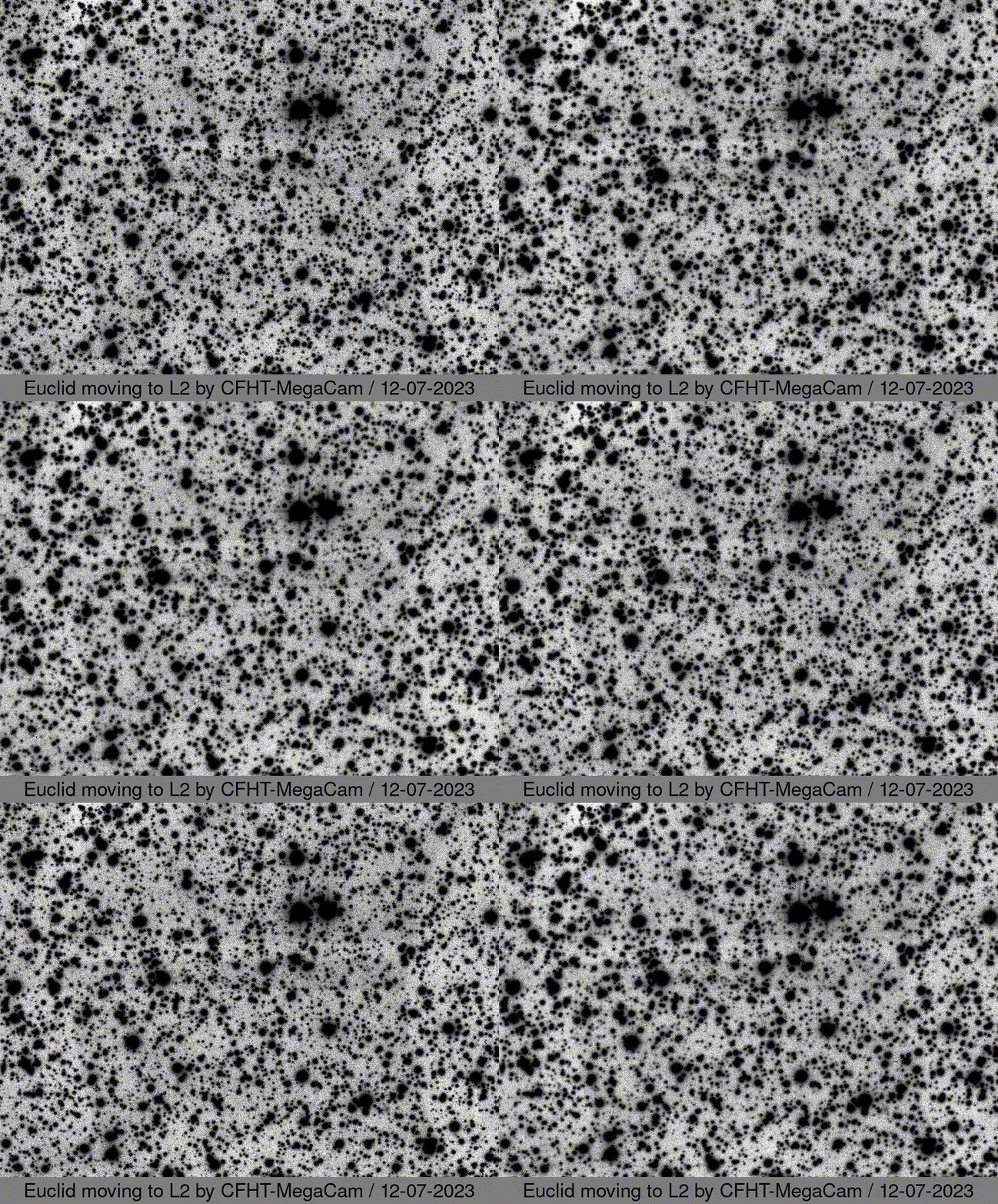
I saw this little movie on the ESA Update page for Euclid and couldn’t resist sharing it here. It’s a montage of images from the Canada-France Hawaii Telescope (CFHT); the object you see moving upwards in the centre of the frame is none other than the Euclid spacecraft, hurtling towards its destination at the 2nd Lagrange Point. You will see other moving objects. I’m not sure what they are but the field is in the ecliptic plane so they’re likely to be small solar system objects, probably asteroids.

Incidentally, people keep asking me for updates about Euclid. Although I am privy to the regular updates available to members of the Euclid Consortium, I am not allowed to publish anything on here that’s not already in the public domain nor would I want to, lest anyone think I would presume to speak on behalf of either ESA or the Euclid Consortium via the medium of a personal blog. You can follow the official updates here from people who actually understand everything that is going on!

I will just say that all the key steps so far – a critical orbit manoeuvre needed to get into the correct trajectory for L2, a temporary rotation of the spacecraft to allow it to heat up and to allow residual gas to evaporate, deployment of the high-gain antenna (essential to send data back to Earth), and the switching on of the two instruments (NISP and VIS) – have taken place in good order. There is however a long way to go before everything is tested, verified, calibrated and ready for action. It’s a very busy time for the engineers and instrumentalists; we just need to give them the time they need to work their technical magic!

Astronomical Observatories on Indigenous Land

Posted in Euclid, Politics, The Universe and Stuff with tags , , , , , , , , on July 15, 2023 by telescoper

I’ve been meaning to post about for some time about the use of telescopes all around the world that reside in observatories on lands previously and/or presently occupied by indigenous peoples. The creation of these astronomical facilities has been accompanied by neglect (and sometimes violent displacement) of tribal communities native to the land on which they now stand. Though we exploit native lands for science, the astronomical community makes little reference to the people who are directly impacted by the advancement of astronomy through colonialism of this sort.

I know I’m not alone in thinking that, at the very least as a community we should do much more to acknowledge our use of astronomical facilities built on land that in many cases was basically “stolen” by colonial settlers. There was a talk about this issue at the recent Euclid Consortium Meeting in Copenhagen, and it came up at the National Astronomy Meeting in Cardiff in the context of the broad issue of the decolonization of astronomy.

Anyway, just for a start I have included here a small gallery of images of modern astronomical observatories of various kinds, with captions giving the names not of the observatory, but of the indigenous peoples upon whose land it is built:

There are many more than these, but hopefully you get the point. The question is: what to do about it?