Archive for October, 2023

On Samhain

Posted in Biographical with tags , on October 31, 2023 by telescoper

So we have arrived at October 31st, Hallowe’en or, in pagan terms, Samhain. This, a cross-quarter day – roughly halfway between the Autumnal Equinox and the Winter Solstice – represents the start of winter (“the dark half of the year“) in the Celtic calendar. Technically, Samhain is tomorrow, 1st November, but the Celtic practice of reckoning days from sunset to sunset makes this a moot point.

Samhain is pronounced something like “sowin”. The h after the m denotes lenition of the consonant (which in older forms of Irish would have been denoted by a dot on top of the m) so when followed by a broad vowel the m is pronounced like the English “w”; when followed by a slender vowel or none “mh” is pronounced “v” or in other words like the German “w” (which makes it easier to remember). The phrase Oíche Shamhna (the Eve of Samhain) is used for Hallowe’en; it contains the genitive form of Samhain.

Anyway, as it was foretold, I am not in Barcelona and will continue to be not-in-Barcelona for a few days. Indeed, tomorrow, if all goes to plan, I’ll be in a different part of non-Barcelona. With all that running about I’m a bit busy for a proper blog post so I’ll just take the opportunity to point out that yet another anagram of my name is El Espectro

Oíche Shamhna shona daoibh go léir!

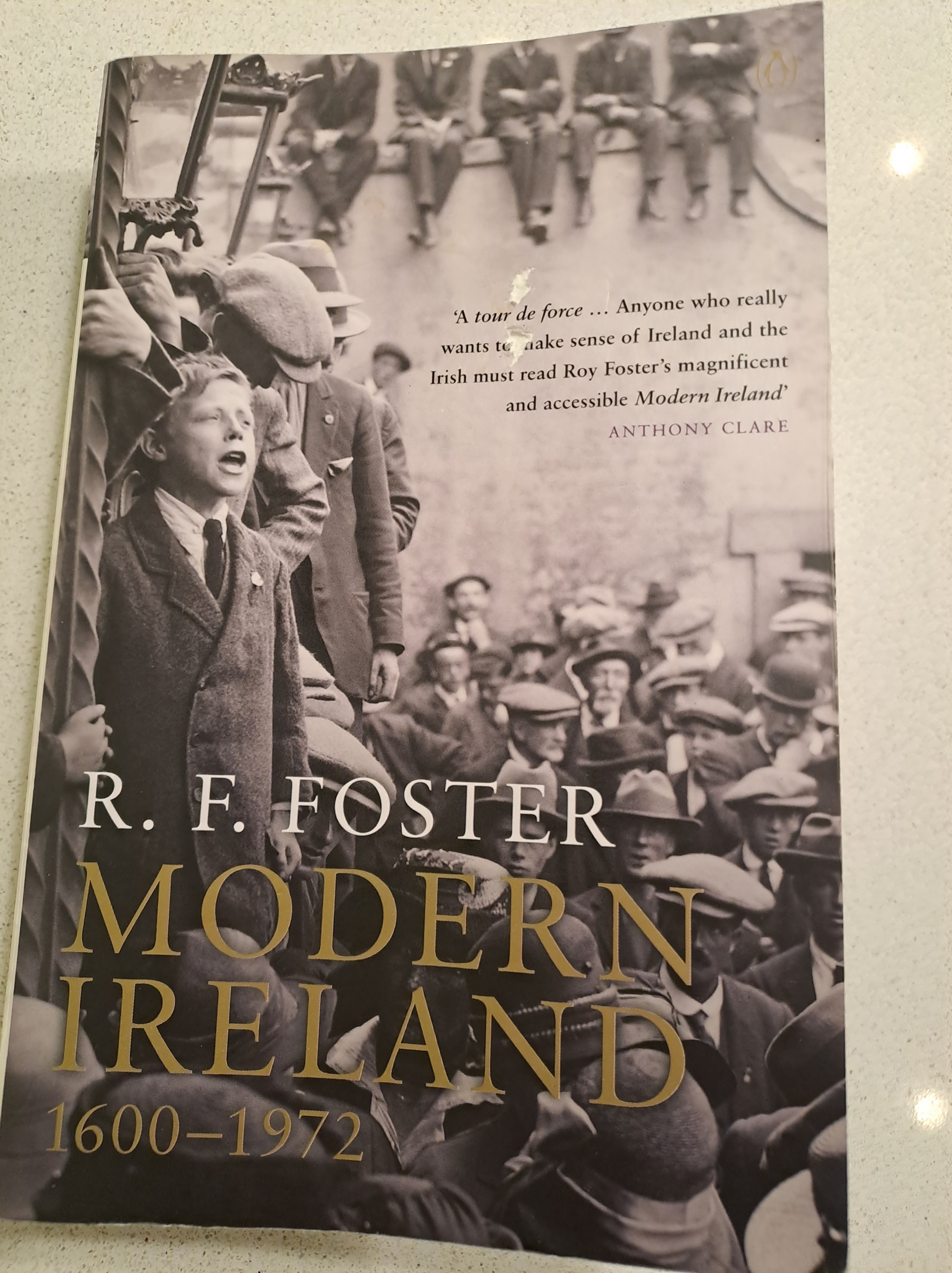
Modern Ireland 1600-1972 by R. F. Foster

Posted in History, Literature with tags , , , , on October 30, 2023 by telescoper

My attempt to catch up with a backlog of reading while on sabbatical has now brought me to Modern Ireland, by R.F. Foster, the paperback version of which, shown above, I bought way back in 2018 but have only just finished reading. In the following I’ll describe the scope of the book and make a few observations.

The book was first published in 1988 so it obviously can’t deal with more recent events such as the Good Friday Agreement. The narrative stops almost 50 years ago in 1972, the year of Bloody Sunday and just before Ireland joined the European Economic Community in 1973, but since it starts way back in 1600 one can forgive Roy Foster for not covering such recent events. The start is in what is usually termed the early modern period, but if truth be told much of Irish society at that point was still organized on mediaeval lines.

To set the scene, Foster starts with a description of the three main sections of the population of Ireland in 1600. These were the (Gaelic and Catholic) Irish, the “Old English”, descendants of the 12th Century conquest of part of the country, who were also Catholic, and the Protestant “New English” who arrived with the Tudor plantations. There were tensions between all three of these groups.

The rest of the book is divided into four parts, roughly one per century: Part I covers the continued Elizabethan plantation of Ireland, rebellions against it, the devastation caused by Cromwell’s so-called “pacification”, and the Penal Laws that basically outlawed the Catholic faith. In Part II Foster discusses a period often called The Ascendancy which showed the consolidation of power in the hands of a Protestant – specifically Anglican – ruling class, though there was a sizeable community of non-conformist Protestants, chiefly Presbyterians, who were regarded by Anglicans with almost as much suspicion as the Catholics. This Part ends with yet another failed rebellion, involving Wolfe Tone and the United Irishmen, against the backdrop of the French revolution. Up until the Act of Union of 1800, Ireland had its own Parliament; after that Irish MPs were sent to the House of Commons in Westminster. The century covered by Part III includes the Irish Famine, rising levels of rural violence, and issues of land reform, and various attempts to deliver some form of Home Rule; it ends with Charles Stewart Parnell. Part IV covers the Easter Rising, War of Independence, Civil War, Partition, the creation of the Irish Free State, and the eventual formation of the Irish Republic. A running theme through all four Parts is a recognition of how historical forces – and not only religion – shaped Ulster in a different way from the rest of Ireland.

As I’ve said before on this blog, it disturbs me quite how little of this history I was taught at school in England so I found it valuable to read a detailed scholarly work whose main message is that everything is much more complex than simple narratives – those peddled by politicians, for example – would have you believe. This is primarily a revisionist history, calling much of received wisdom into question. That said, it’s probably not the best book for a newcomer to Irish history. Foster does assume knowledge of quite a few of the major events and, while reading it, I did have to look quite a few things up. Much is said in the jacket reviews of the author’s writing style. To be honest, I found it sometimes rather mannered and self-conscious, though with some enjoyably arch humour thrown in for good measure. It’s thoroughly researched, as far as that is possible when primary sources are sketchy and contemporary records usually written by someone with an axe to grind. It does seem to rely mainly on documents written in English, however, so one might argue that introduces quite a bias. I gather that there is much greater emphasis among contemporary Irish historians on records written in Irish (Gaelic).

The book is rather heavy on footnotes, too. Usually I dislike these, but in this case they are mostly little biographical sketches of important figures which would have disrupted the flow if included in the main text, and I found many of them valuable. Just to be perverse, I have to say I liked his liberal use of semicolons. Though dense, the books is as accessible as I think a scholarly work can be and although I am not so much a scholar of history as an interested bystander, I learnt a lot. It also made me want to learn more, especially about the period between the death of Parnell in 1891 and the Easter Rising of 1916.

It seems apt to finish with an excerpt that illustrates a theme that crops up repeatedly during the 23 chapters of the book:

Irish history in the long period since the completion of the Elizabethan conquest concerned a great deal more than the definition of Irishness against Britishness; this survey has attempted to indicate as much. But that sense of difference comes strongly through, though its expression was conditioned by altering circumstances, and adapted for different interest-groups, as the years passed. If the claims of cultural maturity and a new European identity advanced by the 1970s can be substantiated, it may be by the hope of a more relaxed and inclusive definition of Irishness, and a less constricted view of Irish history.

Modern Ireland, R. F. Foster, p596

I hope that too. It may even be happening.

Euclid Update!

Posted in Euclid with tags , , , on October 30, 2023 by telescoper

Just a quick post to give advanced notice that, gremlins in the pointing system having been dispelled, the first actual science images from European Space Agency’s Euclid mission will be released on Tuesday 7th November at 14.00 Central European (not Summer) Time, CET. These are called the Early Release Observations (EROs) – they won’t be part of the full survey, but are just to demonstrate the performance of the telescope and detectors.

You can watch the press conference on the new ESA Web TV channel. I’ll post more about the EROs after they become public, but not before.

It’s That Time Again…

Posted in Barcelona, History with tags , , on October 29, 2023 by telescoper

It’s 29th October 2023, which marks the end of “Summer Time” in Europe. Accordingly, the temperature in Barcelona has plummetted to 22°C. I have to make a flying visit to the UK next week and I suspect that I’m in for a bit of a shock, having adjusted to these balmy climes.  I have numerous telecons next week too and, since  some parts of the world will be still on Daylight Saving Time (or whatever) there’s potential for confusion in the timing.

Some time ago, before the Covid-19 Pandemic, the European Parliament approved a directive that would abolish `Daylight Saving Time’.  Unfortunately that plan has been ‘paused’ and there’s no sign of it happening for the foreseeable future.  I’ve long felt that the annual ritual of putting the clocks forward in the Spring and back again in the Autumn was a waste of time effort, so I’ll be glad when this silly practice is terminated. It would be far better in my view to stick with a single Mean Time throughout the year. I’m only disappointed that this hasn’t happened already.

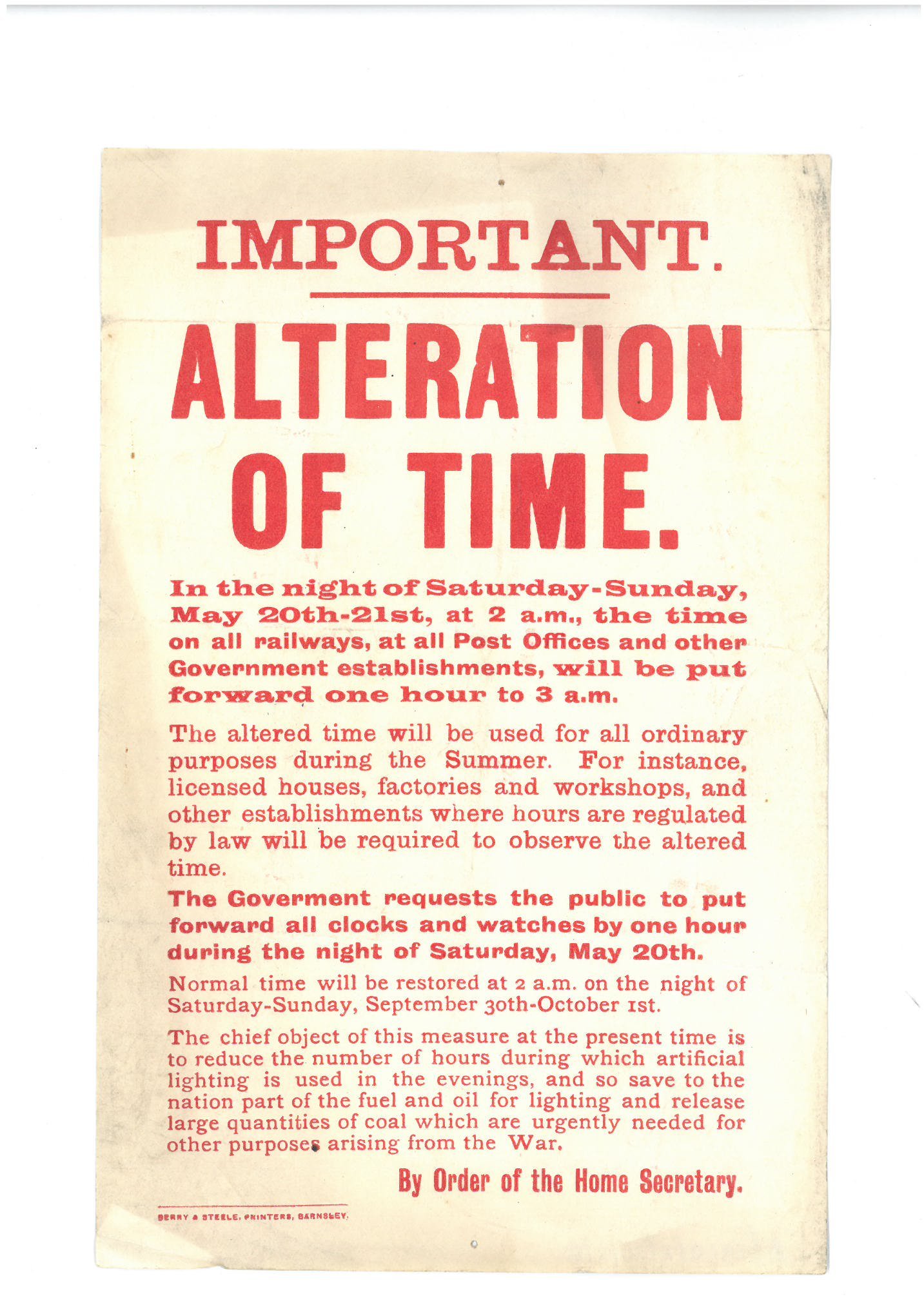
The marvellous poster above is from 1916, when British Summer Time was introduced. I was surprised to learn recently that the practice of changing clocks backwards and forwards in the UK is only about a hundred years old and was introduced as an emergency measure in wartime. To be honest I’m also surprised that the practice persists to this day, as I can’t see any real advantage in it. Any institution or organisation that really wants to change its working hours in summer can easily do so, but the world of work is far more flexible nowadays than it was a hundred years ago and I think very few would feel the need.

Anyway, while I am on about Mean Time, here is a another poster from 1916.

Until October 1916, clocks in Ireland were set to Dublin Mean Time, as defined at Dunsink Observatory, rather than at Greenwich. The adoption of GMT in Ireland was driven largely by the fact that the British authorities found that the time difference between Dublin and London had confused telegraphic communications during the Easter Rising earlier in 1916. Its imposition was therefore, at least in part, intended to bring Ireland under closer control. This did not go down well with Irish nationalists.

Ireland had not moved to Summer Time with Britain in May 1916 because of the Easter Rising. Dublin Mean Time was 25 minutes 21 seconds behind GMT but the change to GMT was introduced in Ireland at the same time as BST ended in the UK, hence the alteration by one hour minus 25 minutes 21 seconds, i.e. 34 minutes and 39 seconds as in the poster.

Britain will probably never scrap British Summer Time on the grounds that whatever the EU does must necessarily be bad. What will happen to Northern Ireland when Ireland scraps Daylight Saving Time is yet to be seen.

The Rugby World Cup Final

Posted in Rugby with tags , , on October 28, 2023 by telescoper

So, after a tense, scrappy, and error-strewn final, South Africa have retained the Rugby World Cup by beating New Zealand 12-11, all the Springboks’ points coming from penalties kicked by Handré Pollard – shades of the 1995 final, when Joel Stransky kicked all the points for South Africa.

The game hinged on the sending-off of the New Zealand captain Sam Cane in the first half – a decision about which the All Blacks can have no complaints. Despite playing for over 50 minutes with only 14 men, New Zealand had chances to win, specifically the missed conversion of the game’s only try, which would have made it 13-12.

But you can’t blame anyone else if you don’t take your chances, so congratulations to South Africa!

It’s been a strange World Cup, with some cracking games, a fair share of heartbreak (especially for Ireland and France), and an absurdly unbalanced draw. Let’s hope the arrangements for 2027 are thought out better!

Stardust – Ruby Braff

Posted in Jazz with tags , on October 28, 2023 by telescoper

Rueben “Ruby” Braff is probably better known as a cornet player than a trumpeter, but whenever he did play the trumpet he showed why Jack Teagarden dubbed him “the Ivy League Louis Armstrong”. Here’s a gorgeous performance by him of the Hoagy Carmichael classic Stardust in which he wears the influence of Louis Armstrong on his sleeve.

P.S. The pianist on this track is a young Dave McKenna.

Teaching in Base 60

Posted in Barcelona, Cardiff, History, mathematics, Maynooth with tags , , , , on October 27, 2023 by telescoper

Some time ago – was it really over a decade? – I wrote a piece about the optimum size of modules in physics teaching. I was still in the United Kingdom then so my ramblings were based on a framework in which undergraduate students would take 120 credits per year, usually divided into two semesters of 60 credits each. In Cardiff, for instance, most modules were (and still are) 10 credits but some core material was delivered in 20 credit modules. In the case of Sussex, to give a contrasting example, the standard “quantum” of teaching was the 15 credit module. I actually preferred the latter because that would allow the lecturer to go into greater depth, students would be only be studying four modules in a semester (instead of six if the curriculum consisted of 10 credit modules), and there would be fewer examinations. In short, the curriculum would be less “bitty”.

In Maynooth the size of modules is reckoned using the European Credit Transfer System (ECTS) which takes a full year of undergraduate teaching to be 60 credits rather than 120 in the UK, but the conversion between the two is a simple factor of two. In Maynooth the “standard” unit of teaching is 5 credits, with some 10 credit modules thrown in (usually extending over two semesters, e.g. projects). This is similar to the Cardiff system. The exception concerns first-year modules, which are 7.5 credits each because students take four modules in their first year so they have to be 30/4=7.5 credits each. The first year is therefore like the Sussex system. It changes to a five-credit quantum from Year 2 onwards because students do three subjects at that stage.

I find it interesting to compare this with the arrangements here in Barcelona (and elsewhere in Spain). Here the ECTS credit size is used, but the standard module is six credits, not five, and year-long projects here are 12 credits rather than 10. The effect of this is that students generally study five modules at a time (or four plus a project). To add to the fun there are also some 9 credit modules, so a semester could be made up of combinations of 6-credit and 9-credit chunks as long as the total adds up to 30.

Anyway, the main point of all this is to illustrate the joy of the sexagesimal system which derives from the fact that 60, being a superior composite number, has so many integer divisors: 2, 3, 4, 5, 6, 12, 15, 20, and 30. The Babylonians knew a thing or two!

The 21 Group – Guest Post by Wyn Evans

Posted in Harassment Bullying etc with tags , , , , , on October 26, 2023 by telescoper

Here’s an important piece by Professor Wyn Evans of Cambridge University relating to the theme of harassment and bullying which I’ve returned to several times on this blog. I strongly support the creation of the 21 Group and agree with the recommendations made in the post below. Indeed, I have myself made a similar suggestion in the context of sexual harassment that the people involved in investigations of such cases…

…should not be employees of the university in question, as they would come under pressure to hush things up – which clearly happens now. It seems to me that far too many institutions prioritize limiting reputational damage over doing the right thing for their staff and students.

https://telescoper.blog/2019/06/12/investigating-sexual-harassment-in-universities/

Now over to Wyn.

—o—

My article on Whistleblowing in the UK Universities is in The Times Higher Education Supplement this week:

https://www.timeshighereducation.com/opinion/investigating-serious-abuses-must-be-taken-out-universities-hands

Whistleblowing is ineffective in the UK Universities. There is no protection for whistleblowers. Any whistleblowing investigation is run by the university without properly independent scrutiny.

Self-directed investigations make no sense in an organisation in which poor behaviour has been tolerated for a long time. We have seen this in the scandals in the Post Office, in the NHS and in the Metropolitan Police.

The Universities are no exception. Organisations that investigate themselves exonerate themselves. They look for rugs enormous enough to sweep everything under.

Universities need an independent Ombudsman to look into serious complaints.

This already exists for complaints by undergraduates. It is the Office of the  Independent Adjudicator for Higher Education.

https://www.oiahe.org.uk

If a student or a former student is dissatisfied with the handling of a matter by a University, then they can appeal to the independent adjudicator.

Postgraduate students and university staff do not have any such rights. We are regarded as ‘service providers’ rather than ‘paying customers’ in the monetized world of higher education.

Vice chancellors and senior managers from Cambridge to Maynooth pontificate that world-class universities are about ‘the people’. That’s where it ends. Senior management are indifferent as to whether the people in universities do actually work in an environment that promotes respect, dignity, safety and equality.

Pressure groups are needed to drive organisational and cultural change in the UK Universities.

So, we have founded the 21 Group

Our name derives from the fact that in a staff survey, 21% of employees at the University of Cambridge reported that they had been subjected to bullying or harassment in the workplace.

https://www.theguardian.com/education/2020/jan/07/third-cambridge-university-staff-experienced-bullying

The 21 Group operates nationally and offers support for staff in UK universities who are experiencing bullying, victimisation and harassment in the workplace. Amongst other things, we are running a national survey of bullying in the UK Universities.

Sadly, we have nothing to be proud of in astronomy. The only systematic survey of UK astronomy was carried out by the Royal Astronomical Society in 2020-2021. They obtained responses from over 650 people.

44% of respondents had suffered bullying and harassment in the workplace within the last year.

https://ras.ac.uk/news-and-press/news/survey-finds-bullying-and-harassment-systemic-astronomy-and-geophysics

A figure of 44% is grotesque. It is almost a half of all respondents.

The Royal Astronomical Society deserves full credit for conducting the survey and publishing the results. What is sad is that the UK astronomical community has not made any discernible efforts to improve matters since its publication in 2021.

Another Country

Posted in Barcelona, Biographical, Maynooth with tags , , on October 25, 2023 by telescoper

It was only when I looked at my calendar this morning, and saw the reminder that my rent is due shortly, that I realized that I have now been in Barcelona for a whole month (plus one day). Lacking the usual cycle of lectures and other teaching sessions, I’ve still had regular telecons and other virtual discussions through which to reckon the passage of time, but these are different. When I’m teaching I always number my lectures consecutively so it’s easy for me to look at my notes and see that we’re, say, approaching half-term. That gives me a sense of progress which I must admit I don’t feel with scheduled telecons, which seem more cyclic – i.e. going around in circles most of the time.

Other than that, I’ve settled in here better than I expected. I’ve even managed to memorize the codes needed to get into my flat – no mean feat given my fading powers of recollection. Progress on the research has been a bit slower than expected, but I hope to finish the paper I’m working on by the weekend.

Next week is Study Week in Maynooth, including a public holiday on Monday 30th October to mark Samhain. Wednesday November 1st is a (national) public holiday in Spain too, Tots Sants (“All Saints” in Catalan). That would be the third public holiday since I arrived in Barcelona, but I won’t be here for it, as I have to make a flying visit to another country to give a talk, and do a few other things.

This reminds me that I should send an update on the affair of Maynooth University’s Governing Authority. As you may recall, the Powers That Be initially decided to scrap elections to the Governing Authority of the University in favour of selection. There was a protest at this authoritarian plan and a petition was raised. After initially proposing a mixture of election and selection, The Management finally backtracked and agreed to elections for all five internal representatives. Although the elections happened after I moved to Barcelona, they were held online so I was able to vote. The process is now complete, and I send congratulations to the five duly elected representatives!

One thing I hope the new members of Governing Authority will do concerns the outcomes of Maynooth University’s “Staff Climate and Culture Survey” which was carried out in 2022 with the promise made to participants that results would be published in early 2023. No such results have ever communicated to staff (or anyone else that I am aware of) and all mention of this survey has been wiped off the University’s web pages. Perhaps the new members of GA can push for the long overdue publication of this information?

The Metamorphosis of Narcissism

Posted in Art, Education, Maynooth with tags on October 24, 2023 by telescoper

My attention was drawn today to a paper in the journal Research Policy. It’s an Elsevier journal so the article is behind a paywall, and the methodology looks very dodgy, but the abstract is worth reading for amusement value (the emphasis is mine):

Universities hold a prominent role in knowledge creation through research and education. In this study, we examine the effects of VC narcissism on university performance. We measure VC narcissism based on the size of the signature, in line with a methodological approach which has been widely used in the recent literature and repeatedly validated in laboratory experiments. We exploit a quasi-natural experiment of VC changes and employ a Difference-in-Difference research design, which alleviates concerns related to endogeneity and identification bias. We show that the appointment of a highly narcissistic VC leads to an overall deterioration in research and teaching performance and concomitantly league table performance. We further identify excessive financial risk taking and empire-building as possible mechanisms explaining the main results and provide evidence on the moderating role of university governance. Our findings are consistent with the view that narcissism is one of the most prominent traits of destructive leadership; they also have practical implications for leadership recruitment and the monitoring of leadership practices in the higher education sector. The results of this study extend prior research in several ways. Extant literature on executive leadership and narcissism yields inconclusive findings; this literature has mainly focused on for-profit organisations and has not considered universities. In addition, prior research in higher education on the determinants of university performance has not yet examined the role of leadership personality traits.

https://doi.org/10.1016/j.respol.2023.104901

I chose the title of this post – an allusion to a famous painting by Salvador Dalí that plays with the themes of hallucination and delusion – reading a sentence in the introduction to the paper:

Over the past few years the complexity and challenges of running a higher education institution have changed beyond recognition.

In other news, I am dismayed that, because of my absence from campus on sabbatical, I am unable to attend today’s long-awaited launch event for the brand new Maynooth University Strategic Plan (which will be accompanied by a protest by postgraduate students at Maynooth about low stipends and poor working conditions). The latter seems to me to be of far greater importance to the future of the University than the former.