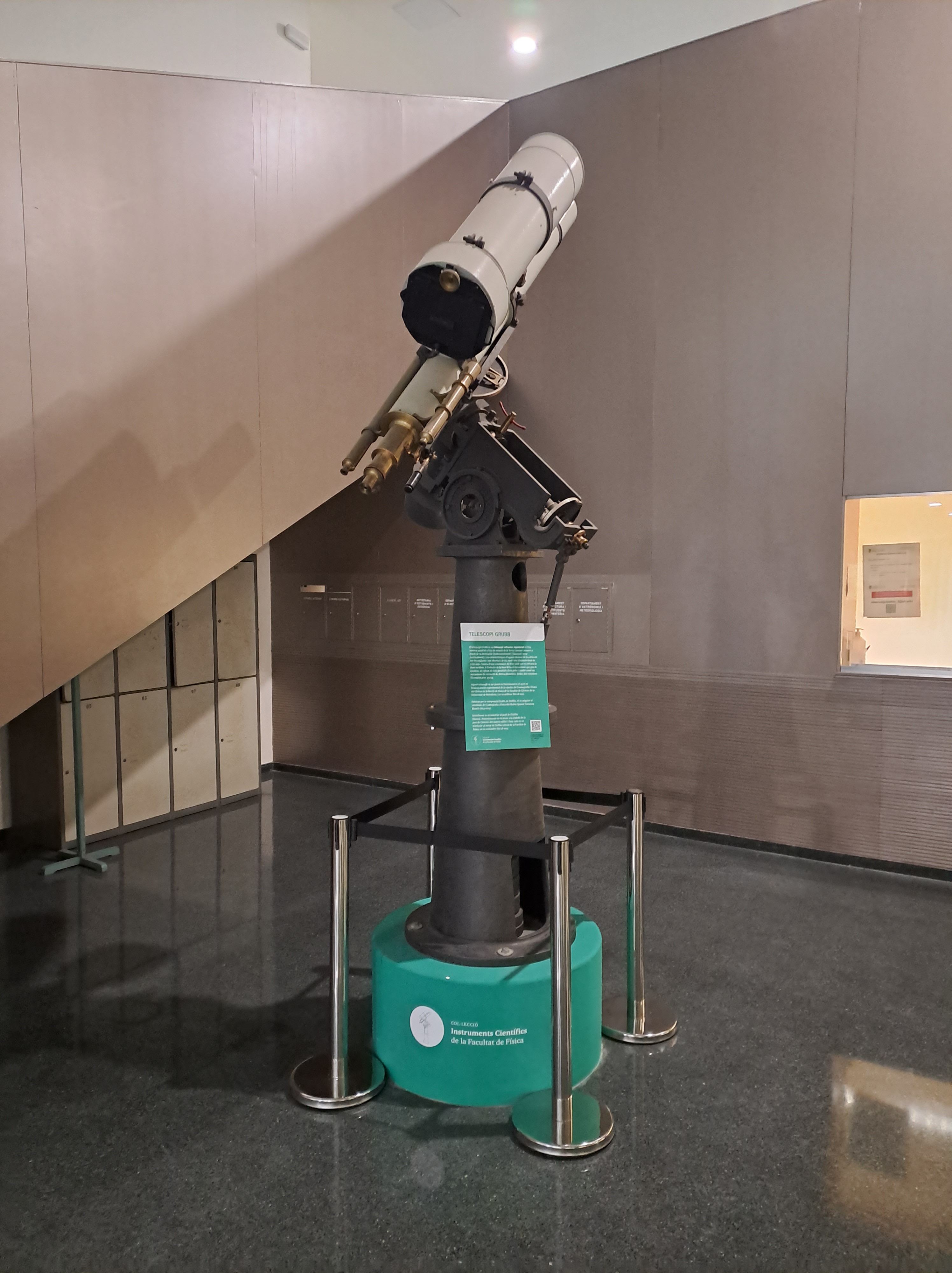
Just after I arrived in Barcelona, I posted a piece about the telescope in the foyer of the Physics Department:
Grubb TelescopeCaption
I’m indebted to Vicent Martínez for the following information and the picture:
Howard Grubb et al.
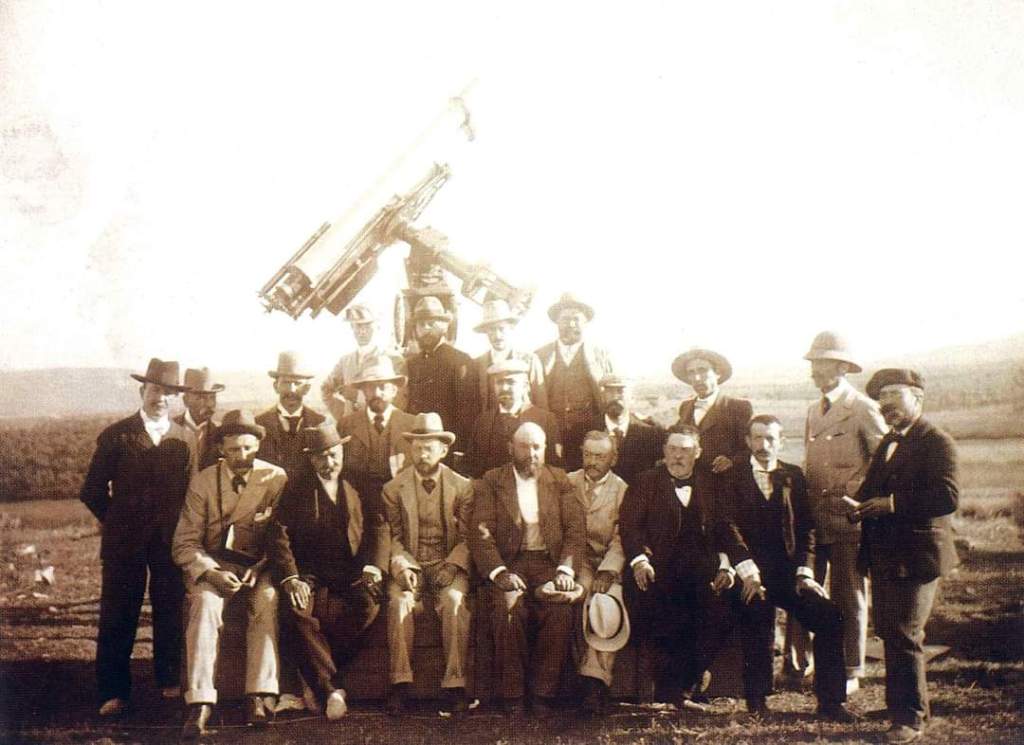
Ignacio Tarzaona bought the telescope in 1906 for the University of Barcelona from the Grubb factory in Dublin. Sir Howard Grubb (son of Thomas Grubb, founder of the Grubb Telescope Company) and Ignacio Tarazona actually knew each other well. In this photograph taken in Berrocalillo (Spain) on May 28, 1900, we can see both of them. The man farthest to the right of all, standing and wearing a “Catalan barretina” is Ignacio Tarazona and Sir Howard Grubb is sitting in the front row, fifth from left with his Panama hat on his knee.
I almost forgot about this but some new data from the ESA Gaia mission will be announced this afternoon at 3pm CEST*, though it seems to be a bit late. This announcement concerns the latest batch of Gaia Focused Product (Gaia FPR) data. The release consists in the publication of 5 papers on specific aspects of the mission and the associated data. You can watch here. Due to technical problems it has been delayed by 30 minutes and there is a new link:
While waiting to view the announcement, you may wish to familiarize yourself with the mission by reading this list of Top Ten Gaia Facts.
Time to announce yet another new paper at the Open Journal of Astrophysics. This one was actually published on Friday (6th October 2023), but for one reason and another I’ve only just got around to announcing it here.
The latest paper is the 38th so far in Volume 6 (2023) and the 103rd in all. The authors are: Matthew Price, Matthijs Mars, Matthew Docherty, Alessio Spurio Mancini, Augustin Marignier and Jason McEwen – all affiliated with University College London, UK.
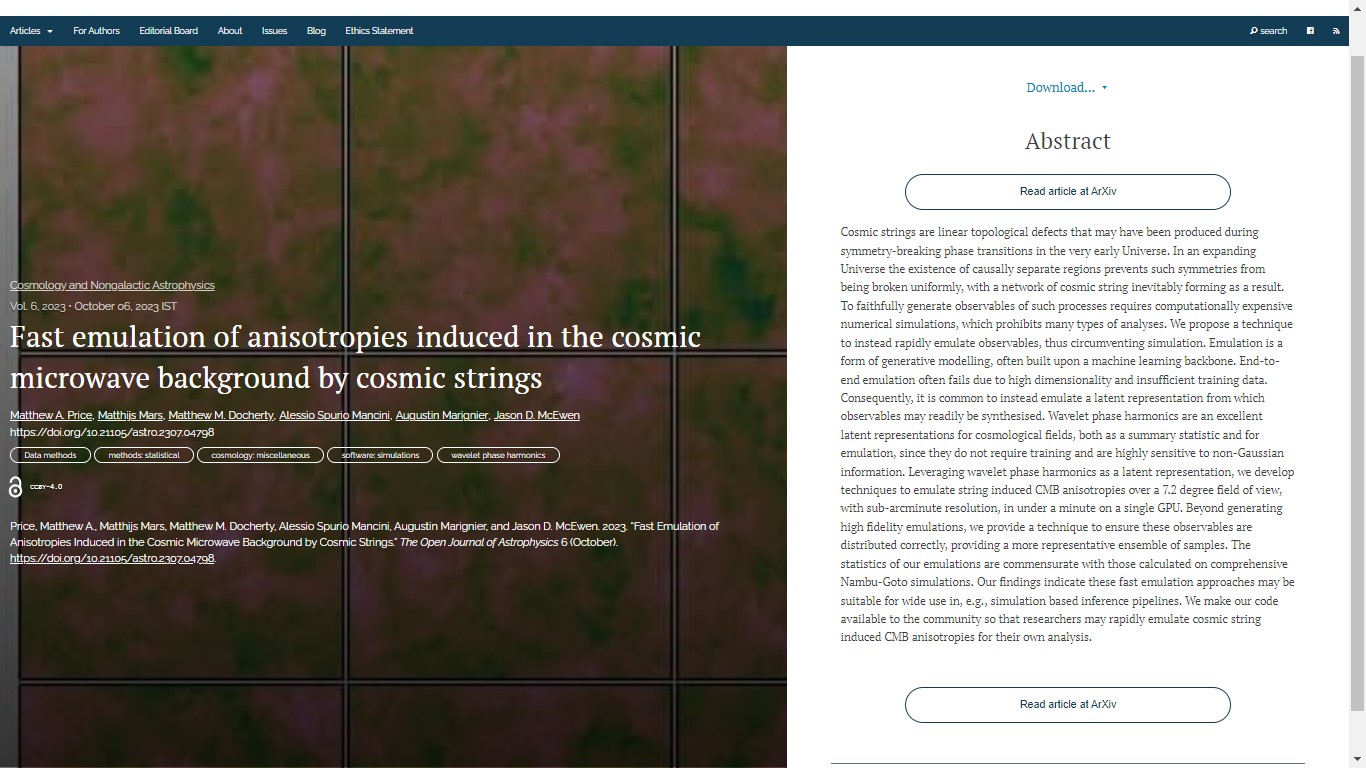
The primary classification for this paper is Cosmology and Nongalactic Astrophysics and its title is “Fast emulation of anisotropies induced in the cosmic microwave background by cosmic strings”. It describes a generative technique for producing generating cosmic microwave background temperature maps using wavelet phase harmonics. For an explanation of what a cosmic string is, see here. If you don’t know the difference between “emulation” and “simulation”, I refer you to the text!
Here is a screen grab of the overlay of the published version which includes the abstract:
You can click on the image of the overlay to make it larger should you wish to do so. You can find the officially accepted version of the paper on the arXiv here.
Knowing that I would be spending even less time watching TV while in Barcelona than I would back in Maynooth, I packed a number of books from the substantial pile that I haven’t yet got around to. The first I’ve finished is The Dream of the Celt by Peruvian author Mario Vargos Llosa which tells the fascinating but ultimately tragic story of Roger Casement using a mixture of thoroughly researched journalistic reportage and fictionalized extrapolations that try to bring this enigmatic character to life.
Roger Casement was born in Sandycove, Dublin, but spent some of his childhood in England. He served with great distinction as a diplomat, and a fierce advocated of human rights, first in the Congo, where he compiled a devastating report of the brutal exploitation of indigenous people, and then in Peru where he exposed even worse cruelty being exacted on native men women and children who were used as forced labour in the rubber plantations. He was knighted in 1911 for his humanitarian efforts.
When he first started out in the diplomatic service, Casement apparently believed that colonization would be a civilizing influence, bringing free trade, the rule of law, and Christianity instead of repression and violence. His bitter experience changed his view entirely, and he became increasingly associated with the cause of England’s first colony, and became a fervent advocate of Irish nationalism. He found himself travelling to Germany during the First World War to procure arms for an Irish rebellion and to raise an Irish Regiment from Irish prisoners of war captured fighting for the British. In the latter he was not successful – he persuaded only about 50 POWs to join the cause. He did succeed in obtaining weapons but the ship smuggling them to Ireland was intercepted and scuttled to avoid the weapons falling into British hands.
Incidentally, Casement was against the Easter Rising of 1916. He thought it would be futile unless it could be combined with a German attack on England. Ireland was not sufficiently important geopolitically for the Kaiser to mount such an operation. The other leaders of the Rising wanted Casement to stay in Germany as it proceeded but he travelled to Ireland in a submarine, was captured, tried for high treason, found guilty, and hanged at Pentonville Prison on 3rd August 1916. He was 51. His executioner later remarked that he was ‘‘the bravest man it fell to my unhappy lot to execute.’
W.B. Yeats wrote a poem about Roger Casement, the last verse of which is:
Come speak your bit in public That some amends be made To this most gallant gentleman That is in quicklime laid.
Leading up to Casement’s execution there was a concerted campaign for clemency, i.e. the commutation of his death sentence, as had happened with some involved directly in the rebellion. But then came the Black Diaries. Parts of these, describing in Casement’s own words his many sexual adventures with men and boys, were leaked to the press by British intelligence services. At a time when homosexuality was still a crime, that effectively ended any hope of avoiding the gallows. The Black Diaries are of questionable authenticity, and many who believe they were genuine think Casement was merely writing about fantasies rather than reality. Maybe writing about things he couldn’t do was a way for him to relieve sexual tension? We’ll never know for sure.
After his execution Casement’s body was subject to a rectal examination to ascertain whether he had had anal sex as described in the books. He was buried in an unmarked grave and it wasn’t until 1965 that his remains were returned to Ireland to be interred at Glasnevin cemetery.
The author tells this story by interspersing Casement’s last weeks and months in Pentonville with flashbacks to his time in the Congo, the Peru, Germany and Ireland. The protagonist did write extensive notes on his travels but they are somewhat disorganized, so he had to make reasonable guesses to fill in the gaps. The conversations with other characters are imagined to make it seem more like a novel than a straight historical biography. This approach makes for a fascinating read, although I did find it somewhat repetitive in places.
Sir Roger Casement, as reconstructed in this book, is a fascinating character, but how close the account is to how he really was as a person is something we’ll never know. In a strange way, that mystery is part of the appeal.
I’ve seen quite a few articles (such as this one on LinkedIn) by academics lamenting the terminal decline of the website formerly known as Twitter, so I thought I’d add my thoughts. I come to bury Twitter, not to praise it.
I joined Twitter in 2009 or thereabouts. Over the years, I accumulated around 7300 followers. Not an enormous number by any standards, but a reasonable one. I used the platform only partly for academic matters. I found it in turns amusing and annoying. I dealt with the latter aspect largely through liberal use of the block facility. I admit I found the recreational aspect mildly addictive.
In recent times, however, Twitter (or X as we’re now supposed to call it) has turned to shit. Since Elon Musk took over, users are basically silenced unless they pay for a blue tick, the social media equivalent of buying a megaphone for use in a library. The API that allowed me to post there from WordPress was axed, which was an additional pain. Add the constant stream of promoted tweets and other ads to the deluge of unmoderated bigotry, and the result is unbearable.
I deleted my Twitter account completely at the end of August and haven’t looked back. Since I’d spent a lot of time there, a number of friends expressed scepticism that I’d manage to do it cold turkey like that, but it was no problem, and I have no withdrawal symptoms.
I now much prefer Mastodon, where I’ve had an account for about a year. I have just over a thousand followers there, just one seventh of the number I had on Twitter, but much higher levels of engagement. More importantly, it’s far more civilized. I’ve only had to block one person. WordPress has also introduced an autopost to Mastodon, so every blog post I write appears there automatically.
I have also joined BlueSky. This site is still in development and, for the time being, is by invitation only, so is rather quiet. In recent weeks, however, I’ve noticed quite a large number of astronomers arriving there, so it is an interesting place to be. I have some spare invites, actually…
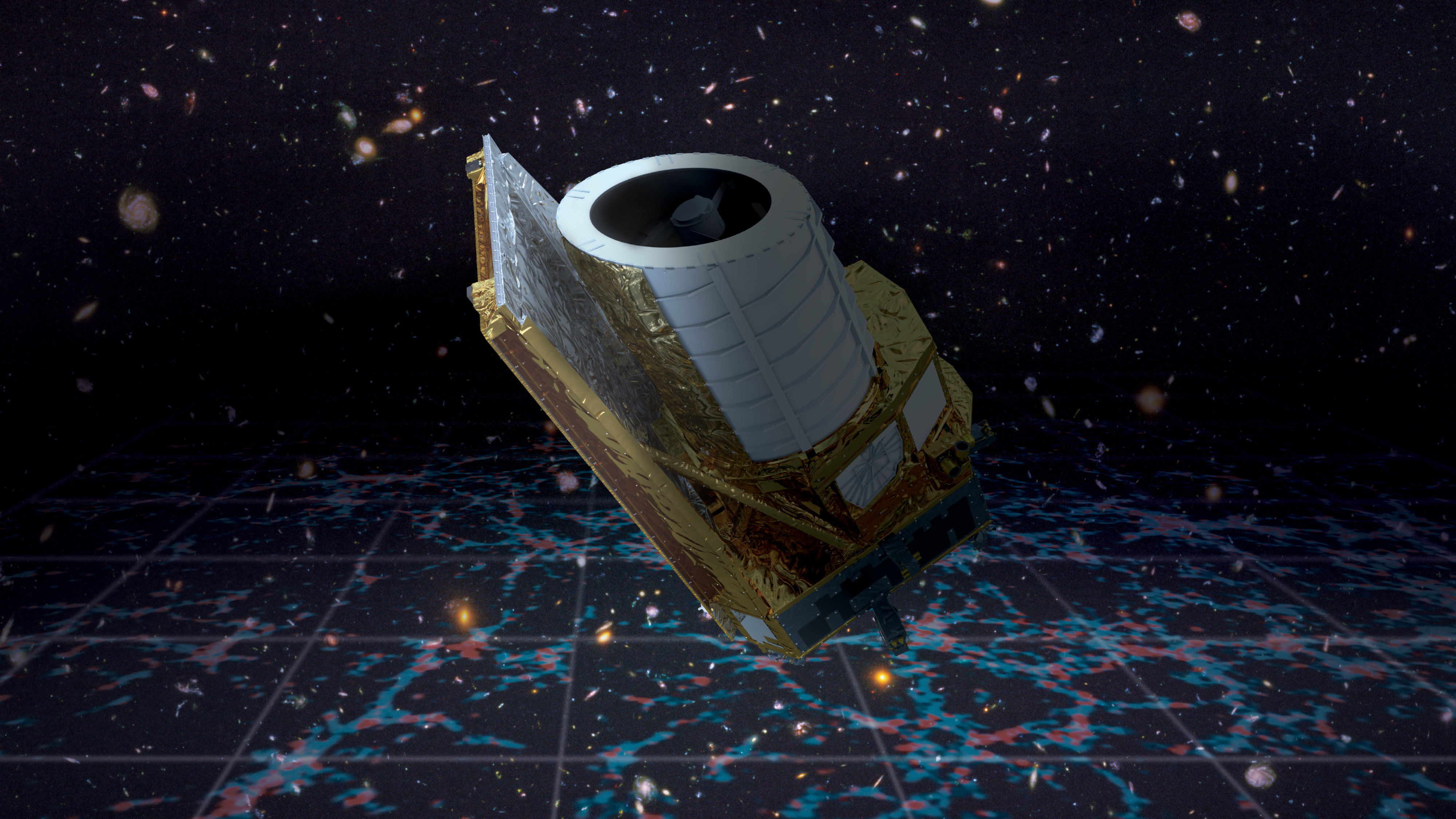
Having settled in to my new apartment on the Gran Via I’ve got time for a another quick update on the European Space Agency’s Euclid mission. For full details about what follows you can see here. Everything I mention here is already in the public domain, so I am not disclosing any secrets!
The last update I posted contained some frustrating and potentially worrisome news: the Performance Verification (PV) phase of the mission had to be put on hold in order to troubleshoot an intermittent problem with the Fine Guidance Sensor (FGS), which is supposed to help to maintain correct pointing of the telescope. This wasn’t working correctly as demonstrated vividly by the following image:
Obviously the survey couldn’t proceed without accurate control of the pointing of the telescope so it was urgently necessary to find out what was going wrong and fix it. It turns out that the software was getting confused by the flashes caused by cosmic ray protons hitting the detectors, think they were the gude stars it was supposed to be steering by. After identifying the problem, new software was written and uploaded to the spacecraft.
I wasn’t sure how this had gone until I saw via an internal communication that the PV phase had restarted. That announcement would not have been made had the upgrade not worked and sure enough it has now been made public that all is well. Congratulations to the instrumentation and software teams for this success. They’ve been working phenomenally hard on this.
There was an additional problem with stray light in the telescope that I have also mentioned before. That was only an issue for specific orientations of the telescope and has been dealt with by simply redesigning the survey a little to minimize the occurrence of the effect.
So the gremlins have been dispelled, and we go on into the PV phase after a delay of about a month. The survey is due to last 6 year so this hiccup is not a big deal really. We can in fact anticipate some early science results from this phase in a month or so, although they will not be part of the full survey which will start after the PV phase is complete, after a few months.
Much to my surprise, my plan for relocating to Barcelona seems to be working out nicely. I booked a hotel initially while I looked around for an apartment for the bulk of my stay. I had a few disappointments with possible properties, and feared I might have to extend the hotel reservation, but then happened to be looking on one of the letting agency websites just as an ideal place in la Dreta de l’Eixample appeared. I got in touch with the agent straight away and had the chance to see the landlord the same day. We did the deal and so I have a place.
I had paid for 12 nights in the hotel (due to check out today), but my apartment was empty yesterday. The landlord was kind enough to allow me to leave some things there yesterday evening, before I returned to the hotel for my last night there. I checked out of the hotel and took the rest of my luggage to the apartment this morning. The apartment is only about 20 minutes away from the hotel, so it was easy to move my stuff.
A Room with a View
I did enjoy staying at the hotel -in particular it’s nice not having to get your own breakfast in the mornings – but it would be way to expensive there in the long term. Moreover, I like cooking and one can’t do that in a hotel room. The kitchen in my new place is small but fully equipped. The only problem is that the shelves are bare, for now, and I’ll need to buy quite a lot of ingredients before I can do anything complicated. My plan for the rest of today, therefore, is to cook something simple and relax with a bottle of the local wine to celebrate a mission accomplished.
Today I attended a cosmology discussion group where the paper being considered was by Jean-Luc Lehners and Jerome Quintin and was entitled A small Universe. Here is the abstract:
Many cosmological models assume or imply that the total size of the universe is very large, perhaps even infinite. Here we argue instead that the universe might be comparatively small, in fact not much larger than the currently observed size. A concrete implementation of this idea is provided by the no-boundary proposal, in combination with a plateau-shaped inflationary potential. In this model, opposing effects of the weighting of the wave function and of the criterion of allowability of the geometries conspire to favour small universes. We point out that a small size of the universe also fits well with swampland conjectures, and we comment on the relation with the dark dimension scenario.
arXiv:2309.03272
This paper is based on rather speculative arguments. I don’t have anything against those, but the discussion of this particular case reminded me that the idea that the Universe might be much smaller than we think is one that has come and gone many times during my lifetime. The point is that Einstein’s equations of general relativity are local in that they relate the geometric properties of space-time at specific coordinate position to the energy and momentum at the same position. When we make cosmological models based on these equations we usually assume a great deal of symmetry, i.e. that defined in a certain way the spatial sections which form surfaces of simultaneity have the same curvature everywhere, regardless of spatial position. The standard cosmology takes this curvature to be zero, in fact, so the spatial sections are Euclidean (flat), though the curvature could be positive or negative.
Usually when we assume the universe is flat we also assume that it is infinite, but it is possible in principle that a flat universe could be finite, for example in the case of a cube with opposite faces identified so that it has a sort of toroidal symmetry that has no physical edge. The size of the notional cube defines a topological scale which is independent of Einstein’s equations. That’ just a simple example: the topology does not have to be based on a cube; it could be, for example, a rhombic dodecahedron…
Likewise when we talk about a universe with negative spatial curvature we also assume it to be infinite, but that doesn’t have to be the case either: there are spaces with negative spatial curvature which are finite. A manifestation of this idea that I remember from way back in 1999 was a paper by Neil Cornish and David Spergel entitled A small universe after all?
Observing a small universe from the inside produces many interesting effects like a sort of cosmic hall of mirrors. For instance, if you can see far enough you will see the back of your own head. More realistically, the observed large-scale structure of the universe would repeat, and there would be correlated features in the cosmic microwave background. The idea is therefore amenable to observational test; the absence of any of the predicted correlations places constrains the topological scale to be comparable to the size of the observable universe or larger. Of course if it’s infinitely large then the small universe is not small at all…
(For a bit of gratuitous self-promotion, I refer you to a paper I wrote with Graca Rocha and Patrick Dineen back in 2004 using the WMAP observations of the CMB to constrain compact topologies. Given the wealth of new data we have acquired since then I’m sure the constraints are even stronger now.)
Anyway, my point is that speculative ideas are all very well but they don’t mean much if you can’t test them. This one at least has the virtue of making testable predictions.
A few days ago I posted an item about how the current system of scientific publication is under such intolerable strain that it is no longer fit for purpose. This is something I’ve felt for a while. Some time ago I wrote a post musing about what should replace it. That article included this:
I know I’m not alone in thinking that the current publishing ecosystem is doomed and will die a natural death soon enough. In my view the replacement should be a worldwide network of institutional and/or subject-based repositories that share research literature freely for the common good.
The Open Journal of Astrophysics was set up to demonstrate a way of achieving this kind of change in the field of Astrophysics. With this in mind I was delighted to to see a paper in PLOS Biology by Richard Sever (published just yesterday) with the following abstract:
Academic journals have been publishing the results of biomedical research for more than 350 years. Reviewing their history reveals that the ways in which journals vet submissions have changed over time, culminating in the relatively recent appearance of the current peer-review process. Journal brand and Impact Factor have meanwhile become quality proxies that are widely used to filter articles and evaluate scientists in a hypercompetitive prestige economy. The Web created the potential for a more decoupled publishing system in which articles are initially disseminated by preprint servers and then undergo evaluation elsewhere. To build this future, we must first understand the roles journals currently play and consider what types of content screening and review are necessary and for which papers. A new, open ecosystem involving preprint servers, journals, independent content-vetting initiatives, and curation services could provide more multidimensional signals for papers and avoid the current conflation of trust, quality, and impact. Academia should strive to avoid the alternative scenario, however, in which stratified publisher silos lock in submissions and simply perpetuate this conflation.
(I added the emphasis). In case you were not aware, Richard Sever is a cofounder of the preprint servers bioRxiv and medRxiv.
I’m very glad to see similar thoughts to those I expressed about astrophysics being echoed in the field of biomedicine. I hope that more disciplines follow this path. The way it is realized will no doubt be domain-specific, but the benefits of such a new ecosystem will be for all science.
Being away on sabbatical I almost forgot to post a reminder of the event I blogged about a few weeks ago at Maynooth University entitled Exploring the Cosmos. I’m told this has attracted a huge amount of interest, but the room for the event is very large and there may well be some space left.
Best wishes to everyone taking part and I hope it goes well!
On the 5th of October, at 6.30pm, in the TSI Building Maynooth University will host an all-ages event to explore the vastness of space. Using stunning visualisations Maynooth University Astrophysicists will examine star and planet formation, peer back in time with our physicists trying to image the very edges of our visible universe, and take a journey into the unknown as we trace the origin and evolution of black holes.
Programme:
18.30 Welcome
18.35: John Regan: “Black Holes in Our Universe”
Black Holes are among the most exotic objects in our Universe. In this talk John will discuss the basics of black hole formation, how we can detect them today and the future of black hole hunting using gravitational wave observatories that Maynooth University is a part of. John will also discuss some of the strange effects you might encounter near a black hole – like time slowing down!
18.55: Aoibhinn Gallagher: “The Dark Universe”
There is so much in our universe which is unknown to us, most of it in fact. What is dark matter, what is dark energy? We will go on a journey during this talk through the history of our universe and the history of cosmology (the study of the universe) itself to try and arrive at answers to these questions. Also I will talk about the real life science happening at Maynooth university on these very topics.
19.15: Tea & Coffee Break
19.45: Neil Trappe: “Seeing the Invisible Universe – Terahertz Astronomy”
When you look outside at the clear night sky you will see many thousands of stars overheard. The Moon, stars, planets, comets and galaxies can all be observed if you know where to look just using your eyes, binoculars or a telescope.
Astronomers spend many hours looking at the night sky with large automated telescopes from many exotic places around the world to add to our knowledge of the Universe and understand difficult questions like how did the Sun and our Solar System form, how are stars born and how do they die, is there life elsewhere in the Universe, and indeed how did the Universe come into existence at all?
In Maynooth University a team of researchers develop telescopes to see the Universe with different kinds of light, specifically far infrared or “terahertz” light. Why do we do this – we see the Universe differently and can learn lots more information ‘seeing’ with terahertz radiation that is invisible to our eyes.
20.05: Patrick Kavanagh: “The First Year of the James Webb Space Telescope”
The James Webb Space Telescope has made unexpected and groundbreaking discoveries almost routine in its first year. It has produced captivating images of our own Solar System, measured the content of atmospheres around other stars, viewed the stellar birth and death in amazing detail, revealed the skeletal structure of galaxies, and peered deep in to the cosmic past in search of the first stars and galaxies. In this talk Dr. Kavanagh will give an overview of Webb and present some of the highlights of the first year of this revolutionary telescope.
20.30: Finish
It should be a fun evening. If you’re around please come along. This event is free to attend but you need to register, which you can do here. Please feel free to share this with friends and colleagues.
The views presented here are personal and not necessarily those of my employer (or anyone else for that matter).
Feel free to comment on any of the posts on this blog but comments may be moderated; anonymous comments and any considered by me to be vexatious and/or abusive and/or defamatory will not be accepted. I do not necessarily endorse, support, sanction, encourage, verify or agree with the opinions or statements of any information or other content in the comments on this site and do not in any way guarantee their accuracy or reliability.






 In the Dark