Archive for January, 2024

Rankings Junk

Posted in Education with tags , , , , on January 31, 2024 by telescoper

A few weeks ago I did a post in response to the fact that Professor Philip Moriarty of Nottingham University – a former colleague of mine – had written a blog post in protest at his institution’s most recent and most blatant attempts to game the wretched world university rankings.

One of the targets of his ire were the Quacquarelli Symonds (QS) rankings. Ironically, I was looking in my spam folder yesterday and what did I find but an invitation to participate in the QS rankings, correctly identified as junk:

Clearly my email filters know what they’re doing!

Anyway, this gives me an excuse to boost Phil’s post again. The open letter contained therein is aimed at persuading not only Nottingham but other universities both in the UK and elsewhere to follow the example of Utrecht and abandon these absurd and meaningless rankings. To sign the open letter please follow this link and to see a list of signatories see here.

PHANGS for the galaxies…

Posted in The Universe and Stuff with tags , , , , , , , on January 31, 2024 by telescoper

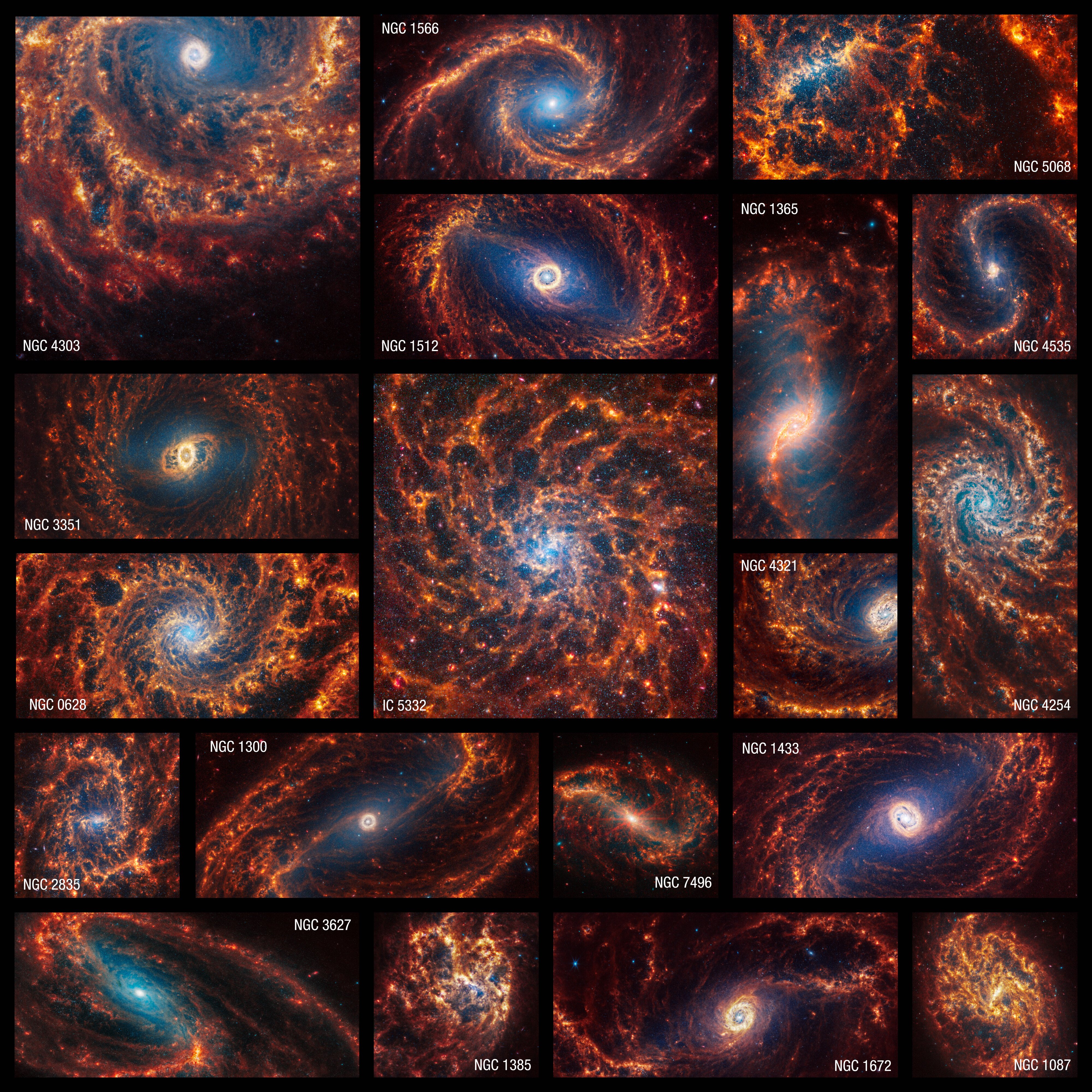
I couldn’t resist sharing this wonderful set of images from JWST courtesy of the PHANGS* team showing exquisite details of 19 face-on spiral galaxies as seen in the infra-red:

More information about the remarkable structures seen in these images, as well as higher resolution versions of the images themselves, can be found on the European Space Agency website here.

*For those of you not in the know, PHANGS stands for Particularly Horrible Acronym Not Generated Sensibly Physics at High Angular resolution in Nearby GalaxieS.

The Little Book of Irish Research

Posted in Euclid, Maynooth, The Universe and Stuff with tags , on January 30, 2024 by telescoper

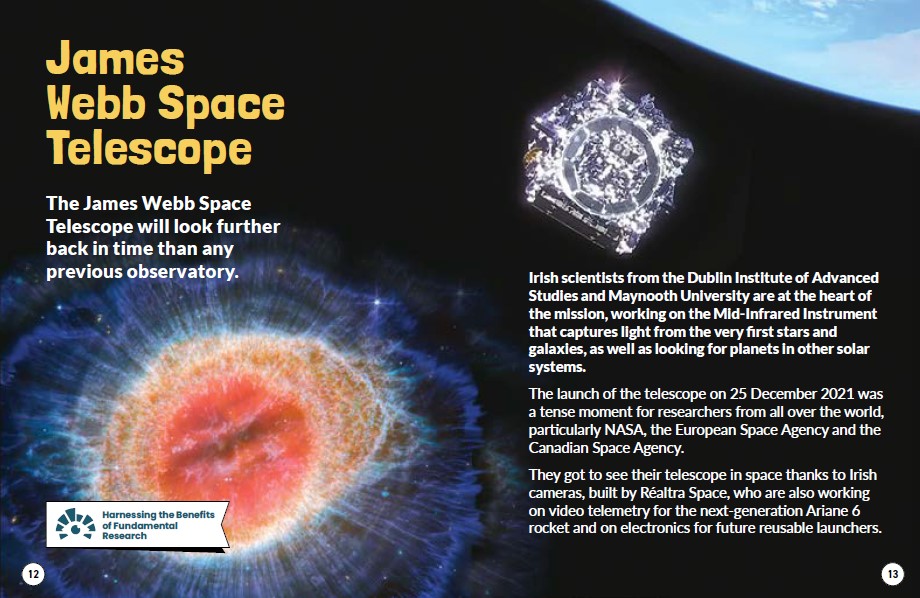
A few months ago, I blogged on the occasion of the launch by Simon Harris TD, Minister for Further and Higher Education, Research, Innovation and Science, of the Little Book of Irish Research. This book, which is aimed at school students, so is written at an elementary level, gives quick summaries of areas of research that the general public said that they were interested in, grouped into sixteen themes, and it will be distributed to schools all round Ireland.

if you want to read it here is a PDF file of the whole thing for you to download at your leisure. When I posted about it last time I hadn’t actually seen a hard copy, but I finally got my hands on one:

I can now confirm that it is indeed a little book. I think we’ll find it useful for our own outreach events, open days, etc, in the Department of Theoretical Physics, and so will the many colleagues in other Departments in other universities and research institutes whose work is also featured.

I was very gratified to see myself get a mention (on page 41), though it’s not really about me but about Euclid which has generated considerable interest in the general public already and is set to continue doing that for many years. As you can see, there’s also a double-page spread of JWST, though unfortunately it does not name the scientists involved; Paddy Kavanagh is the main man at Maynooth for matters JWST.

For Democratic Governance of Universities

Posted in Education with tags , , , on January 30, 2024 by telescoper

Yesterday I stumbled across a paper by Blanca Missé and James Martel of San Francisco State University with the title For Democratic Governance of Universities: The Case for Administrative Abolition.

The abstract is:

In this essay, we argue for administrative abolition, that is, the elimination of all college presidents, provosts, deans and other top level administrators who we argue form a parasitical group that was developed over time in order to exercise both political and financial control over faculty, staff and students. We examine the way that the idea of “shared governance” disguises the de facto dictatorship of administration over faculty self-governance, explore the history of how this power grab took place and furthermore explore alternative forms of faculty self-management in both US history and abroad (especially in Latin America).

Theory & Event, vol. 27 no. 1, 2024, p. 5-29. Project MUSEhttps://doi.org/10.1353/tae.2024.a917791.

You can find the whole paper here. I encourage everyone working in a university to read it.

I’m sure this article will ring true to many academics, besides myself, who dream of a time when universities direct their resources to teaching and research rather than squandering it on the bloated apparatus of management that hinders the very activities it should be supporting.

The Forthcoming Referenda

Posted in Politics with tags , , , , , , , , on January 29, 2024 by telescoper

On Friday 8th March 2024, the Irish electorate – that includes me – will be asked to vote on two amendments to the constitution. I won’t go into the relevant issues in detail here, but the proposed changes are intended to (i) broaden the concept of the family to be more inclusive (for example, currently, there is no constitutional recognition of families in which the parents are not married); and (ii) broaden the definition of “care” in the family home beyond the current constitution which emphasizes exclusively the “duties of women” in this regard.

This post is not really about these constitutional amendments but about the much less important issue that the media are describing them as two referendums. I will explain here why I think there is a good argument for the word referenda being used for the voting on 8th March. Regular readers of this blog know that I’m never pedantic about such matters. Well, maybe a little bit, sometimes. Latin was my best subject at O-level, though, so I can’t resist making a comment.

Any dictionary will tell you that “referendum” is obtained from the Latin verb referre which is itself formed as re- (prefix meaning “back”) + ferre (to carry), thus its literal meaning is “carry back” or, more relevantly to the current discussion, “to refer”. Ferre is actually an irregular verb, which complicates the discussion a bit, so I’ll use simpler examples of regular verbs below.

Latin grammar includes two related concepts derived from a verb, the gerund and the gerundive.

The gerund is a verbal noun; such things exist in English in forms that mean `the act of something’, e.g. running, eating, loving.The word formed from a verb with the ending `ing’ can also function as a present participle in English, but we wont be going there. It may easy to muddle up gerunds with participles in English, but not in Latin as they are formed in distinctly different ways.

As an example in the case of ‘loving’ the relevant Latin verb is  amare (which conjugates as amo, amasamat, and all that); the appropriate gerund is amandus. You can this sort of Latin construction surviving in such English words as “graduand”. Note, however, that a gerund has no plural form because that would make no sense in Latin. There are plural forms in English such as `doings’ and `comings and goings’ but I don’t think these are relevant here as I interpret them as jocular, and pedantry is a very serious business.

Related to the gerund is the gerundive which, as its name suggests, is an adjectival form related to the gerund, specifically expressing necessity. Latin being an inflected language, an adjective takes the ending appropriate to the gender of the noun it describes; the gerundive also follows this pattern.

In the ‘loving’ example above, the gerundive form is amandus in a masculine case or, if referring to a female entity, amanda (hence the name Amanda, which means “deserving or requiring love”) or amandum for a neuter noun. In cases where the noun is plural the forms would be amandiamandae, and amanda. Endings for other gerundives formed from other verbs are constructed in a similar fashion depending on their conjugation. An adjective used without a noun usually means a thing with that property, so amanda would mean a feminine entity deserving love.

From this discussion you can see that in Latin amandum could mean either “loving” (gerund) or “a thing to be loved” (gerundive). Latin grammar is sufficiently precise, however, that the actual meaning will be obvious from the context.

As an aside, based on my own experiences in mathematics and physics, the abbreviation `QED’ which is often placed at the end of a proof is short for `Quod Erat Demonstrandum’, meaning `which was required to be shown’ rather than, as I sometimes facetiously write, `Quite Easily Done’.  I’m surprised how many people (especially students) use QED without knowing what it means!

Now, back to referendum. It seems clear to me that this derives from the gerundive and thus means “a thing to be referred” (the thing concerned being of no gender, as is normal in such cases in Latin). So what should be the word for more than one referendum?

I think it depends on the context. The word  referenda implies “more than one thing to be referred” not “a thing to be referred multiple times” because the plural in referenda refers to the things not to the instances of referral. The familiar word agenda is formed precisely this way and it means “(a list of things) to be done”. This is not the desired meaning we want for multiple referrals of the same question, such as a second vote on the same issue, which would have to be referendums in English, as there is no Latin word that encapsulates that particular meaning. This is what I argued here. Referenda is, however, precisely the word needed for March 8th, when there will be a single act of voting on two issues. 

As supporting evidence I quote this source:

…we maintain that there is value in using referendums for multiple events and referenda for multiple propositions.

I rest my case. Any questions?

P.S. I argue for consistency that, if there is only one item on the agenda, it is an agendum.

The Reinvention of Science

Posted in History, Literature, The Universe and Stuff with tags , , , , , on January 28, 2024 by telescoper

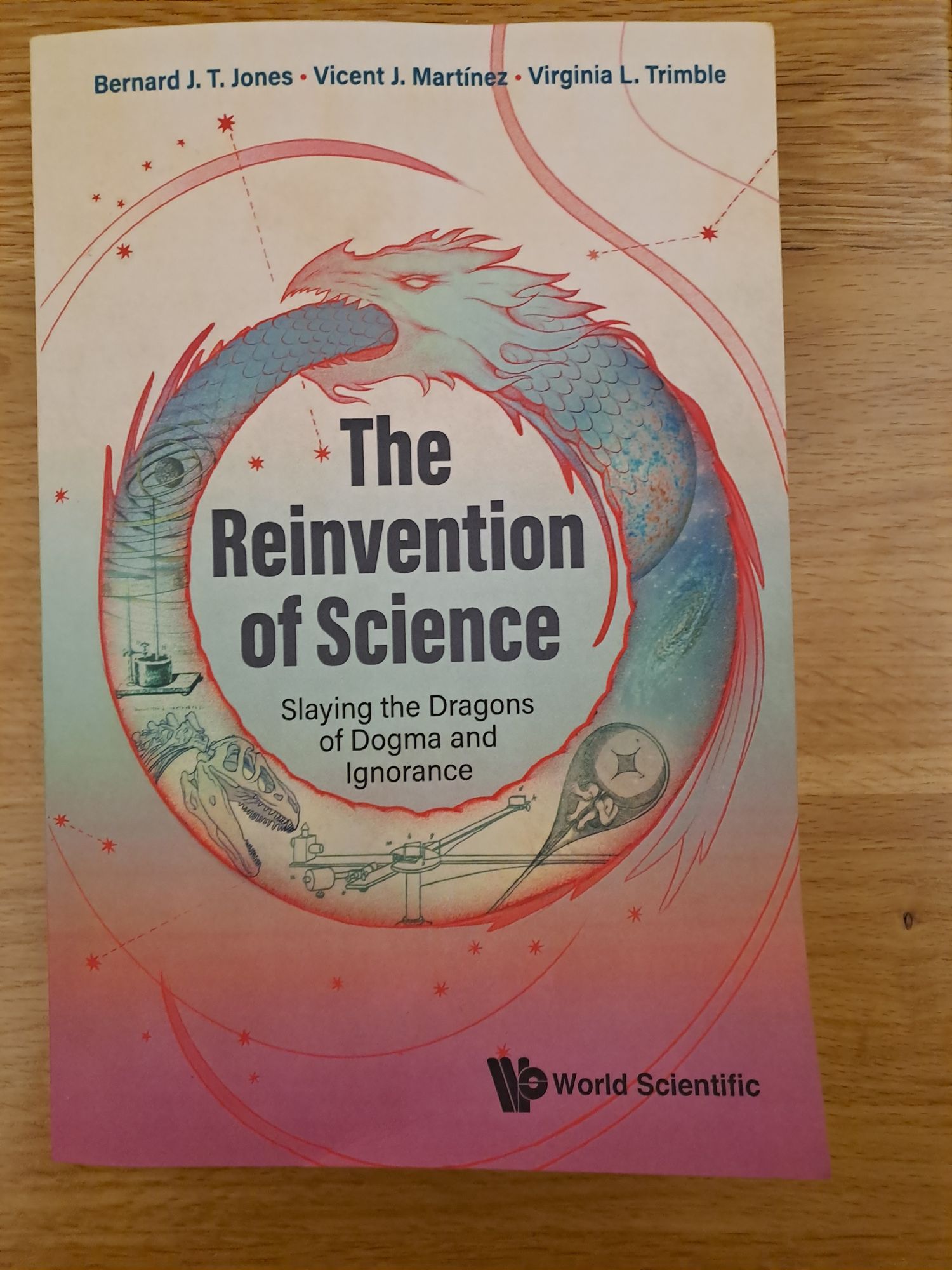
I’ve known about the existence of this new book for quite a long time – the first two of the authors are former collaborators of mine and I’m still in fairly regular touch with them – but I only received a copy a few weeks ago. Had I been less busy when it was in proof stage I might have been in a position to add to the many generous comments on the back cover from such luminaries as Martin Rees, Jim Peebles, Alan Heavens and, my hosts in Barcelona, Licia Verde and Raúl Jiménez. Anyway, now that I’ve read it I’m happy to endorse their enthusiastic comments and to give the book a plug on this blog.

One can summarize The Reinvention of Science as a journey through the history of science from ancient times to modern, signposted by mistakes, fallacies and dogma that have hindered rather than facilitated progress. These are, in other words, not so much milestones as stumbling blocks. Examples include the luminiferous aether and phlogiston to name but two. These and many other case studies are used to illustrate, for example, how supposedly rational scientists sometimes hold very irrational beliefs and act accordingly on them. The book presents a view of the evolution of science in spite of the suppression of heterodox ideas and the desire of establishment thinkers to maintain the status quo.

The volume covers a vast territory, not limited to astrophysics and cosmology (in which fields the authors specialize). It is a very well-written and enjoyable read that is strong on accuracy as well as being accessible and pedagogical. I congratulate the authors on a really excellent book.

P.S. I am of course sufficiently vain that I looked in the index before reading the book to see if I got a mention and was delighted to see my name listed not once but twice. The first time is in connection with the coverage of the BICEP2 controversy on this very blog, e.g. here. I am pleased because I did feel I was sticking my head above the parapet at the time, but was subsequently vindicated. The second mention is to do with this article which the authors describe as “beautiful”. And I didn’t even pay them! I’m truly flattered.

The Body in the Bellaghy Bog

Posted in History, Poetry with tags , , , , , , , , on January 27, 2024 by telescoper

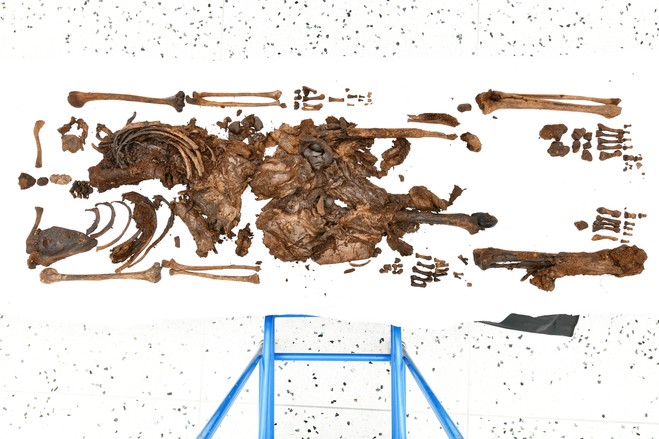
There was an interesting news item last week concerning the discovery of human remains in a peat bog in Bellaghy, County Derry. Radio-carbon dating has established that these remains are about 2,000 years old, so this was a person who lived in the Iron Age; a post-mortem has revealed it to be a teenage boy of around 15 years old. No cause of death has yet been established, but it is generally thought that these bog bodies were people who were executed as a punishment, or perhaps sacrificed for some ritual purpose.

These are neither the oldest nor the best-preserved such remains to be found in Ireland; the oldest belong to Cashel Man, who died, about 4,000 years ago, in the early Bronze Age. Nevertheless, the anaerobic conditions of the bog have slowed decomposition so much that not only bones, but some skin, hair and even parts of internal organs survive. This find is therefore important, not least because it should be possible to obtain detailed information about the DNA of this individual. Understanding of Ireland’s prehistoric past has been upended in recent years by DNA discoveries. What will Bellaghy Boy tell us? And how many more bog bodies are waiting to be found?

Another fascinating aspect of this story is that the location of the remains is very close to the house where the poet Seamus Heaney lived. Heaney wrote a number of poems about bog bodies and it’s ironic that there was one waiting to be found so close to his home.

Anyway, this gives me an excuse to post a vaguely relevant poem by Heaney called Bogland which, appropriately for the title of this blog, comes from a collection called Door into the Dark.

Three New Publications at the Open Journal of Astrophysics

Posted in OJAp Papers, Open Access, The Universe and Stuff with tags , , , , , , , , , on January 27, 2024 by telescoper

Once again it’s a good time for a roundup of the week’s business at the  Open Journal of Astrophysics. This past week we have once again published three papers, taking  the count in Volume 7 (2024) up to 7 and the total published by OJAp up to 122. Looking at the current work flow I expect there to be at least three next week too.

In chronological order, the three papers published this week, with their overlays, are as follows. You can click on the images of the overlays to make them larger should you wish to do so.

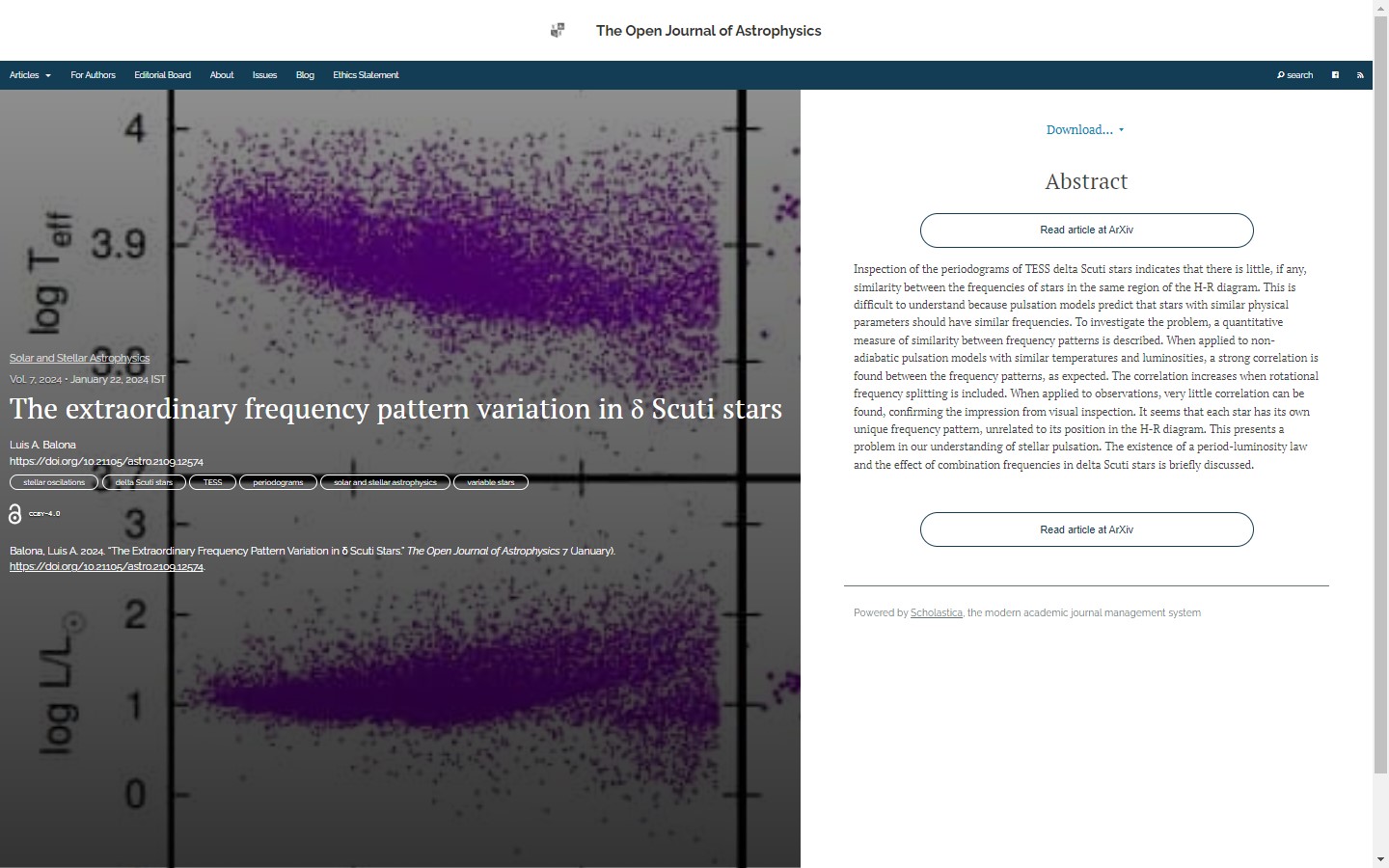
First one up is “The extraordinary frequency pattern variation in δ Scuti stars” by  Luis A. Balona of the South African Astronomical Observatory in Cape Town, South Africa. This paper, published on 22nd  January 2024, is a study of the (lack of) correlation in the structure of periodograms in Transiting Exoplanet Survey Satellite (TESS) data relating to a oscillating delta Scuti variable stars. This paper is in the category of Solar and Stelllar Astrophysics.

Here is a screen grab of the overlay, which includes the abstract:


You can find the officially accepted version of the paper on the arXiv here.

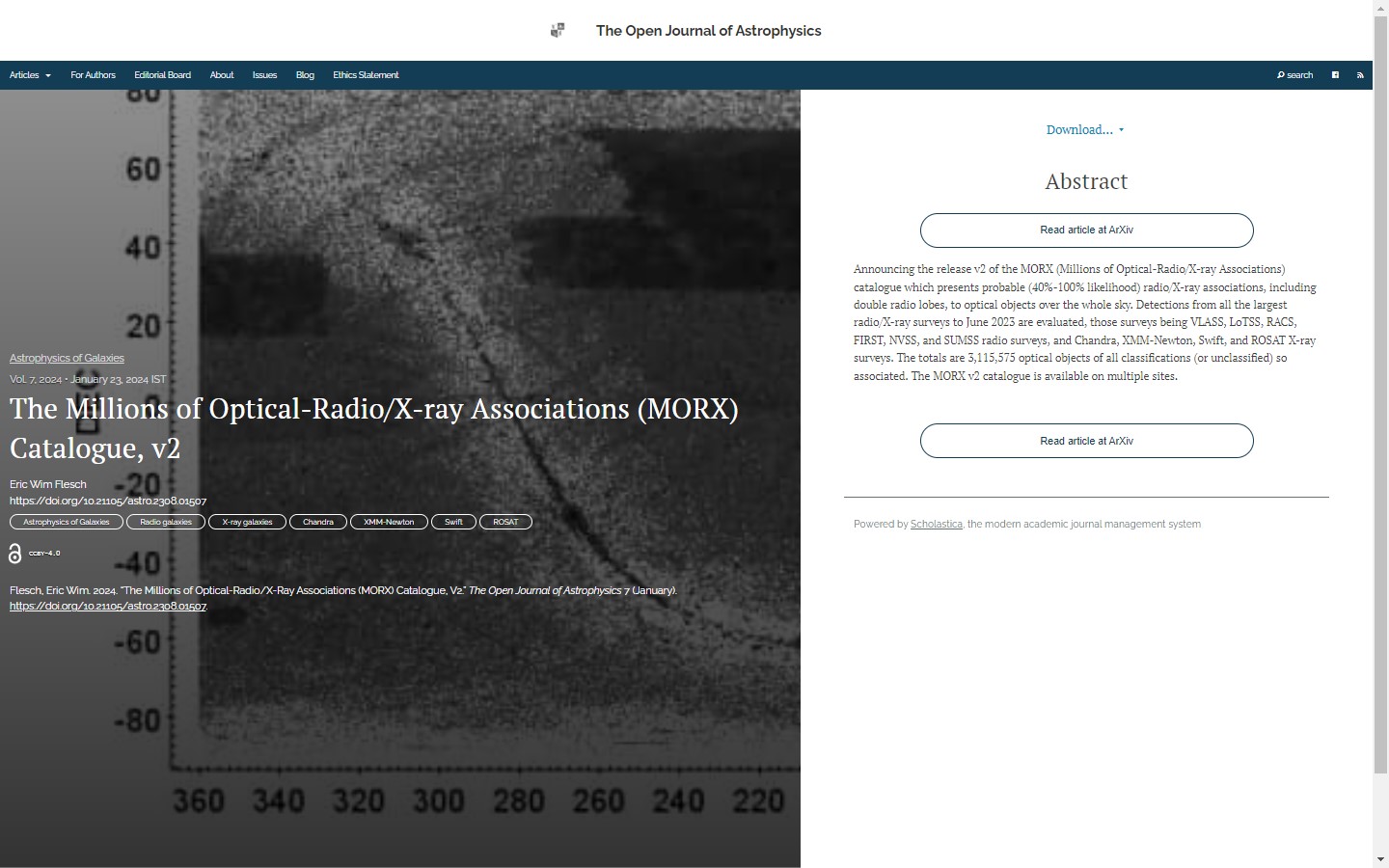
The second paper to announce is “The Millions of Optical-Radio/X-ray Associations (MORX) Catalogue, v2” by Eric Wim Flesch, an independent researcher based in New Zealand.  This presents the MORX catalogue of optical/radio/X-ray/ galaxy associations, containing over three million objects. The catalogue itself can be found in a number of locations on the web, e.g. here or here.

The paper was also published on 23rdJanuary 2024 in the category Astrophysics of Galaxies . You can see the overlay here:


The accepted version of this paper can be found on the arXiv here.

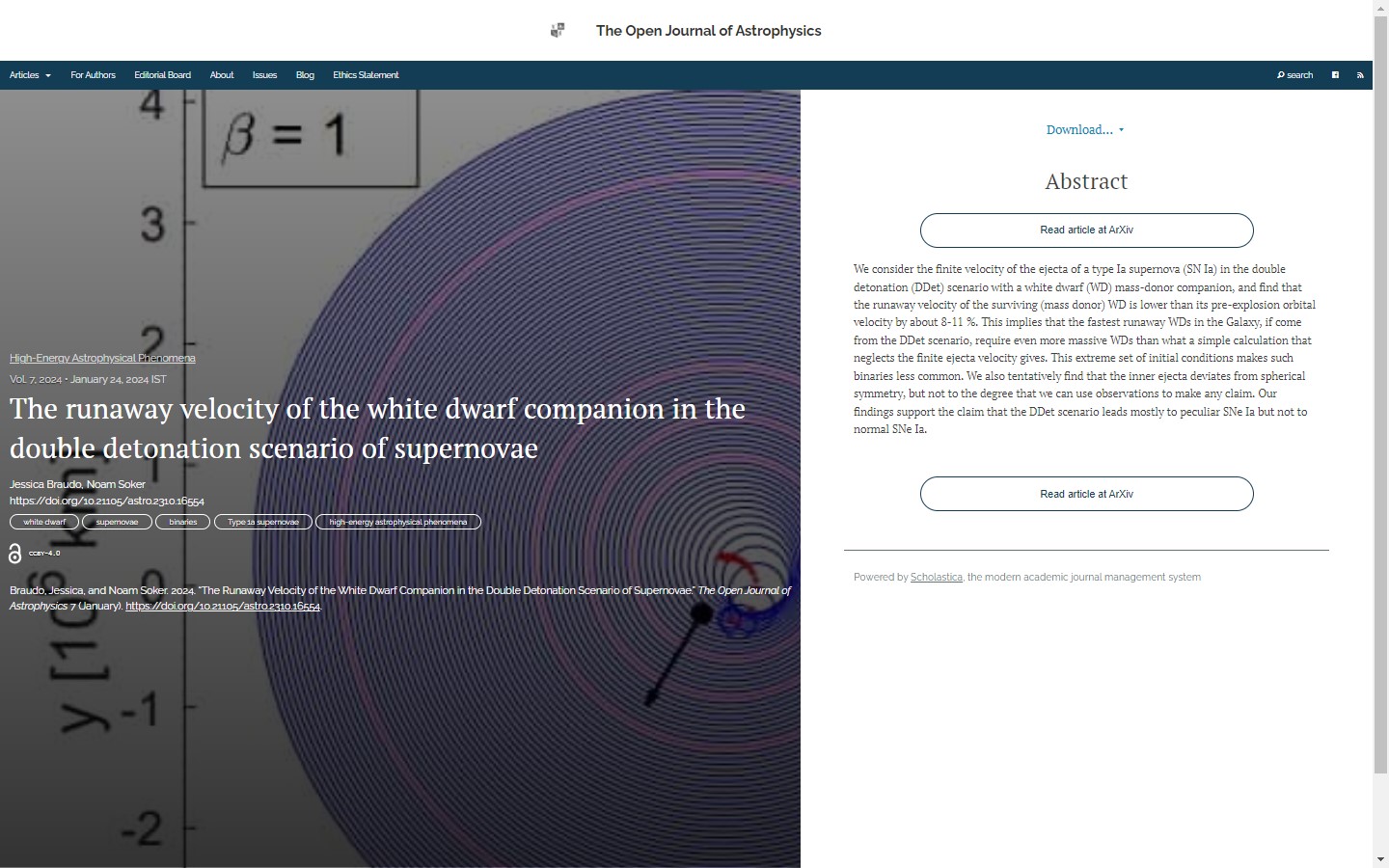
The last paper of this batch is  entitled “The runaway velocity of the white dwarf companion in the double detonation scenario of supernovae” and the authors are Jessica Braudo and Noam Soker of Technion, Haifa, in Israel.  This paper, which presents a study of ejection velocities in the double-detonation scenario of Type 1a Supernovae was published on 24th January 2024 and is in the folder marked High-Energy Astrophysical Phenomena.

Here is the overlay:


You can find the full text for this one on the arXiv here.

And that concludes the update.  As you can see, we’re getting a bit more diverse in terms of subject matter, which is nice. There’ll be more next week!


A Strange Dream

Posted in Biographical with tags , , on January 26, 2024 by telescoper

From time to time on this blog I’ve written about dreams that I’ve had (e.g. here and here). I find dreams rather fascinating but most times when I wake up I don’t remember enough about them to write coherently about. This week, though, I’ve been troubled by a dream I had a few days ago the memory of which has stayed in my brain.

For background, I have had a bit of a cold recently. It’s been nothing serious but has disturbed my sleep a bit and I have dreamt more than usual. One dream, of which I remember only a small part, involved my house being invaded by giant tortoises. Bizarre as that sounds, The Invasion of the Giant Tortoises, didn’t bother me as much as the one I will try to describe now…

In this dream I am at an academic conference of some sort. I am recognized by other people there, attend some talks in lecture theatres, socialize at coffee breaks, join a social dinner, and even go on an excursion by coach with other attendees through a beautiful landscape of mountains, forests and castles.

Nothing particularly weird about that, I suppose. The strange thing is that everywhere I go at this event I have a companion in the form of a young man who is blind. This boy is about twenty to twenty-five years old, with light blond hair, shorter than me, well built and pleasant-looking. His eyes are partly closed and permanently cast to one side. I don’t know his name.

I arrive at the conference with this boy’s arm linked through mine. I sit next to him at talks, sometimes whispering a description of what’s shown on the slides. I get him coffee. When we go to another lecture room we go arm in arm. During the excursion I sit next to him and describe what I can see. He smiles and nods in response. I notice other people looking at us with somewhat patronizing expressions.

Eventually, as dreams do, this all dissolves into some other sequence which I don’t remember. That’s it.

So why do I find this apparently rather innocuous dream so troubling?

The first reason is the identity of the young man. Although I would recognize him if I saw him, as far as I can recall, his face is not one that I’ve ever seen before. Perhaps he is someone I knew a long time ago, or perhaps my subconscious has created a fictional character! His age suggests he might be a student. I have taught blind students before, but I remember them all and he doesn’t resemble any of them. The last time I had a blind student in my class was at Sussex, and I did walk around with him sometimes holding my right arm, e.g. when there were tricky stairs, and was happy to be helpful in that way, but he looked nothing like the boy in the dreams.

More disturbing (to me) than the identity of my sightless companion, however, is what on Earth this dream actually means? Why do I have this boy with me all the time? What does his presence signify? Is it some sort of reference to my sexuality? Nothing at all obviously sexual happens in the dream, by the way, in case you were wondering. I really have no idea how to interpret this!

At this risk of eliciting some strange responses, anyone who has any ideas is welcome to suggest them through the comments box!

UPDATE: An old friend emailed me to say give his interpretation: that a cute blond boy would have to be blind to want to go out with me. Thank you for that.

LISA adopted by ESA

Posted in Science Politics, The Universe and Stuff with tags , , , , on January 25, 2024 by telescoper

I have some good news for gravitational-wave physicists to pass on. The European Space Agency (ESA) has formally “adopted” the Laser Interferometric Space Experiment (LISA) – a gravitational wave experiment in space. This follows the detection of gravitational waves using the ground-based experiment Advanced LIGO and the success of a space-based technology demonstrator mission called Lisa Pathfinder. LISA was actually selected as a potential mission in 2017 – see here – but “adoption” means that the mission concept and technology required are now both sufficiently advanced that it can proceed in 2025, once contractors are found to actually build it.

LISA consists of a flotilla of three spacecraft in orbit around the Sun forming the arms of an interferometer with baselines of the order of 2.5 million kilometres, much longer than the ~1km arms of Advanced LIGO. These larger dimensions make LISA much more sensitive to long-period signals. Each of the LISA spacecraft contains two telescopes, two lasers and two test masses, arranged in two optical assemblies pointed at the other two spacecraft. This forms Michelson-like interferometers, each centred on one of the spacecraft, with the platinum-gold test masses defining the ends of the arms.

Here’s an artist’s impression of LISA:

This is excellent news for the gravitational waves community, especially since LISA was threatened with the chop when NASA pulled out in 2011. Space experiments are huge projects – and LISA is more complicated than most – so it will take some time before it actually happens. The first I heard of the LISA concept was back in the mid-1990s and at the moment LISA is pencilled in for launch in 2035, so it will be forty years in the development.

Ireland is a full member of ESA so let’s hope the Irish Government finds a way of funding participation in the LISA mission. Although Ireland joined ESA nearly fifty years ago, and is paying  into the mandatory science programme which includes LISA (and, for example, Euclid), there is no funding programme in Ireland dedicated to the scientific exploitation of ESA projects. Let’s hope the Irish scientists involved in LISA – including those at Maynooth – are able to play a full part in this exciting project.