Archive for January, 2024

R.I.P. John Peter Rhys (“JPR”) Williams (1949-2024)

Posted in Biographical, Cardiff, R.I.P., Rugby with tags , , , , , , on January 9, 2024 by telescoper

A cold and miserable day in Cardiff yesterday got even sadder when news came out of the death of Welsh rugby legend John Peter Rhys Williams known universally as “JPR” after the winger John James Williams (another great player), joined the national team and became “JJ”. JPR was one of the superb players who dominated Welsh rugby in the 1970s; he stood out even in such exalted company. In my opinion JPR is was the greatest full-back ever.

JPR was instantly recognizable on the field: tall and craggy, with characteristic long hair, prominent sideburns, socks always rolled down around his ankles, he was an imposing figure whether patrolling the defensive lines or stepping up to join the attack. In the famous 1973 match in Cardiff between The Barbarians and New Zealand he was described by commentator Cliff Morgan as “a man who never shirks his responsibility”. Just watch the memorable opening try where you’ll see JPR in the thick of the action, twice shrugging off dangerous tackles around his neck, the second time receiving the ball from Phil Bennett to start the passing move from deep inside his own half.

Many people forget that the man himself scored a great try in that game too:

(Note the involvement of David Duckham in that move; he passed away just a year ago.)

As a full-back, JPR was often the last line of defence. Sometimes, tidying up after a kick from the opposition, he would clear his lines by kicking. More often, though, he would spot a weakness and go charging forward, ball in hand, not afraid to run straight at the opposition. He was quick to spot gaps in his own defence too, rushing to provide cover, often with last-ditch try-saving tackles.

As good as he was at turning defence into attack, he was even better when his side were already in control. Here are two tries he scored for Wales against England in 1976 that demonstrate his superb positional sense in attack as well as his sheer physical strength.

(Wales achieved a Grand Slam in 1976; England got the Wooden Spoon.)

JPR was a tough, aggressive and uncompromising man on the field – players certainly knew when he’d tackled them! – but a gentleman off it, and held in a very high regard throughout the rugby world and beyond. His loss is immeasurable. One by one the legends are leaving us. The world is poorer without them.

Rest in peace, J.P.R. Williams (1949-2024)

P.S. When living in Cardiff years ago I had the pleasure of meeting and talking with two Welsh rugby legends, Gerald Davies and Phil Bennett (the former at a function, the latter at a book-signing). Both were charmingly modest men. I never really met JPR properly but I remember vividly stepping out of my house in Pontcanna on a Six Nations match day and finding myself face-to-face with him in the street. He must have been around 60 then and was still the same imposing figure he was in the 1970s. I recognized him immediately. I wanted to say something and perhaps even shake his hand, but I was too star-struck.

P.P.S. JPR was a fully-qualified orthopaedic surgeon and a Fellow of the Royal College of Surgeons. This is a reminder that back in the 1970s, Rugby Union was still an amateur game.
Cold Cardiff

Posted in Biographical, Bute Park, Cardiff, Uncategorized on January 8, 2024 by telescoper

So here I am after a very busy day in a very cold Cardiff, about to have a pizza for dinner having accomplished quite a few of the things I’d planned, despite having to return to base for a couple of telecons: Euclid business has resumed in earnest after the break.

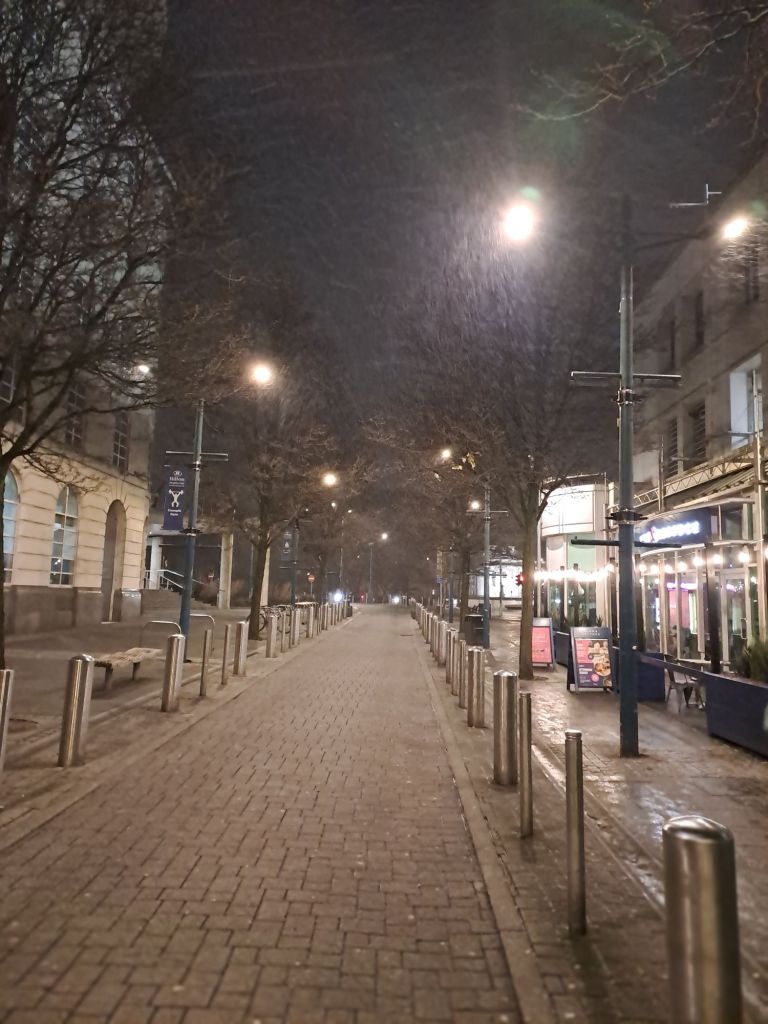
It has just started snowing.

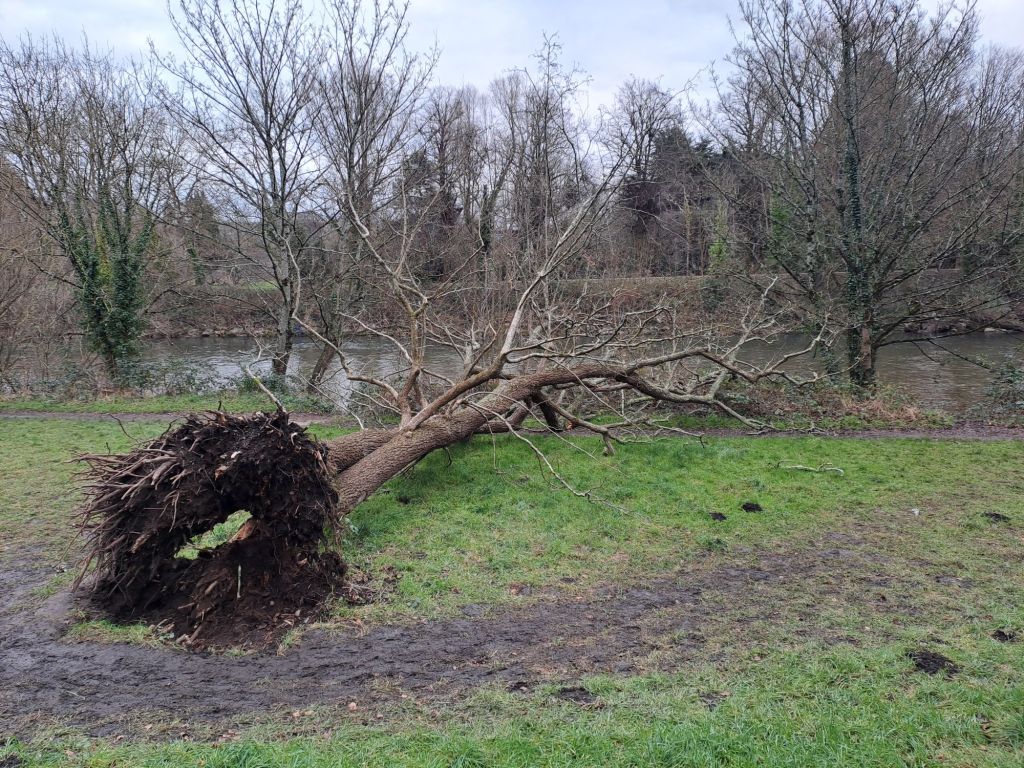
Earlier today, my perambulations took me through Bute Park, where there was quite a lot of evidence of storm damage, including this:

Fallen tree by the River Taff.

The snow is now falling steadily.

Snow on The Friary, Cardiff

I hope it doesn’t go on too long as I have to get a train later in the week, and even a light dusting seems to bring the rail network to a standstill!

Among the Travellers

Posted in Biographical, Cardiff, Education, Maynooth with tags , , , , , , on January 7, 2024 by telescoper

With Nollaig na mBan yesterday that’s the festive season over for me, and time to resume my sabbatical. Joining the crowd of post-Christmas travellers at the airport, today I took my first flight of 2024, complete with last-minute change of gate, apart from which all went perfectly to plan. I won’t be returning to Barcelona immediately, however, as I have a things to do in various different parts of not-Barcelona.

I’m in Cardiff now, where it is fine and dry but very cold, and spending a few days in Cardiff to start with. After that I’ll be taking a train to London to attend a meeting at the Royal Astronomical Society, followed by dinner at the R.A.S Club on Friday 12th January.

Coincidentally, Friday’s dinner is rather appropriately at the Travellers Club, rather than the usual Athenaeum (which is unavailable for some reason). I couldn’t attend any of these occasions between October and December as I was in Barcelona, and for a couple of years. In fact I haven’t been able to attend much at all since the bicentennial dinner in 2020 because of the pandemic and subsequent workload issues. I’m not sure if I’ll be able to go to any others this year either, so I’m looking forward to Friday (despite having to pay the arrears on my subscription) because it is the Parish Dinner, when new members are elected. Owing to the arcane complexity of the rules, and the fact that it all happens after the consumption of a great deal of wine, this usually makes for an amusing occasion.

Meanwhile, in Maynooth, preceded by a few days of revision lectures and tutorials, the January examinations start on Friday 12th January too. Students will therefore be returning from their breaks, swapping the Christmas decorations for the austerity of the examination halls. Although I’m not involved in examinations this year, I’d like to take this opportunity to wish all students at Maynooth and elsewhere all the best for the forthcoming ordeals, and the same for all academic staff whose ordeal by marking will come in due course…

Scopus Listing for the Open Journal of Astrophysics

Posted in Open Access with tags , , , on January 6, 2024 by telescoper

I have been asked a number of times about whether or not the Open Journal of Astrophysics will be listed on Scopus. For myself,  I couldn’t care less about getting listed by Scopus – which is a profit-making service run by publishing giant Elsevier as a gate-keeper for the academic publishing industry. I have, however, heard from many individuals around the world that their research managers and the like actually take it seriously, to the extent that a journal isn’t counted as a journal unless Scopus tells them that is the case.

I’m well aware that hanging the “Approved by Elsevier” tag on the Open Journal of Astrophysics would open us up to the accusation that we collaborating with the enemy. I fully understand that moral objection, but I had to weigh it up against the serious practical difficulties facing researchers who are being forced to pay for Gold Open Access as a result of the absence of OJAp from the Scopus approved list. In the end I decided to apply, but to continue to argue against the use of Scopus and related proprietary databases by research institutions as I consider them just as corrosive as league tables.

Last November, therefore, I decided to hold my nose and apply for Scopus listing; I blogged about this here. Just to clarify, although institutions and organizations pay to subscribe to Scopus, a journal doesn’t have to pay to be listed. The application process, though free, is nevertheless rather time-consuming and I was told to expect the process to take several months. I submitted the application on 21st November 2023.

I was quite surprised yesterday (5th January 2024) to receive an email from Scopus containing the following:

The Scopus Content Selection & Advisory Board (CSAB) has reviewed your application and approved it for coverage.

For your information, the reviewer comments are copied below:

+ The articles are consistently of high academic quality, consistent with the journal’s stated aims.
+ This title is a very welcome addition to the literature.

So there we are. The Open Journal of Astrophysics will indeed be listed on Scopus, though I’m told it might take a few weeks to appear as such. From now on, whenever anyone asks me about this I have a definite answer!

This has, however, reminded me to re-apply for listing by Clarivate. I did apply for this way back in March but the application was rejected on the grounds that we weren’t publishing enough papers (although we publish more papers than many of the journals currently listed by them). Since then our rate of publication has increased substantially, however, so I don’t think they can raise the same objection again.

It will be interesting to see if listing by Scopus makes any difference to the rate of submissions and the geographical distribution of the authors concerned. My guess is it probably will, but not immediately. We’ll just have to wait and see?

Reject the Rankings!

Posted in Education with tags , , , on January 5, 2024 by telescoper

Professor Philip Moriarty of Nottingham University – a former colleague of mine – has written a blog post in protest at his institution’s most recent and most blatant attempts to game the wretched World University Rankings system. I encourage you to read it in its entirety.

The post will touch a nerve with many colleagues around the world who will want to sign – as I have done – the open letter contained therein which is aimed at persuading not only Nottingham but other universities both in the UK and elsewhere to follow the example of Utrecht and abandon these absurd and meaningless rankings.

To sign the open letter please follow this link and to see a list of signatories see here.

Please sign – and spread the link to – this open letter as widely as possible. I’m sure there are many more academics out there who would be more than happy to sign!

A Formula for the New Year

Posted in mathematics on January 4, 2024 by telescoper
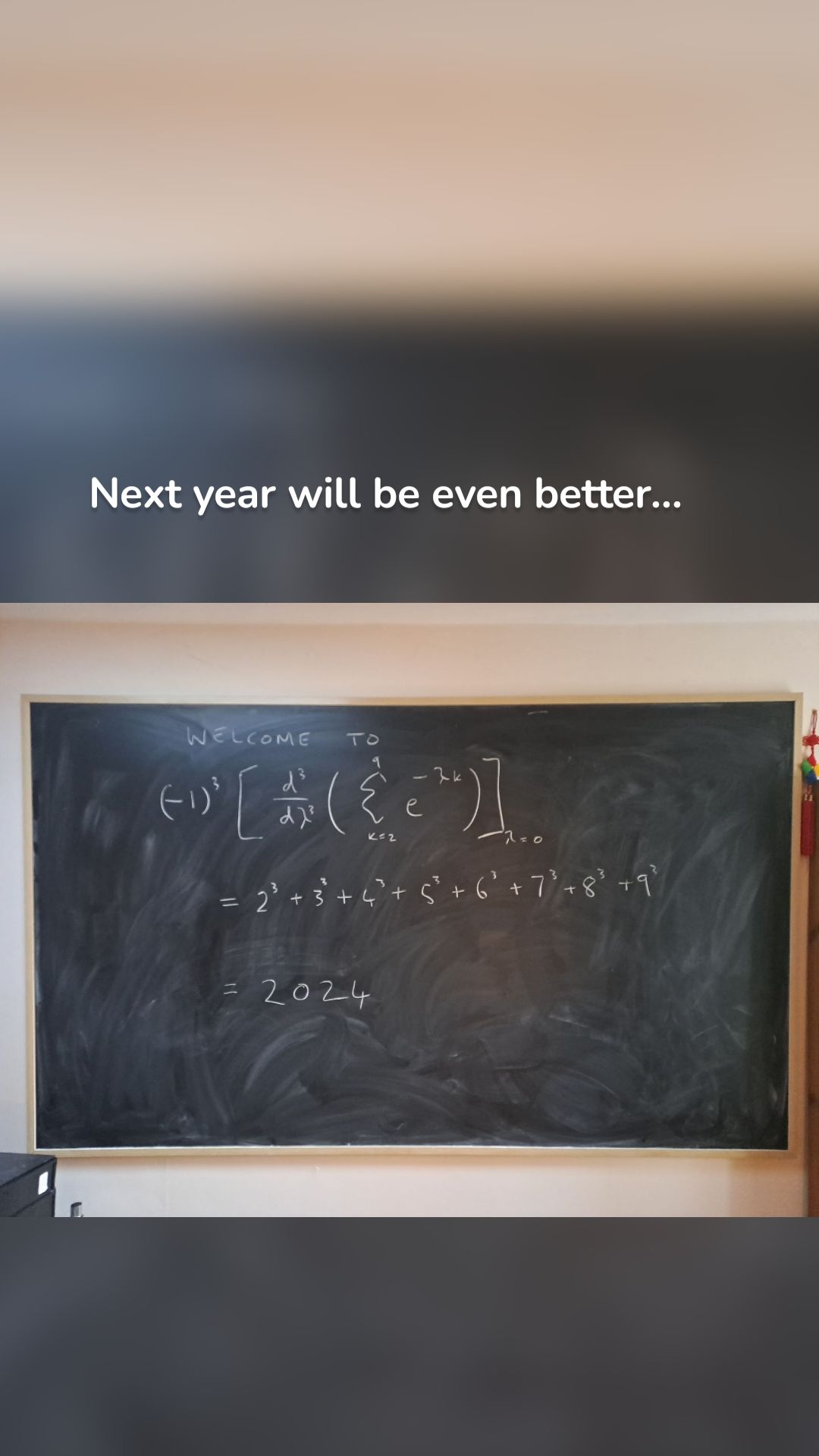
Next year will be even better...

An RAS diary at last!

Posted in Biographical with tags on January 4, 2024 by telescoper

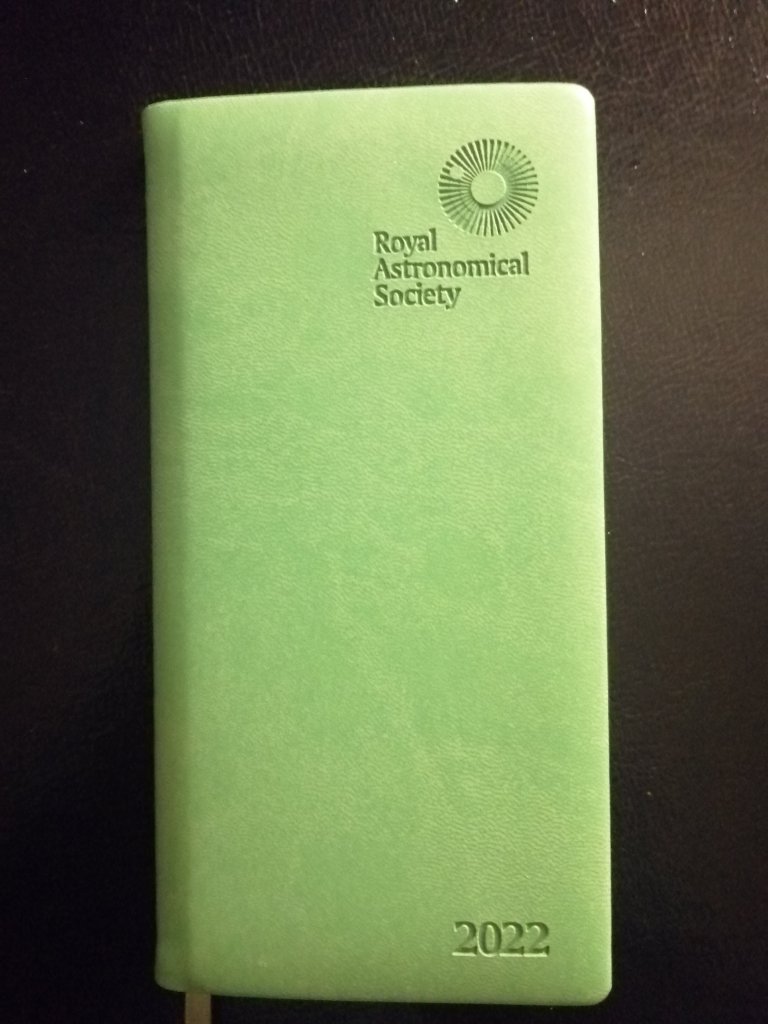
It’s January 4th and my 2024 RAS Diary has at last arrived in Ireland, just a day after I mentioned not having received one this year. According to the customs declaration I see it wasn’t even posted until 22nd December 2023. Why so late?

The diary part of the RAS diary, being I suppose intended for academics, actually runs from October to December the following year. In previous years it has arrived in time to use it for Semester 1 but for the last four years it hasn’t arrived in the post until December at the earliest, meaning that I couldn’t use the first three months in the new diary. I’m actually surprised it got here so quickly given when it was posted.

Anyway, here it is, along with a collection of older ones. It is actually more purple than the blue it appears in the photograph. Notice the change of logo from 2021.

Although many of my colleagues seem not to use them, I like old-fashioned paper diaries. I do run an electronic calendar for work-related events, meetings etc, but I use the paper one to scribble down extra-curricular activities such as concerts and sporting fixtures, as I find the smartphone version of my electronic calendar a bit fiddly.

A Test for Presidential Plagiarism

Posted in Education, Maynooth with tags , , , , on January 3, 2024 by telescoper

I was shocked today to hear the news that Claudine Gay has resigned from her post as President of Harvard University amid allegations of plagiarism.

I think we can all agree that plagiarism is a serious form of misconduct that constitutes a breach of academic integrity and, as such, should be punished wherever it is found. But just how widespread is this kind of unethical behaviour among the leaders of public universities?

Fortunately, I have thought of a simple test to identify Presidential plagiarism, which I encourage academics everywhere to carry out.

One of the documents for which a University President (or Vice Chancellor, or equivalent) is responsible is their institution’s Strategic Plan, which normally carries their Leader’s signature on the front page.

If you work in a University, therefore, all you need to do is run this document through the plagiarism detector Turnitin. This will compare the document with others available on the internet and produce a similarity report indicating how much of it has been copied from elsewhere. If the document is found to have been significantly plagiarized, then your President (or Vice Chancellor, or equivalent) should be forced to resign.

This simple test will probably lead to many so-called leaders being removed from office so, as well as improving academic integrity, it will also save institutions a great deal of money in salary costs. It’s a win-win situation for all (except perhaps for the ex-Presidents).

P.S. Please feel free to copy this idea.

The Time of Perihelion

Posted in The Universe and Stuff with tags , , , on January 3, 2024 by telescoper

Earth’s elliptical orbit viewed at an angle (which makes it look more eccentric than it is – in reality is very nearly circular).

I haven’t received a Royal Astronomical Society diary this year, which I’m sad about as it has been a bit of a tradition, as well as being a useful source of astronomical information. According to other sources,  however, today (Wednesday 3rd January 2024) at approximately 00.39 GMT the Earth reached the point on its orbit  closest to the Sun, i.e. its perihelion. At this time the distance from the Sun’s centre to Earth’s centre was  147,100,632 km. This year, aphelion (the furthest distance from the Sun) is at 06.06 GMT on July 6th 2023 at which point the centre of the Earth will be 152,099,968 km from the centre of the Sun. You can find a list of times and dates of perihelion and aphelion for future years here.

At perihelion the speed of the Earth in its orbit around the Sun is greater than at aphelion (about 30.287 km/s versus 29.291 km/s). This difference, caused by the Earth’s orbital eccentricity, contributes to the difference between mean time and solar time which, among other things, influences the time of sunrise and sunset at the winter solstice that happened a couple of weeks or so ago.

It surprises me how many people think that the existence of the seasons has something to do with the variation of the Earth’s distance from the Sun as it moves in its orbit in that the closer to the Sun we get the warmer the weather will be. The fact that perihelion occurs in the depth of winter should convince anyone living in the Northern hemisphere that this just can’t be the case, as should the fact that it’s summer in the Southern hemisphere while it is winter in the North.

The real reason for the existence of seasons is the tilt of the Earth’s axis of rotation. I used to do a little demonstration with a torch (flashlight to American readers) to illustrate this when I taught first-year astrophysics. If you shine a torch horizontally at a piece of card it will illuminate a patch of the card. Keep the torch at the same distance but tilt the card and you will see the illuminated patch increase in size. The torch is radiating the same amount of energy but in the second case that energy is spread over a larger area than in the first. This means that the energy per unit area incident on the card is decreases when the card is tilted. It is that which is responsible for winter being colder than summer. In the summer the sun is higher in the sky (on average) than in winter. From this argument you can infer that the winter solstice not the perihelion, is the relevant astronomical indicator of winter.

That is not to say that the shape of the Earth’s orbit has no effect on temperatures. It may, for example, contribute to the summer in the Southern hemisphere being hotter than in the North, although it is not the only effect. The Earth’s surface possesses a significant North-South asymmetry: there is a much larger fraction of ocean in the Southern hemisphere, for example, which could be responsible for moderating any differences in temperature due to insolation. The climate is a non-linear system that involves circulating air and ocean currents that respond in complicated ways and on different timescales not just to insolation but to many other parameters, including atmospheric composition (especially the amount of water vapour).

The dates when Earth reaches the extreme points on its orbit (apsides) are not fixed because of the variations in its orbital eccentricity so, in the short-term, the dates can vary up to 2 days from one year to another. The perihelion distance varies slightly from year to year too; it’s slightly larger this year than last year, for example.

There is however a long-term trend for perihelion to occur later in the year. For example, in 1246, the December Solstice (winter solstice for the Northern Hemisphere) was on the same day as the Earth’s perihelion. Since then, the perihelion and aphelion dates have drifted by an average of one day every 58 years and this trend will continue. This means that by the year 6430 the timing of the perihelion and the March Equinox will coincide, although I hope to have retired by then…

The Age Thing

Posted in Biographical, Education with tags , , , , , on January 2, 2024 by telescoper

When I was younger, so much younger than today, I thought I would hate getting old. Now that I’m sixty though I have to say in all honesty that it’s not too bad at all. I could do without the arthritis, of course, but that’s more of an inconvenience than anything else. I am also fortunate to be comfortably off and in a secure job, with the prospect of a decent pension. When I was younger I was frequently under stress, with bouts of insomnia and other issues. Although I am subjected to a bit of aggravation now and then, I seem to have learnt to deal with it better.

I think part of this is that as I’ve got older I’ve become more resistant to peer pressure. Nowadays I go out only when I really want to, and do only what I want to do. Gone are the days when friends used to drag me out to places I didn’t really want to go to. I used to go because I thought people would label me as ‘boring’ if I didn’t. Nowadays, I don’t mind being called boring. I may be boring to you but I am rarely ever bored. I always find plenty to occupy myself.

Another thing that helps is working in a University, which is a good way of being surrounded by interesting young people. So many people of my age seem to resent the young, to the extent of criticizing virtually everything they do. I find the vast majority students friendly, hard-working and engaged, although they have to put up with much more than I had to when I was in their situation.

Teaching physics is interesting because the current generation of undergraduates has to learn a lot of what I had to when I was a student. Every year therefore provides a reminder of the time when I was the age of the new intake, as many of their educational and social experiences are similar. Of course not all. When I was an undergraduate we had no internet or anything like that. There were no social media, either. 

Students these days seem to like using Instagram. I do have an account on Instagram but it is very quiet, probably because I’m not very good at it. Some students follow me there, but I have been told that it would be “inappropriate” to follow them back. That’s probably fair, but I do worry that I appear rude for not following back. It’s not that I’m snobbish or anything. I just feel that I would be intruding, in much the same way as if I wandered into a bar full of students I know. It’s not that I don’t like them, just that I find it awkward (as I’m sure they do). Not having had Instagram when I was young, I suppose I just don’t really understand the etiquette.

One of the things about Instagram is that people do sometimes share quite personal things, and sometimes things that might be quite compromising in a work context, e.g. pictures of themselves in a  state of inebriation. I suppose that’s why it’s a rather contentious issue whether a member of academic staff in a University should or not be “friends” with their undergraduate students on social media. Indeed, this is the official advice given by some institutions to staff. Most wouldn’t have a problem with having social media interactions with their graduate students, though. The nature of the relationship between a PhD student and supervisor is different from that between an undergraduate and a lecturer.

There is a point on social media where professionalism might be compromised just as there is in other social interactions. The trouble is knowing precisely where that boundary lies, which is easy to misjudge. I’ve never felt that it was in any way improper to be friendly to students. Indeed I think that could well improve the students’ experience of education. If the relationship with staff is too distant students may not  feel comfortable asking for help with their work, or advice about wider things. Why should being “professional” mean not treating students as human beings? One can take friendliness too far, however. There have to be some boundaries, and intrusive or demanding behaviour that makes students uncomfortable should be avoided.

I realize I have digressed into social media. Aside from that, though, I’m sure much of student was similar in my day. I’m pretty sure that neither the subject of physics nor students of physics have changed that much over the years. The only difference from my perspective is that every year they look younger! That’s the other side of the coin: the students remind you of your younger self, but not in such a way as to delude you into thinking that you’re still the same person! I think that’s the one thing I’ll miss when I retire, hopefully in the not-too-distant future.

All of this is a roundabout way of saying that I don’t mind getting old. In fact, I feel that my whole life so far has been practice for this.