Archive for July, 2024

Language on Dry Land

Posted in Football, Irish Language with tags , , , , , , , , , on July 13, 2024 by telescoper

Since I’ve got my own computer again now I thought I’d celebrate by doing one of those rambling, inconsequential posts I haven’t had time to do recently.

Last week, in the run up to the European Championship semi-final between England and The Netherlands, I for some reason decided to look up what “The Netherlands” is in the Irish language. I did know this once, as it came up when I was trying to learn Irish a few years ago but I had forgotten. I remembered “England”, which is Sasana (cf. Saxon). Anyway, the answer is An Ísiltír. I’ll return to that in a moment.

Here are some other names:
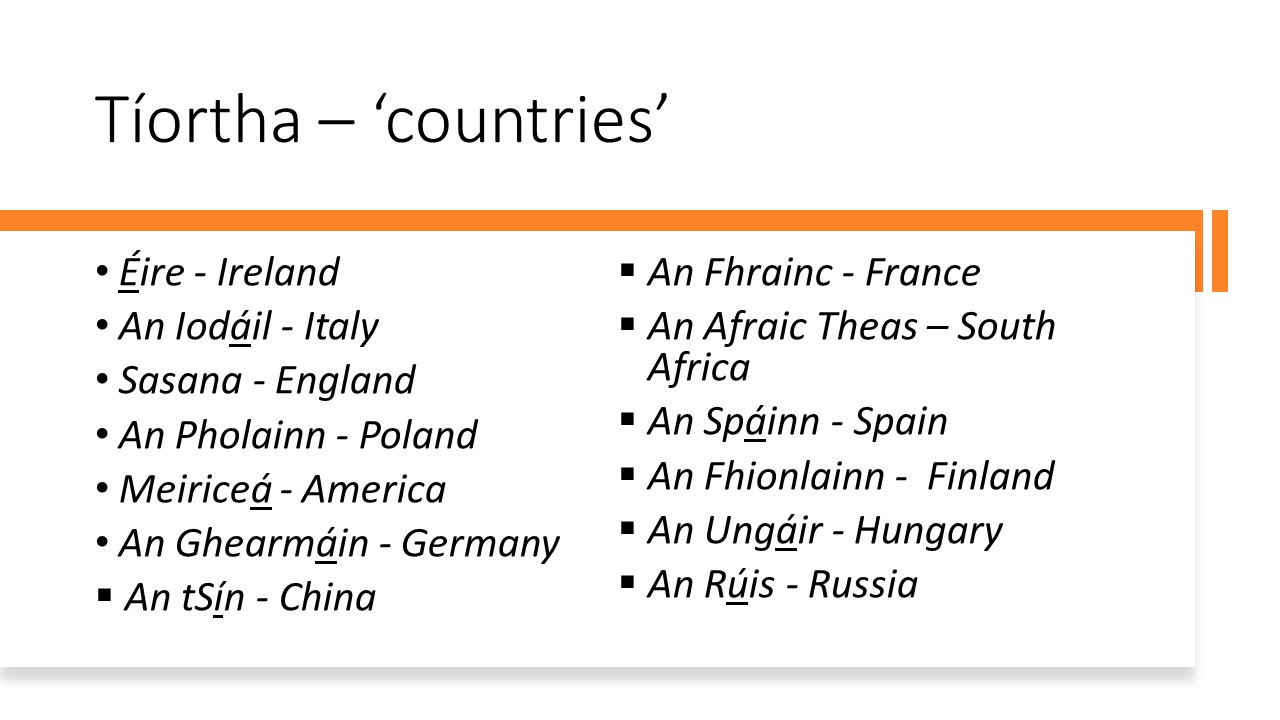
Anyway, a couple of things may be interest. One is that you can see that most country names in Irish are introduced by An. This is the definite article in Irish; there is no indefinite article. This contrasts with English in which only a few names start with the definite article, “The Netherlands” being one. The exceptions in Irish include England (Sasana) and Scotland (Albain). Wales is An Bhreatain Bheag (literally “Little Britain”). Of relevance to the final of the European Championship, Spain is An Spáinn.

I should also mention that some nouns suffer an initial consonant mutation (in the form of lenition, i.e. softening) after the direct article. In modern Irish this is denoted by an h next to the initial consonant, hence Fhrainc, for example; the Irish word for “French” is Fraincis.

The second interesting thing pertains to An Ísiltír itself. The second part of this, tír, means “country” or “nation” – see the plural in the heading above – and the first, Ísil, means “low”. An Ísiltír is therefore literally “The Low Country”. I shared this fascinating insight on social media and found in the replies a mention that the Welsh name for The Netherlands is Yr Iseldiroedda meaning literally “The Low Lands”. The first part of this is clearly similar to the Irish, but the second is the plural of a different word meaning ground or earth or an area of land. There is a word tir in Welsh that means ground or earth or an area of land but it does not mean country or nation like the very similar Irish word; the word for that is gwlad. In Irish the word for land or ground or earth (or turf) is talamh.

Welsh and Irish belong to distinct branches of the Celtic group of languages, the first wave of Indo-European languages to sweep across Europe. I blogged about this here.  Celtic languages therefore share roots with many other Indo-European languages and very basic words in many branches of the tree often bear some similarity in form, if slight but significant differences in meaning. It seems that tír/tir illustrates this rather well. These two words also have a very similar form to the French terre which is derived from the Latin terra. And so I disappeared down an etymological rabbit hole and found that all these words are probably derived from a Proto-Indo-European word meaning “dry”, presumably through reference to “that which is dry” as opposed to the wet bits (although neither Ireland nor Wales is famous for being particular dry).

And to bring this little excursion back full circle, the Irish word tirim means “dry”…

Two New Publications at the Open Journal of Astrophysics

Posted in OJAp Papers, Open Access, The Universe and Stuff with tags , , , , , , , , on July 13, 2024 by telescoper

Another Saturday, another update of the  Open Journal of Astrophysics.  Since the last update we have published two more papers, taking  the count in Volume 7 (2024) up to 56 and the total published by OJAp up to 171.  Both these papers were published on Thursday 11th July 2024.

The first paper of the most recent pair, published on July 3rd 2024,  is “Sunyaev-Zeldovich signatures from non-thermal, relativistic electrons using CMB maps” by Sandeep Kumar Acharya of The Open University of Israel, Ra’anana, Israel.  This article presents a discussion the possible effects of non-thermal electron energy distributions on the form of Sunyaev-Zeldovich distortions and how they might be measured. The paper is in the folder marked Cosmology and NonGalactic Astrophysics.

Here is a screen grab of the overlay which includes the abstract:


You can click on the image of the overlay to make it larger should you wish to do so. You can find the officially accepted version of the paper on the arXiv here.

The second paper has the title “On the contribution of dwarf galaxies to reionization of the Universe” and is by Zewei Wu and Andrey Kravtsov of the University of Chicago in the USA. This paper, which is in the folder marked Astrophysics of Galaxies, presents a model of galaxy formation that suggests that radiation from very faint galaxies may contribute significantly to the reionization of the Universe.

Here is a screen grab of the overlay which includes the abstract:


You can click on the image of the overlay to make it larger should you wish to do so. You can find the officially accepted version of the paper on the arXiv here.

That concludes this week’s update. No doubt I’ll have more for you next week!

The Last Zoom

Posted in Biographical, Euclid with tags , , on July 12, 2024 by telescoper

I mentioned about ten days ago that I was stepping down from my position as Chair and leaving the Euclid Consortium Diversity Committee (ECDC for short). The tedious matter of my broken laptop delayed the official handover, however, so it was only today that I managed to do the official handover to the new ECDC at a Zoom telecon. That was the last ECDC telecon I will chair and, indeed, the last one I will attend. I’ve been participating in these meetings every two weeks or so for four years now, for the last year as Chair, so they have been a regular feature in my calendar for quite a while. Chairing involves quite a lot of preparatory work – compiling and circulating the agenda, keeping minutes, etc – so it feels good to have the responsibility lifted!

I’d like to wish all the new members of the ECDC, who I met (virtually) for the first time today, and those previous members who are continuing, all the best in the future. I’d also like to extend personal thanks to those members who are leaving this year, especially Marc, Florence and Chiara. I’ve enjoyed everyone’s contribution to the discussions.

I’ll still have telecons for other things, of course. In fact I had two others today alone. Why are they so tiring? For better or worse, Zoom meetings are a standard part of academic life nowadays, even more so if you work in a big international consortium such as Euclid for which in-person meetings are not generally feasible. I won’t complain that I’ll be having many fewer of them in future though!

Laptops Old and New

Posted in Biographical with tags , , , on July 11, 2024 by telescoper

At long last the sad story of my laptop is coming to a close. This morning I collected a brand new machine from IT Services in Maynooth and returned the one I’ve had on loan since last week. I took the new machine home, hastily set it up, and installed Zoom on it, so I could do this afternoon’s telecon. Since that call finished I’ve been installing other necessary things (such as Slack), generally setting it up and connecting it to various accounts here and there. I still haven’t managed to get it to talk to my printer though.

The demise of my old machine has been a long, drawn out affair. The machine failed when I got back to Barcelona from Rome last month. I managed to resurrect it a couple of days later, but it was working only intermittently and even when it did it was very slow indeed. Last week it failed completely so I took it to IT Services and was without a machine until I borrowed a new one on Friday. The issue with the old one being fairly terminal I ordered a replacement on Monday. Today (Thursday) I got the new laptop – which is nice – and returned the one I had borrowed. The old laptop is still with the technical folks who are trying to retrieve my data from the hard disk the failure of which was behind all the problems, or so I’m told.

Although I handed over my old machine they didn’t need the power supply, which is a standard one of which they had plenty. Since the new laptop came with its own, identical to the old one, so I am now up by one power supply. Something I should have done ages ago was to get a spare power supply so I could leave one in the office to avoid having to carry it to and from home. That’s now been sorted for me.

I got my old laptop in 2018, so it is about 6 years old and therefore out of warranty. I suppose I should have thought about replacing it anyway, but I’ve actually been lucky with laptops. I have two much older that both still work.

I bought one of them – from Dell, like my new one – when I was at Queen Mary. It still runs Windows 95 and I never connect it to the internet, but I find it good for typing things on as the keyboard has a good feel to it though it is rather heavy. The other one – from Toshiba – dates from 2001 and is much lighter than the other. It also still works, running Windows 2000*, though I don’t use it very often, primarily because the wi-fi antenna no longer works.

P.S. When people ask me whether I’ve upgraded from Windows 10 to Windows 11, I always say that I’m way ahead of them – I’m already on Windows 2000!

Counting the Cost of Gold Open Access

Posted in Open Access with tags , , , , , , , , , on July 10, 2024 by telescoper

If you’re interested in how Article Processing Charges (APCs) have changed over the past five years, the data from six major publishers are now available accompanied by a paper on the arXiv with the abstract:

This paper introduces a dataset of article processing charges (APCs) produced from the price lists of six large scholarly publishers – Elsevier, Frontiers, PLOS, MDPI, Springer Nature and Wiley – between 2019 and 2023. APC price lists were downloaded from publisher websites each year as well as via Wayback Machine snapshots to retrieve fees per journal per year. The dataset includes journal metadata, APC collection method, and annual APC price list information in several currencies (USD, EUR, GBP, CHF, JPY, CAD) for 8,712 unique journals and 36,618 journal-year combinations. The dataset was generated to allow for more precise analysis of APCs and can support library collection development and scientometric analysis estimating APCs paid in gold and hybrid OA journals.

There’s even an interactive data explorer here, at which link you can also find this very informative summary graphic:

Surprise, surprise: the vast majority have gone up!

These figures apply to Gold and Hybrid Open Access publications, but not to Diamond Open Access journals which are free to both authors and readers and avoid these rip-off charges. In my opinion research institutions would be much better off investing in Diamond Open Access publishing than sending their hard-earned cash to profiteering outfits such as Elsevier.

First Flight of Ariane 6

Posted in Uncategorized with tags , on July 9, 2024 by telescoper

Five minutes to go!

Update: it all seemed to go very well, but the timing of the launch was badly planned by the EuropeanSpaceAgency, as it clashed with the semi-final between Spain and France in the European Championship.

Who had one of these as a kid?

Posted in Biographical with tags , , on July 9, 2024 by telescoper
Troll Doll

I had a toy like the one shown above when I was a little kid in the 1960s. We always referred to it as a “Gonk” but I am reliably informed that it is actually a Troll Doll.

One of the things I remember about growing up in Newcastle upon Tyne back then was that there were lots of visitors from Norway in the town at weekends. They came by ferry from Oslo and Bergen to do shopping. For that reason I assumed my Gonk Troll was Norwegian, but these dolls seem to have originated in Denmark.

You live and learn.

Ben Webster in Copenhagen

Posted in Jazz with tags , , , , , on July 9, 2024 by telescoper

The great tenor saxophonist Ben Webster moved to Europe in 1964 and spent much of the rest of his life in Denmark until he passed away in 1973. After his cremation, his ashes were interred in the Assistens Kirkegård in Copenhagen; I visited his grave many moons ago:

That’s a bit of context for a beautiful clip I just stumbled across and couldn’t resist sharing here. It was filmed in Copenhagen in 1965 in the intimate surroundings of the apartment of Danish bass player Niels-Henning Ørsted Pedersen (who plays on the track), with Ole Steenberg on drums and Kenny Drew on piano. Kenny Drew is also buried in the Assistens Kirkegård, in a grave not far from Ben Webster’s.

This is a fine demonstration of Webster’s beautifully tender way of playing ballads, in this case George Gershwin’s Someone to Watch Over Me.

Opinion Polls, Exit Polls and Election Results

Posted in Politics with tags , , , , , , , , , on July 8, 2024 by telescoper

It has been quite an eventful week for voters either side of the English channel. In the United Kingdom, Keir Starmer’s Labour Party were victorious in the General Election, turfing out the Tories after 14 years of misrule, while in France a left-wing coalition managed against the odds to beat Marine Le Pen’s fascist National Rally into third place in their runoff election. In both elections tactical voting clear played a big role. In France many third-placed candidates of the centre or left stood aside to help defeat the Far Right. What happens now with regard to forming a government is anyone’s guess, even for people who know far more about French politics than me.

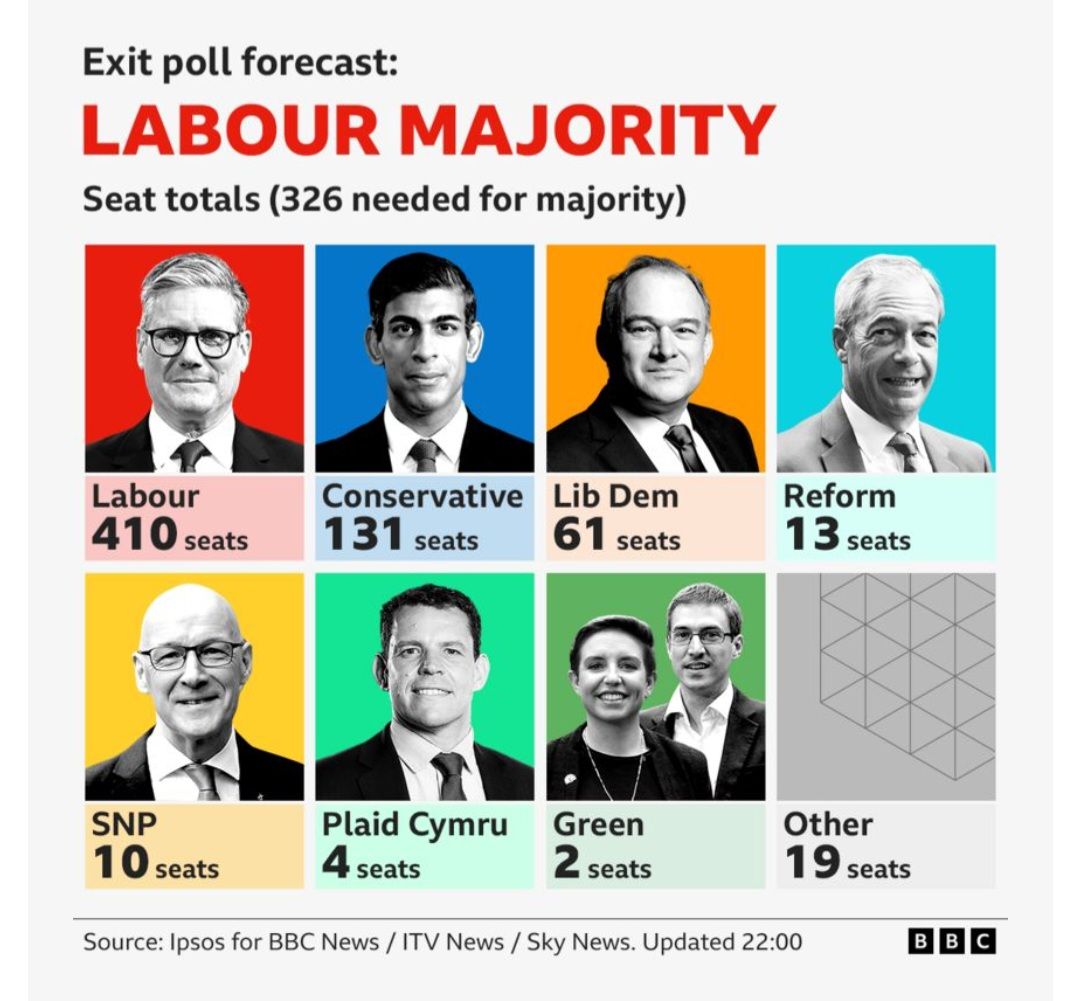
In the runup up to the UK general election, opinion polls had Labour much further ahead in terms of popular vote. As it turned out, however, Labour won 411 seats on a share of the vote of just 33.7% compared to the Conservatives 23.7% and a smaller number of votes than in 2019 when they won just 202 seats. The UK system is not proportional – and doesn’t pretend to be – so this kind of outcome is not surprising. Pundits have rightly pointed to the fact that the far-right Reform party got 14.3% of the vote which undoubtedly took seats from the Tories, but only managed 5 seats and that Labour profited greatly from the collapse of the SNP vote in Scotland.

There are other factors, however. One is that the turnout was 59.9%, well down on 2019 (67.35). That may well be partly due to voters generally not being enthused. But there may be more to it than that. The last time the turnout was below 60% in a UK general election was in 2001. In that year, Labour were miles ahead in the opinion polls so I suppose many Labour voters thought the result was a foregone conclusion and didn’t bother to turn out. It seems likely to me that there was a similar effect on the Labour vote this time. Rather than merely predicting the final result, opinion polls often influence it.

Another factor is that there may have been higher levels of tactical voting, especially with Labour voters switching to the Liberal Democrats to remove the Tory. That might account for why the LibDems did so well. Opinion polls play a role in this too. Yet another is that Labour lost several seats to Independents, standing against the stance on Gaza, and former Labour leader Jeremy Corbyn won his seat standing as an Independent.

That brings me to the exit polls in the UK and France. Here the projections, the first released at 10pm on Thursday and the second at 9pm on Sunday:

Both are pretty accurate, but I’ve always been annoyed by the way the UK exit poll projection (left) is presented as a point estimate without any indication of the uncertainty (which must be considerable, especially for the smaller parties). The final results were Labour 411, Conservative 121, Lib Dem 72, Reform 5, SNP 9, Plaid Cymru 4, Green 4.

The French method of presenting the results (right) is much better in my opinion. In this case the results were 182, 168 and 143 respectively – all within the range presented.

I have to say that I greatly prefer the voting system used here in Ireland to those deployed in either France or the United Kingdom. Elections here are held under Proportional Representation (Single Transferable Vote) which seems to me a very sensible system. One ranks the candidates in order of preference; you can rank all the candidates or just some. In the system employed here in Ireland, votes are progressively reallocated in various rounds until one ends up with the top n candidates to fill the available seats. The STV system involves a quota for automatic election which is N/(m+1) + 1 votes, where N is the number of valid ballots cast and m is the number of seats in the constituency.  To see why this is the case consider a four-seat constituency, where the quota would be 20% of the votes cast plus one. No more than four candidates can reach this level so anyone managing to get that many votes is automatically elected. Surplus votes from candidates exceeding quota, as well as those of eliminated candidates, are reallocated to lower-preference candidates in this process. This system returns representatives with a local constituency connection but is also (approximately) proportional.

One problem with the First Past The Post system deployed in the UK is that if a Reactionary party (Reform) gets 5 seats while a Progressive party (Green) gets only 4, the former gets all the press coverage and the latter gets none..

P.S. I didn’t vote in the UK general election, but the four constituencies in which I lived before moving to Ireland (Cardiff West, Brighton Kemptown, Broxtowe, and Bethnal Green & Stepney) all voted in Labour MPs.

All-Ireland Hurling Semi-Final Weekend

Posted in GAA with tags , , on July 7, 2024 by telescoper

Just a quick post to mention that this weekend saw the semi-finals of this year’s All-Ireland Senior Hurling Championship at Croke Park.

Yesterday, after playing very poorly against Kilkenny in the first half,  Clare staged an epic comeback to create an exciting finish, eventually to win by two points (0-24 to 2-16).

Today’s semi-final was even better, with Cork pulling out all the stops against Limerick in the second half in a match that was played at an extraordinary tempo even by the standards of hurling. Cork ran out deserved winners by 1-28 to 0-29. Once again, only two points separated the sides.

Limerick were bidding to win their 5th All-Ireland championship in a row, but they have to settle for four, as the final in two weeks’ time will be between Cork and Clare.