It’s Satuday morning once again, and time for another update of papers published at the Open Journal of Astrophysics. Since the last update we have published two papers, which brings the number in Volume 8 (2025) up to 29 and the total so far published by OJAp up to 264.
The papers we have published this week are connected by the theme of black holes and their role in galaxy formation, which is a very hot topic nowadays!
and you can find the final accepted version on arXiv here.
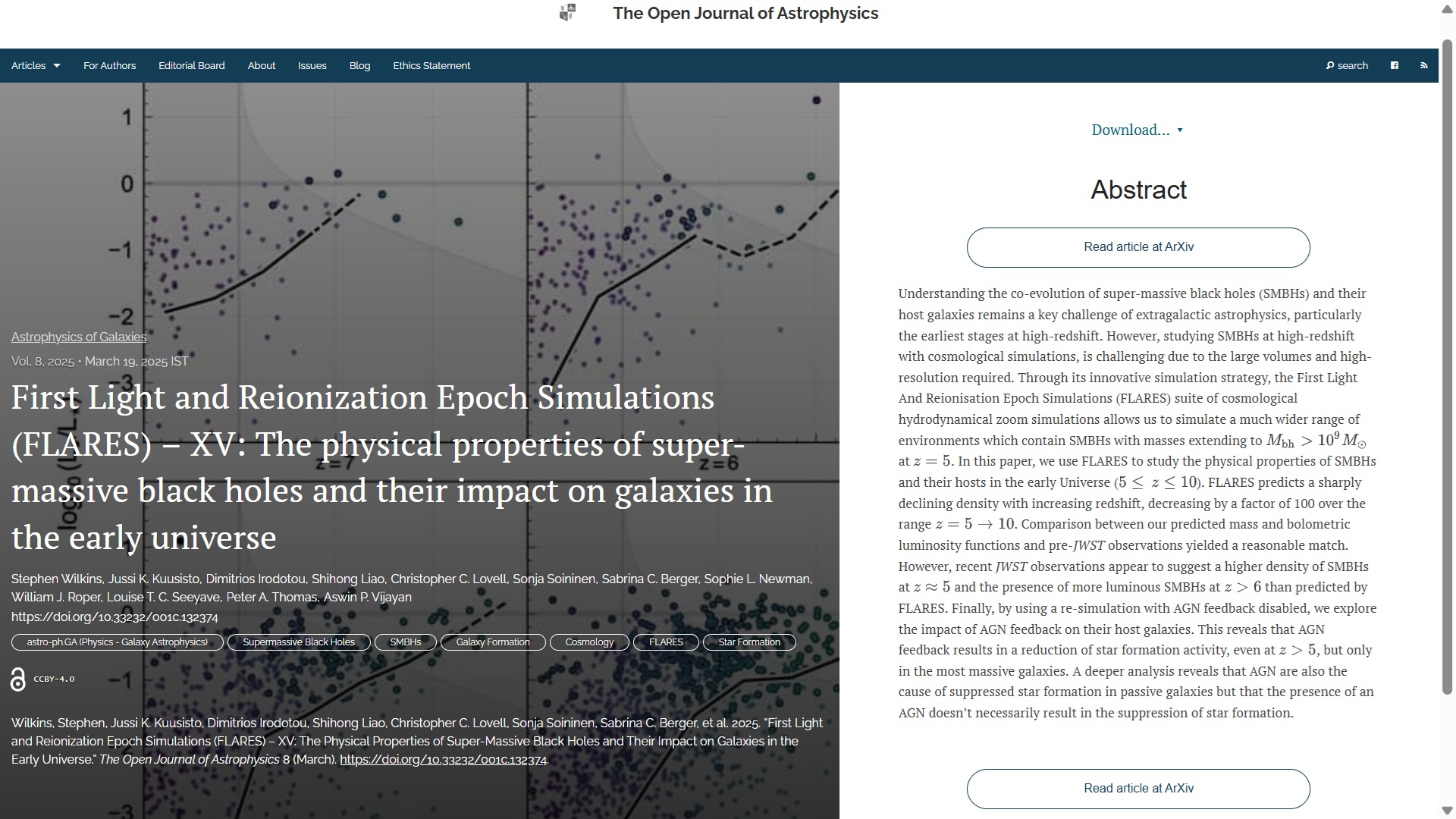
The second paper, which was published on Wednesday 19th March and is also in the folder Astrophysics of Galaxies, is “First Light and Reionization Epoch Simulations (FLARES) – XV: The physical properties of super-massive black holes and their impact on galaxies in the early universe” by Stephen Wilkins & Jussi K. Kuusisto (U. Sussex, UK), Dimitrios Irodotou (Institute of Cancer Research, UK), Shihong Liao (Beijing, China) Christopher C. Lovell (Portsmouth, UK), Sonja Soininen (Insitute of Cancer Research), Sabrina C. Berger (Melbourne, Australia), Sophie L. Newman (Portsmouth, UK), William J. Roper (Sussex), Louise T. C. Seeyave (Sussex), Peter A. Thomas (Sussex) and Aswin P. Vijayan Sussex). This paper uses cosmological hydrodynamical zoom simulations to study the formation of supermassive black holes and their impact on star formation in the early Universe.
Here is the overlay, which you can click on to make larger if you wish:
You can read the officially accepted version of this paper on arXiv here.
That’s all for this week. It’s been a bit frustrating for me as Managing Ediutor, because we have built up a backlog of several papers that were accepted for publication some time ago, but are still waiting for the authors to place the final version on arXiv. I hope these won’t take too long to appear, not least because I would like to clear my workflow on the Scholastica platform!
Beware, all thieves and imitators of other people’s labour and talents, of laying your audacious hands upon our work.
Albrecht Dürer, 1511
I’ve remembered that quotation since it was uttered by Inspector Morse in the episode Who Killed Harry Field? Albrecht Dürer wasn’t referring to Artificial Intelligence when he said it, but it does seem pertitent to what’s going on today.
There’s an article in The Atlanticabout a huge database of pirated work called LibGen that has been used by Mark Zuckerberg’s corporation Meta to train its artificial intelligence system. Instead of acquiring such materials from publishers – or, Heaven forbid, authors! – they decided simply to steal it. That’s theft on a grand scale: 7.5 million books and 81 million research papers.
The piece provides a link to LibGen so you can search for your own work there. I searched it yesterday and found 137 works by “Peter Coles”. Not all of them are by me, as there are other authors with the same name, but all my books are there, as well as numerous research articles, reviews and other pieces:
I suppose many think I should be flattered that my works are deemed to be of sufficiently high quality to be used to train a large language model, but I’m afraid I don’t see it that way at all. I think, at least for the books, this is simply theft. I understand that there may be a class action in the USA against Meta for this larceny, which I hope succeeds.
I think I should make a few points about copyright and authorship. I am a firm advocate of open access to the scientific literature, so I don’t think research articles should be under copyright. Meta can access them along with everyone else on the planet. It’s not really piracy if it’s free anyways. Although it would be courteous of Meta to acknowledge its sources, lack of courtesy is not the worst of Meta’s areas of misconduct.
In a similar vein, when I started writing this blog back in 2008 I did wonder about copyright. Over the years, quite a lot of my ramblings here have been lifted by journalists, etc. Again a bit of courtesy would have been nice. I did make the decision, however, not to bother about this as (a) it would be too much hassle to chase down every plagiarist and (b) I don’t make money from this site anyway. As far as I’m concerned as soon as I put anything on here it is in the public domain. I haven’t changed that opinion with the advent of ChatGPT etc. Indeed, I am pretty sure that all 7000+ articles from this blog were systematically scraped last year.
Books are, however, in a different category. I have never made a living from writing books, but it is dangerous to the livelihood of those that do to have their work systematically stolen in this way. I understand that there may be a class action in the USA against Meta for this blatant larceny, which I hope succeeds.
Yesterday evening (10pm Irish Time) saw the release of new results from the Dark Energy Spectroscopic Instrument (DESI), completing a trio of major announcements of cosmological results in the space of two days (the Atacama Cosmology Telescope and the Euclid Q1 release being the others). I didn’t see the DESI press conference but you can read the press release here.
There were no fewer than eight DESI papers on the astro-ph section of the arXiv this morning. Here are the titles with links:
You can see from the titles that the first seven of these relate to the second data release (DR2; three years of data) from DESI; the last one listed here is a description of the first data release (DR1), which is now publicly available.
Obviously there is a lot of information to digest in these papers so here are two members of the DESI collaboration talking with Shaun Hotchkiss on Cosmology Talks about the key messages from the analysis of Baryon Acoustic Oscillations (the BAO in the titles of the new papers):
A lot has been made in the press coverage of these results about the evidence that the standard cosmological model is incomplete; see, e.g., here. Here are a few comments.
As I see it, taken on their own, the DESI BAO results are broadly consistent with the ΛCDM model as specified by the parameters determined by the Cosmic Microwave Background (CMB) inferred from Planck. Issues do emerge, however, when these results are combined with other data sets. The most intriguing of these arises with the dark energy contribution. The simplest interpretation of dark energy is that it is a cosmological constant (usually called Λ) which – as explained here – corresponds to a perfect fluid with an equation-of-state p=wρc2 with w=-1. In this case the effective mass density of the dark energy ρ remains constant as the universe expands. To parametrise departures from this constant behaviour, cosmologists have replaced this form with the form w(a)=w0+wa(1-a) where a(t) is the cosmic scale factor. A cosmological constant Λ would correspond to a point (w0=-1, wa=0) in the plane defined by these parameters, but the only requirement for dark energy to result in cosmic acceleration is that w<-1/3, not that w=-1.
The DESI team allow (w0, wa) to act as free parameters and let the DESI data constrain them, either alone or in combinations with other data sets, finding evidence for departures from the “standard values”. Here’s an example plot:
The DESI data don’t include the standard point (at the intersection of the two dashed lines) but the discrepancy gets worse when other data (such as supernovae and CMB) are folded in, as in this picture. The weight of evidence suggests a dark energy contribution which is decreasing with time.
These results are certainly intriguing, and a lot of credit is due to the DESI collaboration for working so hard to identify and remove possible systematics in the analysis (see the papers above) but what do they tell us about ΛCDM?
My view is that we’ve never known what the dark energy actually is or why it is so large that it represents 70% of the overall energy density of the Universe. The Λ in ΛCDM is really just a place-holder, not there for any compelling physical reason but because it is the simplest way of accounting for the observations. In other words, it’s what it is because of Occam’s Razor and nothing more. As with any working hypothesis, the standard cosmological model will get updated whenever new information comes to light (as it is doing now) and/or if we get new physical insights into the origin of dark energy.
Do the latest observations cast doubt on the standard model? I’d say no. We’re seeing an evolutionary change from “We have no idea what the dark energy is but we think it might be a cosmological constant” to “We still have no idea what the dark energy is but we think it might not be a cosmological constant”.
Loughcrew Cairn: for a few days on and around the vernal equinox the rays of the rising Sun penetrate the passage and illuminate the back stone.
Just a quick note to mention that the Vernal Equinox (Spring Equinox) in the Northern hemisphere happens this morning, Thursday 20th March 2025, at 9.01 UTC (which is 9.01am local time here in Ireland, i.e. in about half an hour). Many people in the Northern hemisphere regard the Vernal Equinox as the first day of spring; of course in the Southern hemisphere, this is the Autumnal Equinox.
The date of the Vernal Equinox is often given as 21st March, but in fact it has only been on 21st March twice this century so far (2003 and 2007); it was on 20th March in 2008, has been on 20th March every spring from then until now, and will be until 2044 (when it will be on March 19th).
Anyway, people sometimes ask me how one can define the `equinox’ so precisely when surely it just refers to a day on which day and night are of equal length, implying that it’s a day not a specific time? The answer is that the equinox is defined by a specific event, the event in question being when the plane defined by Earth’s equator passes through the centre of the Sun’s disk (or, if you prefer, when the centre of the Sun passes through the plane defined by Earth’s equator). Day and night are not necessarily exactly equal on the equinox, but they’re the closest they get. From now until the Autumnal Equinox, days in the Northern hemisphere will be longer than nights, and the days will continue get longer until the Summer Solstice before beginning to shorten again.
Today is Q1 Day! This means the first public release of data from the full Euclid Survey. It’s only a very small portion (0.4%) of the survey – just 63 square degrees on the sky, while the full survey will be over 14,000 square degrees – but in contrast to earlier data releases, this has been passed through the full Euclid Ground Segment so it represents the true quality of the data we can expect for the rest of the mission. There are no actual cosmology results yet – there isn’t enough data to address the key science goals of Euclid – but there are some great illustrations of the many byproducts of a survey of this type.
Update: here’s one of the Cosmology Talks video by Shaun Hotchkiss with two members of the Euclid Consortium commenting on today’s data release:
As well as the splash of press coverage likely to follow the lifting of today’s embargo, there will be a deluge of Q1-related papers hit the arXiv on 20th March. You can find details here.
Here’s a gallery of pretty pictures released today. These are low resolution versions; try opening the image in a new tab to see it without the caption. You can find and explore higher resolution images on ESASky (see below). Picture credits are: ESA/Euclid/Euclid Consortium/NASA, image processing by J.-C. Cuillandre, E. Bertin, G. Anselmi for the first six images, then ESA/Euclid/Euclid Consortium/NASA, image processing by M. Walmsley, M. Huertas-Company, J.-C. Cuillandre for the next two (bottom row); and ESA/Euclid/Euclid Consortium/NASA; ESA/Gaia/DPAC; ESA/Planck Collaboration for the last one.
This is Euclid’s Deep Field Fornax. After only one observation, the space telescope already spotted 4.5 million galaxies in this field. In the coming years, Euclid will make 52 observations of this field to reach its full depth. This is a zoom-in of Euclid’s Deep Field North, showing the Cat’s Eye Nebula in the centre of the image, around 3000 light-years away. Also known as NGC 6543, this nebula is a visual ‘fossil record’ of the dynamics and late evolution of a dying star. This dying star is shedding its outer colourful shells. This is Euclid’s Deep Field North. After only one observation, the space telescope has already spotted more than ten million galaxies in this field. It is also very rich in Milky Way stars, as it is close to the Galactic plane. In the coming years, Euclid will make 32 observations of this field to reach its full depth. This is Euclid’s Deep Field South. After only one observation, the space telescope already spotted more than 11 million galaxies in this field. In the coming years, Euclid will make more observations of this field to reach its full depth. This image shows an area of Euclid’s Deep Field South. The area is zoomed in 16 times compared to the large mosaic.This image shows an area of Euclid’s Deep Field South. The area is zoomed in 70 times compared to the large mosaic.This image shows examples of galaxies in different shapes, all captured by Euclid during its first observations of the Deep Field areas. This image shows examples of gravitational lenses that Euclid captured in its first observations of the Deep Field areas. This graphic shows the location of the Euclid Deep Fields (yellow). This all-sky view is an overlay of ESA Gaia’s star map from its second data release in 2018 and ESA Planck’s dust map from 2014.
I’m taking the liberty to append the official ESA Press Release, which follows:
–o–
On 19 March 2025, the European Space Agency’s Euclid mission released its first batch of survey data, including a preview of its deep fields. Here, hundreds of thousands of galaxies in different shapes and sizes take centre stage and show a glimpse of their large-scale organisation in the cosmic web.
Covering a huge area of the sky in three mosaics, the data release also includes numerous galaxy clusters, active galactic nuclei and transient phenomena, as well as the first classification survey of more than 380,000 galaxies and 500 gravitational lens candidates compiled through combined artificial intelligence and citizen science efforts. All of this sets the scene for the broad range of topics that the dark Universe detective Euclid is set to address with its rich dataset.
“Euclid shows itself once again to be the ultimate discovery machine. It is surveying galaxies on the grandest scale, enabling us to explore our cosmic history and the invisible forces shaping our Universe,” says ESA’s Director of Science, Prof. Carole Mundell.
“With the release of the first data from Euclid’s survey, we are unlocking a treasure trove of information for scientists to dive into and tackle some of the most intriguing questions in modern science. With this, ESA is delivering on its commitment to enable scientific progress for generations to come.”
Tracing out the cosmic web in Euclid’s deep fields
Euclid has scouted out the three areas in the sky where it will eventually provide the deepest observations of its mission. In just one week of observations, with one scan of each region so far, Euclid already spotted 26 million galaxies. The farthest of those are up to 10.5 billion light-years away. The fields also contain a small population of bright quasars that can be seen much farther away. In the coming years, Euclid will pass over these three regions tens of times, capturing many more faraway galaxies, making these fields truly ‘deep’ by the end of the nominal mission in 2030.
But the first glimpse of 63 square degrees of the sky, the equivalent area of more than 300 times the full Moon, already gives an impressive preview of the scale of Euclid’s grand cosmic atlas when the mission is complete. This atlas will cover one-third of the entire sky – 14 000 square degrees – in this high-quality detail.
“It’s impressive how one observation of the deep field areas has already given us a wealth of data that can be used for a variety of purposes in astronomy: from galaxy shapes, to strong lenses, clusters, and star formation, among others,” says Valeria Pettorino, ESA’s Euclid project scientist. “We will observe each deep field between 30 and 52 times over Euclid’s six year mission, each time improving the resolution of how we see those areas, and the number of objects we manage to observe. Just think of the discoveries that await us.”
“The full potential of Euclid to learn more about dark matter and dark energy from the large-scale structure of the cosmic web will be reached only when it has completed its entire survey. Yet the volume of this first data release already offers us a unique first glance at the large-scale organisation of galaxies, which we can use to learn more about galaxy formation over time,” says Clotilde Laigle, Euclid Consortium scientist and data processing expert based at the Institut d’Astrophysique de Paris, France.
Humans and AI classify more than 380 000 galaxies
Euclid is expected to capture images of more than 1.5 billion galaxies over six years, sending back around 100 GB of data every day. Such an impressively large dataset creates incredible discovery opportunities, but huge challenges when it comes to searching for, analysing and cataloguing galaxies. The advancement of artificial intelligence (AI) algorithms, in combination with thousands of human citizen science volunteers and experts, is playing a critical role.
“We’re at a pivotal moment in terms of how we tackle large-scale surveys in astronomy. AI is a fundamental and necessary part of our process in order to fully exploit Euclid’s vast dataset,” says Mike Walmsley, Euclid Consortium scientist based at the University of Toronto, Canada, who has been heavily involved in astronomical deep learning algorithms for the last decade.
“We’re building the tools as well as providing the measurements. In this way we can deliver cutting-edge science in a matter of weeks, compared with the years-long process of analysing big surveys like these in the past,” he adds.
A major milestone in this effort is the first detailed catalogue of more than 380 000 galaxies, which have been classified according to features such as spiral arms, central bars, and tidal tails that infer merging galaxies. The catalogue is created by the ‘Zoobot’ AI algorithm. During an intensive one-month campaign on Galaxy Zoo last year, 9976 human volunteers worked together to teach Zoobot to recognise galaxy features by classifying Euclid images.
This first catalogue released today represents just 0.4% of the total number of galaxies of similar resolution expected to be imaged over Euclid’s lifetime. The final catalogue will present the detailed morphology of at least an order of magnitude more galaxies than ever measured before, helping scientists answer questions like how spiral arms form and how supermassive black holes grow.
“We’re looking at galaxies from inside to out, from how their internal structures govern their evolution to how the external environment shapes their transformation over time,” adds Clotilde.
“Euclid is a goldmine of data and its impact will be far-reaching, from galaxy evolution to the bigger-picture cosmology goals of the mission.”
Gravitational lensing discovery engine Light travelling towards us from distant galaxies is bent and distorted by normal and dark matter in the foreground. This effect is called gravitational lensing and it is one of the tools that Euclid uses to reveal how dark matter is distributed through the Universe.
When the distortions are very apparent, it is known as ‘strong lensing’, which can result in features such as Einstein rings, arcs, and multiple imaged lenses.
With the help of these models, Euclid will capture some 7000 candidates in the major cosmology data release planned for the end of 2026, and in the order of 100 000 galaxy-galaxy strong lenses by the end of the mission, around 100 times more than currently known.
Euclid will also be able to measure ‘weak’ lensing, when the distortions of background sources are much smaller. Such subtle distortions can only be detected by analysing large numbers of galaxies in a statistical way. In the coming years, Euclid will measure the distorted shapes of billions of galaxies over 10 billion years of cosmic history, thus providing a 3D view of the distribution of dark matter in our Universe.
“Euclid is very quickly covering larger and larger areas of the sky thanks to its unprecedented surveying capabilities,” says Pierre Ferruit, ESA’s Euclid mission manager, who is based at ESA’s European Space Astronomy Centre (ESAC) in Spain, home of the Astronomy Science Archive where Euclid’s data will be made available.
“This data release highlights the incredible potential we have by combining the strengths of Euclid, AI, citizen science and experts into a single discovery engine that will be essential in tackling the vast volume of data returned by Euclid.”
Notes to editors
As of 19 March 2025, Euclid has observed about 2000 square degrees, approximately 14% of the total survey area (14 000 square degrees). The three deep fields together comprise 63.1 square degrees.
Euclid ‘quick’ releases, such as the one of 19 March, are of selected areas, intended to demonstrate the data products to be expected in the major data releases that follow, and to allow scientists to sharpen their data analysis tools in preparation. The mission’s first cosmology data will be released to the community in October 2026. Data accumulated over additional, multiple passes of the deep field locations will be included in the 2026 release.
The three deep field previews can now be explored in ESASky from 19 March 12:00 CET onwards:
Euclid was launched in July 2023 and started its routine science observations on 14 February 2024. In November 2023 and May 2024, the world got its first glimpses of the quality of Euclid’s images, and in October 2024 the first piece of its great map of the Universe was released.
Euclid is a European mission, built and operated by ESA, with contributions from its Member States and NASA. The Euclid Consortium – consisting of more than 2000 scientists from 300 institutes in 15 European countries, the USA, Canada and Japan – is responsible for providing the scientific instruments and scientific data analysis. ESA selected Thales Alenia Space as prime contractor for the construction of the satellite and its service module, with Airbus Defence and Space chosen to develop the payload module, including the telescope. NASA provided the detectors of the Near-Infrared Spectrometer and Photometer, NISP. Euclid is a medium-class mission in ESA’s Cosmic Vision Programme.
Today is going to be a very busy day on the cosmology front – with the Euclid Q1 Data Release coming out at 11am GMT – but I’ll start off by sharing news of final data release (DR6) by the Atacama Cosmology Telescope. This was announced yesterday and includes former colleagues at Cardiff University, so congratulations to them and all concerned. Here is a pretty picture showing one of the beautiful cosmic microwave background polarization and intensity maps:
Intensity and Polarization maps from ACT: arXiv:2503.14451
There are three related preprints on the arXiv today:
There’s a lot to digest in these papers but a quick skim of the abstracts gives two pertinent points. First, from the second paper:
We find that the ACT angular power spectra estimated over 10,000 deg2, and measured to arcminute scales in TT, TE and EE, are well fit by the sum of CMB and foregrounds, where the CMB spectra are described by the ΛCDM model. Combining ACT with larger-scale Planck data, the joint P-ACT dataset provides tight limits on the ingredients, expansion rate, and initial conditions of the universe.
They also find that, when combined with CMB lensing from ACT and Planck, and baryon acoustic oscillation data from the Dark Energy Spectroscopic Instrument (DESI Y1), the ACT data give a “low” value for the Hubble constant: H0=68.22 ± 0.36 km s-1 Mpc-1.
The third paper also says
In general, models introduced to increase the Hubble constant or to decrease the amplitude of density fluctuations inferred from the primary CMB are not favored by our data.
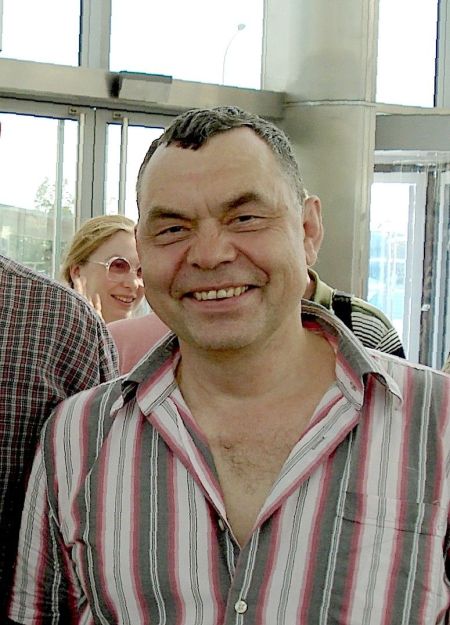
It is my sad duty to pass on the sad news of the death of Sergei Shandarin, who passed away yesterday at the age of 77. He had been suffering from cancer for some time and had been undergoing chemotherapy, alas to no avail. Last week he was moved onto palliative care and we knew he would soon be leaving us. I was going to post something last night when I heard that he had died, but I just couldn’t find the words. I send my deepest condolences to his family, friends and colleagues who are grieving.
(The picture on the left shows Sergei in 2006; I’m grateful to John Peacock for letting me use it here.)
Sergei Fyodor Shandarin was born in 1947 and gained his PhD at the Moscow Institute of Physics and Technology in 1974. He was a student of the great physicist Yakov Borisovich Zeldovich (whom I blogged about here). Sergei moved to the USA in 1991 to take up a Professorship at the University of Kansas, in Lawrence, where he remained until his retirement. More recently he and his wife Vika moved to Toronto to be closer to his daughter Anya and their grandchildren.
Sergei’s main research interests were the dynamics and statistics of the “Cosmic Web” – the supercluster- void network in spacial distribution of galaxies. In particular, he was interested in nonlinear dynamics of gravitational instability, which is the major mechanism for the formation of a large variety of objects in the universe, and in geometrical and topological statistical descriptors of the distribution of mass and galaxies in space.
These topics overlap considerably with my own and I was delighted to have the opportunity to work with Sergei in 1992 when I was invited by Adrian Melott as a visitor to Lawrence fro about a month. My first impression of Sergei was that he was a bit scary – in that typical Russian physicist sort of way – but I soon discovered that, beneath his initially rather fierce demeanour, he was actually a kind and friendly person with a fine sense of humour. I remember that research visit very well, in fact, not only because of Adrian’s and Sergei’s hospitality, but also because the project we did together went so well that we not only completed the research, but I returned to London with a completed manuscript; the paper that resulted was published in early 1993.
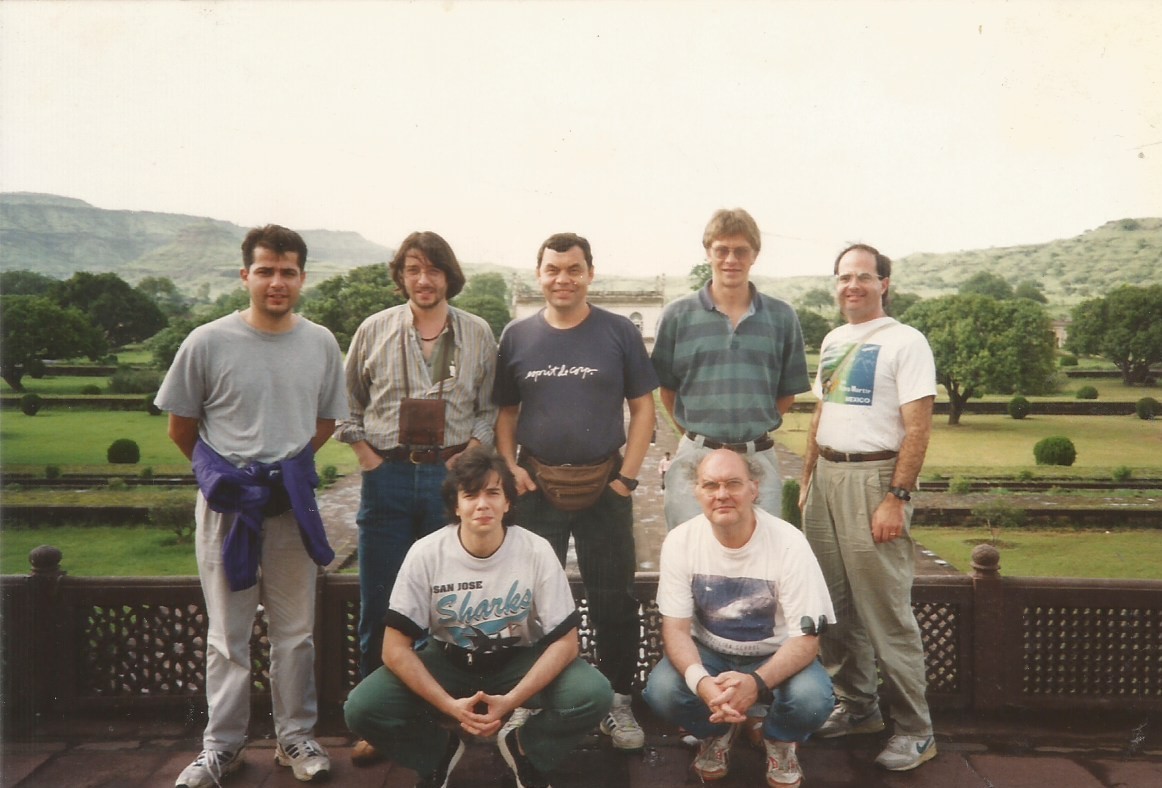
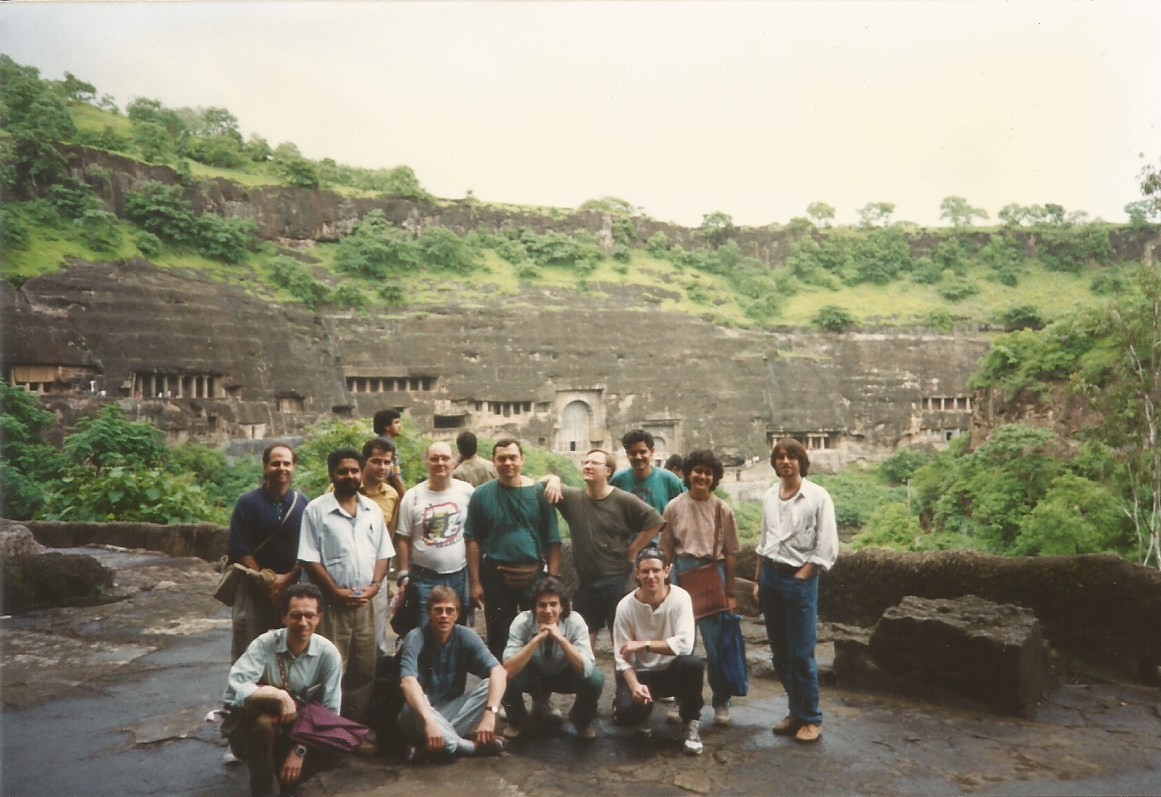
After that I kept in touch with Sergei mainly at conferences. Last night after I heard the news that he has passed away I brought a box of old photographs down from the loft and rummaged around for some pictures. Here are two from a meeting in India in 1994, in which you can see Sergei very much in the centre of things:
The picture on the left shows: (standing, L to R) Francis Bernardeau, Paolo Catelan, Sergei, ?*, Paul R. Shapiro; (crouching) Enzo Branchini and Bernard Jones. The picture on the right has the addition of, among others, Varun Sahni (between Paul Shapiro and Bernard Jones), Dick Bond (with his arm on Sergei’s shoulder) and Sabino Matarrese (front left); I’m on the right of the front row. I remember these pictures were taken on an excursion from Pune to see the historic caves and temples at Ajanta and Ellora.
(*I think the unidentified person might be Lars Hernquist, but I’m not sure: I’d be grateful for any information.)
I also particular remember meeting up with Sergei at meetings in Los Angeles, Nice, Valencia (the meeting at which the first picture was taken). and most recently in Estonia (for a meeting to celebrate the centenary of the birth of Zel’dovich). He was always up for scientific discussions, but also liked to relax with a drink or several; he also liked to watch football.
Sergei was a wonderful scientist as well as a warm and generous human being who was held in a very high regard by the cosmological community worldwide. We will all miss him terribly.
Well, it’s St Patrick’s Day, which is a public holiday here in Ireland, so Lá Fhéile Pádraig sona daoibh go léir!
This morning I watched the Parade in Maynooth. It didn’t rain, but it was a strangely subdued affair notable for the lack of music. The isn’t much of an atmosphere if the participants are walking along in silence! You can’t have Craic agus Ceol if there’s no Ceol. I only counted two tractors too; usually there are many more than that. Fortunately, I have a calendar that offers a tractor for every month to make up for this disappointment. Still, it was good to see the kids enjoing themselves. The highlight for me this year was the Coakley Septic Tank Cleaning Truck, which just outdid the Thornton’s Refuse Collection Vehicle for sheer splendour.
Straffan Road
A Calendar of Tractors
Septic Tank Cleaning Truck
Anyway, I should take the opportunity to write something about St Patrick. Not much is known for certain but it seems he was born in Britain, probably in the late 4th Century AD, probably somewhere around the Severn Estuary, and probably in Wales. It also appears that he didn’t know any Latin. When a young man, it seems he was captured by Celtic marauders coming up the River Severn and taken as a slave to Ireland. He eventually escaped back to Britain, but returned to Ireland as a missionary and succeeded somehow in converting the Irish people to Christianity.
Or did he? This interesting piece suggests his role was of lesser importance than many think.
However it happened, Ireland was the first country to be converted to Christianity that had never been part of the Roman Empire. That made a big difference to the form of the early Church here. The local Celtic culture was very loose and decentralized. There were no cities, large buildings, roads or other infrastructure. Life revolved around small settlements and farms. When wars were fought they were generally over livestock or grazing land. The early Irish Church that grew in this environment was quite different from that of continental Europe. It was not centralized, revolved around small churches and monasteries, and lacked the hierarchical structure of the Roman Church. Despite these differences, Ireland was quite well connected with the rest of the Christian world.Irish monks – and the wonderful illuminated manuscripts they created – spread across the continent, starting with Scotland and Britain. Thanks to the attentions of the Vikings few of these works survive but the wonderful Lindisfarne Gospels, dating from somewhere in the 8th Century were almost certainly created by Irish monks. The Book of Kells was probably created in Scotland by Irish Monks.
The traffic wasn’t entirely one-way however. A few years ago I saw a fascinating documentary about the Fadden More Psalter. This is a leather-bound book of Psalms found in a peat bog in 2006, which is of similar age to the Lindisfarne Gospels. It took years of painstaking restoration work to recover at least part of the text (much of which was badly degraded), but the leather binding turned out to hold a particularly fascinating secret: it was lined with papyrus. The only other books from the same period with the same structure that are known are from the Coptic Church in Egypt. That doesn’t mean that whoever owned the Fadden More Psalter had actually been to Egypt, of course. It is much more this book made its way to Ireland via a sort of relay race. On the other hand, it does demonstrate that international connections were probably more extensive than you might have thought.
Anyway, back to St Patrick’s Day. Saint Patrick’s Day is celebrated on March 17th, the reputed date of his death in 461 AD. Nobody really knows where St Patrick was born, though, so it would be surprising if the when were any better known. In any case, it wasn’t until the 17th Century that Saint Patrick’s feast day was placed on the universal liturgical calendar in the Catholic Church. Indeed, St Patrick has never been formally canonized. In the thousand years that passed any memory of the actual date of his birth was probably lost, so the choice of date was probably influenced by other factors, specifically the proximity of the Spring Equinox (which is this year on Thursday March 20th).
The early Christian church in Ireland incorporated many pre-Christian traditions that survived until roughly the 12th century, including the ancient festival of Ēostre (or Ostara), the goddess of spring associated with the spring equinox after whom Easter is named. During this festival, eggs were used a symbol of rebirth and the beginning of new life and a hare or rabbit was the symbol of the goddess and fertility. In turn the Celtic people of Ireland probably adapted their own beliefs to absorb much older influences dating back to the stone age. St Patrick’s Day and Easter therefore probably both have their roots in prehistoric traditions around the Spring Equinox, although the direct connection has long been lost.
I’m old enough to remember when the Carabao Cup was called the League Cup, and I’m (just) old enough to remember Newcastle United winning the Fairs Cup in 1969. I’m also old enough to remember countless cup final defeats, but I’m not old enough to remember the last time The Toon won a domestic trophy (the FA Cup in 1955), so today’s victory against Liverpool presents a unique opportunity to celebrate a Cup success. Even if it isn’t the most important piece of silverware, such an event is something I’d taken for granted I’d never be able to blog about!
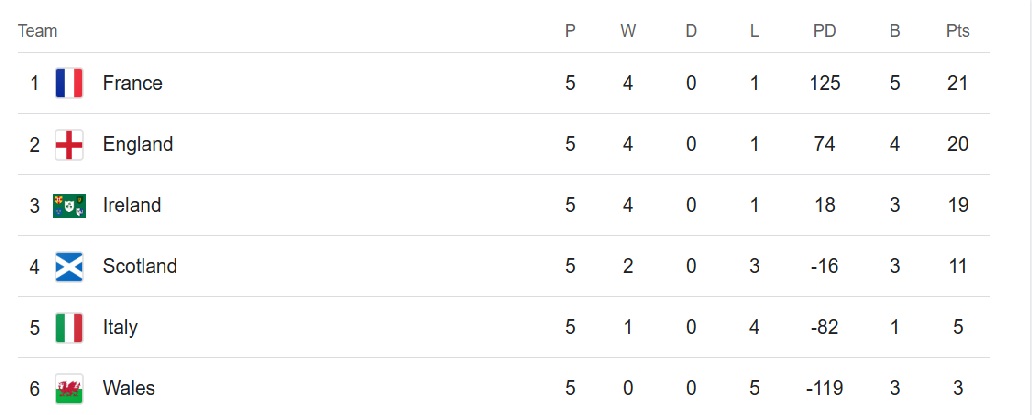
Yesterday I watched the last round of matches in this years Six Nations rugby Championship so, as I did last year, I thought I would do a quick summary of the games and the competition as a whole.
In the first game yesterday, thanks largely to their own errors, Ireland struggled to beat a spirited Italian side in Rome 17-22. That put them briefly top of the table, but with fewer bonus points and a worse points difference than either England or France so needed both those teams to lose in order to win the Championship. Hope of that happening vanished quickly when England scored a try about 2 minutes into their game against Wales in Cardiff, quickly followed by another. England thereafter ran riot and won 68-14 taking them to the top. England did play well, but Wales were very poor. To be honest, I found the game a bit painful to watch. If it had been boxing the referee would have stopped the fight. Memories of the great Welsh teams of the past are very distant nowadays. It’s hard to see where they go from here, with their second successive Wooden Spoon.
Then it was time for the finale, France versus Scotland. I did think that France would win easily but Scotland gave it a good go, and were unlucky not to take a lead into half-time. They wilted in the second half, however, and France duly picked up a bonus point win and the Championship. They are worthy winners, and all credit to them.
(The atmosphere at the Stade de France last night was so raucous that I had difficulty hearing the commentators over the crowd noise. I find commentators rarely add much to the experience, so this isn’t a complaint. In fact, I think it would be good if TV broadcasts allowed the viewer to turn off the commentary but keep the sounds from the stadium.)
The only game France lost was against England on a rainy day at Twickenham on 8th February, a game I watched. France should really have won that game but made a ludicrous number of mistakes and lost by a single point at the death. But for that Les Bleus would have had a Grand Slam. Fair play to England for hanging on and showing great resilience. After an unconvincing start as the competition went on they got better and better, though they needed a slice of luck to beat Scotland 16-15 as Finn Russell missed a conversion that would have won the game.
Up until last week the only team able to do a Grand Slam was Ireland, but they were outplayed in Dublin by France who won 42-27. Sports journalists have a habit of seeing everything as either a triumph or a disaster, and the Irish media portrayed that as the latter. The way I see it is that Ireland’s rugby team reached a high-water mark with their Grand Slam two years ago since when a number of important players have retired. It’s been a time for reconstruction and rebuilding. This is the way of things. I remember Ireland beating France comfortably last season, but France came back strongly this year. At least Ireland collected another Triple Crown, beating England, Wales and Scotland.
After last night’s game I was reflecting on why I enjoy the Six Nations so much. I think it’s mainly because there are relatively few games so each one takes on a significance, either in the context of the Championship or because it represents a longstanding rivalry (e.g. the Calcutta Cup). The point is that there is real jeopardy attached to many of the games. Contrast this with the United Rugby Championship. The games featuring the Irish teams in this competition (Leinster, Munster, Connacht and Ulster) are broadcast free-to-air on television here and I watch quite a few of them. There are 16 teams in this competition, divided into four pools of four: each side plays the 15 others once, and an additional game against the other three in their pool, meaning 18 games per team. After 18 rounds, all that happens is that the bottom eight in the league table are eliminated and the top eight go into the knockout stage. Eighteen games is a long slog when all it does is eliminate half the teams, and it means that there’s much less at stake in individual matches. Still, now the Six Nations is over I’ll be watching the URC for the rest of the season, starting next weekend.
The views presented here are personal and not necessarily those of my employer (or anyone else for that matter).
Feel free to comment on any of the posts on this blog but comments may be moderated; anonymous comments and any considered by me to be vexatious and/or abusive and/or defamatory will not be accepted. I do not necessarily endorse, support, sanction, encourage, verify or agree with the opinions or statements of any information or other content in the comments on this site and do not in any way guarantee their accuracy or reliability.









 In the Dark