Archive for November, 2025

One Hundred Years of the Hot Five

Posted in History, Jazz with tags , , , , , , , on November 12, 2025 by telescoper

Exactly one hundred years ago today, on 12th November 1925, five musicians gathered in the Okeh studios in Chicago to create musical history. The band was Louis Armstrong and his Hot Five and they were about to embark on a series of recording sessions that would result in a rich treasury of 20th century music in the form of 33 sides recorded between November 1925 and December 1927.

The band (pictured above) consisted of Louis Armstrong (on cornet on this track, although he switched to trumpet by the time of the later sessions). Kid Ory played trombone Johnny Dodds Clarinet. Lil Hardin (who was married to Louis Armstrong at the time and credited as Lil Armstrong) played piano and Johnny St Cyr played banjo or guitar. For many people, the collective imagination and sheer drive of Armstrong, Dodds and Ory made them just about the perfect front line. The way they take this one out at the end is a great example.

I won’t even try to write a detailed analysis of this historic record. I’ll just make a couple of points about the Hot Fives.

First, this band never played together as such in live concerts; they were strictly a studio band. In fact, they always sounded like a bunch of friends getting together to have fun making music, which is no doubt because that’s what they were. Most of the records they made were done in a single take, too.

Second, the line-up was unusual because it didn’t have a full rhythm section. At least part of the reason for this was that, at the time, drums were very difficult to record. In Louis Armstrong’s recorded reminiscences he talks about the fact that drums would often make the needle jump when cutting a record if they were were positioned close to the recording equipment. On the other hand if they were too far away to avoid that happening then they often couldn’t be heard at all. The low-frequency response of old fashioned recording systems made bass lines largely inaudible too. Anyway, it was decided that the excellent combination of Lil Hardin’s piano and Johnny St Cyr’s banjo would provide a sufficient framwork. So they were, though later on, in May 1927, a brass bass and drums were added to create the Hot Seven who made a further 11 sides, including the all-time classic Potato Head Blues.

Finally I’ll just remark that according to Satchmo’s memoirs, this track Gut Bucket Blues was the first to be recorded. It does sound like it too, as he introduces the members of the band. I wonder if they knew at this first session what a sensation these records were going to create?

P.S. I know it’s a bit scratchy, but it’s 100 years old. It’s amazing to me that you can hear anything at all.
Ireland has a new President

Posted in Politics with tags , , on November 11, 2025 by telescoper
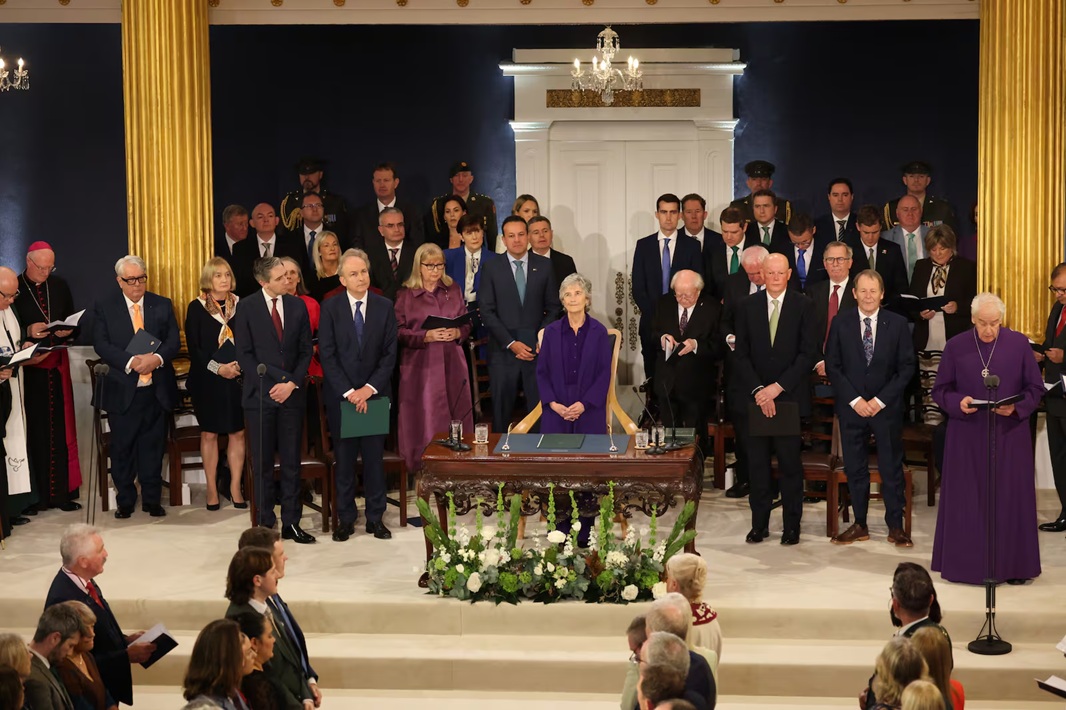
Catherine Connolly (centre), at her inauguration as President of Ireland. Picture from the Irish Times.

Earlier today, in Dublin Castle, Catherine Connolly was sworn in as the new President of Ireland. Her inauguration was the 14th to the office of Uachtarán na hÉireann and she is the 10th person to have that title. The ceremony was the first of its kind I have seen and I was impressed by its combination of simplicity and dignity. The previous president, Michael D. Higgins, looked rather emotional as he handed over the reins. I wish him all the best in his retirement. I think he’ll be a hard act to follow, and I wish Catherine Connolly all the best in the role for the next 7 years.

Incidentally, the oath of office reads:

I láthair Dia na nUilechumhacht, táimse, [ainm*], á ghealladh agus á dhearbhú go sollúnta is go fírinneach bheith i mo thaca agus i mo dhídin do Bhunreacht Éireann, agus a dlíthe a chaomhnú, mo dhualgais a chomhlíonadh go dílis coinsiasach de réir an Bhunreachta is an dlí, agus mo lándícheall a dhéanamh ar son leasa is fónaimh mhuintir na hÉireann. Dia do mo stiúradh agus do mo chumhdach

*This “ainm” is the Irish word for “name”; the President-Elect inserts their name here. I’ll leave it as an exercise for the student to translate the rest of the oath into English.

Can you make a neutral pion from two photons?

Posted in The Universe and Stuff with tags , , , on November 10, 2025 by telescoper

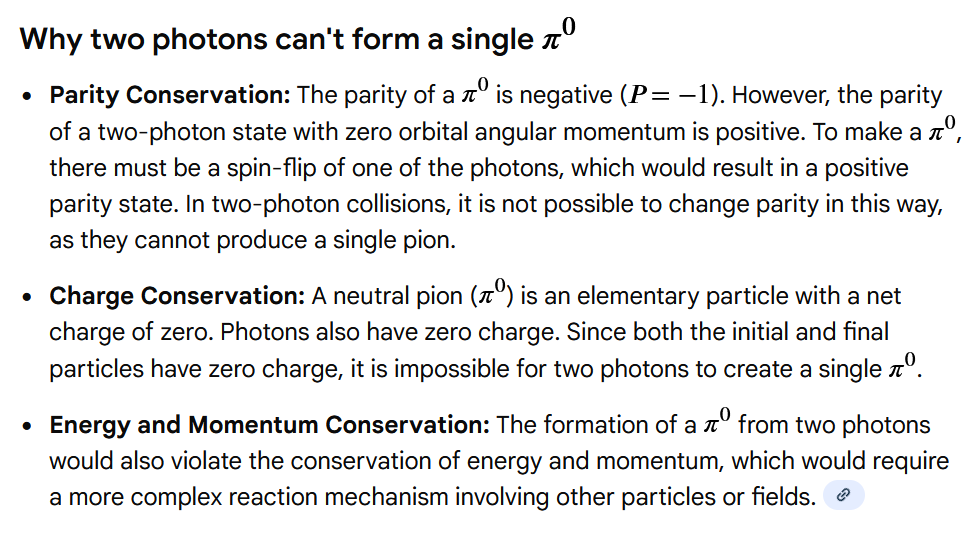
A neutral pion can decay into two photons. It is therefore not unreasonable to ask the question whether the reverse process – the creation of a neutral pion by colliding two photons – is physically possible and, if not, why not? It is perhaps less reasonable to ask an AI bot these questions. One of my colleagues did just that and found it said “no”, giving  the following three answers to the “why not?” question:

I particularly like the second one.

Would anyone like to offer a correct answer through the comments box?

Autumn Transition

Posted in Maynooth with tags , on November 10, 2025 by telescoper

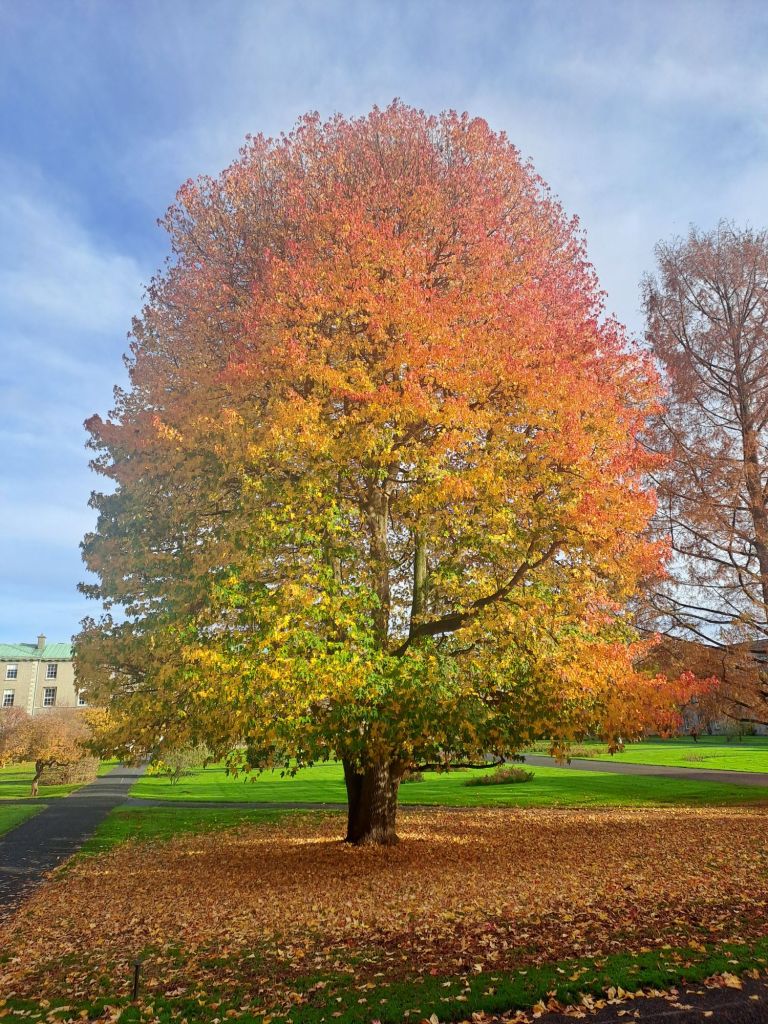
I couldn’t resist sharing this picture I took after lunch of a Norway Maple in St Joseph’s Square on Maynooth University Campus. I like the gradual transitions of colour from green to yellow and orange and red with height. Most of the other trees have lost most of their leaves already.

On the death of James Watson

Posted in History with tags , , , , on November 9, 2025 by telescoper

So James Watson, a deeply unsavoury individual who co-won a Nobel Prize by stealing Rosalind Franklin’s ground breaking research on DNA, and was an unrepentant racist and misogynist, is dead. Lest it be forgotten, here is a collection of authentic quotes that give an insight into his true character.

Ravel, Dessner and Beethoven at the National Concert Hall

Posted in Music with tags , , , , , , , , , on November 8, 2025 by telescoper

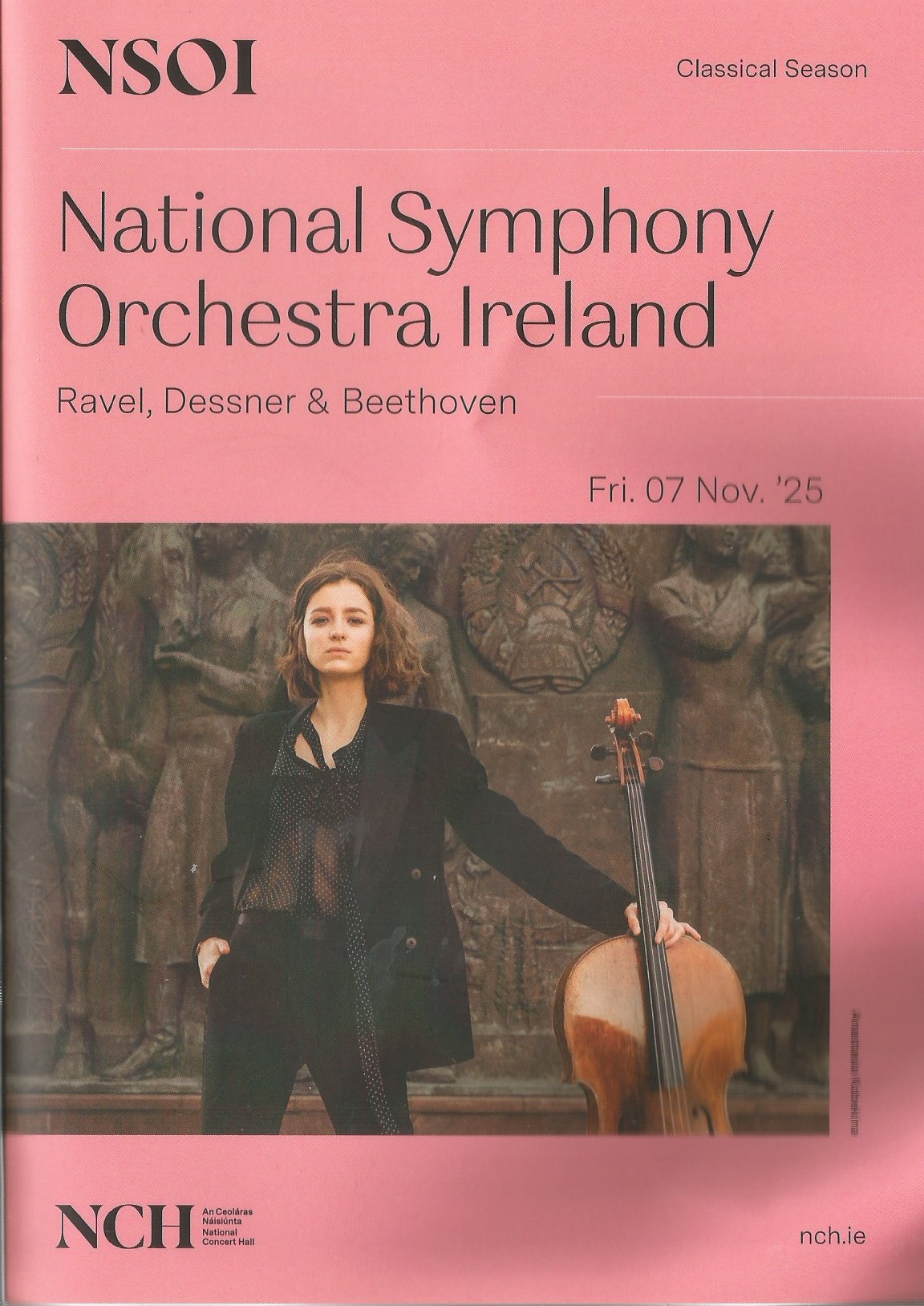
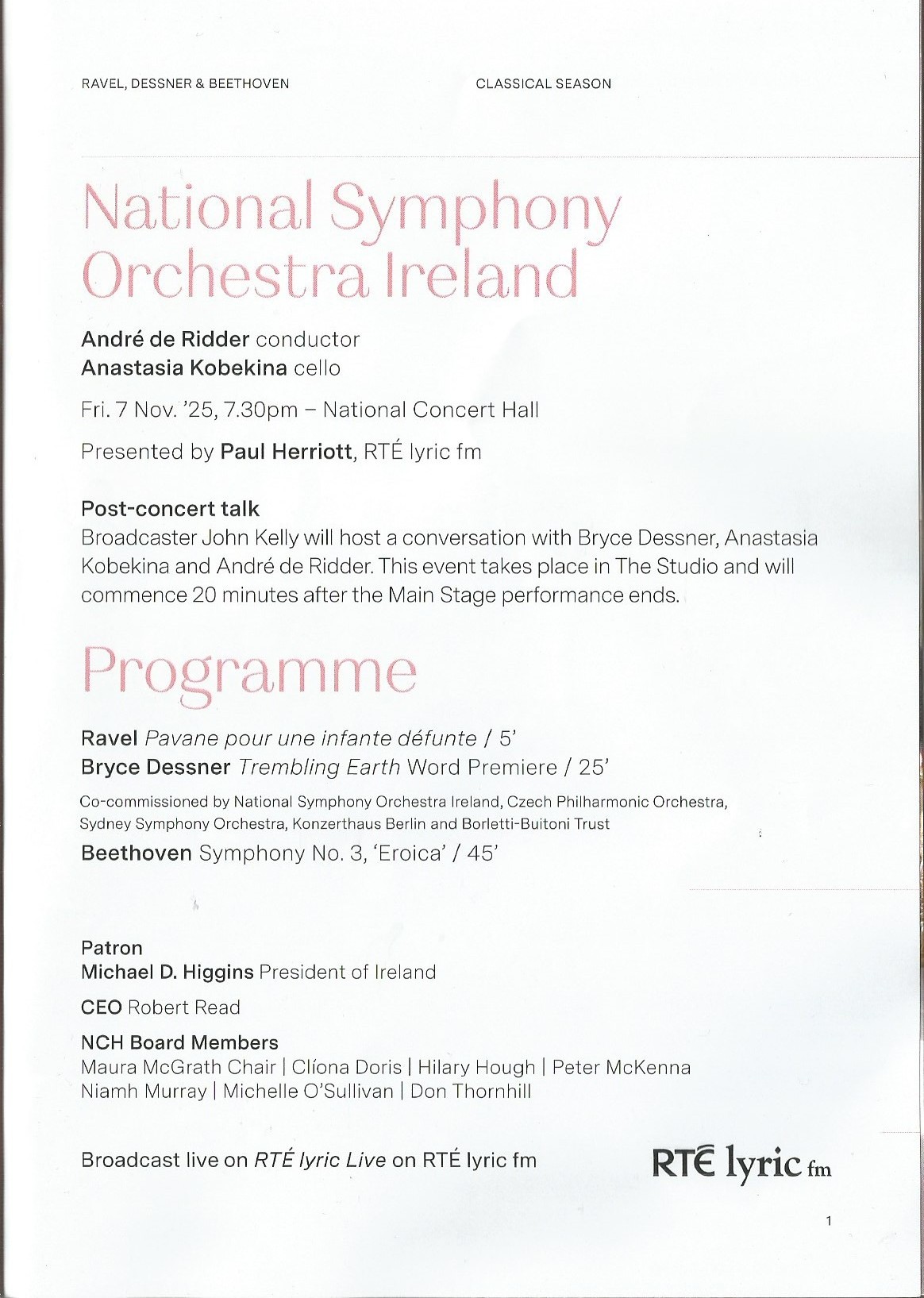
Yesterday evening I made my way through a rather rainy Dublin to the National Concert Hall for a very enjoyable concert by the National Symphony Orchestra Ireland conducted this time by André de Ridder. Incidentally, the Orchestra has been searching for a new Principal Conductor for some time and as now made an appointment in the form of Alexander Shelley, but he won’t take up the baton until September 2026 so until then there will continue to be a number of guest conductors and, it has to be said, a rather piecemeal programme.

Last night’s performance followed a very typical programme for a concert of classical music: a short piece as an appetiser (often an overture or similar), an instrumental concerto featuring a guest soloist, then a wine break, followed by a full symphony or some other large work. They don’t all follow that format, but many do. I always like it when at least one of the pieces is something I’ve never heard before. That was the case last night.

We started with the orchestral version of Pavane pour une infante défunte, played very well but, as always seems to be the case, rather too slowly for my tastes. That particular piece was on the menu at NCH in March this year and I made the same complaint then. I like the piece a lot, but I wish orchestras wouldn’t take it at a funeral pace!

Next one up was the world premiere of a brand new composition by Bryce Dessner called Trembling Earth. This is a cello concerto and it was written for Russian cellist Anastasia Kobekina. One never knows what to expect from a world premiere but this turned out to tremendous. It’s not a cello concerto of the traditional style – divided into movements – but is in a series of sections, with the cello introducing each theme which is then taken up by the orchestra followed by another, and so on. The texture varies from tough and sinewy to soft and lyrical and the solo passages require great virtuosity, some thing Anastasia Kobekina definitely has.

The composition was apparently inspired by a set of landscapes by Norwegian artist Edvard Munch, so I suppose each section might relate to a particular painting. The sections are very varied, with one based on the theme of Dido’s Lament (When I am laid in Earth...) by Henry Purcell, another with very distinct echoes of Ravel, and another showing more than a nod to Philip Glass in its ostinato sections. At the end of the piece, which is about 25 minutes long, there were immediate cheers and a standing ovation, and the composer came on stage to receive the accolades. “Prediction is very difficult”, said Niels Bohr, “especially about the future”, but I think this work will quickly establish itself in the repertoire. I’d love to hear it again.

The concert would have been worth it just for that one piece, but after the interval we came back for the main course, The Symphony No. 3 in E♭ major (“Eroica”)  Ludwig van Beethoven. I’ve blogged about a number of different performances of different Beethoven symphonies over the years, so I’m quite surprised to discover that I’ve never written about this one. It’s hard to know what to say about it really,, except that it’s a magnificent work in its own right as well as being historically important. Before this one, which was published in 1806, symphonies (including not only Beethoven’s First and Second, but those of Mozart, Haydn and others) were much shorter (typically around 20 minutes) and much more constrained in form. This composition – which shares some elements with Mozart’s Symphony No. 39 and was apparently inspired by it – ushered in the era of the epic symphony that culminated with the likes of Mahler and Bruckner. The duration performance we heard last night was about 45 minutes. The first movement, in sonata form, is especially complex.

An interesting point about last night’s performance was the arrangement of the orchestra on stage. From the point of view of the Conductor, the first violins were on the far left (as usual), the cellos and basses were to the front and left, violas to the front and right, and second violins on the far right. I am not sure of the reason for this departure from tradition – second violins are usually adjacent to the firsts, with the cellos and basses on the right – but it was interesting how different it sounded compared to the usual layout.

This superb concert provided a great finish to a very tiring week. Thanks to the NCH for putting on such a wonderful programme. As an added bonus, the rain had stopped by the time it was over so I didn’t get drenched on my way home.

Weekly Update from the Open Journal of Astrophysics – 08/11/2025

Posted in OJAp Papers, Open Access, The Universe and Stuff with tags , , , , , , , , , , , , , , , , , , , , , , on November 8, 2025 by telescoper

It’s Saturday again, so it’s time for the usual update of the week’s new papers at the Open Journal of Astrophysics. Since the last update we have published another five papers, which brings the number in Volume 8 (2025) up to 168, and the total so far published by OJAp up to 403.

The first paper this week is “Maximizing Ariel’s Survey Leverage for Population-Level Studies of Exoplanets” by Nicolas B. Cowan and Ben Coull-Neveu (McGill University, Canada). This article was published in the folder Earth and Planetary Astrophysics on Tuesday 4th November 2025; it discusses various different schemes to select the mission reference sample for a notional three year transit spectroscopy survey with the European Space Agency’s Ariel mission

The overlay is here:


You can find the officially accepted version on arXiv here.

The Fediverse announcement is here:

Open Journal of Astrophysics

New Publication at the Open Journal of Astrophysics: "Maximizing Ariel’s Survey Leverage for Population-Level Studies of Exoplanets" by Nicolas B. Cowan and Ben Coull-Neveu (McGill University, Canada)

doi.org/10.33232/001c.146656

November 4, 2025, 5:08 pm 1 boosts 3 favorites


The second paper of the week is “A substellar flyby that shaped the orbits of the giant planets” by Garett Brown (U. Toronto at Scarborough, Canada), Renu Malhotra (U. Arizona, USA) and Hanno Rein (U. Toronto at Scarborough, Canada). This article was published on Wednesday 5th November 2025, also in the folder Earth and Planetary Astrophysics. It argues that an ancient close encounter with a substellar object offers a plausible explanation for the origin of the moderate eccentricities and inclinations of the giant planets.

The overlay is here:

You can find the official version of this one on arXiv here. The federated announcement on Mastodon is here:

Open Journal of Astrophysics

New Publication at the Open Journal of Astrophysics: "A substellar flyby that shaped the orbits of the giant planets" by Garett Brown (U. Toronto at Scarborough, Canada), Renu Malhotra (U. Arizona, USA) and Hanno Rein (U. Toronto at Scarborough, Canada)

doi.org/10.33232/001c.146688

November 5, 2025, 8:34 am 3 boosts 3 favorites

Next one up is “The Potential Impact of Primordial Black Holes on Exoplanet Systems” by Garett Brown (U. Toronto at Scarborough), Linda He (Harvard U., USA),  and James Unwin (U. Illinois Chicago, USA). This one was also published on Wednesday 5th November 2025, but in the folder Astrophysics of Galaxies. This one is an exploration of the possibility that primordial black holes (PBHs) in our Galaxy, might impact the orbits of exoplanets. The overlay is here:

You can find the official accepted version on arXiv here. The fediverse announcement is here:

Open Journal of Astrophysics

New Publication at the Open Journal of Astrophysics: "The Potential Impact of Primordial Black Holes on Exoplanet Systems" by Garett Brown (U. Toronto at Scarborough), Linda He (Harvard U., USA), James Unwin (U. Illinois Chicago, USA)

doi.org/10.33232/001c.146689

November 5, 2025, 8:49 am 3 boosts 1 favorites

The fourth paper to report is “The Unhurried Universe: A Continued Search for Long Term Variability in ASAS-SN” by Sydney Petz, C. S. Kochanek & K. Z. Stanek (Ohio State U., USA), Benjamin J. Shappee (U. Hawaii, USA), Subo Dong (Peking University, China), J. L. Prieto (Universidad Diego Portales, Chile) and Todd A. Thompson (Ohio State U., USA). This one was also published on Wednesday November 5th 2025, but in the folder Solar and Stellar Astrophysics.  It describes the discovery and investigation of slowly-varying sources in the All Sky Automated Survey for SuperNovae (ASAS-AN) leading to the identification of 200 new variable stars. The overlay is here:


You can find the official published version on arXiv here. The Fediverse announcement follows:

Open Journal of Astrophysics

New Publication at the Open Journal of Astrophysics: "The Unhurried Universe: A Continued Search for Long Term Variability in ASAS-SN" by Sydney Petz, C. S. Kochanek & K. Z. Stanek (Ohio State U., USA), Benjamin J. Shappee (U. Hawaii, USA), Subo Dong (Peking University, China), J. L. Prieto (Universidad Diego Portales, Chile) and Todd A. Thompson (Ohio State U., USA)

doi.org/10.33232/001c.146690

November 5, 2025, 9:08 am 1 boosts 0 favorites

The fifth and final paper for this week is “Measuring the splashback feature: Dependence on halo properties and history” by Qiaorong S. Yu (Oxford U., UK) and 9 others based in the UK and USA. This was published on Friday 7th November 2025 in the folder Cosmology and Nongalactic Astrophysics. It discusses how the properties of “splashback” features in halo profiles relate to the halo’s assembly history (e.g. mass accretion rate and most recent merger time). The overlay is here:

The officially accepted version can be found on arXiv here. The Fediverse announcement is here:

Open Journal of Astrophysics

New Publication at the Open Journal of Astrophysics: "Measuring the splashback feature: Dependence on halo properties and history" by Qiaorong S. Yu (Oxford U., UK) and 9 others based in the UK and USA.

doi.org/10.33232/001c.146824

November 7, 2025, 9:12 am 0 boosts 0 favorites

That’s all the papers for this week. I’ll do another report next Saturday.

Euclid’s “Tuning Fork”

Posted in Euclid, The Universe and Stuff with tags , , , on November 7, 2025 by telescoper

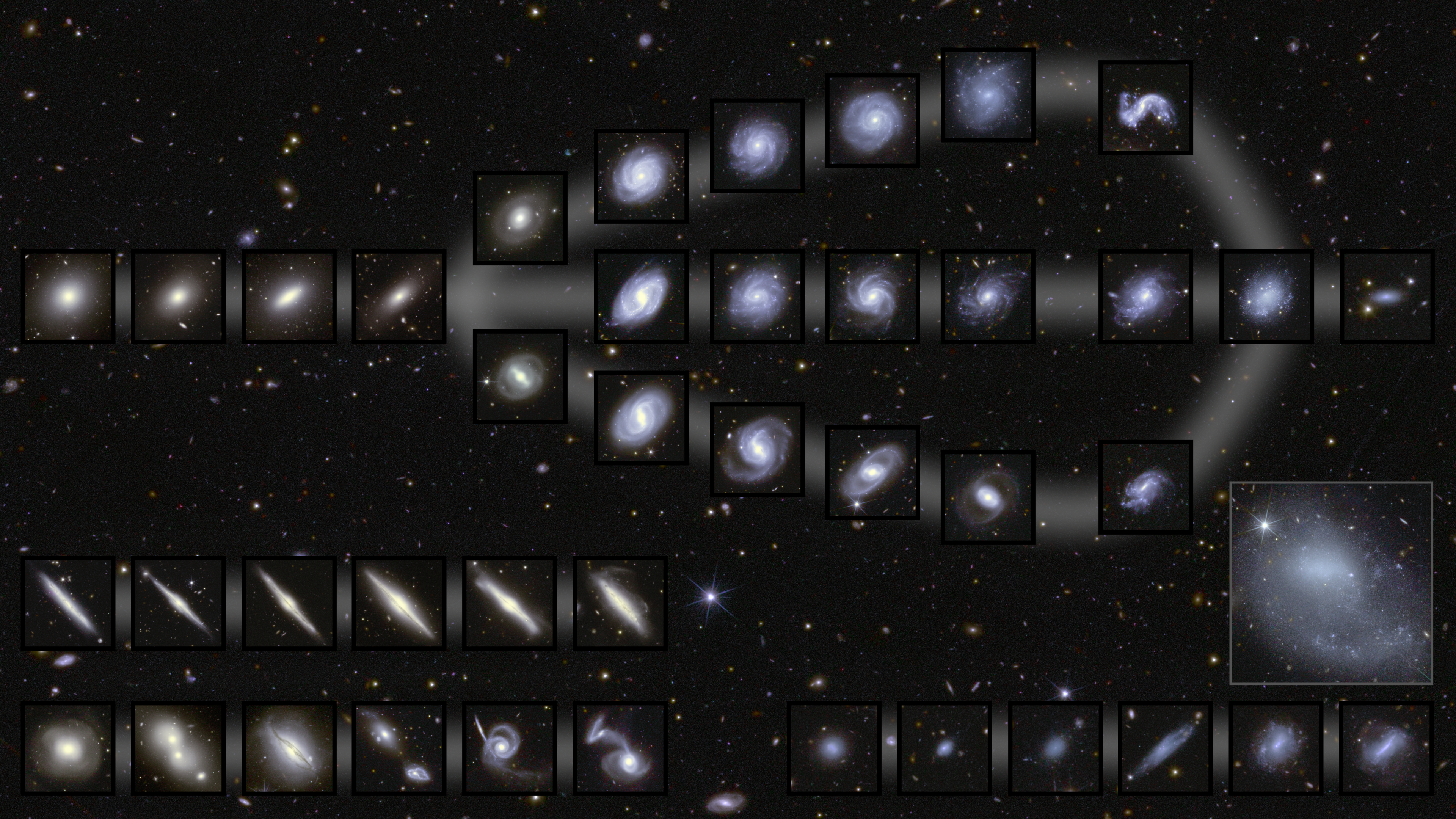
By way of a quick follow-up to yesterday’s post, here’s another Euclid Q1 product. This one is an updated version of the famous “Tuning Fork” representation of galaxy morphology:

Credits: Diagram: ESA/Euclid/Euclid Consortium/NASA, Diagram by J.-C. Cuillandre, L. Quilley, F. Marleau. Images alone: ESA/Euclid/Euclid Consortium/NASA, image processing by J.-C. Cuillandre, E. Bertin, G. Anselmi

You can click on the image to make it (much) bigger.

A galaxy’s structure is a sign of its formation history and the environment in which it resides. Since early on, astronomers have ordered galaxies according to their visible structure – as a basis to understanding the underlying physics: This panorama of galaxies’ structure shows the ‘classical’ morphological sequence from ellipticals (E, left) to lenticulars (S0) through spirals (S) to irregulars and dwarfs (right). The fork divides barred and unbarred spiral families: originally only SA (unbarred) and SB (barred) galaxies were arranged in a ‘tuning fork’ layout, the addition of SAB (weakly barred) galaxies as a third branch is making this term increasingly challenging to use. Lowercase letters a to d indicate progressively later spiral stages (tighter to looser arms), the trailing m (e.g., SAm) denotes Magellanic, very-late-type systems (patchy, often one-armed). The Milky Way is classified as an SBc galaxy.

Below the main sequence there are three auxiliary panels showing objects not represented in the fork: (1) spiral galaxies seen edge-on, with varying bulge-to-disk ratios and warps; (2) interacting and merging galaxies illustrating gravitationally driven morphological change; and (3) the morphological diversity of dwarf galaxies.

You can read more about this image and the other Q1 results here. You can also find an interactive version of the plot here.

Euclid and the Dark Cloud

Posted in Art, Euclid, The Universe and Stuff with tags , , , , on November 6, 2025 by telescoper

I haven’t posted anything recently about the European Space Agency’s Euclid mission, but I can remedy that by passing on a new image with text from the accompanying press release. This is actually just one of a batch of new science results emerging from the first `Quick Release’ (Q1) data; I blogged about the first set of Q1 results here.

Incidentally, I find the picture is very reminiscent of a famous painting by James McNeill Whistler.

Image description: The focus of the image is a portion of LDN 1641, an interstellar nebula in the constellation of Orion. In this view, a deep-black background is sprinkled with a multitude of dots (stars) of different sizes and shades of bright white. Across the sea of stars, a web of fuzzy tendrils and ribbons in varying shades of orange and brown rises from the bottom of the image towards the top-right like thin coils of smoke.

Technical details: The colour image was created from NISP observations in the Y-, J- and H-bands, rendered blue, green and red, respectively.  The size of the image is 11 232 x 12 576 pixels. The jagged boundary is due to the gaps in the array of NISP’s sixteen detectors, and the way the observations were taken with small spatial offsets and rotations to create the whole image. This is a common effect in astronomical wide-field images.

Accompanying Press Release

The above view of interstellar gas and dust was captured by the European Space Agency’s Euclid space telescope. The nebula is part of a so-called dark cloud, named LDN 1641. It sits at about 1300 light-years from Earth, within a sprawling complex of dusty gas clouds where stars are being formed, in the constellation of Orion.  

This is because dust grains block visible light from stars behind them very efficiently but are much less effective at dimming near-infrared light.  

The nebula is teeming with very young stars. Some of the objects embedded in the dusty surroundings spew out material – a sign of stars being formed. The outflows appear as magenta-coloured spots and coils when zooming into the image.  

In the upper left, obstruction by dust diminishes and the view opens toward the more distant Universe with many galaxies lurking beyond the stars of our own galaxy. 

Euclid observed this region of the sky in September 2023 to fine-tune its pointing ability. For the guiding tests, the operations team required a field of view where only a few stars would be detectable in visible light; this portion of LDN 1641 proved to be the most suitable area of the sky accessible to Euclid at the time. 

The tests were successful and helped ensure that Euclid could point reliably and very precisely in the desired direction. This ability is key to delivering extremely sharp astronomical images of large patches of sky, at a fast pace. The data for this image, which is about 0.64 square degrees in size – or more than three times the area of the full Moon on the sky – were collected in just under five hours of observations. 

Euclid is surveying the sky to create the most extensive 3D map of the extragalactic Universe ever made. Its main objective is to enable scientists to pin down the mysterious nature of dark matter and dark energy. 

Yet the mission will also deliver a trove of observations of interesting regions in our galaxy, like this one, as well as countless detailed images of other galaxies, offering new avenues of investigation in many different fields of astronomy

In visible light this region of the sky appears mostly dark, with few stars dotting what seems to be a primarily empty background. But, by imaging the cloud with the infrared eyes of its NISP instrument, Euclid reveals a multitude of stars shining through a tapestry of dust and gas. 

Trouble at Astronomy Ireland

Posted in Biographical, The Universe and Stuff with tags , , on November 5, 2025 by telescoper

I couldn’t resist passing on an unsettling news item about Astronomy Ireland, an Irish Astronomy Club described on its website in the following terms:

Astronomy Ireland is a non profit organisation and the largest national astronomy club in the world relative to population.

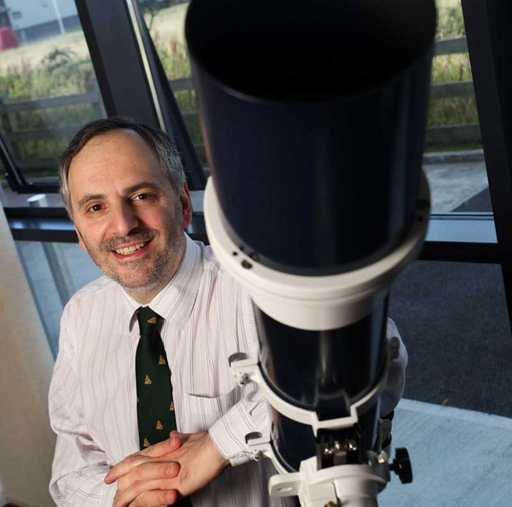
The news item concerned revolves around founder and chairperson David Moore (left), who has been held personally liable for multiple employment rights breaches against a former manager, Sonya Martin, at Astronomy Ireland who said she was forced to quit due to a “toxic” work environment and alleged “serious financial irregularities”.

The astronomy club and four members of its management committee, including David Moore, have been ordered to pay nearly €11,000 to the ex-employee, Sonya Martin, after she complained of constructive dismissal to the Workplace Relations Commission (WRC).

Among the allegations reported were that Mr Moore was keeping funds meant for Astronomy Ireland:

David was taking the money and pocketing it as his own income, as opposed to it going back into the society,” Ms Martin said. “The attitude changed towards myself and Ms Doyle after that,” Ms Martin said.

No doubt the money was just “resting in his account”. I mentioned this story to colleagues in the Department and none was surprised, and many (unlike myself) had known about this case for some time. I’ll keep some of the comments to myself, but one said that they gave a lecture (for free, as we academics usually do) to Astronomy Ireland which was filmed without consent. David Moore then sold DVDs of the talk. Where the profits from this went, I have no idea.

These financial shenanigans are dodgy enough but there are some truly bizarre sections of the news report. Here is one:

As the hearings continued into 2025, Mr Moore made repeated objections to being attached personally to the claim, and told Mr Dolan he had not received hearing notifications.

“Emails are unreliable,” he said. When Ms Martin’s solicitor, Mr O’Connell said the notification was sent by post too, Mr Moore said: “The post is unreliable.”

Even stranger, if not directly relevant to the case of Mr Moore, is this:

During the June 2024 hearing, Ms Martin gave evidence that Astronomy Ireland’s office landlord approached her complaining about having to clean up after the junior administrator, Mr G, who was later dismissed.

“The final straw for the landlord was that he had to clean ejaculate from the bathroom after Mr G was in there,” Ms Martin added.

Ewww…

In the interest of full disclosure, I gave a talk to Astronomy Ireland in December 2019. I don’t remember if it was filmed nor whether DVDs were sold, but given what I know now I don’t think I’ll be accepting any more speaking invitations from that organisation.

Update: it seems DVDs of my talk were made and were on sale but are no longer available. They must have sold out.