I recently reinforced my credentials as a relic of a bygone era with the admission that I can do shorthand specifically Pitman shorthand. I learnt this from my Mam who learnt shorthand and typing (on a mechanical typewriter) at school, and took the corresponding RSA qualification in back in the 1950s. She thought it would be useful to learn shorthand for taking notes when I went to university so she gave me some instruction and a book (which I no longer have, but which was the same as the one on the left below).
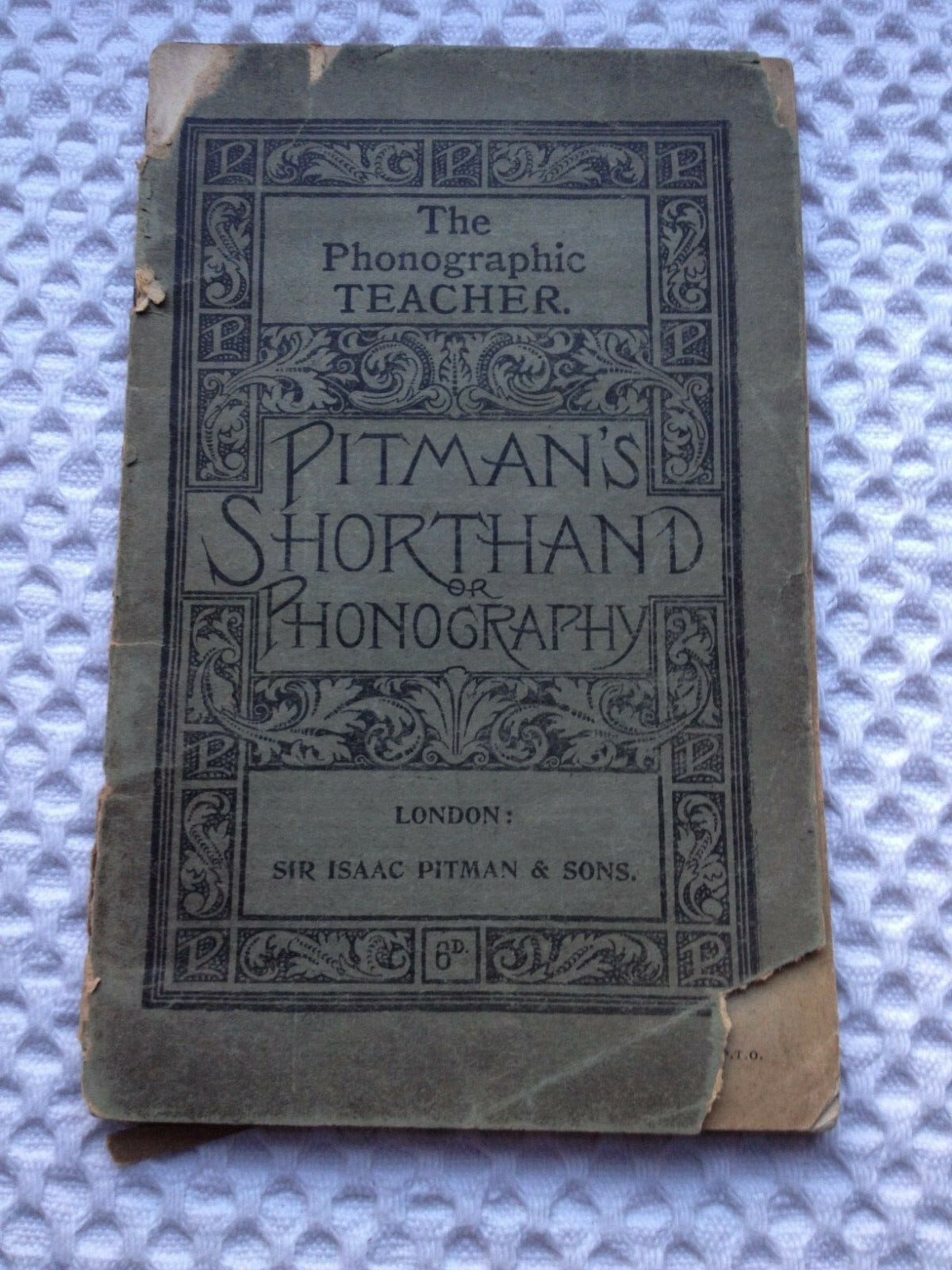
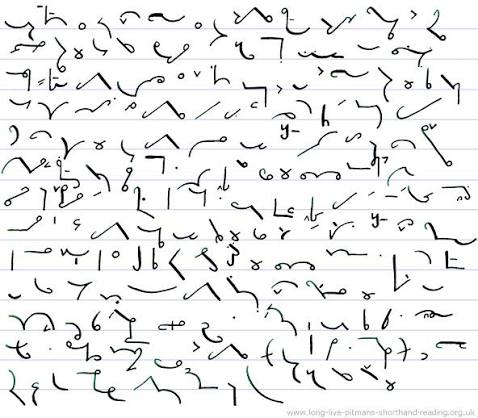
The image on the right shows an example of Pitman’s shorthand. The generic name for shorthand is stenography which comes from the prefex steno- meaning compressed and -graphy meaning writing.
Like most stenographic systems, Pitman’s Shorthand – which was invented in 1837 – is a phonetic transcription system in which the symbols represent sounds rather than letters. The symbols are lines and curves which are quicker to draw than letters and the system is such that most vowels can be indicated by dots in appropriate positions. A person skilled at shorthand can transcribe spoken words in real time at 150 words per minute or more, whereas normal handwriting is more like 10 wpm. I can probably only manage about 35 in shorthand. The world record is over 300 wpm, which is astonishing!
I never actually used shorthand much when I was a student – nor since – because the main challenge in most of my lectures was writing down mathematical equations, rather than text, and shorthand was no use for that. I have therefore forgotten all but the basics, but I still find it useful occasionally – especially when I don’t want anyone to understand what I’m writing!
Another thing I remember being taught is to write shorthand with a pencil held at a shallow angle to the paper. There are several reasons for this. One is that it make it quicker to move across the page if you don’t pick the tip of the pencil so high. Another is that it makes it easier to make heavy and faint lines. For example the phonetic K (“kay”) is a light horizontal while G (or “gay” in the Pitman system) is a heavy horizontal line; the word “gay”, incidentally, is the symbol for G with a dot placed afterwards to indicate that the vowel sound “a” is voiced.
I don’t think there are many people who still use shorthand in a work environment. Many people can type quickly enough to record notes directly onto a laptop, which also avoids having subsequently to transcribe the shorthand into English text. I always tell students that it doesn’t matter so much what method they use to take notes during lectures but it is important to take notes rather than just sit there.


