I was just reminded that exactly 100 years ago today, Enrico Fermi wrote this famous letter to Paul Dirac:
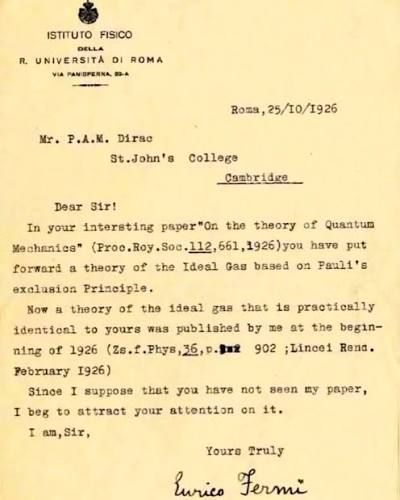
That’s why we call them Fermi-Dirac Statistics!
I was just reminded that exactly 100 years ago today, Enrico Fermi wrote this famous letter to Paul Dirac:
That’s why we call them Fermi-Dirac Statistics!
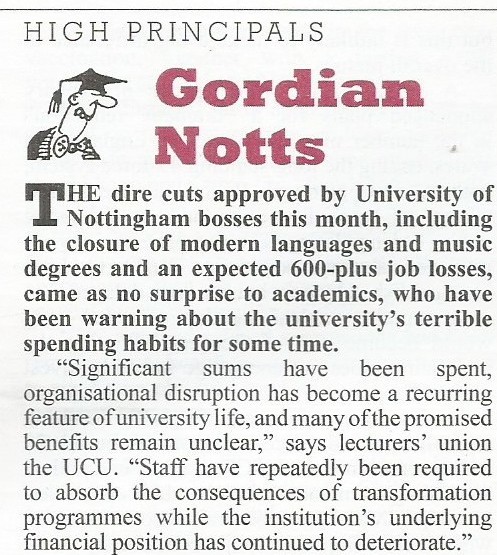
My former colleague at Nottingham University, Philip Moriarty, alerted me to a piece in the latest Private Eye (No. 1686) about the parlous state of affairs there. The teaser on the left shows a bit more than Philip did in his post, but if you want to read the rest you should buy a copy of the Eye. Next to the story about Nottingham University, you will find one about Edinburgh University, which you will want to read if you work there…
The video that appeared in a previous post about Nottingham University has been taken down. I’m not really surprised, because it shows the University Management in a very poor light and we can’t have that, can we?
I have heard stories about how bad the situation is at Nottingham University. Apparently some members of staff are being told that they have to reapply for the jobs they currently hold and will have to do the same every year for the next three years. This is a disgraceful way to treat academic staff, but remember that this crisis was entirely caused by University Management, not the academic or other staff who are bearing the brunt of the cuts.
There may be massive job cuts among ordinary staff at the University of Nottingham, but there’s still money for three new Pro-Vice-Chancellor positions there. The purpose of these positions is “explained” in the following blurb that consists of the sort of vacuous nonsense such advertisements:
Our proposed transition from five faculties to three colleges will strengthen collaboration, support academic excellence and position Nottingham for long-term success. We are recruiting a Pro-Vice-Chancellor for each of the College of Humanities and Social Sciences, College of Health, and College of Science and Engineering. Each will bring together complementary disciplines, creating new opportunities for interdisciplinary education and research, knowledge exchange and external partnerships. Joining at this formative stage, you will shape your college’s strategy, identity and culture, building on established strengths while opening new possibilities for its staff and students.
As a member of the University Executive Board, you will contribute to institutional strategy and decision-making, working collaboratively with your fellow College Pro-Vice-Chancellors to advance the success of the whole university while taking executive responsibility for your college’s performance and development. You will lead excellence in education and student experience, research and knowledge exchange, supported by a coherent and sustainable academic portfolio and effective stewardship of resources. You will shape student growth, recruitment priorities and the long-term academic direction of the college. You will foster a culture of accountability and be responsible for delivering measurable improvements in academic and financial performance against institutional priorities and key performance indicators. Working closely with academic and professional services colleagues across our global campuses, you will lead change, strengthen financial sustainability and build partnerships that enhance Nottingham’s reputation and impact locally, nationally and internationally.
We are looking for accomplished senior leaders who combine strategic vision with a record of delivering change and improving performance. You will bring the communication and interpersonal skills to build trust, navigate difficult conversations and inspire colleagues through change, alongside a demonstrable commitment to equality, diversity and inclusion. Above all, you will be committed to creating an environment in which colleagues and students can succeed, and to advancing the university’s ambitions through partnership, innovation and shared purpose. If you share our values of inclusivity, ambition, openness, fairness and respect, we invite you to help shape the future of Nottingham
I laughed out loud when I read “foster a culture of accountability”. I suppose that phrase does represent an admission that they don’t have one at the moment.
I wonder why they need a Senior Management team at all. The Eye story confirms the fact that all Nottingham University’s “strategic” decisions are made – at great expense – by management consultants.
Of course they are looking to a recruitment agency to fill these posts, so they’ll be fishing in the same pool that supplied such quality material for their previous management team – the one that bankrupted the University. Based on the above blurb, it looks like the three new College PVCs will replace five existing Faculty PVCs. Why could that not have been done through an internal process, which would have spared the considerable expense of resorting to a recruitment agency?
This sums up everything that it wrong with modern university “governance” – a jamboree for self-serving careerist types and austerity for everyone else. It has to stop.
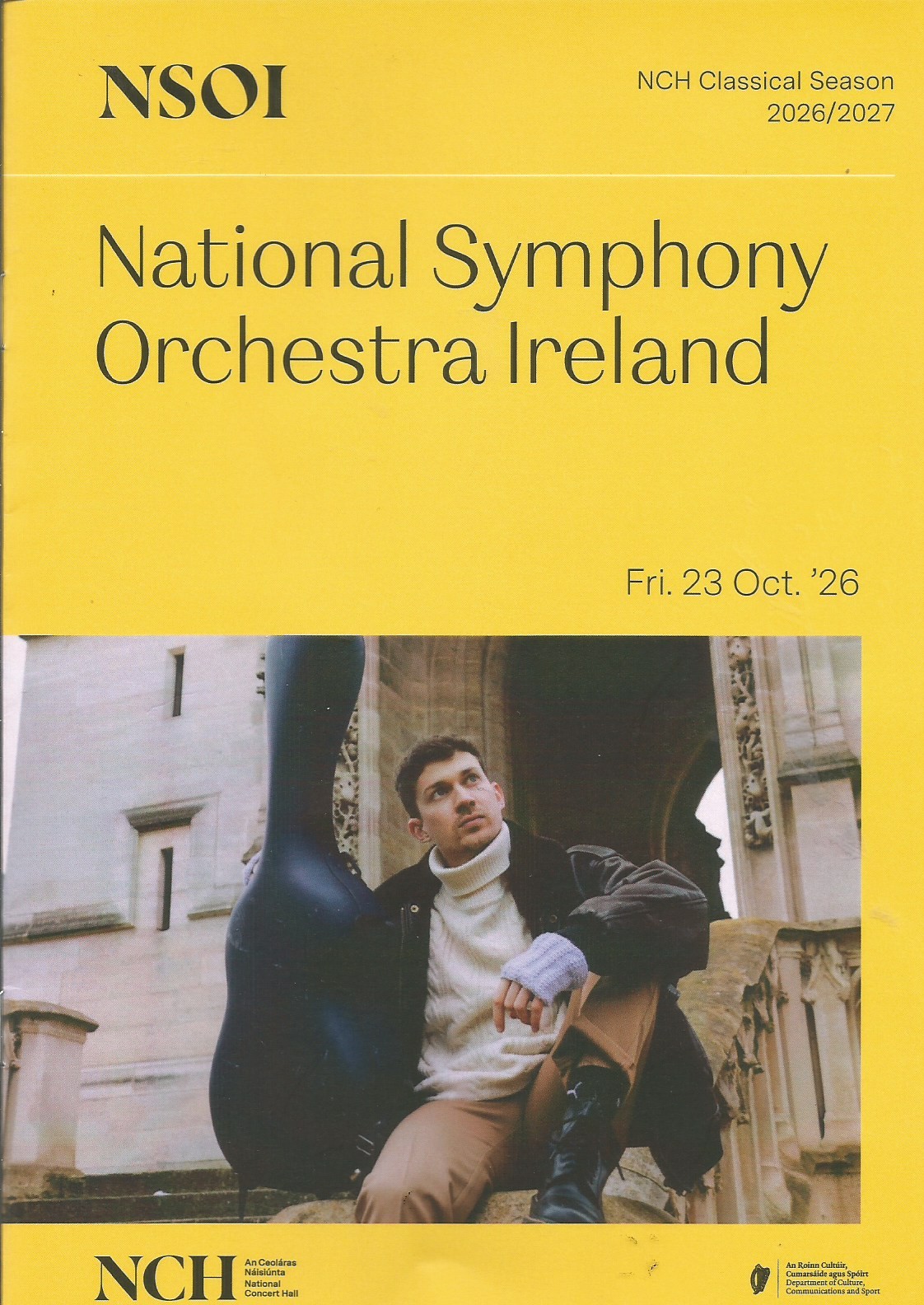
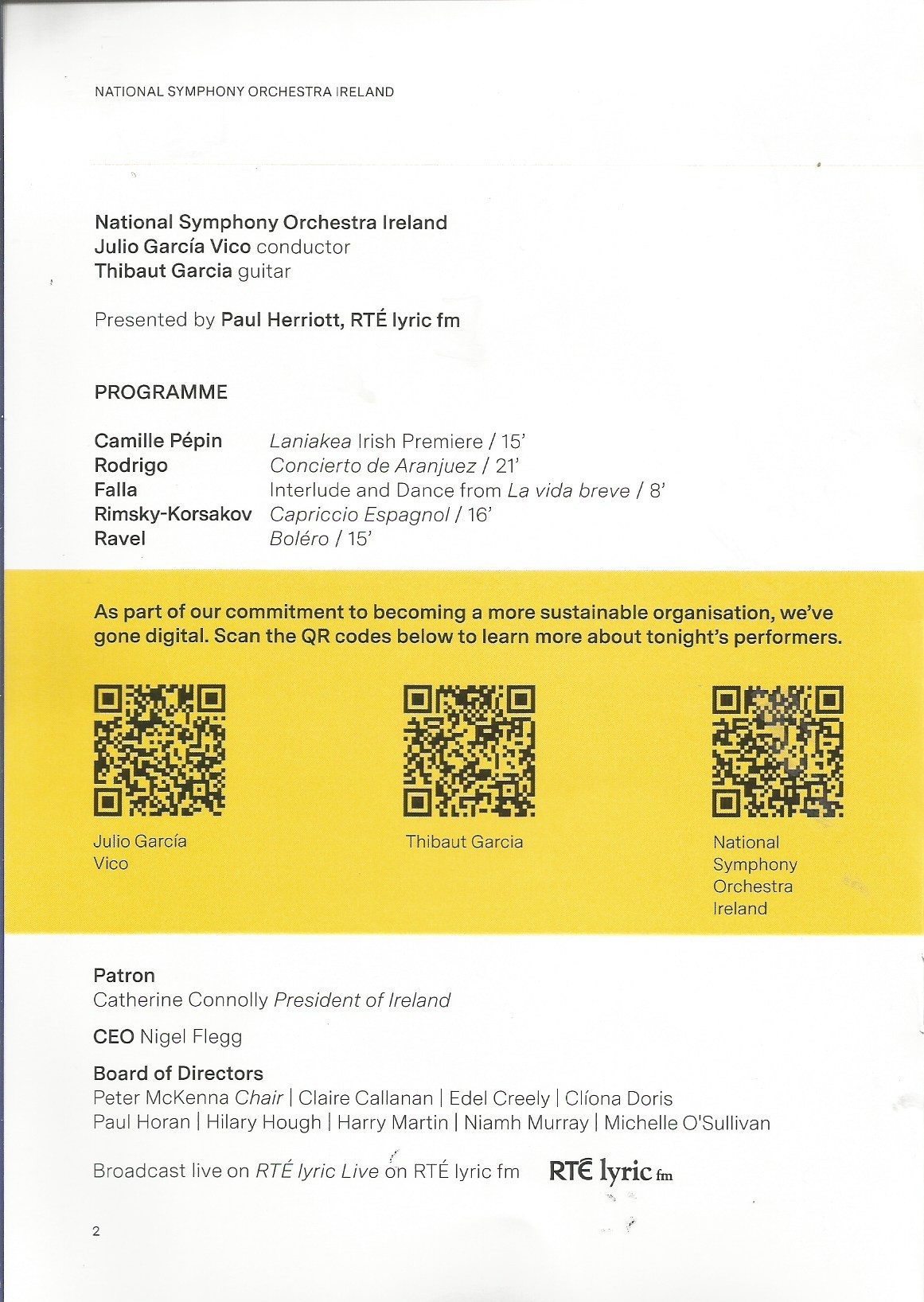
Last night I travelled into Dublin for another concert by National Symphony Orchestra Ireland, this time under the direction of guest conductor Julio García Vico in a programme of music heavy with French and Spanish influences.
The undoubted star of the show was classical guitarist Thibaut Garcia, who is French but has Spanish ancestry, who played the Concierto de Aranjuez by Joaquin Rodrigo. I’ve loved this piece for ages, and have several recordings of it, but although it’s been a familiar part of the concert repertoire ever since it was composed in 1939, I’ve never heard it played live. Last night’s performance was stunningly beautiful, one of those occasions on which it was a privilege just to be there. I loved the way he played the first movement Allegro con Spirito with poise and precision but without a hint of punctiliousness. The famous second movement Adagio gives the soloist much more latitude for interpretation, and Garcia’s version was very different from others I’ve heard. The music here evokes a sense of nostalgia, which comes with both joy and melancholy. I think in too many performances melancholy has the upper hand, but last night we really felt the joy. The final movement, Allegro gentile, contains a playful series of call-and-answer sequences set against varied rhythmic backgrounds. I adored this performance.
I noticed while he was playing that Thibaut Garcia has hyperextensible thumbs (as do I) and, as I went to the bar for my interval drink, I found myself wondering whether having bendy thumbs was an advantage for playing classical guitar. You could have knocked me down with a feather when, as I was returning to my seat after the wine break, that the man himself was sitting in the seat right behind mine preparing to listen to the second half of the concert. I couldn’t resist telling him how much I enjoyed the performance and mentioned his thumbs. It must be very irksome for an artist when strange people intrude awkwardly like that, but he was absolutely charming. After a brief comparison of thumbs, I sat down and left him alone. I was too starstruck to ask him whether distal hyperextensibility is a plus when it comes to playing the guitar. Perhaps someone can offer an opinion through the comments?
Anyway, it would be remiss not to mention the rest of the programme, which contained a great of interest. The first piece, for example, Laniakea by Camille Pépin is inspired by our Local Supercluster of galaxies which astronomers have named Laniakea, an Hawaiian word meaning “immeasurable heaven”.
The programme after the interval contained energetic and colourful performances of music from the opera La Vida Breve by Manuel de Falla, the Capriccio Espagnol by Nikolai Rimsky-Korsakov and, for the finale, the famous Bolero by Maurice Ravel. All these were played very well, but the first half was so wonderful that it was always going to be impossible for the second half to match it.
It’s time for another Saturday update of activity at the Open Journal of Astrophysics. Since the last update we have published a further four papers, bringing the number in Volume 9 (2026) to 249 and the total so far published by OJAp up to 697.
I continue to include the posts made on our Mastodon account (on Fediscience); these announcements also contain a clickable form of the DOI for each paper. Our Mastodon account has regular updates and other announcements from OJAp too, including posts from the OJAp blog.
The first paper this week was published on Tuesday 20th October in the folder Astrophysics of Galaxies. The title is “The Metallicity Distribution of the Ultra-Faint Dwarf Galaxy Segue 1” by Daisy Bissonette (U. Chicago, USA) and 8 others based in the USA, Australia and Canada. The article explains that new data on the metallicity of ultra-faint dwarf galaxy Segue 1 reveal a continuous, short-duration episode of star formation and chemical enrichment, confirming its classification as a galaxy.
The overlay for this one is here:
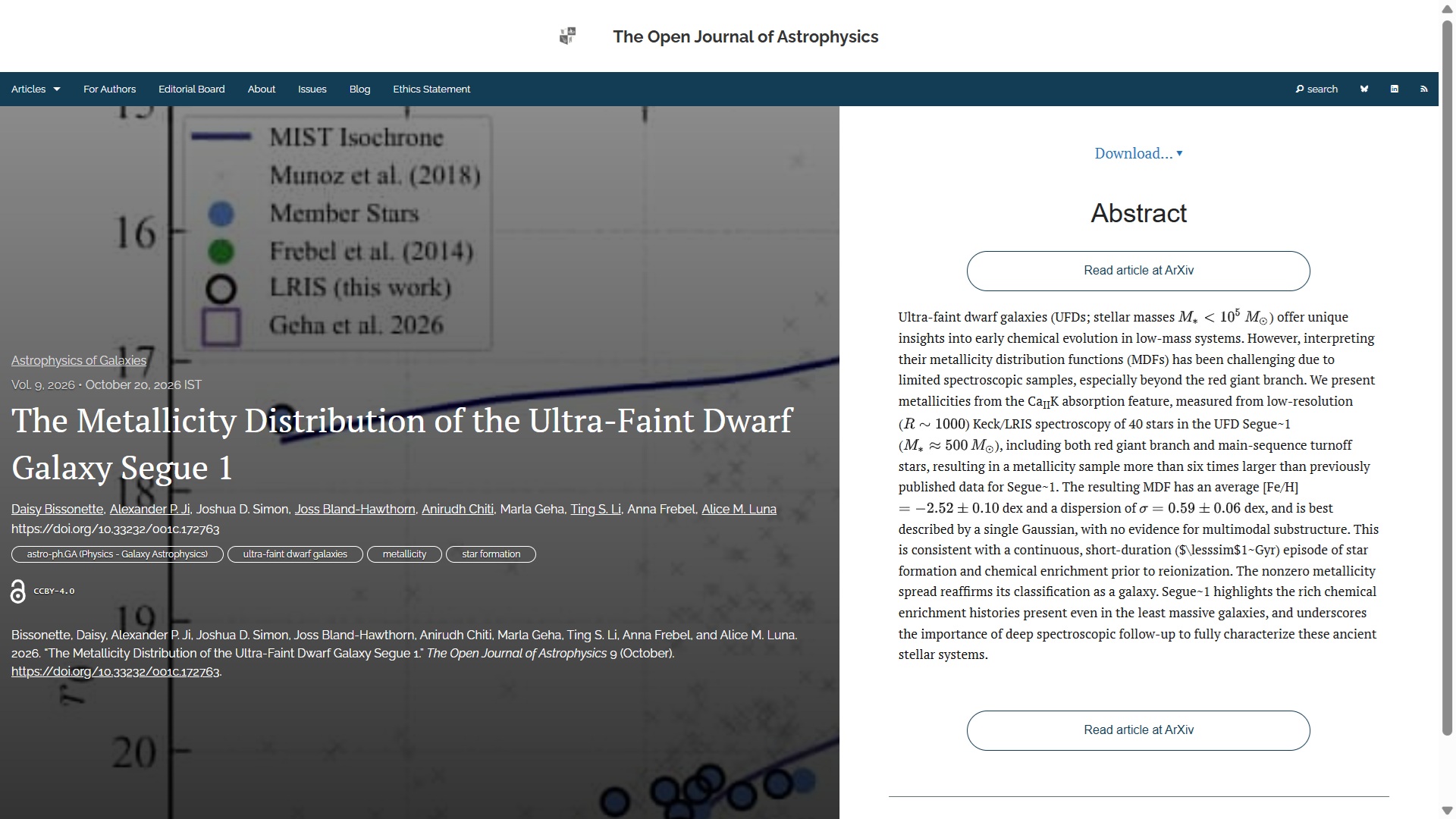
You can find the officially accepted version on arXiv here and the announcement on Fediverse here:
The second paper for this week, also published on Tuesday 20th October in the folder Astrophysics of Galaxies, “Ultraviolet diversity of Little Red Dots as a probe for direct-collapse black hole ages” by Elia Cenci & Melanie Habouzit (U. Geneva, Switzerland) and Dale D. Kocevski (Colby College, USA). This article uses simulations to explore UV emissions from galaxies hosting direct-collapse black holes (DCBHs), finding that these emissions evolve rapidly, reflecting changes in stellar mass and metal enrichment.
The overlay looks like this:
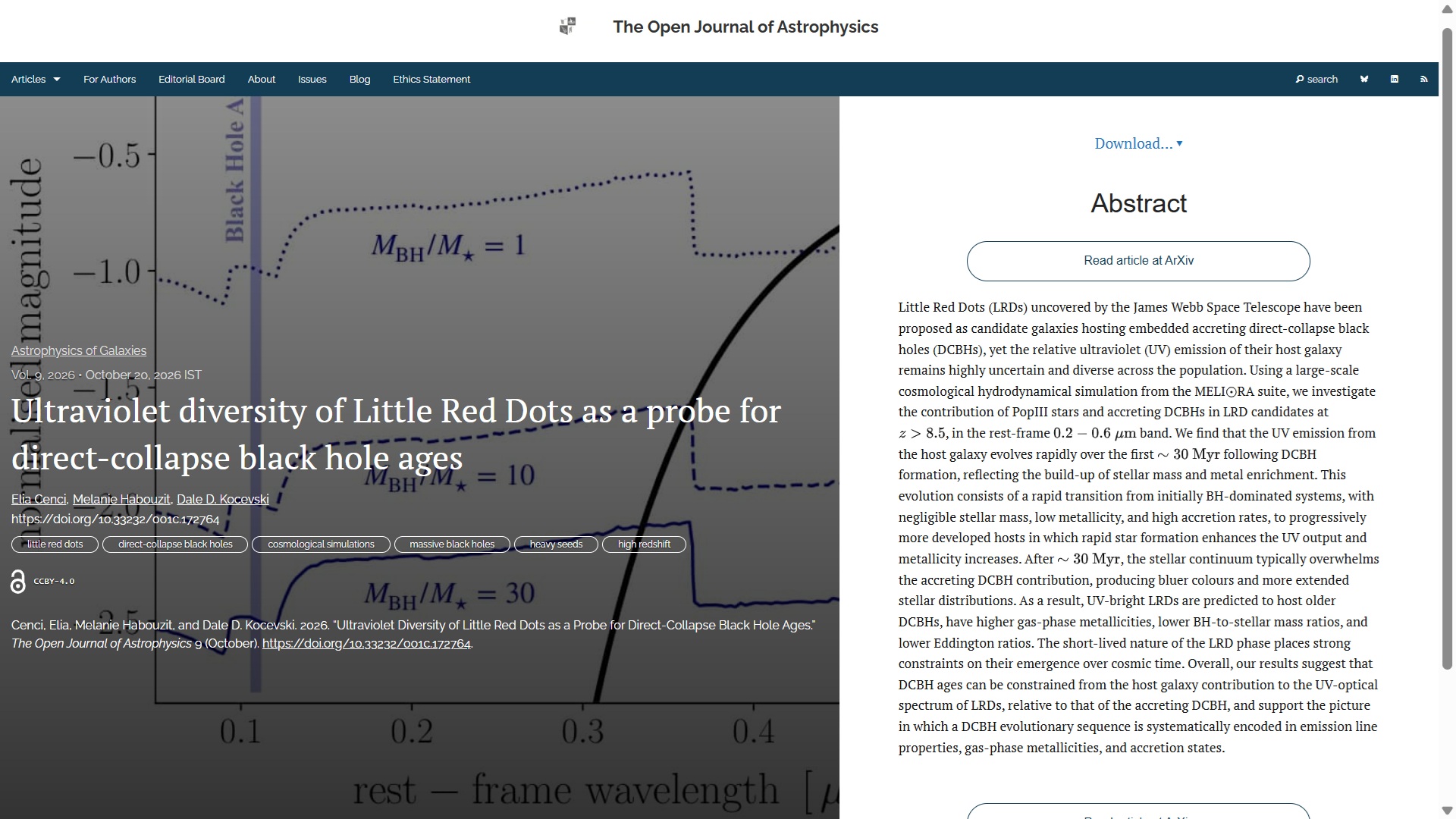
The official version of the paper can be found on arXiv here and the Fediverse announcement here:
The third paper of the week, published on Wednesday October 21st 20206, is “Dark Energy Survey Year 6 Results: improved mitigation of spatially varying observational systematics with masking for the MagLim++ lens sample” by M. Rodríguez-Monroy (Universidad Autónoma de Madrid, Spain) and 65 others from around the world. This paper, which is in the folder Cosmology and Nongalactic Astrophysics, presents a unified definition of the DES (Dark Energy Survey) Y6 JOINT footprint in photometric surveys, improving the modelling of systematics and contamination correction, and optimising the balance between statistical power and systematic control.
The overlay for this is here:
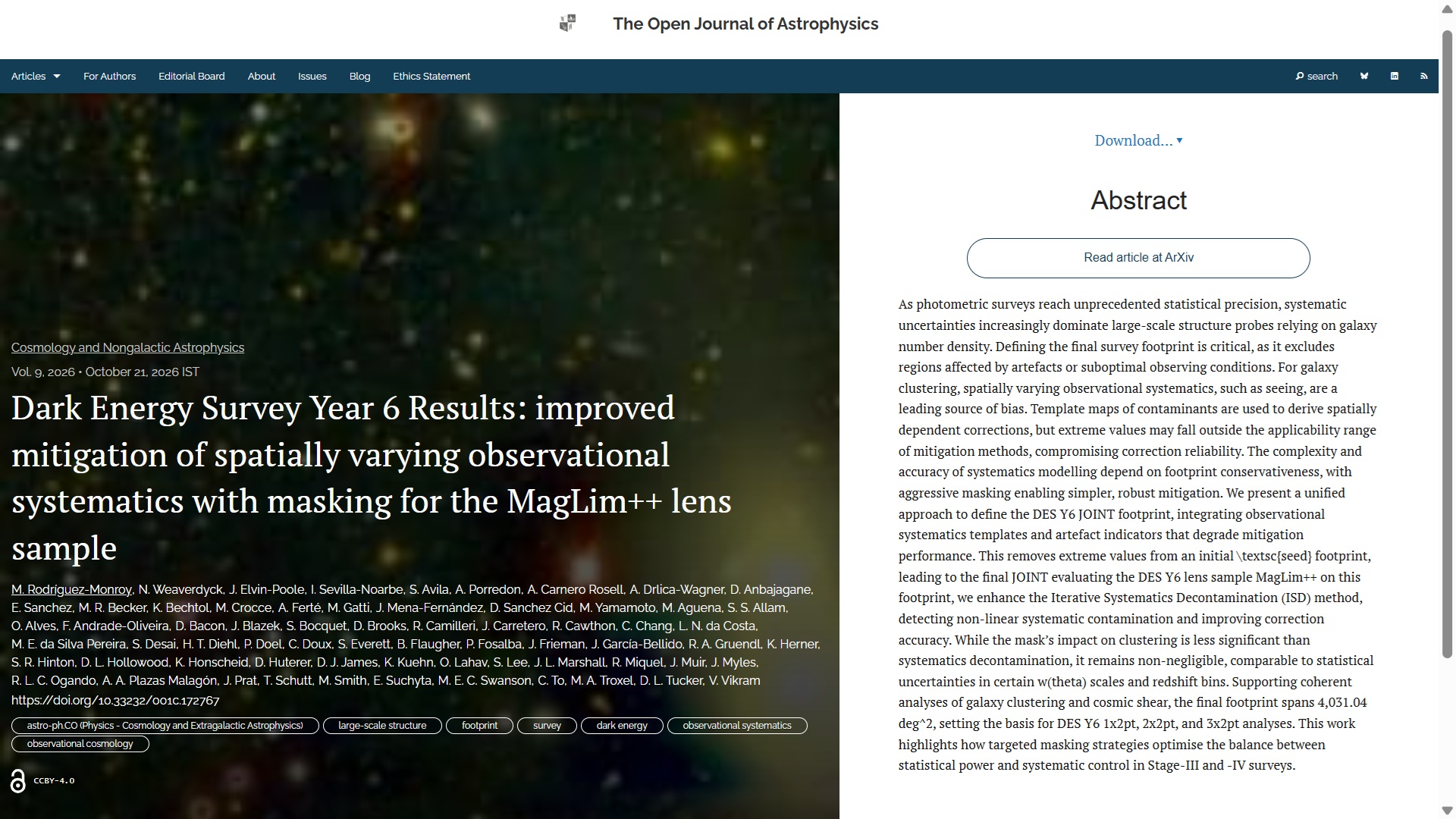
The accepted version of this one can be found on the arXiv here and the Mastodon announcement here:
The fourth and last article of the week, published on Thursday 22nd October in the folder Solar and Stellar Astrophysics is “Spectroscopic Binary Detection as Agent-Callable Tools: Detecting 40,000+ Main-Sequence Binary Candidates from SDSS DR19 APOGEE Spectra” by Serat Mahmud Saad and Yuan-Sen Ting (Ohio State University, USA). The study repackages a method for detecting unresolved binaries in spectroscopic surveys, significantly increasing the number of identified candidates. The tools, skill, and catalog are made publicly available.
The overlay is here:
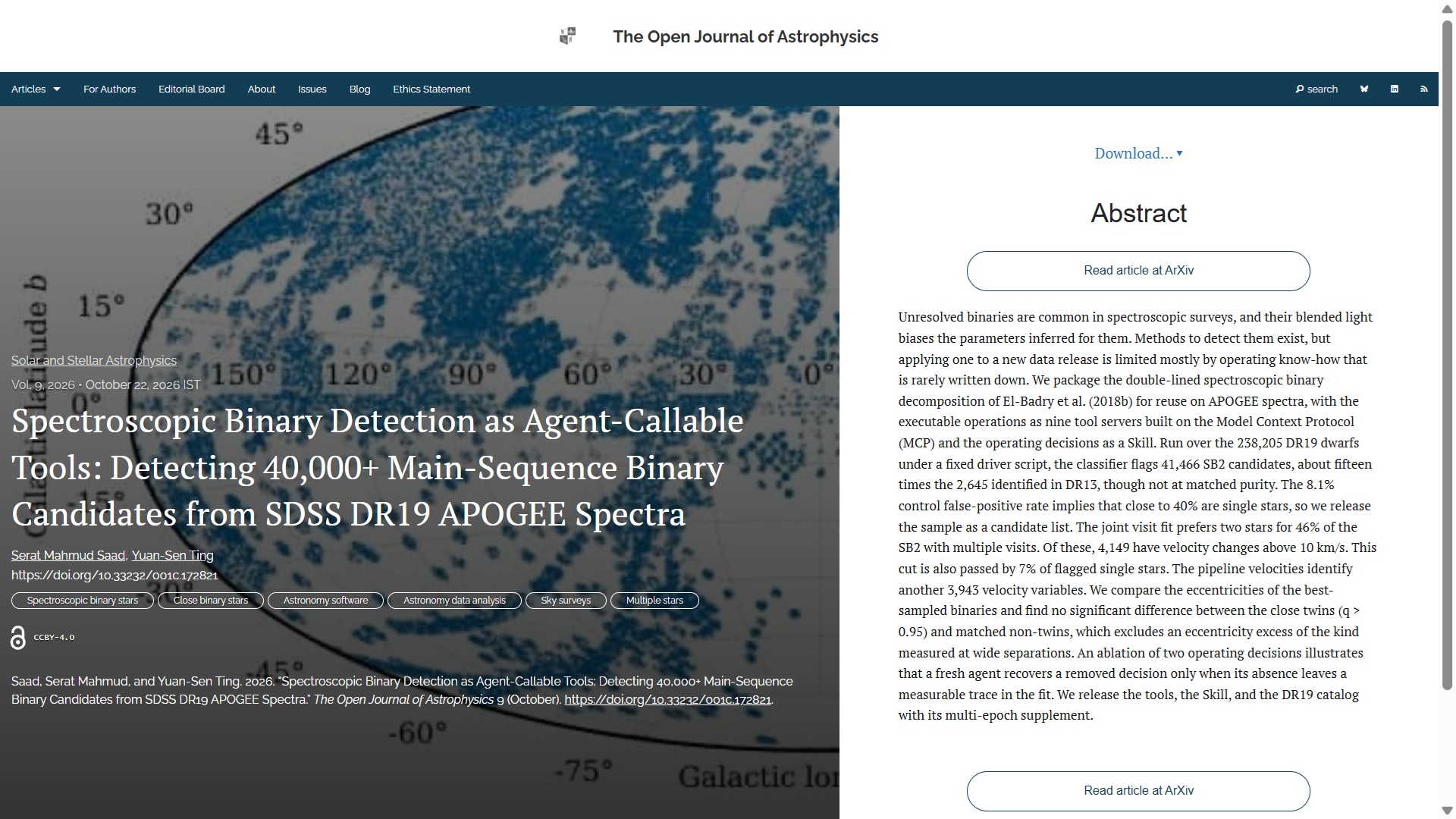
The official version of the paper can be found on arXiv here and the Fediverse announcement here:
That concludes this week’s update. I had anticipate that we’ll pass the 250 mark this week, but business has been slower than of late so we’ll have to wait until next week for that. It is noticeable that the arXiv submission process is slower now than it used to be, presumably because of the huge influx of AI slop that the moderators have to deal with.
Maynooth University Library Cat seems to have survived Storm Austen intact. In fact, all we experienced here in Maynooth was a moderate amount of overnight rain and a bit of a breeze.
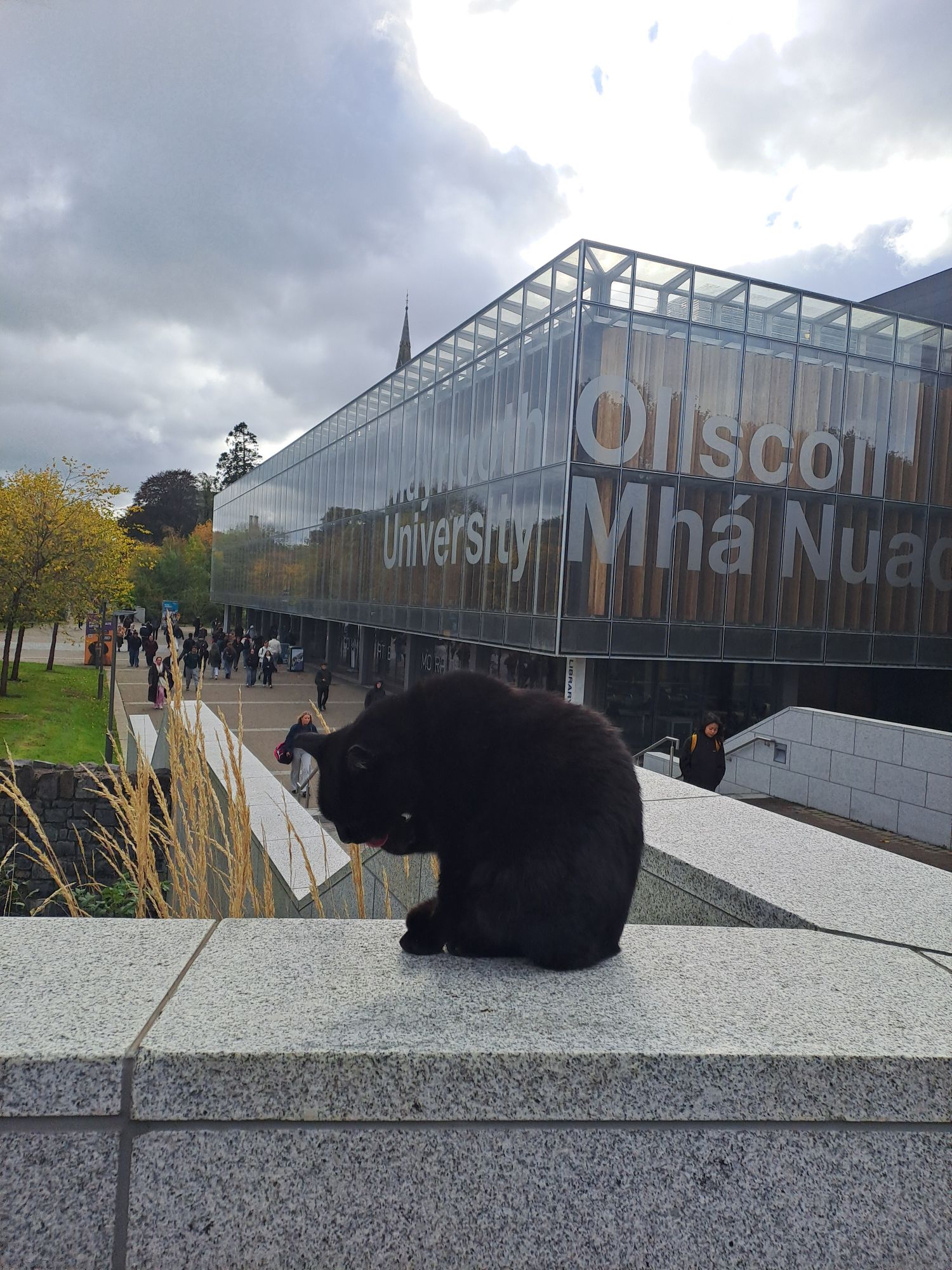
He seems to spending a bit more time these days at the entrance to South Campus on Kilcock Road, where he is pictured here doing his ablutions. His more usual spot is off in the distance, on the left of the picture, past the Library. The Kilcock Rd entrance was picketed during last week’s industrial action, so perhaps he thinks we’re still on strike?
There’s a very important paper on arXiv by P.K.G. Williams (of the Harvard-Smithsoninan Center for Astrophysics) with title AI and the Enclosure of the Scientific Commons and abstract:
The scientific literature can be viewed as an “information commons”: an intangible resource that “no one owns and is shared by everyone.” There are well-established economic and political frameworks for understanding such commons, emerging from the history of agricultural common lands found in places like preindustrial England. This article provides a primer on the history and these frameworks, and considers a key difference between the information commons and the fields of yore: while information commons are robust and immensely valuable — some can be said to rank among humanity’s greatest achievements — the English agricultural commons no longer meaningfully exist. The latter are gone not because of the well-known “tragedy of the commons,” but rather a phenomenon known as the enclosure movement (~1600–1800) that transformed the common lands into private property. Many observers, then and now, judge enclosure to have been theft at a societal scale. This article argues that artificial intelligence (AI) provides precisely the tools needed to enable a previously-infeasible enclosure of the information commons. Although AI-enabled enclosure does not operate identically to physical enclosure, it shares the key features of turning the commons into private wealth and undermining the social systems that support them (via “slop spam”). The concepts presented in this article can provide a scholarly basis for interrogating the foreboding feeling that AI may represent not just a smash-and-grab, but an attack upon a whole way of life.
arXiv:2610.27251
The phrase “Enclosure of the Scientific Commons” is wonderfully apt. I wish I’d thought of it. The rest of the article is very good too and I urge you to read it.
P.S. I remember this little poem from school history lessons when we learnt about the enclosure of the common land in18th century England
The law locks up the man or woman
Who steals the goose from off the common,
But lets the greater felon loose
Who steals the common from the goose.
The European Space Agency’s Euclid Mission is mapping the distribution of galaxies on large scales with the intention of finding out about the nature of dark matter and dark energy. Making such maps involves surveying large areas of the sky for a very long time and doing that makes it inevitable that something unexpected will crop up. That happened last month, between 16th and 24th September 2026, when the Euclid telescope accidentally discovered a comet.
Here is an image showing what Euclid was looking at when the comet intruded:
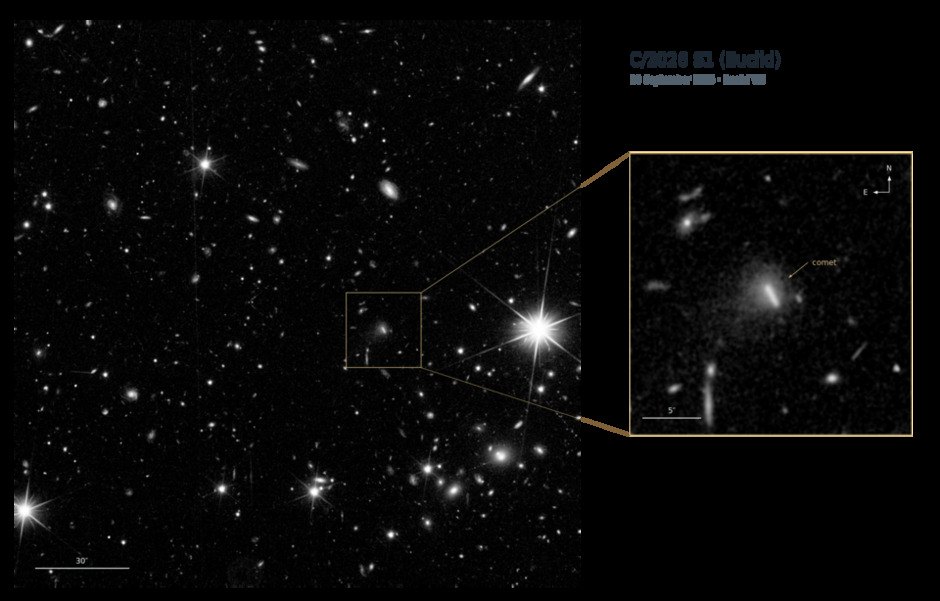
Here is is a comparison of frames showing the motion of the comet, which is easily identifiable by the large arrow pointing at it together with the word “comet”.

The serendipitous comet is named C/2026 S1 (Euclid) – and, before you ask, no it’s not an alien spacecraft.
A post on Bluesky got me thinking about the origin of the word “oyster”, which I shall bore you with shortly, but the post asks an interesting question about the well-known phrase “The World’s Mine Oyster”. This comes from Shakespeare’s The Merry Wives of Windsor and is spoken to Falstaff by Pistol, a swaggering soldier, in the line:
Why, then the world’s mine oyster, Which I with sword will open.
The meaning it has there is that Pistol thinks he can get whatever he wants by force of arms. In more modern usage, however, it is taken to mean that the speaker has everything on a plate. In modern usage it sometimes appears as “the world is your oyster” which means something like “take your pick”. At some point, it is claimed in the 20th Century, this meaning of this phrase changed. There’s a podcast about this here. How, where and why this happened I don’t know, and I don’t know who does. My usual source for information about things like this is the wonderful Brewer’s Dictionary of Phrase and Fable which has the phrase but sheds no light on its change of meaning. If you can shed light on this, please feel free to comment below through the box below.
Anyway, having had oysters in Ireland a few times – with Guinness, obviously- but not knowing the word in the Irish language, I looked it up: it is oisre. Interestingly close, I thought. So then I looked at the etymology of the English word oyster. This first appeared in Middle English via the Latin ostrea (and probably Norman French). The Latin word is derived from the Classical Greek ὄστρεον (ostreon), which is the origin of many words connected with bone, e.g. osteopath and ossuary. This is presumably because it was thought oyster shells were made of bone or at least bony in appearance.
Just for a laugh, here’s a mediaeval representation of an oyster from a Bestiary:

Incidentally, the Romans used ostrea for mussels as well as oysters. This reminds me of my first year at the Royal Grammar School in Newcastle when we had a history teacher whose name escapes me but whose initials – from and old school report I still have – were `BM’ and who possessed a strong Scottish accent. In the first year we learnt a little bit about the Roman invasion of Britain. BM explained that one of the reasons the Romans came to Britain was that they were looking for “perils”. Although confused, I wrote that down unquestioningly in my exercise book. After the lesson was over I asked a classmate about it and he told me the teacher had meant “pearls”. These were very prized in Rome, and there was a rumour circulating there that they were abundant in Britain. But not in oysters. Freshwater mussels were the source of the perils pearls. I guess the Romans used the same word anyway.
Meanwhile, back at the oysters, I find that the Old English (Anglo-Saxon) word is ostre. This might itself have been borrowed from the Latin, but we know that the ancient Britons were eating oysters long before the Romans arrived. In fact, there are shell middens dating back to the mesolithic period. It seemed to me quite possible, therefore, that the word oyster may predate Classical Latin, and even Greek. The similarity of the Gaelic and Anglo-Saxon words may be because they are both linked to Latin, but look at the word for oyster in other languages, German: Auster, Danish østers, Polish: ostryga, etc. Like words for many things with which Europeans have been familiar with for a very long time indeed, could this one have a proto-Indo-European root? I recently read a fascinating book about this and was captivated by the idea of some of our ancient ancestors, thousands of years ago, eating oysters and using a very similar word to describe them.
It seems it does, but the common ancestor is a word not meaning “oyster” directly but “bone”. The Sanskrit word for “bone” is अस्थि (ásthi), which convinces me of its Indo-European origins. It was perhaps the Greeks, or their ancestors, who first adapted this word to refer to an oyster as a “bony thing”.
The number of papers being submitted to the Open Journal of Astrophysics continues to rise, as demonstrated by the following graphic which shows the stats for new submissions for the last five years:
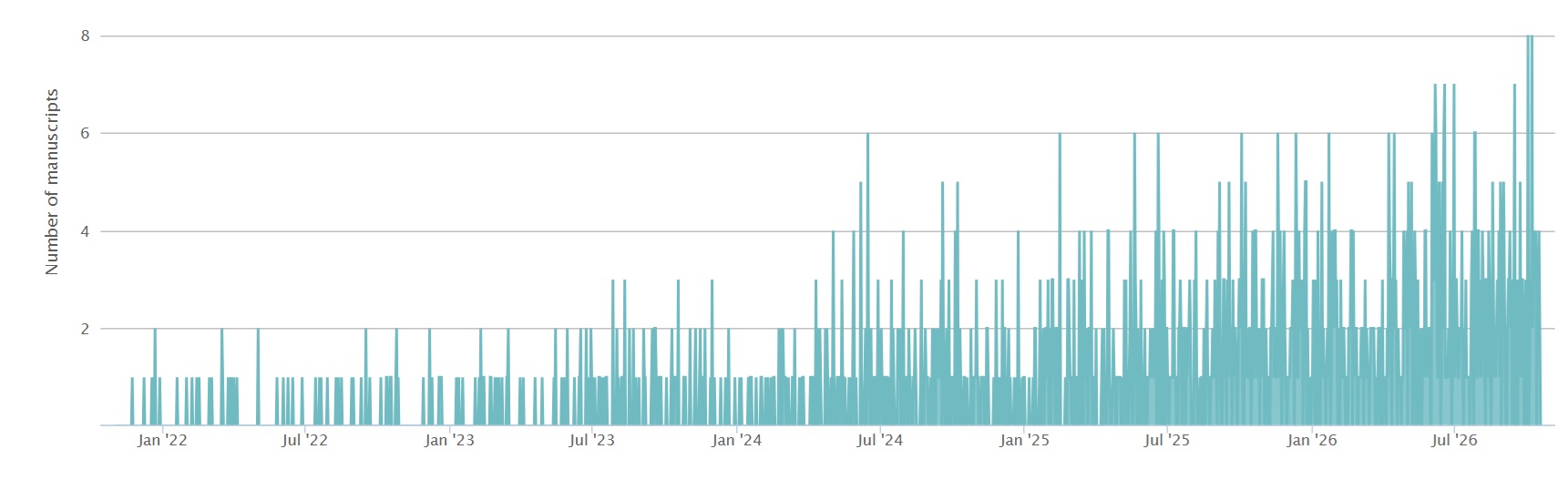
It’s very clear that the thicket is getting thicker and thicker as times goes on! The increasing number of articles is of course very welcome indeed, but it is increasing the load on our Editorial Board and that includes me! I think it’s time once again to look for more volunteers to join the team, in any area of astrophysics. As a reminder, here are the areas we cover, corresponding to the sections of astro-ph on the arXiv:
We are looking for experienced scientists in any of these areas, and it would be useful to have people who can cover a range of subjects (as some of our existing editors do). As I mentioned here, our most popular area is 1 (Astrophysics of Galaxies) but 2 (Cosmology and NonGalactic Astrophysics) is running it a close second. While I would welcome offers from people with expertise in either of those fields, Editors in any of the other areas listed above would be welcome additions. Since we don’t charge authors or readers we can not offer payment to Editors but it is nevertheless a way of providing a service to the community.
If you’re interested, please get in touch either through the Open Journal website here, or through a message Mastodon here, BlueSky here, or LinkedIn here.
Peter Coles
Editor-in-Chief
Open Journal of Astrophysics
This is a version of a piece I posted yesterday on the OJAp blog.
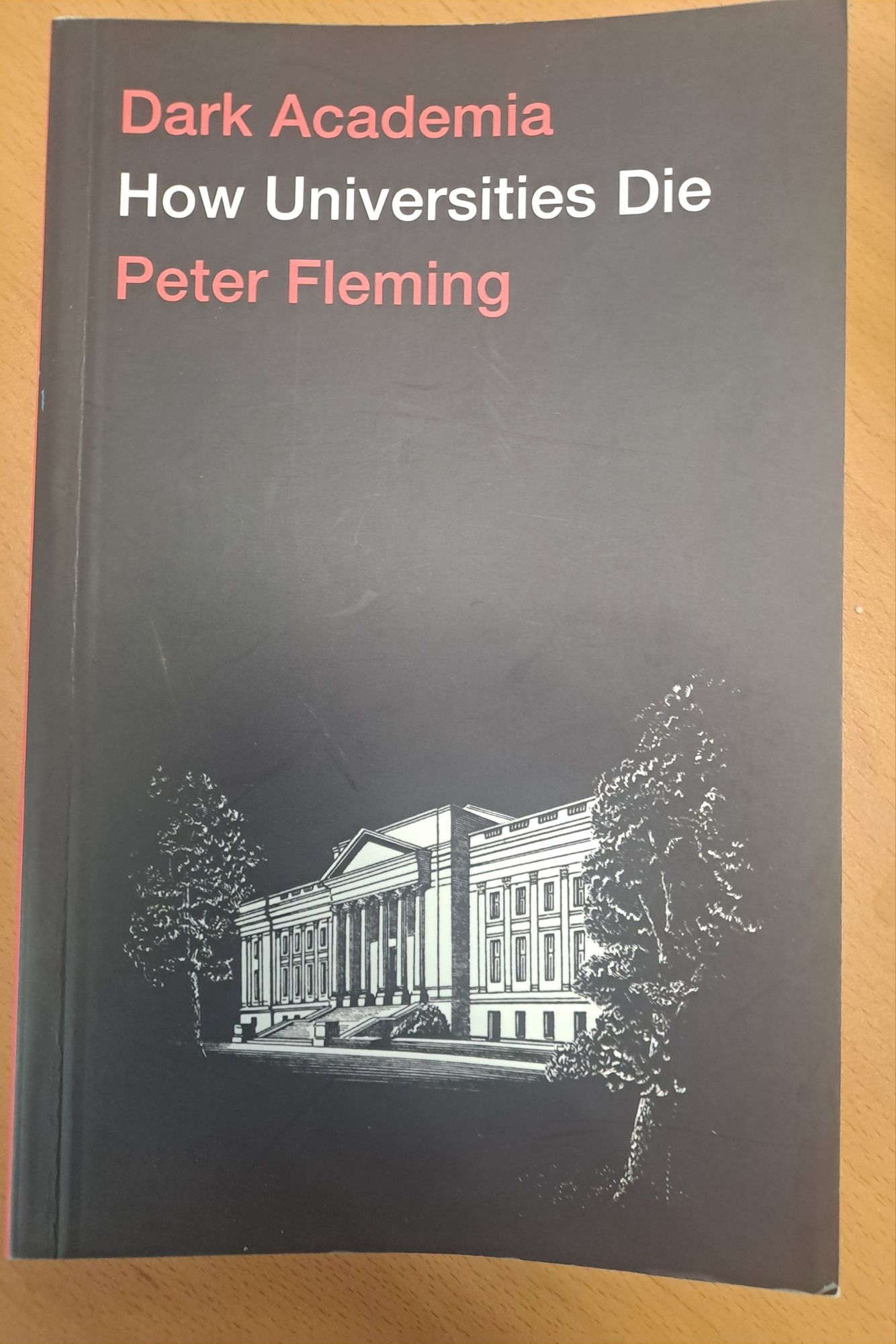
I ordered this book from our local bookshop a while ago but have only just found time to finish reading it. It’s an analysis of the decline of the neoliberal model of the university accompanied by the rise of commercialisation, managerialism and authoritarian models of governance. At 165 pages, not counting the notes and references, it’s a concise and compelling polemic, full of controlled anger and sprinkled with sardonic wit.
The problem I have in reviewing it is that almost every page contains something that rings so true that I’d want to include a quote. There wouldn’t be any point in doing that as I’d end up quoting almost the entire book, so I decided just to include one excerpt, part of a paragraph in the introduction:
Impersonal and unforgiving management hierarchies have supplanted academic judgement, collegiality and professional common sense. in many institutions, senior executives have no PhDs and have been trained in business or the military instead. Mindless performance targets dominate teaching and research to the point of caricature, designed by functionaries who’ve never taught a class or written a research article in their lives. Unfortunately, these hierarchies have become notoriously bossy. Coercion rather than volition compels much academic labour today, even tasks that scholars would have otherwise done willingly because it’s central to their vocation. This surfeit of duress, most of which is unnecessary and counterproductive, is a defining feature of the corporate university.
The book charts the rise of this fanatical managerialism, the consequent fall of academic institutions as places of education, scholarship and research, and their replacement by soulless teaching factories. I’ve been an academic for almost forty years and I’ve seen this process unfold in real time. As I approach retirement, I deeply regret that I didn’t do more to stop it.
Dark Academia was written around the time of the Covid-19 pandemic and published in 2021 so it does not cover the dreadful collapse of higher education in the UK since then. The author does make some presciently pessimistic comments, but the reality has turned out to be far worse than he imagined.
My own experience of the pandemic here in Maynooth illustrates what went on to a greater or lesser extent throughout the university system, namely that it was seen by Management as an opporunity to strengthen its grip. Staff workloads went through the roof as under-resourced departments struggled to deliver adequate teaching. Seeing that we were on our knees, the powers that be decided it was an ideal opportunity to kick us in the teeth. Witholding replacement positions for two lecturers who left at this time, showed a callous disregard for staff morale and student education alike. Needless to say, the person responsible was promoted.
Since the end of the pandemic, the Management of Maynooth University has been led frog-marched down the path towards Dark Academia. The past few years have been a jamboree for senior administrators, with the creation of umpteen new Vice-Presidents on high salaries and extensive perks, such €500,000 on a luxury chauffeur service and €1M. This profligate expenditure on management bloat has been accompanied by austerity everywhere else, especially for teaching and research. This new configuration of the University is clearly unsustainable. The only question is whether anything can be salvaged from the wreckage when it crashes.
The term The University used to have a collective meaning, referring to all staff and students, not just the leadership, but now it simply means The University Management. For example, it was rumbled last year that Maynooth University had paid €47,000 tax on the President’s behalf. The President eventually paid the bill and an anonymous spokesperson said “The University now considers this matter resolved”. I know I’m not the only person working at Maynooth who doesn’t consider it “resolved”: for one thing, I’d like to know who made the decision to pay the President’s tax bill in the first place; and for another I’d like to know who issued the statement that it was “resolved”. I mention this episode because it exemplifies a phrase used by Peter Fleming at the end of his book. Academics used to be able to say that that they worked “in” a university. Not any more we don’t. We work “under” a university.
I’m not very optimistic that academia can change for the better – I think it’s too far gone – but this book at least identifies most of what is wrong. Perhaps, if enough of us read it, we can start trying to reverse the decline.


