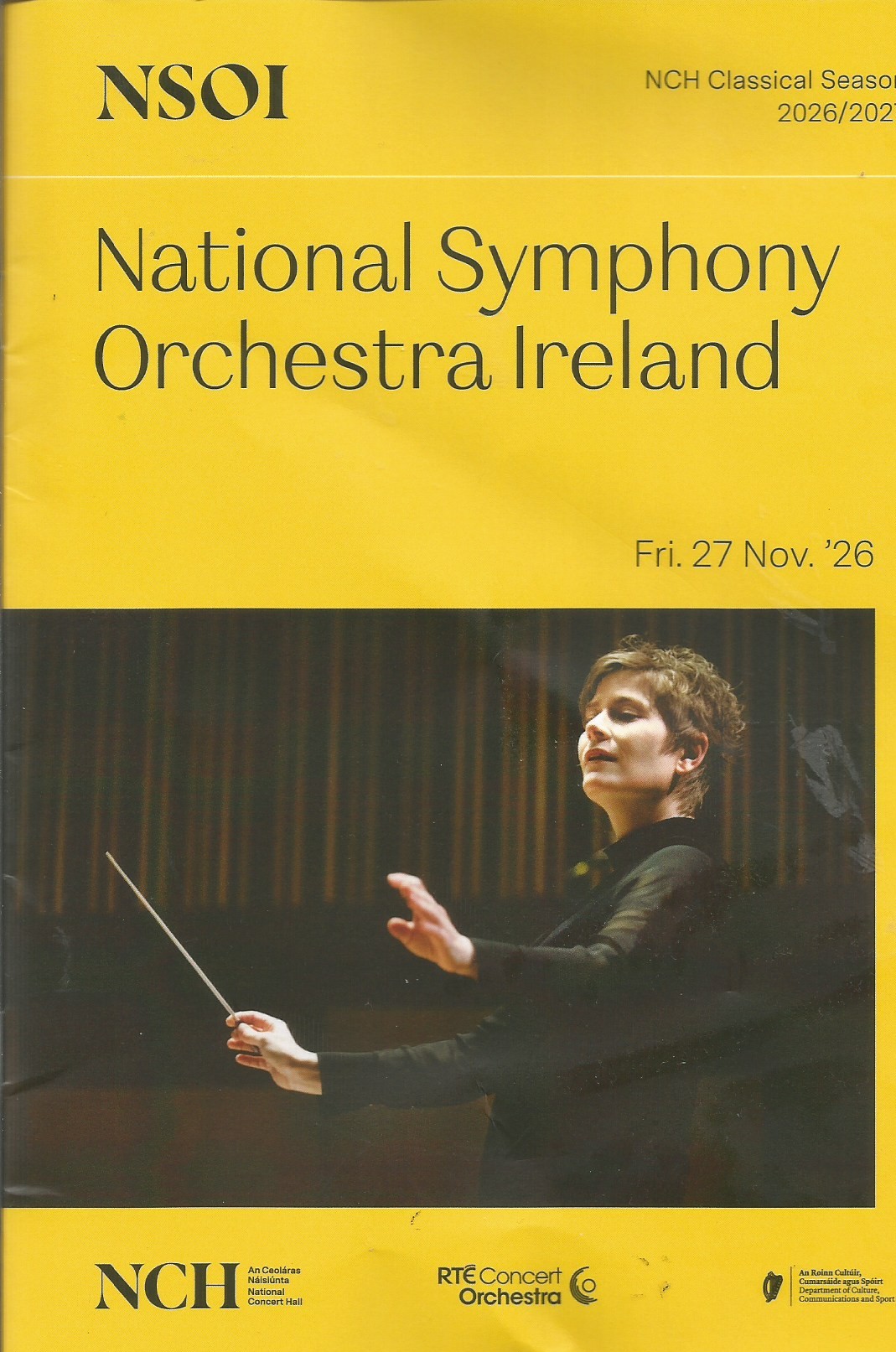
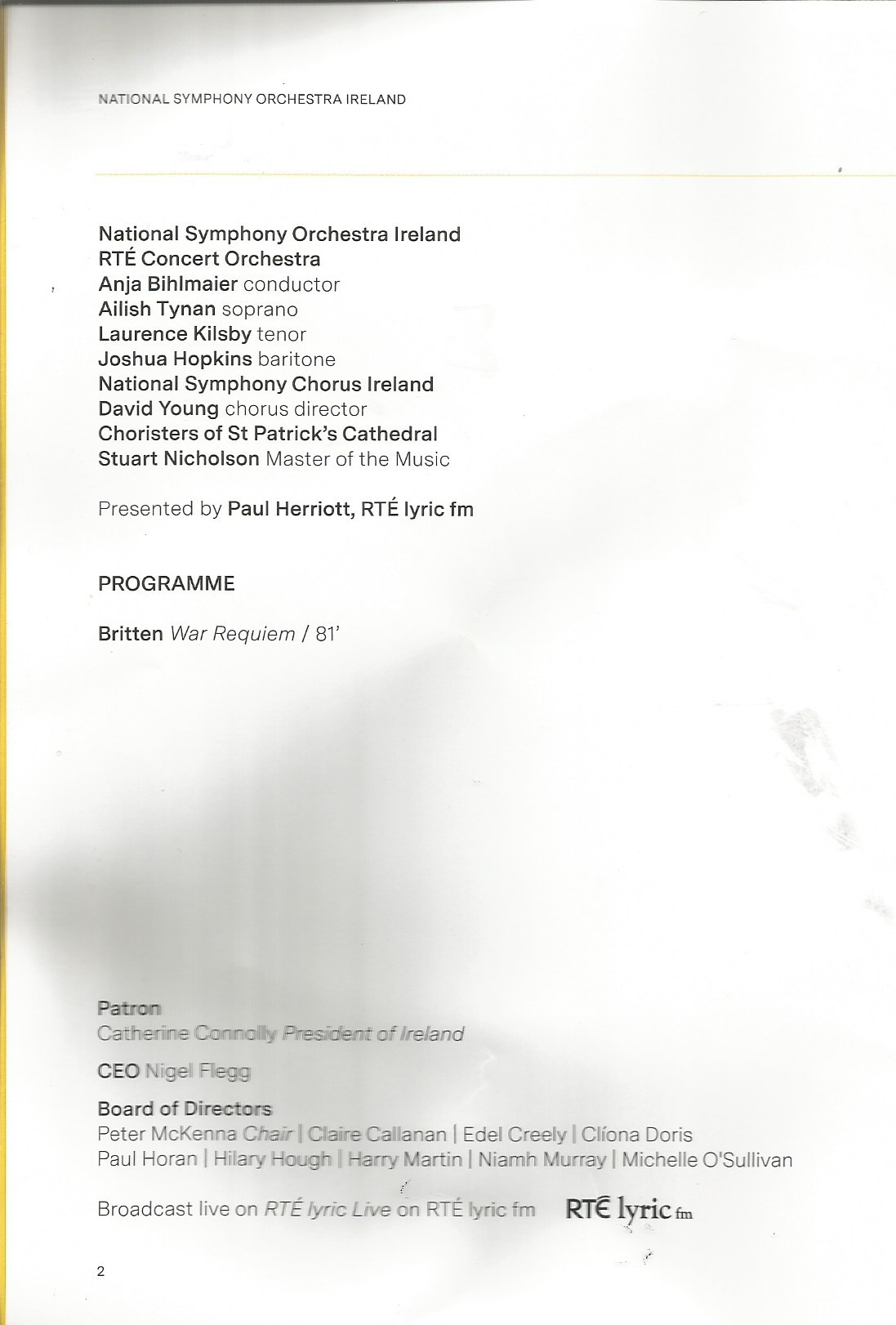
Last night I was back at the National Concert Hall in Dublin for an immensely powerful and moving performance of Benjamin Britten’s War Requiem. The last time I heard this piece was also at the NCH, almost exactly eight years ago. On that occasion (10th November 2018) the performance was to mark the armistice that ended the Great War on 11th November 1918. This time it was a bit later than the annual Remembrance commemorations and took place primarily to mark the forthcoming 50th anniversary of the death of the composer Benjamin Britten.
This vast work is composed for two orchestras (a standard symphony orchestra and a smaller chamber orchestra), two choirs (a chorus of adult voices and a boy’s choir) and three solo vocalists. Last night the soloists were Ailish Tynan (soprano, who also sang in the performance I saw eight years ago), Joshua Hopkins (baritone) and Laurence Kilsby (tenor), who performed with the combined forces of the RTÉ National Symphony Orchestra, the RTÉ National Concert Orchestra, the National Symphony Chorus Ireland and the Boy Choristers of St Patrick’s Cathedral in Dublin. The conductor was Anja Bihlmaier.
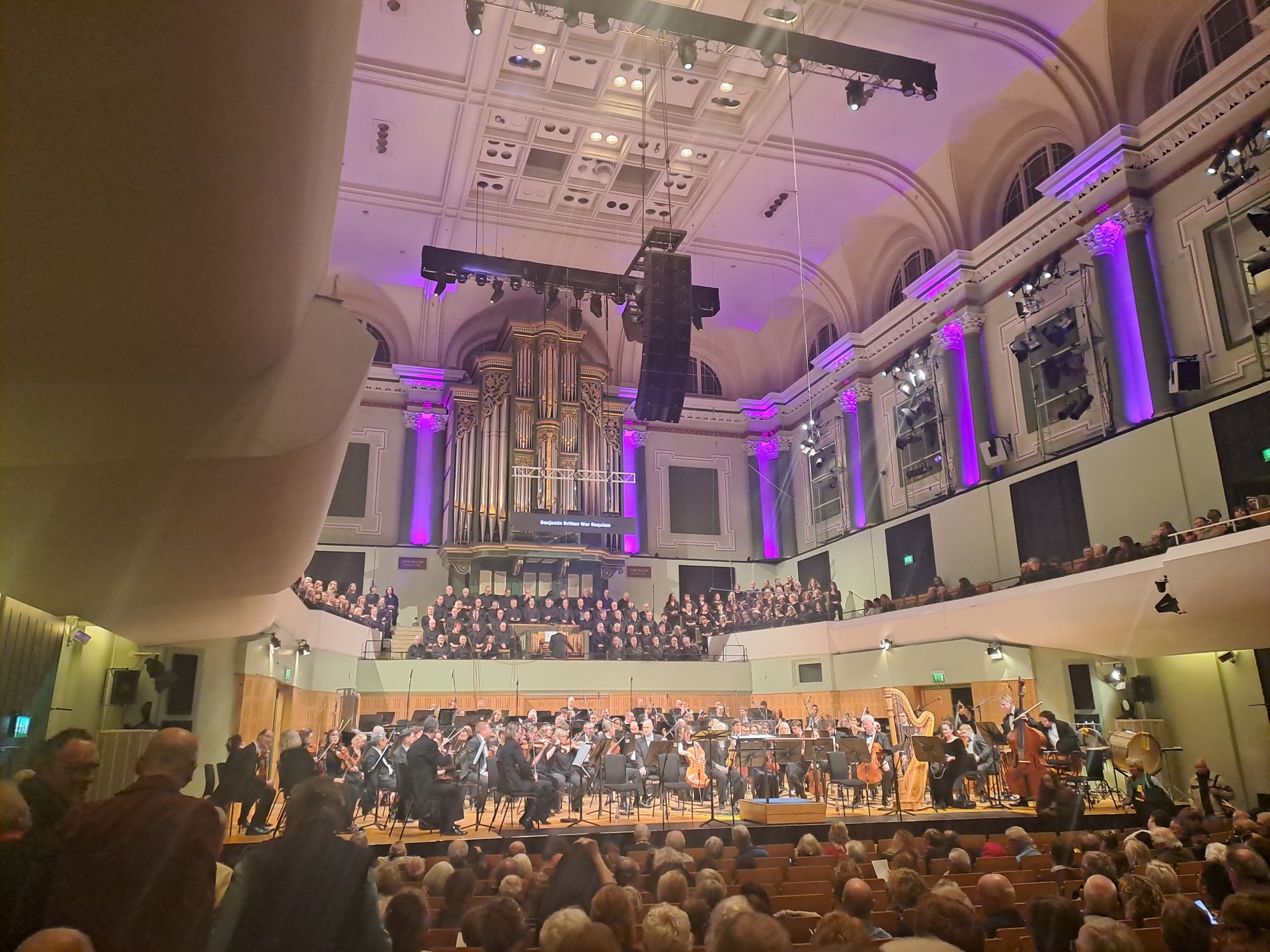
You can see the members of the main choir in position in the above photograph, which I took about ten minutes before the performance began; the choristers were out of sight in the gallery above and behind me. It was a very full house.
The War Requiem was commissioned for the consecration in 1962 of the new Coventry Cathedral built to replace the 14th century cathedral that was destroyed along with most of the city in a devastating air raid ion 1940. It’s a remarkable work that juxtaposes settings of traditional liturgical Latin texts against poems by Wilfred Owen. The idea of doing this may have originated with the first poem Britten uses, Anthem for Doomed Youth, which itself deploys words associated with religious services to emphasize the soulless brutality of warfare:
What passing-bells for these who die as cattle?
   - Only the monstrous anger of the guns.
   Only the stuttering rifles’ rapid rattle
 Can patter out their hasty orisons.
 No mockeries now for them; no prayers nor bells;
     Nor any voice of mourning save the choirs,-
 The shrill, demented choirs of wailing shells;
    And bugles calling for them from sad shires.

What candles may be held to speed them all?
    Not in the hands of boys but in their eyes
 Shall shine the holy glimmers of good-byes.
    The pallor of girls’ brows shall be their pall;
 Their flowers the tenderness of patient minds,
 And each slow dusk a drawing-down of blinds.
These settings are sung by soloists accompanied by the smaller chamber orchestra (positioned at the front and left of the stage) while the more traditional liturgical elements involve the larger forces arrayed behind.
I’ve known this work for many years largely through the classic 1963 recording conducted by Britten himself, with , Peter Pears and Dietrich Fischer-Dieskau as soprano, tenor and baritone soloists respectively. I was particularly struck by how well Laurence Kilsby managed to evoke strong memories of Peter Pears, but all three soloists were excellent last night.
Ailish Tynan sang with extraordinary passion in the Sanctus and Libera Me. The Latin text of the latter section includes:
Tremens factus sum ego, et timeo
 dum discussio venerit, atque ventura ira.
 Libera me, Domine, de morte aeterna.
 Quando coeli movendi sunt i terra.
 Dies illa, dies irae, calamitatis
 et miseriae, dies magna et amara valde.
 Libera me, Domine.
This is not just as an evocation of the horrors of wars past but also expresses and anguished foreboding about wars yet to come. It was deeply moving and clearly heartfelt. The War Requiem expresses the deep tragedy of war, but is not only sorrowful. It is also bitterly ironic. That edge is one of the things that makes it such a great work. Another is the sad fact, that the madness of war is still very much with us.
The first few bars are enough to tell you that this is music is coming from the same imagination that gave us Peter Grimes and a host of other masterpieces, and the quality of the music is sustained throughout the 85 minutes or so of its duration. There are some wonderful touches in the orchestration, such as the Dies Irae (with a definite nod in the direction of Verdi, but with tricky 7/8 rhythms). The Boys Choir was also used extremely effectively, the fact that they could not be seen (at least by me) adding to the ethereal quality of their voices. In all, it added up to an intense experience, I think for the musicians as well as the audience. More than once I felt tears welling up in my eyes. I can’t say why. Sometimes music expresses things that words can’t convey. Actually, come to think of it, that’s what music is for…
At the end of the music, Anja Bihlmaier kept her arms (and baton) extended for a considerable time before gradually lowering them to signal the end of the performance. I really appreciated that several seconds of silence, which was immaculately observed by the audience. It’s good to have a time to reflect on what you’ve just heard before the applause begins.
Congratulations to all the musicians involved last night for a tremendous performance, and thank you for a wonderful experience. It was a privilege to be there.


