Archive for James Joyce

Bloomsday 2026

Posted in Literature with tags , , , , on June 16, 2026 by telescoper

So it’s 16th June, a very special day in Ireland – especially Dublin – because 16th June 1904 is the date on which the story takes place of Ulysses by James Joyce. Bloomsday – named after the character Leopold Bloom – is an annual celebration not only of all things Joycean but also of Ireland’s wider cultural and literary heritage.

If you haven’t read Ulysses yet then you definitely should. It’s one of the great works of modern literature. And don’t let people put you off by telling you that it’s a difficult read. It’s a long read,  that’s for sure -it’s over 900 pages – but the writing is full of colour and energy and it has a real sense of place. It’s a wonderful book. I’ve read it three times now, once as a teenager, once in my thirties, and again a few years ago when I’d reached sixty. Don’t worry if you don’t understand all of Ulysses. It’s like life: most of us never figure out what that’s all about, and it doesn’t really matter.

Joyce once said of Ulysses

I’ve put in so many enigmas and puzzles that it will keep the professors busy for centuries arguing over what I meant.

Well, he wasn’t wrong about that! They’re still arguing, The text is a kind of cultural celebration: references to Greeky mythology jostle with popular songs, lists, parodies, question-and-answer sections, and records of the characters innermost thoughts. The book is full of allusions and part of the fun is trying to follow them up. And anyone who likes puns will have a field day!

Anyway, here’s an excerpt. It’s from near the start of Chapter 4, where we meet Mr Leopold Bloom for the first time and discover that he’s fond of cats. He is making breakfast for his wife Molly, who is still in bed. I don’t know if Joyce ever had a cat, but he obviously knew a lot about them!

–o–

Another slice of bread and butter: three, four: right. She didn’t like her plate full. Right. He turned from the tray, lifted the kettle off the hob and set it sideways on the fire. It sat there, dull and squat, its spout stuck out. Cup of tea soon. Good. Mouth dry. The cat walked stiffly round a leg of the table with tail on high.

—Mkgnao!

—O, there you are, Mr Bloom said, turning from the fire.

The cat mewed in answer and stalked again stiffly round a leg of the table, mewing. Just how she stalks over my writingtable. Prr. Scratch my head. Prr.

Mr Bloom watched curiously, kindly the lithe black form. Clean to see: the gloss of her sleek hide, the white button under the butt of her tail, the green flashing eyes. He bent down to her, his hands on his knees.

—Milk for the pussens, he said.

—Mrkgnao! the cat cried.

They call them stupid. They understand what we say better than we understand them. She understands all she wants to. Vindictive too. Cruel. Her nature. Curious mice never squeal. Seem to like it. Wonder what I look like to her. Height of a tower? No, she can jump me.

—Afraid of the chickens she is, he said mockingly. Afraid of the chookchooks. I never saw such a stupid pussens as the pussens.

—Mrkrgnao! the cat said loudly.

She blinked up out of her avid shameclosing eyes, mewing plaintively and long, showing him her milkwhite teeth. He watched the dark eyeslits narrowing with greed till her eyes were green stones. Then he went to the dresser, took the jug Hanlon’s milkman had just filled for him, poured warmbubbled milk on a saucer and set it slowly on the floor.

—Gurrhr! she cried, running to lap.

He watched the bristles shining wirily in the weak light as she tipped three times and licked lightly. Wonder is it true if you clip them they can’t mouse after. Why? They shine in the dark, perhaps, the tips. Or kind of feelers in the dark, perhaps.

I’ll also mention that if you have about 30 hours to spare you can listen to all of a radio broadcast of Ulysses from 1982.

Bloomsday 2025

Posted in Literature with tags , , , on June 16, 2025 by telescoper

So it’s 16th June, a very special day in Ireland – especially Dublin – because 16th June 1904 is the date on which the story takes place of Ulysses by James Joyce. Bloomsday – named after the character Leopold Bloom – is an annual celebration not only of all things Joycean but also of Ireland’s wider cultural and literary heritage.

If you haven’t read Ulysses yet then you definitely should. It’s one of the great works of modern literature. And don’t let people put you off by telling you that it’s a difficult read. It’s a long read,  that’s for sure -it’s over 900 pages – but the writing is full of colour and energy and it has a real sense of place. It’s a wonderful book. I’ve read it three times now, once as a teenager, once in my thirties, and again last year when I’d reached sixty.

Anyway, here’s an excerpt with an astromomical theme, which seems to me to fit this blog:

With what meditations did Bloom accompany his demonstration to his companion of various constellations?

Meditations of evolution increasingly vaster: of the moon invisible in incipient lunation, approaching perigee: of the infinite lattiginous scintillating uncondensed milky way, discernible by daylight by an observer placed at the lower end of a cylindrical vertical shaft 5000 ft deep sunk from the surface towards the centre of the earth: of Sirius (alpha in Canis Maior) 10 lightyears (57,000,000,000,000 miles) distant and in volume 900 times the dimension of our planet: of Arcturus: of the precession of equinoxes: of Orion with belt and sextuple sun theta and nebula in which 100 of our solar systems could be contained: of moribund and of nascent new stars such as Nova in 1901: of our system plunging towards the constellation of Hercules: of the parallax or parallactic drift of socalled fixed stars, in reality evermoving wanderers from immeasurably remote eons to infinitely remote futures in comparison with which the years, threescore and ten, of allotted human life formed a parenthesis of infinitesimal brevity.

I’ll also mention that, starting at 8am on  RTÉ Radio 1 Extra (but also available at other times on the RTÉ player), you  can listen to the classic radio broadcast of Ulysses from 1982.

Bloomsday Barcelona

Posted in Barcelona, LGBTQ+, Literature with tags , , , , , , on June 16, 2024 by telescoper

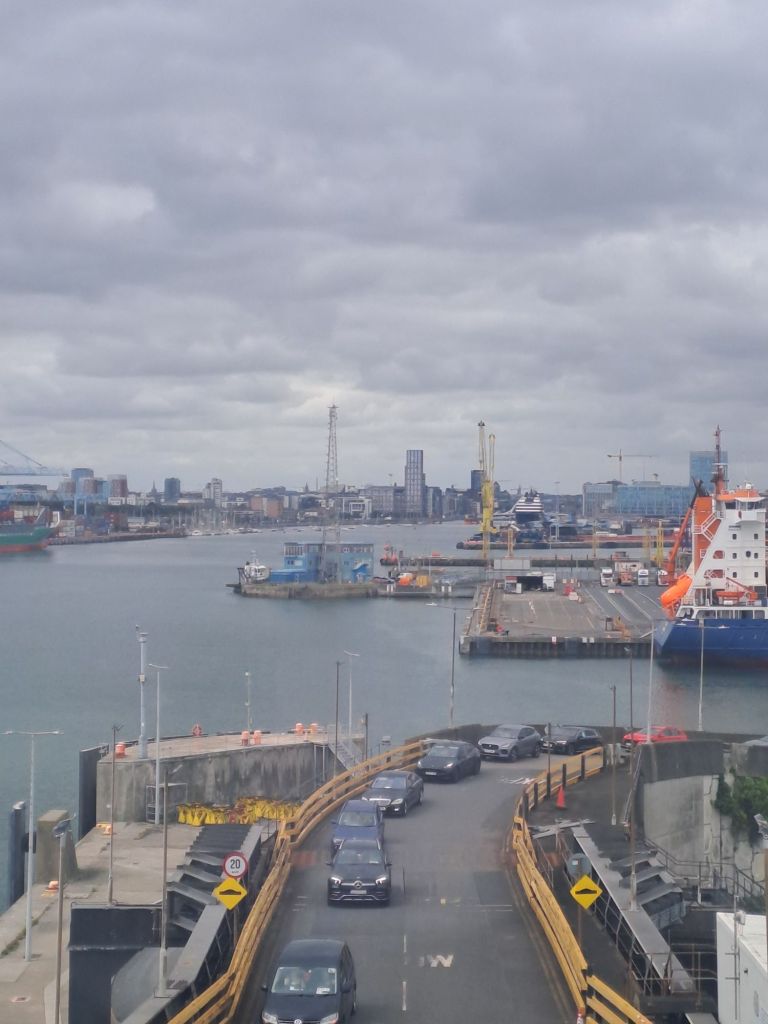
So it’s June 16th which means it is Bloomsday. I looked around for ways to celebrate this day in Barcelona and found that there is a Irish bar on La Rambla called Bloomsday. When I went there, though, I was disappointed to find it not only closed, but apparently abandoned:

Barcelona gets a mention – just one – in James Joyce’s Ulysses:

Noon slumbers. Kevin Egan rolls gunpowder cigarettes through fingers smeared with printer’s ink, sipping his green fairy as Patrice his white. About us gobblers fork spiced beans down their gullets. Un demi sétier! A jet of coffee steam from the burnished caldron. She serves me at his beck. Il est irlandais. Hollandais? Non fromage. Deux irlandais, nous, Irlande, vous savez ah, oui! She thought you wanted a cheese hollandais. Your postprandial, do you know that word? Postprandial. There was a fellow I knew once in Barcelona, queer fellow, used to call it his postprandial. Well: slainte! 

I can confirm that there is no shortage of queer fellows here, but I’ll have to have my lunch before I can have a postprandial but slainte! to you too.

Nollaig na mBan

Posted in Irish Language, Literature with tags , , , on January 6, 2023 by telescoper

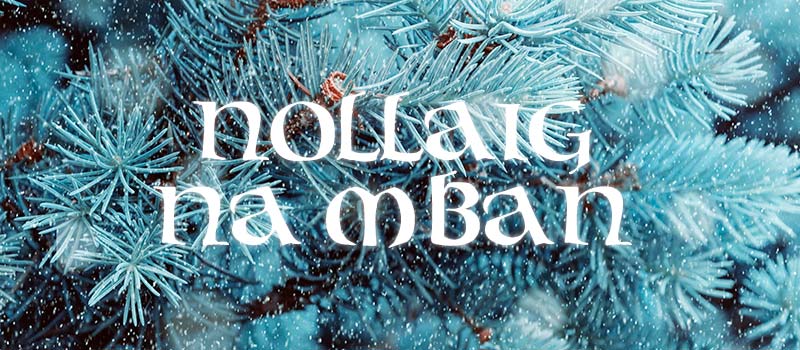
Today is January 6th, which is Epiphany in the Church calendar, Twelfth Night, usually the day the Christmas decorations came down when I was a kid, and here in Ireland a day known as Nollaig na mBan (Women’s Christmas).  You can read more about the origin of this Irish tradition here.

This allows me an excuse to be a grammar bore yet again. The Irish word for “woman” is bean, which has the plural form Ban; na  is the corresponding definite article. However, in the phrase  Nollaig na mBan, “women” is in the genitive case (Christmas of the women) and the B therefore undergoes lenition to become m. This sort initial consonant mutation is very common in the Irish language. Instead of being pronunced “ban” the word for women is therefore spoken as “man”. Fortunately, the written language is kind in that it leaves the unmodified consonant in place, hence mBan.

I was also reminded today that 6th January (in 1914) was the date of the gathering described in James Joyce’s wonderful short story The Deadthe last, the longest, and the best of the collection Dubliners, which I thoroughly recommend if you haven’t read it yet. It’s an ideal gateway into Joyce’s writing:

Nollaig na mBan shona daoibh go léir!

A Century of Ulysses

Posted in Biographical, Literature with tags , on February 2, 2022 by telescoper


When I woke up this morning the radio reminded me that today, 2nd February 2022, is the centenary of the first complete publication of  Ulysses by James Joyce. It had been published in installments before that, but it took a publisher in Paris to bite the bullet and publish the whole thing. The publication date also happened to be the 40th birthday of the author.

I have toyed with the idea of going into Dublin on Bloomsday (16th June, the day on which Ulysses is set) and wandering about some of the locations described in, but what with work and lockdowns I haven’t got round to it.  Maybe this year will be the time!

Or perhaps instead I’ll prepare dinner this evening in a style that Leopold Bloom would enjoy:

He liked thick giblet soup, nutty gizzards, a stuffed roast heart, liver slices fried with breadcrumbs, fried hen cod’s roe. Most of all he liked grilled mutton kidneys which gave his palate a fine tang of faintly scented urine.

Or perhaps not.

If you haven’t read Ulysses yet then you definitely should. It’s one of the great works of modern literature. And don’t let people put you off by telling you that it’s a difficult read. It really isn’t. It’s a long read that’s for sure -it’s over 900 pages – but the writing is full of colour and energy and it has a  real sense of place. It’s a wonderful book.

(There’s also quite a lot of sex in it….)

I’ve read Ulysses twice, once when I was a teenager and again when I was in my thirties. I then lent my copy to someone and never got it back. The copy shown above is a new one I bought last year with the intention of reading the novel again now that I live in Ireland but I sadly have not had the time yet. I will, though.

#Bloomsday and Things Joycean

Posted in Literature with tags , , on June 16, 2021 by telescoper

So it’s 16th June, a very special day in Ireland – and especially Dublin – because 16th June 1904 is the date on which the story takes place of Ulysses by James Joyce. Bloomsday – named after the character Leopold Bloom – is an annual celebration not only of all things Joycean but also of Ireland’s wider cultural and literary heritage. Of course it’s mainly virtual this year, as it was last year.

I was toying with the idea of going into Dublin and wandering about some of the locations described in Ulysses, but I have too much work to do. Maybe next year.  Instead I thought I’d prepare dinner this evening in a style that Leopold Bloom would enjoy:

He liked thick giblet soup, nutty gizzards, a stuffed roast heart, liver slices fried with breadcrumbs, fried hen cod’s roe. Most of all he liked grilled mutton kidneys which gave his palate a fine tang of faintly scented urine.

Or perhaps not.

If you haven’t read Ulysses yet then you definitely should. It’s one of the great works of modern literature. And don’t let people put you off by telling you that it’s a difficult read. It really isn’t. It’s a long read that’s for sure -it’s over 900 pages – but the writing is full of colour and energy and it has a  real sense of place. It’s a wonderful book.

(There’s also quite a lot of sex in it….)

I’ve read Ulysses twice, once when I was a teenager and once when I was in my thirties. I then lent my copy to someone and never got it back. The copy shown above is a new one I bought last year with the intention of reading the novel again now that I live in Ireland but I sadly have not had the time yet. I will, though.

I did manage to read all of Finnegans Wake last summer which I think is quite a difficult read so I approached it by rationing myself to ten pages per day and going slowly, often reading it out loud. In many ways it’s really a more like a very long poem than a prose work. It is

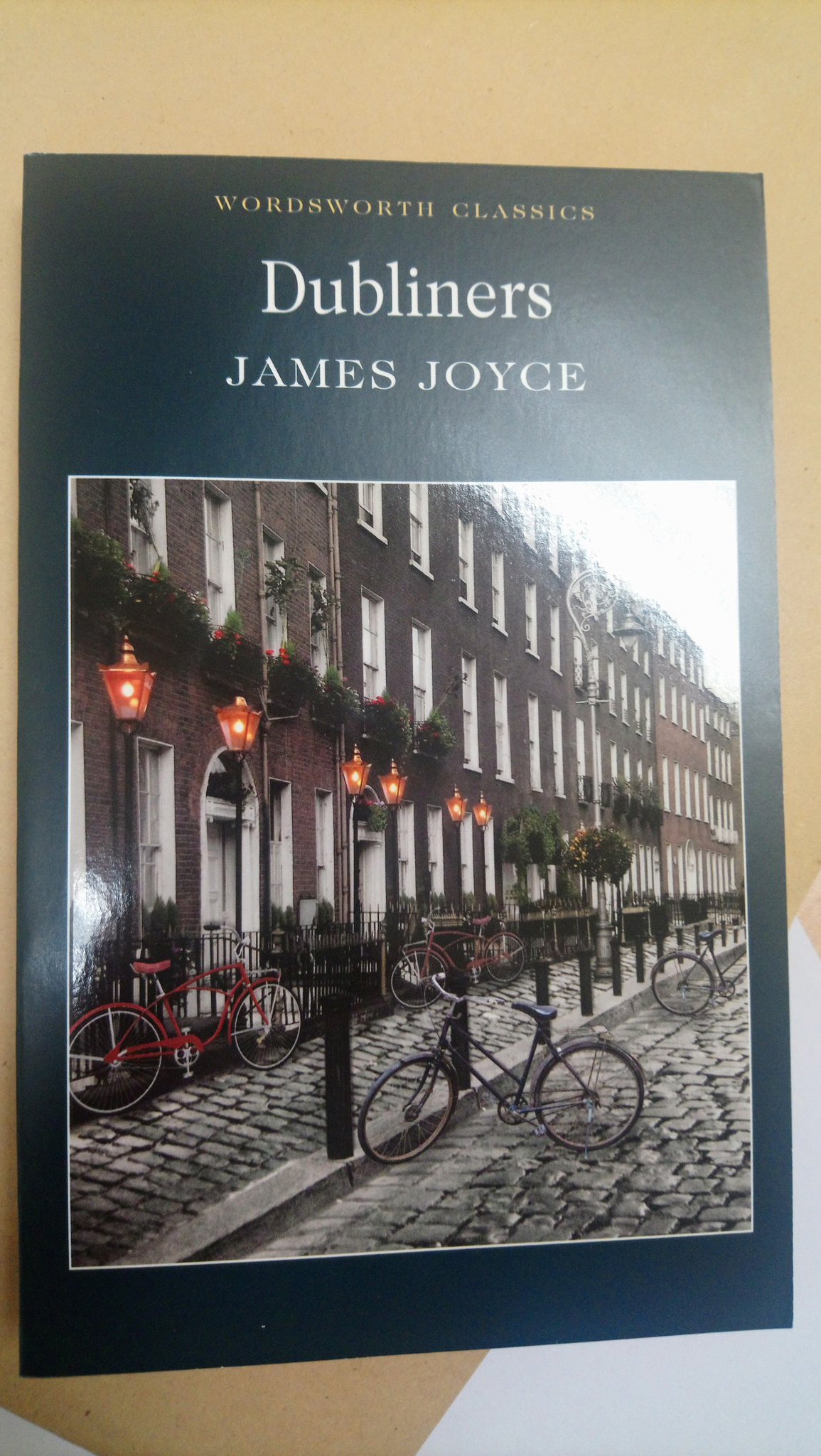
Incidentally if you would like to limber up before making an attempt on either  Ulysses or Finnegans Wake I recommend this set of short stories.

But if you don’t fancy reading it you can listen to an epic 29 hour dramatisation of Ulysses on the radio via RTÉ; see here for details.

Trustan with Usolde

Posted in Literature, Opera with tags , , , , , , , , on August 1, 2020 by telescoper

It is, I think, fairly well known that physicist Murray Gell-Mann was inspired to pick the name quark for the name of a type of subatomic particle by a passage from Finnegans Wake by James Joyce:

— Three quarks for Muster Mark!
Sure he hasn’t got much of a bark
And sure any he has it’s all beside the mark.

What is perhaps less well known is the identity of “Muster Mark” in that quote. In fact it is King Mark of Cornwall, husband of Queen Iseult in the legend of Tristan and Iseult. The Iseult in that legend is Irish. She has has an affair with Tristan, nephew of King Mark, with tragic consequences. This legend appears in many literary forms including, most famously, Richard Wagner’s Opera Tristan und Isolde. It also comes up frequently in Finnegans Wake including this passage on the same page (in the edition I have) as the Muster Mark quote above:

That song sang seaswans.
The winging ones. Seahawk, seagull, curlew and plover, kestrel
and capercallzie. All the birds of the sea they trolled out rightbold
when they smacked the big kuss of Trustan with Usolde.

See how Joyce plays with the substitution of “u” for “i” here as in “Muster”. Either that or the “I” key on his typewriter didn’t work properly. Or he had fat fingers and kept hitting the wrong key; U and I are next door on the keyboard.

Incidentally there is a small village in Dublin called Chapelizod which is where a church was built dedicated to Queen Iseult. Whether there is any real connection between this place and the historical Iseult is very doubtful.

Now, where was I. Oh yes. Back to Opera.

Years ago, when I lived in Nottingham, on a warm summer evening I decided to listen to some of the live broadcast on BBC Radio 3 of a performance of Wagner’s Tristan und Isolde from Glyndebourne. I made myself a cocktail and took the radio out into the garden with the intention of listening to a bit of it before going out for the evening. This was back in the days when I actually used to go out on the town on Saturday nights; now I’m too old for that sort of thing.

Anyway, I was hooked right from the Prelude. Act I came and went and I decided to make some dinner in the interval, opened a bottle of wine, and returned to listen to the rest of it. The glorious music washed over me in the sultry twilight. Darkness fell, a second bottle of wine was opened, and still I listened – no doubt to the consternation of my neighbours. The final Liebestod was so beautiful I almost cried. Eventually I retreated to the house having experienced my first all-out Wagner trip.

My enjoyment of that occasion was of course helped by the fact I could get up and walk around occasionally, as well as by the liberal intake of fine wine. Nevertheless I do think Tristan and Isolde works very well on the radio – nothing very much happens on stage anyway (especially in Act II) so you can just let the music work it’s magic.

The reason for all this rambling is that there is a special broadcast of Tristan und Isolde on RTÉ Lyric FM. This performance, recorded in 2012, features as Isolde the celebrated dramatic soprano Miriam Murphy who very sadly passed away suddenly a few weeks ago. Tonight’s programme is a tribute to her memory. I believe Miriam Murphy is the only Irish soprano to have sung the role of Isolde. I’ve heard a few clips from it and her voice sounds amazing.

The Opera is preceded on the radio by a documentary about the production, the first in Ireland for 50 years and the first by a brand new company based in Ireland. I think James Joyce would have approved.

So that’s my Saturday evening sorted out!

Update: I listened to the broadcast and it is an astonishingly wonderful performance by Miriam Murphy.
Reading Finnegans Wake

Posted in Literature, Maynooth with tags , on July 25, 2020 by telescoper

Doing my bit to support local businesses as they come out of lockdown I decided to order a book from the excellent independent bookshop on Main Street. You can’t browse there yet but you can order books for collection.

I went to collect my order yesterday. I was worried that they might be struggling for business but the place was chock-a-block with packs of school books ready for collection ahead of the new school year.

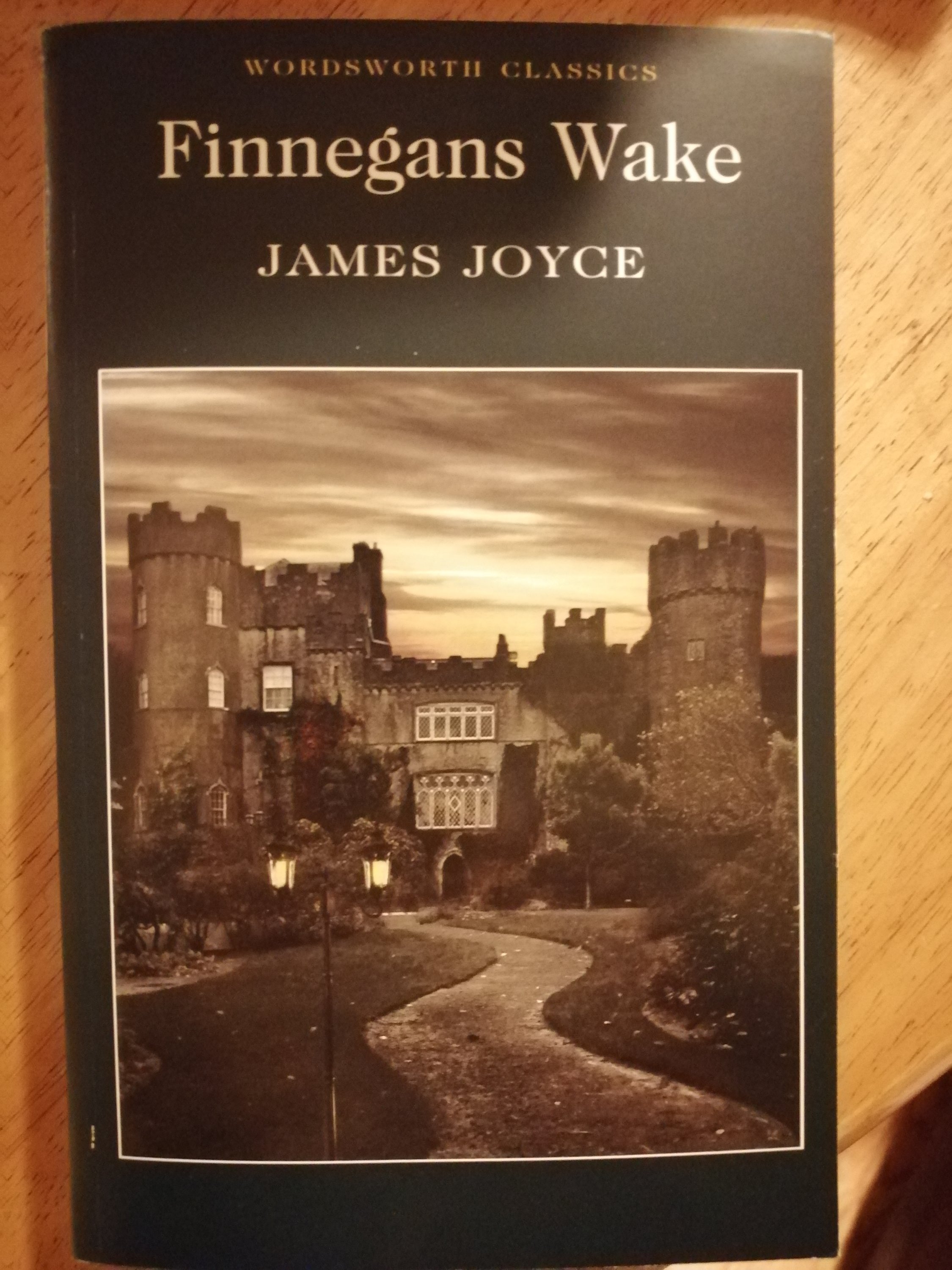
I picked up this bit of light reading:

I disagree with people who say that Ulysses is a difficult read, but Finnegans Wake is certainly a challenge. The lady in the bookshop said “Good luck with it!” as she handed it to me…

Alfred Hitchcock once claimed that “puns are the highest form of literature” and one of the features of Finnegans Wake is the constant stream of puns (in different languages). It seems that almost every sentence contains some form of double meaning too. Finnegans Wake may be hard going but it’s very playful, not only with linguistic meaning but with the sounds that words make, which can be delightful in itself independently of what they’re supposed to mean.

I’ve always thought of Finnegans Wake not so much as a novel but as as a very long poem to be read out loud. Indeed here is a strange but fascinating clip of Joyce himself reading an excerpt. Note the attention he pays to the rhythm:

I’ve set myself the target of reading 10 pages a day, which means it will take me a couple of months to finish it. I’ll try reading some bits out to myself, though I can’t do the accent…

Lucia Joyce

Posted in History, Mental Health with tags , , on June 16, 2020 by telescoper

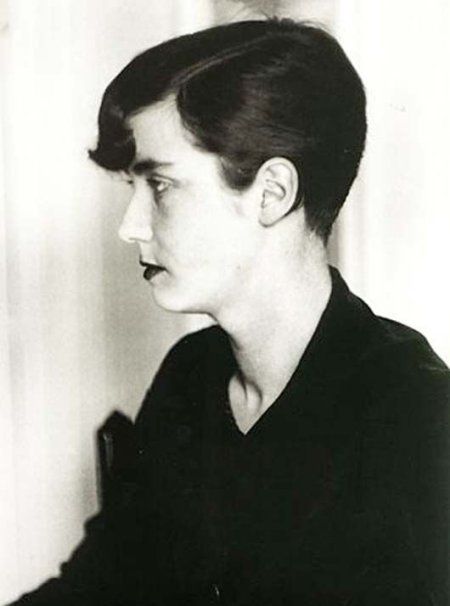
Lucia Joyce photographed by Berenice Abbott (date c.1925-1930)

On Sunday I listened to a programme on the radio about Lucia Joyce a celebrated dancer who just happened to be James Joyce’s daughter. Lucia was born in Trieste in 1907 and subsequently moved with him to Paris where she made a big impact in the field of modern dance. W.B. Yeats was an admirer and wanted to cast her in one of his `plays for dancers’.

Lucia’s early years were filled with artistic promise but shadows gathered around her and by the the middle of the 1930s she had been diagnosed with schizophrenia and was eventually taken away in a straitjacket and forcibly detained in a psychiatric clinic. She spent the rest of her life (until her death in 1982) in various institutions. The programme provides a fascinating insight into her creative early years but the latter part is desperately sad. One can’t escape the conclusion she did not deserve to be locked away the way she was (against her will) and the men in her life (her father, brother and various lovers, including Samuel Beckett) share a large part of the responsibility for her decline. Psychiatric institutions have a long history of being used to dispose of `inconvenient’ women.

Anyway, do listen to the programme which you can find here.

Bloomsday!

Posted in Literature with tags , , on June 16, 2020 by telescoper

So it’s 16th June, a very special day in Ireland – and especially Dublin – because 16th June 1904 is the date on which the story takes place of Ulysses by James Joyce. Bloomsday – named after the character Leopold Bloom – is an annual celebration not only of all things Joycean but also of Ireland’s wider cultural and literary heritage.

If you haven’t read Ulysses yet then you should. It’s one of the great works of modern literature. And don’t let people put you off by telling you that it’s a difficult read. It really isn’t. It’s a long read that’s for sure -it’s over 900 pages – but the writing is full of colour and energy. It’s a wonderful book.

(There’s also quite a lot of sex in it….)

I’ve read it twice, once when I was a teenager and once when I was in my thirties. I then lent my copy to someone and never got it back. The copy shown above is a new one I bought last year with the intention of reading the novel again now that I live in Ireland but I sadly have not had the time yet. I will, though.

Incidentally if you would like to limber up before making an attempt on Ulysses I recommend this set of short stories.

But if you don’t fancy reading it you can listen to an epic 29 hour dramatisation of Ulysses on the radio via RTÉ; see here for details.