It may be the Easter weekend, but it’s still time for a Saturday morning update of activity at the Open Journal of Astrophysics. Since the last update we have published a further four papers, bringing the number in Volume 9 (2026) to 71 and the total so far published by OJAp up to 519. This update coimpletes the first quarter of 2026, which suggests that if we continue to publish at the same rate we’ll reach about 280 for the year.
I will continue to include the posts made on our Mastodon account (on Fediscience) to encourage you to visit it. Mastodon is a really excellent service, and a more than adequate replacement for X/Twitter (which nobody should be using); these announcements also show the DOI for each paper.
The first paper to report this week is “Testing halo models for constraining astrophysical feedback with multi-probe modeling: I. 3D Power spectra and mass fractions” by Pranjal R. S. (U. Arizona, USA), Shivam Pandey Johns Hopkins U., USA), Dhayaa Anbajagane (U. Chicago, USA), Elisabeth Krause (U. Arizona) and Klaus Dolag (Max Planck Institute for Astrophysics, Germany). This paper was published on Tuesday March 31st in the folder Cosmology and Nongalactic Astrophysics.
The overlay is here:
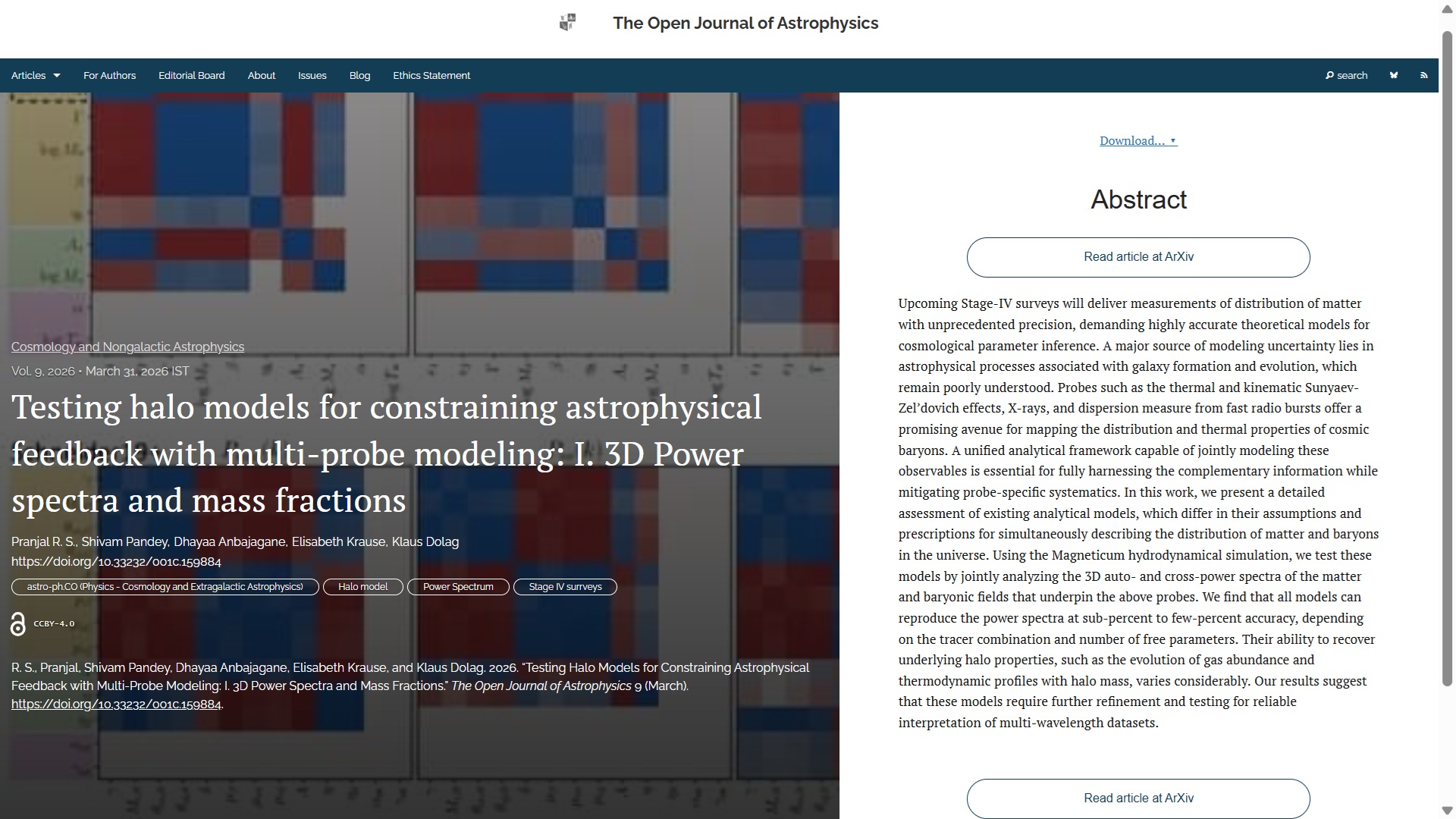
You can find the officially accepted version on arXiv here and the announcement on Fediverse here:

The second paper for this week, also published on Tuesday March 31st in the folder Cosmology and Nongalactic Astrophysics, is “Validation of the DESI-DR1 3×2-pt analysis: scale cut and shear ratio tests” by Ni Putu Audita Placida Emas (Swinburne University of Technology, Australia) and an international cast of 56 others. This study validates the combined analysis of galaxy clustering and weak gravitational lensing data from various surveys, ensuring accurate tests of the standard cosmological model using future Stage-IV surveys
The overlay for this one is here:
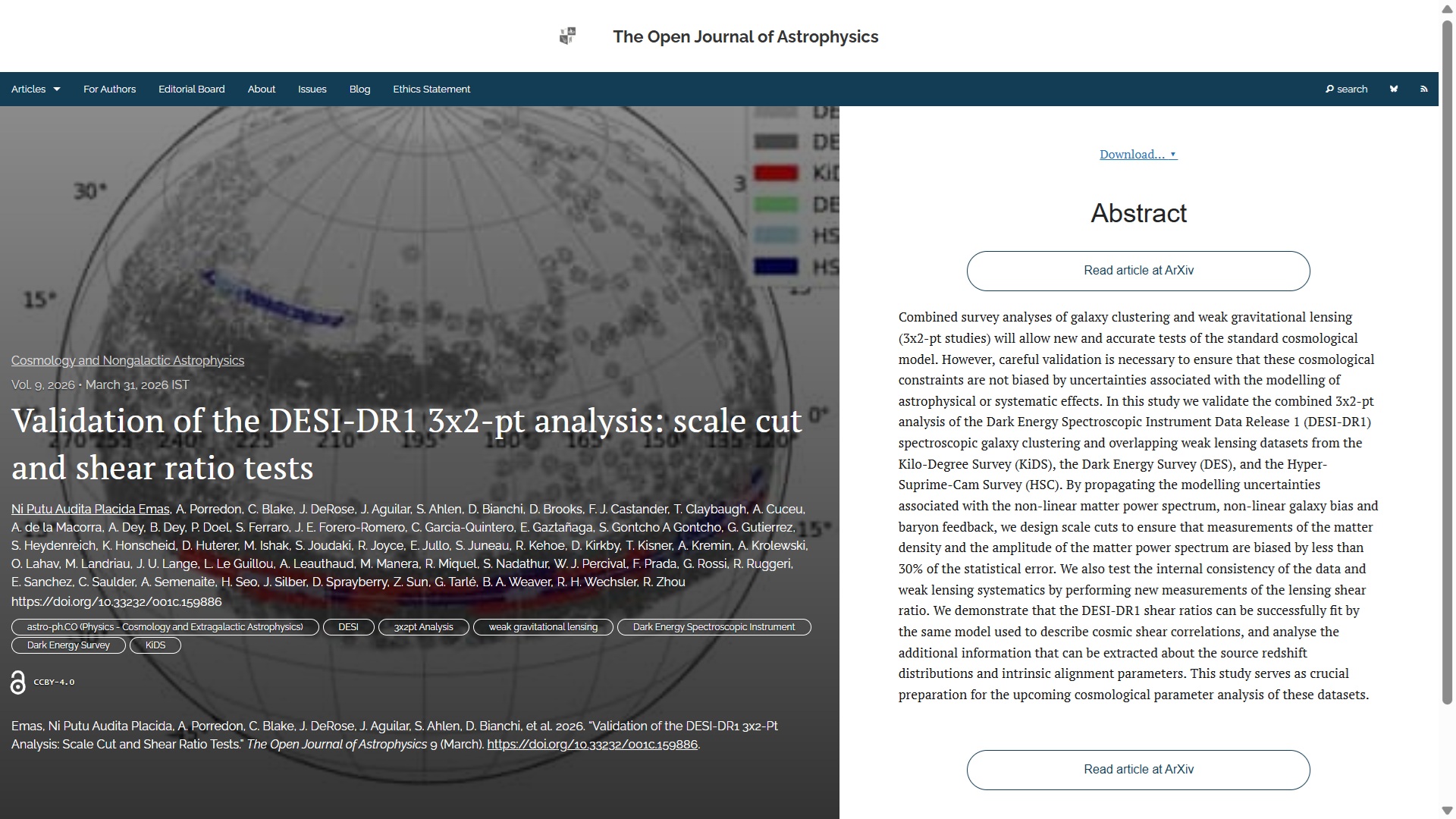
The official version of the paper can be found on arXiv here and the Fediverse announcement here:
Next one up, the third paper of the week, also published on Tuesday March 31st in the folder Cosmology and Nongalactic Astrophysics, is “Differentiable Stochastic Halo Occupation Distribution with Galaxy Intrinsic Alignments” by Sneh Pandya and Jonathan Blazek (both of Northeastern University, USA). This is a paper introducing diffHOD-IA, a differentiable model for galaxy population analysis that incorporates intrinsic alignments and halo occupation distribution. It’s validated against existing models and can be used in next-generation weak-lensing analyses.
The overlay for this one is here:
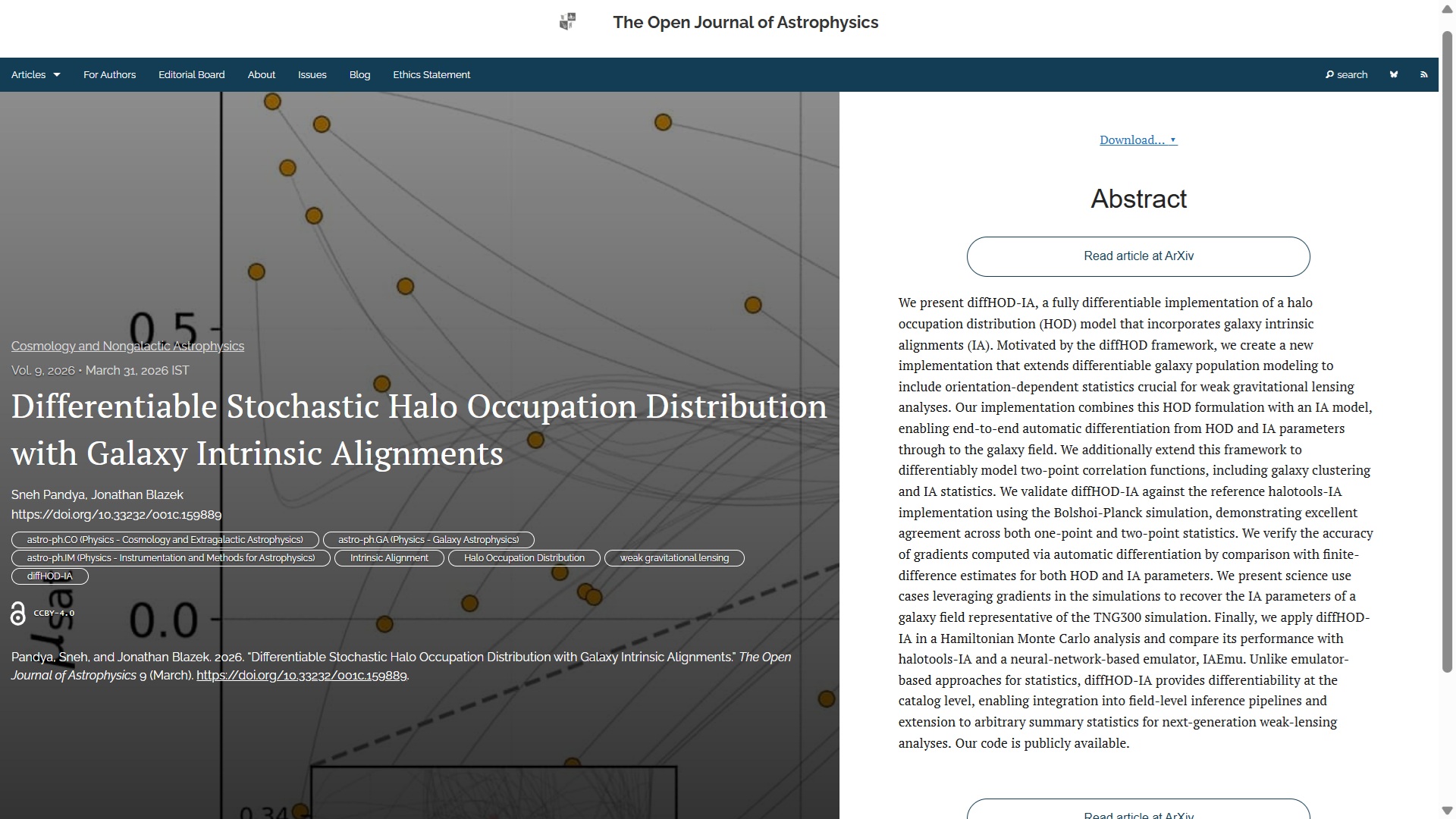
The final, accepted version can be found on arXiv here and the Mastodon announcement is here:
The fourth and final paper this week, published on Wednesday April 1st (but not a joke), is “The Growth of Dust in Galaxies in the First Billion Years with Applications to Blue Monsters” by Desika Narayanan (U. Florida, USA) and 11 others based in the USA and Europe. This one is in the folder Astrophysics of Galaxies; it presents a simulation-based study of dust accumulation in early galaxies via supernovae production and rapid growth on tiny dust grains, with local density and grain size being important factors.
The overlay is here:
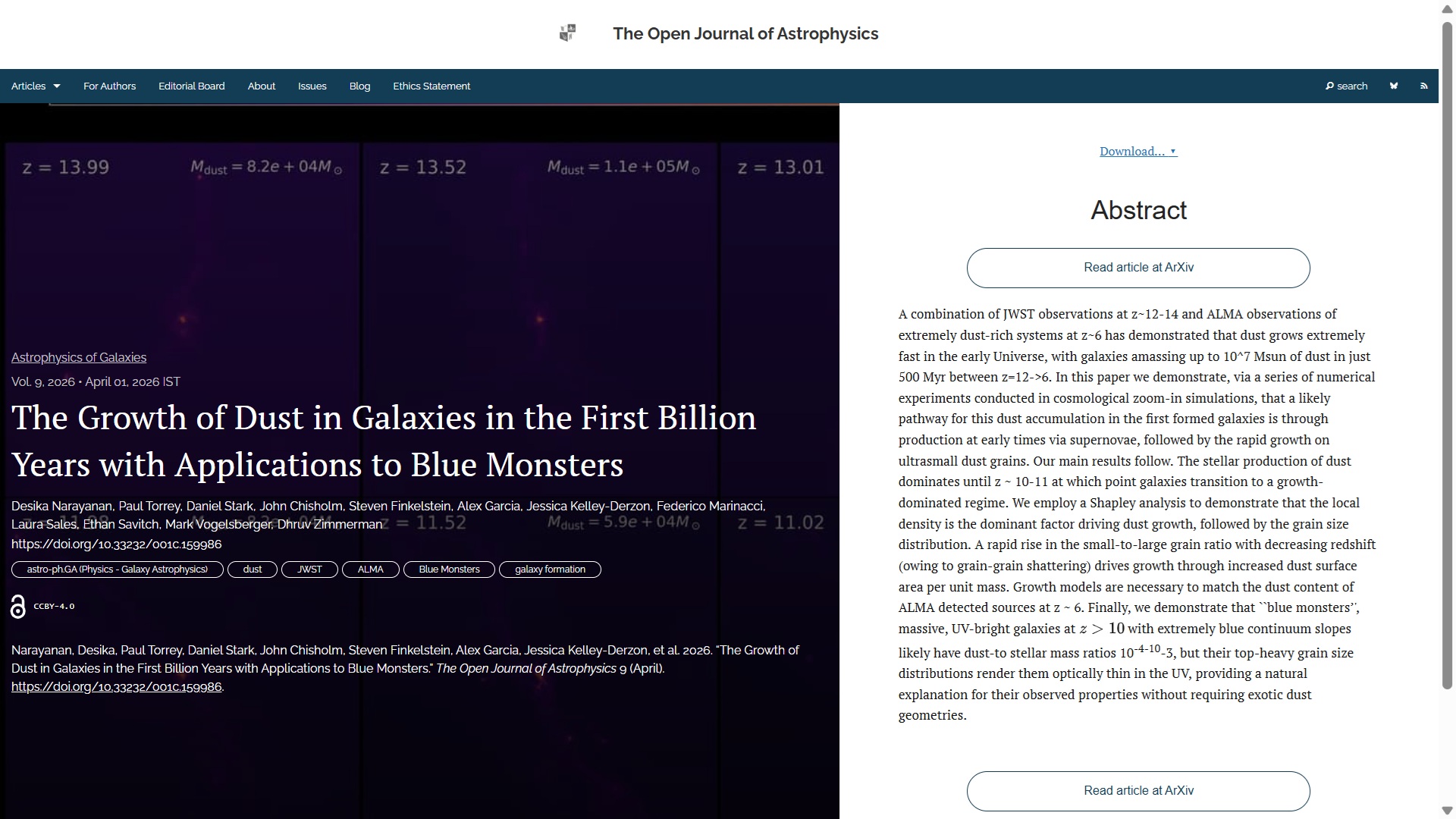
The finally accepted version of this paper can be found here and the Mastodon announcement is here:
And that concludes the update for this week. I’ll do another next week, but I’m expecting a fairly low number of papers owing to the Easter vacation.


