It’s been a busy day and I haven’t the energy for anything strenuous so I thought I’d put up a cute problem I was thinking about (for some reason) on the train home from Friday’s concert.
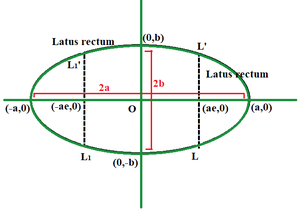
You may have to refresh your memory about units as well as the geometry of ellipses. The following picture will help:
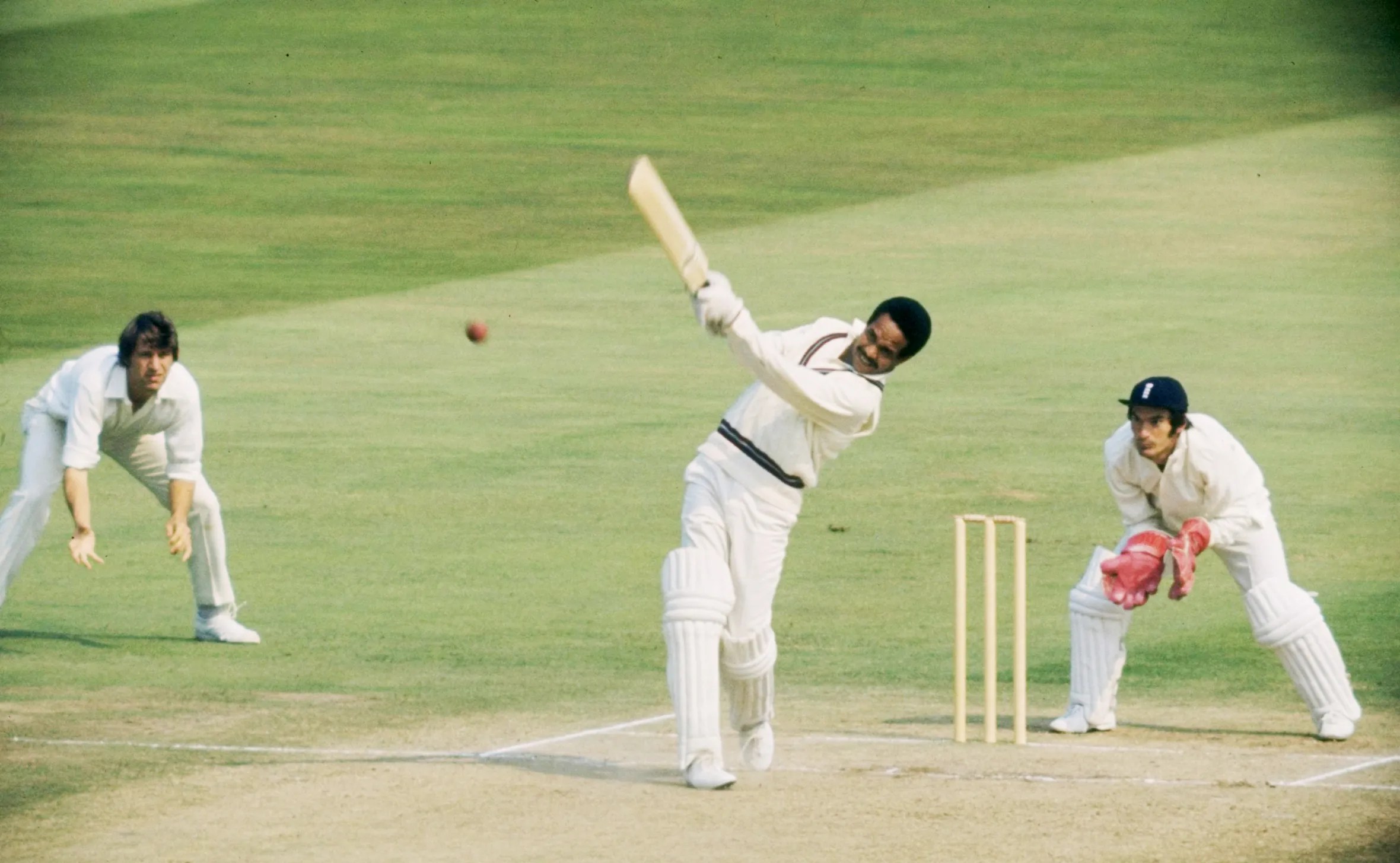
According to Kepler’s First Law of Cricket, the boundary of a cricket field is in the shape of an ellipse, with the two middle stumps each marking one of the foci. These are 22 yards apart, defining the length of the pitch P. The distance from one middle stump to the square leg or cover point boundary is 65 yards. This distance, called S, is the semi-latus rectum of the ellipse.
Derive a formula connecting the eccentricity e of the ellipse to P and S and calculate the value of e for the given values of S and P.
Calculate the major and minor axes of the ellipse for the given value of S.
Calculate the maximum distance from the stumps to the boundary for the given value of S.
Calculate the area of the playing surface in acres for the given value of S.
The value of S given above is the minimum allowed for First-class Cricket. The maximum is 90 yards. Repeat Qs 2-4 for this value of S. (P is always fixed at 22 yds.)
I’ve done quite a few posts recently about the ending of summer – the Autumnal Equinox and the start of a new Academic Year being two examples – but now we really have reached which I regard as the definite conclusion. Today was the last day of the last round of matches in the County Championship.
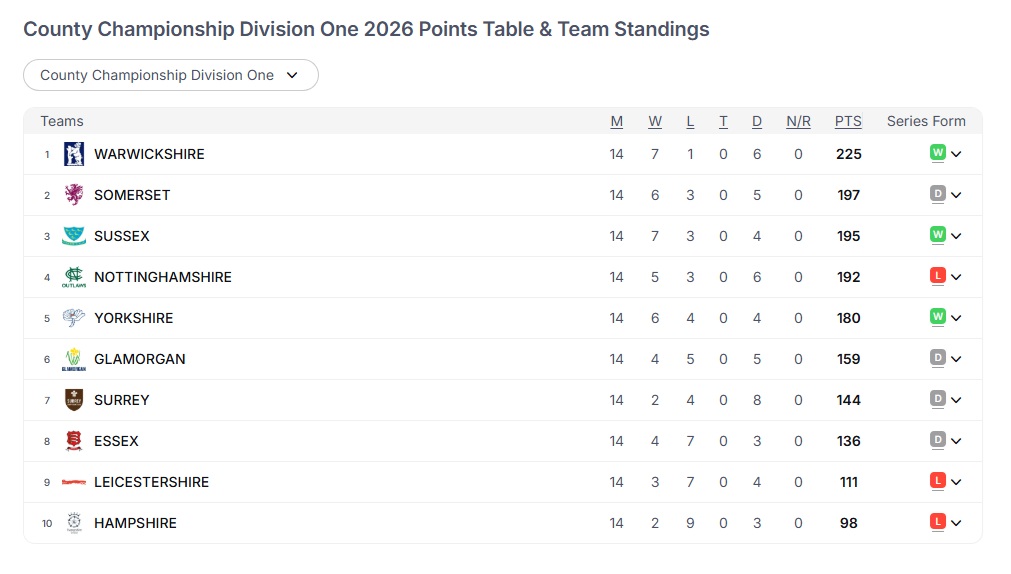
Here is the Table as it stands at the end of the last round of matches:
I haven’t followed county cricket all that closely since I moved to Ireland almost 9 years ago, but I do check the score now and then to see how Glamorgan are getting on, as I used to live quite close to the ground at Sophia Gardens in Cardiff. Glamorgan were promoted last season, for the first time in 21 years but when I wrote about that at this time last year I said that
I wouldn’t bet against them being relegated straight away, though. Last time they got promoted (in 2004) they played just one season (2005) in the First Division, during which they lost 14 of their 16 matches, and dropped back down.
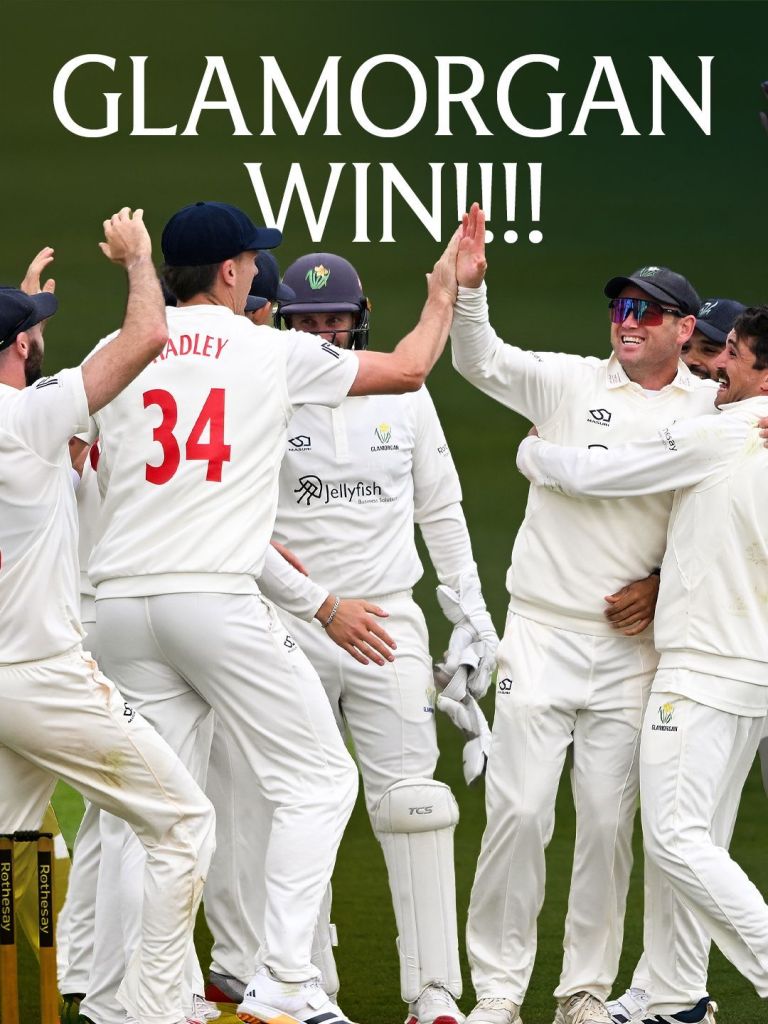
Happily, as you can see from the Table, that didn’t happen. They did have a poor run of games after the resumption of County Cricket after the dreaded Hundred, but won handsomely at the Oval last week and drew their final match in Cardiff against Essex today. They looked likely to win that game after scoring 505 in their first innings and bowling out Essex for 129. Following on, however, Essex batted with greater resilience and today the weather intervened. The whole morning was lost to rain, and when the players did take the field only 21 balls were bowled before it rained again. At that point, just after 1pm, the umpires abandoned the match as a draw with Essex on 351 for 6. That seemed a bit premature to me as the forecast for late afternoon wasn’t bad, Essex were still behind and, even if only 20 overs or so were possible, Glamorgan might well have forced a win. I assume the rain was so heavy and the ground already saturated that the umpires didn’t think a resumption was a realistic prospect, and it’s their decision not mine!
There’ll be big changes at Glamorgan next year with the retirements of three stalwarts: Billy Root (brother of the England captain), Colin Ingram, and Chris Cooke (wicketkeeper). The latter two are both in their forties, so their retirements were not unexpected, but Billy Root is only 34.
Somerset’s game against Surrey also ended in a draw today, with Somerset posting a mammoth 731 in their first innings in response to 422 by Surrey, but unable to force a win. Some of the matches finished yesterday, including Warwickshire’s innings victory against Leicestershire which made them well-deserved Champions. Last years Champions, Nottinghamshire, faded during the latter stages of the season and finished 4th.
Hapless Hampshire are relegated, but there is still an issue to be resolved about the remaining relegation place. Leicestershire were docked 27 points for a substandard pitch (in their game against Glamorgan). The 27 points comprise an 8-point penalty plus the removal of the points gained for winning that match (19). In fact the penalty for a pitch graded poor is 16 points, and the panel decided to defer 8 points to next season. Leicestershire have appealed that decision, and the points deduction is rescinded in full they will finish on 138 points so Essex will be relegated. It seems to me that the 8+8 point penalty is a direct application of the Pitch Regulations, so I’d be surprised if that part were rescinded, and even if Leicestershire get their other 19 points back they will still be relegated. We’ll have to wait and see.
Durham were runaway champions of Division 2, going the entire season unbeaten. Kent are promoted in second place.
In the end the final day was a bit of an anticlimax but since it’s now all over until next spring it seems appropriate to mark the end of the County Championship with a verse from one of the classic cricket poems, Close of Play, by Thomas Moult:
How shall we live, now that the summer’s ended, And bat and ball (too soon!) are put aside, And all our cricket deeds and dreams have blended — The hit for six, the champion bowled for none, The match we planned to win and never won? … Only in Green-winged memory they abide.
I follow the hurling more than the Gaelic football, but I did watch yesterday’s memorable All-Ireland final between Kerry and Mayo which attracted a TV audience of over a million people. Bear in mind that the population of the Republic of Ireland is just 5 million.
Kerry were strong favourites ahead of the game, but it was underdogs Mayo (who played in all-white kit) that prevailed, deservedly, by 1-20 to 1-17.
This result is huge news because it is 75 years since Mayo won the All-Ireland title – they had been beaten finalists six times since 2012, including 2020 and 2021. The last time they won was in 1951. The Mayo colours were much in evidence in Maynooth last night as people celebrated their team lifting the Sam Maguire Cup along with the lifting of the Mayo Curse. I don’t think any members of the Mayo team will be buying their own drinks for a long time!
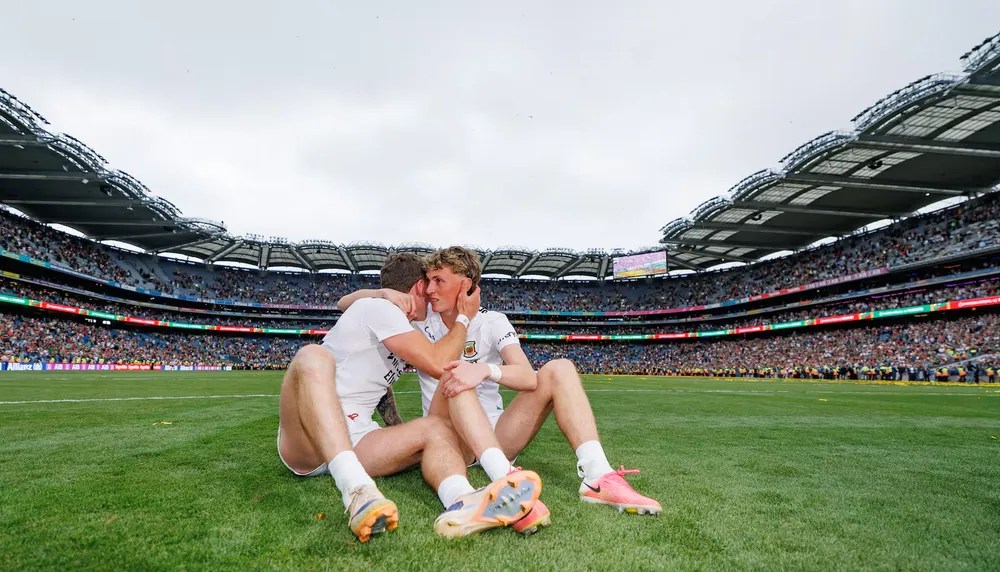
I like this very wholesome picture showing Mayo’s Jordan Flynn and Kobe McDonald on the pitch at Croke Park after the end of the game. That moment will stay with them for the rest of their lives.
Photo Credit: James Crombie/Inpho
Incidentally the Irish name for Mayo, Maigh Eo, means “Plain of the Yew Trees” and the Maigh is also responsible for the first bit of “Maynooth”.
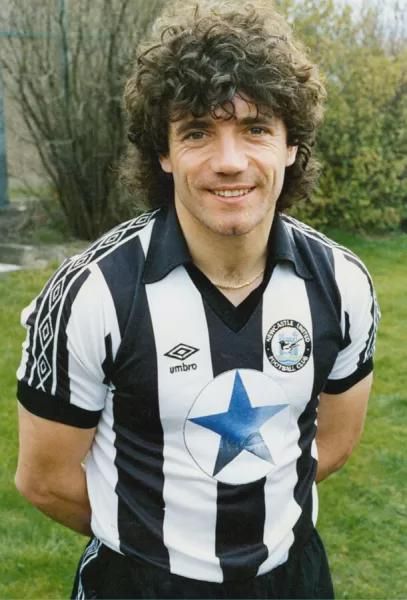
More very sad news. Kevin Keegan (left) has passed away from cancer at the age of 75. He made his reputation at Liverpool, and in Germany, but I remember him best as a player and captain of the Newcastle United team that got promotion to the (then) First Division in 1984. At that time I was a student at Cambridge and member of the local branch of the NUFC Supporters’ Club so I got to see him play quite a few times. Keegan retired from playing at the end of that season and bid an emotional farewell from St James’s Park after the final game against Brighton.
Kevin Keegan was an attacking midfielder who usually operated in the inside-right position. Very good on the ball and an excellent finisher, he was also surprisingly effective in the air. I say “surprisingly” because he wasn’t a very big man, around 5 foot 8 inches tall. After moving to Hamburg he was named European Footballer of Year for two successive years (1978 and 1979). It was quite unusual in those days for English footballers to play on the continent, but Keegan seems to have thrived there.
Later on, in 1992, he rejoined Newcastle United as manager and brought them to promotion to the Premier League. They team led for most of the 1995/6 season but ended up in second place. He had assembled a wonderful group of attacking players but the team’s defensive frailties cost them the title. Keegan had a rather fragile character, and the strain obviously got to him and thence to the players. He was never a great tactical manager – my Dad said Keegan was more of a mascot than a manager – but that team played some great football. Was that really 30 years ago?
On a more personal note, in the 1990s, my Mum was working at a school for physically handicapped children in Newcastle. One day they were visited by Kevin Keegan and some of the Newcastle players. Such PR trips were not uncommon and the staff didn’t think much of them. She didn’t care for footballers in general, but told me that Keegan was very different from most of the other visitors they got. He ignored the photographers aand the formal itinerary and just went to sit on the floor chatting with the kids around him. I never met him in person but it seems he was a genuinely nice man in private life.
P.S. Though he was born in Doncaster, “Keegan” is an Irish name. His paternal grandfather was born in Ireland and moved to Newcastle to work as a miner. He could therefore have played for Ireland rather than England.
We come to it at last. Today is the day of the greatest sporting event of the year, the day we have been waiting for, the event that the eyes of the world will be trained upon. I refer of course to the All-Ireland Senior Hurling Championship Final which takes place this afternoon at Croke Park in Dublin. Throw-in is at 3.30pm.
I’d love to experience the atmosphere of an All-Ireland final in person but it’s an impossible task to get tickets so I’ll be watching the match on TV. Here in Maynooth we get a sample however as many supporters park their cars at the GAA ground in Maynooth and take the train to Drumcondra, which is close to Croke Park. The town will be filled with fans in the green of Limerick or the maroon-and-white of Galway. There will probably more of the latter, as Maynooth is on the direct route from Galway into Dublin. The All-Ireland Final is every bit as big as the FA Cup Final used to be when I was a kid.
I was a little concerned that the Final would be played in sweltering temperatures, but it is a bit cooler today though still sunny. No rain is forecast, but the temperature will be around 21ºC with light northerly winds of about 8km/h. Close to ideal conditions, I’d say.
The bookies have Limerick strong favourites at 1/2 with Galway 5/2, but you should bear in mind that last year Cork were strong favourites, but lost to Tipperary after a stunning second-half turnaround. Holders Tipperary had a poor season this time around and didn’t make it to the knockout stages. Cork were beaten by Galway in a semi-final this year. A peculiarity of the Hurling Championship is that Galway, which is in Connacht, play in the Leinster division (because there isn’t enough competition in Connacht). Just few years ago Limerick were invincible, winning four consecutive All-Ireland finals (2020-3) but faded a bit more recently. Can they return to winning ways? We’ll see. I’ll update at half-time and full-time.
Half-Time Update: Galway 0-08 Limerick 0-13. A low-scoring game so far, with Limerick starting to exert control as half-time approached. The bad news for Galway is that they have only 2 points from play and that Limerick were playing into the wind in the first half…
Full-Time Update: Galway 1-18 Limerick 1-29. Limerick are the All-Ireland Champions! A convincing win for Limerick, who pulled away in the second half and won comfortably. Galway’s goal was scored from a penalty right at the end so was a mere consolation. The result is a repeat of the 2018 final and Limerick have now won six of the last nine All-Ireland titles.
P.S. I believe there’s some football on later too.
Update: the World Cup final was truly dreadful but the better team won in the end. No credit to Argentina for their behaviour during and after the game either.
I just heard the very sad news of the death at the age of 89 of cricketing legend Sir Garfield (“Garry”) Sobers. He was a superb player, a genuine all-rounder. With the bat he was an extraordinary attacking strokeplayer, being the first to hit six sixes in an over (for his adopted county, Nottinghamshire, against Glamorgan in 1968.
I know there’s more than a suspicion that the dropped catch off the 5th ball might have been deliberate, but still…
When I lived in Nottingham my next door neighbour had many memories of Garry Sobers. He was fond of the nightlife, and also liked to bet on the horses. As a captain Sobers was also a bit of a gambler, often making very generous declarations. It didn’t always come off, but it sure made for exciting cricket.
Sobers’s maiden test century against Pakistan turned into a mammoth 365 not out. His batting average in 93 test matches was 57.78, a number that a specialist bat would be proud of. But he was also a superb bowler with the knack of getting good batsmen out, usually with his fast left-arm inswingers bowled over the wicket. Here is an example of him getting Geoffrey Boycott out. He always seemed to enjoy doing that. It’s a low resolution clip, but just look at the swing!
Of that delivery, which got him out lbw, Boycott later said “It was missing off, missing leg, and hitting middle halfway up”. You can tell he knew he was out. (When I played cricket at school I never figured out to bat aginst left-arm over the wicket bowlers even if they didn’t swing…). Sobers was also an adept left-arm spin bowler, who could bowl orthodox but was also adept at the Chinaman (a term for left-arm wrist spin that has fallen into disuse in recent years, but was common in my youth). I should also mention that he was an exceptional fielder too at a time before one-day cricket increased the general level of fielding.
I genuine all-rounder who reaches the level of international excellence at both batting and bowling is very rare in cricket. Most all-rounders are either bowlers who can bat a bit or batters who can bowl a bit. Sobers was the only one in his generation who was great at both. Cricket was fortunate later, from the late 70s to the 80s, to have three four at the same time: Ian Botham (England), Kapil Dev (India), Richard Hadlee (New Zealand) and Imran Kahn (Pakistan). But Sobers was probably the greatest of them all.
I have found this a very disappointing weekend in many respects for sports. Two Irish rugby teams (Ulster and Leinster) both lost their cup finals against French opposition (Montpellier and Bordeaux in the Challenge Cup and Champions Cup, respectively). Glamorgan’s cricketers lost their first two Twenty20 games of the season (both narrowly). And today’s last round of matches in the English Premier League saw Newcastle lose, an outcome made worse by the fact that Sunderland won.
At least however there was an opportunity to enjoy Ireland’s greatest spectator sport (after hurling, of course): the counting of votes in an election. Friday saw two by-elections, one because of the resignation of Paschal Donohoe (FG) from his seat in Dublin Central in order to take a lucrative job at the World Bank, and the other vacated by Catherine Connolly whose seat in Galway West became vacant when she took on the role of President. Neither of these are constituencies in which I could vote, but it was fun watching the results come on.
These elections, like all elections in Ireland, were held under a system of Proportional Representation (Single Transferable Vote). The constituences return multiple members in a General Election, but in the case of a by-election only one candidate is elected. This simplifies matters a bit because the part of the process that involves transferring surplus votes from candidates who exceed quota is not needed. Voters rank the candidates in order of preference with votes progressively reallocated as the lowest-ranked candidates are eliminated. You can rank all the candidates or just some. In the system employed here one ranks the candidates in order of preference with votes progressively reallocated in various rounds until one ends up with one winner.
There was also the presence of gang leader Gerard Hutch among the candidates in Dublin Central, but in the end he didn’t put up a serious challenge.
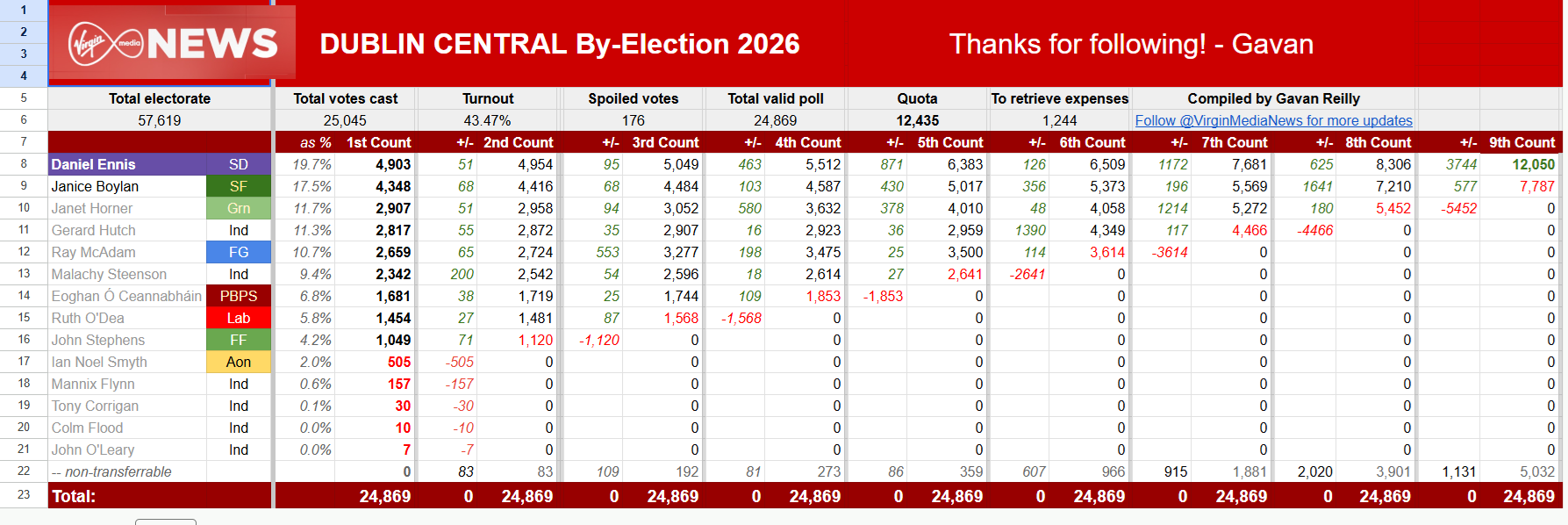
Opinion polls gave Sinn Féin’s Janice Boylan a narrow lead on first preferences, but since SF are notoriously transfer-unfriendly, I was very confident that lead would be overturned by Daniel Ennis of the Social Democrats. As it turned out, however, Ennis actually led on first preferences which confirmed me in my opinion that he would win. This is how the transfers panned out.
Ennis won comfortably, and John Stephens of Fianna Fáil gaining the distinction of getting the lowest share of first preference votes that his party has ever recorded in an election. There are some bizarre transfers, e.g. from the left-wing PBP (People Before Profit) to Fine Gael. Other than that the outcome was as predicted.
Not long ago Sinn Féin were riding high in the polls and might have expected to win a seat here, especially since Mary Lou McDonald, the Sinn Féin leader, holds a seat in Dublin Central, but their popularity has slumped. I think that’s primarily because they have recently lurched to the right – rather like UK Labour has – and many who want a genuinely progressive alternative to the crumbling neoliberal consensus have decided that they can’t support SF which puts on the mask of a progressive party when it suits them but are quick to remove it when chasing the right-wing vote. Mary Lou McDonald is quoted as saying that there is ‘no confusion’ for voters about whether her party was left-wing or right-wing. I think she is correct there, but perhaps not in the way she intended…
A genuinely left-wing party of the size of Sinn Féin should be building coalitions and knocking at the door to power, but instead it has squandered its position by pandering to anti-immigrant sentiment, jumping on the bandwagon of the recent “fuel protests” and signing up to transphobic policies in Northern Ireland. I don’t understand why they have chosen this path, but it looks very foolish to me. I’m not the only one to think this. Is Morgan McSweeney now working for Sinn Féin?
As I write, the count in Galway West is still going on but it has come down to a contest between two unpalatable right-wing candidates so I’m not following it as closely. Oh, the Fine Gael candidate has won.
So here I am, back home in Maynooth after a long weekend away in Not Maynooth. The weather forecast for Maynooth was typically dreadful for a Bank Holiday weekend but I have to say I can’t sign see much sign of the heavy rain that was predicted.
On the way back I checked the cricket scores and discovered that Glamorgan won their County Championship game against Hampshire by an innings and 69 runs. That’s worth marking on this blog because it is their first win in Division One since 2005. Historic. Their first three games this season ended in a defeat and two draws, so it was 4th time lucky. Well played to them!
Anyway the last four days of teaching term beckon, including a 9am lecture tomorrow morning, so I had better leave it at that and try to get into a work frame of mind.
Most readers of this blog will be aware of the existence of Venn Diagrams, but not a lot of people know that their creator, John Venn, invented a mechanical bowling machine for use by cricketers in batting practice. Recently some folks at Cambridge University built a replica of this machine, presumably with the aid of some sort of diagram, and here’s a fascinating video about it.
Modern bowling machines fire the ball at you like a cannon, but this machine has the virtue of the batter being able to see the arm coming over which must help a little. This creation is also able to impart quite a bit of spin, in either direction but it looks like it should be quite easy to pick. The examples shown in the video also demonstratte that batting is only partly about hand-eye coordination – a key element is how to move your feet!
The views presented here are personal and not necessarily those of my employer (or anyone else for that matter).
Feel free to comment on any of the posts on this blog but comments may be moderated; anonymous comments and any considered by me to be vexatious and/or abusive and/or defamatory will not be accepted. I do not necessarily endorse, support, sanction, encourage, verify or agree with the opinions or statements of any information or other content in the comments on this site and do not in any way guarantee their accuracy or reliability.