Author Archive

Is it a truth universally acknowledged?

Posted in Literature with tags , , , on January 15, 2024 by telescoper

For reasons that may or may not be revealed shortly, I am currently re-reading the novel Pride and Prejudice by Jane Austen:
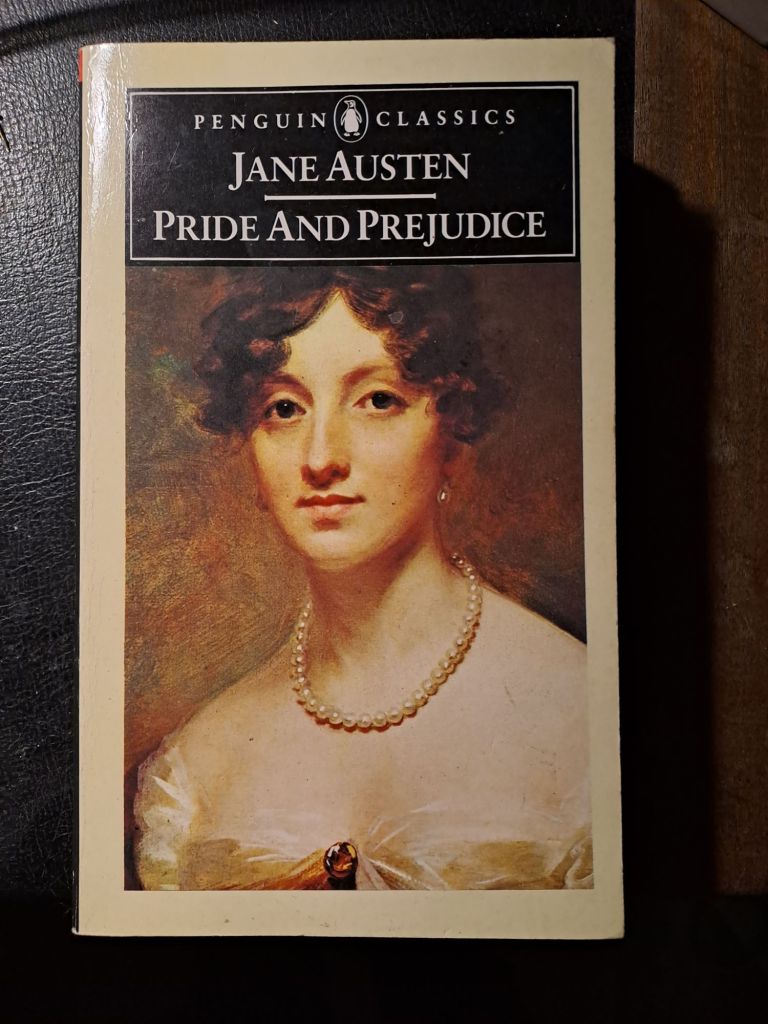
My old copy of Pride and Prejudice, dated 1986.

Among many other things, this has one of the most famously ironic opening lines in all English literature:

It is a truth universally acknowledged that, that a single man in possession of a good fortune must be in want of a wife.

I recently came across this discussion of this sentence by the philosopher Ludwig Wittgenstein, which I thought it would be amusing to share:

Let us ask what it is when we say “It is a truth universally acknowledged” that something is the case. Isn’t this a queer thing to say? How can we possibly understand it? At first sight it may appear that “it” is simply the something that is the case (ie that a man possessed of a certain degree of wealth will always feel the lack, or perhaps, without feeling it, be in need, of a wife). This “it”, however, can be no more than a pronominal anterior reference to the “truth” that is being claimed, without as yet there being any evidence for it, even though it is later stated to be acknowledged as a truth by everyone. In such a case it seems to us that the truth has been claimed a priori, since nothing can be acknowledged until it is proposed, although once proposed, such a supposed truth may be further tested through opinion and behaviour. Consider the much simpler proposition: “A man in possession of a good fortune must be in want of a wife”. We might reply “How do you know?”, a response that immediately raises the idea of possible exceptions to such a generalisation, such as (among other more complex forms of exception) that he may have a wife already, or may be a secret lover of men. To claim universal acknowledgement of a truth is to claim that a probable “truth” is undeniably true, which can be no more than a specious tautology. Moreover, as we have seen, the “it” with which we began has already laid claim to the existence of something (a kind of truth, as it soon turns out) that can only be assumed through this insistent and superfluous pronoun, which is a form of private acknowledgement by the speaker alone, and is by no means obviously universal. That this “it” is true, and that truth is also true, is what is being claimed here, and the double tautology becomes a distinct puzzle. To be induced to assent to an “it”, when there may be ample reason to doubt its very relation to the proposition which follows, is to be invited not to understand it.

I hope this clarifies the situation.
The Big Ring Circus

Posted in Astrohype, Bad Statistics, The Universe and Stuff with tags , , , , on January 15, 2024 by telescoper

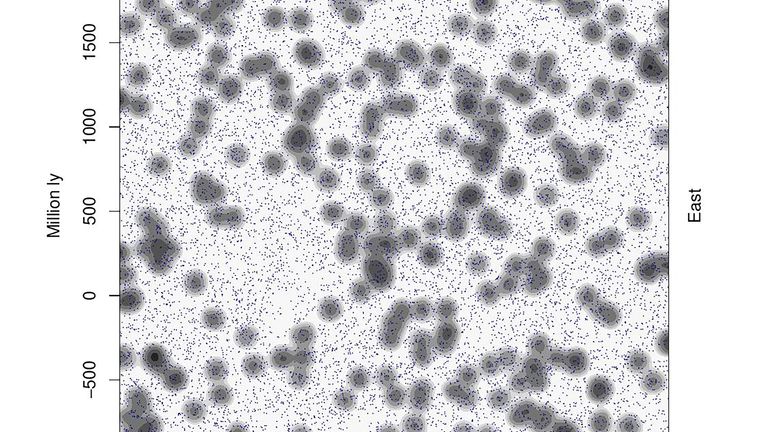
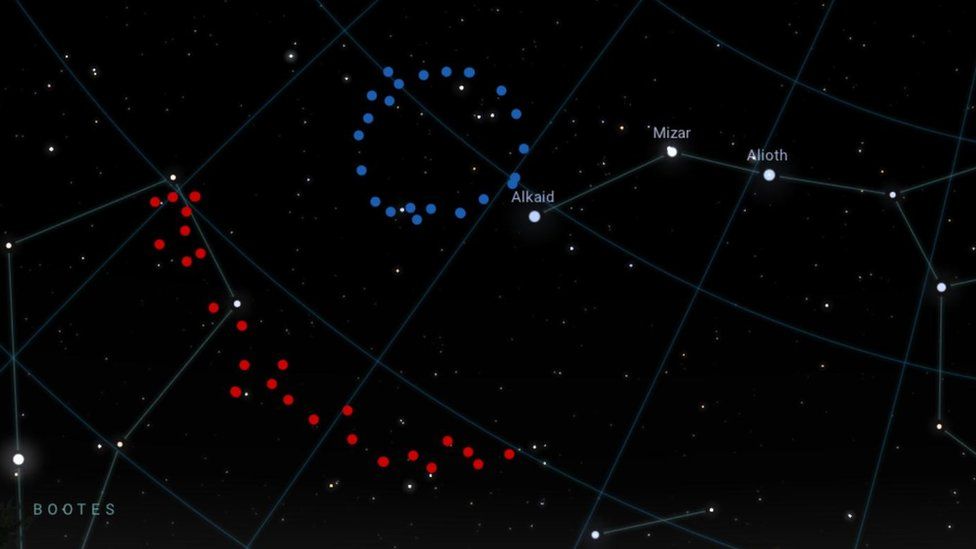
At the annual AAS Meeting in New Orleans last week there was an announcement of a result that made headlines in the media (see, e.g., here and here). There is also a press release from the University of Central Lancashire.

Here is a video of the press conference:

I was busy last week so didn’t have time to read the details so refrained from commenting on this issue at the time of the announcement. Now that I am back in circulation, I have time to read the details, but unfortunately was unable to find even a preprint describing this “discovery”. The press conference doesn’t contain much detail either so it’s impossible to say anything much about the significance of the result, which is claimed (without explanation) to be 5.2σ (after “doing some statistics”). I see the “Big Ring” now has its own wikipedia page, the only references on which are to press reports, not peer-reviewed scientific papers or even preprints.

So is this structure “so big it challenges our understanding of the universe”?

Based on the available information it is impossible to say. The large-scale structure of the Universe comprises a complex network of walls and filaments known as the cosmic web which I have written about numerous times on this blog. This structure is so vast and complicated that it is very easy to find strange shapes in it but very hard to determine whether or not they indicate anything other than an over-active imagination.

To assess the significance of the Big Ring or other structures in a proper scientific fashion, one has to calculate how probable that structure is given a model. We have a standard model that can be used for this purpose, but to simulate very structures is not straightforward because it requires a lot of computing power even to simulate just the mass distribution. In this case one also has to understand how to embed Magnesium absorption too, something which may turn out to trace the mass in a very biased way. Moreover, one has to simulate the observational selection process too, so one is doing a fair comparison between observations and predictions.

I have seen no evidence that this has been done in this case. When it is, I’ll comment on the details. I’m not optimistic however, as the description given in the media accounts contains numerous falsehoods. For example, quoting the lead author:

The Cosmological Principle assumes that the part of the universe we can see is viewed as a ‘fair sample’ of what we expect the rest of the universe to be like. We expect matter to be evenly distributed everywhere in space when we view the universe on a large scale, so there should be no noticeable irregularities above a certain size.

https://www.uclan.ac.uk/news/big-ring-in-the-sky

This just isn’t correct. The standard cosmology has fluctuations on all scales. Although the fluctuation amplitude decreases with scale, there is no scale at which the Universe is completely smooth. See the discussion, for example, here. We can see correlations on very large angular scales in the cosmic microwave background which would be absent if the Universe were completely smooth on those scales. The observed structure is about 400 Mpc in size, which does not seem to be to be particularly impressive.

I suspect that the 5.2σ figure mentioned above comes from some sort of comparison between the observed structure and a completely uniform background, in which case it is meaningless.

My main comment on this episode is that I think it’s very poor practice to go hunting headlines when there isn’t even a preprint describing the results. That’s not the sort of thing PhD supervisors should be allowing their PhD students to do. As I have mentioned before on this blog, there is an increasing tendency for university press offices to see themselves entirely as marketing agencies instead of informing and/or educating the public. Press releases about scientific research nowadays rarely make any attempt at accuracy – they are just designed to get the institution concerned into the headlines. In other words, research is just a marketing tool.

In the long run, this kind of media circus, driven by hype rather than science, does nobody any good.

P.S. I was going to joke that ring-like structures can be easily explained by circular reasoning, but decided not to.

The Club Records

Posted in Biographical with tags , , on January 14, 2024 by telescoper

At the R.A.S. Club on Friday I was presented with the latest edition of the Club Records which covers the last 40 years; the Club itself began in 1820. Friday’s dinner was No. 1571, and there are five volumes of records containing lists of everyone who attended each dinner along with descriptions of notable events and a diagram showing who sat next to whom. I only just got the book because pandemic travel restrictions and other matters prevented me from dining much recently.

For the record, I was elected to the Club at the Parish Dinner on 11th January 2008 (Dinner No. 1448) but wasn’t able to dine until October that year (Dinner No. 1453). According to the records I have now dined 60 times (including last Friday). I wonder if I’ll make it to 100?

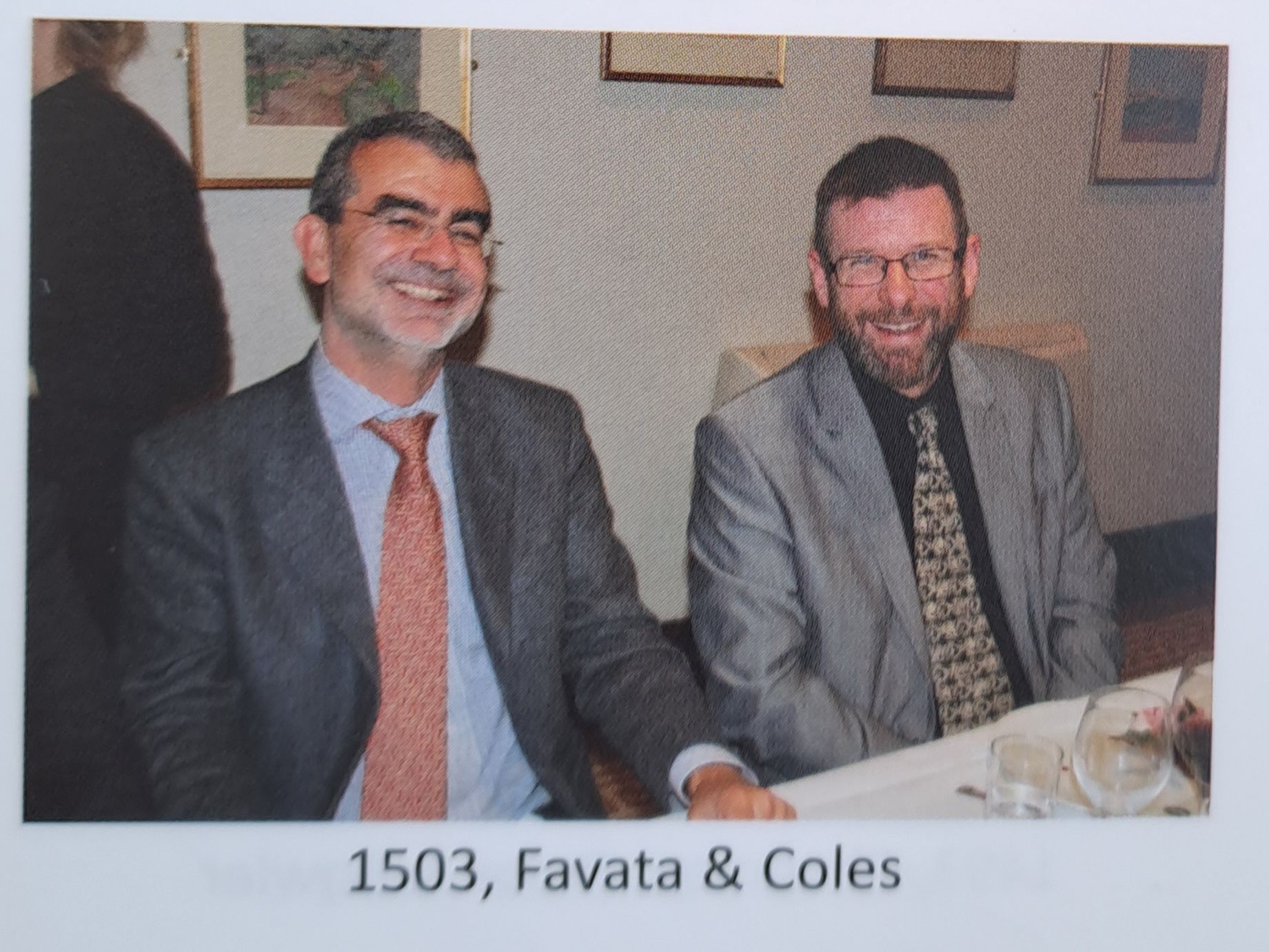
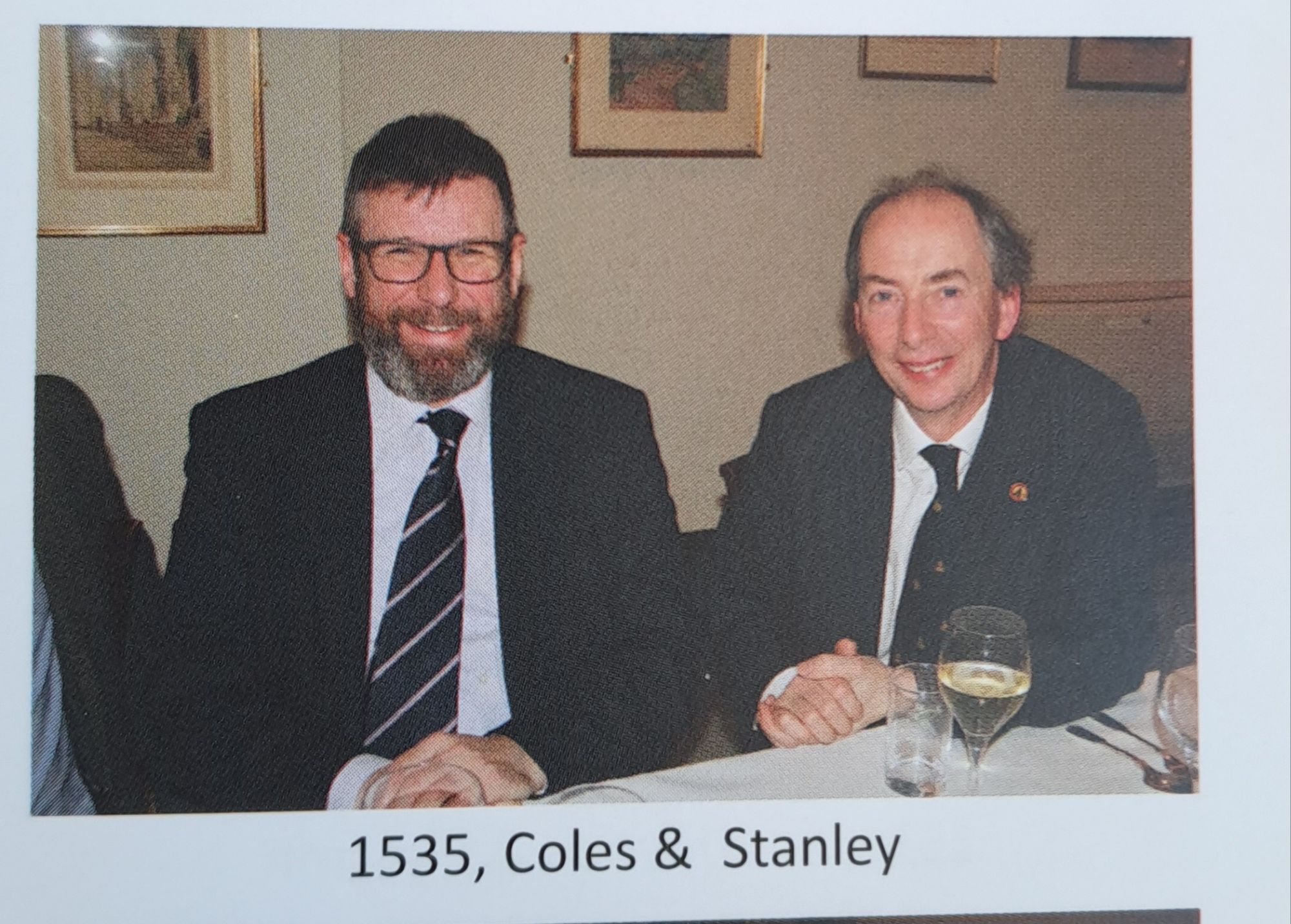
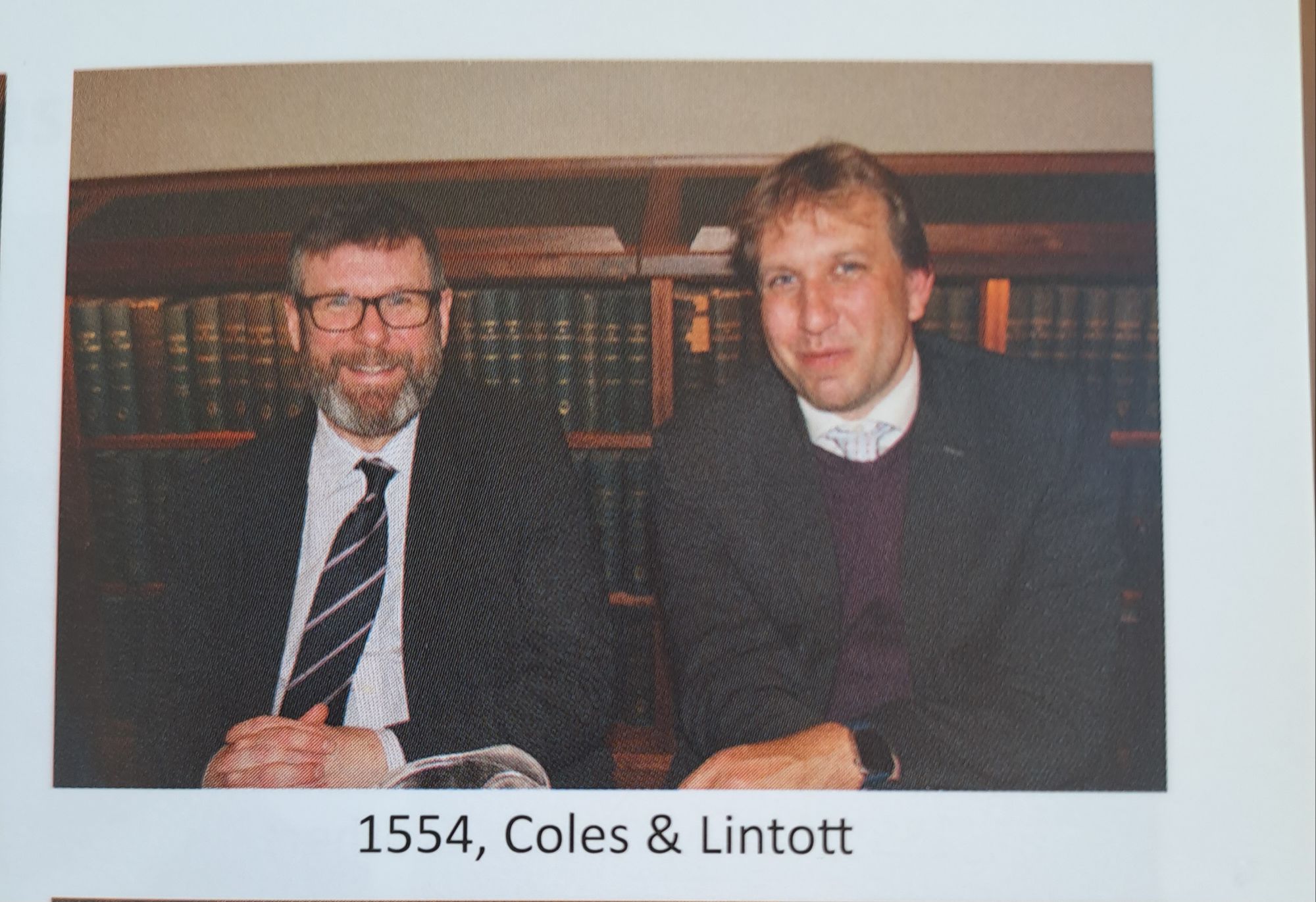
Anyway, here is a selection of pictures taken at Club Dinners past with various other members:

These pictures remind me that I should perhaps consider wearing some different ties in future!

From London

Posted in Biographical with tags , , on January 13, 2024 by telescoper

Here I am in Heathrow Airport waiting for a flight after a couple of days in London.

Every time I visit London it becomes harder to believe that I actually lived there years ago. On Thursday evening I took a stroll around Soho and walked past this place…

I used to be a member at Ronnie Scott’s and spent many late nights there back in the day. It must be about 25 years since I last set foot inside. I must go again for old times’ sake, but I didn’t have time on this trip.

Yesterday (Friday) was a very busy day, but a pleasant one. I spent the morning at a discussion meeting about Simulation based Inference in Astrophysics at which I learnt a lot. I didn’t attend the whole meeting however as I had to take some time out in the afternoon to do other things. I also met up with a couple of people I haven’t seen in person for a while, only to find out later that they both won Royal Astronomical Society Awards. Congratulations, then, to Pedro Ferreira on his Eddington Medal (Pedro is a member of the Editorial Board of the Open Journal of Astrophysics) and Sarah Kendrew for her part in the Team Award given to the MIRI instrument team for JWST.

After that I went to the “Parish Dinner” of the RAS Club at the Travellers in Pall Mall, which is the occasion when new members are elected by an arcane process defined by some truly bizarre rules. Somehow, though, the outcome turned out fine.

Anyway, I’ll soon be en route to a different part of not-Barcelona, so I think I’ll stretch my legs before the flight.

Impressionists on Paper

Posted in Art with tags , , on January 11, 2024 by telescoper
At the Royal Academy until March 10th

Having arrived in that London I thought I’d check out a nice little exhibition at the Royal Academy called Impressionists on Paper. As its name suggests, this is a collection of drawings, sketches, and studies done with charcoal, pencil pastels, and occasionally watercolours, all done on paper. The artists involved cover the spectrum from Degas to Toulouse-Lautrec. My favourite is the study by Seurat that became part of a very famous painting but which is wonderful in its own right.

New Publication at the Open Journal of Astrophysics

Posted in OJAp Papers, The Universe and Stuff with tags , , , on January 11, 2024 by telescoper

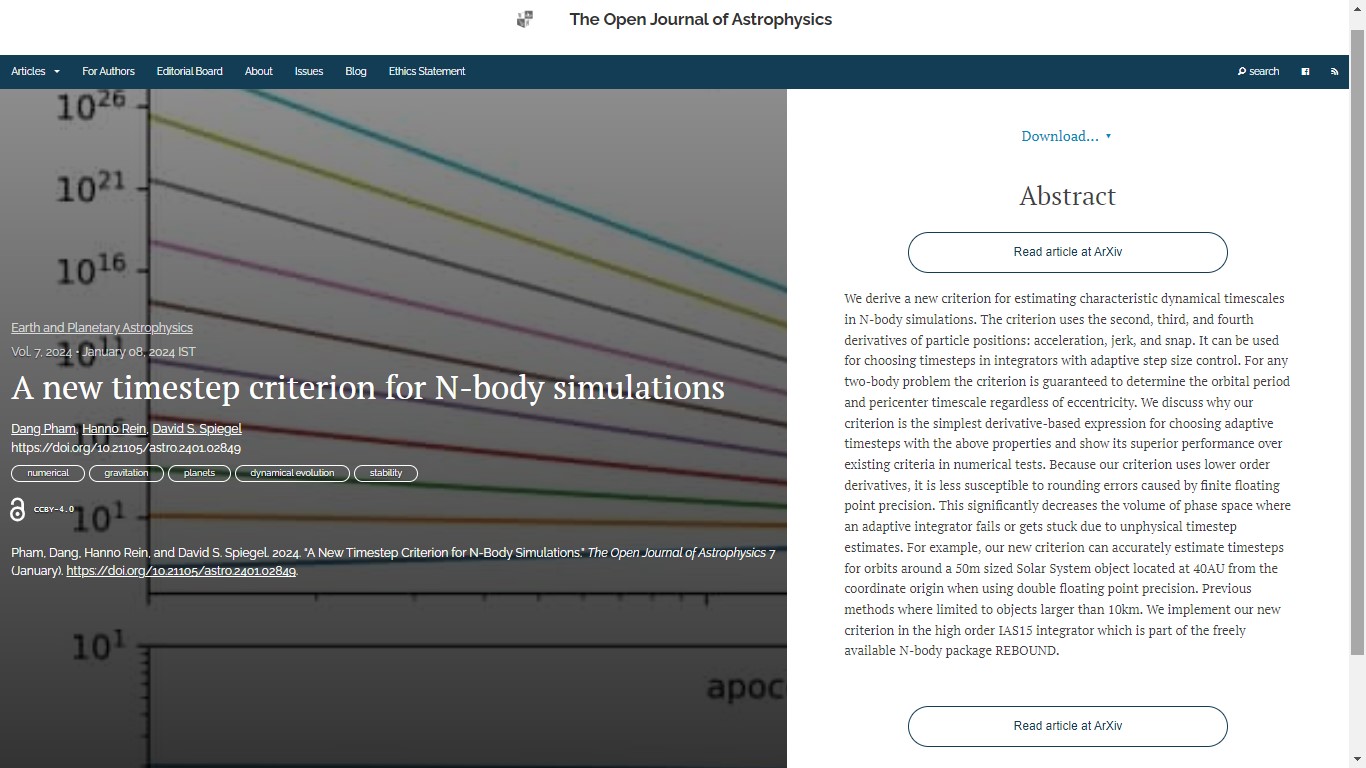
Well, it’s 2024 and time to start a new volume – the seventh – of the Open Journal of Astrophysics with the very first paper of the new year. The paper in question is the 1st paper in Volume 7 (2024)  and the 116th altogether. This one was published on 8th January 2024.

The title is “A new timestep criterion for N-body simulations” and it presents a new method for estimating characteristic dynamical timescales in N-body simulations, based on derivatives up to fourth order, which can be used to adjust timesteps used in numerical computations. The paper is in the folder marked Earth and Planetary Astrophysics as the paper discusses applications to orbital dynamics in planetary systems, but the method is of much wider applicability.

The authors are Dang Pham & Hanno Rein  (University of Toronto, Canada) and David S. Spiegel (Google, USA).

Here is the overlay of the paper containing the abstract:


You can click on the image of the overlay to make it larger should you wish to do so. You can find the officially accepted version of the paper on the arXiv here.

New Dark Energy Survey Supernovae Results

Posted in The Universe and Stuff with tags , , , , , , , on January 10, 2024 by telescoper

Some important cosmological results have just been announced by the Dark Energy Survey Collaboration. I haven’t had time to go through them in detail but I thought it was worth doing a quick post here to draw attention to them. The results concern a sample of Type Ia supernovae (SN Ia) discovered during the full five years of the Dark Energy Survey (DES) Supernova Program, which contains about 1500 new Type Ia Supernovae that can be used for cosmological analysis. The paper is available on the arXiv here; the abstract is:

The key numerical result of interest is the equation-of-state parameter for dark energy, designated by w, which occurs in the (assumed) relationship between pressure p and effective mass density ρ  of the form p=wρc2. A cosmological constant – which for many cosmologists is the default assumption for the form of dark energy – has w=-1 as I explained here. This parameter is one of the things Euclid is going to try to measure, using different methods. Interestingly, the DES results are offset a bit from the value of -1, but with quite a large uncertainty.

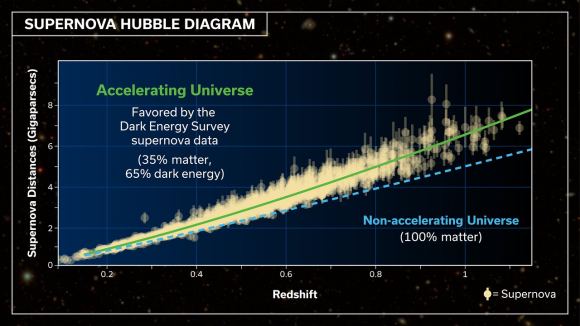
While the results for the equation-of-state parameter are somewhat equivocal, one thing that is clear is that the new SNIa measurements do confirm the existence of dark energy, in that the data can only be described by models with accelerating expansion, as dramatically demonstrated in this Figure:

I think this figure – or versions of it – will very rapidly appear in public talks on cosmology, including my own!

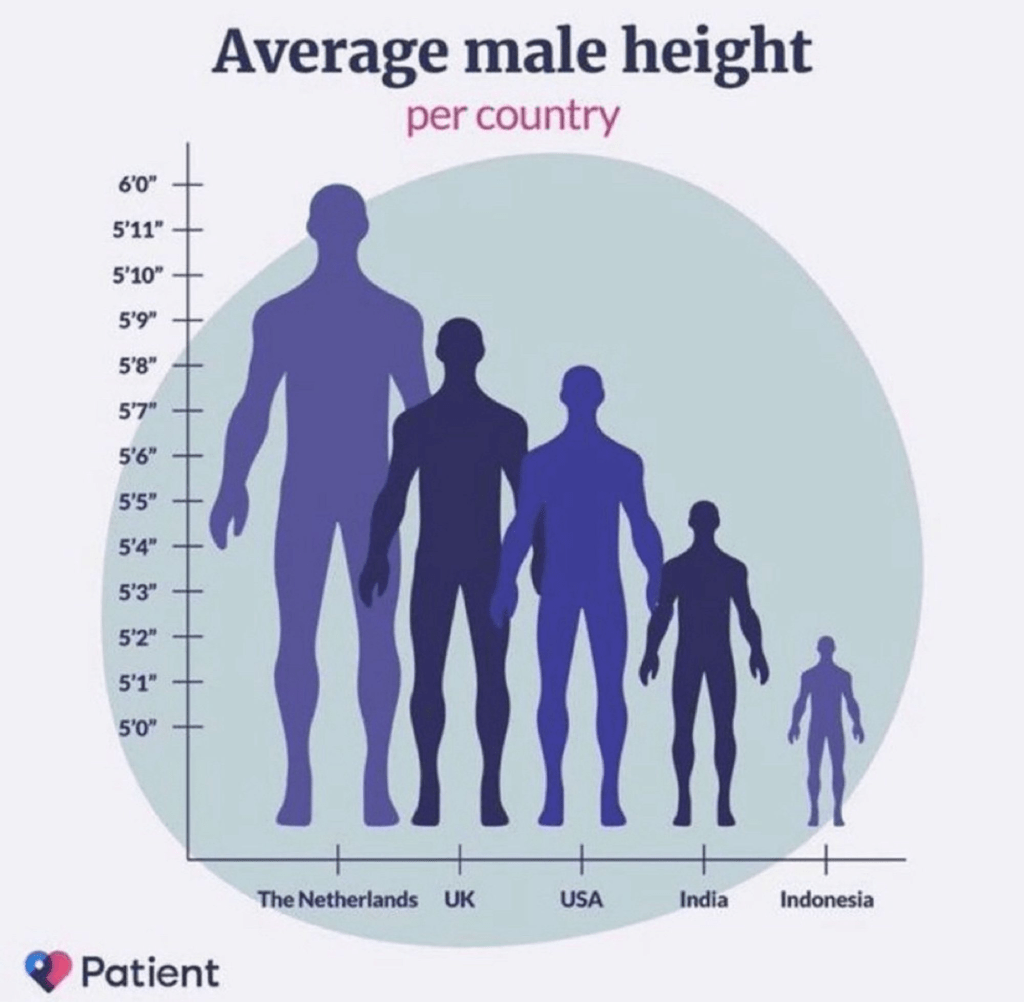
How not to do data visualisation…

Posted in Bad Statistics on January 9, 2024 by telescoper

How many things are wrong about this graphic?

R.I.P. John Peter Rhys (“JPR”) Williams (1949-2024)

Posted in Biographical, Cardiff, R.I.P., Rugby with tags , , , , , , on January 9, 2024 by telescoper

A cold and miserable day in Cardiff yesterday got even sadder when news came out of the death of Welsh rugby legend John Peter Rhys Williams known universally as “JPR” after the winger John James Williams (another great player), joined the national team and became “JJ”. JPR was one of the superb players who dominated Welsh rugby in the 1970s; he stood out even in such exalted company. In my opinion JPR is was the greatest full-back ever.

JPR was instantly recognizable on the field: tall and craggy, with characteristic long hair, prominent sideburns, socks always rolled down around his ankles, he was an imposing figure whether patrolling the defensive lines or stepping up to join the attack. In the famous 1973 match in Cardiff between The Barbarians and New Zealand he was described by commentator Cliff Morgan as “a man who never shirks his responsibility”. Just watch the memorable opening try where you’ll see JPR in the thick of the action, twice shrugging off dangerous tackles around his neck, the second time receiving the ball from Phil Bennett to start the passing move from deep inside his own half.

Many people forget that the man himself scored a great try in that game too:

(Note the involvement of David Duckham in that move; he passed away just a year ago.)

As a full-back, JPR was often the last line of defence. Sometimes, tidying up after a kick from the opposition, he would clear his lines by kicking. More often, though, he would spot a weakness and go charging forward, ball in hand, not afraid to run straight at the opposition. He was quick to spot gaps in his own defence too, rushing to provide cover, often with last-ditch try-saving tackles.

As good as he was at turning defence into attack, he was even better when his side were already in control. Here are two tries he scored for Wales against England in 1976 that demonstrate his superb positional sense in attack as well as his sheer physical strength.

(Wales achieved a Grand Slam in 1976; England got the Wooden Spoon.)

JPR was a tough, aggressive and uncompromising man on the field – players certainly knew when he’d tackled them! – but a gentleman off it, and held in a very high regard throughout the rugby world and beyond. His loss is immeasurable. One by one the legends are leaving us. The world is poorer without them.

Rest in peace, J.P.R. Williams (1949-2024)

P.S. When living in Cardiff years ago I had the pleasure of meeting and talking with two Welsh rugby legends, Gerald Davies and Phil Bennett (the former at a function, the latter at a book-signing). Both were charmingly modest men. I never really met JPR properly but I remember vividly stepping out of my house in Pontcanna on a Six Nations match day and finding myself face-to-face with him in the street. He must have been around 60 then and was still the same imposing figure he was in the 1970s. I recognized him immediately. I wanted to say something and perhaps even shake his hand, but I was too star-struck.

P.P.S. JPR was a fully-qualified orthopaedic surgeon and a Fellow of the Royal College of Surgeons. This is a reminder that back in the 1970s, Rugby Union was still an amateur game.

Cold Cardiff

Posted in Biographical, Bute Park, Cardiff, Uncategorized on January 8, 2024 by telescoper

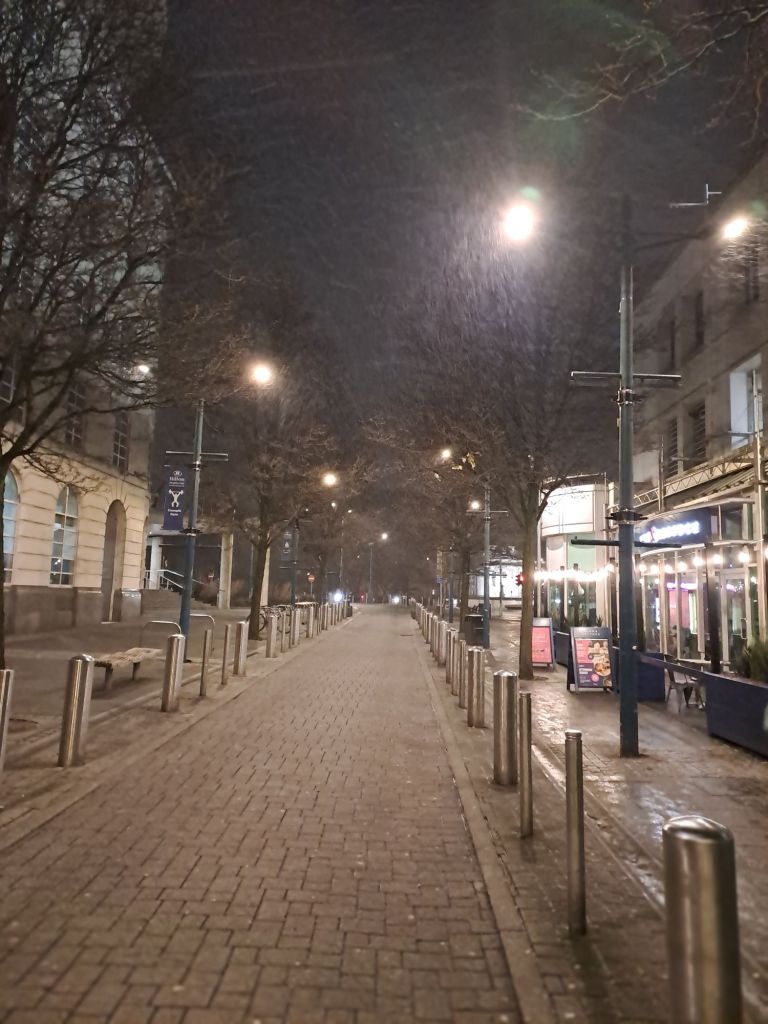
So here I am after a very busy day in a very cold Cardiff, about to have a pizza for dinner having accomplished quite a few of the things I’d planned, despite having to return to base for a couple of telecons: Euclid business has resumed in earnest after the break.

It has just started snowing.

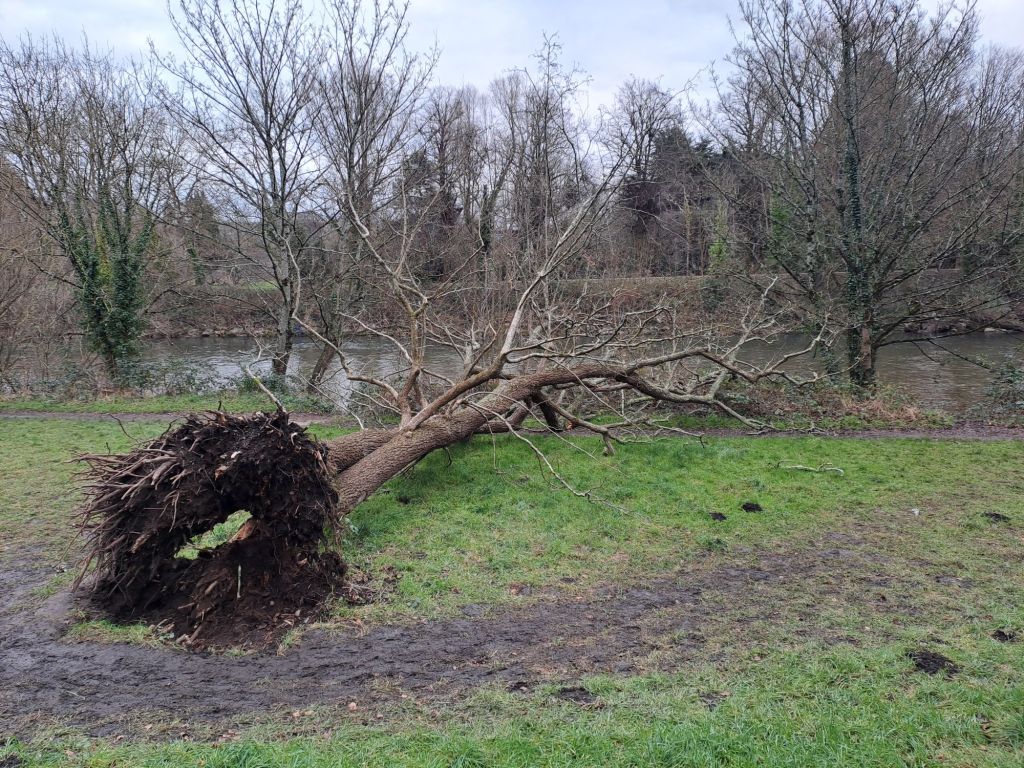
Earlier today, my perambulations took me through Bute Park, where there was quite a lot of evidence of storm damage, including this:

Fallen tree by the River Taff.

The snow is now falling steadily.

Snow on The Friary, Cardiff

I hope it doesn’t go on too long as I have to get a train later in the week, and even a light dusting seems to bring the rail network to a standstill!