Author Archive

Response to the Nelson Memorandum from arXiv

Posted in Open Access with tags , , on April 11, 2023 by telescoper

I just noticed on the arXiv blog that arXiv, along with bioRxiv and medRxiv, has released its response in the form of an open letter to the US Office of Science and Technology Policy (OSTP) “Nelson Memorandum” which recommends that US government agencies update their public access policies to make publications and data from research funded by US taxpayers publicly accessible immediately without embargo or cost. I thought I’d take the liberty of reproducing the letter in full here because what it says should apply beyond the United States. I agree particularly strongly with the last paragraph. I haven’t edited the letter except to replace footnotes with links.

—o—

April 11, 2023

The recent Office of Science and Technology Policy “Nelson Memorandum” on “Ensuring Free, Immediate, and Equitable Access to Federally Funded Research” is a welcome affirmation of the public right to access government funded research results, including publication of articles describing the research, and the data behind the research. The policy is likely to increase access to new and ongoing research, enable equitable access to the outcome of publicly funded research efforts, and enable and accelerate more research. Improved immediate access to research results may provide significant general social and economic benefits to the public.

Funding Agencies can expedite public access to research results through the distribution of electronic preprints of results in open repositories, in particular existing preprint distribution servers such as arXivbioRxiv, and medRxiv. Distribution of preprints of research results enables rapid and free accessibility of the findings worldwide, circumventing publication delays of months, or, in some cases, years. Rapid circulation of research results expedites scientific discourse, shortens the cycle of discovery and accelerates the pace of discovery.

Distribution of research findings by preprints, combined with curation of the archive of submissions, provides universal access for both authors and readers in perpetuity. Authors can provide updated versions of the research, including “as accepted,” with the repositories openly tracking the progress of the revision of results through the scientific process. Public access to the corpus of machine readable research manuscripts provides innovative channels for discovery and additional knowledge generation, including links to the data behind the research, open software tools, and supplemental information provided by authors.

Preprint repositories support a growing and innovative ecosystem for discovery and evaluation of research results, including tools for improved accessibility and research summaries. Experiments in open review and crowdsourced commenting can be layered over preprint repositories, providing constructive feedback and alternative models to the increasingly archaic process of anonymous peer review.

Distribution of research results by preprints provides a well tested path for immediate, free, and equitable access to research results. Preprint archives can support and sustain an open and innovative ecosystem of tools for research discovery and verification, providing a long term and sustainable approach for open access to publicly funded research.

Patterns of Earth – Hyam Plutzik

Posted in Poetry with tags , , on April 11, 2023 by telescoper

Now the new grass is vivid with dandelions,
As last night the ancient sky was constellated.

And the Scorpion, the Dog, Perseus and Hercules
Are less than the gold children of my field.

Whom I will name quickly for their time is flying:
The Butcher, the Baker, and the Candlestick maker.

They will be gone in a fortnight, full upon the wind
And the bullies of the sky will resume their mastery.

by Hyam Plutzik (1911-1962)

Personal Internet History

Posted in Biographical with tags , , , on April 9, 2023 by telescoper

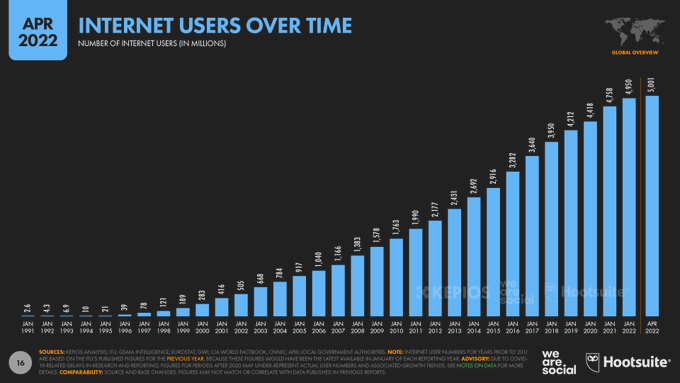
The above graphic, which comes from here, has been doing the rounds on social media and has been eliciting quite a few responses from people of my age or older, about when they started using the internet, so I couldn’t resist a comment or two.

My first experiences of anything like the modern internet was using the computers at the (now defunct) British Gas On Line Inspection Centre (OLIC) in Cramlington, Northumberland. I wrote about this here. That would have been in 1981, in between leaving school and starting University (which I did in 1982). I also went back to OLIC work in the summer holidays while still an undergraduate.

At OLIC did quite a lot of coding (on projects related to pattern recognition), most of which was on VAX computers (and also the odd PDP 11/45). Incidentally, when I later started as a research student in 1985 I was delighted to discover that the STARLINK system in use at Sussex and throughout the UK was also VAX-based because I was already fluent in the command language (DCL) as well as the database software DATATRIEVE. Another reason I am grateful for the experience I gained at OLIC is that, working in that environment, I had to learn to make my code (which, incidentally, was all in Fortran-77) conform to various very strict standards which is no doubt why I am a bit of a stickler when it comes to scripts written in my Computational Physics lab!

Anyway, the Vax computers in use in OLIC and in STARLINK were connected by a thing called DECnet. This allowed users to send emails to other machines. The format of email addresses was much simpler than in use today, being of the form “host::username“. One could send files that way too; the alternative, via, FTP was terribly unreliable. DECnet provided a fast method of communication, but did require the receiving system to be accessible when you tried to send and would fail if this were not the case. Later email protocols would keep trying to send messages if at first they did not succeed.

While working at OLIC, where the powers that be were paranoid about industrial espionage, sending things this way essentially required the sender to log into the receiver’s machine, which terrified the systems people and it was soon blocked. STARLINK allowed this, however, as did the U.S. Space Physics Analysis Network (US-SPAN), the European Space Physics Analysis Network (E-SPAN), and by 1989 there were 17,000 nodes worldwide.

Sending emails outside DECnet was a rigmarole, involving including SMTP% followed by the external address. Messages inevitably had lengthy headers indicating the circuitous taken to reach the destination and often took some time to reach their destination. I was regularly using email in 1985, and if that counts as internet usage, then I started way to the left of the start of the graphic.

I didn’t use the world wide web until later. I’m not sure when, but it must have been around 1991 or so. The arXiv in roughly the form it exists now started in 1993, but it had precursors in the form of an email distribution list and, later, FTP access. Initially, it was based at Los Alamos National Laboratory (LANL) with a mirror site in SISSA (Trieste) that was used by those of us in Europe. In the beginning, arXiv was quite a small-scale thing and it wasn’t that easy to upload full papers including figures. In fact the SISSA system was run from a single IBM 386 PC (called “Babbage”).

The astrophysics section of arXiv (astro-ph) started in April 1992. Although astrophysicists generally were quick to latch on to this new method of distributing preprints, it took me a little time to get onto arXiv: my first papers did not appear there until February 1993; my first publication was in 1986 so there are quite a few of my early papers that aren’t on arXiv at all. In 1993 I was working at Queen Mary & Westfield College (as it was then called). I was working a lot with collaborators based in Italy at the time and they decided to start posting our joint papers on arXiv. Without that impetus it would have taken me much longer to get to grips with it.

Just a Closer Walk with Thee

Posted in Biographical, Jazz with tags , on April 9, 2023 by telescoper

When my father passed away in 2007, the main music music played at his funeral was the hymn or spiritual (and of course Jazz standard) Just a Closer Walk with Thee. It’s a lovely old traditional tune that often plays a central role in New Orleans style funerals and is a melody that, at least for me, has a deep association with loss and bereavement. The recording that was played on that occasion was this one, made at the same session as the track I posted a few days ago, featuring the same personnel (including my Dad on the drums), but with vocals by a fine Jazz and Blues singer by the name of Annie Jenkins.

Newsflash – New MSc Course at Maynooth!

Posted in Education, mathematics, Maynooth with tags , , on April 8, 2023 by telescoper

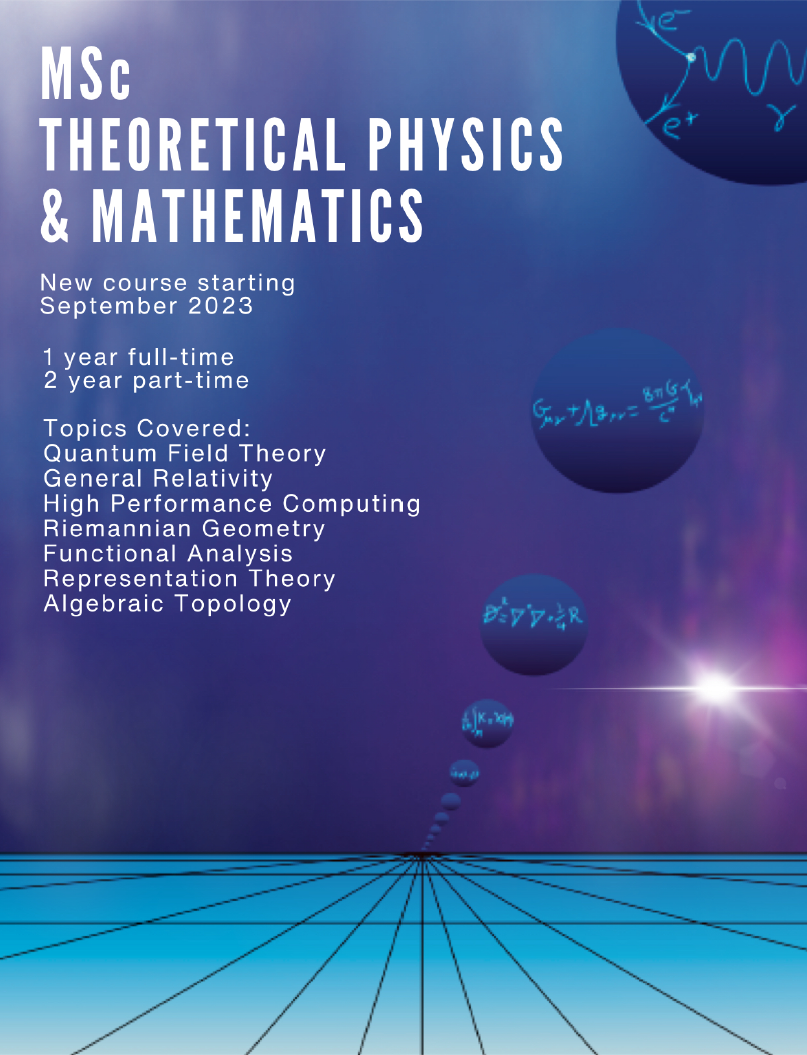
I know it’s the Easter holiday weekend but I couldn’t resist sharing the exciting news that we have just received approval for a brand new Masters course at Maynooth University in Theoretical Physics & Mathematics. The new postgraduate course will be run jointly between the Departments of Theoretical Physics and Mathematics & Statistics, with each contributing about half the material. The duration is one calendar year (full-time) or two years (part-time) and consists of 90 credits in the European Credit Transfer System (ECTS). This will be split into 60 credits of taught material (split roughly 50-50 between Theoretical Physics and Mathematics) and a research project of 30 credits, supervised by a member of staff in a relevant area from either Department.

This new course is a kind of follow-up to the existing undergraduate BSc Theoretical Physics & Mathematics at Maynooth, also run jointly . We think the postgraduate course will appeal to many of the students on that programme who wish to continue their education to postgraduate level, though applications are very welcome from suitably qualified candidates elsewhere.

Although the idea of this course has been on the cards for quite a while, the pandemic and other issues delayed it until now. This has so recently been agreed that it doesn’t yet exist on the University admissions webpages. This blog post is therefore nothing more than a sneak preview. There isn’t much time between now and September, when the course runs for the first time, which is why I decided to put this advanced notice on here! I will give fuller details on how to apply when they are available. You will also find further information on the Department’s Twitter feed, so if you’re interested I suggest you give them a follow.

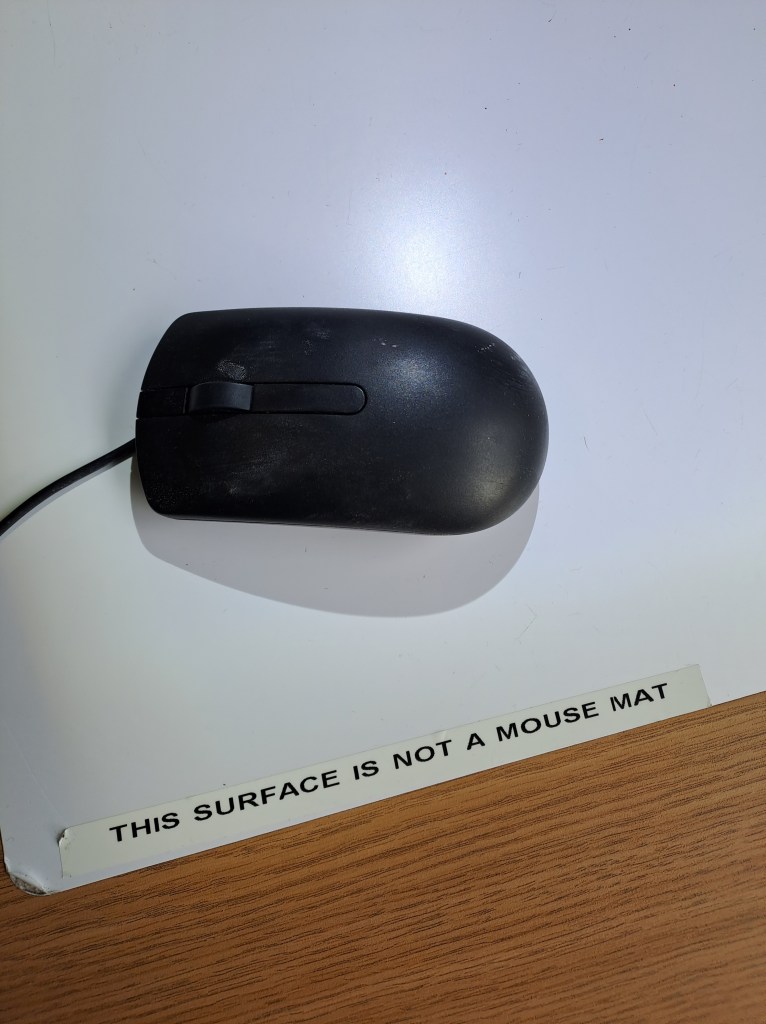
Ceci n’est pas un tapis de souris

Posted in Art, Education, Maynooth on April 7, 2023 by telescoper
It is now…

Easter Time and Sabbaticals

Posted in Biographical, Maynooth with tags on April 6, 2023 by telescoper

So it’s Maundy Thursday, i.e. the day before Good Friday, on which we are supposed to wash the feet of our disciples. Not having been issued with any disciples, I’ll have to give that bit a miss and just work as normal for the rest of today.

Tomorrow is a holiday, as is next Monday, Easter Monday. The rest of next week is a study break, a welcome pause before we embark on the rest of term.

There will still be three weeks of teaching before the end of the Semester when we return on 17th April, but I’ve actually done my last lecture in Computational Physics. I’ve taught them all the things they need for the rest of the module. When they get back students will be mainly working in groups on their mini-projects which are due in by 5th May. The other module I teach will carry on as usual until the end of term.

Anyway, the three weeks that have passed between the St Patrick’s Day study break and today have flown by, but at least I’ve kept up to date.

Yesterday I found out that I have been granted a sabbatical for half of next academic year. I had asked for a full year, but that wasn’t agreed, so I now have to decide whether to disappear from August 2023 to January 2024 or from February 2024 to July 2024. I’ve only got the Easter break to decide which option to take, so I’ll have to spend a bit of time trying to work out what to do. I had planned two different trips during a full-year sabbatical. I’ll probably have to drop one of them. I also made plans for my research students, which I’ll have to change. I’m sure I can work something out though.

My two biggest classes are in Semester 1 so I’d probably get more personal benefit from taking the first option, but it might be harder to find a replacement to teach these modules given the shorter notice. It will also be tricky to make the necessary arrangements with potential hosts elsewhere by August, which tends to motivate the second option. I’ll have to think about it.

The last time I had a sabbatical break was in 2005, when I was at the University of Nottingham. That also was just one semester. After an abortive attempt to get a J-1 visa so I could visit the University of California at Berkeley, I ended up going to Toronto, which was very nice, but instead of giving my teaching to someone else for the term I missed, it was just moved to the second semester so I had a double load when I returned. I hope nobody tries that trick this time!

At least this time there won’t be a problem with visas et cetera, as I intend to exploit the freedom of movement I have within the European Union…

A Jazz Centenary

Posted in History, Jazz with tags , , , , , on April 5, 2023 by telescoper
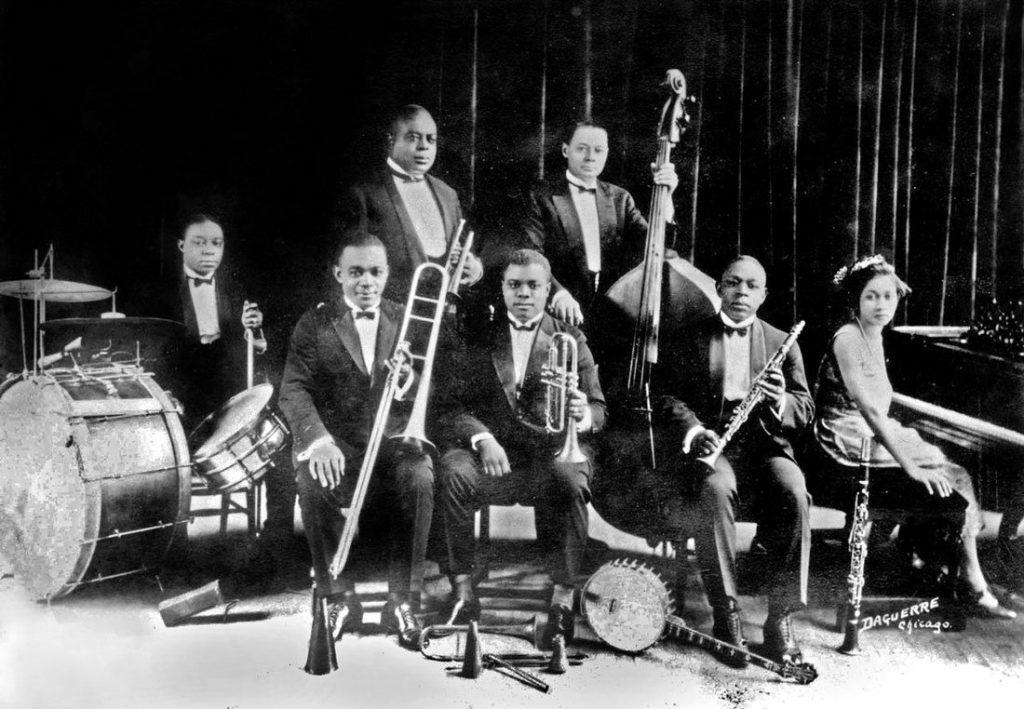
King Oliver’s Creole Jazz Band vintage 1923. From the left: Warren “Baby” Dodds (drums); Honore Dutrey (seated front, trombone); Joe “King” Oliver (standing rear, cornet); Louis Armstrong (seated front, cornet); Bill Johnson (standing rear, string bass and banjo); Johnny Dodds (seated front, clarinet); and Lil Hardin (piano)

I’ve been looking forward to this day because it marks an important jazz centenary. Or at least I think it does. There’s some contradictory evidence about whether it was April 5th 1923 or April 6th, or maybe both, when King Oliver‘s Creole Jazz Band did its first ever recording session at the Gennett studios in Richmond, Virginia. They recorded 20 sides in that session, which may well have involved two days with a break in between or working through the night.

These dates represent a remarkable occasion not only because King Oliver’s band was really the first jazz Supergroup, but also because it had been joined just a few months earlier by a young cornet player by the name of Louis Armstrong. This session therefore represent the first examples of Louis Armstrong ever heard on record.

It is somewhat surprising that this historic session happened at the Gennett studios. The band was based on Chicago, Illinois, and the studios were in Richmond, Virginia, so it required a long road trip to get there. Moreover the studio building wasn’t exactly in a prime location, as it was right next to a railroad line:

Musicians had to time their recordings so as to avoid the noise from passing trains. Still, records only lasted about 3 minutes in those days so presumably weren’t so frequent as to make it difficult to fit in a take between two of them! Recording techniques were rather primitive in those days though, and the sound quality that emerged isn’t great.

The lineup for the band is shown in the picture at the top of this page. It’s interesting to note that four of these musicians (Armstrong, Hardin, and the Dodds brothers) were to feature regularly from 1925 onwards in the classic Hot Fives and Hot Sevens. King Oliver’s band, however, had style that was very different from these later records, with a much greater emphasis on polyphony, much more complex arrangements, and much less emphasis on solos. Also, King Oliver’s band played to live audiences on a regular basis, but the Hot Fives and Hot Seven only ever performed as such in recording studios.

As far as I understand how this band worked, King Oliver made the arrangements. I don’t think they used full written scores, but tended to play from wonderfully intricate “head arrangements” worked out beforehand, with ensemble passages, gaps for breaks and solos, and King Oliver introducing the (usually very catchy themes). Armstrong and Johnny Dodds improvised a decorative counterpoint, and Honore Dutrey added harmonic breadth to the ensemble. This must have been a great learning experience for the young Louis Armstrong, has he had to develop a great ear for what was going on around him to play like this. I gather that Louis Armstrong often tended to play very loud so he was kept well in the background in these early Gennett sessions, but such a prodigious talent was never going to play second fiddle for long and in later sessions he effectively duets with King Oliver and swapped leads with him freely and completely intuitively, producing a sound that was entirely unique. I am always astonished by how much is going on in these old records, even if you can’t hear it all very well!

I’ve mentioned before that, over time, this classic type of polyphonic Jazz – derived from its New Orleans roots – gradually morphed into musical form dominated by much simpler arrangements and a succession of virtuoso solos. This change was also reflected in the differing fortunes of Louis Armstrong and King Oliver. The former went on to become an international celebrity, while the latter lost all his savings when his bank went bust during the Wall Street Crash and ended his life working as a janitor.

As well as Gennett, this band recorded with other labels in 1923 including Okeh and Columbia. Sadly however they split up at the end of 1923 over disagreements about a possible tour in 1924. Only about 40 sides were ever recorded King Oliver’s Creole Jazz Band. Many of them are absolutely marvelous.

This is the first track recorded by the band in April 1923. It’s called Just Gone. It’s a scratchy old record, with a rather compressed acoustic, so it’s like putting your next to one end of a tunnel leading back a hundred years, but it’s a good example of the Creole Jazz Band’s style. Joe Oliver’s lead cornet clearly influenced Louis Armstrong’s later style. You have to listen hard to hear Satchmo in the background on this track, but it’s worth the effort. You’re listening to a piece of music history, and a wonderful piece at that.

Nine Modern Poets

Posted in Biographical, Education, Literature with tags , , , , , , , , , , , on April 5, 2023 by telescoper

I recently acquired – at negligible expense – the above second-hand copy of the anthology Nine Modern Poets. I got a copy because this book was one we we studied when I was at school back in the 1970s. The First Edition was published way back in 1966, and it was reprinted until the mid-1980s but has long been superseded as a school poetry text by other anthologies. It has been out of print for many years so I had to find a second-hand copy via the internet. I bought some other second-hand anthologies too, which I may share in due course.

Anyway, the Nine Modern Poets are: W.B. Yeats, Wilfred Owen, T.S Eliot, John Betjeman, W.H. Auden, R.S. Thomas, Dylan Thomas, Philip Larkin, and Ted Hughes. Yes, they are all male.

Looking back it’s surprising to see John Betjeman in there, I’d have swapped him for Sylvia Plath (though her first collection, Colossus was only published in 1960 and the second, Ariel, in 1965 so these might have been too late), but the reason I look back on this book with some fondness, indeed nostalgia, is that it was this collection that introduced me to the poetry of R.S. Thomas, and I am very grateful to it for that.

Speak Out about Bullying in Academia

Posted in Harassment Bullying etc, Maynooth with tags , on April 4, 2023 by telescoper

I was interested to learn, via 9th Level Ireland, that local TD Bernard Durkan recently tabled a written question in the Dáil Éireann about harassment and bullying in Irish third-level institutions:

To ask the Minister for Education and Skills to indicate the extent to which his Department continues to monitor incidents of professional bullying throughout the higher education system; the extent to which bullying is evident in colleges throughout the country; the action taken or being taken to counter this; and if he will make a statement on the matter.

[15895/23]

The response from the Minister Simon Harris contains the following:

The Deputy will be aware that there are a number of Programme for Government (PfG) commitments aimed at addressing bullying, including a commitment to commission surveys of staff and students in the areas of harassment, sexual harassment, and bullying in higher education.

It also contains this:

The Deputy will also be familiar with the ‘Speak Out’ tool which my Department has funded. Speak Out is an online, anonymous reporting tool for staff, students and visitors to higher education institutions that was developed by the Psychological Counsellors in Higher Education Ireland with financial support from my Department, the Department of Education and the Higher Education Authority.

I must either have missed the news about Speak Out (or forgotten it) but I see that it can be accessed via my own institution, for example, here. Other universities and colleges have their own links. The dialogue page says:

The big problem with taking a bullying complaint further than mere anonymous reporting is that the legal definition of bullying is far less clear than the others. One definition I’ve found is:

Bullying is an ongoing and deliberate misuse of power in relationships through repeated verbal, physical and/or social behaviour that intends to cause physical, social and/or psychological harm.

Even this is problematic because “intent” is difficult to prove. Power relationships in academia are often distorted by the hierarchical management structures, so bullying is not just contained within the academic staff and students but also from senior management and to support staff. For that reason there’s a lot of this about. Reporting is good but I’m not sure what it actually achieves. Universities seem to be keen to hide bullying, conniving with those responsible shield them and avoid institutional harm, just as they do with harassment and other forms of abusive behaviour.